15 Narrow Living Room Ideas Renter Friendly Enough to Keep Your Deposit
Quick answer: The best narrow living room ideas renter friendly tenants can use rely on freestanding and removable pieces: a shallow sofa, a leaning mirror, a plug-in light, a rug that defines zones, tension-based shelving and furniture on the long wall. Keep a walkway of 30 to 36 inches, choose pieces 12 to 16 inches deep along the walls, ask before using any adhesive, and anchor tall furniture in a way your lease allows.
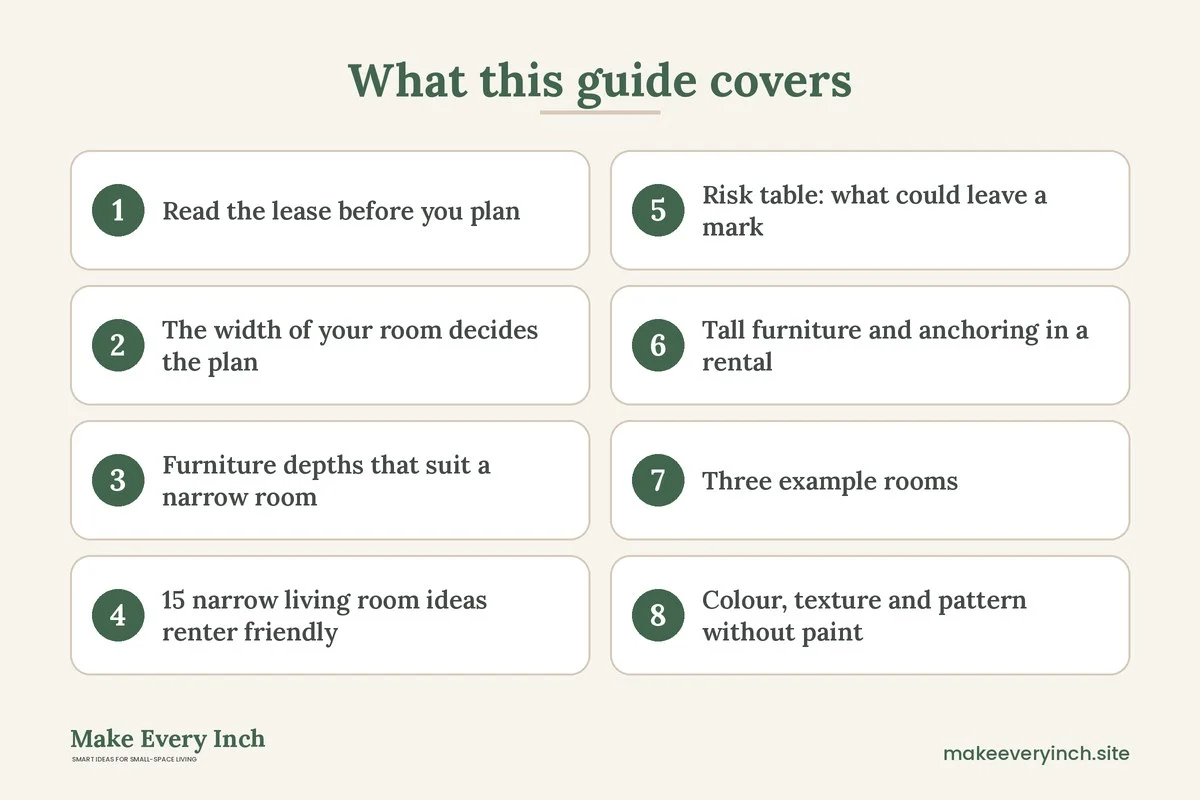
Narrow living room ideas renter friendly enough to protect your deposit start with one fact: in a long, thin room, almost every problem can be solved by moving and choosing furniture rather than by changing the walls. Renters often assume that a tunnel-shaped room needs built-ins, a new wall color or a mounted TV to feel right. It does not. A room that is 8 to 10 feet wide and 14 to 20 feet long mainly needs a clear path, a sofa that fits the width, a few vertical lines and light bounced across the short dimension. All of that can be done without a drill. This guide covers the lease check, the width bands that decide your layout, 15 removable ideas, a risk table that ranks each idea by how likely it is to leave a mark, three example rooms, a section on tall furniture and anchoring, move-out steps and a checklist. For the full overview of long thin rooms, start with our main guide to narrow living room ideas, and for the wider topic see small living room ideas.
Read the lease before you plan
A deposit is lost on details, so spend ten minutes with the lease before you buy anything. Look for the wording on nails, adhesive, paint, wall anchors, light fixtures and anything attached to a ceiling. Some leases ban every hole. Others allow a few small nail holes that you patch at move-out. A few allow temporary adhesive but not on painted walls that were done recently. If the language is vague, send a short written question to the landlord or property manager and keep the reply. A one-line email that says “I would like to hang a lightweight mirror with removable strips, is that fine?” can save an argument later.
Then take photos. Photograph every wall, the ceiling corners, the floors where furniture will stand, and the baseboards. Include a date if your phone adds one. These photos matter more than anything else you do, because they show the condition you started with. Note any scuffs, dents or marks that were there on day one so that nobody blames you for them later.
Finally, decide your risk tolerance. Some tenants are comfortable with a few patched holes, and others want zero contact with the walls. The ideas below are sorted so you can choose. Freestanding items sit at the lowest risk, tension and plug-in items come next, and adhesive items carry the most risk because paint, texture and humidity all change how they behave.
The width of your room decides the plan
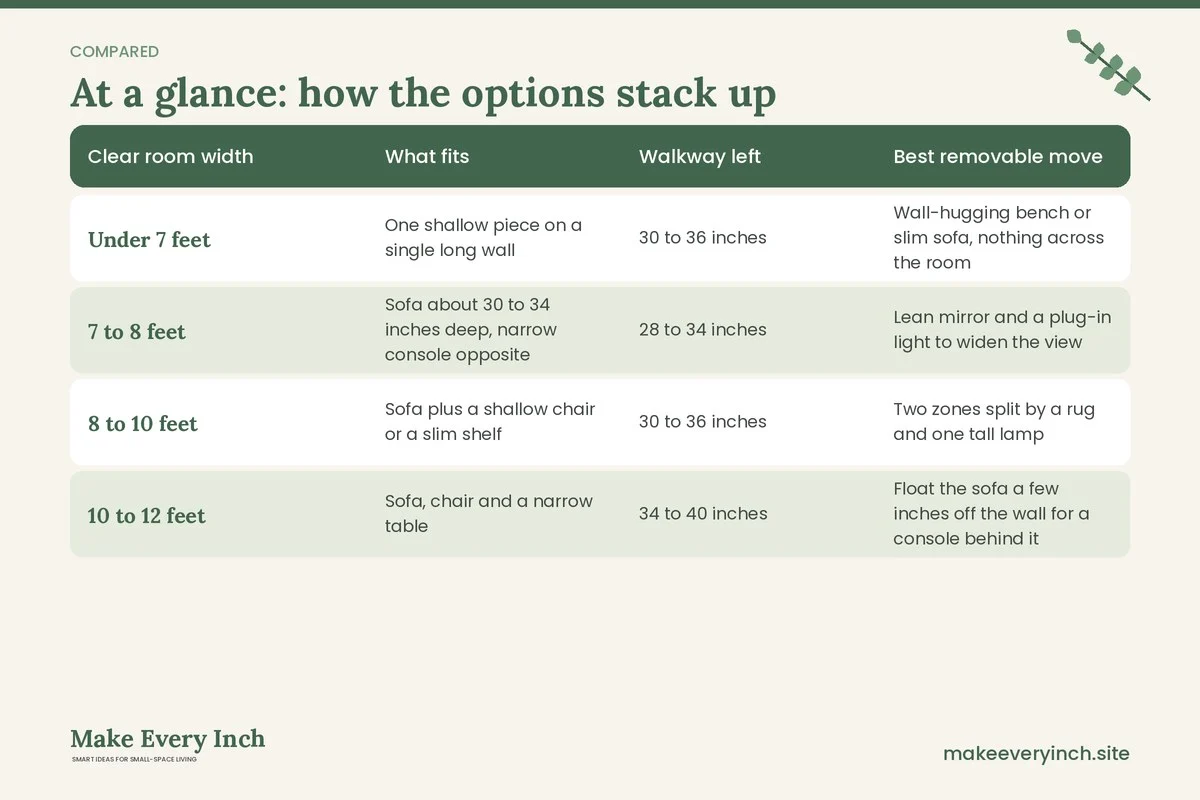
Narrow rooms are not all the same. The difference between a room that is 7 feet wide and one that is 10 feet wide is the difference between a path and a layout. Measure the clear width from wall to wall at the widest point, then again at the doorway, the window and any radiator or vent. Use the smaller number. Then use the bands below as a starting point. The figures are typical ranges, and your room may need small adjustments.
| Clear room width | What fits | Walkway left | Best removable move |
|---|---|---|---|
| Under 7 feet | One shallow piece on a single long wall | 30 to 36 inches | Wall-hugging bench or slim sofa, nothing across the room |
| 7 to 8 feet | Sofa about 30 to 34 inches deep, narrow console opposite | 28 to 34 inches | Lean mirror and a plug-in light to widen the view |
| 8 to 10 feet | Sofa plus a shallow chair or a slim shelf | 30 to 36 inches | Two zones split by a rug and one tall lamp |
| 10 to 12 feet | Sofa, chair and a narrow table | 34 to 40 inches | Float the sofa a few inches off the wall for a console behind it |
The walkway is the most important number. A comfortable main path is about 30 to 36 inches wide. A side path used only now and then can be as little as 24 inches. If the path goes below roughly 28 inches in the part of the room people cross every day, the room will feel like an obstacle course no matter how pretty it is. Tape the path on the floor with painter’s tape before you move a single sofa, and walk it with a laundry basket to see how it feels.
Furniture depths that suit a narrow room
Depth is the hidden culprit in a narrow room. A standard sofa is around 34 to 40 inches deep, and in a room 8 feet wide that single piece uses nearly half the width. A deep armchair does the same on the other side and leaves a path barely wider than a hallway. Choose shallower pieces and the room opens up without any construction.
- Sofa depth: 30 to 34 inches is a good target for rooms under 9 feet wide. A sofa with slim arms and raised legs looks lighter and lets floor show underneath.
- Console or media unit: 10 to 14 inches deep. Anything deeper begins to compete with the path.
- Bookcase or shelf: 8 to 12 inches deep along a wall is plenty for books, baskets and frames.
- Side table: 12 to 16 inches across. A round top is easier to pass than a square one.
- Armchair or accent seat: 26 to 30 inches deep, with a narrow footprint, if the room is 9 feet wide or more.
- Coffee table: 16 to 20 inches wide in a narrow room, or skip it and use a small tray stool that moves. For ideas, read our guide to small living room ideas without a coffee table.
Remember the leg of a sofa and the arm of a chair usually extend a bit beyond the cushion line, so measure the widest point of each piece, not just the seat.
15 narrow living room ideas renter friendly
Layout moves that cost nothing
1. Put the sofa on the long wall
In most narrow rooms, the sofa belongs on the longest uninterrupted wall. This keeps the short dimension open for a path and lets the sofa face the opposite wall or window. Resist the urge to place it across the room, because a sofa that blocks the width turns the room into two tiny halves. If the only long wall has a radiator or a vent, leave 6 to 8 inches of air gap and do not cover it with upholstery.
2. Float the sofa a few inches
In a room 10 feet wide or more, pull the sofa 8 to 12 inches away from the wall. This gives space behind it for a console of about 10 inches deep that holds a lamp, books and a tray. Because nothing is attached to the wall, there is no risk to the deposit. In rooms narrower than 9 feet, skip this move, since the gap costs width you need for the path.
3. Use a rug to cut the tunnel
A long room becomes more comfortable when the floor is divided. A rug about 5 by 8 feet under the front legs of the sofa defines a seating zone and breaks the long line of the floor. Choose one with a low pile so doors clear it, and add a non-slip pad so the edges stay flat. A rug runner works for the path along the other wall if there is room. Both are freestanding and leave no trace.
4. Create two zones, not three
Narrow rooms rarely support more than two zones. Choose seating plus one other function: a reading corner, a desk or a small dining spot. Put the second zone at the far end, where it gets natural light, and use a tall lamp or a shelf to mark the boundary. For long living-dining rooms, our guide to small apartment living room ideas for studios shows zoning in more detail.
Light and mirrors without holes
5. Lean a floor mirror on the long wall
A tall mirror leaned against the wall opposite the window bounces light across the short dimension and makes the room feel wider. Choose one at least 60 inches tall, so you see the room and not just your face. Lean it at a slight angle, and put non-slip pads under the bottom edge. Note that a leaning mirror is heavy and can slide, so keep it out of the main path, use a stopper at the base and see the anchoring section below.
6. Plug-in wall lights
Plug-in sconces with a cord clip use the outlet you already have and give light at eye level without taking up floor space. Run the cord along the wall edge with removable clips, and take it all down at move-out. For more on removable lighting, see our guide to renter-friendly lighting ideas.
7. One tall floor lamp instead of three small lamps
A single slim floor lamp at the end of the sofa saves floor area and lifts the eye to the ceiling. Choose a base under 12 inches across so it does not eat the path. For choices, read our post on the best floor lamps for small rooms.
8. Sheer curtains on a tension rod
A tension rod fits inside the window frame without drilling, as long as the frame is firm and the rod is rated for the width. Hang sheers that run from the rod down to the floor, which draws the eye up and adds light softly. Keep the fabric light, since a heavy curtain on a tension rod can sag.
Storage that stays off the wall
9. A shallow freestanding bookcase
A bookcase 8 to 12 inches deep gives you shelf space without cutting into the path. Put it against the short wall at the far end of the room, where it frames the view. Because it is freestanding, it is deposit safe, but it needs an anchor if it is taller than about 4 feet. Read the anchoring section below before you choose a height.
10. A slim cart for the tight spots
A cart with wheels, about 12 to 15 inches wide, acts as a side table, a bar or a charging station. Park it beside the sofa and roll it away when you need the path. It is a movable alternative to a fixed shelf. For rolling options, see our small kitchen cart ideas, which also work in a living room.
11. A storage bench or ottoman
A bench at the foot of the sofa or under the window hides blankets and remotes, and works as an extra seat. Choose one about 14 to 16 inches deep. For options, take a look at the best storage ottomans.
12. Over-the-door and behind-the-door storage
Over-the-door hooks and organizers use the thickness of the door, not the wall. They suit coats, bags and cleaning tools. Check that the door still closes without scraping the frame.
Walls that come off cleanly
13. Art leaned on a shelf or console
Large frames leaned on a console, a ledge or the top of a bookcase give the look of a gallery wall with no holes. Layer a big frame behind a smaller one, and swap the pieces as often as you like. A narrow ledge shelf that stands on the floor can hold frames too.
14. Removable wallpaper on one wall
Peel-and-stick wallpaper on the short end wall draws the eye down the room and adds depth. It is more involved than other ideas and carries risk if the paint is flat or fresh, so test a small hidden area first. Learn more in our guide to removable wallpaper ideas.
15. Adhesive strips for very light items
For frames, a calendar or a small mirror, adhesive strips rated for the weight can work on smooth, clean, well-cured paint. Follow the weight rating on the pack, use more strips than you think you need and let the surface rest before hanging. Strips can lift paint, especially from walls painted recently or walls with a matte finish, so test first and keep this idea for light items only. For a fuller set of options, read about renter-friendly wall decor ideas.
Risk table: what could leave a mark
Use this table to choose between ideas. The ranking is based on common experience, not a guarantee, and your walls, paint and lease will change the picture.
| Idea | Contact with wall | Typical risk | Notes |
|---|---|---|---|
| Sofa on long wall, rug, cart | None | Very low | Felt pads protect floors |
| Leaning mirror or art | Light, at the base only | Low | Use stoppers, mind the weight |
| Freestanding shelf | Back edge | Low | Anchor if tall, see below |
| Plug-in sconce, cord clips | Clips only | Low to medium | Clips can mark some paint |
| Tension rod curtains | Window frame | Low to medium | Check frame strength |
| Over-the-door storage | Door only | Low | Check the door still closes |
| Adhesive strips | Direct | Medium | Can lift paint on some walls |
| Peel-and-stick wallpaper | Direct | Medium to high | Test first, read lease |
Tall furniture and anchoring in a rental
Narrow rooms push you toward tall, slim furniture, which is good for floor space but needs care. A tall bookcase, a narrow cabinet or a heavy mirror can tip if it is bumped, pulled on by a child or hit during an earthquake. Anchoring tall furniture to the wall is the standard recommendation, and manufacturers typically supply a kit for this purpose. It usually requires a screw into a stud.
In a rental, that screw creates a small hole. Many landlords accept this when you ask, since a patched hole is far cheaper than an injury or a broken wall, and it can be filled at move-out. Ask in writing, tell them where and how big, and offer to patch it. If the answer is no, you still have choices. Pick lower furniture, ideally under about 3 feet for the pieces you cannot anchor. Place heavier items on lower shelves so the weight sits low. Look for anti-tip straps that attach to the furniture and to a removable base or under a heavy item. Use furniture with a wide base or stabilizing feet. Avoid placing tall units where a door swings against them or where small children can climb.
None of these workarounds is as secure as a proper anchor, so treat them as a second best and think about your household before you rely on them. Households with young children or pets should lean toward lower furniture and a landlord conversation rather than a freestanding tall piece.
Three example rooms
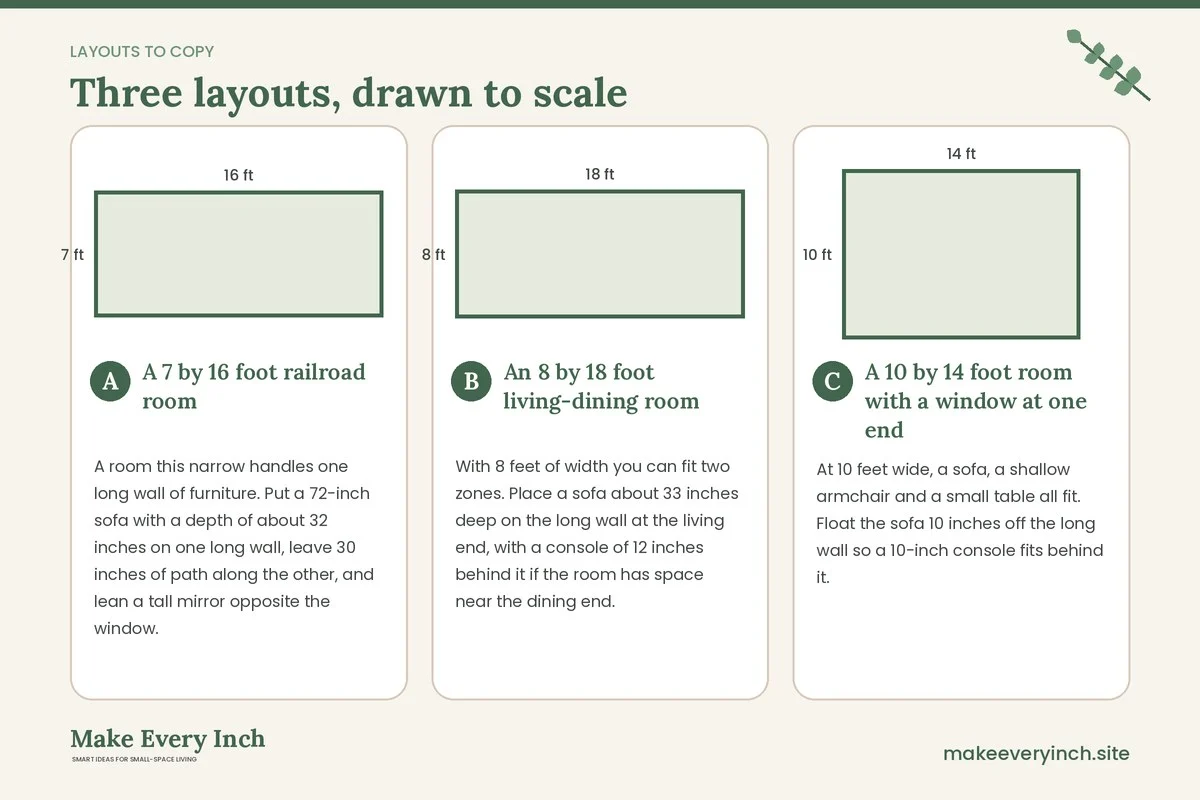
A 7 by 16 foot railroad room
A room this narrow handles one long wall of furniture. Put a 72-inch sofa with a depth of about 32 inches on one long wall, leave 30 inches of path along the other, and lean a tall mirror opposite the window. A small round side table at one end and a slim floor lamp at the other complete the seating. At the far end, place a stool or a cart rather than a chair. A rug about 4 by 6 feet marks the seating zone. This leaves just under three feet for the path, which is tight but workable.
An 8 by 18 foot living-dining room
With 8 feet of width you can fit two zones. Place a sofa about 33 inches deep on the long wall at the living end, with a console of 12 inches behind it if the room has space near the dining end. At the far end, put a small round table of about 30 inches in the corner by the window. Divide the zones with a rug at the sofa and a runner or bare floor at the table. A tall lamp between the zones marks the line. Keep 32 to 36 inches clear down the centre.
A 10 by 14 foot room with a window at one end
At 10 feet wide, a sofa, a shallow armchair and a small table all fit. Float the sofa 10 inches off the long wall so a 10-inch console fits behind it. Put an armchair at an angle at the window end and tuck a pair of sheers on a tension rod behind it. A bookcase of 10 inches deep sits against the short wall. The result has two seats, a surface behind the sofa and a path of about 36 inches. Everything here is freestanding.
Colour, texture and pattern without paint
Painting is the standard fix for a dull room, but many leases forbid it. You can still change how a narrow room feels. Use light, warm neutrals in large items, such as the rug and curtains, to bounce light across the short dimension. Choose a sofa in a colour close to the wall so it recedes, and add contrast with cushions and a throw that you can swap. Use a single bolder accent on the short end wall, such as a large piece of art leaned on a console, to draw the eye down the room. Use horizontal stripes on a rug or a runner only if the room is very long, since they can emphasise the length, and use a vertical pattern on curtains to add height.
Mix textures to avoid a flat look: a woven rug, a linen curtain, a wood table and a metal lamp keep a pale palette from feeling empty. If you want more inspiration on removing visual clutter, see our guide to minimalist apartment ideas.
Move-out checklist for a narrow living room
Preparation at move-in is half the job, and the rest happens in the last week. Work through these steps before the final walk-through.
- Remove adhesive strips slowly, stretching them straight down along the wall, not outward.
- Warm stubborn residue gently with a hair dryer before peeling anything.
- Wipe the marks left by cord clips with a damp cloth and a little mild soap.
- Peel removable wallpaper from the top corner at a low angle, slowly, and pause if paint lifts.
- Fill any approved anchor holes with spackle, sand lightly and touch up with paint only if the lease allows.
- Check the floor for dents under the sofa and table legs, and plan to use felt pads from the start.
- Vacuum the rug area and behind the sofa, where dust gathers.
- Compare the room with your move-in photos and take new ones.
Mistakes to avoid
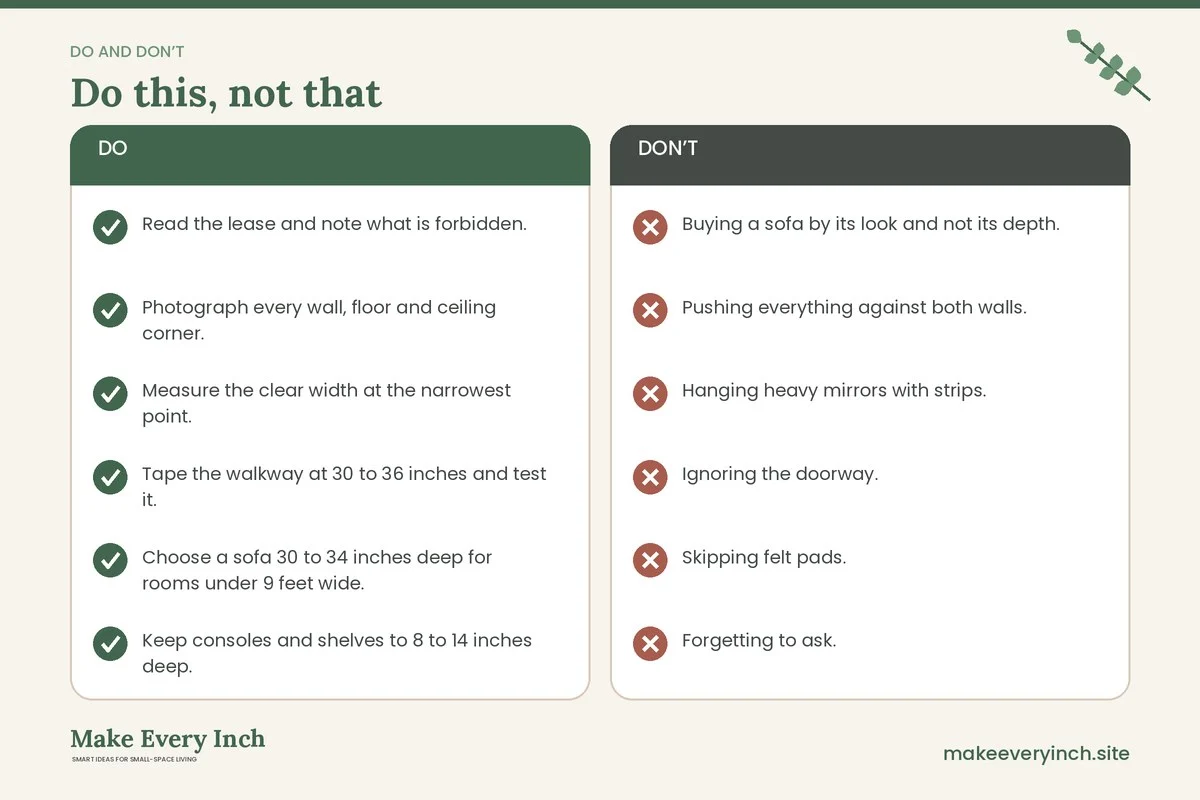
- Buying a sofa by its look and not its depth. A 38-inch sofa in an 8-foot room leaves a path of barely 30 inches before you add anything else.
- Pushing everything against both walls. This makes the room look like a corridor. Keep one side free and light.
- Hanging heavy mirrors with strips. Weight ratings are not a suggestion, and a falling mirror can damage floors, furniture and people.
- Ignoring the doorway. A door that swings into the room can hit furniture, so check the arc.
- Skipping felt pads. Floors are a common source of deposit deductions, and pads cost very little.
- Forgetting to ask. A written yes from the landlord is worth more than any careful guess.
Planning checklist
- Read the lease and note what is forbidden.
- Photograph every wall, floor and ceiling corner.
- Measure the clear width at the narrowest point.
- Tape the walkway at 30 to 36 inches and test it.
- Choose a sofa 30 to 34 inches deep for rooms under 9 feet wide.
- Keep consoles and shelves to 8 to 14 inches deep.
- Lean a tall mirror opposite the window.
- Add a rug that reaches under the front sofa legs.
- Use plug-in and floor lighting instead of hardwired fixtures.
- Ask your landlord about anchoring any tall piece.
- Add felt pads to every leg.
- Keep the packaging notes and receipts so you can return pieces that do not fit.
FAQ
What is the best layout for a narrow rental living room?
Put the sofa on the longest wall, keep the other side as a clear path of 30 to 36 inches, and add a rug under the front sofa legs. Use a leaning mirror and plug-in lights to open the room.
How wide should a sofa be in a narrow room?
Aim for a depth of about 30 to 34 inches in rooms under 9 feet wide. Length matters less than depth, since depth determines how much path you keep.
Can I make a narrow room look wider without painting?
Yes. A mirror across from the window, sheer curtains, a light rug and furniture on raised legs all help. Light colours in large items matter more than the wall colour.
Is it safe to put a tall bookcase in a rental?
It is safest when anchored to the wall, so ask your landlord about a small screw into a stud. If that is not possible, choose lower pieces and put heavy items near the bottom.
Do adhesive strips damage walls?
They can, especially on fresh or matte paint. Test a hidden spot, follow the weight rating and remove them slowly. Our guide on security deposit safe apartment upgrades covers more cautious options.
How do I split a long narrow room into zones without walls?
Use a rug, a tall lamp, a shelf or the back of a sofa to separate areas. Two zones are usually the limit.
Keep going: Keep planning with our small living room ideas for renters, no-drill storage ideas for renters and small living room layout ideas.
Save this guide for later
Pin the ideas you like to Pinterest so you can come back to them when you plan your space.