13 Small Living Room Lighting Ideas Modern Rooms Can Use Tonight
Quick answer: The best small living room lighting ideas modern rooms rely on are a three-layer plan with clean lines: one soft ambient source, two or three lamps at different heights, and a single accent such as a wall washer or shelf strip. Aim for roughly 1,000 to 2,000 total lumens in a small room, choose 2700 to 3000 kelvin bulbs, keep every cord out of sight, and use dimmers so the same room works for reading, TV and company.
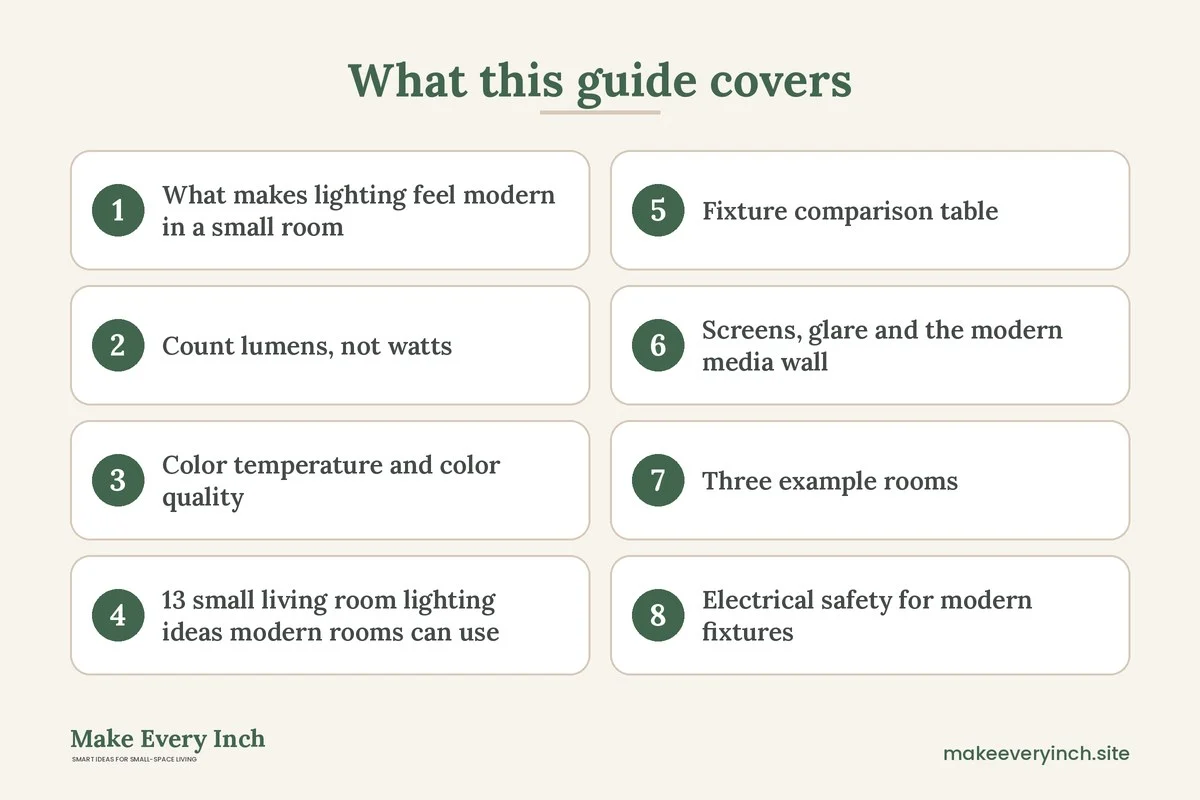
Small living room lighting ideas modern in style have one thing in common: the light itself is the decoration. Instead of a ceiling fixture that floods the room evenly, a modern plan uses a few precise sources, each with a clear job, and lets the shapes of the fixtures read as graphic elements. This guide is built for a living room of about 9 by 12 feet to 12 by 15 feet. It covers how to count lumens, how to set lamp heights by measurement, 13 specific ideas, a fixture comparison table, three example rooms, a glare checklist for screens, electrical safety notes and a FAQ. For the full overview of the topic, start with our main guide to small living room lighting ideas, then see the wider small living room ideas pillar. If your taste leans warmer and softer, the companion post on cozy small living room lighting ideas covers that direction.
What makes lighting feel modern in a small room
Modern interiors are defined by restraint, strong geometry and a limited palette, and lighting follows the same rules. A few principles separate a modern lighting scheme from a merely bright one.
- Fewer, better placed sources. Three to five light points are usually enough in a small room. More than that and the ceiling and walls start to look busy.
- Visible geometry. Arcs, straight tubes, globes, cones and thin linear shapes are the vocabulary. Pick one or two shapes and repeat them.
- Hidden hardware. Cords run along baseboards or behind furniture, strips sit in channels, and plug-in units tuck behind the sofa.
- Controlled color. Stay inside one color temperature family, with a gentle shift from warm white at night to a slightly crisper white during the day.
- Dimmability. A modern room has to change mood without changing furniture. A dimmer, a smart plug with a schedule or a lamp with a multi-step switch does the job.
- Matte or brushed finishes. Glossy chrome throws reflections across a small room. Matte black, brushed metal, white and natural wood stay quiet.
A useful way to think about it is that the room has an outline and the light draws it. A pale wall washed from above reads as taller. A slim floor lamp beside the sofa reads as a vertical line. A shelf with a glow behind it reads as a frame. Each of those is a lighting decision that also changes how large the room feels.
Count lumens, not watts
Wattage tells you how much power a bulb draws, not how bright it is. Today most small living rooms use efficient bulbs, so the number to watch is lumens. A rough planning range for a living room is 10 to 20 lumens per square foot for general comfort, which means a 120 square foot room (10 by 12 feet) needs roughly 1,200 to 2,400 lumens in total when everything is on. That is a planning range rather than a rule, and your own comfort will tell you where in the range to land.
Here is a simple way to build the total without overlighting:
- Ambient layer: about 40 to 50 percent of the total. This might be a ceiling fixture on a dimmer, a wall washer or an uplight in the corner.
- Task layer: about 30 to 40 percent. Reading lamps, a desk lamp or an adjustable arm near the sofa.
- Accent layer: about 10 to 20 percent. Shelf strips, a picture light or a small spotlight on art.
For a 120 square foot room, the numbers could look like this: an ambient source of 600 to 900 lumens, two task lamps of 300 to 500 lumens each, and an accent of 100 to 250 lumens. Check the box or the product page for the lumen figure, and remember that a shade can absorb a share of the output. A shaded table lamp rated at 450 lumens will feel gentler than a bare bulb of the same number.
Because modern rooms often have pale walls, more of the light bounces back into the room. If your walls are white or light gray, aim for the lower half of each range. If they are dark, aim for the upper half and add an extra uplight.
Color temperature and color quality
Color temperature is measured in kelvin. For a modern living room, 2700 to 3000 kelvin gives a clean warm white that flatters skin, wood and fabric without turning yellow. Many people like 3000 kelvin for the ambient layer and 2700 kelvin for lamps, which gives a slight contrast that makes the room feel layered. Avoid mixing very cool bulbs, around 4000 kelvin and above, with warm ones in the same sight line, because the difference looks like a mistake rather than a choice.
Color rendering is the second number worth checking. Look for a rendering index of 90 or higher where it is listed, since it keeps fabrics, wood and plants looking true. A lower number can make a gray sofa look slightly green and a rug look muddy.
13 small living room lighting ideas modern rooms can use
Overhead and ceiling-adjacent ideas
1. A low-profile flush fixture on a dimmer
A flat disc or slim drum sits tight to the ceiling and does not eat headroom. In a room with an 8-foot ceiling, a flush fixture keeps the full height clear. Pair it with a wall dimmer so it can drop to a gentle glow. If the existing switch needs to be replaced with a dimmer, hire a licensed electrician or follow your building rules.
2. A plug-in track or rail
A short plug-in rail with two or three adjustable heads points light at art, a shelf or the wall behind the sofa. It gives the room the feel of a gallery without wiring. Keep the heads aimed at a surface, not at the seat, so nobody sits in a glare.
3. A single oversized shade over the seating
One large pendant or lantern, 16 to 24 inches across, can anchor a small room because it reads as a deliberate focal point. Hang the bottom edge at least 7 feet above the floor in a walkway, or around 30 to 36 inches above a table. In a rental, a plug-in version with a ceiling hook and a cord cover avoids hardwiring. Hardwired installations need a licensed electrician.
4. A semi-flush fixture for low ceilings
When the ceiling sits closer to 8 feet, a semi-flush design with an open bottom shows the bulb and spreads light across the ceiling. The reflected glow helps the room feel taller.
Floor and table ideas
5. A slim arc floor lamp behind the sofa end
An arc lamp lets a light source sit over the sofa without a ceiling mount. Choose one whose head reaches roughly 20 to 30 inches in front of the base, and keep the bottom of the shade at about 60 to 66 inches off the floor so it clears heads. The base should be heavy and stable. For model features worth checking, read our guide to the best floor lamps for small rooms.
6. A torchiere or uplight in the corner
A tall uplight bounces light off the ceiling and corner walls. The effect is a soft wash that makes the corner disappear. It also fills the dark top third of the room, which is what makes small rooms feel closed in. Use a bulb rated for the fixture and stay within its wattage limit.
7. A matched pair of table lamps
Two lamps of the same height and shape on side tables give the sofa symmetry, which is a classic modern device. Aim for a total height of 24 to 30 inches, with the bottom of the shade at about eye level when you are seated, roughly 38 to 42 inches from the floor. If you only have room for one side table, use a single lamp and balance it with a plant or a vase of equal height.
8. A slim task lamp with an adjustable neck
Beside an armchair or at a small desk, a lamp with a jointed arm delivers focused light for reading. The shade should sit about 15 to 20 inches above the page, and the light should come from the side opposite your writing hand to avoid shadows.
Wall, shelf and accent ideas
9. A plug-in wall sconce with a cord cover
A sconce on either side of the sofa or a mirror frees the side table and adds vertical interest. Mount the center at about 60 to 66 inches from the floor, or lower if the sconce is directional. Plug-in versions with a flat cord cover avoid wiring. In a rental, check the lease before drilling. Our guide to renter-friendly lighting ideas covers adhesive and clamp-on options.
10. A shelf strip with a diffuser
A thin strip tucked under the lip of a shelf makes books and objects glow and acts as a night light. Use a diffuser channel so individual dots do not show. Keep the strip within the maximum length and power rating written on its adapter, and never roll a spool tight while it is on, since coiled strips hold heat.
11. A picture light or small spot on art
One piece of art with a small light above it creates a calm focal point. Aim the beam to cover the frame without spilling on the ceiling. A beam angle between about 25 and 40 degrees works for most frames.
12. A wall washer for a pale wall
Place a small uplight or wall washer 12 to 18 inches from a plain wall and aim it up. The scalloped or smooth wash on the wall adds depth. Skip this on textured walls, where it shows every bump.
13. A floating mirror to double the light
A large mirror placed to catch a lamp or window doubles the effect of the source. Hang it so it reflects light, not clutter. A rounded or rectangular frame in a thin metal works well with modern furniture. See our small living room layout ideas modern for placement that works with the seating.
Fixture comparison table
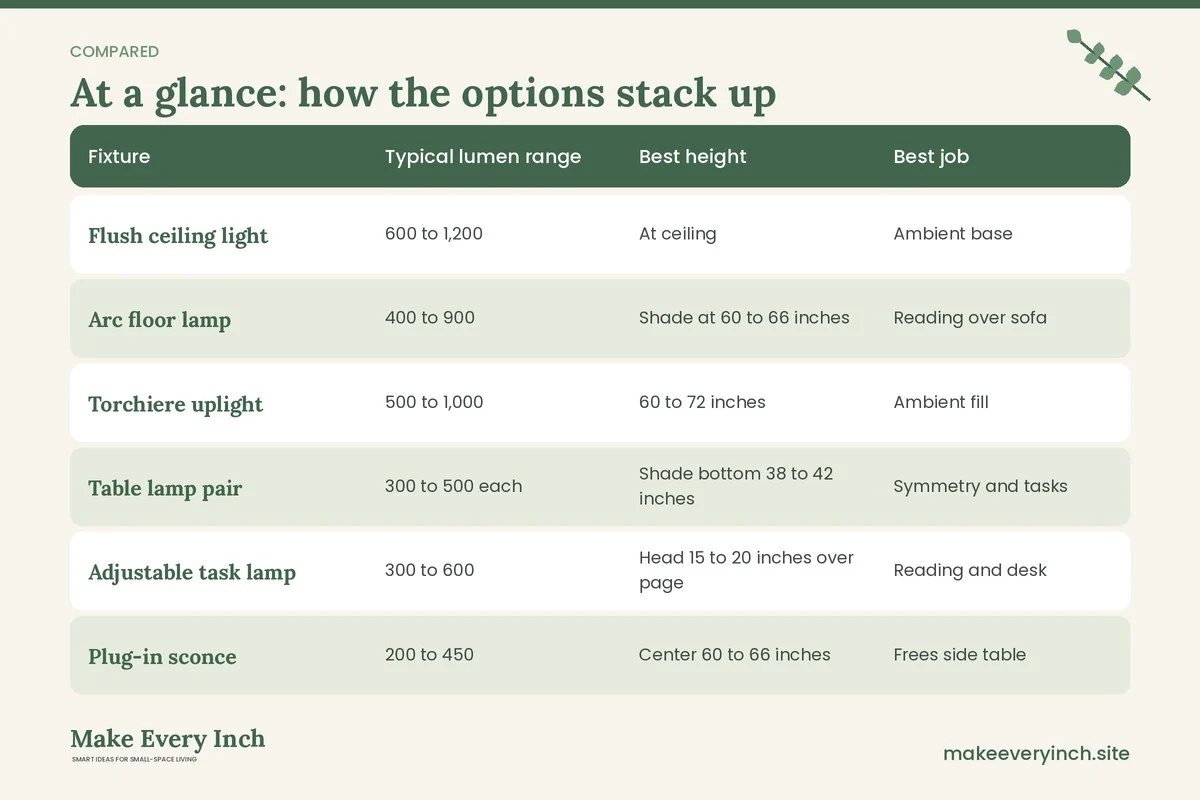
Use this table as a quick filter before you shop. Lumen figures are planning ranges, not promises, so always check the label on the product you buy.
| Fixture | Typical lumen range | Best height | Best job | Watch out for |
|---|---|---|---|---|
| Flush ceiling light | 600 to 1,200 | At ceiling | Ambient base | Harsh if undimmed |
| Arc floor lamp | 400 to 900 | Shade at 60 to 66 inches | Reading over sofa | Weight of base |
| Torchiere uplight | 500 to 1,000 | 60 to 72 inches | Ambient fill | Heat at the bulb |
| Table lamp pair | 300 to 500 each | Shade bottom 38 to 42 inches | Symmetry and tasks | Cord length |
| Adjustable task lamp | 300 to 600 | Head 15 to 20 inches over page | Reading and desk | Glare on screens |
| Plug-in sconce | 200 to 450 | Center 60 to 66 inches | Frees side table | Visible cord |
| Shelf strip | 100 to 300 | Under shelf lip | Accent and night light | Dotted look without diffuser |
| Picture light | 100 to 250 | Above frame | Focal accent | Glare on glass |
Screens, glare and the modern media wall
A modern living room usually has a screen, and screens change the lighting rules. A bright light behind or beside the TV reflects off the glass and makes the picture harder to see, while a completely dark room causes eye strain. The middle path is bias lighting: a soft glow behind the screen at about 10 to 15 percent of the screen’s brightness, which reduces contrast between the screen and the wall.
- Keep lamps off the sight line. Place lamps beside the sofa, not on the media unit opposite it, so they do not reflect in the glass.
- Use matte shades. Glossy shades and bare bulbs create reflections.
- Add a warm strip behind the screen. A low-brightness strip on the back of the unit or the wall lights the surface behind the TV.
- Choose a dimmer for the ambient layer. Movie night calls for a low setting, and cleaning day for a high one.
- Avoid a bright window opposite the screen. Use a sheer curtain to soften the daylight.
Our guide to small living room TV wall ideas shows wall layouts that make these light positions easy.
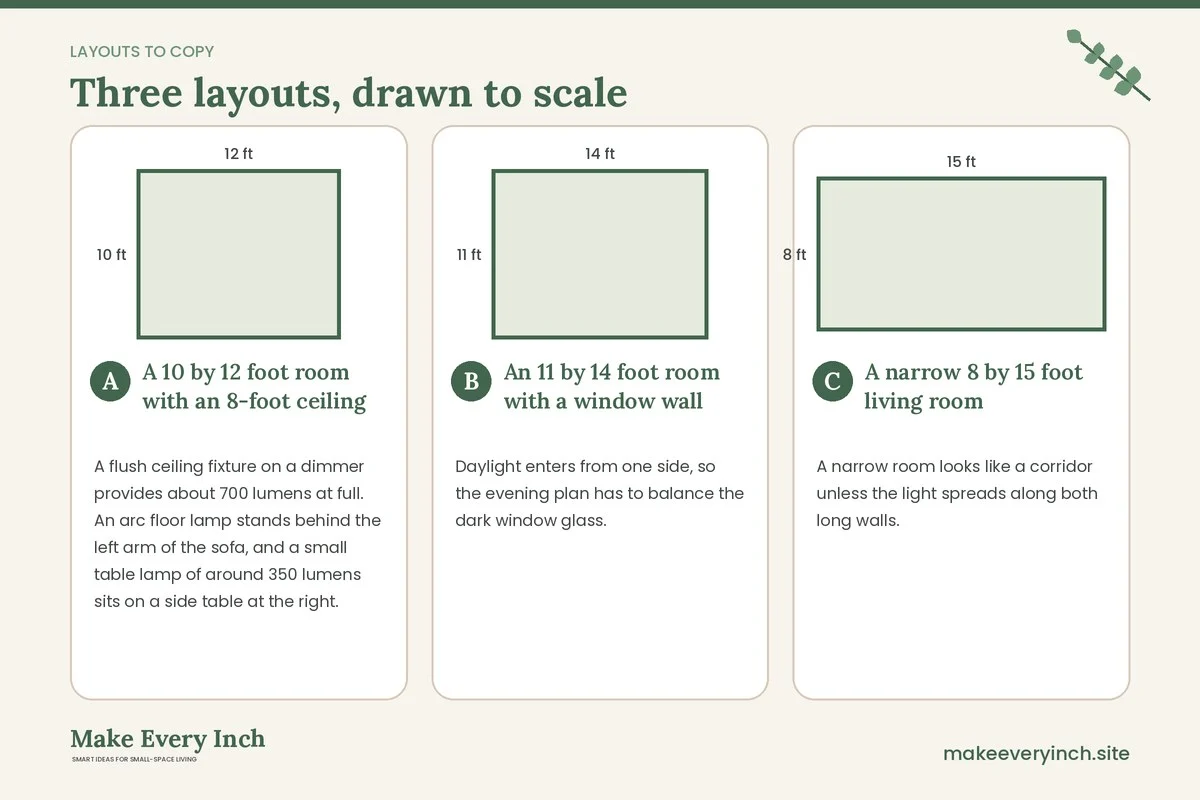
Three example rooms
A 10 by 12 foot room with an 8-foot ceiling
A flush ceiling fixture on a dimmer provides about 700 lumens at full. An arc floor lamp stands behind the left arm of the sofa, and a small table lamp of around 350 lumens sits on a side table at the right. A shelf strip of about 150 lumens glows under a bookshelf. Total at full power: roughly 1,400 lumens, about 12 per square foot, which is comfortable for a pale-walled room. The sofa sits on the long wall, so the arc lamp throws its light over the shoulder of the reader.
An 11 by 14 foot room with a window wall
Daylight enters from one side, so the evening plan has to balance the dark window glass. A pair of table lamps on the sofa side tables, each about 400 lumens, a floor uplight in the corner of about 600 lumens, and a picture light of around 150 lumens above a framed print total about 1,550 lumens. A sheer curtain keeps the glass from turning into a black mirror, and a lamp near the window prevents the room from feeling lopsided after sunset.
A narrow 8 by 15 foot living room
A narrow room looks like a corridor unless the light spreads along both long walls. Two plug-in sconces on one wall at the 60 to 66 inch height, a single lamp at the far end and an uplight near the entry give a rhythm that breaks up the tunnel. Together they supply roughly 1,200 lumens. For more narrow-room strategies, read our guide to narrow living room ideas.
Electrical safety for modern fixtures
Clean lines should never come at the cost of safety. A few habits keep a modern lighting plan safe.
- Respect the wattage limit. Every fixture has a maximum bulb wattage stamped on a label near the socket. Never exceed it, even if the bulb fits, and do not use a bulb with a larger base or a wattage higher than listed.
- Prefer cool-running bulbs. Efficient bulbs produce less heat, which matters under fabric shades and in enclosed fixtures. Check that the bulb is rated for an enclosed fixture if the housing is closed.
- Do not overload outlets. A single outlet or power strip has a total capacity. Do not chain strips together, and do not plug high-draw devices such as heaters into the same strip as your lamps.
- Manage cords. Run cords along walls or under a rug runner only if the product allows it, and never staple through a cord or run one under a rug in a walkway. A cord cover, a clip or a cable channel keeps it neat and out of the way.
- Keep strips and adapters ventilated. Do not cover a power adapter with fabric or tuck it into a tight gap.
- Hardwiring is a job for a licensed electrician. Replacing a ceiling fixture, adding a hardwired sconce or installing a new dimmer switch involves your home’s wiring. Rental tenants should also check the lease and ask the landlord.
- Use a wall dimmer only with compatible bulbs. A dimmer paired with the wrong bulb can flicker or hum. Check that the bulb and the dimmer are listed as compatible.
Styling the fixtures themselves
In a modern room, each fixture is also an object. A few styling rules keep the group looking considered.
- Repeat one finish. Matte black on the arc lamp, the sconce frames and the picture light creates a visual thread.
- Vary the height. Place one tall, one medium and one low light so the eye moves around the room.
- Mind the shade shape. A round globe, a drum and a cone each give a different feel. In a small room, choose two shapes at most.
- Keep the surfaces behind lamps calm. A lamp in front of a busy gallery wall looks cluttered. Put it against a plain wall.
- Make the cord part of the design. A fabric cord in a color that matches the wall disappears, while a bold color cord is a deliberate accent.
If you are planning the seating at the same time, our guide to small living room furniture ideas helps you choose pieces with room for lamps at arm’s reach.
Common mistakes in modern lighting plans
- Relying on a single overhead fixture. It creates flat light and harsh shadows. Add at least two lamps.
- Choosing a statement fixture that is too big. A pendant wider than a third of the room’s shortest side overwhelms the space.
- Mixing color temperatures by accident. Buy bulbs for the whole room at once, and check the kelvin number on each box.
- Putting a bright spot at eye level. An unshaded bulb near seated eye height is a glare source. Use a shade or a diffuser.
- Ignoring the dark corner. A corner without light makes the room look smaller. A single uplight fixes it.
- Leaving cords as a feature. Unless the cord is part of the design, hide it.
- Skipping the dimmer. A modern room without a dimmer is only one mood.

A quick lighting audit
Before you buy, do a ten-minute audit. Sit on the sofa in the evening with the current lights on. Note where you squint, where the room feels dark and where a bright bulb is visible. Take a photo from the doorway. Compare it with the same photo with only the lamps on. The difference shows what the overhead light is doing and what the lamps could do. Then mark the floor with tape where a floor lamp would go and check that the walkway stays 30 to 36 inches wide.
Modern lighting checklist
- Measure the room and note the square footage.
- Set a total lumen goal in the range of 10 to 20 per square foot.
- Choose one kelvin range, usually 2700 to 3000.
- Plan three layers: ambient, task and accent.
- Place table lamp shades with the bottom near seated eye height.
- Keep arc lamp shades at 60 to 66 inches off the floor.
- Check the wattage limit label on every fixture.
- Add a dimmer or a multi-step switch to the ambient light.
- Hide cords with covers, clips or channels.
- Avoid overloading any outlet or power strip.
- Aim lights away from the TV glass.
- Hire a licensed electrician for any hardwired change.
FAQ
How many lights does a small modern living room need?
Three to five light points are usually enough. A common mix is one ambient source, two lamps and one accent. The goal is balance, not a count.
What color temperature suits a modern living room?
Most people prefer 2700 to 3000 kelvin. It keeps the room warm without a yellow cast. Keep every bulb in the room within the same family.
Can I use a ceiling light alone?
You can, but it will feel flat. Add at least two lamps at different heights so the room has depth and so you can switch off the overhead light in the evening.
How high should a floor lamp be?
For a reading lamp beside a sofa, the bottom of the shade should sit at about eye level when you are seated, roughly 38 to 42 inches. For an arc or a uplight, the shade bottom sits around 60 to 66 inches so it clears heads.
How do I light a room if I cannot drill?
Use plug-in sconces with adhesive hooks where allowed, clamp-on lights, floor and table lamps, and battery-powered strips. See our guide to renter-friendly lighting ideas.
Is it safe to leave strips on all night?
Use products that are certified for your region, keep the adapter ventilated, stay within the listed length and turn them off if they feel hot. A timer or a smart plug on a schedule is a helpful habit.
Keep going: Keep planning with our small living room lighting ideas, best floor lamps for small rooms and small living room layout ideas modern.
Save this guide for later
Pin the ideas you like to Pinterest so you can come back to them when you plan your space.