18 Small Living Room Storage Ideas Renter Friendly and Deposit Safe
Quick answer: The best small living room storage ideas renter friendly tenants use rely on freestanding furniture, tension-based poles, over-door hooks, under-sofa bins and adhesive hooks rated for the load. Read the lease, test adhesive on a hidden spot, photograph the room before you start, and keep every item freestanding or removable so nothing needs a patch at move-out.
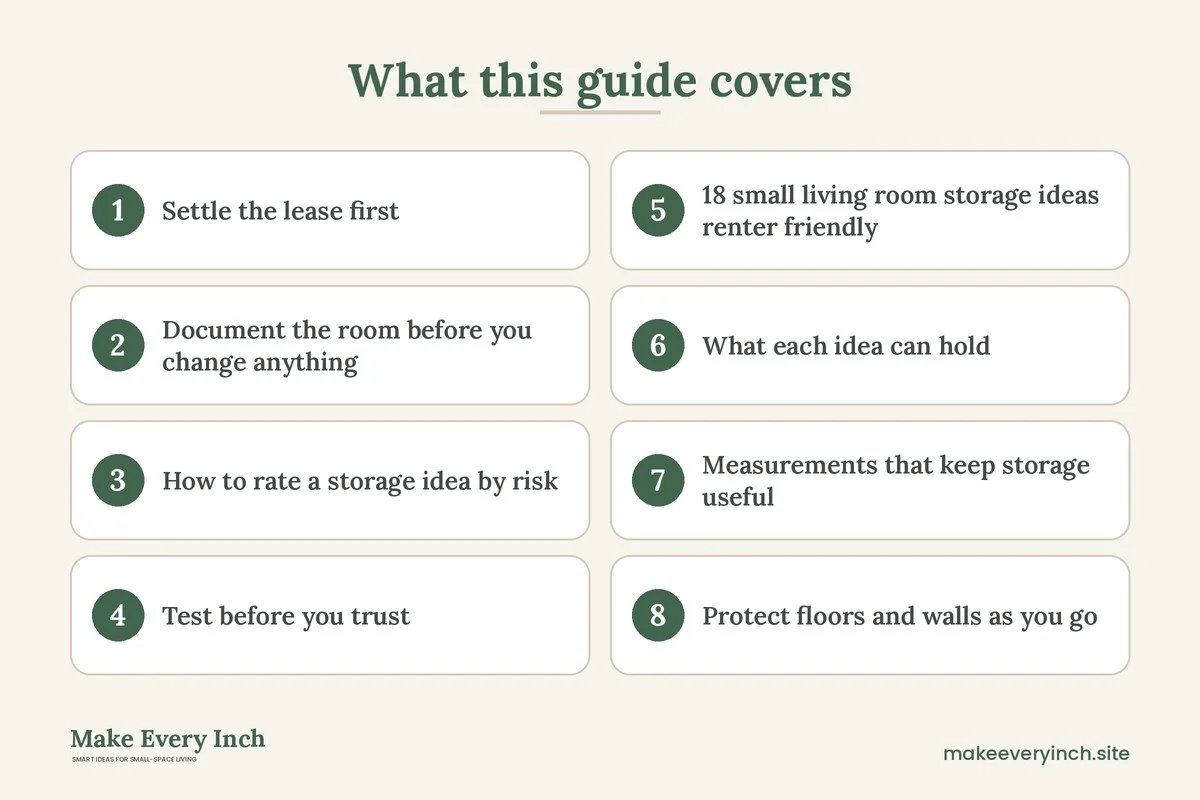
Small living room storage ideas renter friendly enough to protect your deposit begin with a different question than most storage guides ask. Instead of “what holds the most?”, ask “what leaves no trace?” A rental living room is the room where you sit, host, work and store, and the lease usually says you cannot drill, nail or paint. This guide shows you how to build real storage inside those limits. It covers the lease questions to settle first, a way to rate each idea by risk, 18 no-drill and removable ideas, a table of what each one can hold, floor measurements, three example rooms, a move-out routine and a checklist. For the full picture of the topic, see our main guide to small living room storage ideas and the hub on small living room ideas.
Settle the lease first
Every lease is different, so read yours before you buy a single hook. Look for the sections on alterations, nails, adhesives, paint and wall coverings. Many leases ban holes but allow a few small nail holes that you fill at move-out, and some ban everything. If the wording is vague, ask in writing and keep the reply. A short email costs nothing and gives you proof.
Questions worth asking your landlord or manager:
- Are small nail holes or screw holes allowed, and do I need to fill them?
- Is removable adhesive allowed on walls, doors and cabinets?
- Can I use tension rods in window frames and alcoves?
- Are furniture anchors allowed to secure a tall bookcase to the wall, and how should I repair the hole?
- Who is responsible for flooring marks, such as from furniture feet?
- Does the lease say anything about shelves or fixtures that I install and then remove?
Keep a record of the answers with the date. When you move out, a clear record is the best protection for your deposit.
Document the room before you change anything
Walk the room with your phone and take photos of each wall, the floor, the baseboards, the door and the window frames. Take close-ups of any existing marks, holes, scuffs or stains, and note the date. Store the photos in a folder with the lease. If the property has a move-in condition report, check that it matches what you see, and add notes if it does not.
This takes ten minutes and may save you from a dispute months later. It also tells you what is already damaged, so you do not feel pressure to hide it.
How to rate a storage idea by risk
Not all removable ideas are equally safe. Use a simple three-level rating before you commit.
Level 1: Freestanding and zero contact
Furniture that stands on the floor and touches no wall carries almost no risk. Examples are a bookcase, a bench, a basket and a cart. The only risk is floor marks, which felt pads and a rug solve.
Level 2: Tension and over-the-door
Tension poles, over-door hooks and clip-on racks hold themselves by pressure or by hanging, with no adhesive and no holes. The risk is a faint mark on paint from rubber ends, or a scuff on a door, so check the contact points first.
Level 3: Adhesive
Adhesive hooks and strips are removable when installed on the right surface and taken off the right way, but they can pull off paint on delicate or old walls. Test first, respect the weight rating, and remove by pulling the tab straight down along the wall, as the instructions say. Skip adhesive on textured, damp, dusty or freshly painted walls.
Plan your storage with as many Level 1 and Level 2 pieces as you can, and use Level 3 only where nothing else works.
Test before you trust
Before you put adhesive on any wall, find a hidden spot, such as behind a door or inside a closet. Clean the spot with a damp cloth and let it dry. Stick a small strip there, leave it for a few days, and remove it slowly. If the paint lifts, the wall fails the test, and you should use freestanding or tension-based storage instead.
Do the same for rubber feet and pads on floors. Put a pad under a piece, leave it for a week, and check the floor for marks. Some rubber leaves stains on vinyl and on finished wood. Felt or cork pads are safer on hard floors.
18 small living room storage ideas renter friendly
Freestanding furniture that does the work
1. A narrow bookcase that stays freestanding
A bookcase 11 to 14 inches deep and 60 to 72 inches tall holds books, baskets and decor with no wall contact. Put the heavy items low, and keep the top shelves light. Tall units can tip, so check the weight, keep them away from where children play, and ask your landlord about a safe way to secure them if tipping is a risk. Our best narrow bookshelves guide explains the features to check.
2. A storage ottoman in place of a coffee table
A lidded ottoman about 16 to 18 inches tall holds throws, remotes and games, and a tray on top becomes a table. It leaves no mark on any surface. See the best storage ottomans for what to look for.
3. A bench by the door
A bench 14 to 16 inches deep and 36 to 48 inches long gives seating and holds shoes or bags below. Choose open slats or baskets, and put a felt pad under each foot.
4. A TV stand that is really a cabinet
Choose a low cabinet or a console with doors and drawers, so the media gear, cords and games hide away. Leave a gap behind it for airflow and cable slack, and keep it away from radiators and vents.
5. A rolling cart in the dead gap
A slim cart 6 to 10 inches wide fits between the sofa and the wall or beside a chair. It holds a book, a mug, remotes or craft supplies, and you can roll it out when you vacuum. Check our guide to small kitchen cart ideas, since many of the same carts work in a living room.
6. A secondhand dresser or sideboard
A dresser gives deep, closed storage. Check the drawers, the joints and the weight. Use felt pads on the feet and a runner or rug under it if the floor is soft.
Tension and over-the-door ideas
7. A tension pole shelf in a corner
A floor-to-ceiling tension pole with shelves or baskets holds plants, books and small items in a corner. Check the ceiling height and the ceiling surface, since popcorn ceilings and soft drywall do not hold pressure well. Put protective pads at both ends.
8. A tension rod across an alcove
A rod across a window alcove or a recess holds curtains, hanging baskets, a throw or a small row of hooks. Check the rated weight, and do not use it to hold anything heavy. See our post on no-drill storage ideas for renters for more ways to use rods.
9. An over-door organizer
An over-door rack or a pocket organizer holds shoes, bags, scarves, cleaning supplies or kids’ items. Check that the door still closes, and that the hooks do not scratch the paint. Add a bit of felt on the hook contact points.
10. An over-door hook rail
A set of hooks that hang over the door takes coats, hats and bags off the sofa. Choose a rail with a rubber coating so it does not scratch the door.
11. A clamp-on or clip-on shelf
Some shelves and lamps clamp onto a table edge or a bed frame. Use them on furniture you own, and protect the surface with a thin pad.
Adhesive and Level 3 ideas, used carefully
12. Adhesive hooks for light items
Adhesive hooks hold keys, a lightweight bag, a wreath or a string of lights. Use the weight rating on the pack and keep the load below it. Press for the full time in the instructions, and wait before you load them.
13. Adhesive strip ledges for frames and small objects
A narrow ledge on strips holds light frames and a few small items. Choose the lightest ledge, check that the wall passes the test, and use more strips than the minimum.
14. Cord clips and cable boxes
Clips on the back of a console hold cords in place, and a cable box hides the power strip. Adhesive clips are light and come off easily if you heat them gently, as the label says.
Under, behind and between
15. Flat bins under the sofa
Measure the gap under the sofa, then buy flat bins that fit. They hold blankets, board games and seasonal items. Use fabric or low plastic bins with a lid, and do not slide them across a soft floor. See under-bed storage ideas, as the same bins often work under a sofa.
16. A sofa table behind a floating sofa
A table 10 to 12 inches deep behind the sofa holds a lamp, a tray and baskets on its lower shelf. It divides the room without a wall or a screen. Keep a path of 30 inches behind it.
17. Baskets that double as decor
A set of baskets under a console, beside a chair or on a shelf hides clutter in plain sight. Use lids on baskets that hold small items, and choose a handle you can lift with one hand.
18. A storage trunk or a nesting set
A trunk 24 to 30 inches wide holds throws and doubles as a side table. Nesting tables stack away when you do not need them and spread out when you host.
What each idea can hold: a risk and capacity table
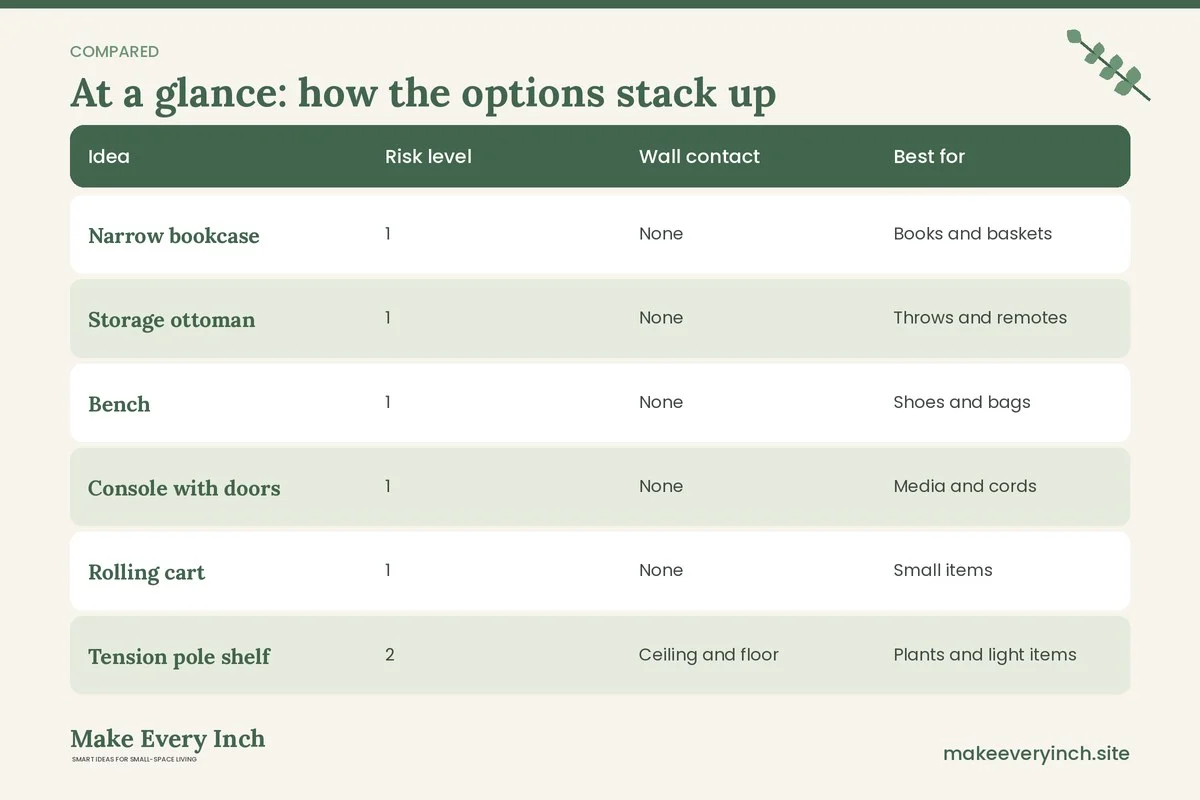
Weights and capacities vary by product, so always check the label. This table compares ideas in general terms.
| Idea | Risk level | Wall contact | Best for | Watch out for |
|---|---|---|---|---|
| Narrow bookcase | 1 | None | Books and baskets | Tipping if overloaded at the top |
| Storage ottoman | 1 | None | Throws and remotes | Lid weight |
| Bench | 1 | None | Shoes and bags | Floor marks from feet |
| Console with doors | 1 | None | Media and cords | Heat and airflow |
| Rolling cart | 1 | None | Small items | Wheel marks on soft floors |
| Tension pole shelf | 2 | Ceiling and floor | Plants and light items | Ceiling type and rated weight |
| Tension rod | 2 | Frame sides | Light hanging items | Slipping if overloaded |
| Over-door organizer | 2 | Door only | Shoes and bags | Door closing and scratches |
| Adhesive hooks | 3 | Wall | Keys and light bags | Paint lift on weak walls |
| Adhesive ledge | 3 | Wall | Light frames | Weight limit and wall finish |
| Under-sofa bins | 1 | None | Blankets and games | Floor scratches |
Measurements that keep storage useful
Renter storage works best when it fits the room, so measure first.
- Walkways: keep 30 to 36 inches in main paths, with 24 inches as the minimum for a side path.
- Sofa to coffee table or ottoman: 14 to 18 inches.
- Bookcase depth: 11 to 14 inches for most small rooms.
- Under-sofa gap: measure from the floor to the lowest part of the frame, and buy bins at least half an inch lower.
- Bench depth: 14 to 16 inches, with 18 inches of clear floor in front if it has a lid.
- Tension pole: measure the ceiling height at the exact spot, and choose a pole that fits within its range, not at the extreme end.
- Door clearance: check the gap between the door and the frame before you add an organizer, and test that the door shuts.
A small tape measure and a roll of painter’s tape make the planning easy. Mark footprints on the floor, live with them for a day and adjust.
Protect floors and walls as you go
Storage pieces cause most of the damage in a rental through scratches, dents and marks. A few simple habits prevent that.
- Put felt pads or cork under every foot and every corner.
- Lift pieces when you move them, instead of dragging them.
- Use a rug or runner under heavy furniture on soft floors.
- Keep a gap of an inch or two behind furniture, so air can move and the wall does not get scuffed.
- Wipe adhesive residue with a soft cloth and a mild cleaner, as the product label suggests.
- Do not stack or hang more than the label allows.
Three example rooms
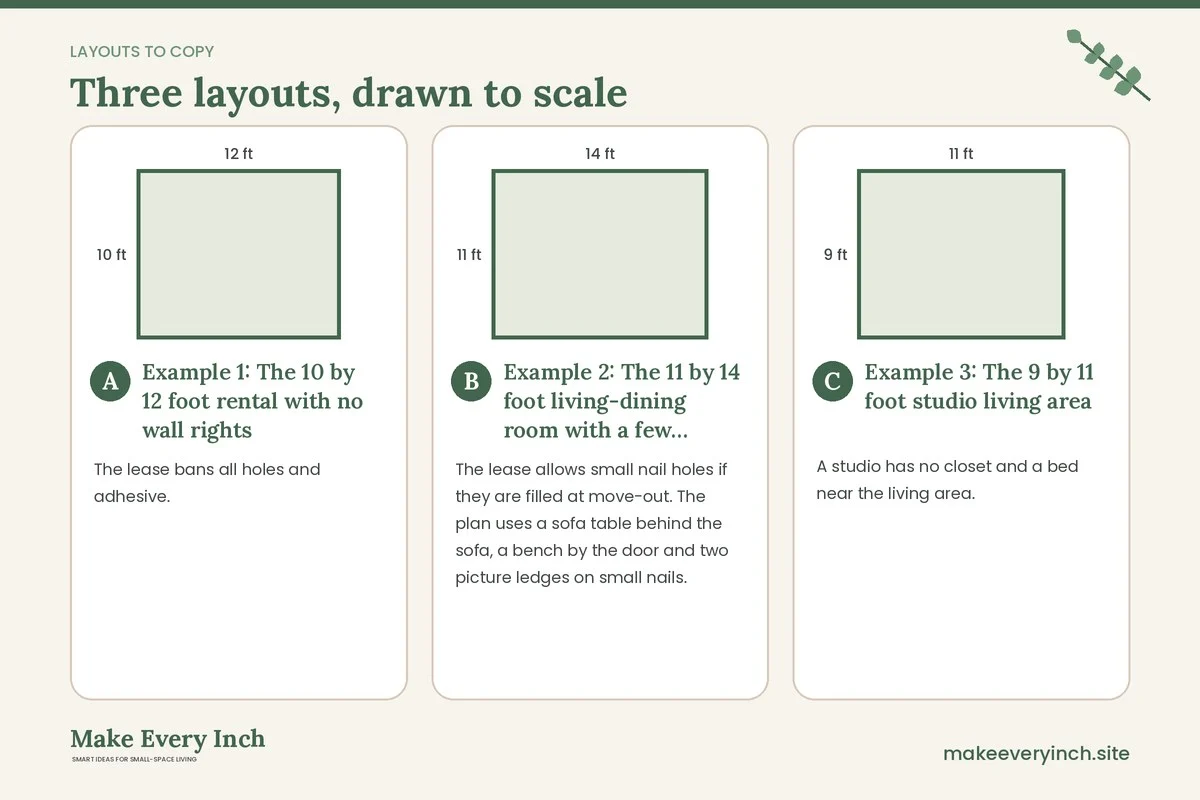
Example 1: The 10 by 12 foot rental with no wall rights
The lease bans all holes and adhesive. The plan uses a 24 inch wide freestanding bookcase beside the window, a lidded ottoman in place of the coffee table, flat bins under a 78 inch sofa and a rolling cart in the gap beside the sofa arm. An over-door hook rail takes coats and bags. Everything stands on the floor or hangs over the door. The walkway from the door runs at 34 inches. Move-out takes minutes, since the only task is to carry things out.
Example 2: The 11 by 14 foot living-dining room with a few allowed nail holes
The lease allows small nail holes if they are filled at move-out. The plan uses a sofa table behind the sofa, a bench by the door and two picture ledges on small nails. A tension rod in the window alcove holds a plant and a lightweight basket. Adhesive hooks hold keys and a bag. The tenant keeps the nail holes to five, writes down where each one is, and fills them at the end.
Example 3: The 9 by 11 foot studio living area
A studio has no closet and a bed near the living area. The plan uses a tall tension pole shelf in the corner, a bench at the foot of the bed with baskets under it, an over-door organizer on the bathroom door and a cart under the window. A console with doors hides the media gear. See small apartment living room ideas for studios for more layout help. The tenant keeps the whole system freestanding so it moves to the next apartment.
Plan for move-out from day one
Choose storage that comes with you. A bookcase, a cart, a bench and a set of bins fit into any apartment, but a custom fix that depends on one wall does not. Keep boxes, hardware and instructions for any piece that you may need to take apart.
When you leave, follow this routine.
1. Take everything off the walls and out of the room.
2. Remove adhesive slowly, as the label says, and keep the tabs.
3. Wipe the wall, the door and the floor with a soft cloth.
4. Fill any permitted nail holes with a small amount of spackle, and sand lightly if the lease requires it.
5. Take photos of each wall and the floor again, with the date.
6. Compare the photos with your move-in set, and keep them for a few months.
For more ways to protect your deposit, see our guide to security-deposit-safe apartment upgrades.
Mistakes to avoid
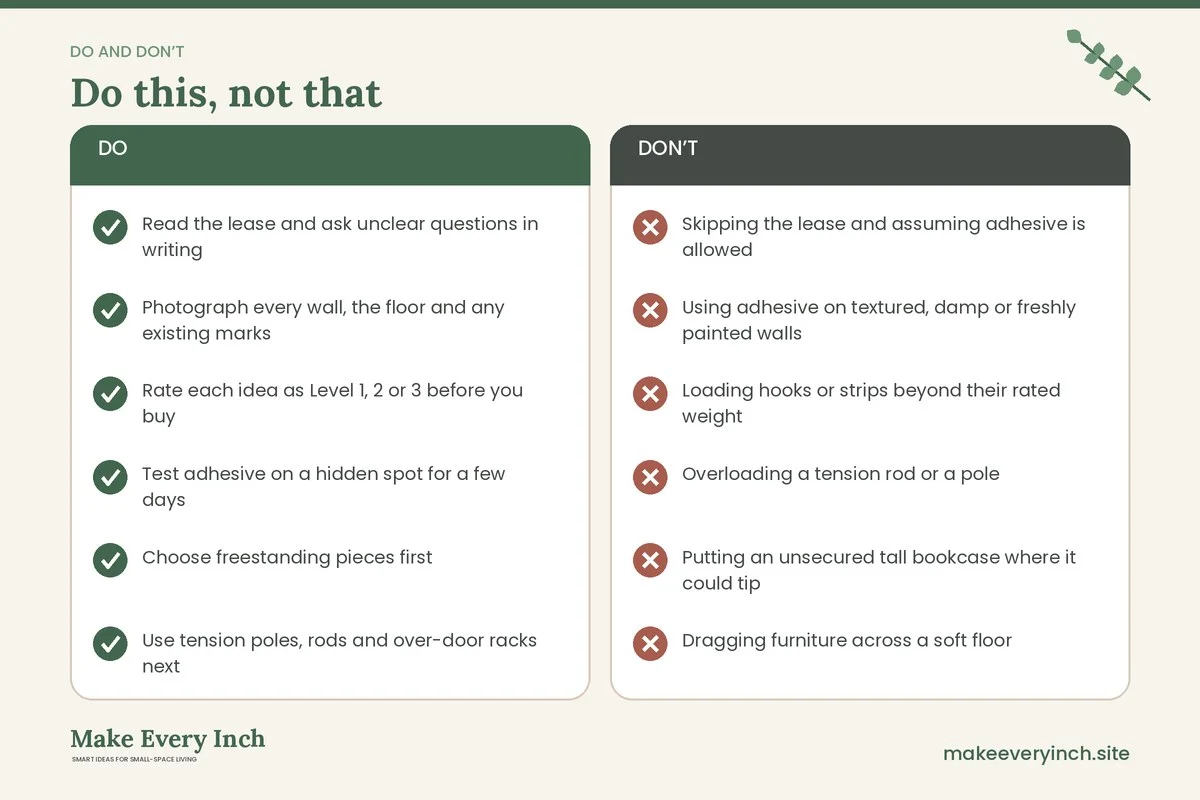
- Skipping the lease and assuming adhesive is allowed
- Using adhesive on textured, damp or freshly painted walls
- Loading hooks or strips beyond their rated weight
- Overloading a tension rod or a pole
- Putting an unsecured tall bookcase where it could tip
- Dragging furniture across a soft floor
- Using rubber pads that stain vinyl or finished wood
- Forgetting to photograph the room before you start
- Buying custom pieces that will not fit the next place
Renter-friendly storage checklist
- Read the lease and ask unclear questions in writing
- Photograph every wall, the floor and any existing marks
- Rate each idea as Level 1, 2 or 3 before you buy
- Test adhesive on a hidden spot for a few days
- Choose freestanding pieces first
- Use tension poles, rods and over-door racks next
- Keep adhesive to light items and check the weight rating
- Measure walkways, gaps and clearances
- Add felt pads under every foot
- Plan the move-out steps and keep the instructions
- Take move-out photos and keep them
FAQ
What is the safest kind of storage for a renter?
Freestanding furniture, such as a bookcase, a bench, an ottoman and a cart, because it touches no wall and leaves no hole.
Are adhesive hooks safe for a rental?
They can be, if you test a hidden spot, stay under the weight rating and remove them slowly. Skip them on delicate, textured or damp walls.
Can I use a tension pole in a rental?
Often yes, because it uses pressure and leaves no hole. Check the ceiling type and the rated weight, and use pads at both ends.
How do I stop a tall bookcase from tipping without drilling?
Keep the heavy items low, avoid overloading the top and place it where it is not in a play area. If tipping is a real risk, ask your landlord about a safe anchoring method.
What should I ask my landlord about storage?
Ask about nail holes, adhesives, tension rods and furniture anchors, and get the answer in writing.
How do I hide clutter in a rental living room without shelves?
Use a lidded ottoman, a console with doors, baskets with lids and flat bins under the sofa.
Will felt pads protect my floor?
Felt or cork pads protect most hard floors from scratches, but check them after a week, and clean the floor under them from time to time.
What should I do before I move out?
Remove adhesive slowly, wipe the surfaces, fill any permitted holes, photograph the room and compare with your move-in photos.
Keep going: Keep going with our renter-friendly shelving, organization ideas for renters and small living room ideas for renters.
Save this guide for later
Pin the ideas you like to Pinterest so you can come back to them when you plan your space.