19 Small Apartment Decor Ideas That Cost Very Little
Quick answer: For small apartment decor under $100, spend first on warm lighting, then textiles such as pillow covers and a throw, then one mirror or large print, then a plant. Do the free changes before you buy anything, use thrift swaps for lamps and frames, and choose renter-safe items that need no nails, so you can take everything with you.
Small apartment decor under $100 is realistic if you spend in the right order. A hundred dollars will not furnish a room, but it can change how a room feels, because light, texture and one focal point do more than a pile of small purchases. The biggest mistake is spending the budget on many cheap objects that add clutter. This guide gives 19 ideas, a priority order, a list of free changes, a table that compares what each purchase delivers, thrift swaps and three itemized plans for a living room, a bedroom and a whole apartment. Every plan totals $100 or less at typical prices, which vary by store and city. If you have more to spend later, our small living room makeover under $500 is the natural next step.
Set the rules before you spend
Decide three things first. Pick one palette of two or three colors, since a consistent palette makes cheap items look intentional. Pick a focal point for each room, such as the wall behind the sofa or the bed. Read your lease and photograph the room, so you know what you may change and can prove the starting condition. Then keep the receipts for anything you might return.
A fixed total also helps you say no. Write the budget on your phone, and subtract each purchase as you go. Prices below are hedged ranges, so check current prices before you shop.
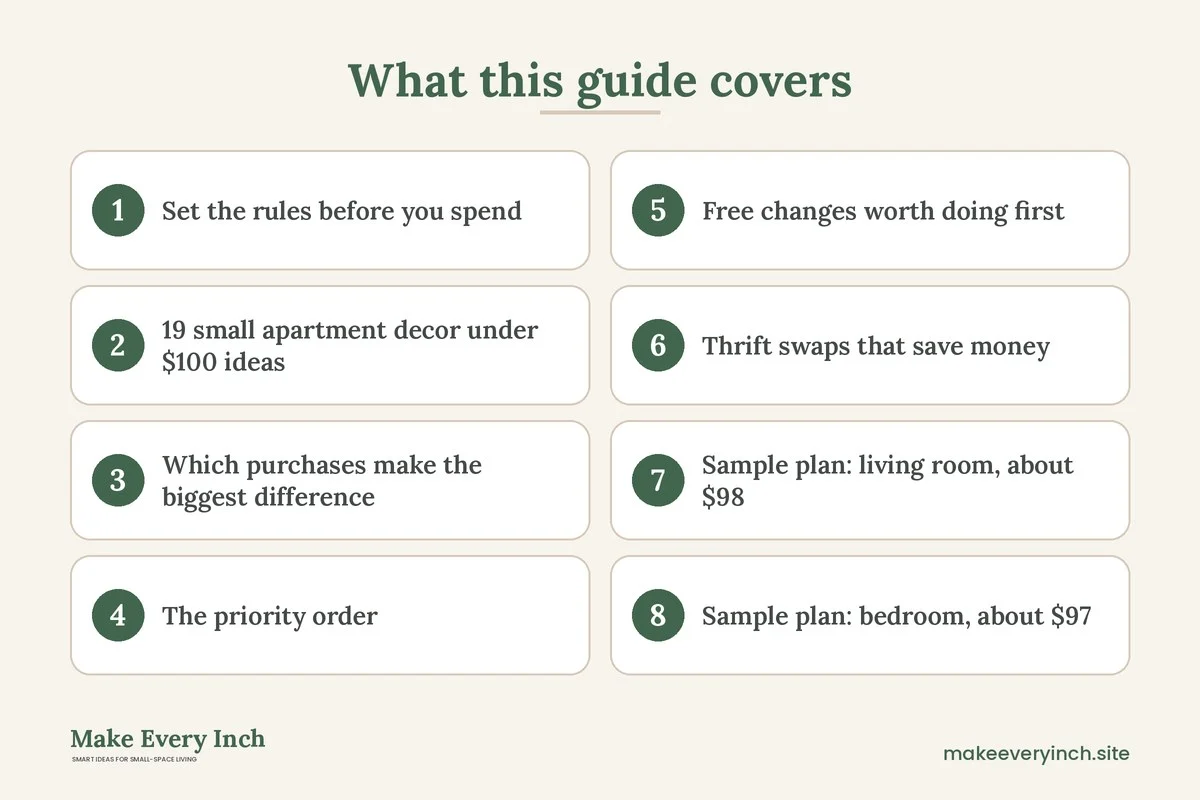
19 small apartment decor under $100 ideas
Free and nearly free changes
1. Rearrange before you buy
Move the sofa a few inches off the wall, angle a chair or float a rug so it sits under the front legs of the furniture. A different layout can fix a room that felt wrong, and it costs nothing. Live with the new arrangement for a few days before you decide what is missing.
2. Clear every surface, then add back
Take everything off shelves, the coffee table and the dresser, wipe them and return only your favorites. Group items in odd numbers, and leave gaps. This is the cheapest upgrade available, and it makes later purchases look better.
3. Shop your own home
Move a lamp from one room to another, borrow a vase from the kitchen or lean a framed photo from a drawer on a shelf. Fresh pairings often feel like new decor.
Light
4. Warm bulbs in every lamp
Swap harsh cool bulbs for warm white ones, usually labeled around 2700K. A multipack often costs $6 to $15, and it is the best value on this list. Use dimmable bulbs where a lamp has a dimmer.
5. One lamp at eye level
Overhead light flattens a small room. A single table lamp, often $15 to $35 new or less at a thrift store, adds a soft pool of light at a lower height. Place it in the darkest corner.
6. Plug-in string lights
A strand of warm string lights behind a headboard or along a shelf adds glow. Many cost $8 to $20, and a plug-in version needs no installation. See our renter-friendly lighting ideas for more.
Textiles
7. Pillow covers, not new pillows
Covers cost much less than full pillows, and you can reuse the inserts you own. Buy two or three covers in your palette, often $6 to $12 each, and mix a solid with a pattern.
8. One good throw
A textured throw in cotton, wool blend or chenille adds depth to a sofa or a bed. Expect roughly $15 to $30, and fold it over one arm instead of spreading it flat.
9. A new duvet cover
A bed is the largest surface in a bedroom, so a fresh duvet cover changes the whole room. Expect about $25 to $45 for a basic cotton or washed look. Pick a calm color, and add one accent pillow.
10. Curtains hung high
If you already have curtains, hang the rod higher and closer to the ceiling, which makes the room look taller. If you need new panels, look for inexpensive linen-look panels, and wash them before hanging.
Walls and mirrors
11. A single large mirror or print
One big piece beats many small ones in a small room. A thrifted mirror may cost $10 to $30. Lean it on a dresser or the floor, or hang it with strips rated for the weight, only if the lease allows.
12. A frame set with your own prints
Buy plain frames, often $3 to $10 each, and print free art, family photos or your own images at a copy shop. A wide mat makes a cheap print look finished. See our renter friendly wall decor ideas for layouts that do not need nails.
13. Fabric as art
A scarf, a tea towel or a remnant stretched over a canvas frame adds color for very little money. Hang it with a hook or lean it on a shelf.
Plants and objects
14. One real plant in a good pot
A pothos, snake plant or ZZ plant usually costs $8 to $20, and tolerates low light. Put it in a ceramic pot from a thrift store, and place it at a different height from your other objects.
15. A tray to organize a surface
A tray turns scattered items into a deliberate group. Place candles, a small plant and a book on it. Expect $5 to $15, or less used.
16. A candle or diffuser you love
Scent is part of a room’s mood. A candle in a jar in the $8 to $20 range is enough, and keep it on a heat-safe tray away from curtains.
Practical upgrades that look like decor
17. Hooks that look good
A row of adhesive hooks or an over-the-door set holds bags, towels and coats. Choose finishes that match your palette. Check the weight limit and follow the removal instructions.
18. Baskets with a purpose
One or two baskets hide blankets, shoes and cables, and tidy the floor. They also soften hard lines. Expect $8 to $20 each new, and less secondhand. See our cheap storage ideas for apartments for more.
19. A rug refresh with a small mat
If you cannot afford a large rug, a small mat in the entry or at a bedside defines a zone. Choose a flat weave that is easy to clean, and add a non-slip pad.
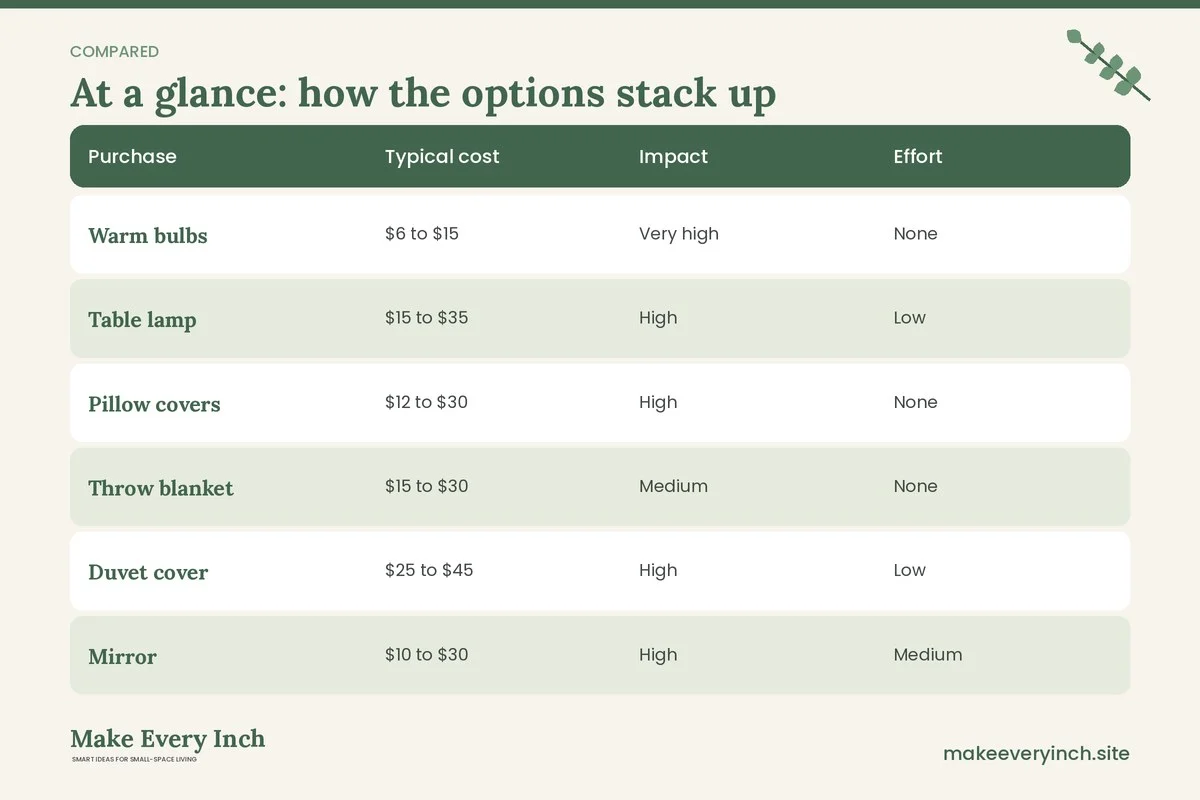
Which purchases make the biggest difference
| Purchase | Typical cost | Impact | Effort | Renter safe |
|---|---|---|---|---|
| Warm bulbs | $6 to $15 | Very high | None | Yes |
| Table lamp | $15 to $35 | High | Low | Yes |
| Pillow covers | $12 to $30 | High | None | Yes |
| Throw blanket | $15 to $30 | Medium | None | Yes |
| Duvet cover | $25 to $45 | High | Low | Yes |
| Mirror | $10 to $30 | High | Medium | Yes, if leaned |
| Plant and pot | $10 to $25 | Medium | Low | Yes |
| Peel-and-stick items | $15 to $40 | Medium | High | Check the lease |
The priority order
Spend in this order, and stop when the money runs out.
- First, light. Fix the bulbs, and add one lamp if the room has only overhead lighting.
- Second, the largest soft surface. In a living room that is the sofa, and in a bedroom it is the bed.
- Third, one focal piece, such as a mirror, a print or a fabric hanging.
- Fourth, something alive, such as a plant, or a bowl of fruit if you do not trust yourself with plants.
- Fifth, small objects, but only if you still have money and a clear spot for them.
This order works because light and textiles change the whole room, while small objects change only the surface they sit on.
Free changes worth doing first
These cost nothing, and several may solve a problem you were about to spend money on.
Edit the walls
Take down anything you no longer love. Empty wall space makes a small room feel larger, and gives the remaining pieces room to breathe.
Move the furniture
Pull the sofa away from the wall by a few inches, or turn the bed so the head sits on the longest wall. Test pathways, and keep about 30 inches clear where you walk, if the room allows.
Open the windows
Clean the glass, wash the curtains and pull them fully to the edges of the frame, so they do not cover the glass. More daylight is the cheapest decor there is.
Group by color
Group books by color or turn spines inward on a shelf, and place two or three objects in the same tone together. Color grouping makes a shelf look styled.
Hide the cords
Bundle cords with a clip or a tie, and run them behind furniture. A tidy floor looks calmer than a new accessory.
Thrift swaps that save money
Swapping new items for secondhand ones stretches the budget. See our full guide to thrifted apartment decor ideas for where to shop and what to skip.
- A thrifted lamp base with a new shade often costs less than a new lamp, and looks better.
- Used frames cost a fraction of retail, and a coat of spray paint makes them match.
- Ceramic vases and bowls work as planters and catch-alls, often for a few dollars each.
- Baskets and trays are easy to find, and cheap to clean.
- Mirrors with solid frames cost much less than new ones of the same size.
Skip anything with frayed cords, signs of pests or heavy odors, and avoid upholstered items from the curb. Wipe and test every piece before you place it.
Sample plan: living room, about $98
All prices are typical ranges, and your total will vary.
- Two pillow covers: $18
- One textured throw: $22
- A table lamp, new or thrifted: $18
- Warm bulb multipack: $8
- A thrifted mirror to lean on a console: $15
- A plant in a thrifted pot: $12
- Adhesive hooks and strips for a light frame or a cord: $5
Total: $98. The lamp and bulbs fix the lighting, the pillows and throw add softness, and the mirror and plant give the room a focal point. If you need a sofa too, see our guide to the best sofas for small apartments.
Sample plan: bedroom, about $97
- A duvet cover: $35
- Two pillow shams or covers: $14
- A thrifted bedside lamp: $12
- Warm bulbs: $6
- Two thrifted frames with your own prints, leaned on a dresser: $12
- A woven basket for blankets or laundry: $8
- A plug-in string light: $10
Total: $97. The duvet cover and shams carry most of the change, and the lamp, bulbs and string lights give the room a softer light at night. Wash the new bedding before use.
Sample plan: whole apartment, about $97
- Warm bulb multipack for every lamp: $10
- A thrifted lamp for the living room: $12
- A throw for the sofa: $18
- Two pillow covers: $14
- A thrifted mirror for the entry or the living room: $15
- A tray for the coffee table or the entry: $6
- One plant in a pot: $10
- Adhesive hooks for the entry: $6
- Kitchen towels and a glass jar for the counter: $6
Total: $97. This plan spreads small amounts across each zone, so the apartment feels more consistent. Use a single palette across all rooms, and the small pieces will tie together.
Renter-safe rules
Read the lease, and photograph every wall and floor before you start. Choose freestanding, leaning and plug-in items first. If you use adhesive strips or hooks, test a hidden spot, follow the weight limits and remove them slowly with the tab pulled parallel to the wall. Do not paint, drill or install wallpaper without written permission. Keep the original bulbs, curtain rods and hardware in a box, in case you need to restore anything at move-out. For more, see our guide to budget renter upgrades.
How to shop within the $100 limit
Write the plan before you go, and add a small cushion for tax. Shop secondhand first for lamps, frames, trays and baskets, and new for anything that touches a bed or a body, such as bedding. Compare unit prices for bulbs and covers, and wait for a sale on anything that is not urgent. Buy one item at a time, and place it before buying the next, so you know the room needs it. Keep returnable items in their packaging for a few days.
A two-hour weekend routine
Start by clearing and wiping surfaces, which takes about thirty minutes. Move furniture and test the new layout for another twenty. Swap bulbs and place the lamp in the darkest corner, then dress the sofa or the bed with covers and a throw. Hang or lean the mirror last, and stand in the doorway to judge the view. Take one item away before you finish, since a calm room usually has a little less in it than you expect. Photograph the result, and wait a week before buying anything else.
Budget guide
Under $50
Warm bulbs, one lamp, two pillow covers and a plant. This is enough to change the mood of one room.
About $100
Lighting, a throw, covers and a mirror or a duvet cover, as in the sample plans above.
When to go beyond $100
If the room needs real furniture, a rug or a new sofa, save for it, and use our DIY apartment upgrades ideas in the meantime.
Mistakes to avoid
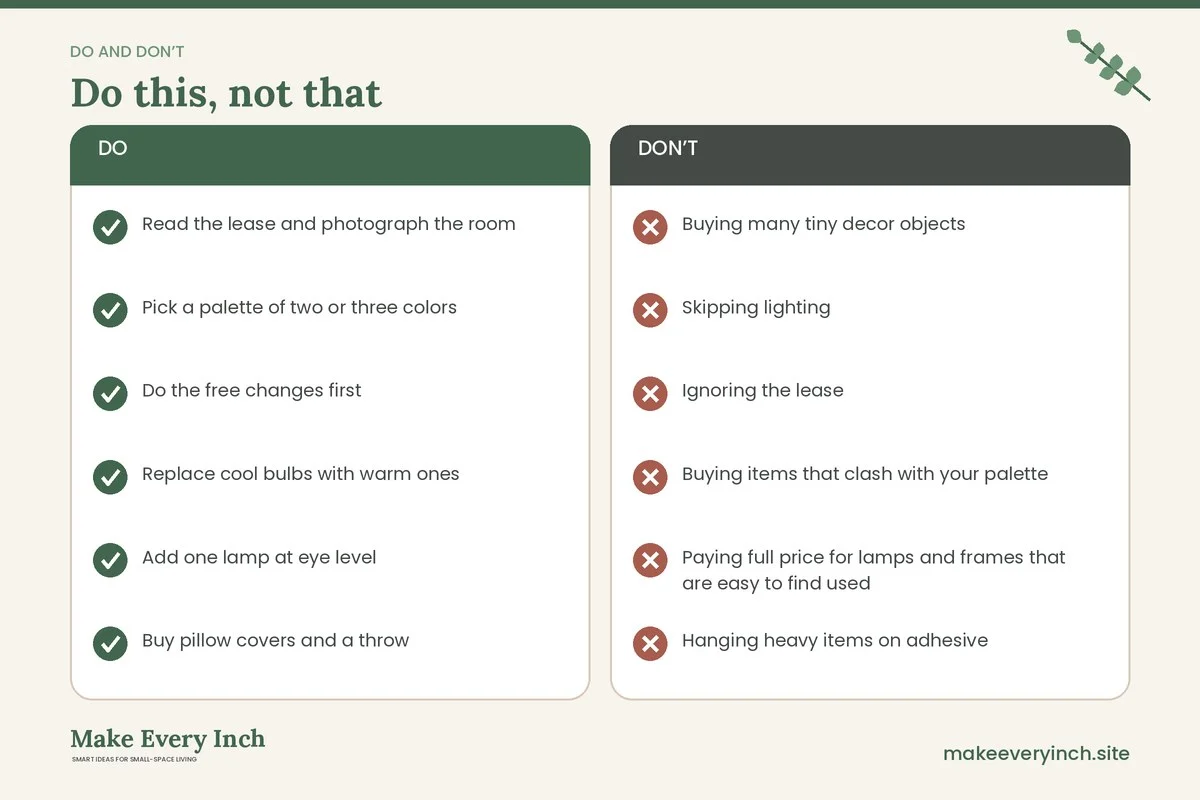
- Buying many tiny decor objects
- Skipping lighting
- Ignoring the lease
- Buying items that clash with your palette
- Paying full price for lamps and frames that are easy to find used
- Hanging heavy items on adhesive
- Forgetting tax and shipping in the total
- Decorating before clearing clutter
Under $100 checklist
- Read the lease and photograph the room
- Pick a palette of two or three colors
- Do the free changes first
- Replace cool bulbs with warm ones
- Add one lamp at eye level
- Buy pillow covers and a throw
- Choose one mirror or print as a focal point
- Add one plant
- Shop secondhand for lamps, frames and baskets
- Keep receipts and original hardware
FAQ
Can I really decorate a small apartment for under $100?
Yes, if you spend on light, textiles and one focal piece, and use free changes and secondhand items for the rest.
What should I buy first?
Warm bulbs and a lamp, since lighting changes how everything else looks.
What are the best cheap decor items for a small apartment?
Pillow covers, a throw, a mirror, a plant in a good pot and a tray give the most return.
How do I make a small apartment look bigger on a budget?
Clear surfaces, use warm layered light, lean a large mirror opposite a window and keep the palette tight.
Is it better to buy new or thrifted?
Buy bedding new, and buy lamps, frames, baskets and mirrors used. Check cords and condition first.
How do I decorate without damaging a rental?
Use freestanding and leaning items, plug-in lights and adhesive hooks within their weight limits, and photograph the room first.
How do I avoid clutter when decorating cheaply?
Set a budget, keep a palette and buy one thing at a time. Leave empty space on every surface.
What if I only have $50?
Choose warm bulbs, a lamp, two pillow covers and a plant, and do all the free changes.
Keep going: Explore our small apartment makeover on a budget, small bedroom makeover under $200 and budget small kitchen makeover.
Save this guide for later
Pin the ideas you like to Pinterest so you can come back to them when you plan your space.