17 Small Living Room Storage Ideas Budget Plans That Actually Hold Clutter
Quick answer: The best small living room storage ideas budget shoppers can use are a spend-order plan: first edit what you own, then use free vertical space with a cheap bookcase, then add lidded containers where clutter lands, and only then buy one hybrid piece such as a storage ottoman. Thrift, secondhand and DIY finds work well if you measure first and check the joints, the depth and the weight.
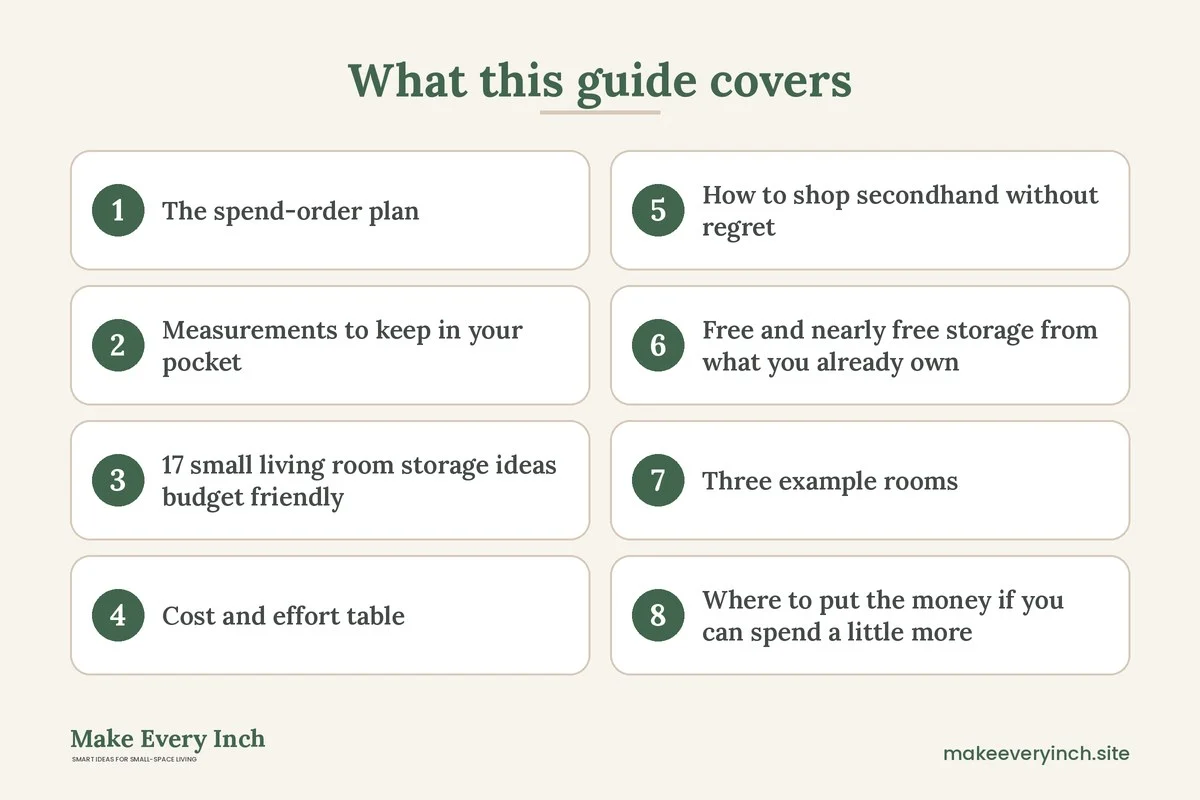
Small living room storage ideas budget shoppers can trust start with a counterintuitive rule: do not buy storage first. Most cluttered small living rooms do not lack boxes. They lack a plan for what each object does, where it lands every day and how much room it is allowed to take. When you buy containers before you decide that, you end up with a room full of tidy boxes and no floor. This guide gives you a spend-order plan, 17 low-cost ideas grouped by where the clutter actually lives, a table that compares options by cost range and effort, measurements for the most common pieces, a thrift-store checklist, three example rooms and a final checklist. It builds on our main guide to small living room storage ideas and the wider hub on small living room ideas, so start there if you want the big picture and come back here when money is the limit.
The spend-order plan: what to do before you buy anything
A budget works best when each step costs less than the one after it, and when each step tells you whether you need the next. Work in this order and stop whenever the room works.
Step 1: Edit for free
Take everything that does not belong in the living room and carry it out. Be literal. Make four piles: keep here, keep elsewhere, donate or sell, and trash. Items that collect in a living room are usually mail, chargers, shoes, craft supplies, kids’ toys, spare blankets, old magazines and the remote that no longer has a TV. Each item you remove is storage you did not have to buy. If you want a method for this, our guide to small apartment decluttering ideas walks through it by category.
Count what is left after the edit. A simple rule is to group the remaining items into six or fewer categories, such as media, books, throws, games, office and everyday trays. If you can name six categories, you know you need about six places, and not twenty.
Step 2: Use space you already pay for
Floor space is the most expensive thing in a small room, and wall and corner space is nearly free. Before you buy a piece that sits on the floor, look at the zones above 48 inches, behind doors, under the sofa and between the sofa arm and the wall. These zones hold shelves, hooks, slim baskets and flat boxes without taking a single square inch of walkway.
Step 3: Buy containers only for what is left
Now you know the categories and the free zones, so you can measure and buy containers that fit. Buy the fewest pieces that solve the largest category first, and add the next only after you live with the first for a week.
Step 4: Splurge on one hybrid piece
If the budget has any room, spend it on a single piece that is both furniture and storage, such as an ottoman with a lid or a console with a shelf. One hybrid piece replaces two separate pieces, and it is the item you touch every day, so it earns the extra cost.
Measurements to keep in your pocket
Storage fails more often because of a bad measurement than a bad product. Write these numbers in your phone before you shop.
- Walkway: keep 30 to 36 inches clear in main paths, and never less than 24 inches on a side path.
- Sofa to coffee table: 14 to 18 inches.
- Bookcase depth: 11 to 14 inches is enough for books and baskets, and a deeper unit starts to eat the room.
- Shelf spacing: 10 to 12 inches for paperbacks, 12 to 14 inches for large books and baskets, and 16 inches or more for a tall lamp or a plant.
- Under-sofa clearance: measure the gap from floor to the lowest frame. Many sofas leave 4 to 6 inches, which fits flat bins but not boxes.
- Door swing: leave about 3 feet in front of any cabinet door that opens outward.
- Wall studs and anchors: if you do mount a shelf, know the wall type and use the hardware that suits it.
Keep a small tape measure in the room until the project is done. Cardboard cutouts of the footprint also help, and they cost nothing.
17 small living room storage ideas budget friendly
Vertical ideas that use the wall
1. A tall, narrow bookcase
A bookcase 11 to 12 inches deep and 60 to 72 inches tall holds a lot on a footprint of about 2 square feet. Choose one that is 24 to 30 inches wide so it fits beside a window or a door. Fill the lower shelves with lidded baskets and keep the top two shelves for books and objects. See our guide to the best narrow bookshelves for what to look for.
2. A secondhand shelving unit with a fresh finish
Used shelving is easy to find and usually costs less than new. Check that it stands without a wobble, that the shelves do not sag, and that the back panel is still attached. A coat of paint or a new set of knobs turns a tired unit into a feature, and the cost is a can of paint and an hour.
3. Floating ledges for frames and small items
A picture ledge 4 to 5 inches deep holds frames, a few books and a small plant. Mount it above the sofa or beside the TV, 6 to 8 inches above furniture. Ledges cost little, and they turn a blank wall into a display. If you rent, see our post on renter-friendly shelving.
4. A hanging rail with hooks by the door
A single rail with four to five hooks at 60 to 66 inches takes coats, bags and a hat off the sofa. It is one of the cheapest changes in the room because it needs one small board and a few screws.
5. Wall pockets and a cork or pegboard panel
A pegboard panel with a few baskets holds mail, keys and chargers in a space of about 2 feet square. Painting it the wall color makes it fade out. Keep it to one panel, since a wall of pegboard looks like a garage.
Low and under ideas that hide clutter
6. Flat bins under the sofa
Measure the gap, then buy bins slightly shorter than it. Flat fabric bins or shallow wooden crates on casters hold blankets, board games and seasonal items. Label the end that faces out. See our guide to under-bed storage ideas, since the same bins often work under a sofa.
7. Crates as cubbies
Wooden crates stacked two high and screwed together form a cubby tower. Sand the edges, stain or paint them, and add a board on top to make a side table. Crates are cheap, and you can rearrange them later.
8. A storage bench at the foot of the sofa or by the door
A bench 14 to 16 inches deep and 36 to 48 inches long holds shoes or throws and also gives seats. It must have a lid you can open without moving it, so leave 18 inches clear in front.
9. A lidded ottoman
This is the classic hybrid piece. Pick one about 16 to 18 inches tall, so it matches the sofa seat, and test that the lid is not so heavy that it falls on fingers. An ottoman with a tray on top works as a coffee table in a room where the floor is tight. Our guide to the best storage ottomans lists what to check.
10. A coffee table with a shelf
A table with a lower shelf gives you two surfaces in the footprint of one. Use the lower shelf for a tray of baskets, and keep the top for what you use daily. Round tables are friendlier in tight gaps.
Corner and gap ideas
11. A corner shelf stack
A tall corner shelf uses a spot that nothing else uses. Check that the shelves are at least 9 to 10 inches deep, or books will hang over the edge. Place the heaviest items at the bottom.
12. A slim cart between the sofa and the wall
A rolling cart 6 to 8 inches wide fits into a gap that is otherwise dead. It holds remotes, a book, a mug or cleaning supplies on rollers, and it slides out when you need to vacuum. See our guide to best rolling kitchen carts, since many of them also suit the living room.
13. Behind the door
A door-hung organizer or an over-door hook rack holds bags, umbrellas and small tools on a surface that is otherwise wasted. Check the door still closes, and that the rack does not hit the wall.
Furniture-based and DIY ideas
14. A TV console with doors
An old dresser or sideboard can become a TV console with a few drawers of storage. Check that the top is deep enough for the TV stand, at 14 to 16 inches or more. Drawers hide the cords, the controllers and the games that otherwise sit in a pile.
15. A sofa table behind the sofa
A narrow table 10 to 12 inches deep behind a floating sofa holds a lamp and a tray, and its lower shelf takes baskets. It also divides the room, so you can use it in an open living-dining space.
16. A DIY storage cube bench
A pair of cube units with a cushion on top makes a seat with six or eight openings. It needs no tools beyond a screwdriver, and fabric bins let you hide what is inside.
17. A repurposed suitcase or a trunk
A vintage trunk at 24 to 30 inches wide holds throws, and a stack of two suitcases forms a side table. Look for ones with working latches, and check the inside for smells before you take one home.
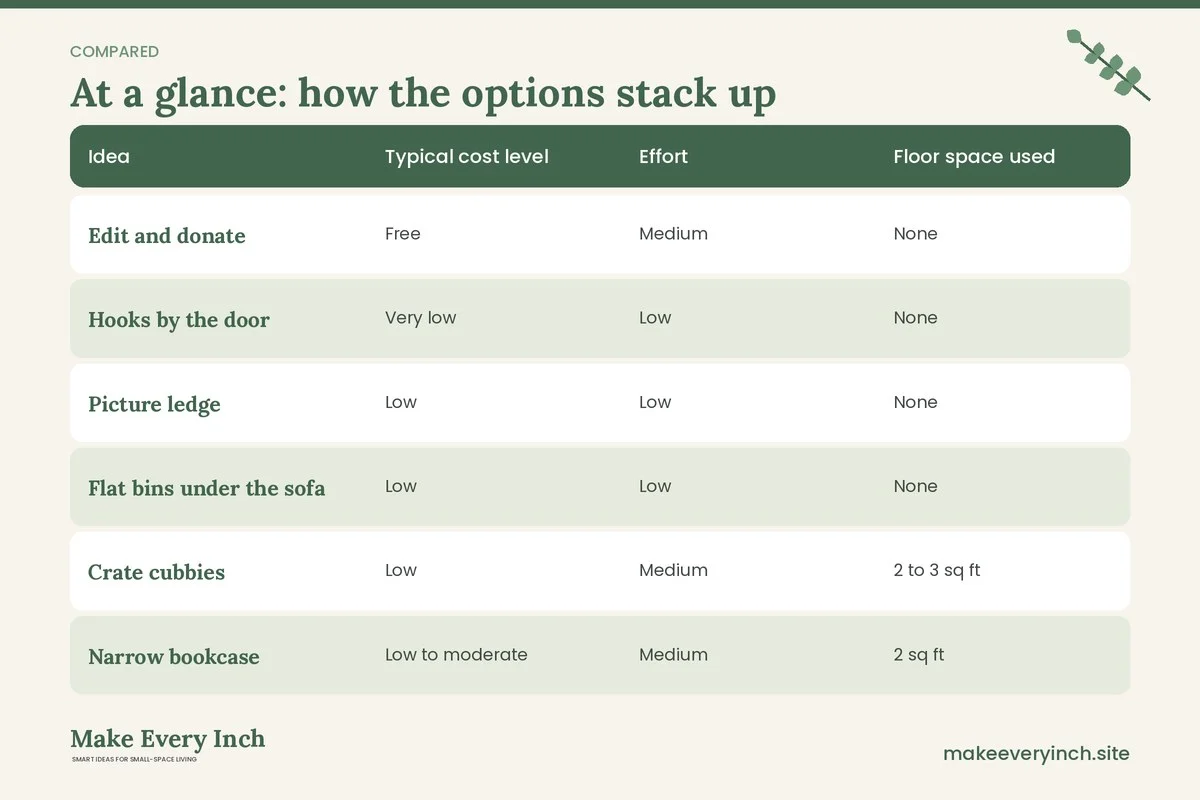
Cost and effort table
Cost ranges below are rough and vary by region, by condition and by where you shop. Use them as a way to compare options, not as a quote.
| Idea | Typical cost level | Effort | Floor space used | Best for |
|---|---|---|---|---|
| Edit and donate | Free | Medium | None | Every room |
| Hooks by the door | Very low | Low | None | Coats and bags |
| Picture ledge | Low | Low | None | Frames and small items |
| Flat bins under the sofa | Low | Low | None | Blankets and games |
| Crate cubbies | Low | Medium | 2 to 3 sq ft | Mixed items |
| Narrow bookcase | Low to moderate | Medium | 2 sq ft | Books and baskets |
| Lidded ottoman | Moderate | Low | 3 to 4 sq ft | Throws and remotes |
| Storage bench | Moderate | Low | 4 to 5 sq ft | Shoes and seats |
| TV console with doors | Moderate | Medium | 4 to 6 sq ft | Media and cords |
| Secondhand dresser | Low to moderate | High | 5 to 7 sq ft | Everything small |
How to shop secondhand without regret
Secondhand furniture is where a small budget goes furthest, but a bad find costs more than a new one. Use a checklist before you pay.
- Measure the item and the doorway, the stairwell and the elevator it must pass through.
- Press down on the top and rock it. A piece that wobbles seldom stops wobbling.
- Pull every drawer out and in. Check that it slides on its runners and that the bottoms are not cracked.
- Smell the inside. Smoke and mildew are hard to remove, and a smell stays in a small room.
- Look for water rings, swollen edges and bubbling veneer, which mean moisture damage.
- Check for pests, such as tiny holes or dust piles in the joints.
- Check that the screws and cam locks are all there. Missing hardware is a hidden cost.
- Ask whether the seller will lower the price if you carry it away on the same day.
Solid wood and well-made veneer survive repainting, and flimsy particleboard with a peeling surface does not. If you plan to repaint, plan time for cleaning, sanding, priming and two coats, and keep the weight of the finished piece in mind when you move it.
Free and nearly free storage from what you already own
You can often get several pieces of storage for nothing at all.
- A sturdy shoe box with a lid holds cables, remotes and spare batteries.
- Jars and mugs hold pens, brushes and small tools on a shelf.
- A basket you already own becomes a throw basket beside the sofa.
- A ladder or a towel rack can lean against the wall to hold blankets.
- A wooden tray turns a stool into a table that holds the remote and a mug.
- A large drawer from a dresser you are not using sits on casters as an under-sofa bin.
Group like items, give each group a container, and label the container. A label takes thirty seconds and keeps the system alive.
Three example rooms
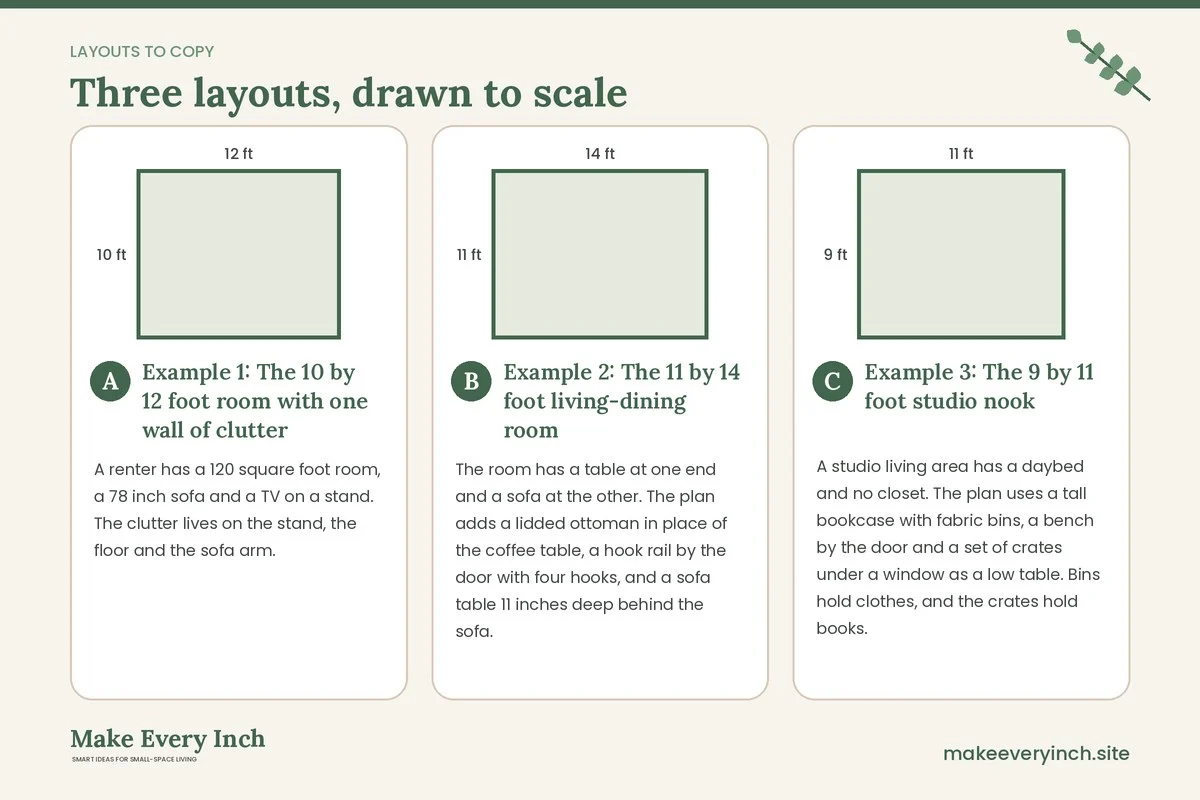
Example 1: The 10 by 12 foot room with one wall of clutter
A renter has a 120 square foot room, a 78 inch sofa and a TV on a stand. The clutter lives on the stand, the floor and the sofa arm. The plan edits the room to five categories, adds a 24 inch wide bookcase, 12 inches deep, beside the window, and puts two flat bins under the sofa. The TV stand is swapped for a secondhand dresser with three drawers. The sofa arm gets a small tray. The new items take about 6 square feet, and the floor is clear for the rug.
Example 2: The 11 by 14 foot living-dining room
The room has a table at one end and a sofa at the other. The plan adds a lidded ottoman in place of the coffee table, a hook rail by the door with four hooks, and a sofa table 11 inches deep behind the sofa. The sofa table holds a lamp, a tray and two baskets on its lower shelf. The dining table holds a cart for mail and school bags that rolls out of the way at dinner. The walkway stays at 34 inches.
Example 3: The 9 by 11 foot studio nook
A studio living area has a daybed and no closet. The plan uses a tall bookcase with fabric bins, a bench by the door and a set of crates under a window as a low table. Bins hold clothes, and the crates hold books. The bench takes shoes, and a rail holds bags. Total spend stays low because every piece is secondhand or DIY. See small apartment living room ideas for studios for layout help.
Where to put the money if you can spend a little more
If you find a bit of room in the budget, spend it in this order.
1. A bookcase that fits the wall exactly, since a fitted piece wastes no space.
2. A hybrid piece such as a lidded ottoman, which you touch every day.
3. Quality hinges, runners and fasteners. A drawer that closes smoothly gets used.
4. Matching baskets or bins, which make a mixed set look intentional.
5. A lamp near the storage, since good light makes it easy to find things and to put them back.
Do not spend extra on decorative boxes that you will not fill, or on a large piece that blocks a walkway.
Make cheap storage look good
Budget storage looks cheap when it is mismatched, overfilled or unlabelled. Three habits fix that. First, pick two finishes and repeat them, such as wood and black metal, or white and natural woven. Second, leave a third of every open shelf empty, so the eye can rest. Third, hide the ugly items behind lids and use the open shelves for the objects you like.
Paint can unify a set of mismatched pieces. A single color on a dresser, a crate and a shelf makes them read as a suite. Changing knobs is a small step that changes the whole look. Fabric liners in the same color make mismatched baskets look alike.
Mistakes to avoid
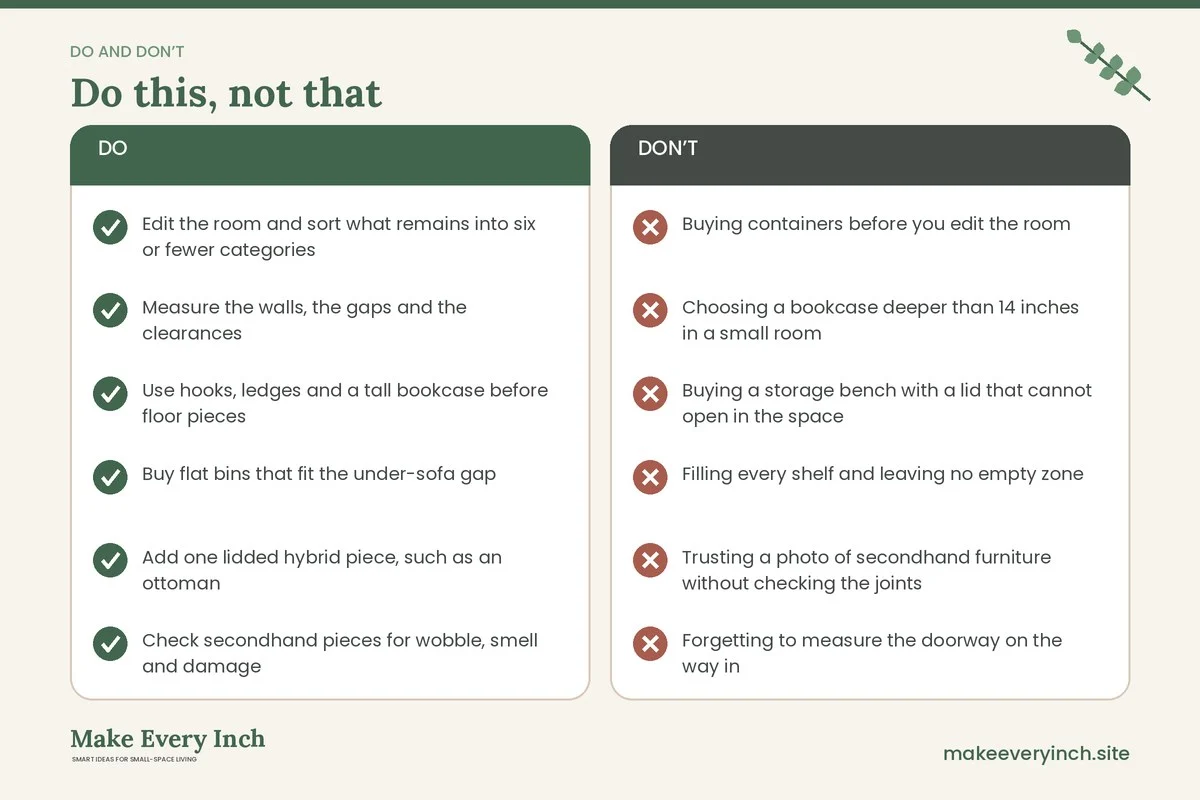
- Buying containers before you edit the room
- Choosing a bookcase deeper than 14 inches in a small room
- Buying a storage bench with a lid that cannot open in the space
- Filling every shelf and leaving no empty zone
- Trusting a photo of secondhand furniture without checking the joints
- Forgetting to measure the doorway on the way in
- Storing heavy items on the top shelf of a tall unit
- Letting a storage piece become a new place to pile things
- Putting a decorative basket on the floor where it blocks a path
Budget storage checklist
- Edit the room and sort what remains into six or fewer categories
- Measure the walls, the gaps and the clearances
- Use hooks, ledges and a tall bookcase before floor pieces
- Buy flat bins that fit the under-sofa gap
- Add one lidded hybrid piece, such as an ottoman
- Check secondhand pieces for wobble, smell and damage
- Label every container
- Leave a third of the open shelves empty
- Keep walkways at 30 to 36 inches
- Review after a week and remove anything that does not earn its spot
FAQ
What is the cheapest way to add storage to a small living room?
Edit first, since removing items costs nothing. Then use hooks, picture ledges and flat bins under the sofa, which cost little and use no floor.
Is secondhand furniture a good way to save money on living room storage?
Yes, if you check it. Measure it, test it for wobble, open the drawers, smell it and look for moisture damage before you pay.
How deep should a bookcase be in a small living room?
Eleven to fourteen inches is enough for books and baskets. A deeper unit takes more floor than a small room can spare.
What is one piece worth spending extra on?
A hybrid piece such as a lidded ottoman or a console with doors, because it replaces two items and gets daily use.
How do I hide clutter without buying a lot?
Use lidded boxes and fabric bins, and keep only a few things on open shelves. Leave a third of each shelf empty, so the display looks calm.
Can I use crates and cubes as storage?
Yes. Sand and seal wooden crates, screw them together if you stack them, and add a top board. Cube units with fabric bins work well as a bench.
How do I keep budget storage from turning into a new pile?
Give each container one job, label it and review the room once a week. Anything that has no home leaves.
What should I buy first?
Buy nothing until you edit. Then buy the piece that solves your biggest category of clutter, and live with it for a week before the next.
Keep going: Keep going with our cheap storage ideas for apartments, small apartment decor under $100 and vertical storage ideas.
Save this guide for later
Pin the ideas you like to Pinterest so you can come back to them when you plan your space.