Small Outdoor Storage Ideas for Apartments: 15 Safe Balcony Fixes
Quick answer: The safest small outdoor storage apartments ideas keep weight low, near the wall and away from the railing: a lidded bench, a slim weatherproof cabinet, stackable bins, over-the-door style hooks on a solid wall surface where allowed, and a rolling cart that tucks away. Check your lease and building rules first, never overload the floor, secure everything against wind and keep items from hanging over the edge.
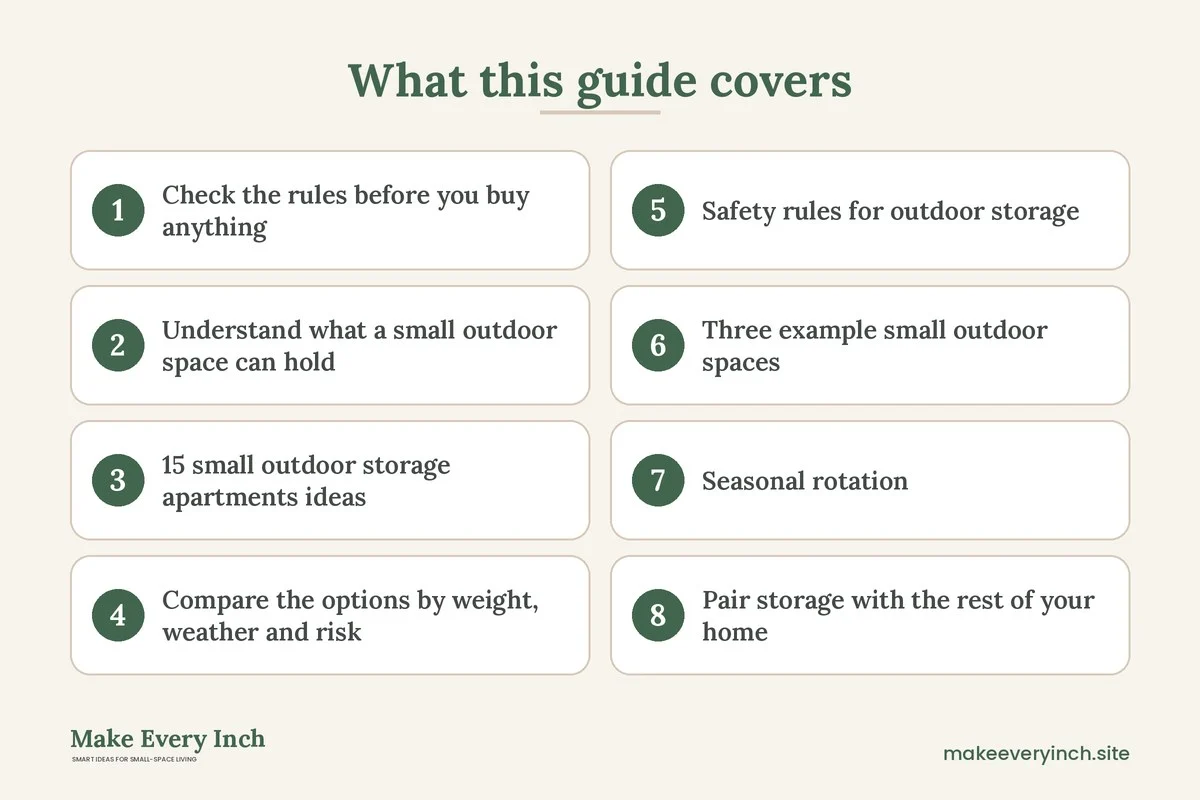
Small outdoor storage apartments planning starts with a harder question than “what looks good”: what is this balcony or patio allowed to hold, and what happens if something falls, tips over or leaks? A balcony is a tiny room with no ceiling, rules from a landlord and neighbours directly below. That is why storage here works differently from storage indoors. This guide covers the lease check, how to measure and zone a small outdoor space, 15 storage ideas sorted by where they sit, a table that compares the options by weight and risk, a full safety section, three example layouts, seasonal rotation, a checklist and a FAQ. For the bigger picture of styling the whole space, see our pillar guide to small balcony ideas, and for the mistakes that turn good storage into clutter, read small balcony mistakes to avoid.
Check the rules before you buy anything
Outdoor storage is the part of balcony planning where a quick question to the landlord saves the most trouble. Read your lease, house rules and any HOA or building guidelines. Look for statements about items on balconies, visible storage, hanging items from railings, fire safety, and what you may keep outside in winter. Some buildings ban anything stored above the height of the railing. Some ban bikes, bins and boxes that can be seen from the street. Others have rules about weight, because a balcony is a structural element and is designed for a limited load.
If the lease is silent, ask in writing and keep the reply. Describe what you plan to add, for example “a low storage bench and a 20 inch wide weatherproof cabinet, both freestanding, no drilling.” Landlords often say yes to freestanding furniture and no to anything fixed. That answer shapes the rest of your plan, which is why most ideas below are freestanding and removable. If you live in a rental, our guide to renter-friendly small balcony ideas goes deeper on lease-safe styling.
Never drill into railings, walls, ceilings, door frames or floors without written permission. Drilling can void waterproofing, damage the structure and cost you a deposit. Where this guide mentions hanging or fixing anything, it means only methods your building allows.
Understand what a small outdoor space can hold
Balconies and patios are not storage rooms. They are exposed to rain, sun, wind, temperature swings and sometimes snow. Anything you keep there has to survive those conditions, and the structure under it has a load limit. A useful rule is to store only things you use outdoors, plus a small amount of seasonal gear that tolerates weather.
Good candidates include cushions in a water-resistant box, a watering can, hand tools, gloves, plant food in sealed containers, a folding chair, a doormat, a dustpan and brush, outdoor lanterns that run on batteries and a few games for the season. Poor candidates include paper, electronics, anything flammable, cleaning chemicals, paint, fuel, fertilizer in open bags, books and clothing. Heat, damp and pests ruin these quickly, and several are hazards.
Zones by height, not by square footage
Think of your outdoor space as three vertical zones instead of a floor plan.
- Low zone, 0 to 18 inches: heavy items, such as a bench with a lid, a storage box or a stack of crates. Weight sits near the floor, where it cannot fall far or tip easily.
- Middle zone, 18 to 48 inches: things you reach for often, such as a slim cabinet, a cart or a narrow shelf against the wall. Keep this zone at least 12 inches back from the railing.
- High zone, above 48 inches: light items only, such as hanging baskets with small plants or a lantern on a freestanding hook, and only when the method is allowed and secure. Nothing heavy belongs here.
This keeps the center of gravity low, which matters in wind, and keeps the sightline open so the space does not feel boxed in.
Measure like a tape-measure detective
Measure the depth and width of the floor, the railing height, the door swing and the clearance you need to walk. A door that opens outward needs its swing clear, or you will pin it against your own storage. Many small balconies are about 3 to 5 feet deep, which leaves only a narrow strip for storage if you want to sit as well. Aim to keep a clear path of about 24 to 30 inches from the door to the main spot you use. Mark each piece’s footprint with painter’s tape on the floor, and stand there for a minute to feel the space. If you cannot comfortably turn around, the piece is too big.
Record two more numbers: the height of the railing and the gap between bars. These matter for safety, as covered later. Measure the slope of the floor too. Most balconies slope slightly away from the door so water drains. Furniture on a slope can rock, so check that every piece sits level and does not block the drainage path.
15 small outdoor storage apartments ideas
On the floor, against the wall
1. A lidded storage bench
A bench with a lid doubles as seating and hides cushions, tools and a watering can. Choose one made of weather-resistant material with drainage or ventilation holes so moisture does not pool inside. Keep the lid light enough to lift easily, and stay aware that a loaded bench can be heavy. Look at the manufacturer’s weight rating for a person plus contents, and compare it with any rule from your building.
2. A slim weatherproof cabinet
A narrow cabinet, around 12 to 20 inches deep, holds tools, gloves and supplies behind doors. Place it against the wall, not near the railing, so people and pets cannot climb it. If the cabinet is tall, it needs protection against tipping in wind. Anchor to a wall only if the building allows it. If not, choose a low cabinet or add weight at the base with the heavier items, and keep the doors closed. Tall furniture is a tip-over hazard outdoors, so lower is safer.
3. A deck box
A deck box is a lidded container that holds cushions and small gear. It sits flat, has a low center of gravity and is easy to move. Pick one with a lid that locks or latches, so wind cannot open it and scatter the contents. A box about 20 inches deep fits many balconies, and it can serve as a plant stand if the surface is sturdy and you do not overload it.
4. Stackable bins or crates
Stackable crates in a weather-resistant material hold shoes for the garden, kids’ outdoor toys or seasonal decor. Stack no more than two high, and place the heavier one at the bottom. A bin with a lid keeps rain and leaves out. These are good for renters because they are freestanding and easy to remove at move-out.
5. A low shoe or boot tray
A shallow tray by the door catches dirt and keeps muddy shoes from entering the home. Choose a tray with raised edges so water does not run onto the floor and drain toward a neighbour. Empty it regularly, because standing water leaves marks and attracts insects.
Under and inside furniture
6. Seating with built-in storage
An outdoor pouf, ottoman or bench with a hollow base stores blankets and cushions. Choose weather-resistant fabric and a base that lets air in, because trapped damp makes mold. Do not store anything flammable under seating, and keep it away from heat sources.
7. A small table with a lower shelf
A bistro table with a lower shelf stores a watering can, a book or a small basket of tools. Check that the shelf is stable, and keep heavier items on it, not on top. Keep the table at least 12 inches back from the railing, so no one climbs it.
8. Folding furniture that stores flat
Folding chairs and a folding table disappear against a wall when not in use. Lean them against the wall or lay them flat, and secure them against wind, for example with a strap around the stack if your building permits a method that does not damage the surface. Folded items are lightweight, and light items blow around, so do not leave them unattended in strong wind.
Vertical and wall-adjacent
9. A freestanding ladder shelf
A leaning shelf with a wide base uses vertical space. Pick a weight-rated unit, place it against a solid wall, keep it at least 12 inches from the railing and fill the lower shelves with heavier items. Because it leans, check its stability by gently pushing it before loading it. Secure planters on it so wind cannot knock them off. A falling pot from a balcony can injure someone below, so only use shelves that are stable and enclosed at the edge.
10. Hooks on a solid surface, where allowed
A hook on a solid wall surface can hold a watering can, a broom or a small bag of gloves. Use only methods permitted by your lease, such as removable adhesive rated for outdoor conditions and for the weight. Outdoor temperature swings weaken adhesive, so keep loads light and check them often. Do not hang heavy items, and never attach anything to the railing without permission. Items hanging from a railing can fall onto people below and can also lead to climbing.
11. A tension pole or freestanding plant stand
A plant stand with several tiers can double as light storage for small tools in a basket. Keep it low, stable and away from the edge. See our guide to small space plants and planters ideas for how to choose pots that stay put.
Smart and seasonal
12. A rolling cart
A cart on locking wheels stores supplies and rolls into a corner or indoors. Lock the wheels whenever it is parked, because a cart can roll on a sloped floor. Keep the cart away from the railing, and keep the load light and low. A cart that can come inside also solves the problem of winter storage.
13. A vacuum-sealed or lidded seasonal tote
Use a lidded tote for off-season cushions, but only if the lid seals and the tote sits off the floor on feet or a pallet-style base, so water cannot soak it. Do not put any item that a pest would enjoy, such as food, in the tote. Label it. Seasonal storage should move indoors when the weather turns, if you have the space.
14. A shared building storage unit
If your building offers a storage cage, bike room or shared locker, use it for bulky seasonal items. Moving big gear off the balcony is the most effective way to keep the space safe and calm. Ask the building manager about rules and costs, and see our guide to small space organization ideas for ways to decide what deserves space.
15. A one-in, one-out rule
The best storage idea is a limit. Allow yourself one bench, one box or one cabinet and decide that the balcony holds only what fits. A limit prevents the slow creep that makes a balcony look like a storage closet and puts more weight on the structure.
Compare the options by weight, weather and risk
Use this table to choose. The ratings are general guidance, not a promise. Always check the manufacturer’s information and your building rules.
| Option | Weight when loaded | Weather needs | Main risk | Best for |
|---|---|---|---|---|
| Lidded bench | Medium to heavy | Drainage holes, UV resistant | Overloading the floor | Cushions, tools |
| Slim cabinet | Medium | Sealed doors, ventilation | Tipping in wind | Tools, supplies |
| Deck box | Medium | Latching lid, drainage | Moisture inside | Cushions, toys |
| Stackable bins | Light to medium | Lidded, UV resistant | Blowing over | Small gear |
| Ladder shelf | Medium | Stable base | Falling pots, tipping | Plants, light tools |
| Rolling cart | Light to medium | Locking wheels | Rolling on a slope | Supplies, serving |
| Folding furniture | Light | None, stored flat | Blowing away | Chairs, tables |
| Wall hooks | Very light | Outdoor-rated adhesive | Falling items | Watering can, broom |
| Building storage | Not on balcony | Depends on building | Rules and access | Bulky seasonal gear |

Safety rules for outdoor storage
This is the section that matters most. A few minutes of care prevents injuries, water damage and fines.
Weight limits and the structure
Balconies and decks have a maximum load. You may not see the number, and it is not something to guess. Ask the building manager or check the building documents. Water-filled planters, wet soil, stacked bins and a person all add up, and a loaded storage bench full of heavy items can weigh much more than it looks. Spread weight across the floor, keep heavy items near the wall where the structure is usually stronger, and avoid putting concentrated loads at the edge. If the balcony shows cracks, sagging, rust, flaking concrete or loose railings, stop adding weight and report it to the landlord.
Railings, children and pets
Railings are a safety barrier, and anything you place near them can turn them into a ladder. Keep benches, boxes, cabinets, chairs and tables at least 12 to 18 inches away from the railing, and farther if children or climbing pets live with you. Horizontal bars on a railing can act as steps for a child. Large gaps can let a small child or pet slip through. Do not hang storage from the railing, and do not store items on top of it. Never leave children or pets unsupervised on a balcony, and think about whether a pet-safe barrier is permitted by your building. If you are unsure, ask the landlord about what is acceptable.
Wind and tip-over
Wind accelerates between buildings and at height. Light chairs, empty planters, umbrellas, bins with lids and cardboard boxes can blow or fall. Keep the center of gravity low, put heavy items at the bottom, use closed storage with latches, and bring light furniture indoors in storms. If a tall unit can tip, choose a lower one or anchor it only where permitted. In winter, snow and ice add weight and make surfaces slippery, so clear access paths and keep storage from blocking drainage.
Falling objects
A pot, tool or box falling from a balcony can hurt someone and damage property below. Keep everything inside the line of the railing, with nothing hanging over the edge. Secure planters on shelves with a lip or a non-slip base. Store hand tools in closed containers, not on open shelves at the edge. Look at the space as if every item could be knocked by the wind or a pet, then ask where it would land.
Fire, grills and flame
Many leases, building rules and local fire codes prohibit grills, fire pits, patio heaters and open flame on balconies. Do not assume yours is allowed. Check before you store charcoal, lighter fluid, gas canisters or anything flammable. Never keep fuel, aerosols, paint thinner or similar items on a balcony, because heat from the sun and a stray spark can cause a fire. Keep storage clear of any exit path, because a blocked balcony door is a hazard in an emergency.
Candles, lights and electrical safety
Use only outdoor-rated string lights, extension cords and plugs, and plug them into a socket protected by a ground-fault circuit interrupter (GFCI) where available. Do not overload sockets or daisy-chain cords. Keep cords out of walkways and away from standing water, and do not run them through a door gap that could crush them. Choose battery-powered or solar candles instead of real flame, especially near cushions, fabric and dry plants. If you are not sure about an outdoor outlet, ask the landlord or a qualified electrician.
Drainage and water damage
Balconies drain through floor slopes and drains. If storage blocks the drain, water can pool, leak onto neighbours below, and rot materials. Keep drains clear, and lift storage on feet so water flows under it. Do not hose down the floor in a way that sends water over the edge. Empty trays and saucers, and shake out wet covers before you store them. Lidded boxes should drain, not hold, water.
Plants, toxicity and heat
Some common ornamental plants are toxic to pets and children if chewed or swallowed. Before you add plants to a shelf or planter, check each one with a veterinary or poison-control source. Sun heats metal, dark plastic and stone, which can burn skin and bare paws, so choose light colors and avoid placing hot surfaces in reach of children or pets. Soil and fertilizer should live in sealed containers.
Permission and no-drill rules
Get permission before you attach, drill or anchor anything to a railing, wall, ceiling or floor. Use freestanding items first. Document the state of the balcony with photos before you start. If you must change something, ask in writing and ask what repair standard the landlord expects at move-out.
Three example small outdoor spaces
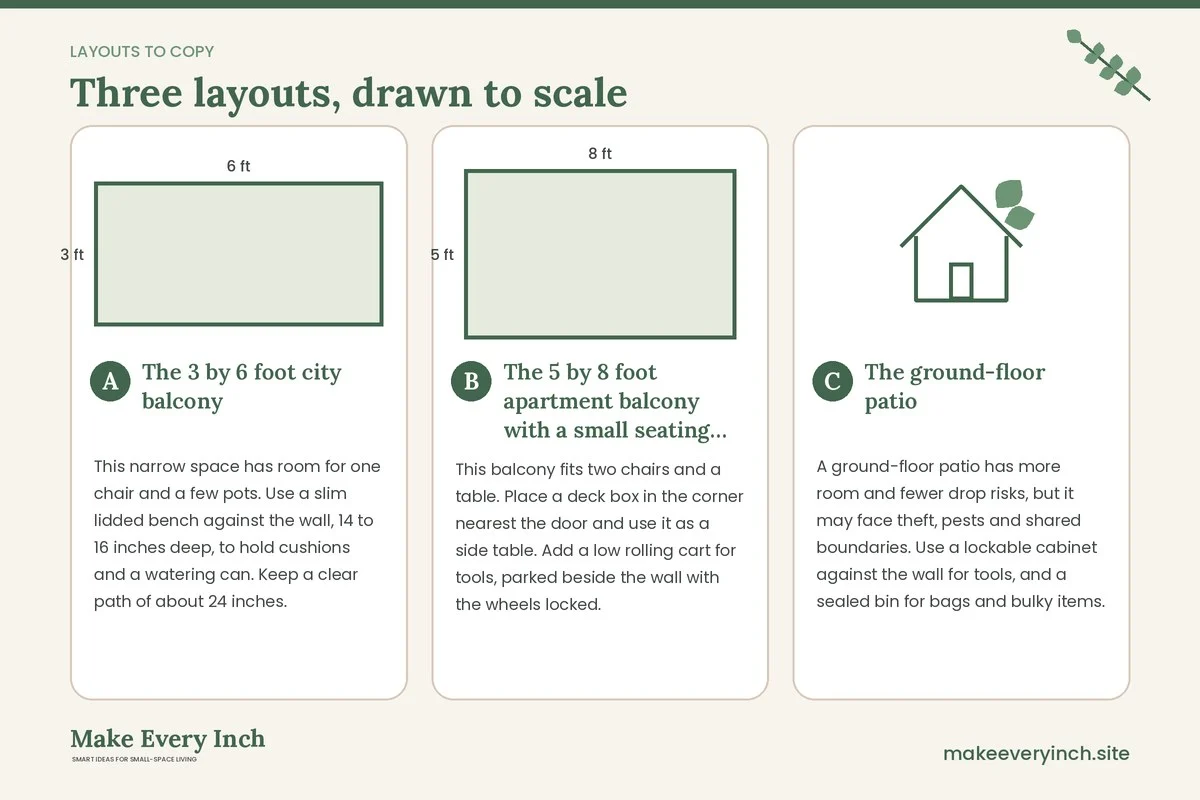
The 3 by 6 foot city balcony
This narrow space has room for one chair and a few pots. Use a slim lidded bench against the wall, 14 to 16 inches deep, to hold cushions and a watering can. Keep a clear path of about 24 inches. Add a small folding table that goes inside when not in use. Skip tall shelves, because a narrow space with tall furniture feels like a hallway. Keep plant pots low and secure. The only storage that needs to be visible is the bench, and everything else goes inside.
The 5 by 8 foot apartment balcony with a small seating area
This balcony fits two chairs and a table. Place a deck box in the corner nearest the door and use it as a side table. Add a low rolling cart for tools, parked beside the wall with the wheels locked. Keep both pieces at least 12 inches from the railing. Put cushions in the box in bad weather. Keep the center open for chairs. A small ladder shelf could hold plants but only if the base is wide and the wall is solid.
The ground-floor patio
A ground-floor patio has more room and fewer drop risks, but it may face theft, pests and shared boundaries. Use a lockable cabinet against the wall for tools, and a sealed bin for bags and bulky items. Keep the storage off the ground on feet so air flows. Leave an exit path to a gate or door. Check that the storage does not block drainage or shared access, and follow the rules for fences and shared walls.
Seasonal rotation: what lives outside and when
Treat outdoor storage as a seasonal system. In spring, bring out cushions, lanterns and tools and check each for damage. In summer, keep sun-sensitive items in the box and store only what you use. In autumn, clean and dry everything before it goes into storage, and watch for leaves blocking drains. In winter, bring cushions, soft goods and anything that cracks in the cold inside, and consider covering furniture with breathable covers. A cover that traps moisture invites mold, and a cover that blows loose becomes litter. Secure it according to what your building allows.
Clean items before storing. Dirty cushions attract insects and mold. Shake out soil from tools and hang them dry. Wipe the inside of boxes at the start of each season. This is a good time to apply the one-in, one-out rule: if something has not been used all season, move it out of the space.
Pair storage with the rest of your home
Outdoor storage works better when your indoor storage is organized, because it lets you keep outdoor storage small. If your entry has a spot for gardening gloves and a watering can, you will not need a cabinet outside. For help making those inside homes, see our guides to no-drill storage ideas for renters, vertical storage ideas and hidden storage ideas. For furniture that stores things for you indoors and out, see small space storage furniture and best storage ottomans. If you are furnishing a whole apartment on a limit, our guide to budget small space ideas shows how to prioritize.
Balconies often sit beside the living room or dining area, and the two spaces feel bigger when they work together. Repeat a color, a material or a plant between inside and out, and keep the doorway clear. For ideas on the indoor side, see small living room ideas and small dining room ideas.
A checklist before you buy or build
- Read the lease, house rules and any HOA or building guidelines.
- Ask in writing about weight limits, visible storage and anything fixed or drilled.
- Measure the floor, door swing, railing height and bar gaps.
- Mark each piece’s footprint with painter’s tape.
- Keep a clear path of about 24 to 30 inches.
- Choose freestanding, weather-resistant, low and stable pieces.
- Keep all furniture at least 12 to 18 inches from the railing.
- Place heavy items low and near the wall.
- Keep nothing hanging from or sitting on the railing.
- Check that wheels lock and lids latch.
- Keep drains clear and lift storage on feet.
- Use outdoor-rated, GFCI-protected electrical items and no overloaded sockets.
- Skip grills, open flame and fuel unless explicitly permitted.
- Check plants for toxicity to pets and children.
- Photograph the space before and after.
- Review and reduce the contents every season.
FAQ
How much can my balcony hold?
There is no single answer. Balconies are designed for a limited load, and the number depends on the construction. Ask your landlord or building manager and follow what they say. When in doubt, keep storage light and avoid concentrated heavy loads.
Can I keep a grill or fuel on my balcony?
Many leases and local codes prohibit grills, fuel and open flame on balconies. Check with your landlord and local fire rules before you buy or store anything of this kind. Battery or solar lanterns are a safer way to get ambience.
What should I never store outside?
Avoid paper, electronics, food, paint, chemicals, fuel, aerosols and anything flammable or easily damaged by damp. Keep these indoors or in a proper storage unit.
How do I stop storage from blowing around?
Keep it low, use items with weight at the base, choose lidded boxes with latches and bring light items inside before storms. Use anchoring only where permitted.
Is it safe to put storage next to the railing?
Keep it away. Storage next to a railing can become a step for children or climbing pets. Keep at least 12 to 18 inches clear, and more if needed.
Can I hang storage from my railing?
Only if your building allows it, and even then be careful. Items hanging from a railing can fall onto people below. Many buildings prohibit it. Freestanding storage is the safer choice.
How do I prevent water damage to the neighbour below?
Keep drains clear, lift storage on feet, avoid overwatering, empty saucers and do not hose water over the edge. Report any leaks or cracks to your landlord.
What if I have no room for any storage?
Use the building’s storage area, keep gear indoors, or limit yourself to a single folding chair. A small clear balcony is better than a crowded one.
Keep going: Keep planning with our pillar guide to small balcony ideas, the list of small balcony mistakes to avoid and our renter-friendly small balcony ideas.
Save this guide for later
Pin the ideas you like to Pinterest so you can come back to them when you plan your space.