15 Small Living Room Lighting Ideas IKEA-Style Shoppers Can Copy
Quick answer: The best small living room lighting ideas IKEA-style shoppers can use rely on three flat-pack-friendly lamp types: an arc or slim floor lamp, a pair of compact table lamps, and a clip or wall-plug light for shelves. Add a smart bulb or two for warm-to-cool control, aim for roughly 1,500 to 3,000 total lumens in a small room, keep shades 40 to 48 inches off the floor at eye level when seated, and never exceed the wattage printed on the lamp socket.
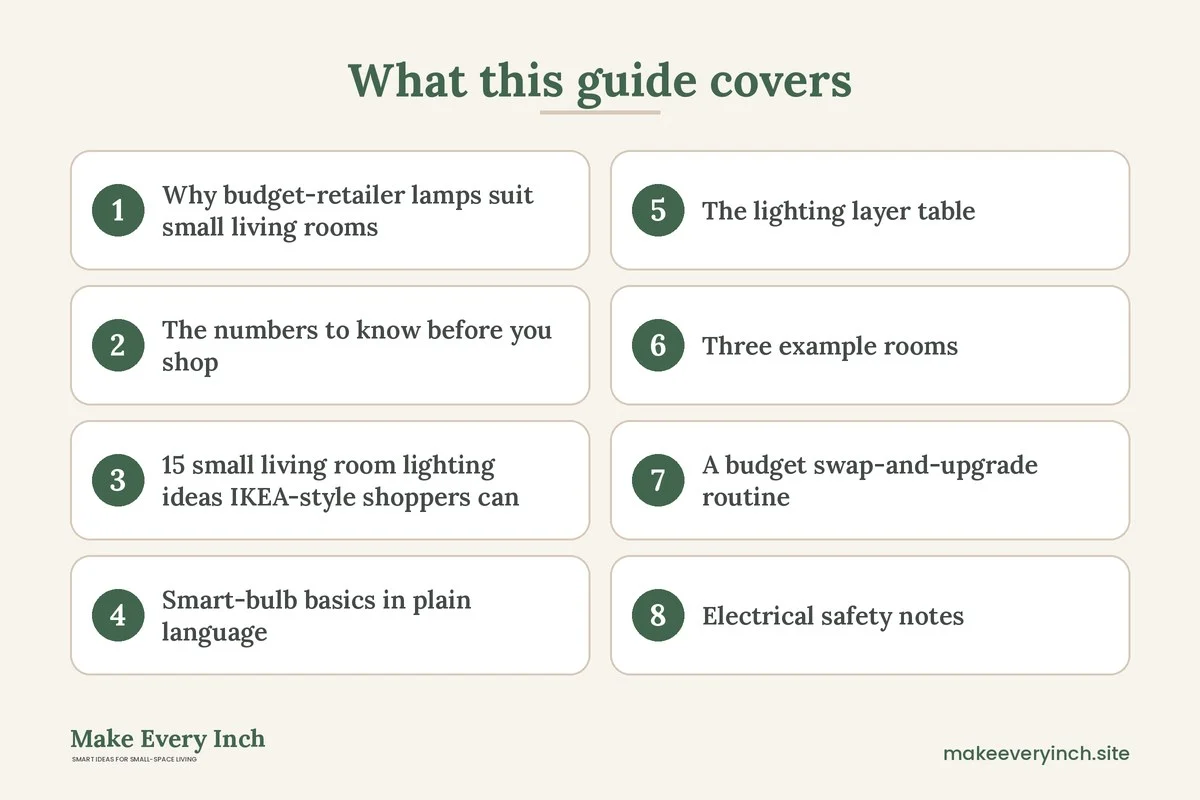
Small living room lighting ideas IKEA fans search for usually come down to one question: how do you get a layered, comfortable glow from the kind of simple, flat-pack-friendly lamps that big budget home retailers sell? The answer is that you do not need special fixtures. You need the right lamp shapes in the right spots, bulbs with the right brightness and color, and a plan for cords and switches. This guide covers generic budget-retailer lamp styles, smart-bulb basics, measurements for heights and distances, a layer table, three example rooms, a swap-and-upgrade routine, electrical safety notes and a checklist. For the full overview, start with our main guide to small living room lighting ideas, then pair it with the broader small living room ideas pillar and our walkthrough of budget flat-pack small space ideas.
We deliberately avoid product names and prices here. Ranges, catalogs and stock change from season to season, so this post teaches you to recognize a good lamp shape and a good bulb on any shelf, in any store or online listing. If a lamp you find matches the descriptions below, it will do the job.
Why budget-retailer lamps suit small living rooms
Budget-retailer lighting tends to share a few traits that happen to suit small rooms. The lamps are lightweight, so you can move them while you rearrange. They are slim, so they take little floor space. They often use a standard screw-in socket, so you can choose the bulb yourself instead of being locked into a built-in light source. And they come in simple shapes, such as a drum shade, a paper globe, an arc, a cone or a rod, which blend into most styles.
There are downsides too. Thin shades can glare if the bulb is too bright. Lightweight bases can tip if someone bumps them. Cords are often short, which pushes you toward outlets you may not want to use. Knowing these weak points in advance lets you shop smart and fix them with small tweaks, such as a heavier base, a cord clip or a lower-lumen bulb. The rest of this guide shows you how.
The numbers to know before you shop
Lighting advice often sounds vague, so start with a few measurable targets. These are hedged ranges, not strict rules, and your room, ceiling height and wall color will shift them.
- Total light for the room: many designers suggest roughly 10 to 20 lumens per square foot in a living room. A 10 by 12 foot room is 120 square feet, so about 1,200 to 2,400 lumens in total, spread across several sources. Dark walls or north-facing windows push you toward the top of the range.
- Per lamp: a reading lamp commonly needs 400 to 800 lumens. An ambient table lamp can sit at 200 to 450 lumens. An accent light on a shelf or plant can be as low as 50 to 150 lumens.
- Color temperature: 2200 to 2700 kelvin reads as warm and cozy for evenings. 3000 kelvin is a soft neutral. 4000 kelvin and above feels bright and clinical, which is fine for a desk but cold for a sofa.
- Table lamp height: the bottom of the shade should sit at about eye level when you are seated, which is roughly 38 to 44 inches from the floor. A common total lamp height is 24 to 30 inches on a side table that is 20 to 26 inches tall.
- Floor lamp height: 58 to 66 inches for a straight floor lamp. For an arc lamp, the shade should hang about 18 to 24 inches above the seat cushion, and the base should sit within 12 to 24 inches of the sofa arm.
- Distance to the seat: a reading light should sit roughly 24 to 36 inches from the book, shining over the shoulder from the side or behind.
- Wall washing: a light placed 6 to 12 inches from a wall brightens it and makes the room feel wider. Closer than 4 inches creates harsh scallops.
- Cord reach: measure from the lamp spot to the outlet and add 12 inches. Many budget lamps ship with cords of about 5 to 6 feet, so check before you fall in love with a position.
15 small living room lighting ideas IKEA-style shoppers can copy
Floor lamp shapes that save space
1. A slim rod floor lamp in the corner
A straight, thin floor lamp with a small drum or cone shade takes about 10 to 12 inches of floor. Tuck it into the dead corner beside the sofa or behind the door. Use a bulb of about 450 to 800 lumens, and aim the shade up and out so it washes the ceiling corner. This one lamp often does the work of two table lamps in a narrow room. See our guide to the best floor lamps for small rooms for shapes worth looking at.
2. An arc lamp over the sofa end
An arc lamp reaches over the seat without needing a side table. The base sits behind or beside the sofa, and the shade hangs about 18 to 24 inches above the cushion. Make sure the base is heavy enough, or add a flat weight under the sofa leg to anchor it. Arc lamps are the best budget answer for rooms where a side table would block the walkway.
3. A tripod floor lamp for a layered look
A tripod lamp has three splayed legs and a fabric shade, and it fills an empty corner visually. The footprint is wider, so reserve about 18 to 22 inches. Keep the legs out of the walking line, because they trip people more easily than a single pole.
4. A torchiere that bounces light off the ceiling
An uplight points the bulb upward and fills the ceiling with soft light. It suits rooms with ceilings 8 feet or lower, because the bounce spreads gently. Do not use a bulb above the wattage printed on the socket label, and keep any shade or cloth at least a few inches from the bulb.
Table lamps in tight spots
5. A pair of compact table lamps on narrow side tables
Two lamps with 8 to 10 inch shades on 12 to 14 inch tables give the sofa a balanced frame. Choose shades in a light, translucent fabric or paper so the glow stays soft. Warm 2700 kelvin bulbs of 300 to 450 lumens each work well.
6. A single small lamp on a console
A 20 to 24 inch lamp on a console behind the sofa lights the back of the room and makes it feel deeper. Place the lamp near one end, not the middle, to leave space for keys and a tray.
7. A lamp on a shelf or a bookcase top
A short lamp, 14 to 18 inches tall, on a shelf brings light to eye height without using floor space. Use a bulb of 100 to 300 lumens so the shelf does not glare.
8. A paper globe pendant lamp swapped for a plain shade
If the existing ceiling light is a bare bulb or a harsh fixture, a lightweight paper or fabric globe shade can soften it. Many are hung by clipping to the existing socket and cord, and you do not need to rewire. Pick a size around 14 to 18 inches for a small room. If you want a new ceiling fixture wired in, hire a licensed electrician.
Plug-in and no-drill lights
9. A clip-on spotlight on a bookcase
A clip light that grips the edge of a shelf or headboard directs a narrow beam to a page or a picture. It uses a small bulb of 200 to 400 lumens and takes no floor space. Tidy its cord down the back of the shelf with removable clips.
10. A plug-in wall sconce with a cord cover
Plug-in sconces mount on two screws or adhesive hooks and use a cord to reach the outlet. Hide the cord in a paintable cord channel that runs down the wall. For renters, our post on renter-friendly lighting ideas explains the no-drill options in depth.
11. LED strip lights under a shelf or behind the TV
A strip of LED tape under a shelf lights the counter or the media unit. Behind the TV, it eases the contrast of a bright screen in a dark room. Look for strips that list a color temperature of 2700 to 3000 kelvin, and run them from a power supply with a built-in safety mark, never from a bare adapter you cannot identify.
12. A battery puck light for a dark nook
Small stick-on puck lights run on batteries and light a bookcase, a niche or the inside of a cabinet. They are not for reading, but they add glow with no cord at all.
Smart bulbs and control
13. A smart bulb in the main lamp
A smart bulb lets you dim and change warmth from a phone or a voice assistant, and you can set a schedule so the room warms at sunset. Basic models connect over Wi-Fi, Bluetooth or a hub protocol. Check whether a bulb needs a separate hub, and whether the lamp’s shade, which can trap heat, is rated for it. Choose a bulb with a base that fits the socket, usually a standard screw-in type, and stay under the maximum wattage on the lamp.
14. A smart plug for a lamp that does not dim
A smart plug turns any ordinary lamp on and off by schedule or voice. It does not dim, but it gives you a single tap to switch all the lamps on. Check the plug’s rated load, which is printed on it, and plug in only the lamp, not a heater or a second power strip.
15. A dimmer switch or inline dimmer for warm evening light
A cord dimmer clips onto the lamp cord and dials the brightness. Use only a dimmer that is compatible with the bulb, since many LED bulbs are not dimmable. If you want a wall dimmer to replace a switch, hire a licensed electrician.
Smart-bulb basics in plain language
Smart bulbs look complicated, but only a few choices matter for a small living room.
- Connection type: some bulbs connect directly to your Wi-Fi, some use Bluetooth with a phone, and some need a small hub plugged into the router. Direct and Bluetooth bulbs are simpler. A hub suits a larger set of lights.
- White range vs color: tunable white bulbs shift between warm and cool white. Color bulbs add the whole spectrum. For a living room, tunable white is usually enough, because it covers a reading mode and a relaxing mode.
- Lumens and dimming: check the box for lumens, and that the bulb dims smoothly down to a low level, which is key for movie night.
- Wall switch problem: if someone turns off the wall switch, the smart bulb loses power and cannot be controlled. Put a small label by the switch, or use a lamp with its own switch and leave the wall switch on.
- Shade and heat: check that the bulb is rated for enclosed fixtures if you use it inside a closed globe.
- Network habits: keep the bulb firmware updated and use a strong, unique Wi-Fi password for the home network. If you are unsure about any app permissions, read them before accepting.
- Backup: always keep one plain bulb in a drawer, in case the app or network fails.
The lighting layer table
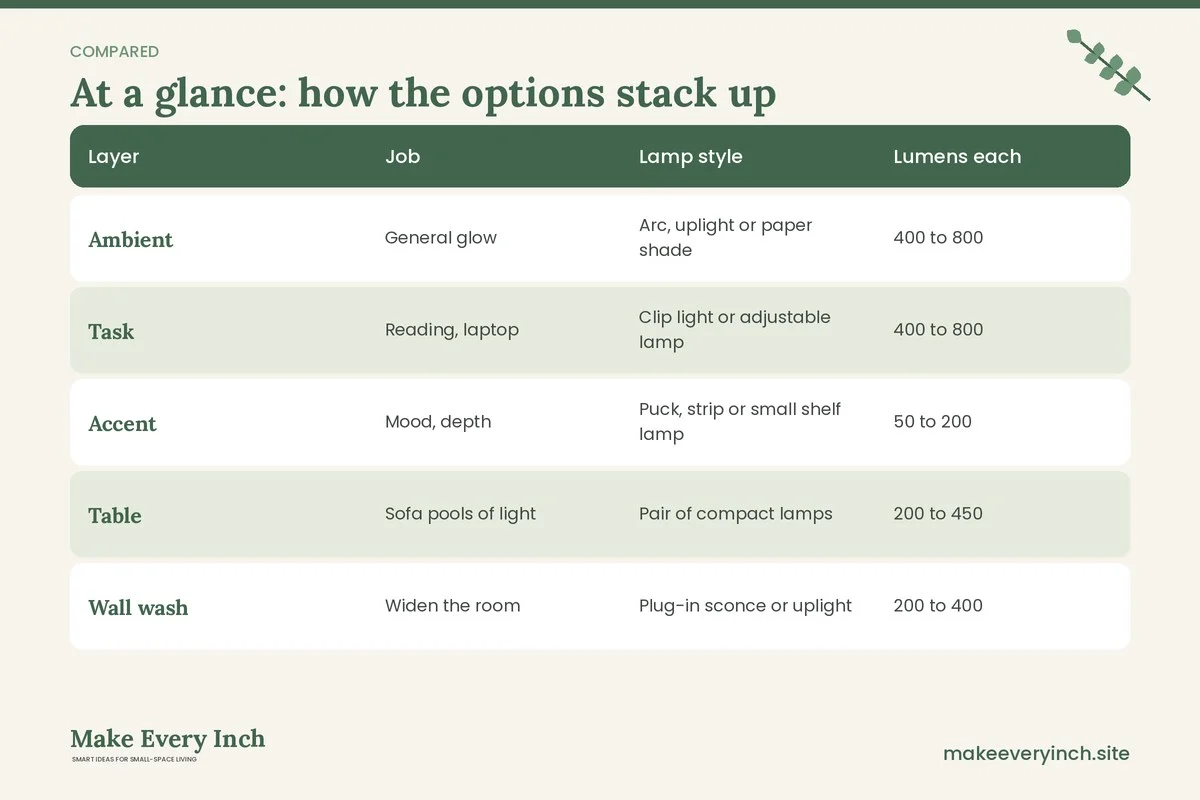
Good lighting stacks three types of light, and a small room needs all three at modest power. Use this table to see where budget-style lamps fit.
| Layer | Job | Lamp style | Lumens each | Height or position |
|---|---|---|---|---|
| Ambient | General glow | Arc, uplight or paper shade | 400 to 800 | Shade 58 to 66 inches high, or ceiling |
| Task | Reading, laptop | Clip light or adjustable lamp | 400 to 800 | 24 to 36 inches from the page |
| Accent | Mood, depth | Puck, strip or small shelf lamp | 50 to 200 | At shelf or floor level |
| Table | Sofa pools of light | Pair of compact lamps | 200 to 450 | Shade bottom at 38 to 44 inches |
| Wall wash | Widen the room | Plug-in sconce or uplight | 200 to 400 | 6 to 12 inches from the wall |
Aim for at least three light sources at different heights. A single overhead fixture flattens a room, while lights at the floor, table and shelf levels create depth and make the space feel larger.
Three example rooms
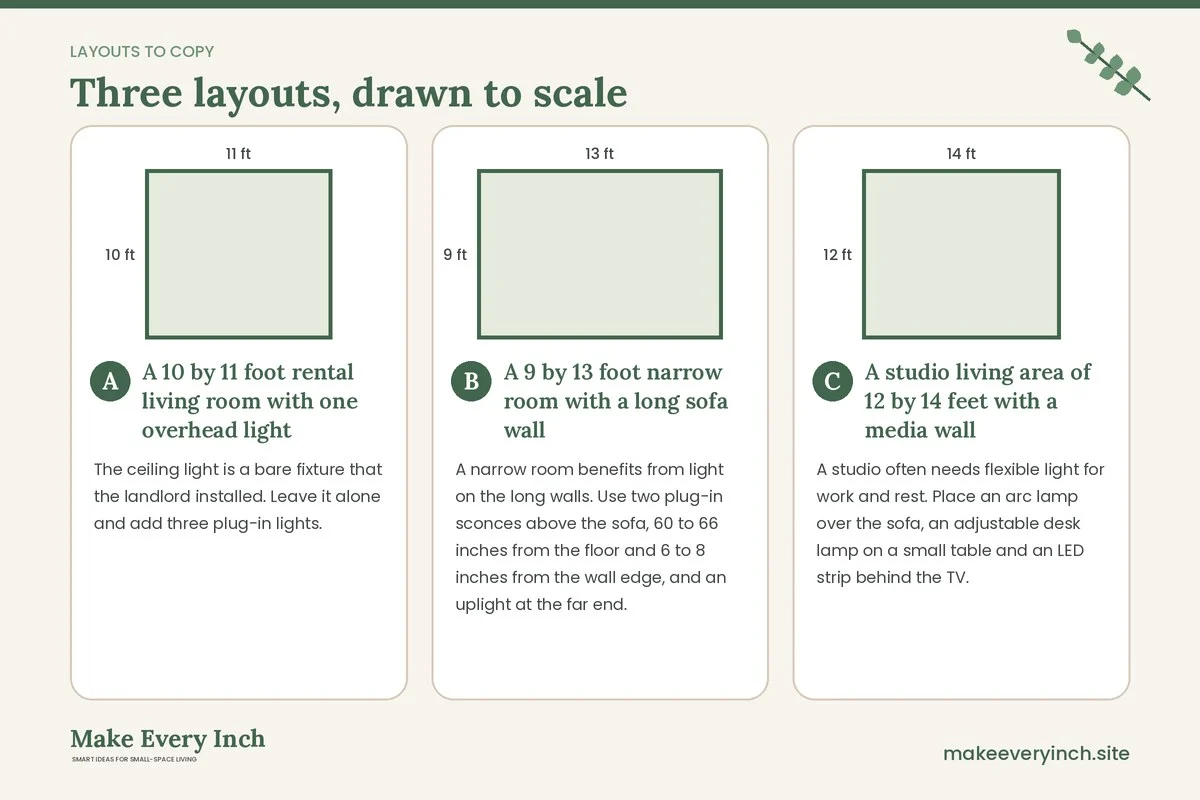
A 10 by 11 foot rental living room with one overhead light
The ceiling light is a bare fixture that the landlord installed. Leave it alone and add three plug-in lights. Put a slim floor lamp in the corner beside the sofa, a compact table lamp on the side table at the other end and a clip light on a bookcase. Use 2700 kelvin bulbs in the lamps, around 450 lumens for the floor lamp and 300 for the table lamp. Run the cords along the baseboard with removable clips. The overhead stays off most evenings, and the three lamps give about 1,000 to 1,300 lumens, which sits at the low end of the comfortable range. Add a fourth, such as a shelf puck, if the room feels dim.
A 9 by 13 foot narrow room with a long sofa wall
A narrow room benefits from light on the long walls. Use two plug-in sconces above the sofa, 60 to 66 inches from the floor and 6 to 8 inches from the wall edge, and an uplight at the far end. Choose bulbs of about 250 to 350 lumens each for the sconces. The light on the walls lifts the room’s width, and the uplight brightens the end that is farthest from the window. See also our guide to narrow living room ideas.
A studio living area of 12 by 14 feet with a media wall
A studio often needs flexible light for work and rest. Place an arc lamp over the sofa, an adjustable desk lamp on a small table and an LED strip behind the TV. Add a smart bulb in the arc lamp for a bright setting in the daytime and a warm one at night. A plug-in timer on the strip turns it off at bedtime. For more media wall options, see our small living room TV wall ideas.
A budget swap-and-upgrade routine
Lighting is one of the easiest areas to improve in stages. You can work through this routine over a few weeks.
- Week one, swap the bulbs. Replace any cool white bulbs with 2700 kelvin ones and record the lumens. This alone often changes the mood of the room.
- Week two, move the lamps. Try each lamp at a new height and angle. Lift a low lamp onto a stack of books, a shelf or a small table to test whether eye level is better.
- Week three, add one layer. If the room lacks task light, add a clip lamp. If it lacks depth, add a shelf light or an uplight.
- Week four, automate. Add a smart plug or a smart bulb to your most used lamp and set a sunset schedule.
- Month two, review. Notice dark spots and glare. Adjust shades and bulbs before you buy more lamps.
Shopping second-hand is another budget route. Check any used lamp for a cracked cord, a loose socket or a missing plug prong before you use it, and replace the cord if it is brittle. If you are not sure how to rewire a lamp, take it to a professional.
Electrical safety notes
Cheap or old, every lamp deserves the same safety checks. These notes are general guidance, and local codes and your lease may add more rules.
- Respect the wattage limit. Every socket has a maximum wattage printed near it. Never use a bulb above that number. LED bulbs list both a low actual wattage and an equivalent number, so check the actual wattage on the box.
- Check the cord. A cord should be intact, with no fraying, cracked insulation or bare wire. Replace damaged cords before use.
- Do not run cords under rugs. Heat can build up and the cord can wear through. Do not staple through a cord or pinch it behind a door or furniture leg.
- Never overload an outlet. Plugging many lamps and devices into one outlet through adapters is risky. Use a power strip with a built-in surge and overload protection, keep it uncovered and do not chain one strip to another.
- Keep fabric away from bulbs. Shades should clear the bulb by a few inches, and a lamp should not stand where a curtain touches the shade.
- Use the right bulb type. Check whether a bulb is rated for enclosed fixtures, for dimmers and for the lamp’s socket size.
- LED strips need a proper supply. Use the power supply that came with the strip, and do not exceed its rated length or load.
- Hardwiring is for professionals. Installing a new ceiling fixture, a hardwired sconce, a wall dimmer or a new circuit should be done by a licensed electrician. Do not attempt to replace a wall switch or rewire a socket yourself unless you are qualified.
- Smoke and carbon monoxide alarms stay clear. Do not hang lamps or decorative lights over or against alarms.
Common mistakes
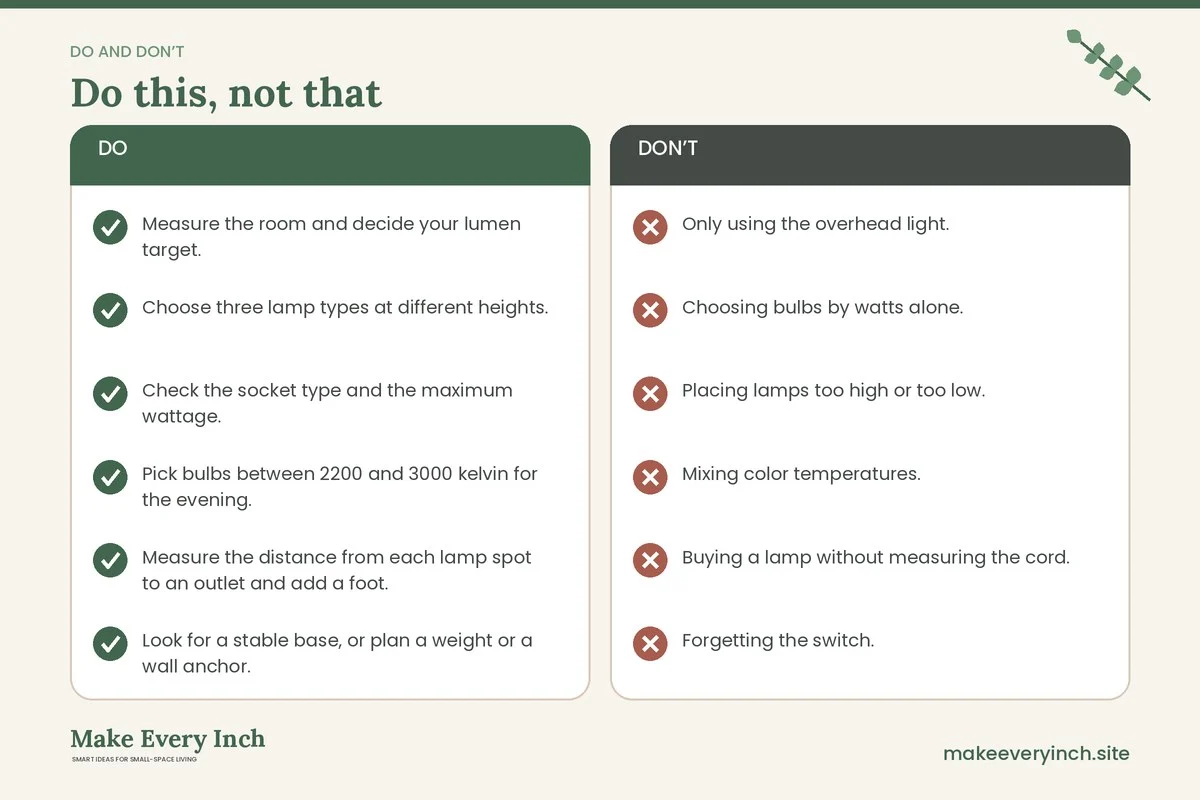
- Only using the overhead light. A single fixture casts shadows and flattens a small room. Add lamps at two other heights.
- Choosing bulbs by watts alone. With LEDs, lumens and kelvin matter more. Check both.
- Placing lamps too high or too low. A shade that sits above your eyes causes glare, and one that sits too low lights only the table.
- Mixing color temperatures. A cool lamp beside a warm one looks patchy. Keep all bulbs in the room within a narrow band, such as 2700 to 3000 kelvin.
- Buying a lamp without measuring the cord. A lamp that cannot reach the outlet ends up with an extension cord across the floor.
- Forgetting the switch. A lamp that is awkward to turn on gets left off. Place it where you can reach the switch, or use a smart plug.
- Overcrowding the side table. A big lamp leaves no space for a mug. Use a smaller lamp, a wall light or a floor lamp.
- Ignoring daylight. Lighting at night is only half the story. Pull curtains back, and keep furniture from blocking the window, so the room needs less light in the day. For help with the bigger picture, read our small living room layout ideas.
A shopping checklist for lamps and bulbs
- Measure the room and decide your lumen target.
- Choose three lamp types at different heights.
- Check the socket type and the maximum wattage.
- Pick bulbs between 2200 and 3000 kelvin for the evening.
- Measure the distance from each lamp spot to an outlet and add a foot.
- Look for a stable base, or plan a weight or a wall anchor.
- Check shades for a translucent, light fabric or paper finish.
- Choose dimmable bulbs if you want a dimmer.
- Decide whether you want smart bulbs or smart plugs, and confirm the connection type.
- Plan cord routes along baseboards with removable clips.
- Buy a power strip with overload protection if you need one.
- Keep one spare plain bulb in a drawer.
FAQ
What lamps work best in a small living room?
A slim floor lamp, a pair of compact table lamps and one clip or plug-in light usually cover ambient, table and task light without using much floor space.
How many lumens does a small living room need?
Many guides suggest about 10 to 20 lumens per square foot, which is roughly 1,200 to 2,400 lumens in a 120 square foot room. Spread the light across several lamps, and adjust to your wall color and daylight.
What color temperature should I choose?
Choose 2200 to 2700 kelvin for a cozy evening, or up to 3000 kelvin if you want a soft neutral. Keep all bulbs in the room close to the same number.
Do I need smart bulbs?
No. They add convenience, such as dimming, schedules and color tuning, but good bulbs and well-placed lamps matter more. A smart plug or a cord dimmer is a lower-effort option.
Can I use a lamp with a short cord?
Only if the outlet is within reach. Avoid stretching a cord across a walkway, and avoid long chains of extension cords. Choose a lamp with a longer cord, or move the lamp closer to the wall.
Can I install a ceiling light myself?
Swapping a shade or a bulb is fine. Installing or replacing a hardwired fixture, a wall switch or a dimmer is work for a licensed electrician.
How do I make a small room look bigger with light?
Use light on the walls, with uplights and sconces, keep bulbs warm and consistent and avoid a single bright spot in the middle of the ceiling.
Keep going: Keep going with our small living room lighting ideas, the small living room ideas pillar and renter-friendly lighting ideas.
Save this guide for later
Pin the ideas you like to Pinterest so you can come back to them when you plan your space.