Make a Rental Feel Like Home Without Renovating: A 4-Week Plan
Quick answer: To make a rental like home without renovating, work in four weeks instead of one big weekend. Week one makes the place livable (light, bed, a clear entry). Week two adds personal objects and soft layers. Week three fixes sound, scent and storage. Week four sets rituals and a small final project. Check the lease before you change anything permanent, and keep every change reversible.
Making a rental like home without renovating is less about decor and more about familiarity. A home is a place where your hands know where things are, where the light is kind at the hours you are there, and where the objects around you tell you who you are. None of that needs a new floor or a painted wall. It needs a plan that lets you settle in a sensible order, so you are not living out of boxes for six months or buying everything in a panic during the first weekend. This guide gives a four-week plan with measurements, routines, a table comparing reversible methods, three example homes and a checklist. For the wider picture, read our hub guide on renter-friendly apartment decorating ideas, and keep the lease in mind at every step.
Why a rental feels temporary, and what actually fixes it
A rental feels temporary for reasons that are easy to name. The walls are bare and uniform. The lighting is a single harsh fixture. The furniture does not fit the room, because it was bought for a different one. Your belongings are still partly packed. Most important, you have not yet formed habits in the space, such as a spot for keys, a chair for the morning, a place for the evening reading lamp. People often respond by trying to fix everything at once, then give up when the budget or the energy runs out.
Feeling at home has four ingredients that you can build without a drill or a paintbrush:
- Familiarity: objects, textiles and photos that you already know and like.
- Control over light: the ability to make a room bright in the morning and warm at night.
- Order: a place for the everyday items so the room can be reset in ten minutes.
- Ritual: repeated small actions in the space, such as making tea in the same mug at the same window.
The plan below follows this order. It starts with the changes that affect daily comfort the most and finishes with the ones that are purely personal. If you only have time for the first two weeks, the home will already feel noticeably different.
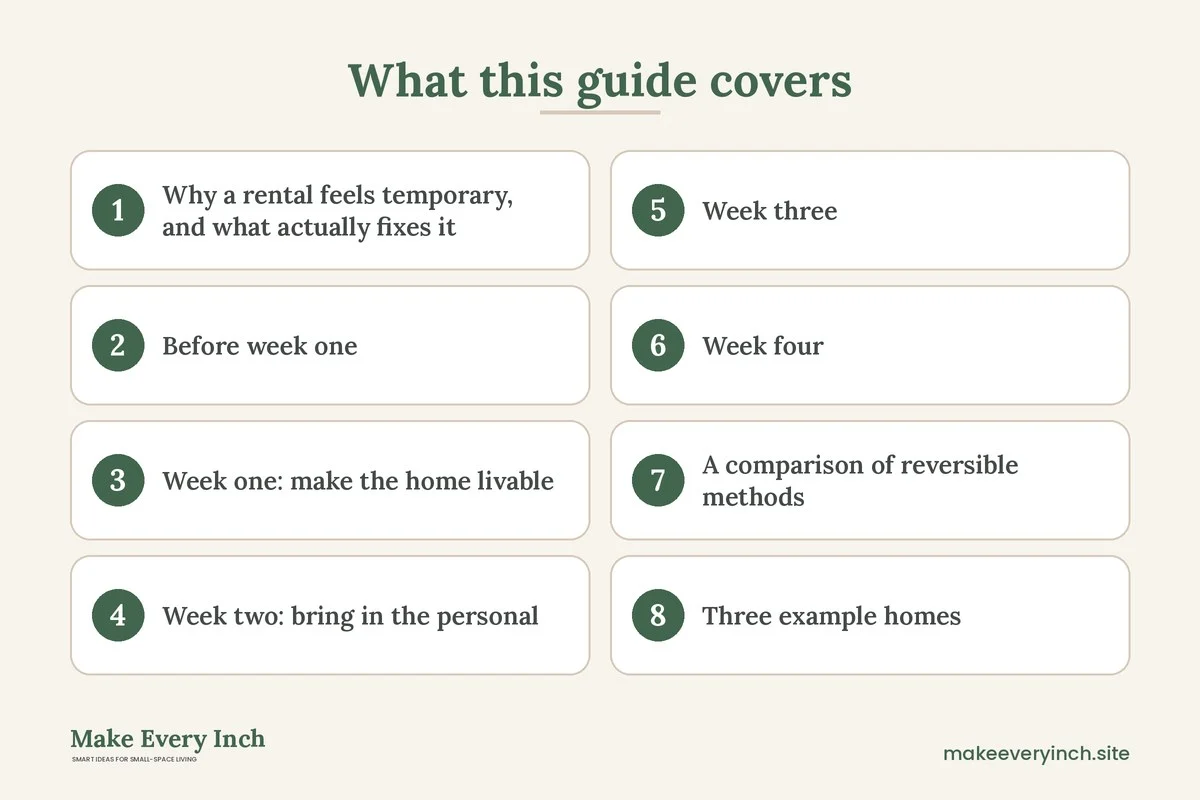
Before week one: the lease and the baseline
Read the lease and any move-in notes about alterations. Look for words on nails, adhesives, paint, wallpaper, light fixtures, window coverings and flooring. Some landlords allow small nail holes, and others ban every change. If a point is unclear, ask in writing and save the reply. Never drill, repaint or remove a fixture without written permission, even if it seems minor, because repairs can come out of a deposit. Our guide to security-deposit-safe apartment upgrades goes deeper on what tends to be safe.
Then take a baseline. Photograph every wall, the floors, the windows and the inside of cabinets with the date visible. Note any existing marks or damage. Also measure the room and write down the width of each doorway, the ceiling height and the position of every outlet. These numbers will guide every purchase in the weeks ahead. A table you bring home that does not clear a 30-inch doorway is a very expensive mistake in time, even if the table itself was a bargain.
Finally, unpack in a deliberate order. Open the boxes labeled bedroom, bathroom basics and kitchen essentials first. Leave decor boxes for later. A calm base makes every later choice easier.
Week one: make the home livable
The first week is about function. Do not hang anything yet. You are trying to be able to sleep, wash, eat and find your keys without effort.
Day 1 and 2: the bed and the bathroom
Set up the bed with sheets, a pillow and a blanket you already own. Sleep in a space that is tidy and quiet, since the first nights set the mood for the whole move. Place the bed so you can see the door if that makes you feel secure, and keep at least 24 inches of clearance on the side you step out on. Set up the bathroom with a towel hook solution that does not need drilling, a bath mat and a small basket for daily items. In wet areas, keep electrical items away from water and plug anything near a sink into an outlet protected by a ground fault circuit interrupter, often shown by test and reset buttons on the outlet. If the outlet has no such protection, do not use heaters or hair tools near water and ask your landlord about it.
Day 3 and 4: light
Swap the harshest light first. Many rentals have one overhead light that flattens the room. Add at least two lamps at different heights, one near the seating and one near the bed or work area. Aim for a warm, soft white in the evening and a brighter white where you read or cook. Use bulbs that match the wattage rating printed on the fixture, and never exceed it. For more ideas that need no wiring, see our guide to renter-friendly lighting ideas. Lamps should have stable bases, and cords should run along walls or behind furniture where nobody trips on them, which our guide to hiding cords in a rental covers in detail.
Day 5 to 7: the entry and the main surface
Make the first three feet inside the door work. A hook or a tray for keys, a place for shoes and a spot for the bag will change how you feel when you arrive. If drilling is not allowed, use a freestanding rack, an over-the-door hook or a console with a tray. Then clear one main surface, such as the dining table or a desk, and keep it clear. A single empty surface shows you the room is under control, and it gives you somewhere to unpack the rest.
Week two: bring in the personal
Week two is where the place starts to look like yours. The goal is to place objects you already own, in groups, before you buy anything new.
Photographs, books and keepsakes
Gather everything with meaning: framed photos, a favorite book, a mug, a plant, a travel souvenir, a blanket that someone gave you. Place these on surfaces that already exist, such as a windowsill, a shelf, a dresser top or a side table. Group items in odd numbers, with different heights, and leave space around each group. A cluster of three objects on a tray looks deliberate, while twelve scattered across a shelf looks like clutter.
Textiles do the heavy lifting
Soft layers change a room more than most purchases. A rug under the main seating zone defines the area and softens sound. Use a non-slip pad, and avoid placing a rug over a threshold where it becomes a trip hazard. A throw on the sofa, a pair of curtains hung on a tension rod and a couple of cushions add color. If the walls are white, pick two or three colors and repeat them across the room so it feels planned. For window ideas that respect your lease, see our guide to renter-friendly window treatments.
Plants and what to check first
Plants make a room feel inhabited. Choose by the light you have, and note that some common houseplants are harmful to cats and dogs if chewed, so check a reliable pet safety list if you share the home with animals. Keep pots on saucers to protect floors, and avoid placing heavy planters on a shelf that was not designed for them.
Walls without damage
This is the point to hang a few things, using methods the lease allows. Leaning a large frame on a dresser or a bookcase works in almost any rental. Lightweight frames on adhesive strips rated for their weight can work on suitable painted walls, and the wall surface and the manufacturer’s weight chart should guide every decision. For more detail, see our guide to renter-friendly wall decor ideas and our guide to small space wall art ideas.
Week three: fix sound, scent, storage and the layout
By week three you have lived in the space long enough to notice what annoys you. Write those annoyances down for three days, then fix the top three.
Sound
Bare rooms echo. Rugs, curtains, upholstered pieces and a bookcase with books on it absorb sound. A felt pad under furniture legs reduces scraping on hard floors and noise for the neighbors below. If hallway noise bothers you, a draft stopper at the bottom of the door can help a little, and so can a rug runner outside the bed.
Scent and air
Open the windows for a few minutes daily when the weather allows, since fresh air is the cheapest scent change. Use ventilation in kitchens and bathrooms, run the exhaust fan while cooking and showering, and avoid heavy aerosol products in a small room. If you paint anything with the landlord’s written permission, choose a low-VOC paint, keep the windows open and let the room air out before sleeping there. Keep candles on stable, heat-safe surfaces, never near curtains, and never leave them burning when you go out. Many small homes do better with a simple bowl of citrus or a clean, uncluttered kitchen than with strong fragrance.
Storage that fits the way you live
Notice where things pile up. A basket by the sofa for blankets, a tray for the remote, a shelf for the mail and a closet organizer that hangs from the rod rather than the wall solve the most common mess without tools. Our guides to no-drill storage ideas for renters and renter-friendly shelving without drilling cover options in detail. When you use a tall bookcase or a dresser, anchor it to the wall if the lease allows it, or use a method the landlord approves, because tall furniture can tip, especially when children climb on it. If you cannot anchor a piece, choose a lower one and keep heavy items on the bottom shelves.
Layout tweaks
Try moving the largest piece. A sofa pulled 4 to 6 inches from the wall can make the room feel deeper, and a bed moved to the centered wall can free a side. Keep walkways at 30 to 36 inches where people walk, and 24 inches in secondary paths.
Week four: rituals and one finishing project
Rituals turn a space into a home. Choose three and repeat them for a week:
- A morning drink at the same window, with the curtains open.
- An evening reset of ten minutes where cushions go back, dishes are washed and the main surface is cleared.
- A weekend habit, such as cooking one meal from scratch or calling someone from the same chair.
Then complete one finishing project that reflects you. Options include a small gallery of leaned frames, a temporary accent wall using removable wallpaper where the lease allows it (see our guide to removable wallpaper ideas), a reading corner or a cleaner kitchen counter system. Test any adhesive product on a hidden spot first, follow the weight rating and keep the removal instructions.
A comparison of reversible methods
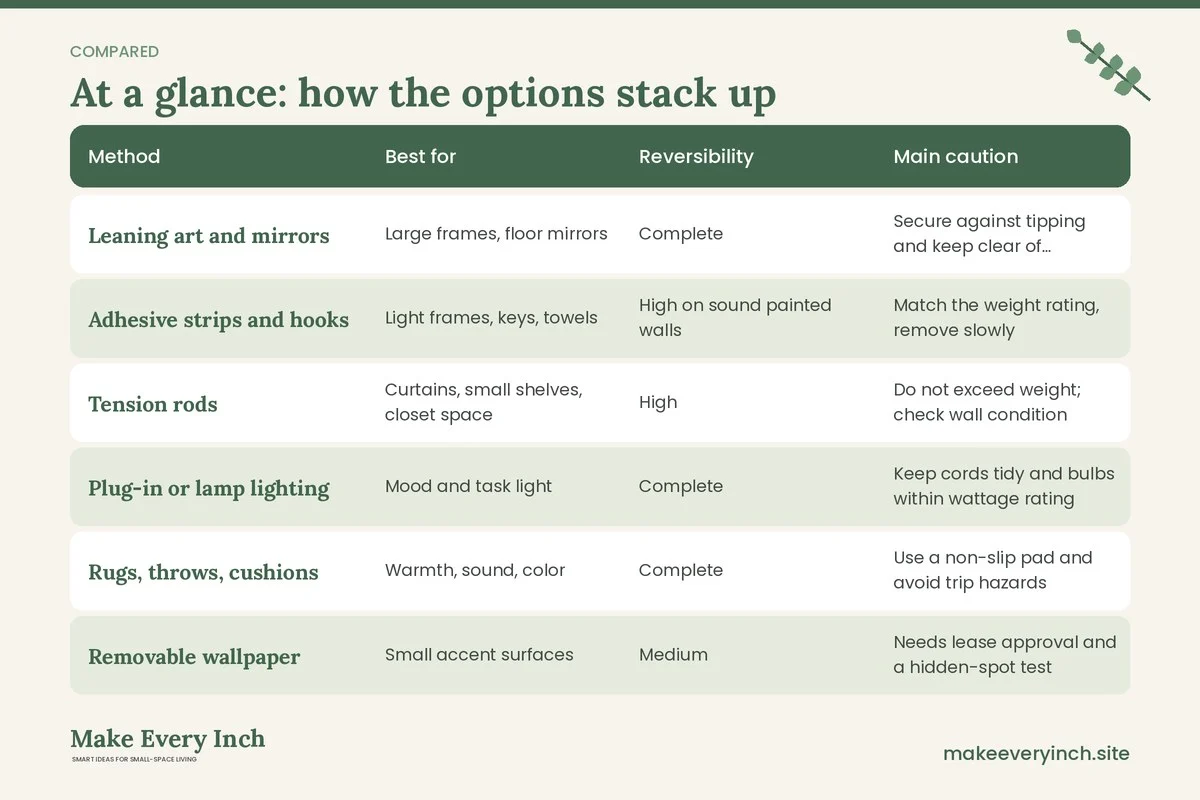
The table below compares common ways to change a rental. Always follow the lease, and treat the risk column as a general guide, since walls and finishes vary.
| Method | Best for | Reversibility | Main caution |
|---|---|---|---|
| Leaning art and mirrors | Large frames, floor mirrors | Complete | Secure against tipping and keep clear of walkways |
| Adhesive strips and hooks | Light frames, keys, towels | High on sound painted walls | Match the weight rating, remove slowly |
| Tension rods | Curtains, small shelves, closet space | High | Do not exceed weight; check wall condition |
| Plug-in or lamp lighting | Mood and task light | Complete | Keep cords tidy and bulbs within wattage rating |
| Rugs, throws, cushions | Warmth, sound, color | Complete | Use a non-slip pad and avoid trip hazards |
| Removable wallpaper | Small accent surfaces | Medium | Needs lease approval and a hidden-spot test |
| Freestanding shelves | Books, display, storage | Complete | Anchor tall units where permitted |
| Nails and screws | Heavy items only | Low | Only with written permission |
Three example homes
Example 1: A 400-square-foot studio
The goal is to separate sleep from living without walls. Week one places the bed on the wall farthest from the door and adds two lamps. Week two uses a rug under the sofa and a bookcase as a partial divider, leaving 30 inches of walkway on each side. Week three adds a basket for blankets and a slim console at the entry. Week four sets an evening reset and leans a large framed print on the bookcase. See our hub guide on studio apartment ideas for renters for more layouts.
Example 2: A one-bedroom with a dark living room
The issue is light. Week one adds a floor lamp in the darkest corner and a table lamp by the sofa. Week two hangs lighter curtains on a tension rod and moves a mirror opposite the window. Week three replaces a bulky chair with a smaller one. Week four builds a reading corner with a plant and a throw. Because the light is the problem, the plan spends more time on lamps and mirrors than on art.
Example 3: A shared two-bedroom with roommates
The issue is the shared space. Week one settles the entry, with one hook or basket per person. Week two sets a shared shelf for common items and personal shelves for each person. Week three agrees on a cleaning rhythm, since order is the base of comfort. Week four sets one shared ritual, such as a Sunday dinner. Each bedroom follows the same four-week order but remains private.
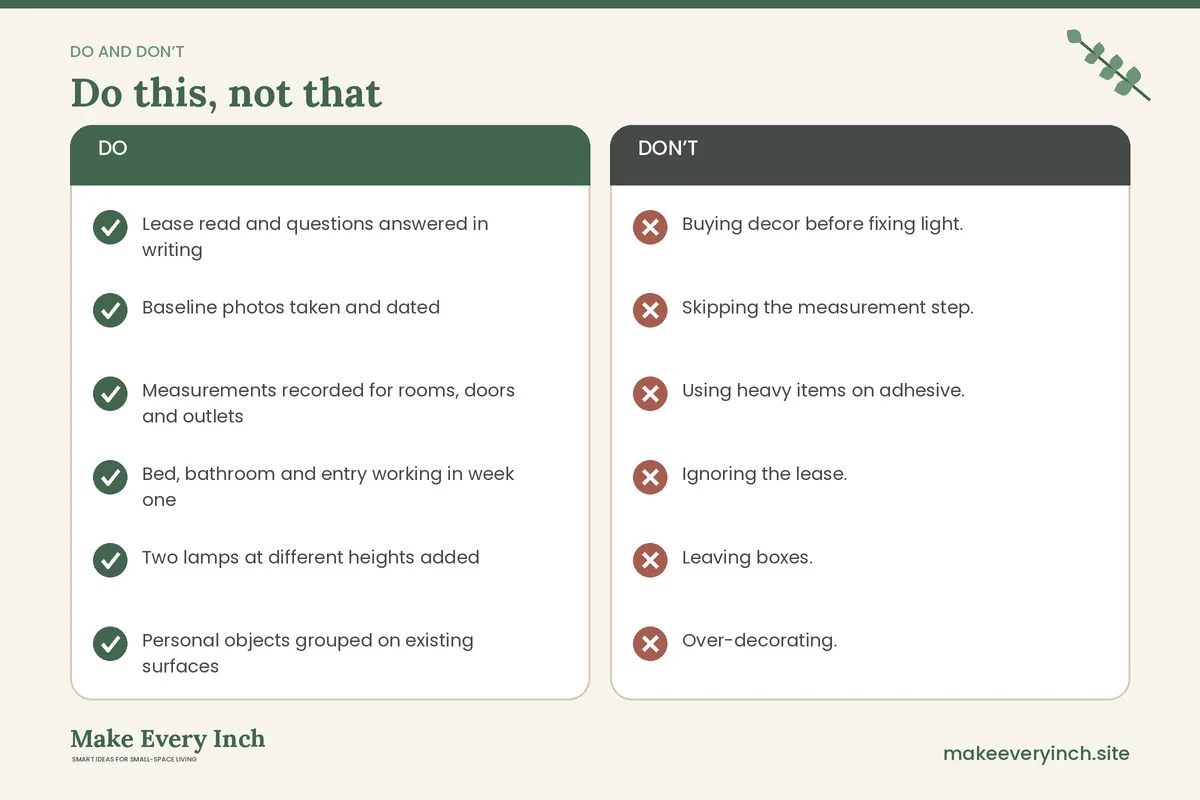
Common mistakes
- Buying decor before fixing light. Art in a poorly lit room looks flat.
- Skipping the measurement step. Furniture that does not fit never feels right.
- Using heavy items on adhesive. Respect the weight rating, and test on a hidden spot.
- Ignoring the lease. A tiny hole is still a hole if the lease says no.
- Leaving boxes. A box in the corner after a month tells your brain you are still moving.
- Over-decorating. Leave empty surface so the room can breathe.
- Forgetting safety. Anchor tall furniture, protect cords and keep candles away from fabric.
Safety checklist for a rental refresh
- Anchor tall furniture where allowed, and choose lower pieces where it is not.
- Keep cords off walkways and never run them under rugs.
- Do not overload power strips, and check the label for the maximum rating.
- Use GFCI-protected outlets near water, and ask your landlord if they are missing.
- Choose low-VOC paint only with permission, and ventilate well.
- Keep heavy objects off high shelves, especially with children or pets at home.
- Check plants and cleaning products for pet and child safety.
- Do not drill, nail or remove fixtures without written permission.
The final checklist
- Lease read and questions answered in writing
- Baseline photos taken and dated
- Measurements recorded for rooms, doors and outlets
- Bed, bathroom and entry working in week one
- Two lamps at different heights added
- Personal objects grouped on existing surfaces
- Rug, throw and curtains in place
- Three annoyances fixed in week three
- Tall furniture anchored or replaced with lower pieces
- Three daily rituals chosen
- One finishing project completed
- Removal instructions saved for anything adhesive
FAQ
How long does it take to make a rental feel like home?
Most people feel settled after a few weeks of deliberate changes, though the pace varies. The plan above is a guide rather than a deadline, so move through it in whatever order suits your schedule and energy.
What if my landlord allows nothing at all?
You can still use leaned art, lamps, rugs, curtains on tension rods, freestanding shelves and plants. These cover most of what makes a space feel personal.
Should I paint if the landlord says yes?
Only with written permission, and ideally with a plan to repaint at move-out if the lease requires it. Use low-VOC paint and ventilate. If you are unsure, a removable alternative or leaned art may be easier.
Do I need to spend a lot?
No. Start with what you own, borrow or find secondhand, and add the items that fix your biggest annoyance. Our guide to budget renter upgrades offers more ideas.
How do I keep the home feeling fresh without clutter?
Rotate a few objects with the seasons, keep one clear surface and do a ten-minute reset each evening.
Keep going: Next, browse renter-friendly small space upgrades that make a difference, plan your walls with renter-friendly wall decor ideas and read our companion guide on damage-free hanging ideas for small homes.
Save this guide for later
Pin the ideas you like to Pinterest so you can come back to them when you plan your space.