Small Bedroom Ideas with a Desk
Quick answer: The best small bedroom ideas with a desk start with the desk type that fits the wall you have: a 16 to 20 inch deep wall-mounted or fold-down desk for tight rooms, a 20 to 24 inch slim console for a bit more space, or a corner or window desk for a real workstation. Keep the seat 24 to 30 inches from the bed edge when you can, face away from the bed while working, route cables along the wall and out of walkways, and use a lamp, a cover or a closing door to mark where work stops and sleep starts.
Small bedroom ideas with a desk have to answer two questions at once. Where does the desk physically go, and how do you stop the room from feeling like an office at eleven at night? A bedroom that must also hold a workstation has little spare floor, so the choice of desk, the position and the habits around it matter more than the decor. This guide walks through the measurements that make a desk usable, six desk types compared, placement rules for different room shapes, ergonomic basics, cable and electrical safety, three example rooms, ways to draw a line between work and sleep, and a checklist. For the wider topic, read our main small bedroom ideas guide, and for the room plan around it see our posts on small bedroom layout ideas and small bedroom storage ideas.
Decide how you will actually use the desk
Before measuring, be honest about the job the desk does. A desk for twenty minutes of email and bill paying is a different object from a desk that carries a laptop, a monitor and a notebook for six hours. Many people buy a large desk for the second kind of day and then use it for the first kind, and the bedroom pays for the mistake in lost floor.
Sort your use into one of three levels. A light desk is for short sessions with a laptop, a tablet or paperwork, and it can be shallow, folding or wall-mounted. A daily desk is for a few hours most days, and it deserves a fixed surface that is at least 40 inches wide and 20 inches deep, plus a comfortable chair. A full workstation holds a monitor, a keyboard, papers and perhaps a second screen, and it needs a surface 48 inches wide or more and 24 inches deep. In a small bedroom, the full workstation usually needs the room’s best wall or window, and it is worth saying so out loud before you plan the bed.
Also note when you use it. A desk used in daylight wants the window. A desk used at night wants good task lighting and a way to turn the work off. Both patterns change where it should sit, and the second one makes the sleep boundary more important.
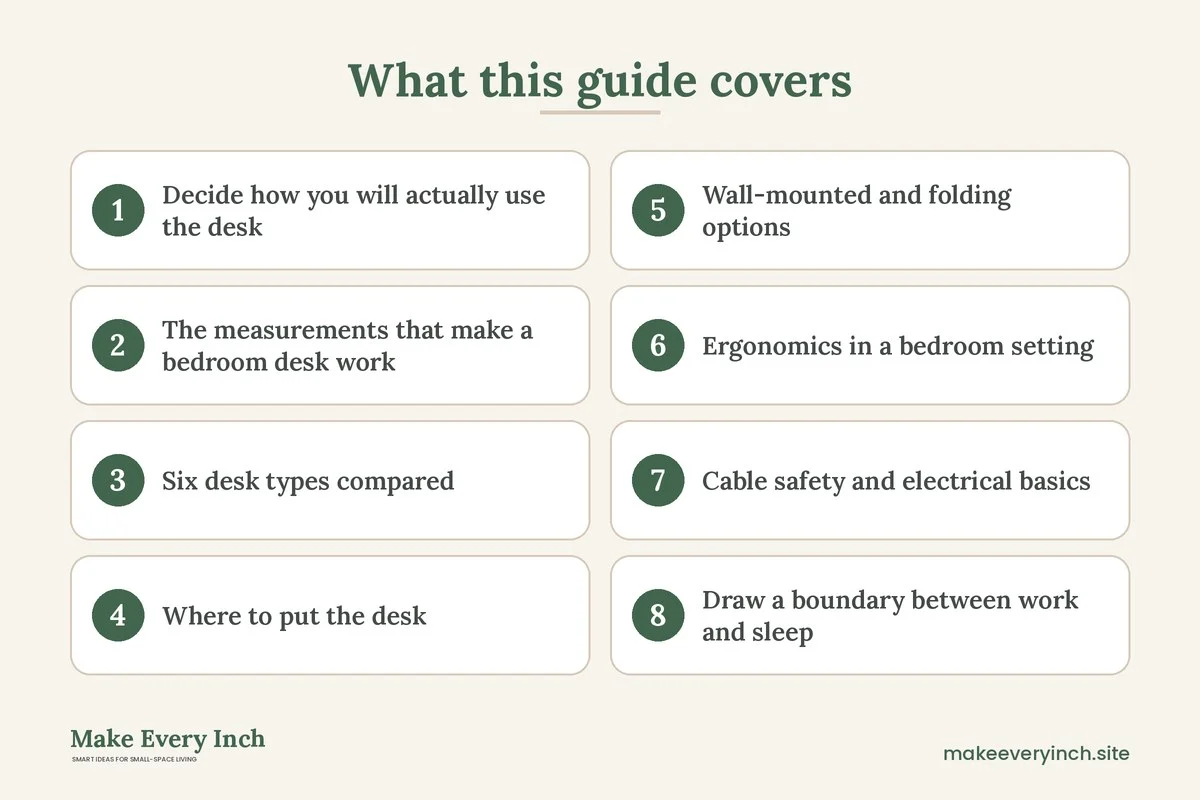
The measurements that make a bedroom desk work
A desk that technically fits can still be unusable if the chair has nowhere to go. These ranges are general guides and a starting point for taping out the room, not strict rules.
- Desk surface height: most adults are comfortable with a work surface around 28 to 30 inches from the floor, with a chair that lets elbows rest at roughly a right angle. Adjustable chairs and footrests help people who are shorter or taller than average.
- Desk depth: 16 to 20 inches for a laptop-only desk, 22 to 26 inches if you use a monitor, since screens need distance for comfortable viewing.
- Desk width: 30 to 36 inches is a bare minimum for a laptop and a mug, 40 to 48 inches for a daily desk, and 48 to 60 inches for a monitor setup with papers.
- Chair clearance: about 30 to 36 inches behind the desk to push the chair back and stand up. In very tight rooms, 24 inches is workable if the chair is armless and slides under.
- Knee space: at least 24 inches wide and 18 inches deep below the surface, so a drawer unit or a bed rail does not block your legs.
- Distance to the bed: 24 to 30 inches between the chair and the bed edge is comfortable. Less than that works only if the chair slides fully under the desk, or if the desk folds away.
- Walkway: keep a 24 to 30 inch route from the door to the bed, to the closet and to the window.
Use painter’s tape on the floor to mark the desk footprint plus the chair zone, then walk the room as you would on a normal day. Try getting into the closet and making the bed. If the chair zone collides with a door swing or a drawer front, the plan needs another wall.
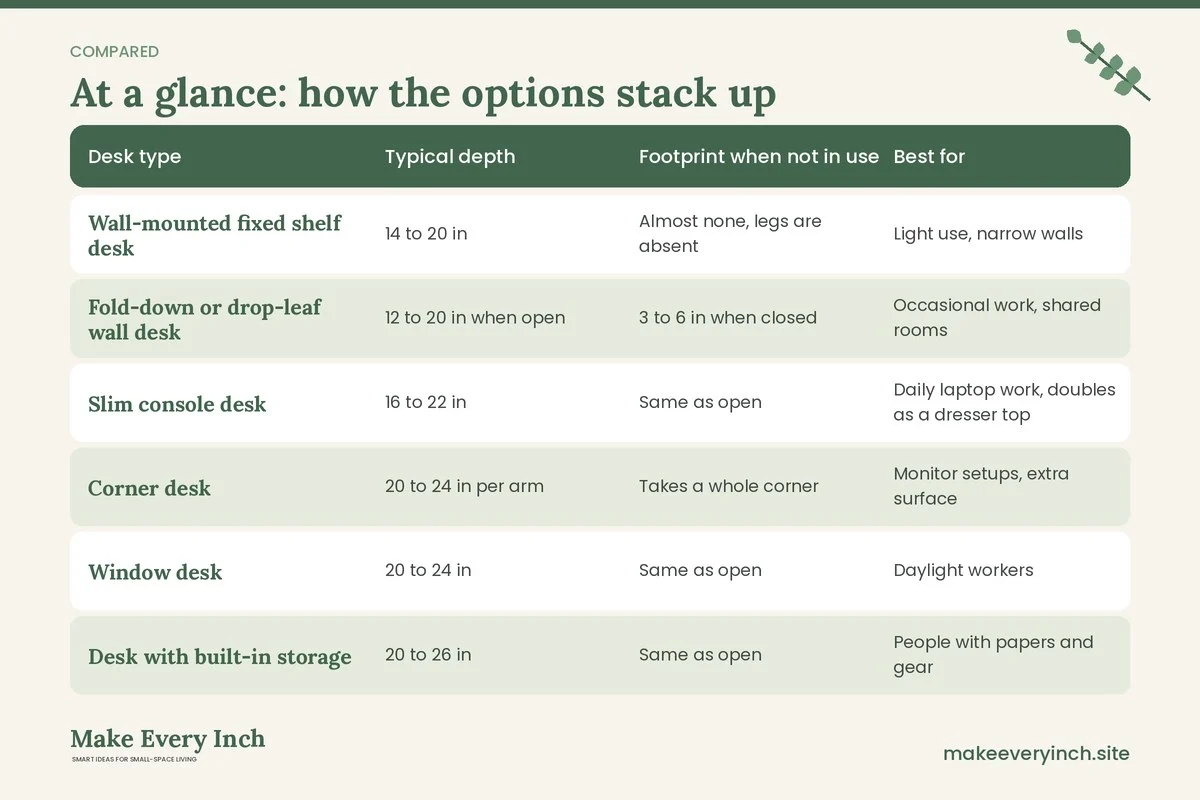
Six desk types compared
The table below sets out how common desk types behave in a small bedroom. Sizes are typical ranges and vary widely.
| Desk type | Typical depth | Footprint when not in use | Best for | Watch out for |
|---|---|---|---|---|
| Wall-mounted fixed shelf desk | 14 to 20 in | Almost none, legs are absent | Light use, narrow walls | Needs solid anchoring into studs or proper wall fixings, check the lease |
| Fold-down or drop-leaf wall desk | 12 to 20 in when open | 3 to 6 in when closed | Occasional work, shared rooms | Weight limits and a clear 24 inch zone for the chair |
| Slim console desk | 16 to 22 in | Same as open | Daily laptop work, doubles as a dresser top | Little knee space if it has drawers |
| Corner desk | 20 to 24 in per arm | Takes a whole corner | Monitor setups, extra surface | Awkward in rooms with a door near the corner |
| Window desk | 20 to 24 in | Same as open | Daylight workers | Cold air near glass, glare on screens |
| Desk with built-in storage | 20 to 26 in | Same as open | People with papers and gear | Bulky, may dominate the room |
If you want product comparisons instead of types, our guide to the best desks for small apartments covers what to look for, and the shorter small bedroom desk ideas post collects quick ideas. This post focuses on how to place the desk, set it up and protect your sleep.
Where to put the desk: placement options
Under or beside the window
A window gives daylight, which is easier on the eyes than a bright screen in a dim room. A shallow desk below the sill, 16 to 20 inches deep, makes use of the dead zone under a window. If the sill is too low, a desk that wraps around a radiator may be impossible, and heat sources near a laptop are worth avoiding. Place a screen at a right angle to the window instead of facing it, so that glare falls to the side. Closing a curtain or blind at the end of the day is a handy way to hide the desk and finish work. Check for drafts, since cold air near glass can be uncomfortable in winter.
At the foot of the bed
The wall at the foot of the bed is often the emptiest wall in a small bedroom. A desk 16 to 20 inches deep works there if you keep about 24 to 30 inches between the bed foot and the desk edge for the chair. The advantage is that the desk keeps the long sides of the bed free. The downside is that you face the bed while you work, so a cover, a folding screen or a curtain on a ceiling track matters for the sleep boundary.
In a corner
A corner desk uses two walls and keeps the middle of the room open. Because the arms of an L-shape take 20 to 24 inches each, try one longer arm for the work surface and one short arm for a printer or a plant. Add a shelf above the corner for books and files, so the desk stays clear.
Beside the bed as a nightstand desk
A slim desk 14 to 18 inches deep can double as a bedside table on one side. This suits couples, since only one person needs the surface. The desk holds a lamp and a glass of water at night, and a laptop by day. Keep the area clean of papers before bed, so the nightstand role feels calm.
Inside the closet
If the closet is shallow or unused, a desk niche works. Remove the doors if your lease allows it, or keep them and fold them back. A shelf at 28 to 30 inches becomes the desk, with open storage above. When you shut the doors, the work vanishes. Ventilation and lighting are the main points: add a plug-in or battery light, and leave airflow. Check the lease before changing doors or fixtures.
Along the long wall with a slim console
If the bed sits against the short wall, the long wall may take a console desk 16 to 20 inches deep. Slide a stool or a slim chair underneath. In a 9 by 11 foot room, this keeps 36 inches of walkway on most layouts, though you should measure rather than assume.
Wall-mounted and folding options
Wall-mounted desks free the floor and make a small room look larger, but they carry weight and need proper fixing. A few notes make the choice safer.
- Check the lease and get permission before drilling. Many rentals forbid holes, and a fold-down desk needs strong fixings. If drilling is not allowed, choose a freestanding slim desk or a desk that clamps to a bed frame or table, and read our guide to no-drill storage ideas for renters.
- Anchor into studs or use wall fixings rated for the load. Walls vary. Plasterboard needs the right anchors, masonry needs different ones, and a stud finder helps. Follow the manufacturer’s instructions and consider asking a professional if you are unsure. Adhesive hooks and strips are not suitable for a desk surface.
- Mind the load. Include the weight of a laptop, a monitor, books and your forearms leaning on the front edge. Do not exceed the stated limit, and recheck fixings now and then.
- Plan the chair. A fold-down desk is only useful if a chair stays nearby. A folding chair or a stool that tucks under the shelf solves this.
- Think about the bed. A desk that folds up above the bed edge needs clearance for your head when you sit up, so keep a few inches of room.
Fold-down desks suit light users. They hide cables, a lamp and papers when closed, which improves the sleep boundary. Some versions have a built-in cubby inside the door for pens and a notebook. They are less suited to monitors, because the shelf is shallow and the hinge limits weight.
Ergonomics in a bedroom setting
A bedroom is not designed as an office, so small adjustments make a large difference. These are general comfort tips and not medical advice. If you have pain, speak to a professional.
- Do not work from the bed. A bed is soft and unsupportive for a back and wrists. A proper chair and surface protect your posture and keep the bed linked with rest.
- Choose a supportive chair. A dining chair with a cushion can do for short sessions. For daily work, an adjustable chair with back support is worth finding, even a second-hand one. Small-footprint chairs without arms tuck under the desk.
- Set the screen at a comfortable height. The top edge of the screen is often near eye level. A stack of books or a laptop stand raises the laptop, and a separate keyboard keeps the arms relaxed.
- Keep feet supported. If your feet dangle, use a footrest or a box.
- Light the work, not just the room. A desk lamp that shines on the page from the side reduces eye strain. A warm bulb in the evening feels gentler than a cold one.
- Take breaks. The bedroom’s small size can lead to long sitting. Stand up each hour and stretch near the window.
Cable safety and electrical basics
A desk adds plugs to a room that may have few outlets. Handle power carefully.
- Do not overload a socket. Laptops, monitors, lamps and phone chargers add up. Use one good-quality surge-protected power strip that carries a recognized safety mark, and follow its rated load.
- Never daisy-chain strips. Plugging one extension into another is a fire risk.
- Keep cables out of walkways. A cable across the floor is a trip hazard and can be pulled by a chair. Route cords along the wall, behind the desk, or through a cable channel or clips that stick to the baseboard. Check that adhesive products are safe for your paint, and test first in a hidden spot.
- Give power strips air. Do not bury them under a blanket, a bed skirt or a stack of papers. Keep them off the bed.
- Leave space for charger heat. Chargers and laptops warm up. Place them on hard surfaces, not on bedding.
- Tidy with sleeves, not tape. Cable sleeves, hook-and-loop ties and clips bundle cords without gluing them to the wall. Leave some slack so connectors are not strained.
- Inspect cords. Replace anything frayed or hot to the touch, and turn off equipment at night if you can.
- Consider a switch. A power strip with a switch lets you cut the power to the whole desk at bedtime, which also becomes a sleep ritual.
If the room has too few outlets, ask an electrician or your landlord about adding one. Do not run an extension cord under a rug.
Draw a boundary between work and sleep
Sleep experts commonly suggest that a bed should be a place for sleep, and many people find it easier to switch off when work is out of sight. The following ideas help a small bedroom do both jobs. They are suggestions and not medical advice, and the right level depends on how you feel in the room.
- Face away from the bed. If you can, turn the chair so the bed is behind you while you work. The reverse is true at night, when the desk should be out of sight from the pillow.
- Cover the desk. A fabric panel on a tension rod, a folding screen or a curtain closes the work area at the end of the day.
- Use a closing desk. A fold-down desk, a secretary desk or a desk inside a closet shuts the work away entirely.
- Use light as a switch. A bright, cool task light for the day and a warm lamp for the evening mark the time. Turning off the desk lamp becomes the signal that the day is done.
- Clear the surface. Put the laptop in a drawer or a basket each night. A clear surface reads as a dresser or a console.
- Create a shutdown ritual. Write tomorrow’s tasks on a notepad, close the laptop and put a cover over it, and then leave the desk side of the room.
- Separate the sensory cues. A different rug, a lamp color or a scent can set the desk zone apart. Do not place a laptop charger or a work phone on the nightstand.
- Keep screens out of bed. Use a phone alarm or a plain clock, and charge devices across the room if you tend to scroll.
If you share the room, agree on quiet hours and on where headphones live, so that the person working does not disturb the person resting. The same applies to couples, and our post on small bedroom ideas for couples covers sharing a limited space.
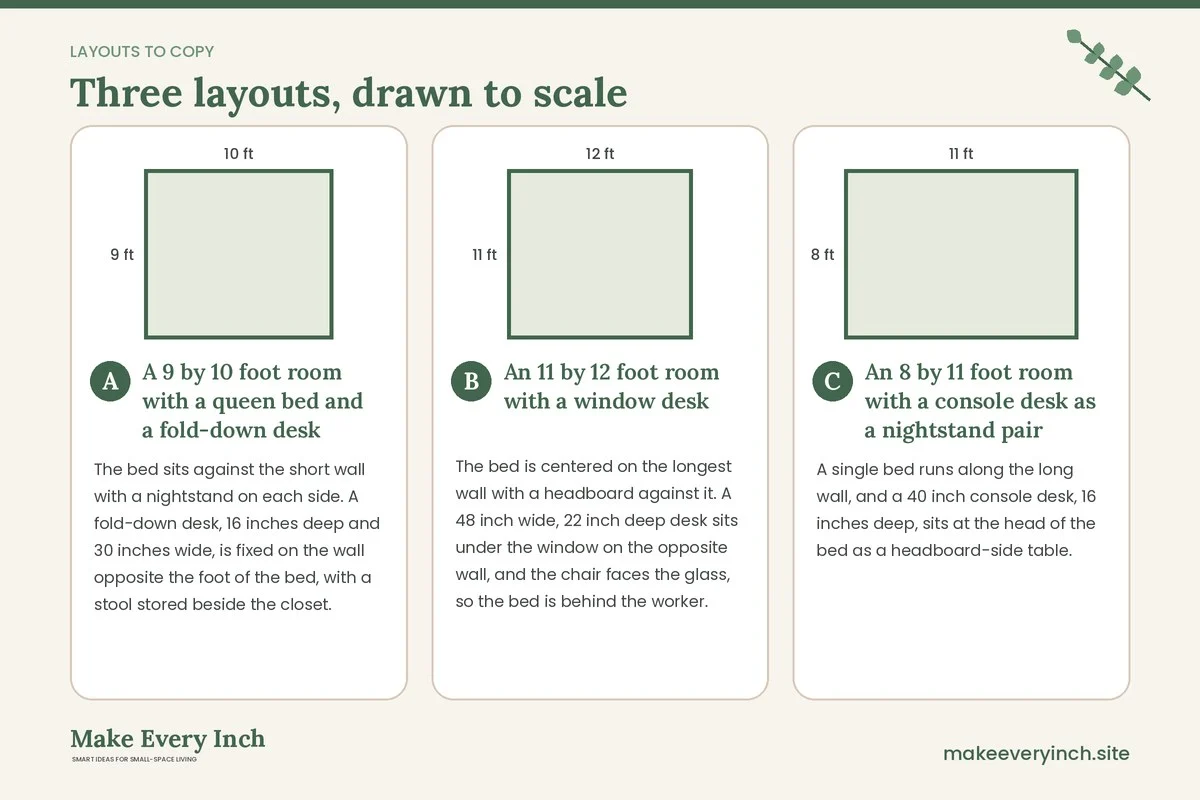
Three example rooms
A 9 by 10 foot room with a queen bed and a fold-down desk
The bed sits against the short wall with a nightstand on each side. A fold-down desk, 16 inches deep and 30 inches wide, is fixed on the wall opposite the foot of the bed, with a stool stored beside the closet. When the desk is open, the stool sits 26 inches from the bed foot. When it is closed, the wall is a flat panel with a mirror or a piece of art. This plan suits someone who works at home a few hours a week, and it keeps the walkway clear. Check the wall fixings carefully, and ask your landlord before drilling. For bed size tips, see our guide to small bedroom ideas with a queen bed.
An 11 by 12 foot room with a window desk
The bed is centered on the longest wall with a headboard against it. A 48 inch wide, 22 inch deep desk sits under the window on the opposite wall, and the chair faces the glass, so the bed is behind the worker. A curtain on the side covers the desk when work ends. A floor lamp sits in the corner, and a shelf above the desk holds files and a plant. Under-bed drawers hold the supplies that would otherwise clutter the desk, which links to our post on under-bed storage ideas. This plan suits a daily worker who wants daylight and a clear boundary.
An 8 by 11 foot room with a console desk as a nightstand pair
A single bed runs along the long wall, and a 40 inch console desk, 16 inches deep, sits at the head of the bed as a headboard-side table. A slim lamp and a small tray hold glasses at night, and a laptop and notebook come out during the day. The chair is a stool that slides under. The room keeps 30 inches of walkway on the other side. This plan suits students and renters who need a flexible surface and no extra furniture. See also our small bedroom ideas for renters for more flexible ideas.
Storage and organization around the desk
A desk fills with clutter fast in a room with no spare drawers. Use vertical space instead of surface space.
- Wall shelves above the desk. One or two shelves hold books, a printer and a plant. Follow the wall fixing advice above, or use a freestanding ladder shelf.
- A pegboard or wire grid. A board can hold pens and clips. A leaning wire grid avoids holes.
- A drawer cart. A slim rolling cart slides beside the desk and tucks into the closet.
- A lidded basket for cables and chargers. It hides a mess and can be moved at bedtime.
- A document box. One box holds the papers for the week, and a filing habit keeps the rest out of the room. See our guide to vertical storage ideas for more.
- A tray on the desk. A tray holds the items that live on the surface and lifts away in one move, which makes the desk look cleared in seconds.
Styling the desk so it belongs in a bedroom
A desk that matches the bedroom feels less like an office. Use the same wood tone or paint color as the other furniture. Choose a table lamp with a fabric shade, a ceramic cup for pens and a small plant. A hanging fabric panel or a mirror above the desk makes it look like part of a dressing area. If the room is dark, our small bedroom lighting ideas include layered lamp options. When painting, choose a low-VOC paint and ventilate the room well, and avoid sleeping in a freshly painted bedroom until the smell has gone.
Common mistakes
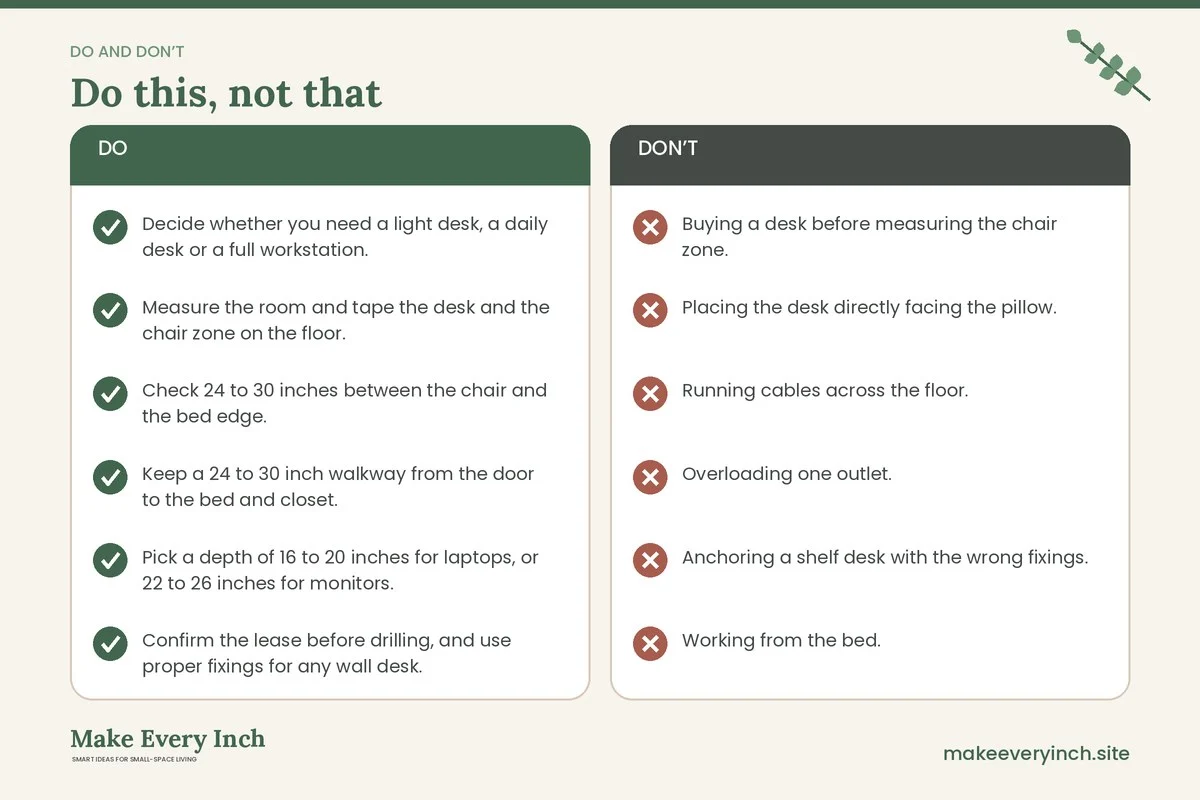
- Buying a desk before measuring the chair zone. The desk fits, but the chair has no room.
- Placing the desk directly facing the pillow. The work stays in your sight when you try to rest.
- Running cables across the floor. They trip you and wear out.
- Overloading one outlet. Laptops, lamps and chargers add up.
- Anchoring a shelf desk with the wrong fixings. A weak anchor can fail under load, so use fixings rated for the wall type.
- Working from the bed. It hurts posture and blurs the boundary.
- Forgetting storage. A desk without a home for papers becomes a pile.
- Ignoring light. A screen in a dark room strains the eyes, and a bright lamp at midnight keeps you awake.
Desk setup checklist
- Decide whether you need a light desk, a daily desk or a full workstation.
- Measure the room and tape the desk and the chair zone on the floor.
- Check 24 to 30 inches between the chair and the bed edge.
- Keep a 24 to 30 inch walkway from the door to the bed and closet.
- Pick a depth of 16 to 20 inches for laptops, or 22 to 26 inches for monitors.
- Confirm the lease before drilling, and use proper fixings for any wall desk.
- Use one surge-protected power strip, with no daisy-chained extensions.
- Route cables along walls, and keep them out of walkways.
- Add a desk lamp with a warm bulb for evening work.
- Face away from the bed, or cover the desk at night.
- Choose a supportive chair and a footrest if needed.
- Store papers in a box or drawer so the surface can clear in a minute.
- Create a shutdown ritual to end the work day.
FAQ
What size desk fits in a small bedroom?
Most small bedrooms can hold a desk 30 to 48 inches wide and 16 to 22 inches deep. A fold-down or wall-mounted desk saves floor space. Measure the chair zone as well as the desk, and tape it out before buying.
Can I put a desk in a bedroom without hurting my sleep?
Many people do. Keep the desk out of sight from the bed, clear the surface at night, use a separate lamp for work and avoid working in bed. These are general suggestions, and if you have trouble sleeping, consider talking to a health professional.
Is a wall-mounted desk a good idea in a rental?
It can be, but only with the landlord’s permission, since it needs holes. If drilling is not allowed, choose a freestanding slim desk, a clamp-on shelf or a desk that tucks beside the bed.
How do I hide cables in a small bedroom?
Use cable sleeves, clips along the baseboard and a lidded box for the power strip. Keep cables out of walkways, away from bedding and off the floor where chairs roll. Do not run cords under rugs.
Where should the desk go if the room has one window?
Under or beside the window works well for daylight, though a corner or the foot of the bed may suit a room where the window sits near the bed. Turn the screen at a right angle to the glass to cut glare.
Can a nightstand double as a desk?
A slim console or a wide nightstand can hold a laptop for light use. It works best on one side of the bed, and you should clear it before sleep.
Keep going: Keep planning with our small bedroom furniture ideas, small bedroom organization ideas and small bedroom ideas with a TV.
Save this guide for later
Pin the ideas you like to Pinterest so you can come back to them when you plan your space.