15 Small Living Room Lighting Ideas Minimalist Style: Fewer Fixtures, Better Light
Quick answer: The best small living room lighting ideas minimalist style use three to four well-placed sources instead of many small ones: one dimmable ambient light, one task lamp at the reading seat and one low accent glow. Aim for roughly 10 to 20 lumens per square foot in total, keep bulbs warm at about 2700 kelvin, hide cords along edges and give every fixture a clear job.
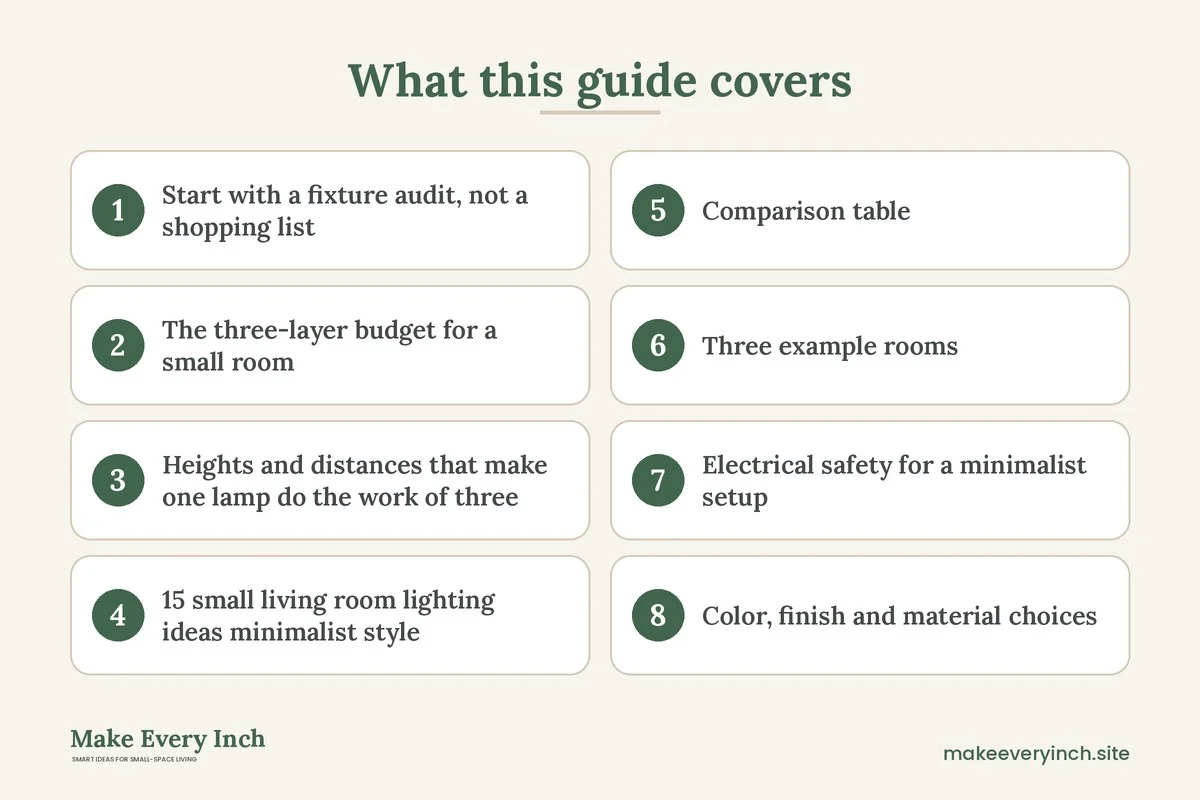
Small living room lighting ideas minimalist style begin with a surprising rule: the room usually needs fewer lights, not more. A cluttered mix of a ceiling fixture, three table lamps, a string of bulbs and a candle collection makes a small space feel busy even when every surface is clear. A minimalist plan gives each light one job, places it carefully and removes the rest. The result is calmer, easier to switch on and off, and kinder to the electricity bill. This guide walks through a fixture audit, a simple lumen budget, the heights and distances that make a lamp work, 15 ideas, a comparison table, three example rooms, cord and safety rules, and a checklist. For the wider topic, read our main guide to small living room lighting ideas, the broader small living room ideas pillar and our companion post on minimalist small living room layout ideas.
Start with a fixture audit, not a shopping list
Before you buy anything, count every light source in the room, including lamps that are plugged in but rarely used. Write down what each one does. A good minimalist plan has only three jobs to cover: general light so you can see the room, task light so you can read or work, and accent light so the room feels soft in the evening. If a fixture does not clearly serve one of those jobs, it is a candidate to remove.
Next, sit in the room at the time of day you use it most. For many people this is the evening, between sunset and bedtime. Switch on one light at a time and notice what it does. A ceiling light may flatten the room, and a lamp in the far corner may only light a patch of wall. Mark the lights that earn their place, and move or remove the rest. It is common to find that one good floor lamp does the work of two table lamps and a string of bulbs.
Finally, look at the switches. A minimalist room is easy to operate. If you need to cross the room to reach a lamp, or press five buttons to set a mood, the plan is too complicated. Aim for one switch or one plug strip that turns on your evening setting, and one that turns on the bright setting for cleaning and guests.
The three-layer budget for a small room
Light designers often split a room into layers. In a small living room you only need three, and each can be a single fixture. Treat the numbers below as hedged ranges, since ceiling height, wall color and window size all shift what feels right.
- Ambient layer: the overall glow. A common planning range for living rooms is about 10 to 20 lumens per square foot. A 10 by 12 foot room is 120 square feet, so the total across all sources lands at roughly 1,200 to 2,400 lumens. Light walls and a pale ceiling sit at the lower end of that range, while dark finishes need more.
- Task layer: the reading or hobby light. A reading lamp often works in the range of 400 to 800 lumens, aimed at the page or the lap rather than at your eyes.
- Accent layer: the low glow that makes the room feel finished. Around 100 to 300 lumens is plenty for a wall wash, a shelf light or a small lamp on the floor.
Count lumens from the box or the bulb label, not from the watts. LED bulbs deliver the same brightness as old bulbs at a much lower wattage, so the lumen figure is the number that matters for brightness and the wattage figure matters for safety. Keep the bulb within the maximum wattage printed on the fixture or lamp socket. If a lamp says a maximum of 40 watts and you screw in a bulb marked as a 60 watt equivalent LED that draws only 8 or 9 watts, the draw is within the limit, but always read the label on the lamp and the bulb rather than assuming.
Heights and distances that make one lamp do the work of three
A minimalist plan depends on placing each fixture precisely. These ranges are starting points, and a quick test with the lamp switched on will confirm them.
- Table lamp beside a sofa: the bottom of the shade should sit near eye level when you are seated, usually about 38 to 42 inches from the floor to the shade bottom. A lamp that is too tall glares, and one that is too short leaves the sofa back in shadow.
- Floor lamp reading height: the bottom of the shade or the light source about 40 to 48 inches from the floor, and 16 to 24 inches behind and to the side of your shoulder so the light falls over the page without casting a shadow.
- Arc lamp reach: an arc floor lamp should hang its shade about 18 to 24 inches over the seat, and the base should sit at least 6 to 8 inches clear of the sofa so nobody trips on it.
- Wall sconce height: a sconce at a seated reading spot usually sits around 52 to 60 inches from the floor, or about 24 to 30 inches above the seat.
- Pendant over a seating area: the lowest edge about 7 feet from the floor in a walkway, or around 30 to 36 inches above a table surface.
- Uplight on the floor: a small can placed behind a plant or a chair, 4 to 8 inches from the wall, throws a soft arc up the wall.
- Bulb to eye: keep a bare bulb out of your direct line of sight when seated. A shade, a diffuser or an angled head solves this.
15 small living room lighting ideas minimalist style
Reduce and replace
1. Replace the multiple small lamps with one tall floor lamp
A single arc or column floor lamp can cover the reading seat and wash the ceiling, which means two table lamps and a corner lamp can go. A slim base keeps the footprint small, and a dimmer on the cord or the bulb lets it serve as both the bright and the soft setting. See our guide to the best floor lamps for small rooms for features worth checking.
2. Swap a fussy ceiling fixture for a flush, plain one
A decorative fixture draws the eye and eats headroom. A flush, round fixture with an opal or frosted diffuser disappears into the ceiling and spreads light evenly. If the existing fixture is hardwired, a licensed electrician should handle any change to the wiring. A simple bulb change inside the existing fixture is a safer do-it-yourself step.
3. Remove the string lights and keep one candle-like glow
String lights multiply the number of visible bulbs and cords. If you love the effect, keep a single short string in one spot, such as behind a plant, and remove the rest. A minimalist room benefits from one deliberate moment of sparkle instead of several scattered ones.
4. Choose one lamp style and repeat it
Two identical table lamps look intentional, and five different ones look like a pile. Pick a single shape, such as a plain white cylinder or a simple ceramic base, and use it for every lamp in the room. The repetition is what makes a minimalist room look calm.
Hide the source
5. Use a lamp with a slim, matte base
A narrow base in a neutral color melts into the wall. Pick a matte finish in white, black, wood or stone so that the base does not reflect other lights and add visual noise.
6. Hide the cord along the baseboard
Run each cord along the baseboard or the corner, and fix it with cord clips rated for the cord’s thickness. Do not run cords under rugs, since they can overheat and be damaged by foot traffic. Do not staple through a cord. If a cord is too long, loop it neatly and secure it with a tie, leaving it uncovered so heat can escape.
7. Use a plug-in sconce and a paintable cord cover
Plug-in wall sconces avoid hardwiring. Choose a flat or arm-style sconce and a paintable cord channel in the wall color so the cord reads as part of the wall. In a rental, check the lease before drilling, or use a non-drilling mount rated for the weight. Our post on renter-friendly lighting ideas covers options that leave no marks.
8. Tuck an LED strip behind a shelf or the TV
A strip of warm white LEDs hidden behind a shelf lip or the back of a media console adds a soft glow with no visible fixture. Keep it to about 2700 kelvin, avoid mixing it with cooler bulbs, and use the power supply that came with the strip. Do not coil or cover the power supply, since it warms up in use. For screen-wall ideas, see our guide to small living room TV wall ideas.
Shape the light
9. Wash a wall instead of lighting the room
Light a single plain wall with an uplight or a wall washer and the room reads as larger. The brightest surface on the wall makes the eye travel, and the sofa area can stay dim. This is a good trick for narrow rooms.
10. Use a dimmer on the main light
A dimmer turns one fixture into three moods. A plug-in dimmer for a lamp is a simple option. For a wall dimmer, make sure the bulb is marked as dimmable and the dimmer is rated for LEDs. If the switch needs rewiring, hire a licensed electrician.
11. Aim one lamp at the ceiling
An uplight bounces light off a pale ceiling and brings a soft, even glow without adding a visible bulb at eye level. Place it in a corner, 6 to 12 inches below the ceiling line if it is a tall floor lamp, and keep the shade at least a foot clear of the ceiling.
12. Use warm, matching bulbs everywhere
Mixed color temperatures make a small room look patchy. Choose one temperature, around 2700 kelvin for an evening living room, and use it in every lamp. If you prefer a crisper look for daytime, a dimmable range around 3000 kelvin is a hedged option.
Make the lights earn their place
13. Give the reading seat its own task light
One chair, one lamp. A slim task light near the seat that you actually read in is better than a generic glow over the entire room. Place it behind your shoulder and keep the shade low enough that the bulb is not visible from the seat.
14. Mount a swing-arm sconce instead of a side table lamp
A swing-arm sconce frees up the surface of a side table, which in a minimalist room can stay empty or hold a single object. Use a plug-in version if you cannot hardwire. For help with surface planning, read our guide on small living room furniture ideas.
15. Group switches into two scenes
Put the evening lights on one plug strip with a switch and the bright lights on another. Press one switch and the room goes into evening mode. Choose a strip that has surge protection and a rated capacity above the total load. Do not daisy-chain strips.
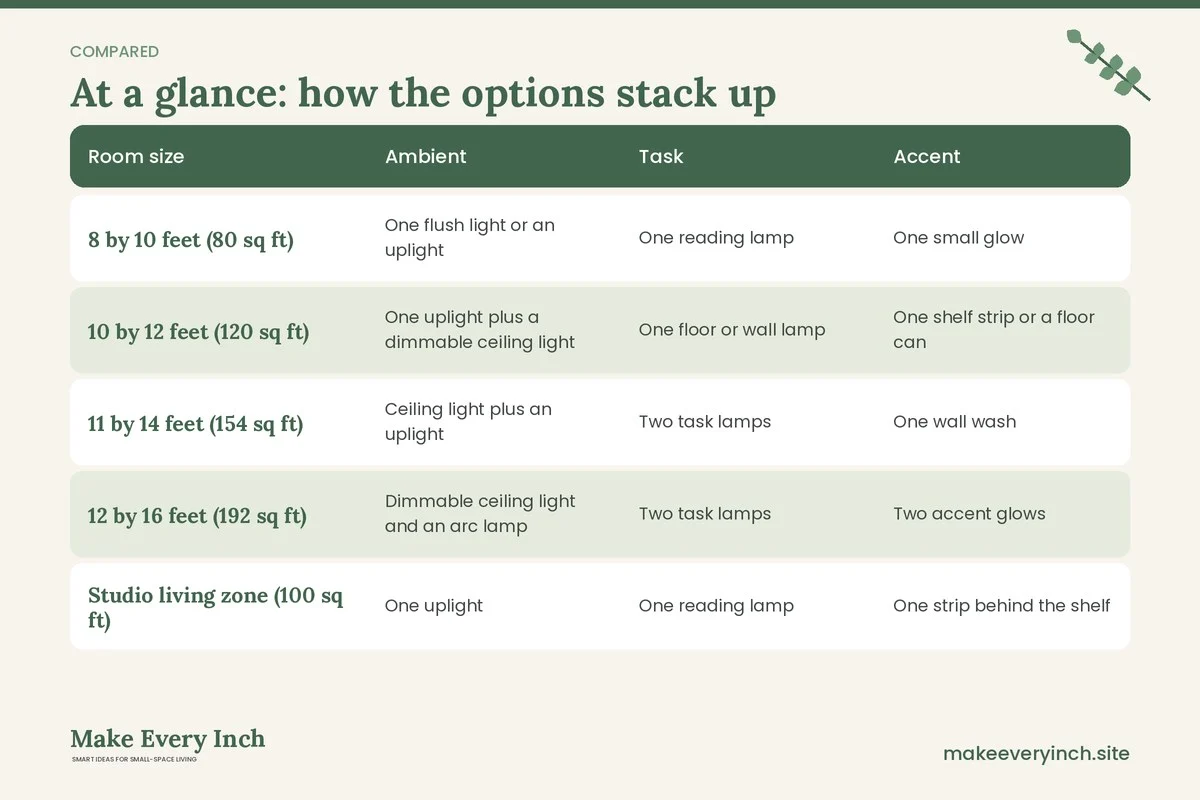
Comparison table: how many fixtures does your room need?
Use the table as a rough filter. The columns assume a room with a single window and light-to-medium wall colors.
| Room size | Ambient | Task | Accent | Total lumens (hedged range) |
|---|---|---|---|---|
| 8 by 10 feet (80 sq ft) | One flush light or an uplight | One reading lamp | One small glow | About 800 to 1,600 |
| 10 by 12 feet (120 sq ft) | One uplight plus a dimmable ceiling light | One floor or wall lamp | One shelf strip or a floor can | About 1,200 to 2,400 |
| 11 by 14 feet (154 sq ft) | Ceiling light plus an uplight | Two task lamps | One wall wash | About 1,500 to 3,000 |
| 12 by 16 feet (192 sq ft) | Dimmable ceiling light and an arc lamp | Two task lamps | Two accent glows | About 1,900 to 3,800 |
| Studio living zone (100 sq ft) | One uplight | One reading lamp | One strip behind the shelf | About 1,000 to 2,000 |
Three example rooms
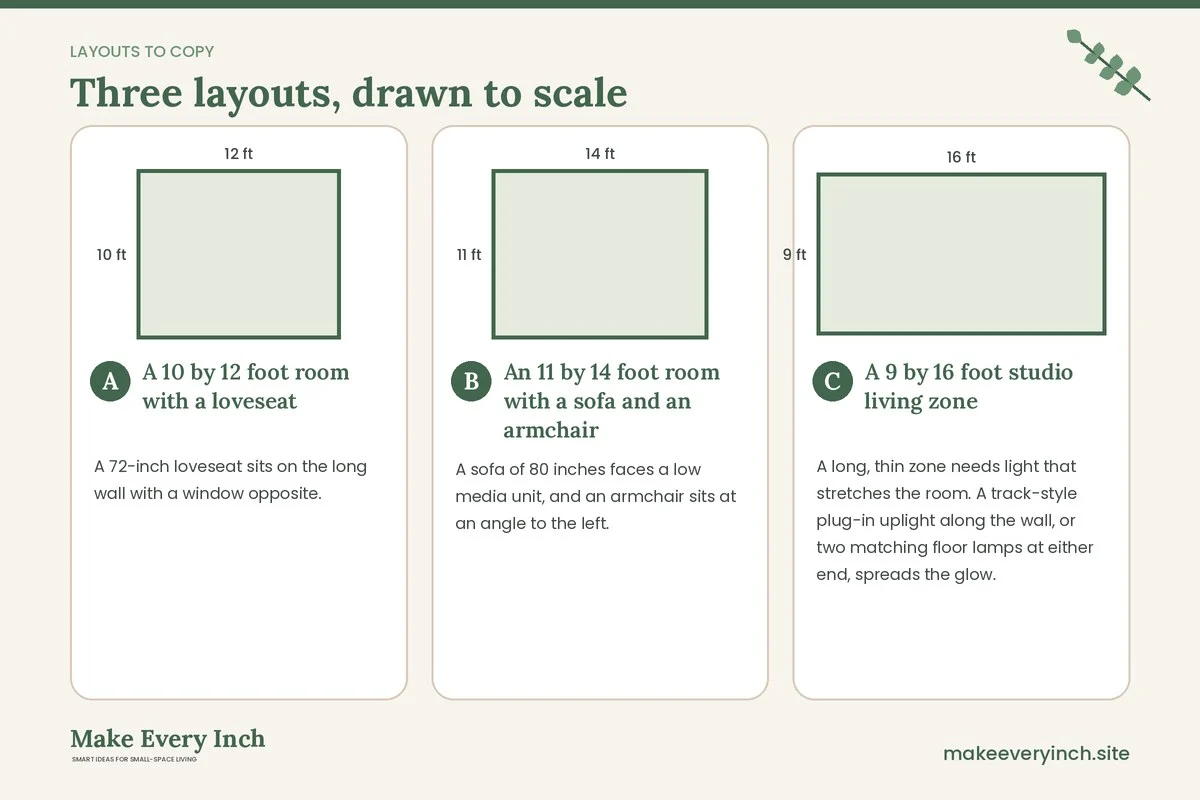
A 10 by 12 foot room with a loveseat
A 72-inch loveseat sits on the long wall with a window opposite. Replace the three lamps that were in the room with one floor lamp of about 800 lumens, placed 18 inches behind the right arm so the shade bottom sits about 44 inches off the floor. Keep the existing flush ceiling light and fit a dimmable warm bulb. Add a 150 lumen shelf strip behind the media console. That makes three sources and about 1,800 lumens in total, which sits in the middle of the range for the room.
An 11 by 14 foot room with a sofa and an armchair
A sofa of 80 inches faces a low media unit, and an armchair sits at an angle to the left. Put a swing-arm sconce above the armchair at about 54 inches from the floor, and an arc lamp over the sofa with a base 8 inches clear of the arm. Add a small uplight in the opposite corner behind a plant to wash the wall. Keep all bulbs at the same temperature. The arc lamp handles the ambient layer and the sconce handles the task, so the room only needs two switches.
A 9 by 16 foot studio living zone
A long, thin zone needs light that stretches the room. A track-style plug-in uplight along the wall, or two matching floor lamps at either end, spreads the glow. Put one floor lamp near the sofa and one near the window, and a bright overhead option on its own switch for cleaning. A single power strip at the sofa end with a rated surge protector controls both lamps. Keep a clear 30 inch path along the lamp side of the room.
Electrical safety for a minimalist setup
Fewer lights does not mean fewer rules. A tidy room should also be a safe one.
- Respect the wattage limit: check the label on every lamp socket and fixture and never exceed it. Using an LED with a lower real wattage than the limit is fine, but never use a bulb with a higher real wattage than the label permits.
- Do not overload outlets: a single outlet should not run several high-draw devices at once. Do not plug a power strip into another strip, and avoid running heaters and large appliances on the same strip as lamps.
- Check cords: replace any cord that is cracked, frayed or hot to the touch. Keep cords out from under rugs and away from furniture feet, and do not run them across doorways where people walk.
- Use dimmers rated for your bulbs: an LED bulb on a dimmer that was designed for older bulbs may flicker or buzz. Check the packaging for compatibility.
- Keep fabric shades clear of the bulb: a minimum gap around the bulb prevents heat from scorching the shade. Paper or fabric should never touch a hot bulb.
- Hire a licensed electrician for hardwiring: installing a new ceiling fixture, a hardwired sconce, a wall dimmer or a new circuit is work for a licensed electrician. Turn off the breaker for any work you do yourself, such as bulb changes, and wait for the bulb to cool.
- Keep LED strip power supplies ventilated: do not bury them in fabric or tape them in a closed box.
Color, finish and material choices
A minimalist plan benefits from restraint in the lamps as well as in the count. Choose finishes that match the furniture: a white shade near a white wall, a black base next to a black frame, a wood base next to a wooden table. A shade that is slightly translucent diffuses the bulb and spreads a gentle glow, and an opaque shade throws the light up and down. Choose the translucent one for a reading chair and the opaque one for a wall wash. Avoid shiny metallic finishes beside a window, since they reflect daylight and create glare.
Shapes matter too. Cylinders, spheres and plain cones sit quietly in a small room. A lamp with many arms, tiers or ornaments adds visual weight even if it is small. If you have a fixture you love but that is too ornate, keep it as the single decorative object and make everything else plain.
Daylight counts as a fixture
In the day the biggest light source is the window. Keep it clear of heavy curtains, and use a sheer or a light roller shade that can be pushed aside. Place the sofa or the reading chair where it receives side light instead of back light, so you do not need to switch on a lamp in the afternoon. A mirror placed on a wall perpendicular to the window can bounce daylight deeper into the room. For rooms that stay dim, our guide to dark apartment ideas shows how to combine daylight and bulbs.
Mistakes that undo a minimalist lighting plan
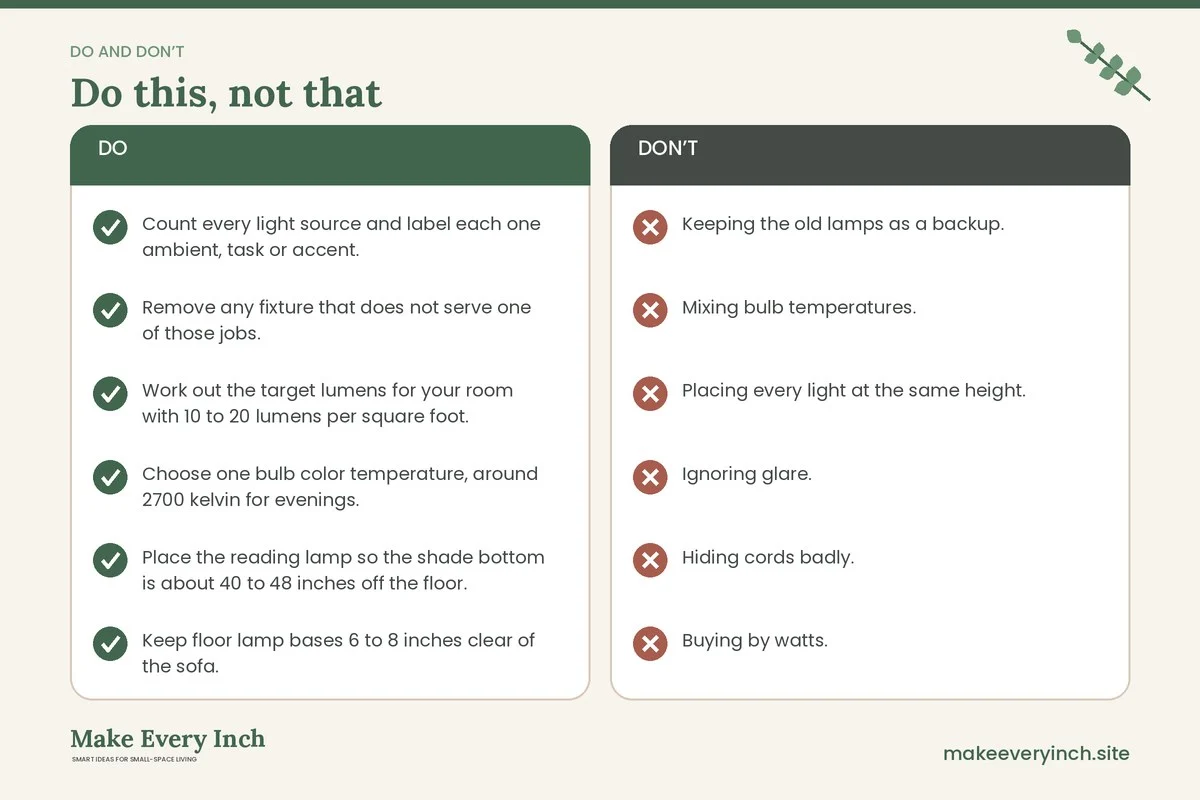
- Keeping the old lamps as a backup. If a lamp is not part of the plan, it should leave the room, or the clutter returns.
- Mixing bulb temperatures. A cool white bulb next to a warm one makes the walls look stained.
- Placing every light at the same height. A room lit only from the ceiling feels flat, so include at least one low source.
- Ignoring glare. A bare bulb in your line of sight is tiring. Use shades and angle the heads away from the seat.
- Hiding cords badly. A cord that runs diagonally across the floor does more harm than a visible lamp. Run cords along edges.
- Buying by watts. Compare lumens and kelvin, and check the wattage only as a safety limit.
- Overloading a power strip to keep it tidy. A neat strip is not a safe one if it is carrying more than it is rated for.
Minimalist lighting checklist
- Count every light source and label each one ambient, task or accent.
- Remove any fixture that does not serve one of those jobs.
- Work out the target lumens for your room with 10 to 20 lumens per square foot.
- Choose one bulb color temperature, around 2700 kelvin for evenings.
- Place the reading lamp so the shade bottom is about 40 to 48 inches off the floor.
- Keep floor lamp bases 6 to 8 inches clear of the sofa.
- Add a dimmer or a dimmable bulb to the main light.
- Hide cords along the baseboard with clips, never under a rug.
- Check the maximum wattage label on every lamp socket.
- Use a rated, surge-protected strip, and never chain strips.
- Group the lights into an evening scene and a bright scene.
- Call a licensed electrician for any hardwired change.
FAQ
How many lights does a small minimalist living room need?
Most small rooms work well with three or four sources: one ambient, one task and one or two accents. The exact number depends on the room size, the wall color and how much daylight you get.
What brightness should I aim for?
A planning range for living rooms is roughly 10 to 20 lumens per square foot across all sources. Lighter rooms can sit toward the low end, and darker rooms toward the high end. Use dimmers to fine-tune.
Are floor lamps or table lamps better in a minimalist room?
A floor lamp keeps surfaces clear, which suits a minimalist plan. A table lamp works when a side table already exists. Choose according to where you need the light and whether you want to keep the surfaces bare.
Can I use LED strips in a living room?
Yes, if they are warm white, powered by the supplied adapter and installed where the power supply can stay ventilated. Hide the strip behind a lip or a shelf so only the glow shows.
What bulb color is best?
Warm white at about 2700 kelvin suits most evening living rooms. A slightly cooler tone around 3000 kelvin is a hedged option if you use the room for daytime tasks.
Do I need an electrician?
You can change bulbs and plug in lamps yourself. Hardwiring a new ceiling light, a sconce or a wall dimmer should be done by a licensed electrician.
How do I stop a minimalist room feeling cold?
Keep the bulbs warm, use soft shades and add one texture, such as a linen shade or a wool throw. Soft light at a low height warms a plain room more than any decoration.
Keep going: Keep planning with our minimalist apartment ideas, cozy small living room ideas, minimalist edition and small living room storage ideas.
Save this guide for later
Pin the ideas you like to Pinterest so you can come back to them when you plan your space.