Studio Apartment Ideas for Renters
Quick answer: The best studio apartment ideas for renters are reversible: freestanding furniture, tension rods, plug-in lighting, rugs, removable adhesive products and fabric dividers. Read your lease first, document the room’s condition with dated photos, ask in writing before you change anything permanent, and favor pieces you can take to your next home. Keep exits clear and anchor tall furniture with permission.
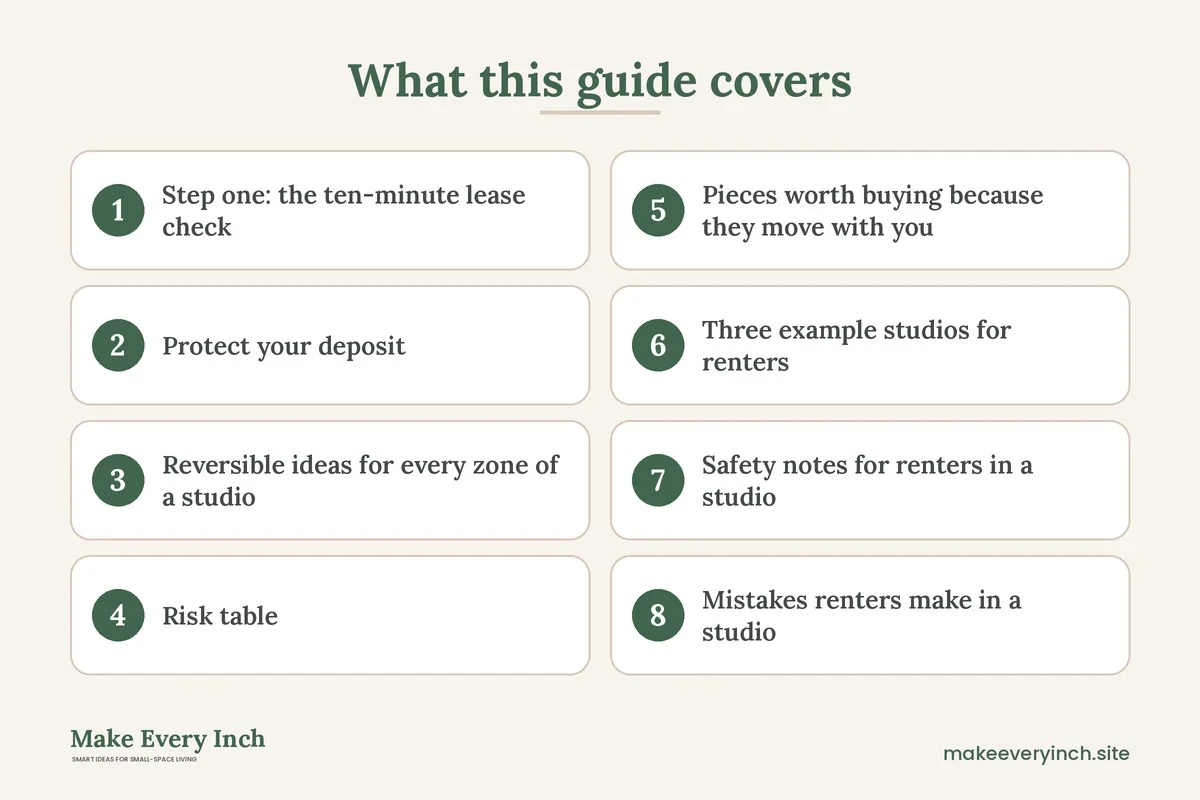
Studio apartment ideas for renters start with a different question from the usual design advice. Instead of asking what would look best, ask what you can undo, what you can take with you and what could cost you part of your deposit. A studio makes this more pressing, because one room carries your bed, your kitchen counter and your desk, so every change is visible and every mark is noticed at move-out. This guide covers a lease check you can do in ten minutes, a deposit protection routine, reversible ideas for each zone, a risk table, take-with-you pieces, three example studios, safety notes and a checklist. For the full overview, see our main guide to studio apartment ideas, then pair this post with our broader renter-friendly apartment decorating ideas and the companion read on studio apartment ideas on a budget.
Step one: the ten-minute lease check
Before you buy a single hook, read the parts of your lease that govern changes to the unit. Leases differ, and local rules differ too, so treat this as a checklist of questions rather than legal advice. If anything is unclear, ask your landlord or property manager, and keep the answer in writing.
- Alterations clause: Does the lease forbid nails, screws, paint, wallpaper or fixtures? Some allow small nail holes, others forbid anything on the walls.
- Painting and wall coverings: Is paint allowed, and if so, must you restore the original color before you leave?
- Window treatments: Are there rules about what can be seen from outside or about hardware on the frames?
- Flooring: Are rugs allowed over every type of floor? Some floors need a specific kind of pad.
- Light fixtures and appliances: Can you swap a fixture, install a ceiling fan or add a plug-in appliance with a high load?
- Security deposit terms: What counts as normal wear, and what counts as damage? What is the notice period for the move-out inspection?
- Common area and balcony rules: Are there limits on what you can store in hallways or on a balcony?
- Pets and smoke: Candles, incense and heaters may be restricted, and a studio concentrates smells.
- Approval process: Is permission needed in writing, and who gives it?
If a rule is vague, ask a specific question. “May I mount a bookcase to a stud using the anti-tip strap supplied by the manufacturer?” is better than “May I hang things?” Keep a copy of the reply with your lease.
Protect your deposit: document, then decorate
A deposit dispute is mostly a dispute about evidence. A few minutes of record keeping when you move in, and again when you change things, can save a long argument at move-out.
Photograph the room before you change it
Take wide shots of each wall and floor area, and close-ups of existing scuffs, marks, stains, chips and worn spots. Photograph appliances, the inside of cupboards and the windowsills. Make sure the photos carry a date, and email them to yourself and to your landlord with a note such as “Condition on move-in.” Keep the email.
Use a simple change log
For each change, write the date, what you did, which product you used and how you plan to undo it. If you stick a hook to the wall, note the type and the wall surface. If you hang a curtain on a rod, note the rod’s fixing method. A log stops you from forgetting what you did two years from now.
Test adhesives in a hidden spot
Paint finishes vary. Some peel with tape, others lift when you remove an adhesive. Test any removable adhesive product in a hidden area for a few days before you use it in a visible spot. Follow the manufacturer’s weight rating and wall-surface guidance, and stay well below the limit.
Remove things gently
Peel adhesive strips slowly, stretching them along the wall as directed, rather than pulling them away from it. Use low heat if the instructions recommend it. Clean any residue with the cleaner the product maker suggests, and test it on a hidden spot first.
Do a pre-move-out walk-through
About a month before you leave, walk through with your photos and your change log. Remove adhesive items, fill any holes only if the lease allows, clean thoroughly, and take a second set of dated photos. If your landlord offers a pre-inspection, accept it.
Reversible ideas for every zone of a studio
A studio has four jobs to do: sleep, sit, work and eat. Each zone has renter-friendly options. Choose according to your lease, and always check weight ratings.
The sleep zone
1. A freestanding bed frame with storage
A frame with drawers uses the space under the mattress, so you can skip a dresser. Because it is freestanding, it leaves no marks on the wall. See our guide to best beds with storage for what to look for.
2. A headboard that leans or hangs from the frame
A padded panel that attaches to the bed frame or leans against the wall adds a finished look with no fixings in the wall. Make sure it cannot slide forward onto the sleeper.
3. Clip lights and plug-in sconces
Plug-in wall lamps with a long cord, or clamp lights on the bed frame, replace bedside lamps. Hide cords with channels or clips that stick to the baseboard. Our post on renter-friendly lighting ideas covers more.
4. A curtain around the bed
A curtain on a ceiling-height tension rod can enclose a sleeping nook. Hang it so you can pull it aside in seconds and keep it away from heaters. This is a softer divider than a bookcase and easier to take down.
The living zone
5. A rug with a pad
A rug defines the living area on a bare floor and protects the surface under the sofa. Use a pad that is safe for your floor type, since some rubber backings can stain certain finishes. Check the lease if your floor is delicate.
6. A sofa with legs and a slim profile
A sofa with exposed legs shows floor underneath, which makes the room feel bigger. Choose one that fits through your door and hallway, since you will have to move it again. Felt pads under the legs protect the floor.
7. A storage ottoman
An ottoman is a seat, a table and a hiding place for blankets or papers. For more, read our guide to the best storage ottomans.
8. A freestanding shelf unit as a divider
A bookcase that stands between the sleep zone and the living zone saves you from putting up a wall. Choose one that is open at the back so light passes, and keep it low enough to see over if you can. A unit that is taller than about 4 feet should be anchored to the wall, with permission, or else replaced with a shorter one.
The work zone
9. A desk that folds or tucks
A drop-leaf desk or a narrow console serves as a desk by day and a shelf by night. Both avoid wall fixings and take up little floor space.
10. A lap desk on a tray
A tray for the laptop, with a cushion beneath, turns the sofa into a work spot when you do not have space for a desk. Store it under the sofa.
11. A monitor stand that doubles as storage
A small shelf over the desk surface keeps cables and notebooks off the work area. Choose a freestanding version.
The eating zone
12. A drop-leaf or gateleg table
A table that folds to 10 to 12 inches deep along a wall opens to seat two or four. Pushed against the wall, it takes almost no floor space.
13. A rolling kitchen cart
A cart adds counter space and storage without altering the cabinets. Choose one with locking wheels so it stays put when you chop.
14. Tension-rod and over-the-door storage in the kitchen
A tension rod under the sink holds spray bottles, and an over-the-door rack holds foil and wraps. See our renter-friendly kitchen storage ideas for more.
Walls, windows and cords
15. Renter-friendly wall decor
Lean framed art on a shelf or the floor, use removable adhesive products within their weight limits, or hang a lightweight tapestry with a tension rod. Our guide to renter-friendly wall decor ideas goes into more detail.
16. Window film and curtains
A privacy film that clings with water can soften a view onto a neighbor, and curtains on a tension rod add color. Check the lease about frames and hardware. Our post on renter-friendly window treatment ideas covers options.
17. Cord management without fixings
Stick-on cable clips, fabric sleeves and baseboard channels keep cords off the floor and out of sight. Our guide to renter-friendly ways to hide cords explains the details.
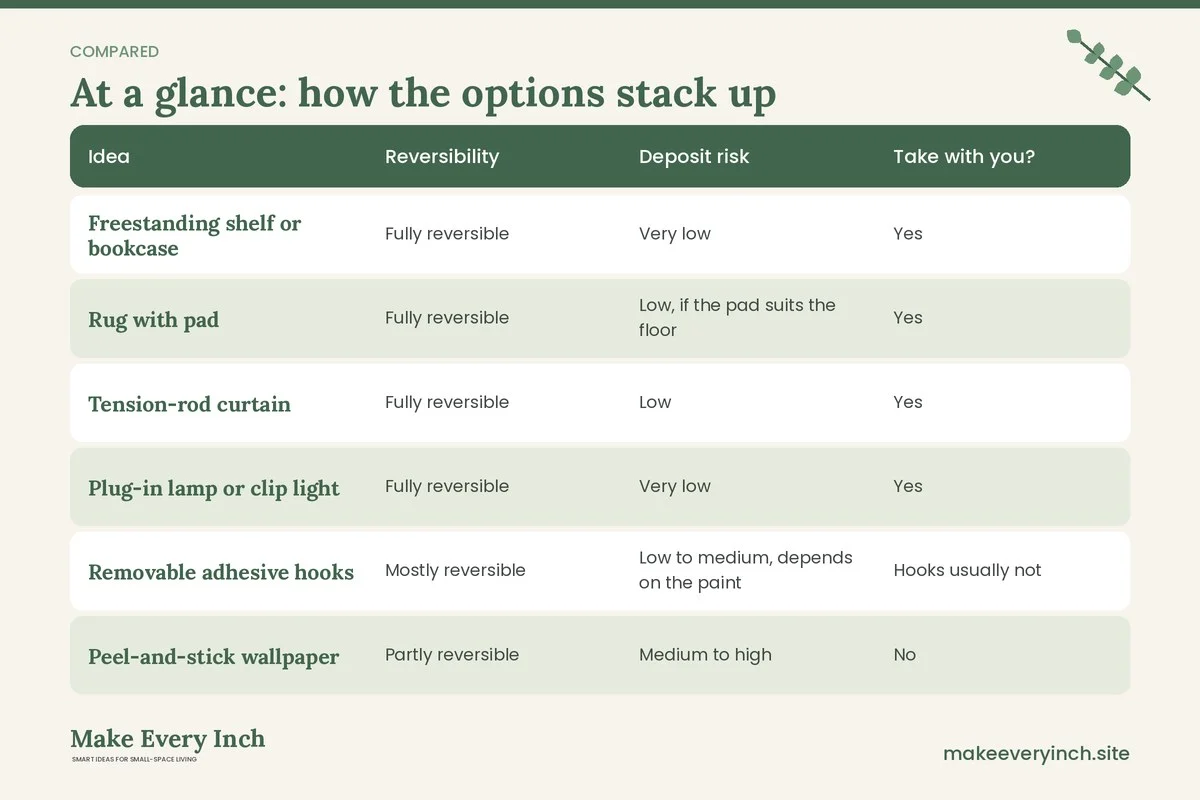
Risk table: how reversible is each change?
Use the table to rank any idea before you commit. Reversibility depends on your walls, floors and lease, so treat it as a starting point.
| Idea | Reversibility | Deposit risk | Take with you? |
|---|---|---|---|
| Freestanding shelf or bookcase | Fully reversible | Very low | Yes |
| Rug with pad | Fully reversible | Low, if the pad suits the floor | Yes |
| Tension-rod curtain | Fully reversible | Low | Yes |
| Plug-in lamp or clip light | Fully reversible | Very low | Yes |
| Removable adhesive hooks | Mostly reversible | Low to medium, depends on the paint | Hooks usually not |
| Peel-and-stick wallpaper | Partly reversible | Medium to high | No |
| Painted walls | Reversible only by repainting | High unless approved | No |
| Drilled shelves or screws | Needs filling | High unless approved | Shelves yes, holes no |
| Replaced light fixture | Reversible if you keep the original | Medium, needs permission | Fixture yes |
Pieces worth buying because they move with you
A renter moves often, so the best purchases are the ones that fit the next home as well as this one. Before you buy, ask three questions: does it fit through a standard door, can I take it apart, and will it work in a different layout?
- Modular shelving: pieces that can be stacked, stood side by side or used as a divider adapt to a new floor plan.
- A bed with storage drawers: a sleeping place and a wardrobe in one, wherever you live.
- Lamps and a lighting set: they carry across any unit, and good light changes any room.
- Curtains and rods: buy panels wide enough for a larger window, since you can fold them to fit a smaller one.
- A drop-leaf table: it works as a desk, a dining table or a console.
- Storage bins and baskets in matching sizes: consistency lets you reorganize in minutes.
- A rug in a neutral pattern: it works with many palettes.
- A mirror that leans: it moves easily, and no wall repair is needed when it leaves.
Avoid items cut for one room, such as a unit built to fit one alcove. They look good, but they rarely fit again.
Three example studios for renters
A 350 square foot studio in an older building
The lease allows two small nails per wall but forbids paint. The renter documents the scuffs, then puts a freestanding bookcase between the bed and the sofa, anchored to a stud with written permission. A rug marks the living zone. A tension-rod curtain covers a closet that has lost its door. Lighting comes from plug-in lamps and a floor lamp, and a cord channel hides the TV wires. At move-out, everything leaves with the renter.
A 280 square foot studio with no wall fixings allowed
The lease forbids any hole or adhesive on the walls, so the renter leans a large mirror on the floor, secured so it cannot tip. A drop-leaf table sits against the wall. The bed has built-in drawers and a headboard that leans on the frame. A rolling cart holds cooking tools, and an over-the-door rack holds coats. A fabric screen made from panels divides the sleeping area from the entrance. The room needs no repair when the lease ends.
A 420 square foot studio with a shared laundry hallway
The renter has a long, narrow room. A pair of curtains hangs on ceiling-height tension rods on either side of the window, and a daybed serves as a sofa and a guest bed. A slim console behind the daybed carries a lamp and a basket for keys. Storage bins fit beneath the bed, and a low shelf runs along the wall. The renter keeps the path to the entry clear at 36 inches and checks that the dividers do not block the way to the window.
Safety notes for renters in a studio
A studio puts everything in one room, so the safety basics matter even more for renters, who may not control the wiring or the alarms.
- Keep egress clear. Whatever you use to divide the room, never block the path to the door or a window that might serve as an emergency exit. Choose dividers you can move in seconds.
- Anchor tall furniture. Bookcases, wardrobes and tall shelves can tip. Ask your landlord for permission to anchor them, and use anti-tip hardware made for the purpose. If you cannot anchor, choose lower furniture and keep heavy items low.
- Respect electrical limits. Use surge-protected power strips, never daisy-chain them, and keep cords out of walkways. Do not run cords under rugs. If an outlet feels warm or sparks, stop using it and tell your landlord.
- Keep heat sources clear. Curtains, screens and bedding should stay away from heaters and stoves.
- Ventilate. Use low-VOC products if you paint or refinish anything with permission, and open windows. A studio with cooking, sleeping and washing in one space needs fresh air.
- Never drill without permission. Written permission protects you. If the landlord says no, use a freestanding option.
- Smoke and carbon monoxide alarms. Do not remove or cover alarms. Test them regularly, and report faults to your landlord.
Mistakes renters make in a studio
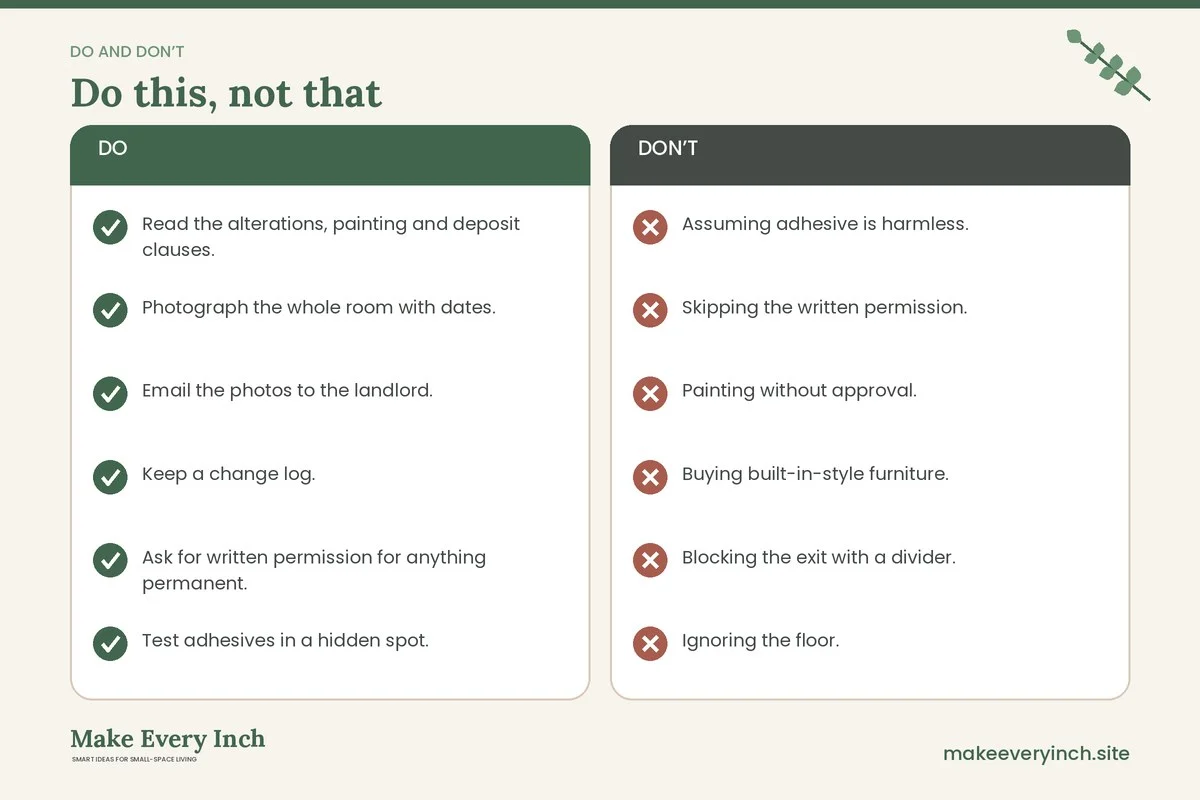
- Assuming adhesive is harmless. Some wall finishes lift paint when you remove a hook. Test first.
- Skipping the written permission. A spoken yes is hard to prove at move-out.
- Painting without approval. Repainting a wall to its original color often costs more time and money than people expect.
- Buying built-in-style furniture. Pieces cut to fit one alcove rarely fit the next home.
- Blocking the exit with a divider. A beautiful screen is not worth a blocked path.
- Ignoring the floor. A heavy frame on bare floor can scratch it, so use felt pads and a rug.
- Forgetting to photograph the room. Without a record, it is your word against a landlord’s.
A renter’s timeline
- Before you move in: read the lease, ask questions, and photograph every wall, floor and appliance.
- First week: measure the room, test layouts, and send your photos to the landlord.
- First month: add freestanding pieces, lamps, a rug and curtains. Log each change.
- Mid-lease: review what still bothers you, ask in writing for any change that needs approval, and avoid permanent fixes.
- One month before move-out: remove adhesive items, clean, photograph, and request a walk-through.
- Move-out day: compare the room to your first photos and keep copies of every document.
Checklist
- Read the alterations, painting and deposit clauses.
- Photograph the whole room with dates.
- Email the photos to the landlord.
- Keep a change log.
- Ask for written permission for anything permanent.
- Test adhesives in a hidden spot.
- Choose freestanding furniture first.
- Check exits and keep paths at 30 to 36 inches.
- Anchor tall furniture with permission, or choose lower pieces.
- Use surge-protected strips and keep cords tidy.
- Pick pieces that will fit your next home.
- Do a walk-through before moving out.
FAQ
Can I paint a rental studio?
Only if the lease or your landlord allows it. Ask in writing, and ask whether you must repaint before you leave. Use low-VOC paint and ventilate well.
How do I divide a rental studio without drilling?
Use a freestanding bookcase, a folding screen, or a curtain on a tension rod. Keep exits clear and anchor tall pieces with permission. For more ideas, read our guide to renter-friendly ways to divide a studio apartment.
Are adhesive hooks safe for my deposit?
They are lower risk than nails, but they can lift paint on some walls. Test in a hidden spot and stay within the weight rating. Remove them slowly.
Do I need permission to anchor a bookcase?
Usually yes, because anchoring means a small hole. Ask in writing. Safety is a good reason, and many landlords agree. If they say no, choose a lower piece.
What should I take photos of when I move in?
Every wall, floor, window and appliance, plus close-ups of existing marks. Date them and email them to your landlord.
What furniture is best for a renter who moves often?
Modular and freestanding pieces, such as shelves, a bed with drawers and a drop-leaf table, because they adapt to new layouts. Our guide to DIY room divider ideas for studio apartments has options that take apart easily.
Keep going: Keep planning with our no-drill storage ideas for renters, small apartment living room ideas for studios and small space organization ideas.
Save this guide for later
Pin the ideas you like to Pinterest so you can come back to them when you plan your space.