16 Small Bedroom Ideas Japandi Style for a Calm, Uncluttered Sleep Space
Quick answer: The best small bedroom ideas japandi style combine a low bed, a quiet palette of warm white, oat and soft charcoal, natural materials such as wood, linen and paper, and very few objects on show. Keep 24 to 30 inches of clear floor on the main side of the bed, hide most storage, use warm 2200 to 2700 K light at low height, and let one wall stay almost empty.
Small bedroom ideas japandi style work especially well because a bedroom has one job, which is rest, and Japandi is a design approach built around calm. It blends the clean lines and warmth of Scandinavian rooms with the restraint, craft and natural materials of Japanese interiors. In a small bedroom that means fewer things, lower furniture and softer light, so the room feels larger and quieter at night. This is a bedroom guide, not a living room guide, so every idea here is judged by one question: does it help you fall asleep and wake up in a room that feels spacious? You will find a palette plan, bed placement and measurements, 16 ideas, a materials table, lighting and safety notes, three example rooms, a four-week plan, a checklist and an FAQ. For the wider topic, read our main guide to small bedroom ideas, and if you rent, our guide to small bedroom ideas for renters shows how to do all of this without damaging walls.
What Japandi means in a bedroom
Japandi borrows two ideas. From Japan comes the principle that empty space is useful, that objects should be well made and that a room should feel grounded and low. From Scandinavia comes the habit of softening that restraint with warm light, pale wood and cozy textiles. In a living room the mix can be decorative. In a bedroom it becomes practical, because the same qualities help you wind down: fewer visual signals, gentler contrast and natural materials that feel good against the skin.
You do not need to buy a themed collection. Japandi in a small room is mostly subtraction. Clear the surfaces, pick a narrow palette, choose a few honest materials and give each item a purpose. If you already own a plain bed, a wooden stool and linen bedding, you are halfway there. For a broader look at the style across a home, see our guide to Japandi apartment ideas.
Start with the quiet palette
A small bedroom looks calmer when the colors sit close together. Choose a base, a warm mid-tone and one dark accent, and keep everything else within those three families.
- Base: warm white, soft cream or pale greige on the walls, bedding and curtains. Avoid stark blue-white, which can feel cold at night.
- Mid-tone: oat, sand, light oak or soft clay in the rug, the headboard and the nightstand.
- Accent: charcoal, deep olive or near-black in one or two small items, such as a lamp base, a frame or a ceramic vase. The dark note gives the eye a place to rest and stops the room from looking washed out.
Keep patterns quiet. A fine stripe, a subtle weave or a visible linen texture adds depth without noise. If you want a wall color, choose a soft, matte, muted shade, and apply it with the window open or a fan running, because fresh paint gives off fumes. Look for a low-VOC formula and follow the label’s drying and ventilation times before you sleep in the room. If you rent, ask before painting, or use the ideas in removable wallpaper ideas as a reversible alternative.
Bed placement and measurements
In a small room the bed decides everything, so start there. These measurements are common starting points, and your own room, door swing and window position may change them.
- Walkway: aim for 24 to 30 inches of clear floor along at least one long side of the bed, and about 18 to 24 inches on the other. Tighter than 18 inches and making the bed becomes a chore.
- Door and drawer clearance: a door that swings in needs its full arc free. Drawers need roughly their own depth plus 12 inches of standing room.
- Bed height: Japandi favors low beds. A top-of-mattress height of about 16 to 22 inches keeps the room feeling taller, though anyone with a bad back or knees may prefer a higher seat.
- Headboard wall: place the head against the wall that has no window or radiator if you can, with the bed centered under or away from any window to avoid drafts and glare.
- Bedside gap: leave 12 to 16 inches between the bed and a wall or a nightstand so a hand can reach a lamp, a glass and a book.
Tape the bed outline on the floor with painter’s tape and walk around it for a day. Open the wardrobe doors, the drawers and the room door. Adjust before you move anything heavy. Our guide to small bedroom layout ideas covers more layouts if the room is awkward.
16 small bedroom ideas japandi style
The bed and its surroundings
1. A low platform bed
A platform bed with a simple wooden frame sits close to the floor and lets the walls look taller. Choose one with clean lines and no tall headboard. If you need storage, a model with drawers underneath keeps the visual calm while holding bedding and off-season clothes. See our roundup of best beds with storage for what to look for.
2. A floor-level mattress on a slim base
A mattress on a low slatted base is a classic Japanese-inspired look and costs less than a full frame. Make sure the base lets air move beneath the mattress, and lift the mattress against a wall now and then to prevent damp, especially in cool rooms.
3. A headboard made from a wall treatment
Instead of a bulky headboard, use a painted arch, a wide wooden slat panel or a hung linen panel behind the pillows. The effect frames the bed without adding depth, which matters when the room is only a few inches wider than the bed. A slatted panel should be fixed securely, and if you rent, a leaning wooden screen or a fabric panel on a rod is a safer choice.
4. Tuck the bed into an alcove
If the room has a recess, slide the bed in so only one side or the foot is open. Add a shelf above at head height or higher, and keep it nearly empty. The alcove turns the bed into a quiet nest and frees floor space elsewhere.
Storage you do not see
5. Under-bed boxes in matching wood or fabric
Flat boxes in a single color keep the floor line clean. Label the ends with small paper tags and rotate seasonal clothes through them. Our post on small bedroom storage ideas goes deeper on what fits where.
6. A closed wardrobe with flat doors
A plain, closed front hides clutter, and a wardrobe in a pale tone melts into the wall. If there is no closet, a freestanding unit with sliding or flat doors saves floor space compared with swinging doors. Read small bedroom ideas without a closet for layouts that work.
7. One open shelf, styled lightly
Japandi accepts a few visible objects if they are chosen carefully. Keep one shelf for a plant, a ceramic bowl and a stack of books, and leave the rest of the shelf empty. Empty space is part of the design.
8. A bench at the foot of the bed
A low wooden or upholstered bench holds a folded blanket and doubles as a place to sit while dressing. Choose one that is about 14 to 18 inches deep, so it does not cramp the walkway at the foot of the bed.
Light and mood
9. Warm bedside lamps at low height
Two small table lamps or wall lights give a pool of light at head height. Use bulbs in the warm range, around 2200 to 2700 K, because cooler light can feel stimulating in the evening. Paper or linen shades diffuse the glow. For more, our small bedroom lighting ideas guide covers layers in detail.
10. A paper lantern or rice-paper pendant
A round paper shade softens an overhead light and costs little. Keep the bulb within the maximum wattage printed on the fixture, and keep paper well away from hot bulbs. Prefer a low-heat LED bulb for any enclosed or paper shade.
11. Dimmers or smart bulbs on a schedule
A dimmer lets you drop the light slowly in the hour before bed. If you rent, plug-in dimmers or bulbs with a built-in dim function avoid any wiring. Our guide on renter-friendly lighting ideas lists other plug-in options.
Textiles and surfaces
12. Linen bedding in two tones
Washed linen or cotton in oat and white feels relaxed, and the wrinkles look intentional. Layer a light quilt and one textured throw. Keep cushions to two or three, since each extra pillow adds mess.
13. A natural fiber rug that extends past the bed
A jute, wool or woven rug under the lower two thirds of the bed gives a soft landing. In a small room, a rug about 5 by 8 feet usually works with a double or queen bed. Use a thin non-slip pad, and check the rug edge does not catch a door.
14. Linen curtains hung high
Hang the rod close to the ceiling and let the curtains fall to the floor. Sheer layers in a pale tone soften the light by day, and a lined layer behind helps sleep at night. Choose curtains that skim the floor rather than puddle, since extra fabric collects dust.
Walls and the finishing details
15. One quiet piece of art
Choose one large calm piece, such as a simple line drawing, a landscape photo or a textile, and hang it low enough to relate to the bed. Leaving the other walls plain makes the one piece feel intentional.
16. Plants and branches over ornaments
A single leafy plant or a vase with a few dried branches brings the outdoors in without clutter. Use a plant that tolerates the light level in the room, and place it where watering is easy. Dried stems should be kept away from candles and heaters.
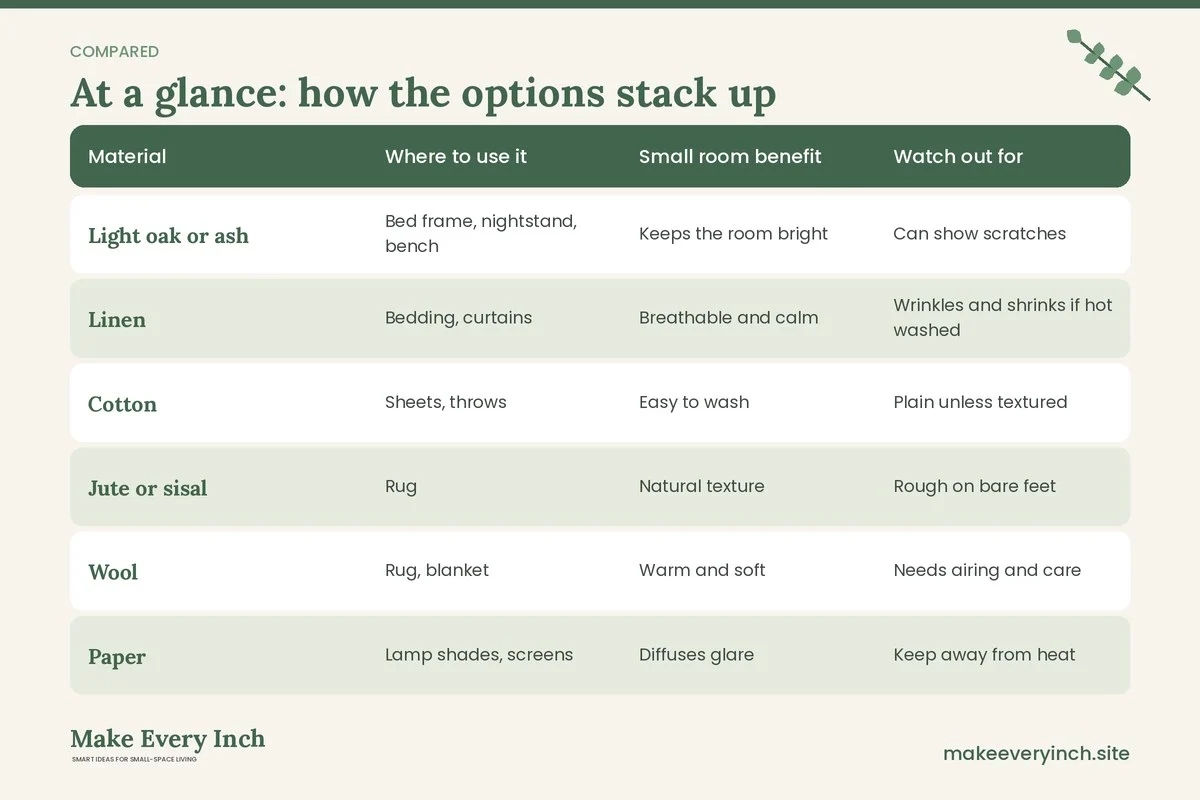
Japandi materials at a glance
The table compares common Japandi materials by how well they suit a small bedroom. Ratings are general, and your own taste and climate matter more than any chart.
| Material | Where to use it | Small room benefit | Watch out for |
|---|---|---|---|
| Light oak or ash | Bed frame, nightstand, bench | Keeps the room bright | Can show scratches |
| Linen | Bedding, curtains | Breathable and calm | Wrinkles and shrinks if hot washed |
| Cotton | Sheets, throws | Easy to wash | Plain unless textured |
| Jute or sisal | Rug | Natural texture | Rough on bare feet |
| Wool | Rug, blanket | Warm and soft | Needs airing and care |
| Paper | Lamp shades, screens | Diffuses glare | Keep away from heat |
| Ceramic | Lamp base, bowl | Adds weight and color | Heavy and breakable |
| Bamboo or rattan | Baskets, shelves | Light and flexible | Can splinter if cheap |
Anchoring and safety notes
Calm rooms should also be safe rooms. A few checks are worth making before you finish.
- Anchor tall furniture. Wardrobes, tall dressers and narrow bookcases can tip, especially if drawers are pulled open or a child climbs. Use the anti-tip hardware that came with the furniture, fix it into a stud or use an appropriate wall anchor for your wall type, and place heavier items low. If you rent, ask your landlord about anchoring, or choose lower pieces that stay stable on their own.
- Keep electrical loads sensible. Do not daisy-chain extension cords, and avoid covering plugs or cords with rugs. Use a surge-protected strip rated for the load, and keep chargers off the bed and bedding.
- Mind the heat. Paper shades, linen curtains and dried plants should sit away from bulbs, candles and heaters. Prefer LED bulbs and flameless candles in a bedroom.
- Ventilate after painting. If you do repaint, open windows, run a fan and wait until the smell has gone before sleeping there. Choose a low-VOC paint where available.
- Check the floor. Rugs on smooth floors need a non-slip pad, and low platform beds should have sturdy slats and legs.
Three example Japandi bedrooms
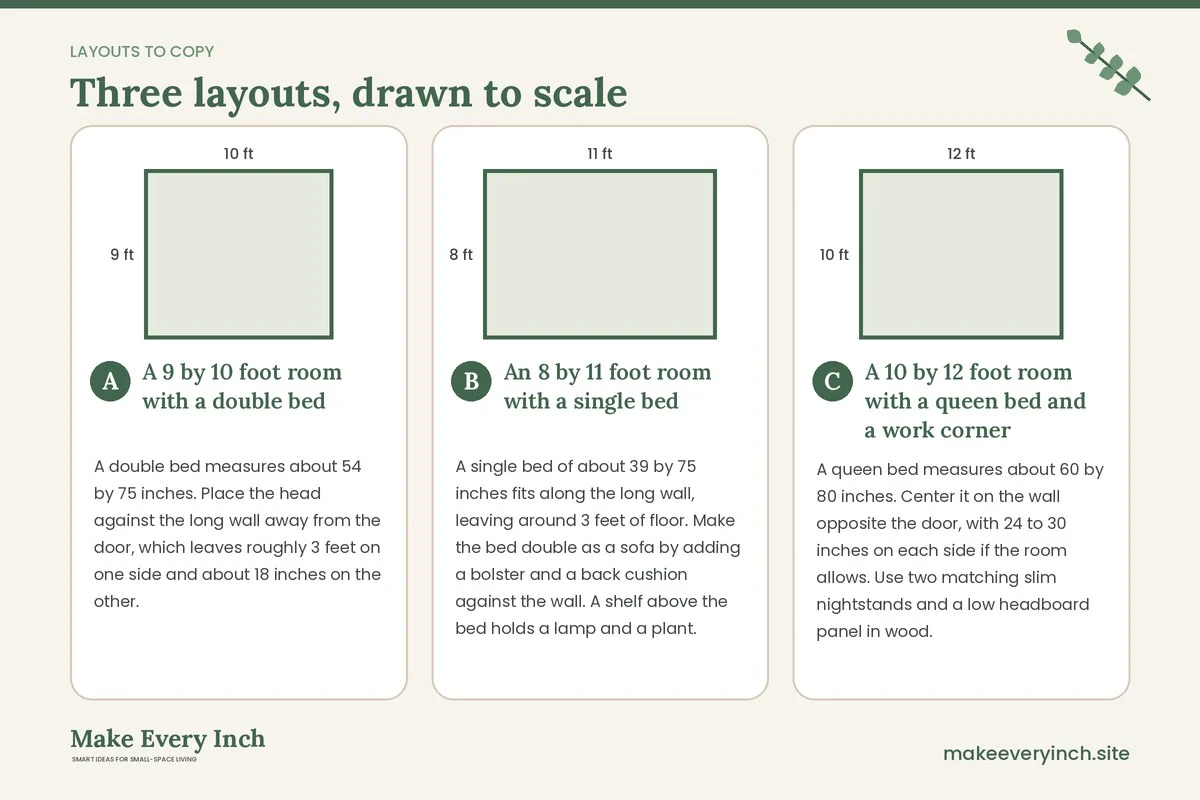
A 9 by 10 foot room with a double bed
A double bed measures about 54 by 75 inches. Place the head against the long wall away from the door, which leaves roughly 3 feet on one side and about 18 inches on the other. Use a low platform bed with drawers, a wall-hung shelf or slim nightstand on the wide side and a single wall light on the narrow side. Add a 5 by 8 foot rug that sits two thirds under the bed, linen curtains hung high and one large framed piece above the pillow. A closed wardrobe stands against the shorter wall, and a small bench goes under the window.
An 8 by 11 foot room with a single bed
A single bed of about 39 by 75 inches fits along the long wall, leaving around 3 feet of floor. Make the bed double as a sofa by adding a bolster and a back cushion against the wall. A shelf above the bed holds a lamp and a plant. A narrow ladder-style rail or a few wall hooks hold clothes in daily use. A pale round rug anchors the middle, and a slim desk or a floating shelf under the window works as a work or vanity surface. See small bedroom desk ideas for a few space-saving options.
A 10 by 12 foot room with a queen bed and a work corner
A queen bed measures about 60 by 80 inches. Center it on the wall opposite the door, with 24 to 30 inches on each side if the room allows. Use two matching slim nightstands and a low headboard panel in wood. The corner by the window holds a small desk and a stool in light oak. Keep the desk surface mostly bare and hide cables in a box. For more on this layout, see small bedroom ideas with a queen bed.
Declutter the Japandi way
Japandi does not ask you to throw everything away. It asks you to keep what you use and love, and to give each thing a home. The method below works in an hour or two and can be repeated seasonally.
- Empty one surface at a time. Start with the top of the nightstand, then the dresser, then the floor.
- Sort into three piles: keep and use, keep and store, let go. Do not create a fourth pile for “maybe”, or set a date by which the maybe pile must be decided.
- Return only the essentials. A lamp, a book and a glass of water are enough on a nightstand. Everything else lives in a drawer.
- Use one tray for small things. A shallow wooden or ceramic tray collects jewelry, a watch or keys, so the surface still looks tidy.
- Fold clothes upright. Vertical folding in drawers shows every item at once and saves space.
For more systems, see our post on small bedroom organization ideas.
A four-week plan
Spreading the work over a month keeps the cost low and the room livable. Adjust the order to your own priorities.
- Week 1: clear and plan. Declutter, measure the room, tape the bed outline and decide on your three-color palette. Wash or replace bedding in the new tones.
- Week 2: light and textiles. Swap harsh bulbs for warm ones, add a dimmer or a bedside lamp, hang higher curtains and lay down a rug.
- Week 3: storage and furniture. Add under-bed boxes, a closed wardrobe or a bench, and move any furniture that blocks the walkway. Anchor the tall pieces.
- Week 4: finishing touches. Hang one piece of art, add a plant, style a single shelf and remove everything that does not belong. Live in the room for a few nights before adding anything else.
Japandi bedroom checklist
- Choose a palette of three colors.
- Keep 24 to 30 inches of clear floor on the main side of the bed.
- Pick a low bed or a low base.
- Hide most storage behind flat doors or under the bed.
- Use warm bulbs of about 2200 to 2700 K at bedside.
- Add a dimmer or a lamp that can be turned down.
- Hang curtains high and to the floor.
- Lay a natural fiber rug under the lower two thirds of the bed.
- Limit bedding to two tones and a single throw.
- Anchor wardrobes and tall dressers.
- Keep paper shades and dried stems away from heat.
- Ventilate the room after painting.
- Leave one wall almost empty.
FAQ
Is Japandi good for a very small bedroom?
Yes. Its focus on low furniture, a narrow palette and open space tends to make small rooms feel larger. The main risk is making the room look sparse, so add warmth through textiles and soft light.
Can I do Japandi on a budget?
Yes. The style relies on restraint, so you often need fewer items. Start with bedding, bulbs and a rug, and add wood pieces slowly. Second-hand wood furniture can suit the look well.
What colors work best for small bedroom ideas japandi style?
Warm white, oat, sand, soft clay and a single dark accent such as charcoal or olive. Avoid lots of bright colors or strong patterns.
Do I need a low bed?
No. A low bed helps the room feel taller, but a standard bed in a simple frame works fine. Choose what is comfortable for your body and your mattress.
How do I add storage without clutter?
Use drawers under the bed, a closed wardrobe, labeled boxes and one open shelf. Keep the visible items few and meaningful.
What lighting is best for sleep?
Warm, dim light in the evening, ideally in the 2200 to 2700 K range, with a low bedside lamp or wall light. Keep brighter light for daytime and tasks. If you are sensitive to light, add lined curtains or a sleep mask.
How is this different from a Japandi living room?
A bedroom puts rest first, so the plan centers on the bed, the walkway, sleep-friendly light and soft textiles, while a living room has to seat people and hold a screen. Our small bedroom makeover ideas post shows how to apply a similar approach to a full refresh.
Keep going: Keep planning with our small bedroom ideas, small bedroom ideas for renters and small bedroom storage ideas.
Save this guide for later
Pin the ideas you like to Pinterest so you can come back to them when you plan your space.