Small Entryway Ideas with No Closet
Quick answer: The best small entryway ideas with no closet replace the missing closet with a vertical coat zone (a hook rail at 60 to 66 inches for adults), a freestanding rack or slim cabinet for overflow, a shoe tray or bench, and a seasonal rotation that moves off-season coats to another room. Plan for about 4 to 6 hooks per adult household member, keep 30 to 36 inches of clear floor, and anchor anything tall.
Small entryway ideas with no closet begin with a simple fact: a coat closet is just a hidden wall hook with a door on it, and almost every job it does can be done in the open with the right parts. Many apartments, older cottages and compact new builds open straight into a living room or a kitchen with nowhere to put a jacket, a bag or a pair of wet boots. The result is a pile on the nearest chair. This guide shows how to build a working coat zone from hooks, rails, freestanding racks and cabinets, how to size each piece, how to rotate coats by season so the zone never overflows, and how to keep the whole thing looking calm. For the wider topic, read our main guide to small entryway ideas, the deeper dive on small entryway storage, and the companion post on small coat storage ideas.
What a closet actually does, and how to replace each job
Before choosing furniture, list the jobs a closet performs, because a good substitute covers every one of them. A typical coat closet does five things. It hangs coats so they dry and keep their shape. It holds bags, hats and scarves on shelves. It hides shoes, umbrellas and sports gear. It stores off-season items. And it conceals all of this behind a door, so the entry looks tidy even when the contents are not.
Open storage can do the first three jobs very well, and with a little planning the fourth and fifth too. Hanging happens on hooks or rails. Small items live in baskets on a shelf above the hooks. Shoes live on a tray, a bench or a slim cabinet. Off-season items leave the entry altogether, which is the single most useful habit for a closet-free home. Concealment comes from a curtain, a cabinet door or a deliberately edited display, depending on your taste.
Write down what your household actually brings through the door. A couple in a mild climate may need only four coats and two bags in the entry at once. A family of four in a cold region may need eight coats, four hats, gloves and boots. The number of coats you must hold in the entry at one time, not the total in your wardrobe, drives every choice that follows.
Measure the wall before you choose
Stand in the entry and measure three things: the widest clear wall, the depth you can lose without blocking the door, and the height of any obstruction such as a light switch or a thermostat. These numbers decide what fits.
- Door swing: keep the arc of the front door clear. If the door opens against the only wall, look at the wall behind the door or the wall beside it instead.
- Clear floor: leave 30 to 36 inches of walkway from the door into the home. In a very tight space 28 inches can work for one person, though it feels snug with a stroller or a bag.
- Usable depth: a coat hanging on a hook sticks out about 8 to 12 inches. A freestanding rack with hangers needs 16 to 24 inches for coats to hang flat. A slim shoe cabinet is often 7 to 10 inches deep.
- Wall width: allow 6 to 8 inches of rail length per hook for bulky coats, or 4 to 5 inches for light jackets and bags.
- Hook height: 60 to 66 inches from the floor for adult coats, 44 to 52 inches for a second, lower row that suits shorter adults and teens.
Photograph the wall and mark the position of each piece with painter’s tape before you buy anything. Stand at the door and pretend to hang a coat. If you bump the door, the tape is in the wrong place.
Ten ways to replace a coat closet
Hooks and rails
1. A single hook rail
A rail is a board with several hooks, and it is the cheapest and most flexible closet substitute. Mount it at 60 to 66 inches off the floor, and choose a board long enough for one hook every 6 to 8 inches. A rail of 36 inches holds four to five coats. Attaching to wall studs matters if you hang heavy wool coats or a loaded bag. Because a rail spreads weight over several fasteners, it is more forgiving than single hooks.
2. Double-height hooks
Two rows of hooks, one at 62 inches and one at 48 inches, double the capacity without adding wall width. The upper row holds long coats, and the lower row holds bags, scarves and shorter jackets. Stagger the hooks so garments do not stack on each other. This is a good layout when your wall is narrow but tall.
3. Over-the-door hooks
If you rent, an over-the-door hook set uses the back of the door and needs no drilling. Check that the door still closes and that the hooks do not scrape the frame. Over-the-door hooks work for light jackets and bags, but heavy wool coats can stress the door, so keep loads modest.
4. A hanging rail on a tension rod
A tension rod wedged across an alcove, a short hall or a window recess makes an instant coat rail. Hang a curtain in front of it, and the coats disappear. This is the nearest thing to a closet that costs very little, and it is removable. Use a rod rated for the weight, and place it tight at the correct height, about 66 to 70 inches for long coats. A tension rod suits light and medium loads rather than a winter of heavy parkas.
Freestanding options
5. A freestanding coat rack
A rack with a stable base takes no wall space and can move. Choose one with a wide, heavy foot, and keep the load balanced, because a rack loaded on one side can tip. A rack with hooks at several heights holds more than a single pole. Place it in a corner where the base cannot be kicked, and keep it out of the walkway. A rack tolerates about four to six light garments, though a heavy load needs a wall mount.
6. A garment rail with a shelf
A small clothes rail, like those used in shops, gives you a hanging bar at 60 inches and a shelf or shoe rack below. It holds the coats of a family well. Hang only what you wear this season, and tuck a basket on the lower shelf for gloves and hats. A rail on wheels can be pushed to the side when you need floor space.
7. A hall tree
A hall tree combines hooks, a bench and sometimes a mirror. It is a one-piece answer to the closet question. Measure carefully, because many are deeper than the 12 inches you might have. Tall hall trees are top heavy, so anchor them to the wall with the hardware provided, and read the section on safety below.
Cabinets and enclosed storage
8. A slim coat cabinet
A narrow cabinet 16 to 20 inches deep with a hanging rod inside is the closest thing to a real closet. Doors hide the contents, and the top is a landing spot for keys. Look for models with a rod and a shelf, or fit a small tension rod yourself. In a tiny entry, a cabinet that is 20 inches deep and 30 inches wide can hold four to six coats.
9. A wardrobe in an adjacent room
If the entry is too small, move the coat function next door. A wardrobe or a shelf unit in the hall, living room or bedroom nearest the door can serve as the closet. Keep a single hook by the door for today’s coat, and store the rest in the wardrobe. This split is handy in studios where the entry is a corner of the main room. Our guide to no entryway apartment ideas covers this layout.
10. A built-in nook or alcove
An alcove 24 to 36 inches wide, a space beside a chimney or the area under stairs can become a coat nook with a rod, shelves and a curtain. Line it with a coat of low-VOC paint, ventilate while it dries, and add a light so you can see inside. Under stairs, the sloping space suits a row of hooks at the tall end and a shoe tray at the low end.
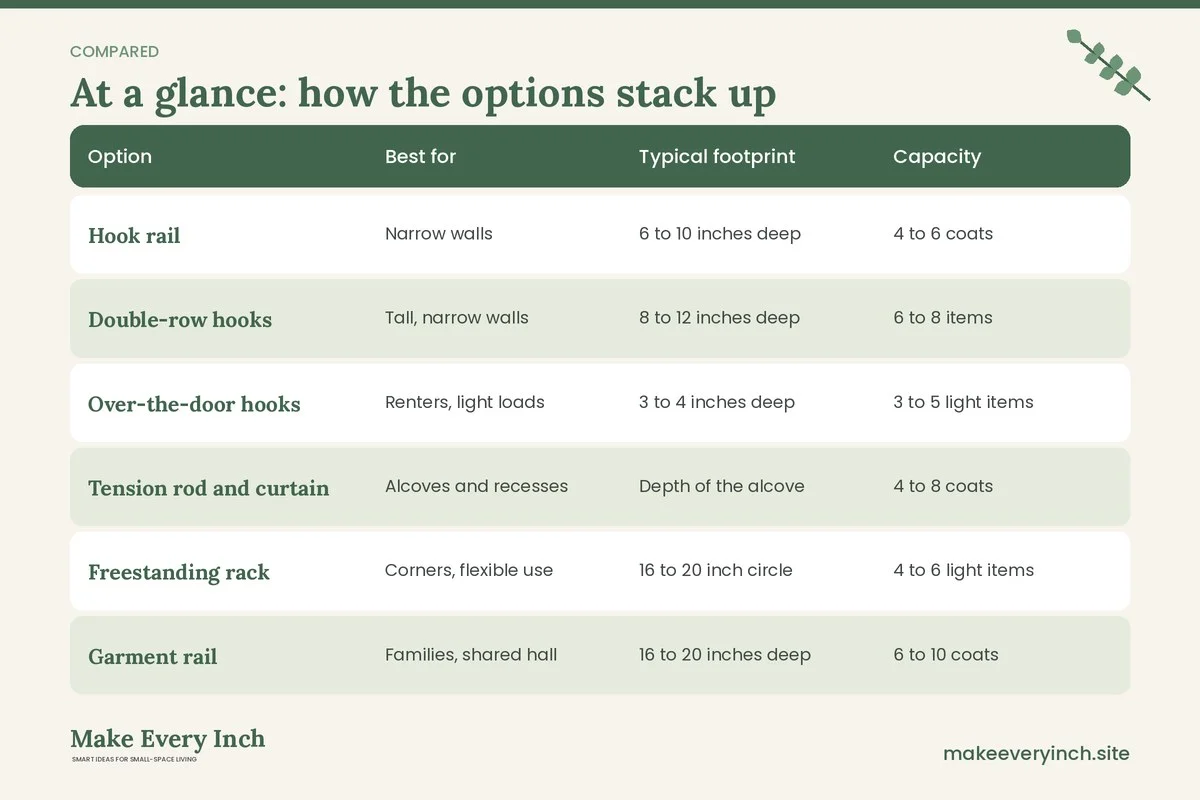
Comparison table: closet substitutes at a glance
The table below compares the main options so you can choose by wall, load and effort.
| Option | Best for | Typical footprint | Capacity | Drilling needed |
|---|---|---|---|---|
| Hook rail | Narrow walls | 6 to 10 inches deep | 4 to 6 coats | Yes, ideally into studs |
| Double-row hooks | Tall, narrow walls | 8 to 12 inches deep | 6 to 8 items | Yes |
| Over-the-door hooks | Renters, light loads | 3 to 4 inches deep | 3 to 5 light items | No |
| Tension rod and curtain | Alcoves and recesses | Depth of the alcove | 4 to 8 coats | No |
| Freestanding rack | Corners, flexible use | 16 to 20 inch circle | 4 to 6 light items | No |
| Garment rail | Families, shared hall | 16 to 20 inches deep | 6 to 10 coats | No |
| Hall tree | Entry with 2 feet of width | 14 to 18 inches deep | 4 to 6 coats and a bench | Anchor to wall |
| Slim cabinet | Hidden storage | 16 to 20 inches deep | 4 to 6 coats | Anchor to wall |
Many entries use two of these together. A hook rail for the daily coats plus a slim cabinet or garment rail for overflow is a common and sturdy pairing.
Seasonal rotation: the habit that replaces the closet
The most powerful closet substitute is not a piece of furniture; it is a rotation. A closet feels roomy because it lets you hide the season you are not using. In an open entry, you recreate that by keeping only the current season at the door and storing everything else elsewhere.
Divide your outerwear into three groups. Daily coats are the one or two jackets you reach for each day this month. Seasonal coats are the heavier or lighter pieces you need only at certain times. Archive pieces are for rare use, such as a formal coat or a heavy parka in summer. Only the daily group lives on the hooks. Seasonal pieces go to a wardrobe, a bedroom closet or under-bed storage, and archive pieces go to the deepest storage you have.
Set a rotation date, twice a year, on the first cool weekend and the first warm weekend. On that day, pull every coat out, wash or clean what needs it, and decide what gets a place. Anything you did not wear all season should leave. Use breathable garment bags or cotton covers for wool, because airtight plastic can trap moisture. Keep a small label on the bag so you can find a coat quickly when the weather turns.
A small basket on a shelf above the hooks holds the in-season accessories. In winter it holds hats and gloves, and in summer it holds sunhats and sunscreen. Swap the contents on the same rotation days.
Shoes without a closet
A closet usually swallows shoes. In an open entry, plan for them early, because a pile of shoes is the quickest way to make an entry look cluttered. Allow one pair per person on the floor, and put the rest elsewhere. Use a boot tray, 24 to 30 inches long, to catch water and mud. A narrow bench with a shelf below holds about four to six pairs. If you want more, read our guide to small shoe storage ideas and the roundup of best narrow shoe cabinets.
For renters or anyone who does not want to drill, a freestanding shoe cabinet that tilts or flips out stores a surprising number of pairs in a depth of 7 to 9 inches. Keep a mat inside the door to protect the floor.
Make it look intentional
Open storage can look messy if you are not careful. Three small design moves keep it calm.
- Limit the palette. Choose hangers in one color and one material. Matching hangers make a row of coats look like a deliberate display.
- Give each hook an owner. A hook per person, labeled or color-coded, prevents the pile-up of three coats on one hook.
- Add a mirror or a shelf. A mirror above a console or hook rail makes the zone feel like a destination, and it bounces light around a dark entry. A shelf above the hooks holds a basket, a tray for keys and one decorative object.
If you want to hide the coats completely, hang a curtain on a track in front of a rail and an open shelf, or put a folding screen in front of a garment rail. A curtain is far cheaper than a cabinet, and it softens a small space.
Safety notes
Entry storage is used daily, often by children and by people in a hurry, so a few safety rules are worth following.
- Anchor tall furniture. Cabinets, hall trees and tall racks can tip if a child climbs or if the load is uneven. Use the anti-tip hardware that comes with the piece, and fix it into a wall stud or use an anchor rated for the wall type.
- Never drill without permission. If you rent, read the lease and ask your landlord before you drill. Choose no-drill options such as tension rods, over-the-door hooks and freestanding racks. See our post on no-drill storage ideas for renters for more.
- Check for hidden wires and pipes. Before drilling, use a stud finder with live-wire detection, and avoid drilling directly above or below outlets and switches.
- Respect weight limits. Hooks and rods each have a rated load. A wet wool coat weighs far more than a dry one, so leave a margin.
- Keep exits clear. Do not let a rack or cabinet narrow the path to the door below the clear width you need to leave quickly.
- Ventilate when painting. If you paint a nook or a cabinet, use a low-VOC paint, open windows and allow it to cure before hanging coats against it.
Three example entries with no closet
A studio apartment entry of 3 by 4 feet
The door opens into the kitchen area, and the only free wall is 36 inches wide. Mount a hook rail at 63 inches with five hooks, and a second, lower row at 48 inches with three hooks for bags. Place a boot tray, 26 inches long, below the rail, and put a small mirror above a 6-inch-deep shelf that holds keys and a basket. The coat rotation keeps only the current season at the door, and the rest hangs in the bedroom wardrobe. The walkway stays at 32 inches.
A one-bedroom apartment with a short hall
A hall 40 inches wide and 6 feet long runs from the door to the living room. One wall is free. Install a slim cabinet 16 inches deep and 30 inches wide with a hanging rod inside, and mount a hook rail above the cabinet for guests. The cabinet doors hide most of the coats, and the top holds a tray for mail. The hall keeps a clear width of 24 inches beside the cabinet, which is acceptable for a short, rarely crowded passage. Our post on narrow hallway ideas covers more tight-hall layouts.
A two-person rental with a recess beside the door
There is a recess 30 inches wide and 12 inches deep next to the door, left by a former chimney. Fit a tension rod at 66 inches inside the recess and hang a curtain in front. Put a basket on the floor for shoes and a shelf above for hats. The recess works as a real closet without any drilling, and it is easy to take down when you move. In summer, take the winter coats off the rod and store them in a bag under the bed.
Keep the zone working
Once the zone is installed, a few habits keep it tidy.
- One-in, one-out: when a new coat arrives, an old one leaves the hook.
- A weekly sweep: on Sunday, take everything off the floor and put it back where it belongs.
- A guest plan: keep two empty hooks free for visitors. If you host often, add a second rail in the living room.
- A damp-coat plan: after rain, hang wet coats near the door on hooks with a tray below, and let them dry before they join the dry coats. Wet coats against a wall can leave marks.
- A twice-yearly reset: on rotation days, clean the hooks, wipe the tray and check that fasteners are still tight.
Mistakes to avoid
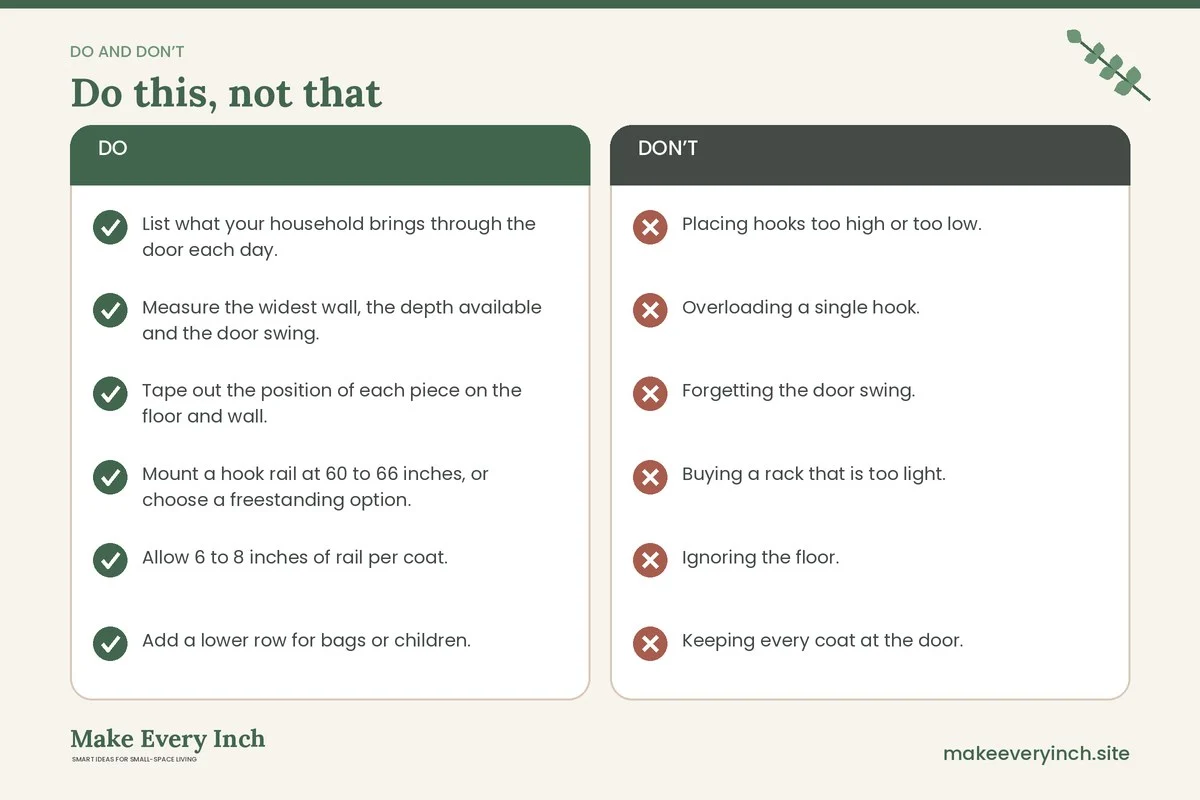
- Placing hooks too high or too low. Hooks at 66 inches suit adults, but low hooks help shorter members of the household.
- Overloading a single hook. Three coats on one hook pull it down and crush the garments.
- Forgetting the door swing. Test the door with tape before you drill.
- Buying a rack that is too light. A narrow base tips when loaded. Choose a heavy base.
- Ignoring the floor. Without a tray, wet boots stain the floor and a rug can slip.
- Keeping every coat at the door. The rotation is the whole point. Fewer coats means a calmer entry.
Checklist: no-closet entry
- List what your household brings through the door each day.
- Measure the widest wall, the depth available and the door swing.
- Tape out the position of each piece on the floor and wall.
- Mount a hook rail at 60 to 66 inches, or choose a freestanding option.
- Allow 6 to 8 inches of rail per coat.
- Add a lower row for bags or children.
- Pick a shoe solution: tray, bench or slim cabinet.
- Anchor any tall piece to the wall.
- Choose matching hangers and give each hook an owner.
- Set two rotation dates each year and store off-season coats elsewhere.
- Keep a 30 to 36 inch walkway.
- Check the lease before you drill.
FAQ
How many hooks does a closet-free entry need?
Plan for about four to six hooks per adult in the household, plus two spare for guests. If you rotate coats by season, you can often manage with fewer.
What can I use instead of a coat closet in a rental?
Use a tension rod with a curtain, an over-the-door hook set, a freestanding rack or garment rail, or a slim freestanding cabinet. None of these need drilling, so they are friendly for rentals. Always check the lease.
How high should coat hooks be?
Mount hooks at 60 to 66 inches for adults. Add a lower row at 44 to 52 inches for shorter people or for bags.
How do I hide the coats if I have no closet?
Hang a curtain on a track or tension rod in front of the rail, use a folding screen, or choose a slim cabinet with doors. A curtain is the cheapest option.
Where do I put off-season coats?
Store them in a bedroom closet, under the bed, in a wardrobe or in breathable garment bags on a high shelf. Avoid airtight plastic for wool. Rotate twice a year.
Is a freestanding coat rack safe?
It is safe when it has a heavy base, balanced loads and a spot out of the walkway. Anchor tall racks and hall trees to the wall if the manufacturer provides hardware, especially if children are in the home.
Keep going: Keep planning with our guides to tiny foyer ideas, DIY entryway storage for tiny homes and apartment entryway decorating.
Save this guide for later
Pin the ideas you like to Pinterest so you can come back to them when you plan your space.