Small Dining Room Ideas for Families
Quick answer: The best small dining room ideas for families put durable, wipeable surfaces first, then fit kid seating (a bench, stools or a booster) along the wall side, round or rounded-edge tables for safe corners, and a table that expands for guests. Plan roughly 24 inches of width per adult seat and 18 to 20 for a child, keep about 36 inches behind chairs where you can, and give homework and storage a home so the table clears fast.
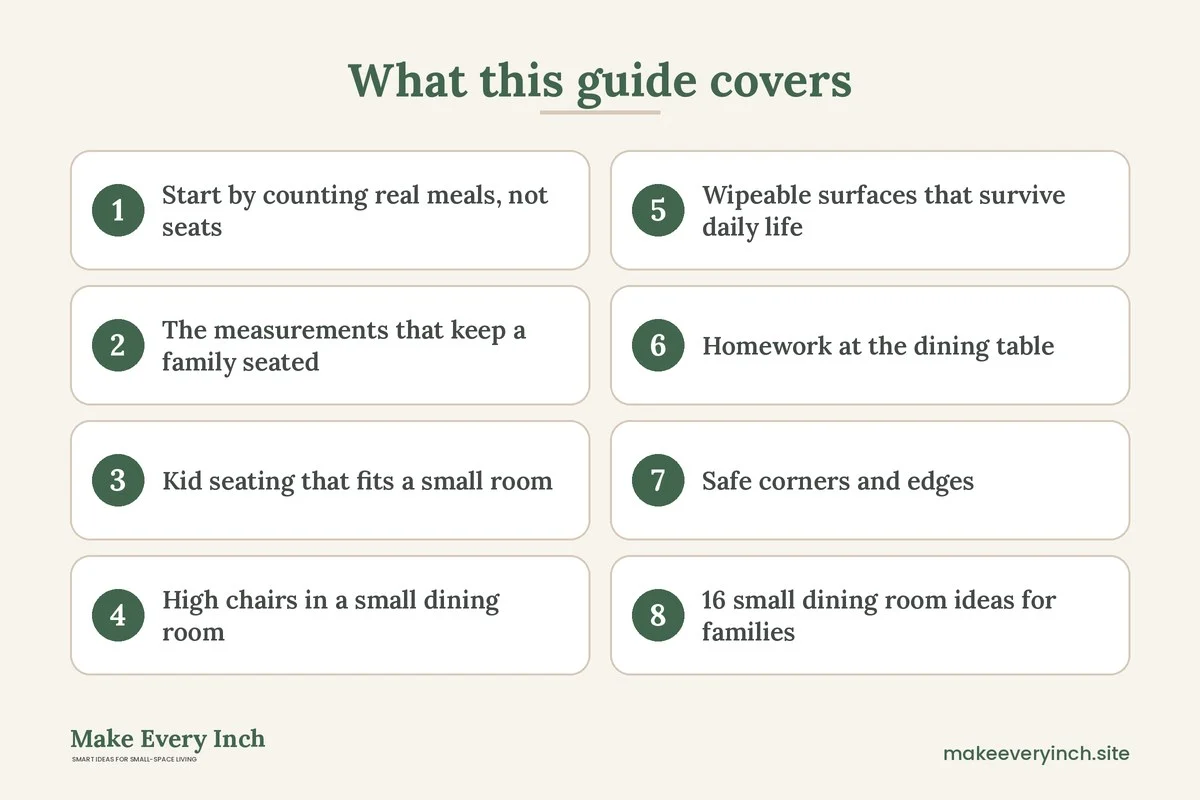
Small dining room ideas for families have to solve a harder problem than the same room for two adults. The table is not only for dinner. It is also the homework desk, the craft station, the place where a toddler throws peas, the spot where the grandparents sit at holidays and the surface that gets wiped down five times a day. When the room is small, every one of those jobs competes for the same few square feet. This guide walks through how to plan a small family dining space step by step. It covers the measurements that keep everyone seated, kid seating options, surfaces that survive daily life, high chair rules, homework routines, safe corners, 16 ideas, a comparison table, three example rooms, flexible expansion and a checklist. For the full overview, start with our main guide to small dining room ideas, and for the opposite situation, read the companion post on small dining room ideas for two people.
Start by counting real meals, not seats
Most families buy a table for the biggest meal of the year and then live with a crowded room for the other 360 days. Instead, count your real week. Write down how many people eat together on a normal weeknight, how many on a weekend, and how many times a month you host more than that. A family of four that hosts six guests twice a year does not need a six-seat table all the time. It needs a four-seat table that can stretch.
Next, list every job the table does besides meals. Common ones are homework, laptops, board games, craft projects, bill paying and folding laundry. Mark which of these happen at the same time as dinner and which happen before it. Homework usually finishes before dinner, so the table only needs a fast clear-and-wipe step between the two. Crafts often run long, so they may need a different surface altogether.
Finally, note the ages in your house. A baby needs a high chair that stays upright and out of the walkway. A toddler needs a seat that is stable and a table with no sharp corners. A school-age child needs a seat at the right height for writing. A teenager needs elbow room, a charger nearby and legroom that does not collide with a table leg. Planning around ages, not just headcount, is what makes a small dining room feel calm.
The measurements that keep a family seated
Family dining rooms fail on clearance more than on table size. These ranges are typical starting points. Check them with tape on your own floor before you buy, because chair designs and body sizes vary.
- Seat width: roughly 24 inches per adult and 18 to 20 inches per child. A bench lets you squeeze children closer together than separate chairs allow.
- Table height: about 28 to 30 inches for most standard tables. Children’s seats need to bring the child’s elbows close to table height, which is where booster seats and footrests come in.
- Space behind a chair: about 36 inches from table edge to the nearest wall or furniture is a comfortable target for a person to pull out a chair and stand. In very tight rooms, 30 inches can work for the wall side if people rarely walk behind that chair, but expect to turn sideways.
- Chair pull-out: often around 18 to 24 inches from the table edge. A chair with arms needs more. A stool that tucks fully under needs almost none.
- Walkway behind seated people: about 24 to 30 inches if someone must pass, and closer to 36 if someone carries hot dishes. Hedge these numbers to your household, and watch where people actually walk during dinner.
- Table depth: about 30 to 36 inches deep lets two people face each other with space for dishes in the middle. Narrower tables, around 24 to 28 inches, save floor space but leave less room for serving plates.
- Overhang for knees: leave 10 to 12 inches of clear space beneath the table edge for legs, and check that a leg or pedestal base does not hit a child’s knees.
Mark the table footprint and the chair pull-out zones on the floor with painter’s tape. Sit in each spot for a full dinner’s length of time. If you find yourself leaning or twisting, adjust before buying. Walkways that look fine on paper can feel tight with a child carrying a cup.
Kid seating that fits a small room
Seating is the biggest lever you have in a small family dining room, because chairs take far more floor space than a table does. These are the main options, from most space-saving to most traditional.
A bench along the wall side
A bench is the classic small-family answer. It tucks fully under the table, seats several children in a row and lets you slide the whole row in and out without moving individual chairs. Choose one that is as deep as a chair seat, roughly 14 to 18 inches, with a firm, wipeable top. A bench with a low back or a wall behind it helps younger children stay in place. Add a thin cushion or pad that wipes clean and can be removed for washing. See our guide to small entryway bench ideas for storage bench details that also apply in a dining nook.
Stools that tuck fully under
Backless stools disappear beneath the table when meals end and free the walkway. They suit school-age children who sit still, and they are easy to stack or move. For younger children, stools can feel unsafe, so add a stool with a low back or a footrest bar, or keep stools for the older ones only.
A mix of chairs and a bench
Put the adults on chairs at the ends and a bench on the long side. The bench covers the children, and the chairs make the table feel complete. This also helps with flexible expansion, because you can add a stool or two when guests arrive.
Booster seats and clip-on seats
For toddlers, a booster seat that straps to a regular chair raises the child to table height without taking extra floor. Read the instructions carefully, check weight limits and always use the harness. Do not use a clip-on seat on a table that is not designed for one, and never place a clip-on seat on a glass or loose-topped table. Child seat safety rules vary by product, so follow the maker’s manual rather than a rule of thumb.
Folding chairs stored on a wall
Folding chairs hung on a wall hook or kept in a closet give you extra seats on holidays without permanent floor use. If you rent, check what your lease allows before installing any hooks, and use a no-drill option if needed. Our guide to no-drill storage ideas for renters shows how.
High chairs in a small dining room
A high chair is bulky, and it is only needed for a short stretch of years. Choose a model that fits your room, not just your baby. Folding versions can be stored behind a door between meals. A narrow, tall high chair takes less floor than a wide one with a big tray. Some families choose a space-saving seat that attaches to a chair instead of standing alone.
Place the high chair at a corner of the table where the baby can see the family and you can reach them without stepping around furniture. Keep it away from the walkway to the kitchen, where a hot pan could pass at head height. Leave the legs clear of cords and curtains, and keep a 12-inch zone around the tray free of objects the baby can grab and pull, such as tablecloths, hot drinks and tall candles.
Safety basics matter more than space. Always use the harness. Check that the chair is stable and does not tip if a child pushes off the table with their feet. Keep it away from a hot stove, windows, blind cords and sharp edges. Check the product’s age and weight guidance, and replace any seat that is damaged or recalled. Ask your pediatrician or follow the maker’s instructions if you are unsure about a particular seat.
Wipeable surfaces that survive daily life
A family dining table takes spills, scratches, crayons and the occasional scissor mark. Choose finishes that clean up fast and forgive wear.
- Tabletop: a sealed wood or laminate surface with a durable finish wipes easily. Matte or lightly textured finishes hide scratches better than glossy ones. Glass shows every fingerprint and can feel risky around young children, so many families avoid it.
- Placemats and table covers: silicone or wipeable fabric placemats protect the surface and let you wash them in the sink. A clear, fitted table cover can protect a wood table during craft sessions, though check that it does not trap heat or moisture under hot dishes.
- Chair seats: wood, plastic or wipeable faux leather clean up fast. Fabric seats need a stain-resistant treatment or a removable cover. Choose darker or patterned fabrics if you do use them.
- Floor under the table: a flat-weave or low-pile washable rug catches crumbs and cleans easily. Check that the rug has a non-slip pad, and that chairs can slide over it without catching. A flat rug also keeps chair legs from tipping. Avoid thick shag under a table where food falls.
- Walls near the table: semi-gloss or satin paint wipes clean better than flat. If you rent, ask before repainting, and choose low-VOC paint, plus good ventilation, if you do paint with permission. Washable wallpaper or a peel-and-stick panel can protect a wall behind a bench, but test a hidden corner first and check the lease.
- A cleaning kit within reach: a small caddy on a shelf or inside a cabinet with a cloth, a spray and a brush makes wiping a thirty-second job. A fast wipe-down is the habit that keeps a small dining room usable.
Homework at the dining table
In many small homes the dining table is the only large flat surface, so it becomes the homework desk. This works well if you plan for it.
First, give homework a clear start and end. A simple routine keeps the table from turning into a permanent paper pile. Homework happens at a set hour, supplies come out of a bin, and everything goes back into the bin before dinner. The bin or caddy lives on a shelf, in a sideboard drawer or under a bench seat.
Second, set up a good lighting and seating position. A child needs enough light on the page. If the room has a single ceiling fixture, add a lamp on a nearby surface or a clip-on light on a shelf. Watch cords, and keep them out of the walkway. Our guide to small kitchen lighting ideas covers task lighting that also works over a dining table. Always check that any plug-in light is rated for your outlet, avoid overloading power strips and do not cover bulbs with fabric, since bulbs can get hot.
Third, think about seat height. A child who has to reach up to a table can get tired and fidgety. A cushion or a footrest, such as a sturdy box under the feet, can help a smaller child sit comfortably. The aim is feet supported and elbows near table height.
Fourth, decide where devices charge. A shallow tray or a charging station on a sideboard keeps cords from spreading across the table. Keep chargers away from drinks, and avoid placing power strips on the floor where spills happen.
Safe corners and edges
Small rooms put furniture close to children, so sharp corners and tip hazards matter more.
- Round or oval tables: they remove sharp corners and make it easier to squeeze one more person in. A round table also lets chairs tuck closer to the walls. Pedestal bases free up knee room, but check that the base is wide enough not to tip when a child leans on the edge.
- Rounded or softened corners: if you already have a square table, soft corner guards made for furniture can reduce bumps. Pick ones that stay put and are made of non-toxic materials, and follow the product instructions.
- Anchoring tall furniture: any bookcase, sideboard, hutch or china cabinet should be anchored to the wall with the right hardware, because children climb and tip furniture. If you rent, read the lease and ask your landlord before drilling. If drilling is not allowed, choose low furniture, or heavier pieces with a lower center of gravity, and keep the shelves bottom-heavy.
- Stable benches: a bench should be wide, solid and unlikely to tip when a child kneels or stands on it. Check the legs and the joints regularly and tighten any that loosen. Do not let children stand on benches, stools or chairs, even when the piece seems sturdy.
- Cords and blinds: keep lamp cords tucked away, and keep window blind cords out of reach of children. Cordless blinds are safer around a dining area, if you have the choice.
- Hot items: keep hot dishes away from the table edge, and avoid long tablecloths that a toddler could pull. A runner or placemats are safer.
- Lighting: hanging pendants should be out of reach of heads and swinging arms, usually about 30 to 36 inches above the tabletop as a rough range, although fixtures vary. Electrical work should be done by a qualified person, and rental lighting changes need landlord permission. Plug-in swag lights are a simpler alternative if you cannot rewire.
16 small dining room ideas for families
Seating that saves floor space
1. A banquette corner
Build or place a bench along two walls in an L shape and push a table up against it. Everyone slides in from the open side. This seats more people in a smaller footprint than free chairs. If you rent, use freestanding benches and avoid fixing anything to the wall without permission.
2. A bench plus two chairs
Use a bench on the wall side and a chair at each end. It keeps the table classic while saving a full row of chairs. Children climb in along the bench, and adults take the ends.
3. Stools stored beneath
Backless stools slide under the table and vanish between meals. They are especially useful in a dining room that doubles as a play space.
4. Stackable chairs
A set of stackable chairs gives you extra seats for guests and stores away in a corner or closet. Look for versions with rounded corners and no pinch points for little fingers.
Tables that suit family life
5. A round table with a pedestal
No corners, and no legs to bump knees. A 36 to 42 inch round table can seat four in tight quarters. Choose a heavy base for stability.
6. A drop-leaf table against a wall
Keep the leaves down for daily meals, and raise them for holidays. A drop-leaf table also works as a console against a wall when no one is eating.
7. An extending table
A table with a built-in leaf or an extension lets you grow from four to six or eight seats. Store the leaf flat under a bed or behind a door. Check how the extension mechanism handles small fingers, and keep children away from sliding parts.
8. A counter-height table with stools
A taller table frees leg room underneath for storage or stools. It suits older children, though younger ones need seat safety, so choose stools with backs and footrests. Keep young children off high seats unless they can climb safely.
9. A folding wall-mounted table
For very tight rooms, a fold-down table hinged to the wall gives you a surface only when needed. It requires secure mounting into studs or a proper support, so check the lease and use a qualified installer. In a rental, a freestanding folding table is the easier choice.
Storage and surfaces
10. A sideboard as a homework station
A narrow sideboard, 12 to 16 inches deep, can hold school supplies, placemats, a lamp and a charging tray. Anchor it to the wall if it is tall or top-heavy, and with permission only. See our guide to small space organization ideas for more ways to store supplies.
11. Under-bench storage
Choose a bench with a lift-top or drawers, and use it for placemats, games and craft supplies. Make sure the lid has a slow-closing hinge or a stay, so it cannot slam on little fingers.
12. A rolling cart
A cart acts as a serving trolley at dinner, a craft cart after school and a snack station on weekends. It parks against the wall at other times. See our guide to the best rolling kitchen carts for features to look for. Lock the wheels when it is parked, and keep it away from toddlers who might climb it.
13. Wall hooks and a rail
A rail at child height holds backpacks and aprons. It keeps the table clear and teaches children to hang things up. Use adhesive hooks if you cannot drill, and respect weight limits.
Light and atmosphere
14. A pendant or a plug-in swag light
Hang a light over the table to define the dining zone. For renters, use a plug-in pendant with a ceiling hook only with permission, or choose a floor lamp placed behind a bench. Use warm light for dinner, and a brighter setting for homework. See our post on renter friendly lighting ideas.
15. A washable rug
A flat-weave rug in a pattern hides crumbs and defines the dining zone. Choose a size so the chairs stay on the rug when pulled out, often 24 inches larger than the table on every side as a rough guide.
16. A chalkboard or magnetic panel
A framed magnetic or chalk panel on a wall near the table holds the week’s schedule, artwork and notes. Use a panel that leans or is hung with permission. Keep chalk dust off the table.
Comparison table: which table suits which family
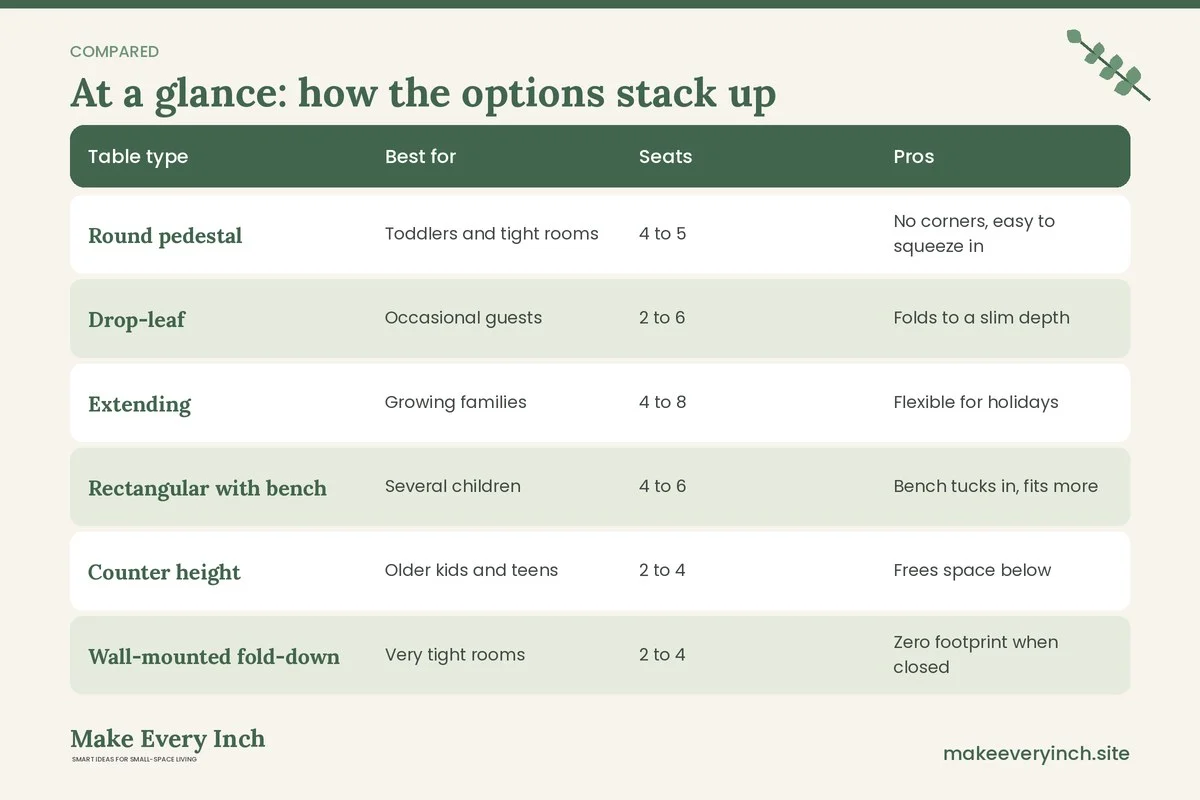
| Table type | Best for | Seats | Pros | Watch out for |
|---|---|---|---|---|
| Round pedestal | Toddlers and tight rooms | 4 to 5 | No corners, easy to squeeze in | Larger groups feel crowded |
| Drop-leaf | Occasional guests | 2 to 6 | Folds to a slim depth | Leaves can pinch fingers |
| Extending | Growing families | 4 to 8 | Flexible for holidays | Storing the leaf takes space |
| Rectangular with bench | Several children | 4 to 6 | Bench tucks in, fits more | Hard for children to climb out |
| Counter height | Older kids and teens | 2 to 4 | Frees space below | Stools must be safe for age |
| Wall-mounted fold-down | Very tight rooms | 2 to 4 | Zero footprint when closed | Needs secure mounting |
| Small square with stools | Apartments | 4 | Stools tuck away | Corners need guards |
Three example rooms for families
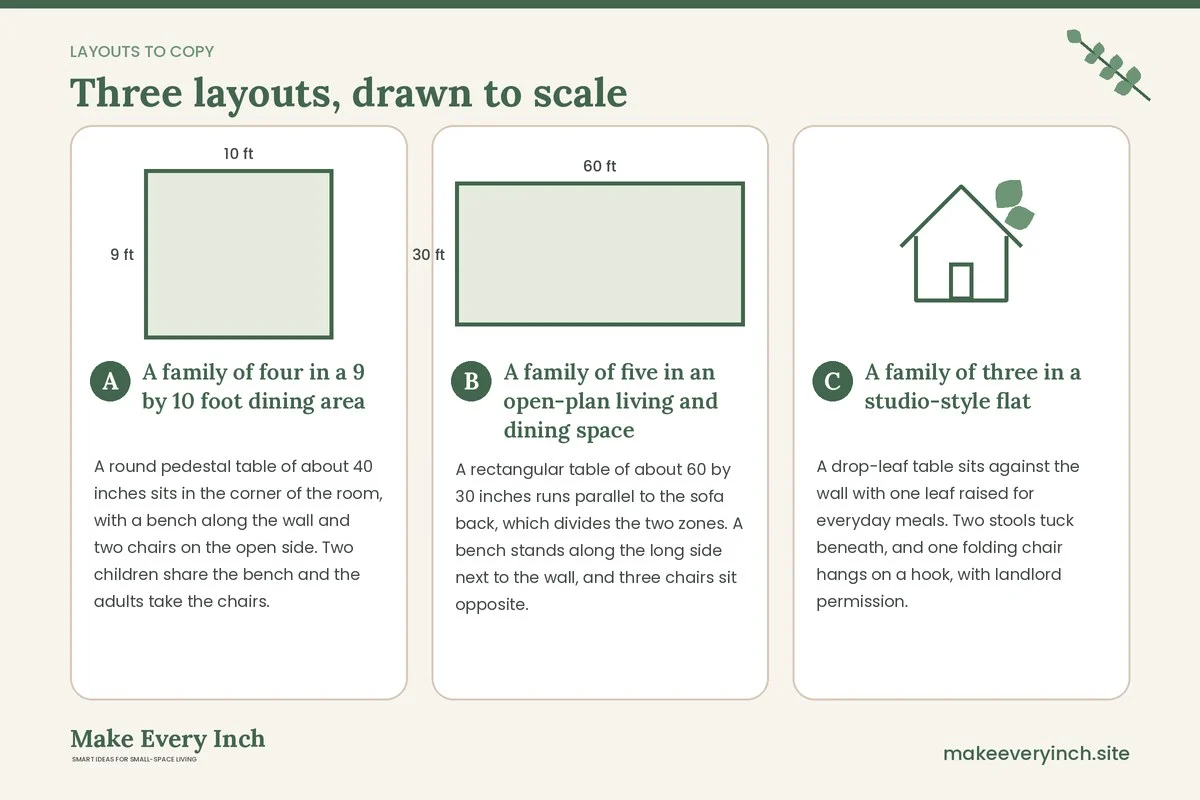
A family of four in a 9 by 10 foot dining area
A round pedestal table of about 40 inches sits in the corner of the room, with a bench along the wall and two chairs on the open side. Two children share the bench and the adults take the chairs. The bench has a hinged top for placemats and a basket of homework supplies. A 5 by 7 foot washable rug sits under the table, large enough that the chairs stay on it when pulled out. A sideboard 14 inches deep stands against the opposite wall, and a pendant hangs over the table. The walkway to the kitchen is kept clear at about 30 to 36 inches. This plan works because the bench handles the children, and the round table gives everyone a place without corners.
A family of five in an open-plan living and dining space
A rectangular table of about 60 by 30 inches runs parallel to the sofa back, which divides the two zones. A bench stands along the long side next to the wall, and three chairs sit opposite. When guests arrive, a folding chair joins each end. A low console behind the sofa holds a lamp and baskets, and the whole space gets a single large rug under the table. A rolling cart sits at one end as a serving station. The family uses the cart to clear the table fast after dinner. Hedge the chair spacing: the row of chairs on the open side needs roughly 36 inches of walkway behind it, and the room is planned so the path to the kitchen stays outside that zone.
A family of three in a studio-style flat
A drop-leaf table sits against the wall with one leaf raised for everyday meals. Two stools tuck beneath, and one folding chair hangs on a hook, with landlord permission. For homework, the child sits on a stool with a footrest, using a plug-in clip lamp on the shelf above. The leaf goes up fully for weekend meals with grandparents. A sideboard stands beside the table with a charging tray and a basket of supplies, anchored to the wall with the owner’s permission. For more studio ideas, read our guide to studio apartment dining area ideas.
Flexible expansion for holidays and guests
The best small family dining rooms grow only when they need to. These strategies let you add seats without living with them all year.
- A leaf or drop-leaf: the table itself grows. Store a leaf under a bed, in a closet or behind a door.
- A second table: a small side table or a folding table placed end to end with the main table can extend it for a holiday. Cover both with one tablecloth to hide the join, and make sure the heights match or add a thin riser.
- A bench that fits more people: a bench seats extra people more easily than chairs, since people can slide along it.
- Folding chairs on a shelf: keep four folding chairs flat in a closet or behind a door, and bring them out for guests.
- A kids’ table nearby: a small folding table in the living room can host children at big gatherings, which frees seats at the main table.
- A buffet instead of a plated meal: serve food from a sideboard or the kitchen counter, so the table holds only plates, not serving dishes. This reduces the surface you need.
- Move the sofa: at holidays, push the sofa back a foot or two, and set the table at an angle. Measure first, and keep walkways at roughly 30 inches or more.
When you reset after the event, return the room to its daily layout the same evening. A habit of putting the leaf away right after guests leave means the room never gets stuck in holiday mode.
A simple routine that keeps the room usable
Furniture helps, but routine does more. A small family dining room works when the table is clear for dinner every night. Try this pattern.
- After school: snack and homework at the table. Supplies come from the bin.
- Thirty minutes before dinner: the child puts supplies back in the bin, and the table is wiped with a cloth.
- At dinner: placemats go down, and every person has a seat. Keep devices off the table and charging in the tray.
- After dinner: each child clears their own plate, and the table is wiped again. Placemats go in the sink or the dishwasher.
- Weekend: use the table for crafts or games, on a washable cover. Restore the room before the evening meal.
A routine like this takes about five minutes a day. It prevents the pile-up that makes a small room feel cramped.
Mistakes to avoid
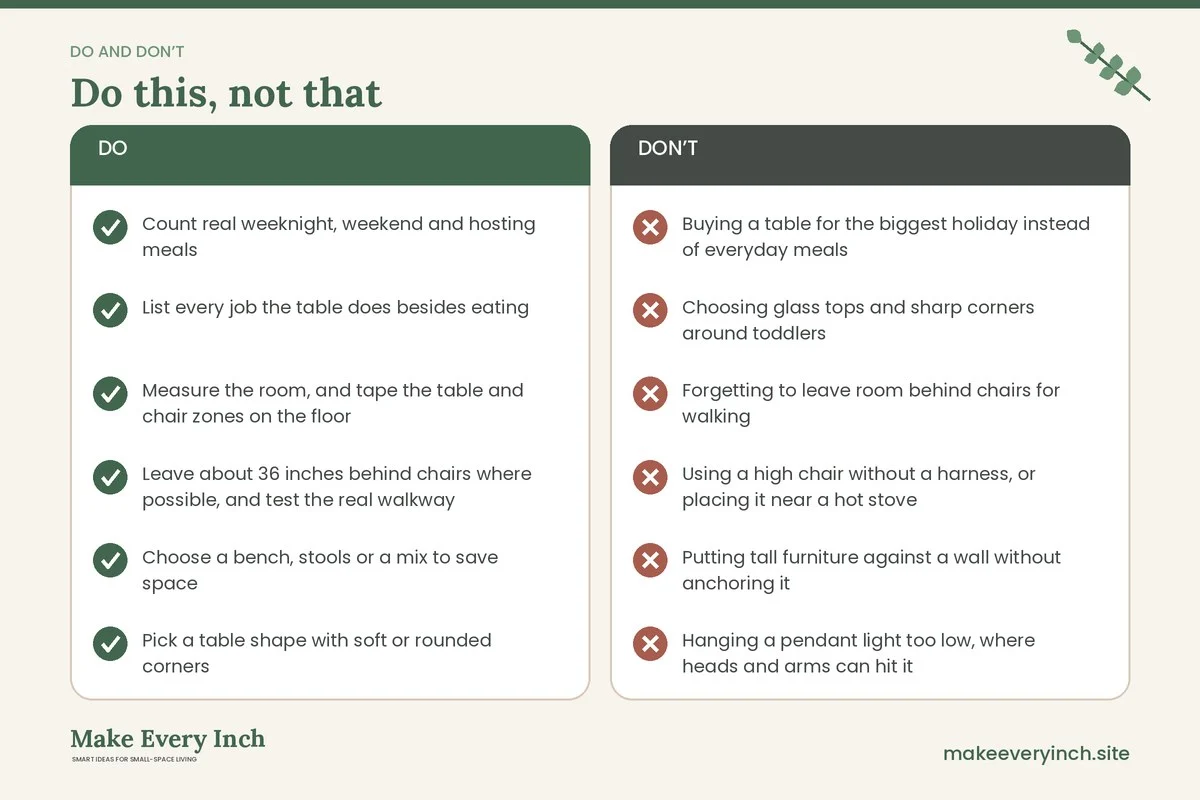
- Buying a table for the biggest holiday instead of everyday meals
- Choosing glass tops and sharp corners around toddlers
- Forgetting to leave room behind chairs for walking
- Using a high chair without a harness, or placing it near a hot stove
- Putting tall furniture against a wall without anchoring it
- Hanging a pendant light too low, where heads and arms can hit it
- Installing hooks or lights in a rental without permission
- Choosing a thick rug that catches chair legs and traps crumbs
- Letting homework supplies live on the table all week
- Skipping a cleaning caddy within reach
Checklist for a small family dining room
- Count real weeknight, weekend and hosting meals
- List every job the table does besides eating
- Measure the room, and tape the table and chair zones on the floor
- Leave about 36 inches behind chairs where possible, and test the real walkway
- Choose a bench, stools or a mix to save space
- Pick a table shape with soft or rounded corners
- Choose wipeable surfaces for the table, seats and rug
- Plan a place for the high chair and use the harness every time
- Create a homework bin and a clear start and end time
- Add task lighting for homework and warm light for dinner
- Anchor tall furniture, and ask permission first if you rent
- Keep cords and blind cords out of reach
- Plan flexible expansion with a leaf, folding chairs or a second table
- Keep a cleaning caddy within reach
FAQ
What is the best table shape for a small family dining room?
A round or oval table with a pedestal base is often the easiest for families with young children, since there are no sharp corners and chairs can tuck closer. A rectangular table with a bench works well for several children in a narrow room. Choose by the shape of the room and the ages of the children.
How much space do I need per person at a dining table?
A common starting point is about 24 inches of width per adult and 18 to 20 inches per child. Benches let you fit children a little closer. Treat these as ranges and test them with tape on your floor.
Is a bench safe for kids?
A wide, stable bench with sturdy legs is a common choice for children, but children should sit, not stand or kneel on it. Check the joints regularly, and choose one with a low back or a wall behind it for younger children.
Where should a high chair go in a small dining room?
Put it at a corner of the table, out of the main walkway and away from stoves, windows and blind cords. Use the harness every time, and follow the maker’s age and weight guidance.
How can I make a dining table wipeable?
Choose a sealed wood, laminate or similar surface, add washable placemats and keep a cleaning caddy nearby. Avoid delicate finishes and glass if you have young children.
How do I fit homework at the dining table?
Use a bin or caddy for supplies, add a lamp, set a regular homework hour and clear the table before dinner. A footrest or cushion can help a smaller child sit comfortably.
Can I use a fold-down table in a rental?
Only with the landlord’s written permission, since wall mounting needs secure fixings. If drilling is not allowed, choose a freestanding drop-leaf or folding table.
How do I seat extra guests in a small dining room?
Use a leaf, a bench, folding chairs stored in a closet or a second table placed end to end. Return the room to its daily layout the same evening.
Keep going: Keep planning with our small dining room ideas guide, the companion post on small dining room ideas for two people and our list of the best small dining tables.
Save this guide for later
Pin the ideas you like to Pinterest so you can come back to them when you plan your space.