16 Small Room Lighting Ideas for Every Corner
Quick answer: To light every small room corner, give each corner one job: a floor or table lamp in the sofa corner, a wall or clip light in the reading corner, a task lamp at the desk corner and a low glow in the empty corner. Layer ambient, task and accent light, use warm bulbs within the fixture’s labeled wattage, and keep cords tidy and sockets uncrowded.
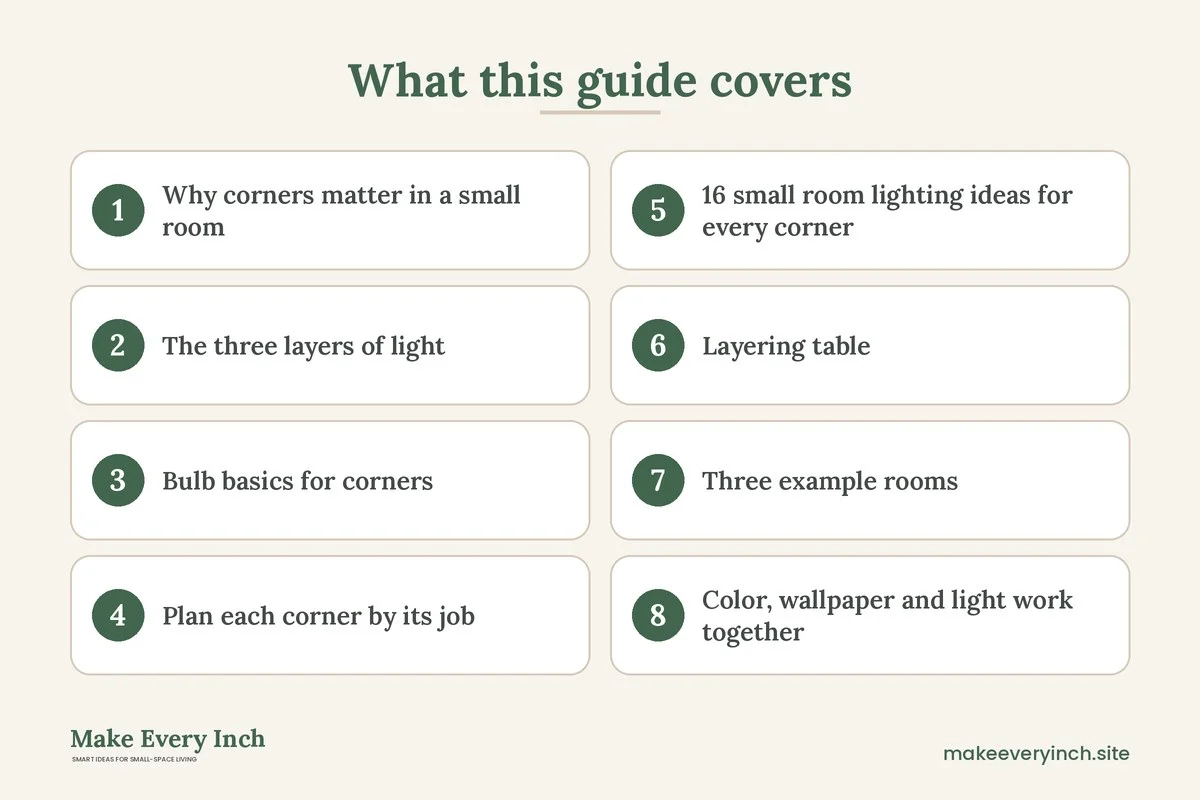
A small room lighting corner plan starts from a simple observation: most small rooms are lit by a single ceiling fixture, and the corners are the first places to go dark. Dark corners make walls feel closer, ceilings feel lower and the room feel smaller than it is. Lighting each corner for a specific purpose fixes that without a renovation. This guide walks the room corner by corner. It covers the three layers of light, bulb basics, a plan for each corner type, 16 ideas, a layering table, three example rooms, cord and electrical safety, a checklist and a FAQ. For the wider approach to styling compact rooms, start with our pillar guide on small room decor ideas.
Why corners matter in a small room
In a large room, a dark corner can feel cozy. In a small room, it usually reads as lost space. Light defines the edges of a room, and when the edges fade into shadow, the eye perceives a smaller box. Lighting the corners pushes the visual boundary outward, so the room feels wider and taller, even though nothing has moved.
Corners are also the places where lamps fit best. They are out of the walkway, close to outlets in many rooms and often too awkward for furniture. A lamp in a corner uses almost no floor space. It also bounces light off two walls at once, which spreads the glow more evenly than a lamp placed against a flat wall.
Finally, corners give you a way to organize a room into zones. A studio or a one-room apartment may need a sleeping corner, a work corner and a sitting corner, and each can have its own light. That helps the space feel like several small rooms, each with a purpose.
The three layers of light
Lighting designers talk about layers, and the idea is simple enough to apply to any corner.
- Ambient light is the general glow that lets you move around safely. It usually comes from a ceiling fixture, a floor lamp that bounces light off the ceiling or several lamps combined.
- Task light is focused light for a specific activity, such as reading, working or cooking. It should be bright enough to see detail and positioned to avoid glare and shadow on your work.
- Accent light is a low, decorative glow that highlights a plant, a shelf, a piece of art or a wall. It creates depth and mood.
A small room usually needs all three, but in small amounts. The mistake is to rely on ambient light alone. A single overhead fixture flattens a room, casts shadows under the chin and leaves the corners dim. Adding one task light and one accent light makes a bigger difference than swapping the main bulb for a brighter one.
Bulb basics for corners
You do not need to be an expert to pick a good bulb. These points are enough for most corners.
Color temperature
Color temperature is measured in kelvins. Warm white, roughly in the 2700K to 3000K range, gives a soft, yellowish glow that suits living rooms and bedrooms. Neutral white, roughly 3500K to 4000K, is crisper and suits task areas such as a desk or a kitchen counter. Cool daylight bulbs, above about 5000K, can feel harsh in a small room at night. Use the same color temperature across lamps in the same room, so the light looks consistent.
Brightness
Brightness is measured in lumens, not watts. Watts describe how much power a bulb uses. As a loose guide, an ambient corner lamp may use something in the range of 400 to 800 lumens, and a reading or desk lamp may use about 450 to 1100 lumens, though the right number depends on the room, the shade and your eyes. Check the label on the packaging.
Fixture limits
Every lamp and fixture has a maximum wattage printed on the socket or the label. Never exceed it. Using a bulb with higher wattage than the rating can overheat the socket, melt the wiring or start a fire. LED bulbs use much less power than older types for the same brightness, which helps you stay under the limit, but you still need to check the label for the fixture’s maximum.
Dimming
Dimmable bulbs let you change the mood. Use dimmable bulbs only with dimmers rated for them, and check that the bulb and the dimmer are compatible. Plug-in dimmers exist for lamps, and they must be rated for the load you connect.
Plan each corner by its job
Walk through your room and name each corner’s job. Then choose the lighting that matches.
The sofa or seating corner
This is the corner where you relax. A floor lamp beside the sofa gives soft ambient light and a place to read. Choose a lamp with a shade that diffuses the glow, and place it so the bulb is not in your direct line of sight when you sit. An arc lamp can reach over the sofa without taking up table space. If you rent and cannot wire anything, a plug-in lamp is the simplest solution. See our guides to best floor lamps for small rooms and small living room lighting ideas.
The reading corner
A reading corner needs focused light that falls on the page and not in your eyes. Place the light slightly behind or beside your shoulder, a bit above head height. A swing-arm wall lamp, a clip-on lamp or a slim floor lamp works well. Choose a warm to neutral bulb, with a shade that directs light downward.
The desk corner
A desk corner needs even, glare-free light. Put the lamp on the side opposite your writing hand to avoid shadows. A monitor needs ambient light behind it, so the contrast between screen and room is not harsh. See our small home office lighting ideas for more.
The sleeping corner
Bedrooms need low, warm light. A small lamp on each side of the bed gives a soft glow, and a wall sconce frees the nightstand. A low accent light near the floor can help you walk at night without turning on a bright light. See small bedroom lighting ideas.
The empty corner
Every small room has a corner that holds nothing. Use it to add depth. A small uplight, a lamp with a plant or a lamp on a stool turns the dead zone into a glow. A plant in the corner with an uplight casts a soft shadow pattern on the wall and ceiling.
The entry corner
The area by the door needs enough light to find keys and put on shoes. A plug-in wall light, a small table lamp on a shelf or a lit mirror helps. Our small hallway lighting ideas go into more depth.
The dining corner
A small dining corner needs warm light over the table and some ambient glow around it. A pendant hung 28 to 34 inches above the table is a common guide, though the right height depends on the table and the ceiling. See small dining room lighting ideas.
16 small room lighting ideas for every corner
Floor and table lamps
1. A slim floor lamp in the sofa corner
A narrow base takes little floor space, and a fabric shade softens the glow. Place it just behind the arm of the sofa.
2. An arc lamp over the seating
The arm reaches over the sofa, so you do not need a side table. Make sure the base is heavy enough to be stable, and keep the arm clear of walkways.
3. A table lamp on a shelf or console
When floor space is short, lift the lamp. A small lamp on a shelf lights a corner without a footprint.
4. A lamp on a stool in the empty corner
A stool or a small plant stand lifts the lamp and adds height. Use a stable stand and keep the cord tucked.
5. A pair of bedside lamps
Two matching lamps give a balanced glow and a symmetrical look. Choose compact lamps that leave room for a phone and a glass.
Wall and clip lights
6. A plug-in wall sconce
A sconce with a plug and a cord cover gives wall-mounted light without hardwiring. Check the lease before fixing anything to the wall, and see renter-friendly lighting ideas.
7. A swing-arm lamp for reading
The arm lets you aim the light, and a wall mount frees the nightstand. Anchor it to a stud or rated anchor if you are allowed to drill, and never drill without permission.
8. A clip-on lamp on a shelf or headboard
A clip lamp attaches without tools. Use a model with a sturdy clamp and check the weight and the surface it grips.
9. A picture light over art
A small light above a frame creates a gentle accent. Battery models avoid cords, though you will need to replace the batteries.
Task and desk lighting
10. A desk lamp on the far side
A lamp on the side opposite your writing hand reduces shadows. A flexible arm lets you adjust.
11. Under-shelf lights
Strip lights under a shelf light a counter or a desk without taking up space. Use products rated for the setting and fix them as the instructions say.
12. A lit mirror in the entry
A mirror with built-in light helps in a dark entry, and it adds brightness by reflection. Check the weight, and hang it securely.
Accent and mood lighting
13. An uplight behind a plant
A small light placed low behind a plant casts shadow patterns on the wall. Keep the light away from leaves so heat does not scorch them, and check whether the plant is safe for pets, since some common houseplants are toxic when chewed.
14. A string of lights along a shelf
Strings of small lights add a warm accent. Use a product rated for indoor use and do not run it near curtains or paper that could get hot.
15. A low light in the hallway or under the bed
A soft light near the floor guides you at night. A motion-activated model avoids leaving a light on.
16. A shaded lamp near a window
A lamp near the window balances daylight and reduces the contrast between a bright window and a dark room at night.
Layering table: which light for which corner
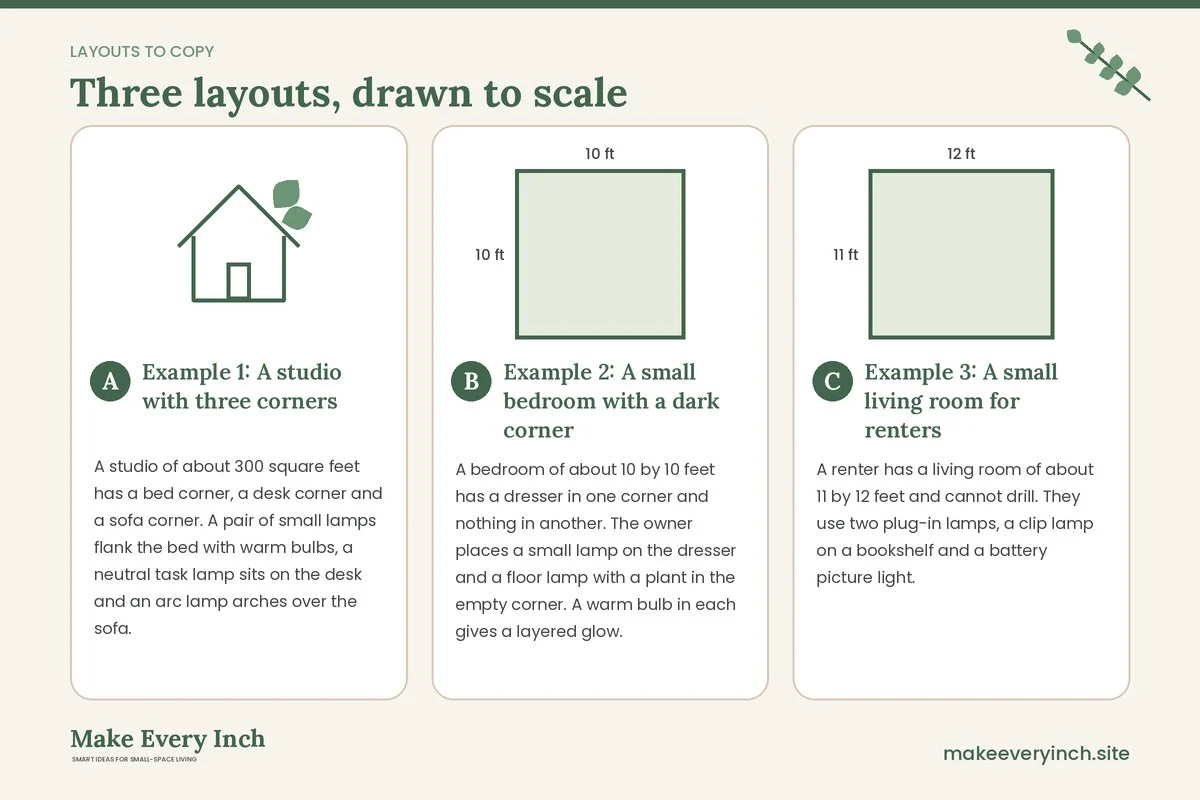
Use this table to match a corner to a type of fixture. It is a general guide, and the right choice depends on your room.
| Corner | Layer | Fixture ideas | Bulb guide | Watch out for |
|---|---|---|---|---|
| Sofa corner | Ambient and task | Floor lamp, arc lamp | Warm, dimmable | Glare in the eyes |
| Reading corner | Task | Swing-arm, clip lamp | Warm to neutral | Cord across the floor |
| Desk corner | Task | Desk lamp, under-shelf strip | Neutral | Shadow from your hand |
| Sleeping corner | Ambient and accent | Bedside lamps, sconce | Warm, low | Overcrowded nightstand |
| Empty corner | Accent | Uplight, lamp on stool | Warm | Heat near plants |
| Entry corner | Ambient | Plug-in sconce, lit mirror | Neutral | Dark hooks area |
| Dining corner | Ambient and accent | Pendant, shaded lamp | Warm | Glare on the table |
Three example rooms
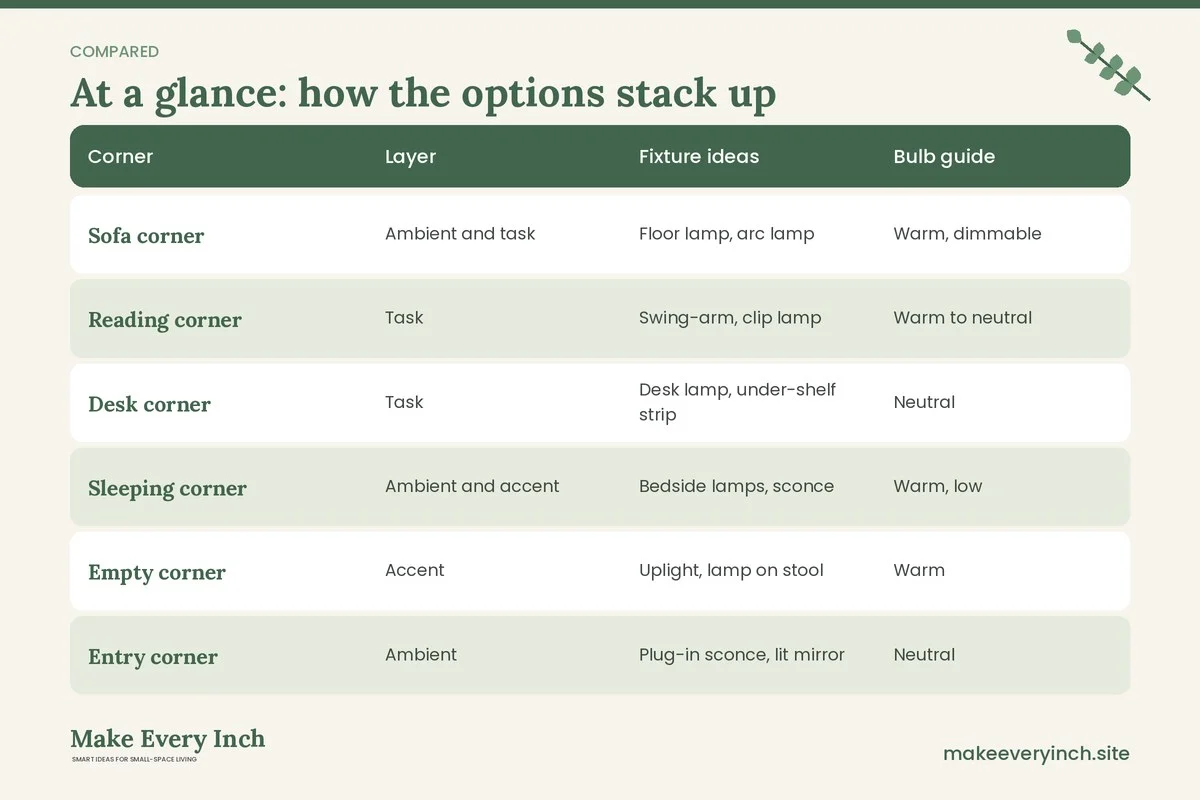
Example 1: A studio with three corners
A studio of about 300 square feet has a bed corner, a desk corner and a sofa corner. A pair of small lamps flank the bed with warm bulbs, a neutral task lamp sits on the desk and an arc lamp arches over the sofa. A small uplight sits in the entry corner. The result is three clear zones, each with its own light, and the ceiling fixture stays off most evenings. See our studio apartment lighting ideas for more.
Example 2: A small bedroom with a dark corner
A bedroom of about 10 by 10 feet has a dresser in one corner and nothing in another. The owner places a small lamp on the dresser and a floor lamp with a plant in the empty corner. A warm bulb in each gives a layered glow. The lamp on the dresser doubles as a mirror light. The corners now feel finished, and the walls seem farther apart. See small bedroom ideas.
Example 3: A small living room for renters
A renter has a living room of about 11 by 12 feet and cannot drill. They use two plug-in lamps, a clip lamp on a bookshelf and a battery picture light. Cord covers keep wires along the baseboard, and a power strip with a built-in surge protector, used within its limits, serves the TV and one lamp. The light is layered, nothing is fixed to the wall and everything goes with them when they move. See small living room ideas.
Color, wallpaper and light work together
Light interacts with color. Light walls bounce more light into corners, so a pale paint or a pale paper makes lamps work harder. Dark walls absorb light, and corners with dark walls need brighter or more numerous lamps. Pattern and texture also change how light looks. A matte wall diffuses light, while a glossy surface reflects it, sometimes as glare.
If you plan to add wallpaper, think about how lamps will hit it. A lamp placed close to a patterned wall will emphasize its texture, which can be lovely, or too much. Our guide on small space wallpaper that does not overwhelm covers scale, contrast and placement. For palettes, see studio apartment color schemes.
Mirrors help too. A mirror placed across from a lamp doubles the glow, and a mirror at a corner can bounce light into the dark side of the room. Keep mirrors away from direct sunlight that could reflect onto flammable items, and hang them securely.
Electrical and cord safety
Good lighting should never create a hazard. These points apply to every corner.
Respect socket and fixture limits
Check the maximum wattage on every lamp socket and never exceed it. Use LED bulbs, which run cooler, but still follow the label. Do not use bulbs that are too large for a shade, since the shade can trap heat.
Do not overload outlets
Do not plug several high-power items into one outlet or one power strip. A power strip is not a way to add capacity. Lamps with LED bulbs draw very little, but heaters, hair dryers and kettles do not belong on the same strip. Use only strips rated for the load, and replace any that feel warm, smell odd or show damage.
Keep cords tidy
Do not run cords under rugs, because heat can build up and wear can go unnoticed. Do not run cords across walkways, where they are a trip hazard. Do not staple or nail cords, and do not pinch them in doors or under furniture legs. Use cord covers along walls and baseboards, and see renter-friendly ways to hide cords for safe options.
Keep heat away from fabric and paper
Keep bulbs away from curtains, paper shades and bedding. Do not drape fabric over a lamp. Use shades designed for lamps and keep them at a safe distance from the bulb.
Hang and anchor with care
Floor lamps can tip, so choose a stable base and keep them away from busy walkways and pets. Wall lights and mirrors need proper anchoring into studs or rated anchors, based on the wall and the weight. Never drill without permission if you rent.
Plants and pets
If you place lamps near plants, keep the bulb from touching leaves. Some common houseplants are toxic to pets if chewed, so check before you place one in a corner where a cat or dog can reach it.
Water and humidity
Keep lamps away from sinks and baths, and use fixtures rated for damp areas in bathrooms. When in doubt, ask a qualified electrician.
Mistakes to avoid
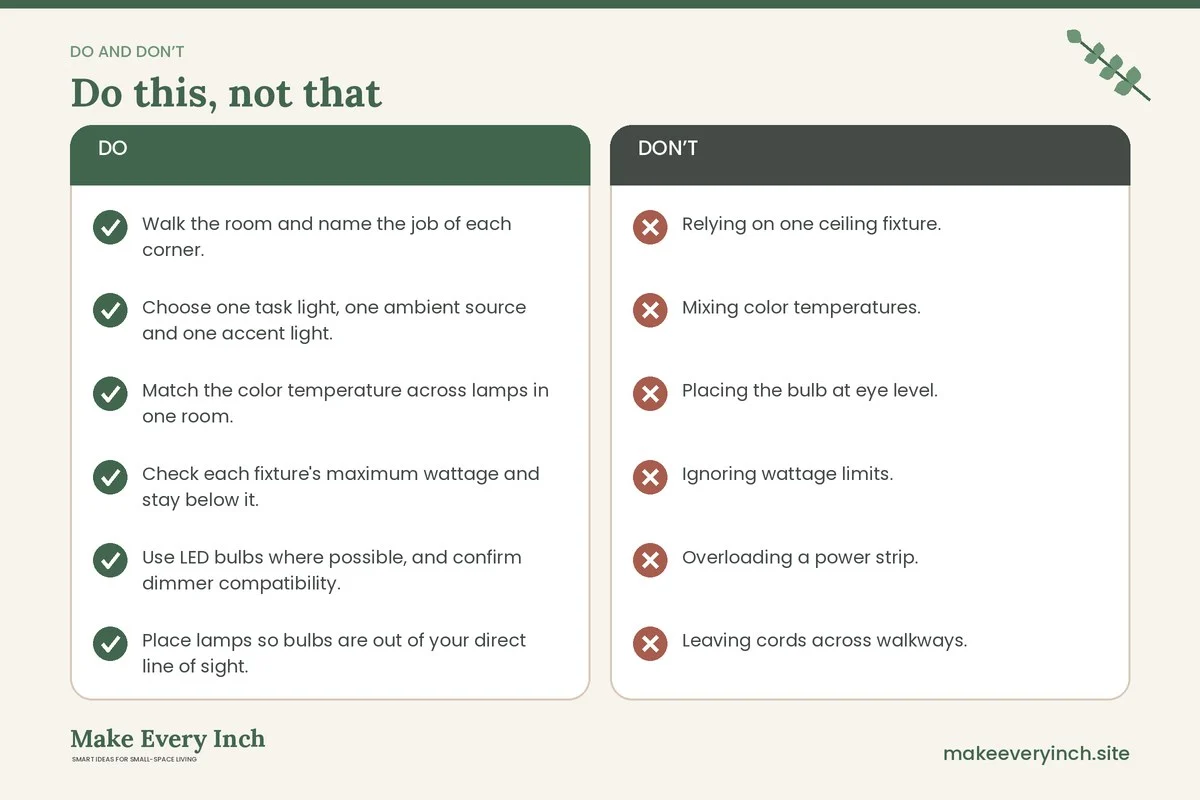
- Relying on one ceiling fixture. It flattens the room and leaves the corners dark.
- Mixing color temperatures. A cool lamp next to a warm one looks patchy.
- Placing the bulb at eye level. Glare tires the eyes and makes the room feel harsh.
- Ignoring wattage limits. This is a safety risk, so check the label.
- Overloading a power strip. Keep it for low-power items and within limits.
- Leaving cords across walkways. They are a trip hazard.
- Lighting only the center. Corners define the edges of a room.
- Using a lamp that is too big. A bulky lamp eats space, so choose a slim shape.
Checklist: light every corner
- Walk the room and name the job of each corner.
- Choose one task light, one ambient source and one accent light.
- Match the color temperature across lamps in one room.
- Check each fixture’s maximum wattage and stay below it.
- Use LED bulbs where possible, and confirm dimmer compatibility.
- Place lamps so bulbs are out of your direct line of sight.
- Keep cords off walkways and out from under rugs.
- Do not overload sockets or power strips.
- Keep bulbs away from fabric and paper.
- Choose stable bases and anchor wall items properly.
- Never drill without permission if you rent.
- Check plants for pet safety before placing them near lamps.
- Test the layout in the evening and adjust.
FAQ
How many lamps does a small room need?
Many small rooms do well with three to four light sources at different heights, but the right number depends on the room. Aim for layers, not for a large count.
Should I use warm or cool bulbs?
Warm bulbs suit living rooms and bedrooms. Neutral bulbs suit desks and kitchens. Keep the same temperature within a room.
What is the best light for a dark corner?
A slim floor lamp or a lamp on a stool works well, and an uplight behind a plant adds depth. Choose a warm bulb within the fixture’s rating.
Can I use a higher wattage bulb for more light?
No. Never exceed the fixture’s maximum wattage. Choose a bulb with higher lumens and lower wattage, such as an LED, instead.
How do I light a corner if I cannot drill?
Use plug-in lamps, clip lamps, battery lights and lamps on shelves or stools. Check the lease before using adhesive products.
Do mirrors help with corner lighting?
Yes. A mirror placed across from a lamp reflects the glow and brightens the dark side of the room. Hang it securely and keep it away from direct sun.
Is it safe to use a power strip for lamps?
Yes, if the strip is rated for the load, is not overloaded and is in good condition. Do not plug heating appliances into the same strip.
Does wall color change how I light a corner?
Yes. Light walls reflect light and need less. Dark walls absorb light and may need brighter or more numerous lamps.
Keep going: Keep planning with our small room decor ideas, small space wallpaper ideas that do not overwhelm and budget small space ideas.
Save this guide for later
Pin the ideas you like to Pinterest so you can come back to them when you plan your space.