How to Create a Tiny Outdoor Dining Area on a Balcony
Quick answer: To create a tiny outdoor dining area, measure the space, check the weight and fire rules for your building, then choose a folding, wall-hugging or bar-height table with seating that tucks away. Leave about 24 to 30 inches behind each chair, keep everything back from the railing, secure anything that could blow or fall, and add outdoor-rated lighting and a small drainage plan.
If you want to create tiny outdoor dining area space from a narrow balcony, a corner of a patio or a few feet of porch, the trick is to treat it like a very small restaurant booth rather than a miniature version of your dining room. Every inch has a job, the furniture has to survive sun, wind and rain, and a few safety rules decide what you can place where. This guide walks through the whole process: the measurements that make a table usable, the lease and weight checks to do first, seven table and seating formulas, a comparison table, three example spaces, lighting, shade, storage, safety and a checklist. For indoor inspiration, see our guide to small dining room ideas, and for the bigger picture on balconies, see the pillar post on small balcony ideas.
Start with permission and safety, not furniture
Before you buy a single chair, find out what you are allowed to do. Outdoor dining on a balcony is not only a design question. It is also a question of weight, fire, water and neighbours.
Read the lease, rules and building notes
Check your lease, building rules and any HOA or landlord notes. Many of them cover balcony use, what may hang from railings, whether planters are allowed, whether you can store items outside and whether grills, open flames or heaters are banned. When the rules are unclear, ask in writing. Never drill into a railing, wall or floor without permission, because railings are often structural and owned by the building. Every idea in this guide uses freestanding, clamp-free or permission-based solutions.
Respect weight limits
A balcony or deck has a load limit that you cannot see. A dining set with people on it, a heavy planter and a full water container can add up faster than you expect. Check with the building manager or the landlord about the limit, and do not stack heavy items in one spot. Spread the weight, pick lightweight materials where you can, and keep the number of people on the balcony at once modest. If a floor feels springy or you notice cracks, rust or loose railings, stop using the space and report it.
Keep furniture away from the railing
The railing is the most important safety feature on the balcony. Furniture placed against it can become a step for a child or a pet, and a chair next to a rail makes a climbing route. Keep tables, chairs, benches and planters at least a couple of feet back from the rail where you can, and especially if children or pets use the space. Rail height rules vary by area, and a railing that is adequate for adults may not stop a toddler. Do not rely on a decorative screen to make it safe. If you have young children, consider whether the balcony should be a supervised-only space.
Plan for wind and tip-over
Wind on a high balcony can be much stronger than on the ground. Lightweight chairs slide, umbrellas lift and a tall planter can tip. Choose a low, stable table, avoid large umbrellas or shades unless they are rated for the building and safely anchored without drilling, and bring light items inside on windy days. Never leave glassware, candles or loose cushions out in a gust.
Secure anything that could fall
Objects falling from a balcony can injure people below. Keep planters, shelves and decor inside the line of the railing, not on top of it. Rail-mounted planter boxes are a common risk, and many buildings ban them. Use heavy, low containers on the floor instead. Place saucers and trays so that a bump does not send a pot over the side, and never balance anything on the top of the railing, including drinks.
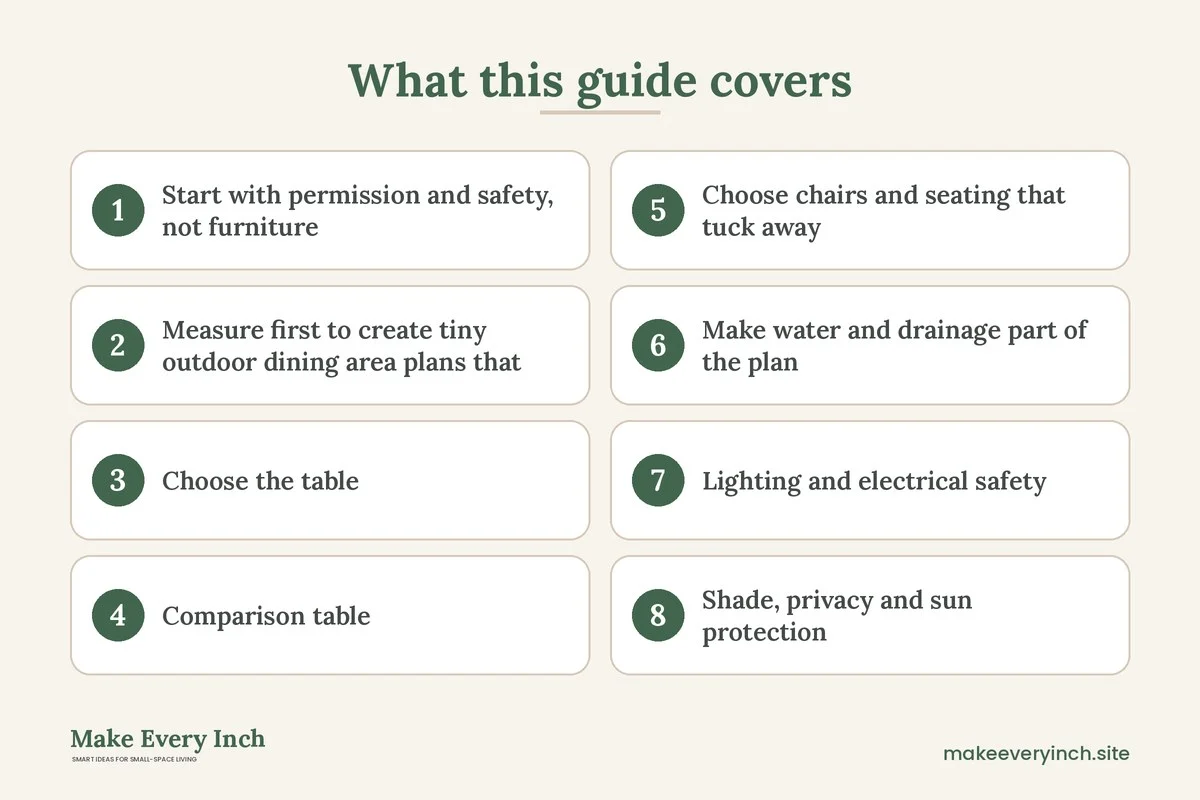
Measure first to create tiny outdoor dining area plans that work
Tiny outdoor spaces fail when furniture is bought by eye. Measure the width and depth of the area, the door swing, the position of drains and any fixed items such as a downpipe or a meter. Draw a simple plan on paper, or tape the outline on the floor with painter’s tape.
The numbers that matter
- Walkway: keep 24 to 30 inches clear behind each chair where people pass, and at least 30 inches by the door. In a very tight spot a 20 to 24 inch lane can work for a short run if nobody needs to squeeze past a seated person.
- Table height: a standard dining table is about 28 to 30 inches, a counter-height table is about 34 to 36 inches and a bar-height table is about 40 to 42 inches. Pair stools with the right height, and leave about 10 to 12 inches between the seat and the underside of the table.
- Table depth: 18 to 24 inches fits two people on one side with plates and glasses. Below 16 inches, plates hang over the edge.
- Seat to table: about 18 inches from the seat to the table edge is comfortable for most adults when seated.
- Per-person width: allow roughly 20 to 24 inches of table edge per person. A table 24 inches long seats one comfortably and two at a squeeze.
- Door swing: keep the swing arc clear. A table that blocks the door is a safety problem, especially if it is also the only exit.
- Clearance from the railing: keep the table edge at least 12 to 18 inches from the railing so a seated person does not lean against it, and more if there are children or pets.
Tape the outline of the table and each chair. Sit in the tape for a few minutes with an imaginary plate. If you can reach the door, pour a drink and stand up without bumping a neighbour, the plan works.
Check the sun and the wind
Stand on the balcony at different times of day and note where the sun hits. A table in full sun at noon is hard to use, and a metal surface can become hot enough to be uncomfortable or to burn skin. Note the wind direction too, since a table on the windy side will catch napkins and light plates. A plan that is workable at 8 a.m. may not be workable at 3 p.m.
Choose the table: seven formulas for tiny spaces
There is no single best table for small outdoor dining, but there are seven that repeatedly suit small spaces. Pick the one that matches your shape.
1. A folding bistro table
A small round or square folding table with a folding top sets up in a minute and disappears when you need the floor. It suits balconies under 4 feet deep. Choose a table with a solid frame, and check that it will not wobble on an uneven floor. Round tops are kinder to hips and walkways than square ones.
2. A wall-leaning drop-leaf or flap table
A table that attaches to the wall would need drilling, which is usually not allowed in rentals. Instead, look for a freestanding drop-leaf table that sits against the wall with one leaf lowered. It gives you about 12 inches of depth when closed and 24 to 30 when open. The weight rests on the floor, not the wall.
3. A bar-height table with stools
A narrow bar-height table, about 16 to 20 inches deep, sits against a wall and seats two on stools. Stools tuck beneath. Because the table is tall, it also frees floor space. Make sure the stools are stable and have footrests, and keep them away from the railing, as tall seats raise a person closer to the top of it.
4. A railing-clear corner table
A triangular or quarter-round table fits a corner and leaves the walkway open. It suits L-shaped balconies and patio corners. Keep the table back from the rail, not tucked against it.
5. A bench plus a narrow table
A bench against the wall with a narrow table in front seats more people than chairs in the same footprint, since people can squeeze together. A storage bench holds cushions and tableware. For the indoor version, see our post on a small dining room with a bench.
6. A nesting pair
Two small nesting tables can be pulled apart for a meal for two and nested for a single coffee. They suit balconies that double as a plant corner or a reading spot.
7. A tray-top stool or ottoman
For the smallest spots, a sturdy stool with a removable tray works as a drinks table for one or two. It is not a full dining table, but it makes a lovely coffee corner. Do not use it as a step.
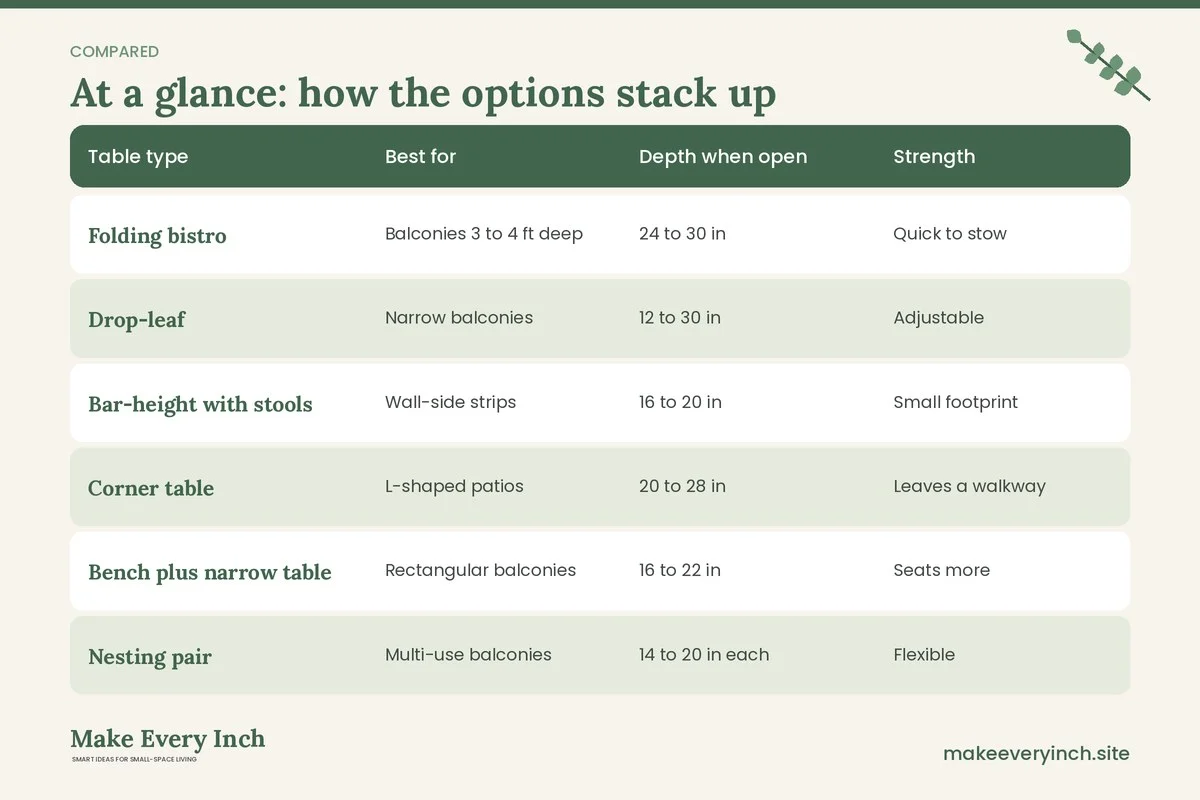
Comparison table: which table suits which space
| Table type | Best for | Depth when open | Strength | Watch out for |
|---|---|---|---|---|
| Folding bistro | Balconies 3 to 4 ft deep | 24 to 30 in | Quick to stow | Wobble on uneven floors |
| Drop-leaf | Narrow balconies | 12 to 30 in | Adjustable | Leaf locks and finger pinch |
| Bar-height with stools | Wall-side strips | 16 to 20 in | Small footprint | Tall seats near the railing |
| Corner table | L-shaped patios | 20 to 28 in | Leaves a walkway | Pointed edges |
| Bench plus narrow table | Rectangular balconies | 16 to 22 in | Seats more | Needs permanent spot |
| Nesting pair | Multi-use balconies | 14 to 20 in each | Flexible | Light and may blow |
| Tray-top stool | The tightest nooks | 12 to 16 in | Minimal | Not a full meal table |
Choose chairs and seating that tuck away
In a tiny dining area, the chairs matter as much as the table. Look for chairs that fold flat, stack or tuck completely under the table. Open slat or mesh seats drain rain quickly and keep the visual weight low. Avoid chairs with wide arms, since arms stop the chair from tucking under the table and eat into your walkway.
- Folding chairs stow flat against a wall or behind a door. Check the locking mechanism so the chair does not collapse.
- Stacking chairs can be tucked into a corner during storms.
- Stools slide fully under a counter or bar table and take almost no space.
- A banquette bench along the wall seats several and can hold storage underneath.
- Poufs and cushions can serve as extra seats for guests, but should be stored inside to avoid mildew.
Keep the chair legs on a flat, dry surface. If your floor has a slope towards a drain, use stable furniture feet or pads to level the table rather than stacking things under a leg. Never place a chair on top of a drain cover, as this blocks drainage.
Make water and drainage part of the plan
Balconies are designed to shed water, and anything that blocks the drain can cause pooling, damage to the structure and leaks onto the neighbour below. Keep drains clear. Do not hose down the floor, because the water runs off the edge or into the neighbour’s space. Rugs and mats should dry fast and be lifted off the floor from time to time so moisture does not sit under them. Plant pots need saucers with a lip, and the saucers should be emptied after heavy rain or watering. Never let water flow onto the balcony below. If you notice staining, mold or peeling paint, tell the building manager.
Lighting and electrical safety
Evening is the best time for a small outdoor meal, so lighting is part of the design. It is also where most safety issues arise.
Choose outdoor-rated, low-risk lighting
Use lights marked for outdoor use. Battery-powered or solar lanterns and string lights avoid cords altogether, and are the simplest and safest choice for a rented balcony. If you use mains-powered lights, make sure they are outdoor-rated, plug them into a GFCI-protected outlet where one exists, and avoid running cords across walkways or through door gaps that can be pinched. Do not overload a socket or a power strip, and do not use indoor extension cords outside. Keep cords and plugs off wet floors, and unplug lights in storms.
Think twice about candles and flames
Open flame is a risk on a balcony. Many leases and codes ban candles, grills, fire pits and patio heaters on balconies, and a spark can ignite a cushion, a plant or a neighbour’s property in seconds. Check your rules. Even where candles are allowed, choose flameless LED versions in glass or lanterns, which give the same glow without the fire risk. Never leave a flame unattended, and never use one in windy conditions.
Grills and heaters
Most apartment buildings forbid charcoal and gas grills on balconies, and fire codes may apply even to electric ones. Do not assume a small grill is allowed. If you want to cook outside, find a communal area that permits it, or simply cook indoors and serve outdoors. The same goes for patio heaters, which can also produce carbon monoxide if used in an enclosed space.
Layer the light
A small area does well with three layers: a soft ambient glow from string lights or a lantern, a task light at the table, and a low accent such as a floor lantern. Warm white lights feel inviting. Keep lights from glaring into neighbours’ windows. For indoor lighting principles that carry outdoors, read our guide to layered lighting ideas for small apartments.
Shade, privacy and sun protection
Hot sun makes a tiny dining area uncomfortable, and an exposed space makes diners feel watched. Use freestanding solutions that do not need drilling.
- A tall planter screen with sturdy, non-toxic plants gives privacy, though it must be low enough and heavy enough not to be a wind or weight hazard. See our guide to small space plants and planters.
- A weighted freestanding umbrella works only if the base is heavy and the building allows it. In high winds, close it and lay it down.
- Outdoor curtains or panels on a tension pole can be attached to a railing with ties, but only if the building permits, and they must not catch wind like a sail.
- A light shade cloth pulled across a corner, tied without drilling, can cut midday glare. Make sure it is securely tied and cannot break loose.
- A reflective or pale tablecloth reduces heat, and a light-colored floor mat keeps the floor cooler.
Remember that sun heats surfaces. Metal tables, dark floor tiles and black cushions can be hot enough to burn skin on a bright day. Test surfaces with the back of your hand before children or pets use them, and choose lighter colors and materials that stay cooler.
Choose plants wisely
Greenery softens a small dining area, but plant choice matters. Some common ornamental plants are toxic to pets and children if chewed or swallowed, including some lilies, oleander and certain succulents. Check each plant against a reliable pet-safe plant list before bringing it home, and keep any risky plants out of reach. Use heavy, low planters on the floor, not on the railing, and secure tall ones against tipping. Water carefully so that runoff does not drip on the neighbours below. Herbs such as basil, mint and chives are practical, but check that the plants are safe for any pets who share the space.
Storage that keeps the area usable
A tiny outdoor dining area can easily turn into a dumping ground. Create a single storage point.
- A bench with a lid holds cushions, a tablecloth and tableware. Use one that drains or is vented so the contents stay dry.
- A weatherproof bin in a corner stores a folding chair or tablecloth, but only if the building allows outdoor storage.
- A small cart can be rolled in and out for plates and drinks.
- Hooks on a freestanding rack hold a tote or a lantern, but not heavy items.
- Bring cushions inside at night, as dew and rain cause mold and attract insects.
For wider ideas on keeping a small home organized, see our post on small space organization ideas.
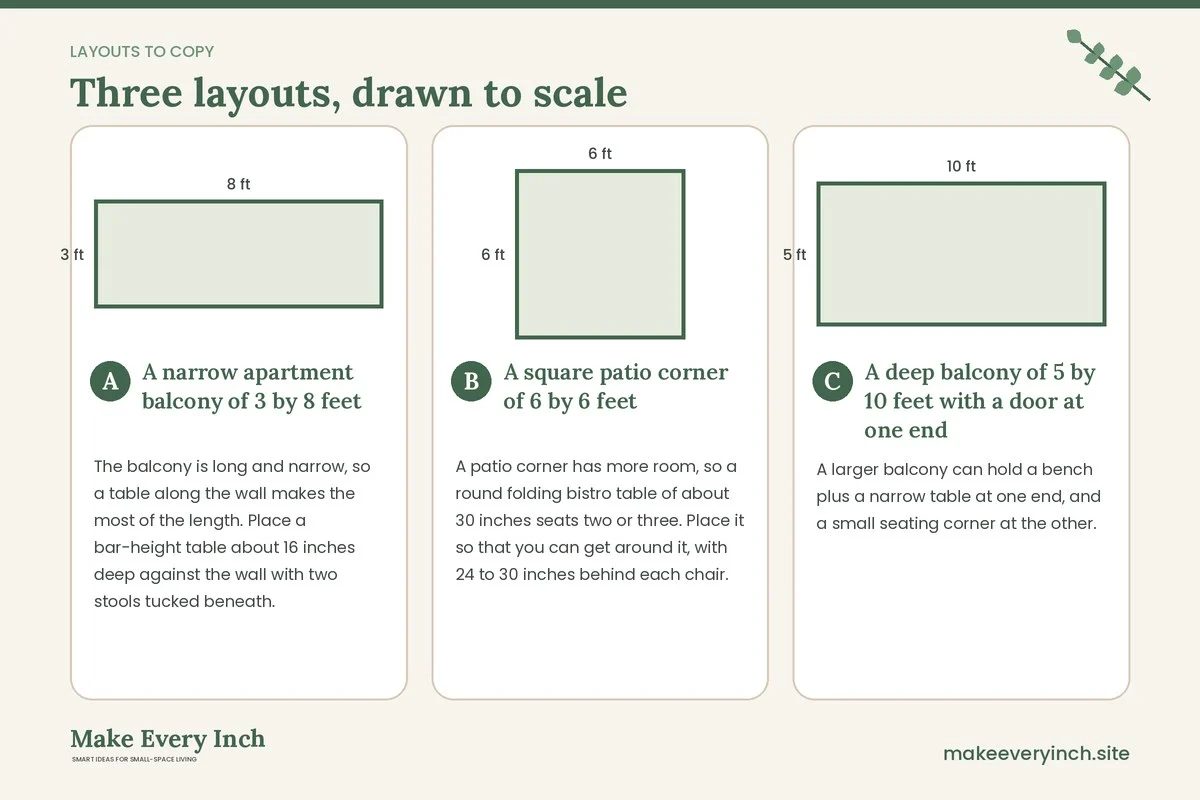
Three example tiny outdoor dining areas
A narrow apartment balcony of 3 by 8 feet
The balcony is long and narrow, so a table along the wall makes the most of the length. Place a bar-height table about 16 inches deep against the wall with two stools tucked beneath. This leaves around 20 inches of walkway on a 36-inch width, and the stools slide fully under when not in use. Keep the table and stools at least 18 inches from the railing, and put a low, heavy planter in the far corner. Use battery lanterns for light. This layout suits a single person or a couple who dine outdoors in good weather, and it keeps the end near the door clear.
A square patio corner of 6 by 6 feet
A patio corner has more room, so a round folding bistro table of about 30 inches seats two or three. Place it so that you can get around it, with 24 to 30 inches behind each chair. Add a bench along the wall as a third seat, and place a low planter at the open edge to mark the boundary. A weighted umbrella can provide shade, but only if it is stable and allowed by the building. A rug that dries fast helps define the zone, as long as it does not trap water.
A deep balcony of 5 by 10 feet with a door at one end
A larger balcony can hold a bench plus a narrow table at one end, and a small seating corner at the other. A bench 16 inches deep with a storage lid sits against the wall, a table of about 20 by 36 inches sits in front, and two folding chairs sit on the open side. Leave a 30-inch lane to the door. Keep chairs at least 18 inches from the railing, and place plants against the wall rather than on top of the railing. This arrangement suits a family or four friends, as long as the weight is sensible and the railing is safe for any children.
Make it feel like a dining room
Once the safe basics are in place, small touches make the space feel special.
- A tablecloth or runner in a weather-friendly fabric makes the table feel set. Weights or clips keep it in place in the wind.
- Unbreakable dishes are practical outdoors. Use melamine or enamel plates and shatter-resistant glasses so a gust or a bump does not cause shards.
- A small tray carries everything in one trip and doubles as a landing zone.
- A color palette of two or three tones keeps the space calm. Light colors reflect heat and make a small space look larger.
- A mirror or reflective panel can bounce light, but should be shatter-resistant and secured, and not placed where it could focus sun onto plants or surfaces.
- Cushions in outdoor fabric add comfort but must dry quickly and be stored inside when it rains.
If you rent, remember that all of this should be removable. See our guide to renter-friendly small balcony ideas and the broader post on renter-friendly apartment decorating ideas.
Budget approach
You do not need to buy everything at once. Start with the table and one chair, and use the space for two weeks before adding more. Second-hand furniture is often cheaper, and a sturdy indoor stool can work outdoors if it is sealed and dried properly. Check every used item for loose joints, rust or splintered wood. Skip fragile, decorative items that will not survive a season. For more ways to stretch a small budget, see budget small space ideas.
Common mistakes to avoid
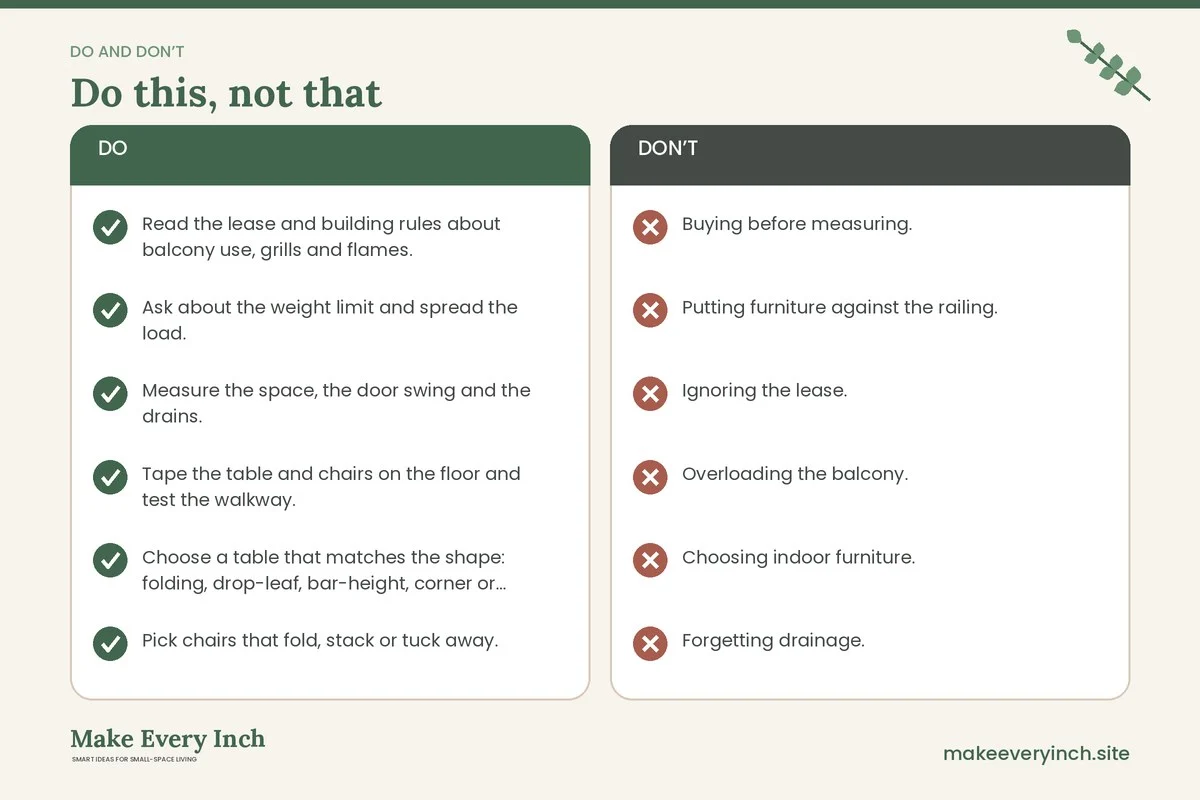
- Buying before measuring. A table that fits in a shop may block the door at home.
- Putting furniture against the railing. It creates a climbing risk and a drop hazard.
- Ignoring the lease. A banned item can cost you a deposit.
- Overloading the balcony. Heavy planters, big tables and many guests add up.
- Choosing indoor furniture. Indoor pieces warp, rust or mold outside.
- Forgetting drainage. Pooled water causes damage and annoys the neighbours below.
- Using candles or grills where banned. Fire risks are serious, so check the rules.
- Using indoor cords outside. Always use outdoor-rated lighting.
- Leaving cushions out. They mildew and attract pests.
- Ignoring the sun. A hot surface can burn, so test it first.
Seasonal care
At the end of the season, wipe down the table, let everything dry, and fold chairs flat. Store cushions indoors, and cover or bring in anything that will be hit by winter weather if the building allows. In spring, check each piece for rust, loose screws and mildew before use. Inspect the floor and drains for debris, and clear leaves. A short seasonal check keeps the space safe and extends the life of the furniture. If the balcony is shared with a neighbour or has strict storage limits, plan to keep only what you can bring inside.
Frequently asked questions
How much space do I need to create a tiny outdoor dining area?
A bar-height table with two stools can fit on a strip about 24 to 30 inches deep, while a bistro table and two chairs need roughly 4 by 4 feet. Aim for 24 to 30 inches of walkway where people pass.
Can I put a table near the railing?
Keep it back. Furniture near a railing creates a climbing hazard, especially for children and pets. Leave at least 12 to 18 inches from the rail, and more where possible.
Is a balcony strong enough for a dining set?
Every balcony has a load limit. Ask the building manager or landlord what it is, avoid heavy furniture and stacked planters, and limit how many people stand on it at once. If you see cracks, rust or movement, stop using it.
Can I use candles or a grill?
Often not. Many leases and local codes ban open flames and grills on balconies. Check your rules, and use flameless LED candles and cook indoors if in doubt.
Are string lights safe?
They can be, if they are outdoor-rated, plugged into a GFCI-protected outlet, kept away from water and flammable fabrics, and not overloading a socket. Battery or solar lights avoid most electrical issues.
What plants are safe around pets and children?
Check each plant against a trusted pet-safe plant list. Some common ornamental plants are toxic if chewed. Keep risky ones out of reach or choose safer herbs.
How do I stop water running down to my neighbours?
Keep drains clear, use saucers with a lip under pots, avoid hosing the floor, and wipe up spills quickly. Tell the building manager if you notice leaks or staining.
Can I attach anything to the railing or wall?
Only with written permission. Many railings and walls are structural or owned by the building. Choose freestanding, weighted or tied solutions instead.
Final checklist
- Read the lease and building rules about balcony use, grills and flames.
- Ask about the weight limit and spread the load.
- Measure the space, the door swing and the drains.
- Tape the table and chairs on the floor and test the walkway.
- Choose a table that matches the shape: folding, drop-leaf, bar-height, corner or bench.
- Pick chairs that fold, stack or tuck away.
- Keep furniture 12 to 18 inches or more from the railing.
- Secure planters and anything that could fall or blow.
- Use outdoor-rated lighting, GFCI outlets and no overloaded sockets.
- Skip candles and grills unless clearly permitted.
- Plan shade without drilling.
- Check plants for toxicity to pets and children.
- Keep drains clear and prevent water reaching neighbours.
- Test surfaces for sun heat.
- Store cushions inside and review seasonally.
Keep going: Keep going with our pillar guide to small balcony ideas, the sunny-day companion on small balcony hot sunny spaces and our practical post on renter-friendly small balcony ideas.
Save this guide for later
Pin the ideas you like to Pinterest so you can come back to them when you plan your space.