16 Layered Lighting Ideas for Small Apartments, Zone by Zone
Quick answer: Layered lighting small apartments depend on three layers: soft ambient light for the whole room, focused task light where you work, and gentle accent light that adds depth. Aim for at least three light sources at different heights in each room, put the main lights on dimmers or separate switches, and keep bulbs within each fixture’s rated wattage.
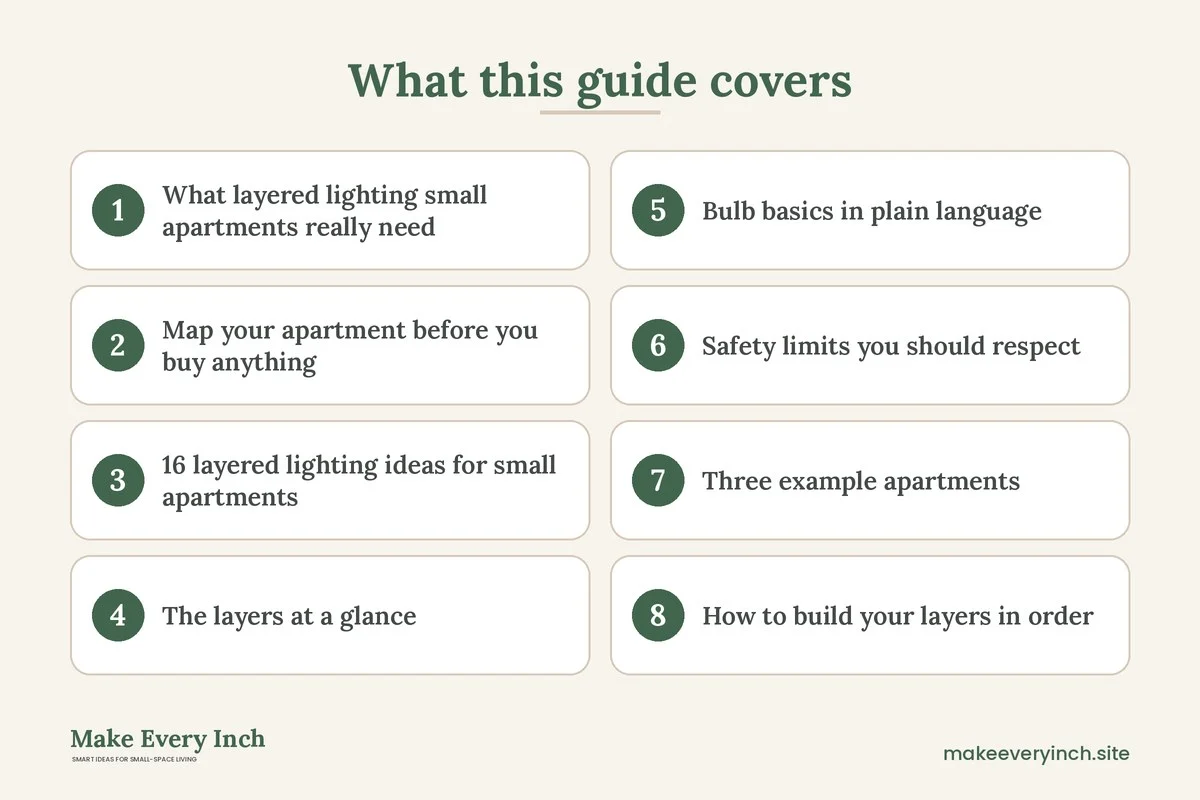
Layered lighting small apartments is the single most useful lighting idea for anyone living with one overhead fixture, a few dark corners and a lease. A lone ceiling light flattens a room, throws harsh shadows and makes a compact space feel like a waiting room. The fix is not more light. It is light at different heights, with different jobs, that you can switch on in combinations. This guide explains the three layers, how to map them in a studio or a one-bedroom, 16 ideas that work without rewiring, a comparison table, three example rooms, bulb basics, safety limits and a checklist. For the bigger picture of styling a compact home, read our pillar guide on small room decor ideas, and for rules that suit leases, see renter friendly lighting ideas. If your style is still undecided, our guide to apartment decorating styles can help you pick lamp shapes that fit.
What layered lighting small apartments really need
Lighting designers talk about layers because each one solves a different problem. In a small apartment you rarely need all three at full strength at once, but you need all three available.
- Ambient light is the general glow that lets you walk around safely. It usually comes from a ceiling fixture, a pair of wall lights or a floor lamp that bounces light off the ceiling.
- Task light is focused light for a job: reading, chopping, applying makeup, working at a desk. It should be brighter than ambient light and aimed at the work surface, not at your eyes.
- Accent light is low, decorative light that picks out something, such as a shelf, a plant, a piece of art or a textured wall. It adds depth, which is what makes a small room feel larger.
A fourth idea sits across all three: mood. Mood comes from dimming, warm color temperature and the number of lamps on. A room with five small pools of light feels calmer than a room with one bright fixture, even when the total light output is similar.
Map your apartment before you buy anything
Walk through the apartment in the evening with the main light on and write down where you are uncomfortable. Common answers are the kitchen counter, the desk, the reading chair, the bed, the entry and the dark corner by the window. Each answer is a missing layer.
Then sketch the room as a rectangle and mark three things: where the switches are, where the outlets are, and where you spend time. Lamps must live near outlets, and cords should never cross walkways. Mark every spot where a lamp could stand on a surface, a floor corner that could hold a slim floor lamp, and every place where a plug-in wall light could sit beside a bed or a sofa.
Finally, decide on one color temperature for the whole apartment. Warm white (often labeled around 2700K) suits living and sleeping areas. Neutral white (often around 3000K to 4000K) suits kitchens, desks and bathrooms. Mixing wildly different color temperatures in one room looks patchy, so choose a main one and treat any task lamp as the single exception.
16 layered lighting ideas for small apartments
Ambient layer ideas
1. Bounce light off the ceiling
A slim floor lamp with an upward-facing head, or a torchiere style, throws soft light across the ceiling and fills the room evenly. In a small room it often replaces the need for a harsh overhead light entirely.
2. Swap the shade or diffuser on the existing fixture
If the lease bans changing the fixture, you can often change what is in it. A frosted or fabric-style shade softens glare. Check the fixture label for the maximum wattage and for the bulb base type before you buy anything.
3. Add a dimmer you can fit without wiring
Plug-in dimmers sit between a lamp’s plug and the outlet, and dimmable smart bulbs adjust through an app or a remote. Both avoid touching the wall switch. Make sure the bulb is labeled dimmable and the dimmer is rated for the load.
4. Use two matching lamps on opposite sides
A pair of lamps on opposite sides of a room, or on each side of a sofa or bed, creates balanced light and a sense of order. Two 40 to 60 watt equivalent LED bulbs are often enough for ambient glow in a small space.
5. Hang a plug-in pendant
Where a ceiling fixture is dull but you cannot replace it, a plug-in pendant hung from a ceiling hook can add a focal point. Only drill a hook into the ceiling with written permission, or use a freestanding arc floor lamp to get the same overhead effect with no holes.
Task layer ideas
6. A desk lamp with an adjustable arm
A task lamp should reach the page without shining into your eyes. Place it on the side opposite your writing hand to avoid shadows, and aim the head at the work surface.
7. Clamp or plug-in reading lights at the bed
A swing-arm reading light beside a bed saves a nightstand surface. Wall-mounted versions need drilling, so a clamp light on a headboard or a plug-in lamp on a slim shelf is the lease-safe route.
8. Under-cabinet strips for the kitchen
Stick-on or plug-in LED strips under upper cabinets light the counter without touching the wiring. Pick strips with a low-heat rating, place them away from the stove, and keep the power adapter off the wet counter.
9. A vanity or mirror light in the bathroom
Light on both sides of the face is more flattering than one light overhead. Battery-powered or plug-in mirror lights work, but bathrooms are damp, so check that any light used near a sink is rated for damp locations and that cords do not hang over water.
10. A swing-arm floor lamp by the reading chair
In a hallway or entry, the same lamp trick works; see small hallway lighting ideas.
A floor lamp with a bent arm places light over your shoulder, takes only a few inches of floor and doubles as an ambient source when angled at the ceiling.
Accent layer ideas
11. Light a bookshelf from within
Battery-powered puck lights or a low-wattage strip tucked under a shelf lip make a shelf glow. It makes a compact room feel layered and deeper.
12. Uplight a plant
A small spotlight on the floor aimed upward through foliage throws leaf shadows on the wall. Choose a cool-running LED and keep it clear of leaves. If you have pets, check that the plant is not toxic to cats or dogs before placing it at floor level.
13. Wash a wall with a gentle strip
A strip behind a headboard, a TV unit or a desk makes the wall glow indirectly. Use removable mounting clips instead of strong adhesive if the paint is delicate.
14. Light the art
For ways to fill walls without nails first, see renter friendly wall decor ideas. A small picture light or a clip-on lamp aimed at a frame turns a flat print into a feature. Keep the light a few inches from the frame and pick a low-heat LED so the artwork does not fade or warm.
15. String lights, used sparingly
String lights add a sparkle layer, but too many make a room look busy. Use one string in one place, such as along a curtain rod or a headboard, and follow the maximum run length on the packaging.
16. A candle-look LED for a tabletop
Flameless, flicker-style LEDs give a warm low glow on a side table without a naked flame. They are a better choice around pets, curtains and sleeping children.
The layers at a glance
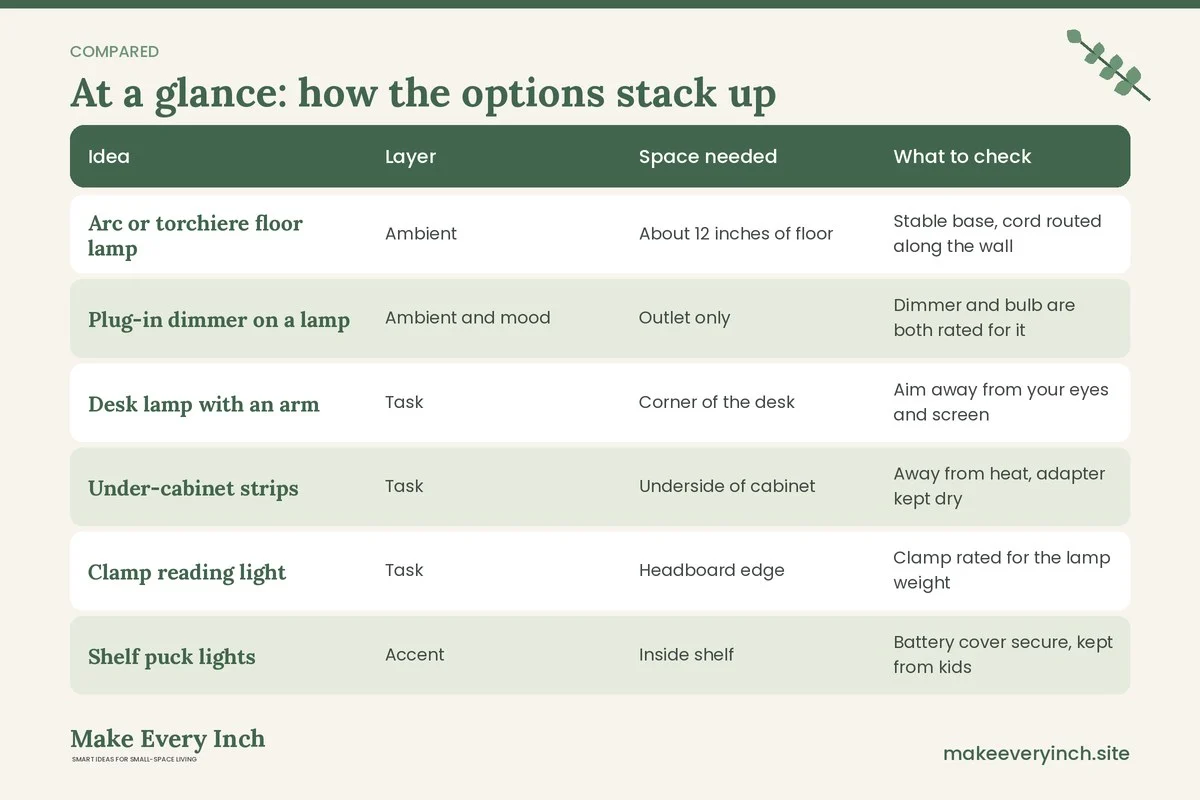
The table shows which layer each idea serves, how much it demands from your space, and what to check.
| Idea | Layer | Space needed | What to check | |
|---|---|---|---|---|
| Arc or torchiere floor lamp | Ambient | About 12 inches of floor | Stable base, cord routed along the wall | |
| Plug-in dimmer on a lamp | Ambient and mood | Outlet only | Dimmer and bulb are both rated for it | |
| Desk lamp with an arm | Task | Corner of the desk | Aim away from your eyes and screen | |
| Under-cabinet strips | Task | Underside of cabinet | Away from heat, adapter kept dry | |
| Clamp reading light | Task | Headboard edge | Clamp rated for the lamp weight | |
| Shelf puck lights | Accent | Inside shelf | Battery cover secure, kept from kids | |
| Plant uplight | Accent | A few inches of floor | Cool-running bulb, plant safe for pets | |
| Picture light | Accent | Above or below frame | Low heat, stable mounting | |
| String lights | Accent and mood | One wall or rail | Rated length, no overloaded outlet |
Bulb basics in plain language
You do not need to become an electrician, but three terms decide how a room looks.
- Brightness is measured in lumens, not watts. A bright reading lamp might produce several hundred lumens, while a soft accent might produce under a hundred. Use more lumens for task lamps and fewer for accent lamps.
- Color temperature is shown in kelvin. Lower numbers look warmer and yellower, and higher numbers look cooler and bluer. Warm white is relaxing, and neutral white helps with detail work.
- Color rendering (often listed as CRI) describes how natural colors look. A higher rating usually makes skin, food and fabric look more true, which matters in kitchens, bathrooms and dressing areas.
Choose LED bulbs in most places because they run cooler and use less power than older types, and check that the bulb base matches the socket. Always read the wattage limit printed on the lamp or fixture. A bulb that glows brighter than the limit allows is a heat risk, even if it fits.
Safety limits you should respect
Lighting is one area where cutting a corner can cause a fire or a shock, so treat these as non-negotiable.
- Stay within the labeled wattage. Every lamp and fixture lists a maximum. LED bulbs labeled as equivalents usually draw far less than the limit, but check the actual draw on the bulb, not the equivalent number.
- Do not overload sockets. Avoid plugging many lamps, strips and chargers into one outlet or a chain of power strips. Use a surge-protected strip with a built-in breaker where you need more outlets, and keep it in the open, not under rugs or behind heavy furniture.
- Keep cords visible and out of the way. Never run a cord under a rug, over a doorway or through a place people walk. Use cord covers that sit flat and keep cords away from heaters and from where a pet could chew them.
- Keep heat away from fabric. Shades, curtains and paper should sit clear of bulbs. A lamp that is hot to the touch needs a lower-heat bulb or more distance.
- Use damp-rated products near water. Bathrooms and kitchens need lights labeled for those conditions. Keep adapters and plugs dry and off the counter edge.
- Do not drill, hardwire or replace fixtures without permission. In a rental, ask the landlord in writing before installing hooks, wall lights or a hardwired change. Many of the ideas above avoid this.
- Turn off decorative lights when you leave or sleep. Use a timer or a smart plug rated for the load so you are not relying on memory.
- Anchor tall lamps. A tall floor lamp near a doorway or a pet or child should have a heavy base. Place it in a corner or where it cannot be knocked.
Three example apartments
Example 1: A 400 square foot studio
The studio has one ceiling light, a bed in the corner, a desk by the window and a small kitchen along one wall. Ambient light comes from an arc floor lamp aimed at the ceiling and a table lamp on a dresser. The desk gets a task lamp, and the bed gets a clamp reading light. Under-cabinet strips light the counter. A plant uplight and one string of lights behind a curtain form the accent layer. In the evening, the overhead light stays off and the four lamps do the work. This design uses six sources and no wiring. See our guide to studio apartment lighting ideas for more zoning plans.
Example 2: A one-bedroom living room
The living room has a ceiling fan with a bright light kit and a sofa against one wall. Replace the bulbs with dimmable LEDs and use a dimmer. Add a table lamp on each end of a console behind the sofa, and a swing-arm floor lamp beside the reading chair. A picture light on the main art and a battery shelf light on the bookcase supply the accents. Watching TV, only the console lamps and the bookcase are on, which prevents glare on the screen. For living-room specifics, read our small living room lighting ideas.
Example 3: A small bedroom
The bedroom has a flush ceiling light and no wall outlets near the bed. Pick two small bedside lamps with warm, dimmable bulbs. If there is no room for nightstands, use a slim shelf or a stool. Cord and bulb storage matters too, so see small space organization ideas. Add a plug-in strip behind the headboard for a soft glow, and a floor lamp in the corner for dressing. The ceiling light is only for cleaning. For the wider room plan, see small bedroom ideas. For sleeping-area lighting, see small bedroom lighting ideas.
How to build your layers in order
If you are starting from nothing, add light in this order so you spend only where it matters.
1. Fix the biggest complaint first. Usually that is a task spot, such as the desk or the counter.
2. Add an ambient lamp at a corner. One tall lamp that bounces light off the ceiling changes the whole room.
3. Add a second lamp at a different height. A table lamp at about eye level when seated gives you the mid-level glow that most small rooms lack.
4. Add one accent. Pick the thing you most want to show off, such as art, a plant or a shelf.
5. Add control. Put the lamps on a timer, a dimmer or a smart plug so the room can shift from work to rest.
6. Review in a week. Notice which lamps you actually switch on, and move or drop the rest.
Common mistakes
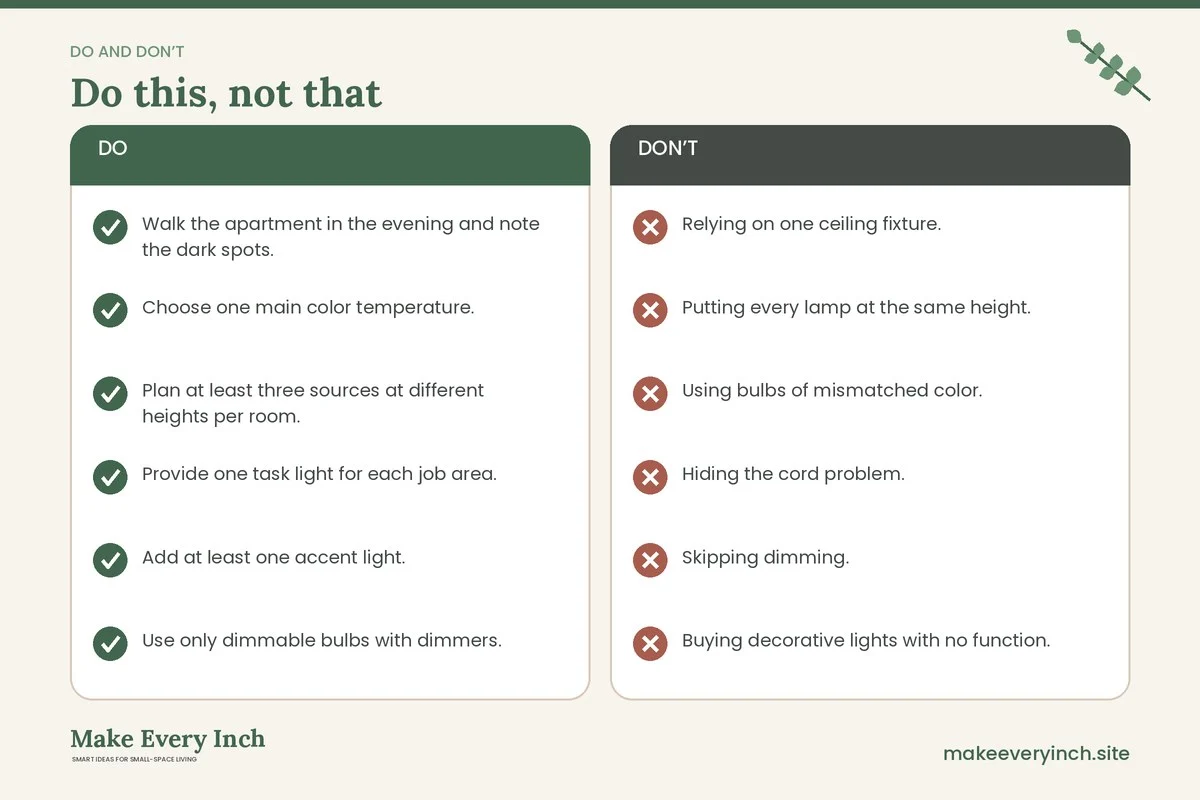
- Relying on one ceiling fixture. It creates shadows under your chin and a flat room.
- Putting every lamp at the same height. Mix floor, table and wall-level light.
- Using bulbs of mismatched color. One blue-white bulb among warm ones looks like a mistake.
- Hiding the cord problem. A beautiful lamp with a cord across the floor is a trip hazard.
- Skipping dimming. Bright light at 10 pm keeps a room feeling like daytime.
- Buying decorative lights with no function. Every lamp should earn its spot by serving a layer.
- Forgetting the lease. Check permissions before drilling, hardwiring or using strong adhesive.
Checklist
- Walk the apartment in the evening and note the dark spots.
- Choose one main color temperature.
- Plan at least three sources at different heights per room.
- Provide one task light for each job area.
- Add at least one accent light.
- Use only dimmable bulbs with dimmers.
- Check every bulb against the labeled wattage limit.
- Spread plugs across outlets and use a surge-protected strip with a breaker if needed.
- Route cords along walls and keep them off walkways.
- Keep fabric and paper clear of bulbs.
- Use damp-rated lights in bathrooms and kitchens.
- Get written permission before drilling or hardwiring.
- Choose pet-safe plants for floor-level accent lights.
- Set timers for decorative lights.
FAQ
How many lamps does a small apartment need?
There is no fixed number, but a good aim is at least three light sources per room at different heights. A small bedroom might use two bedside lamps and a floor lamp, and a living room might use a floor lamp, a table lamp and a shelf light.
Do I need to keep the ceiling light?
Not necessarily. Many people rarely turn it on once good lamps are in place. Keep it for cleaning and for the occasional bright moment, and use a dimmer on it if the lease allows replacing the bulb type.
Is warm or cool light better for small spaces?
Warm white tends to feel cozy and is often best for living and sleeping areas. Neutral white is better for kitchens, desks and bathrooms. Keep one main tone for the whole apartment so the rooms feel connected.
How bright should a task lamp be?
It should be noticeably brighter than the ambient lighting, with enough light to read comfortably without eye strain. Packaging lumen ratings help here. If you need to squint, the lamp is too dim or poorly aimed.
Can I layer light without drilling?
Yes. Floor lamps, table lamps, clamp lights, plug-in strips and battery lights all work without holes. If you want wall lights or ceiling hooks, ask permission first.
Are string lights safe to leave on?
Use only products labeled for your intended use, follow the run limit on the package, keep them clear of fabric and heat, and turn them off when you sleep or leave. A timer makes this easy.
Final thought
Layered lighting small apartments is less about spending and more about placing. Three sources at three heights, with a dimmer and a task light where you work, will change a cramped room more than a new paint color. Start with one corner this week, and build the layers as you see what you use.
Keep going: Pair your new lamps with a plan for the whole home. Read our pillar on small room decor ideas, learn how mirrors double your light in small room mirror placement ideas, and see how to style on a budget with budget small space ideas.
Save this guide for later
Pin the ideas you like to Pinterest so you can come back to them when you plan your space.