19 Small Apartment Living Room Ideas With Storage Built Into Every Piece
Quick answer: The best small apartment living room ideas with storage begin with an audit, not a shopping trip. List what the room must hold by category (media, games, blankets, books, papers, cables, guest items), measure each pile, then choose pieces whose real capacity matches. Aim for about two thirds closed storage and one third open display.
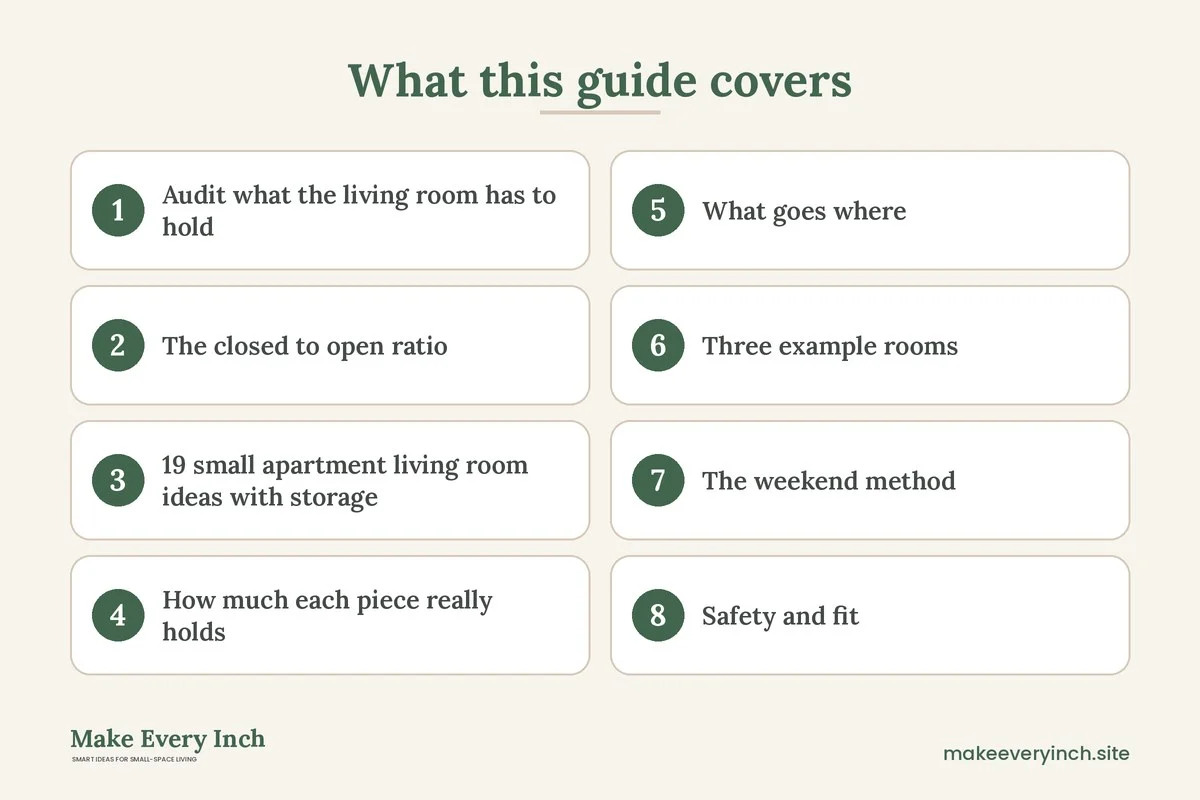
Small apartment living room ideas with storage usually start with a list of furniture to buy. This guide starts one step earlier, because the most common storage mistake is buying a beautiful cabinet that holds the wrong things. Instead you will count what the room has to hold, match each category to a piece, and check how much each piece holds in practice. You will find a seven category audit, 19 pieces with storage built in, a capacity table, a rule for the ratio of closed to open storage, three example rooms with dimensions, a method for the weekend and a checklist. For quick lists of ideas, see our guides to small living room storage ideas and the pillars on small living room ideas and small apartment living room ideas.
Audit what the living room has to hold
Walk through your apartment and collect everything that currently ends up in the living room, or that you want to keep there. Sort it into seven categories and give each a size. Use shelf feet for flat items, and boxes or baskets for loose ones.
Media
Consoles, discs, remotes, streaming boxes, speakers and the cables that join them. Most households need very little shelf space for media now, perhaps 1 to 2 feet, but they need a ventilated spot for a router and a console.
Games and hobbies
Board games are the heavy part, since a standard box is about 12 by 12 by 3 inches, and ten of them fill a shelf 30 inches wide when stacked flat. Cards, puzzles and craft kits need a closed bin so loose pieces do not escape.
Blankets and pillows
A throw takes up about as much room as a bed pillow when folded. Three throws and four spare pillows fill a basket about 18 inches across and 18 inches deep.
Books
A paperback is about 1 inch thick, and a hardcover about 1.5 inches. A 30 inch shelf holds roughly 25 paperbacks, and a 5-shelf, 30 inch bookcase holds about 100 to 120. Decide how many you really read or reference, and give the rest to a library or a swap.
Papers and mail
This category is small but grows fast. A single magazine file and a lidded box for the year’s records usually cover it. Keep a slim tray for today’s mail.
Cables and chargers
Chargers, power strips and spare cords. One shallow box or a drawer divider holds them all, and a cable box on the floor behind the TV hides the strip.
Guests’ things
A spare duvet, pillows and a towel are bulky, and you may use them only a few times a year. These go in the least convenient storage in the room: under the sofa or inside an ottoman.
Add up the numbers. If the total is more than about 12 cubic feet, you need at least one large closed unit. If it is under 6 cubic feet, a single bench or console may be enough.
The closed to open ratio
Open shelves are easier to use and look lighter, but they show everything. Closed storage hides the mess but costs more and can look heavy. For a living room under 200 square feet, a good target is about two thirds closed and one third open. That means that for every three feet of shelf or cabinet run, two feet are doors, drawers or lidded boxes, and one foot is open. Keep the open part at eye level, where you want to see the display, and put closed storage below the waist and above the reach. If your room has more daily clutter, move the ratio to three quarters closed. If you have a lot of books and plants, you can go to half and half, but you must edit the open shelves each month.
19 small apartment living room ideas with storage
Seating that stores
1. A storage ottoman as coffee table
A 30 inch square ottoman with a lid holds around 5 to 7 cubic feet, enough for the entire guest bedding set or four to five board games. Add a tray on top so drinks have a firm surface. See best storage ottomans for what to check.
2. A sofa with a storage chaise
The chaise of an L-shaped sofa often lifts to reveal a space about 20 by 55 by 12 inches. That holds a duvet and two pillows. Check that the lift mechanism holds open on its own.
3. A storage bench behind the sofa
A 48 inch bench with a lid, behind a floating sofa, takes up 16 inches of depth and holds shoes, games or a bin of toys. It also marks the edge of the room if you share a studio.
4. Under-sofa bins on low frames
If your sofa has legs at least 6 inches high, flat bins about 5 inches tall slide beneath. Together two bins hold about one spare duvet, or a season of throws and a box of cables.
Tables that store
5. A coffee table with drawers
A 40 inch table with two drawers holds remotes, coasters, a deck of cards and a few chargers. Each drawer takes about 0.5 to 0.75 cubic feet. It suits items you reach for every day.
6. A nesting table pair with a lower shelf
A pair of nesting tables with one shelf holds about 6 inches of books. They are the best option when you want storage that can disappear when you do not need it.
7. A console behind the sofa
A console 10 to 12 inches deep and 48 to 60 inches long holds a lamp, a tray and baskets underneath. Baskets 10 by 10 by 10 inches hold chargers, mail and hand tools.
8. A side table with a cabinet door
A side table 24 inches high with a door holds a small router, a power strip and a box of games. The door hides the cables.
Wall units
9. A tall, narrow bookcase
A bookcase 12 inches wide, 72 inches high with 5 shelves holds around 50 paperbacks, and a version 31 inches wide holds around 120. Anchor it to the wall. See best narrow bookshelves.
10. A bookcase with doors on the lower half
Doors on the lowest two shelves hide games and cables. Keep the top three shelves open for books and display. This gives you the closed to open ratio built into a single piece.
11. A floating shelf run above the sofa
Three shelves 8 inches deep, spaced 12 inches apart, hold around 15 feet of books or frames in total. Keep the load light, since these sit above your head. If you cannot drill, see small apartment living room ideas without drilling.
12. A media console with doors and a vented back
Choose a console 54 to 60 inches long and 16 inches deep, with doors that open fully and a back panel with cutouts. Together the cabinets hold a console, a router and a box of games. See small living room TV wall ideas.
Hidden and borrowed space
13. Baskets with lids on open shelves
A lidded basket 12 by 12 inches holds about one cubic foot of blankets or toys. Lids make a shelf look neat, and they hide the contents from dust.
14. A wall-mounted or leaning ladder shelf
A leaning ladder shelf uses a corner and holds plants, baskets and books on a slim 10 inch footprint, with no drilling. It is lighter than a bookcase but holds less.
15. A shoe or slim cabinet near the door
A cabinet 8 inches deep and 36 inches high holds about 12 pairs of shoes, but in a living room it can instead hold remotes, keys and mail. See best narrow shoe cabinets.
16. A fold-down desk cabinet
A wall cabinet 24 inches wide that opens into a desk holds a laptop, papers and chargers, then closes to look like a cupboard. It suits people who work in the living room only a few hours a day.
17. A bed or sofa riser
Risers that lift furniture 4 to 6 inches give you a flat space beneath for boxes. A sofa at 6 inches gains about 2 cubic feet per foot of width, so a 7 foot sofa gains about 14 cubic feet. Check weight ratings first.
18. A cabinet over the door or window
A shallow cabinet or shelf above a door or window uses a zone that otherwise sits empty. Use it for the items you touch twice a year, like spare bulbs or holiday linens.
19. A lidded storage trunk as a side table
A trunk 24 by 16 by 18 inches holds about 4 cubic feet and works as a side table or a seat. It is useful beside a sofa when you have no room for a bigger piece.
How much each piece really holds
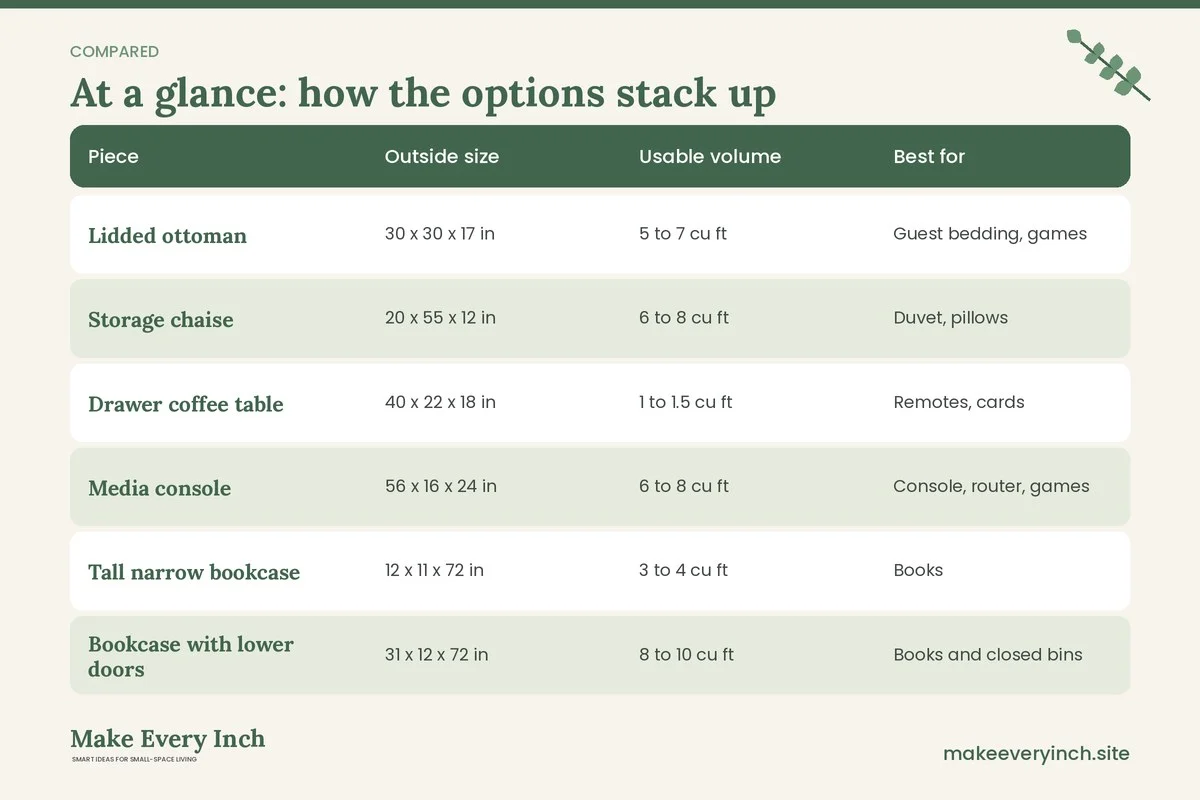
Manufacturers list outside dimensions, but usable space is smaller. Panels, lids, drawer slides and the back of a unit remove 15 to 25 percent of the volume, and awkward shapes make it worse. These figures are working estimates, not lab results, so measure your own pieces.
| Piece | Outside size | Usable volume | Best for | Typical cost |
|---|---|---|---|---|
| Lidded ottoman | 30 x 30 x 17 in | 5 to 7 cu ft | Guest bedding, games | $80 to $250 |
| Storage chaise | 20 x 55 x 12 in | 6 to 8 cu ft | Duvet, pillows | Part of the sofa price |
| Drawer coffee table | 40 x 22 x 18 in | 1 to 1.5 cu ft | Remotes, cards | $100 to $350 |
| Media console | 56 x 16 x 24 in | 6 to 8 cu ft | Console, router, games | $150 to $500 |
| Tall narrow bookcase | 12 x 11 x 72 in | 3 to 4 cu ft | Books | $50 to $150 |
| Bookcase with lower doors | 31 x 12 x 72 in | 8 to 10 cu ft | Books and closed bins | $120 to $400 |
| Lidded trunk | 24 x 16 x 18 in | 4 cu ft | Throws, pillows | $60 to $200 |
| Under-sofa bins (pair) | 30 x 16 x 5 in each | 4 to 5 cu ft total | Off-season bedding | $25 to $60 |
What goes where
Match each category from the audit to a piece. Media and cables go in the console behind a door, with the router near the vent. Games go in the lower half of a bookcase with doors, so the heaviest boxes sit lowest. Blankets go in a lidded basket or an ottoman within arm’s reach of the sofa. Books go on the open shelves, face out for a few, so the shelf looks styled. Papers go in a lidded box in a drawer or a cabinet, and the day’s mail goes in a tray. Cables and chargers go in a drawer of the coffee table, or a small box in the side cabinet. Guest items go under the sofa or in the chaise. If a category does not fit, you own too much of it, or you need another piece.
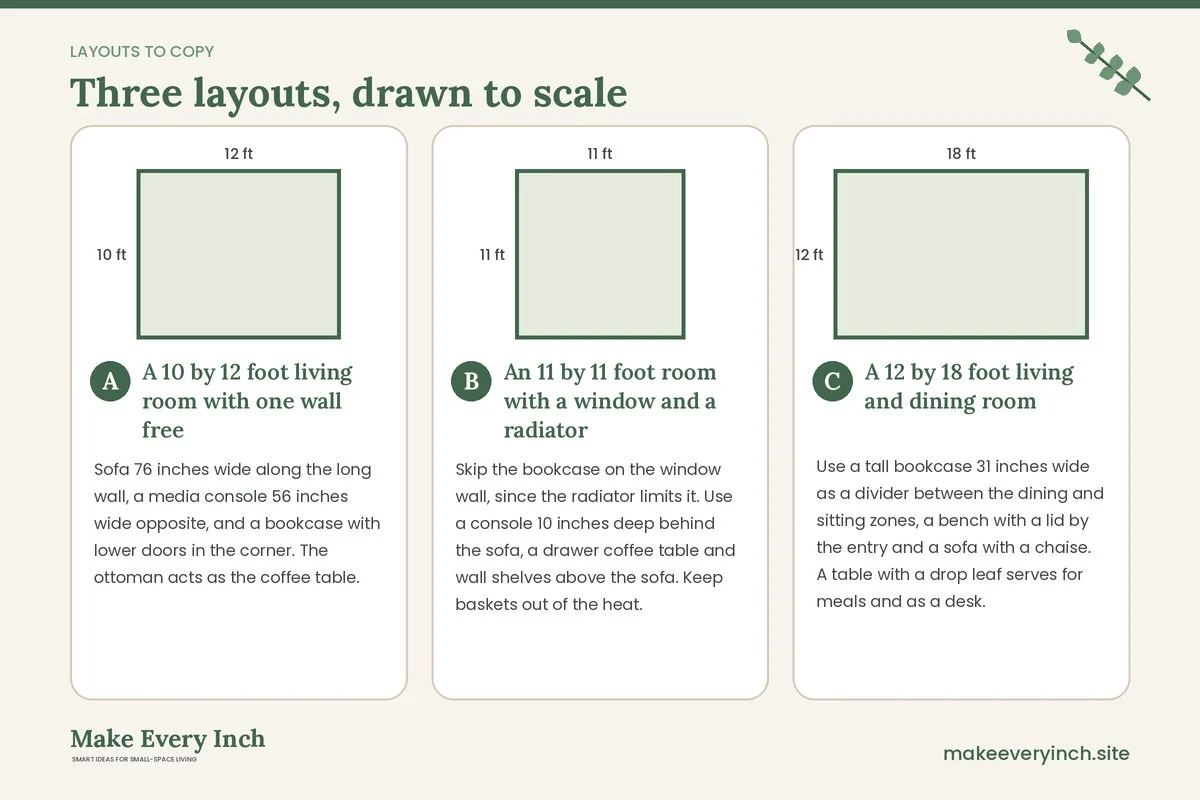
Three example rooms
A 10 by 12 foot living room with one wall free
Sofa 76 inches wide along the long wall, a media console 56 inches wide opposite, and a bookcase with lower doors in the corner. The ottoman acts as the coffee table. Total closed storage is about 25 cubic feet, enough for the media, the games, a duvet and the mail. Leave 30 inches between the sofa and the console.
An 11 by 11 foot room with a window and a radiator
Skip the bookcase on the window wall, since the radiator limits it. Use a console 10 inches deep behind the sofa, a drawer coffee table and wall shelves above the sofa. Keep baskets out of the heat. Total storage is about 15 cubic feet, so audit the games and give away half.
A 12 by 18 foot living and dining room
Use a tall bookcase 31 inches wide as a divider between the dining and sitting zones, a bench with a lid by the entry and a sofa with a chaise. A table with a drop leaf serves for meals and as a desk. The extra length allows about 40 cubic feet of storage, which is enough for a small family or a hobby.
The weekend method
Saturday morning: empty and sort
Clear the surfaces and pull everything out of the living room. Sort into the seven categories and set aside anything that belongs elsewhere. Count what remains.
Saturday afternoon: measure and plan
Measure the free wall space, the heights under furniture and the door swing. Write the cubic feet each category needs, and match them to pieces from the table above. Draw a plan, with the heaviest items low.
Sunday: place and label
Place the pieces, start with the largest and fill from the bottom. Label the bins, and keep the last shelf only half full so you have room to grow. Photograph the finished room, so you can keep it that way.
Safety and fit
Anchor every bookcase over 30 inches high to the wall with a strap, since a loaded unit can tip. If you rent, ask about brackets, and use a furniture strap that attaches to a stud with a small screw, or choose a low, wide unit. Check the load rating on floating shelves, and do not stack heavy hardcovers above the sofa. Leave a gap behind electronics, since consoles need air. Keep 30 inches clear in walkways, and leave drawers and doors room to open. Measure the stairs and the door before you buy a large piece.
Storage that matches your style
If you like a calm look, choose closed storage in the same color as the wall. If you like warmth, mix wood and woven baskets. For a modern look, use handleless doors and a single material. For a collected look, leave one open shelf for objects you love. Pieces from the same line or color family make the room feel organized even when the shelves are full. See small living room layout ideas in a minimalist style and small living room layout ideas in a Japandi style.
Budget guide
These ranges are rough, and prices depend on region and store.
Under $150
Under-sofa bins, two lidded baskets, a trunk or a used bench and a cable box. This covers the guest items, throws and cables.
$200 to $600
A storage ottoman, a bookcase with lower doors and a drawer coffee table. Together they add about 20 cubic feet of storage in a small room.
$800 and up
A media console, a sofa with a storage chaise and a custom wall unit. Buy the console and the sofa first, since they hold the most.
Mistakes to avoid
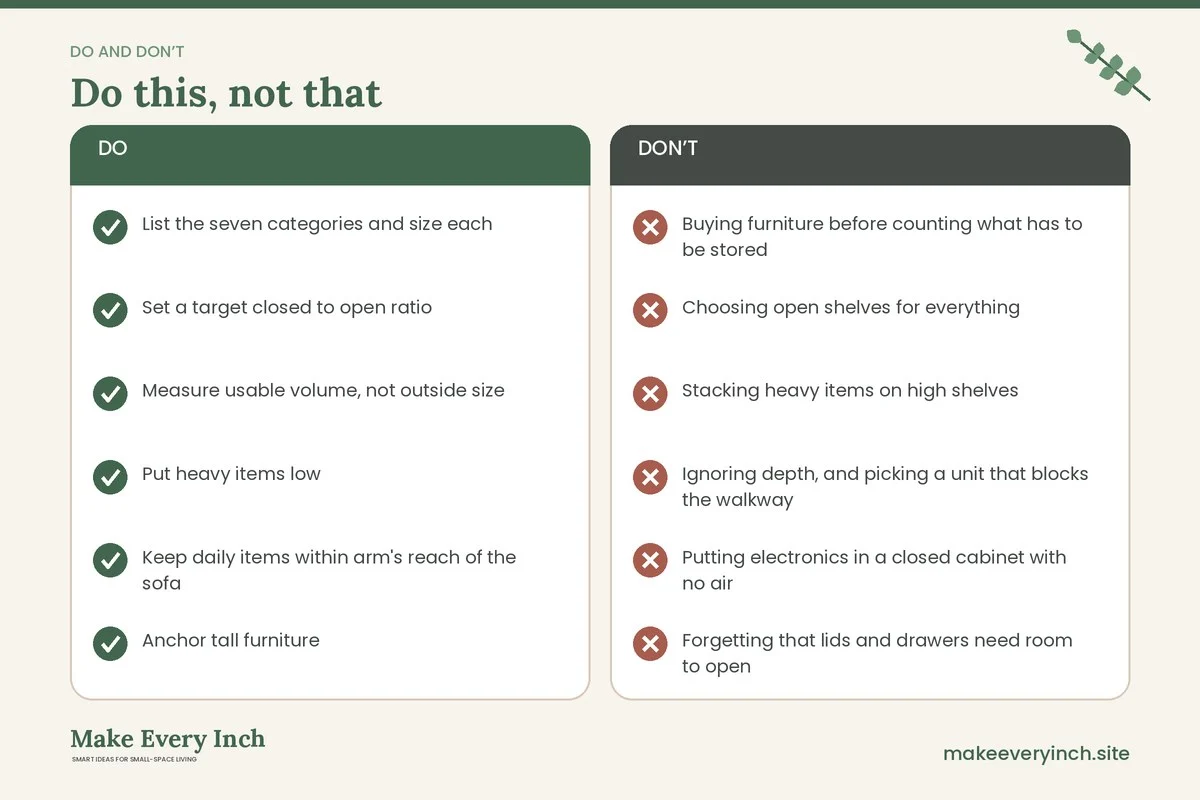
- Buying furniture before counting what has to be stored
- Choosing open shelves for everything
- Stacking heavy items on high shelves
- Ignoring depth, and picking a unit that blocks the walkway
- Putting electronics in a closed cabinet with no air
- Forgetting that lids and drawers need room to open
- Filling every shelf to the edge
- Keeping items that you have not used in a year
- Skipping the wall strap on a tall bookcase
Living room storage checklist
- List the seven categories and size each
- Set a target closed to open ratio
- Measure usable volume, not outside size
- Put heavy items low
- Keep daily items within arm’s reach of the sofa
- Anchor tall furniture
- Leave air around electronics
- Hide guest items in the hardest spot to reach
- Label every bin
- Keep one shelf half empty
FAQ
How much storage does a small living room need?
It depends on what you keep there. Most small living rooms need 12 to 25 cubic feet of closed storage for media, games, blankets and cables, plus a few feet of open shelf for books.
What is the best storage piece for a small living room?
A bookcase with doors on the lower half or a large storage ottoman usually gives the most for the floor space used. Pick the piece that matches your biggest category from the audit.
Should I choose open or closed storage?
Use both. A ratio of about two thirds closed to one third open keeps the room tidy and lets you show a few things. Raise the closed share if clutter is your main problem.
How can I add storage without drilling?
Use freestanding bookcases, ladders, ottomans, trunks, under-sofa bins and furniture risers. See small apartment living room ideas without drilling.
Where do I hide cables and a router?
Use a console with a vented back and a cable hole, or a lidded box on the floor behind the TV. Keep the router near the front of the cabinet, so the signal is not blocked by metal.
How do I store blankets in a small living room?
Keep two or three in a lidded basket or an ottoman beside the sofa. Store the rest in a vacuum bag under the bed or in the guest storage.
How do I keep storage from looking cluttered?
Fill shelves to about 80 percent, group items by color and use matching baskets. Keep the top of each piece mostly clear, with one lamp and one object.
How do I store things in a studio living area?
Treat storage as part of the divider. A bookcase with doors on both sides separates the bed from the sofa and holds items for both. See small apartment living room ideas for studios.
Keep going: Keep going with small living room storage ideas, small living room layout ideas and small space storage furniture.
Save this guide for later
Pin the ideas you like to Pinterest so you can come back to them when you plan your space.