15 Entryway Drop Zone Ideas for Small Homes
Quick answer: A good entryway drop zone small homes can live with has five slots: keys, mail, bags, outerwear and shoes. Give each slot a fixed home within one arm’s reach of the door, keep a clear floor path of 30 to 36 inches, hang hooks at the height of the person using them, and end each day with a two-minute reset. Anchor any tall piece and ask before drilling.
An entryway drop zone small homes can actually keep tidy is not a piece of furniture. It is a short sequence of habits that happen in the first three steps inside the door. You walk in, your hands are full, and in about ten seconds you decide where the keys, the bag, the coat, the mail and the shoes will land. If every item has an obvious home within reach, the decision costs nothing. If not, the items land on the nearest flat surface, and the entry becomes a pile by the end of the week. This guide treats the drop zone as a system rather than a shopping list. It covers a five-slot method, the measurements that keep it comfortable, 15 ideas, a comparison table, three example entries, a time-based daily routine, safety notes and a checklist. For the full overview of the area, read our pillar guide on small entryway ideas. If you want a quick list of drop zone layouts, our post on small home drop zone ideas gives one, and this guide goes further into measurements, routines and safety.
What a drop zone does in the first ten seconds
Think of the moment you arrive home. You are carrying something, you may be holding a child’s hand or a dog’s leash, and you want to put your hands free as soon as you can. A drop zone has one job: let you empty your hands and your pockets in the order you naturally do it, without taking more than a step or two. When a drop zone fails, it is almost always because one item has no home and so it takes over a surface that was meant for something else.
Watch yourself for two or three evenings before you buy anything. Note the order in which you let go of things. Many people first drop the keys, then the bag, then take off shoes, then deal with the coat, and look at the mail last. The best layout follows that order from the door inward. Keys go on the first surface or hook you meet, bags and coats go next, and shoes go at the point where you sit or lean. Mail goes last, because it is the one item you want to carry further into the home to sort. A layout that fights this order feels clumsy even if every piece is beautiful.
Also count the people. A drop zone for one adult needs far less capacity than one for two adults, a child and a dog. Write down each person’s items, and then add a guest allowance of two coats and two bags. The count tells you how many hooks, how many bins and how many inches of shelf you need, and it stops you from buying a unit that is too small or one that overwhelms the wall.
The five-slot system
Almost every entry clutter problem can be sorted into five slots. Give each slot a name and a home, and the rest of the design follows.
Slot 1: Keys and small carry items
Keys, a wallet, sunglasses and a transit card are the first things that leave your hands. They need a spot you can reach without bending, at roughly 40 to 48 inches from the floor for adults. A single wall hook, a shallow dish on a narrow shelf or a small wall-mounted key rail works. The rule is one dish or one rail for the whole household, with a labeled space per person if there are several adults, because shared dishes become dumping grounds faster than named ones.
Slot 2: Mail and paper
Mail is the item most likely to spread. Give it a vertical home, such as a slim wall file, a letter rack or a narrow tray, and pair it with a small recycling bin nearby so junk mail never gets past the door. A slot that holds about a week of mail is enough. If it fills, it tells you that it is time to sort.
Slot 3: Bags
Bags are bulky and they flop. Hooks at 55 to 62 inches from the floor hold an adult’s bag clear of the floor, and a basket or bin on the floor holds a gym bag or a tote. Check the handles’ weight against the hook rating, and leave at least 4 inches between hooks so two bags do not bump each other.
Slot 4: Outerwear
A coat needs about 4 to 6 inches of width on a hook or rail and about 10 to 12 inches of depth if it hangs flat. A small home may not have room for every coat, so use a rotation: the current season’s two coats live at the door, and the rest go to a closet or under-bed storage. Our guide on small coat storage ideas explains how to rotate without crowding the door.
Slot 5: Shoes
Shoes are the heaviest source of floor clutter. Plan for a household rule of about two pairs per person at the door, which is roughly 8 to 10 inches of shelf width per pair for adult shoes. A narrow shoe shelf, a bench with a cubby or a boot tray covers it. For a deeper look, see our small shoe storage ideas and best narrow shoe cabinets.
Measurements that keep the drop zone comfortable
Numbers prevent the two common failures: a zone that is too deep and blocks the path, and a zone that is too shallow and cannot hold anything.
- Clear path: keep 30 to 36 inches of floor from the door to the rest of the home. Narrow halls can go to 28 inches for a short run, but not where a stroller or a wheelchair passes.
- Depth of wall furniture: 8 to 12 inches for a slim shelf or console, and up to 16 inches for a bench with storage. Anything deeper in a narrow entry eats the path.
- Door swing: measure the swing arc and keep furniture outside it. A door that opens against a bench corner will chip paint and surprise guests.
- Hook height for adults: 60 to 66 inches for coats, 55 to 62 inches for bags, 40 to 48 inches for keys.
- Hook height for children: 36 to 48 inches depending on age, so a child can reach their own coat without help.
- Bench seat height: 16 to 18 inches, which suits most adults for putting shoes on.
- Shelf spacing above a bench: 12 to 16 inches between the bench seat and the first shelf, so a bag sits comfortably.
Mark the footprint with painter’s tape on the floor and the position of hooks with tape on the wall. Walk through with your hands full for a day before drilling or buying anything. If you rent, check the lease and the section on safe mounting later in this guide.
15 ideas for an entryway drop zone small homes can use
When there is almost no wall
1. A single door-back rail
The back of the entry door itself is an unused surface. An over-the-door rack with three to four hooks holds a coat, a scarf and a bag without any drilling. Check that the door still closes smoothly, that the rack does not rub the frame, and that the total weight stays within the rating on the rack.
2. A narrow console that doubles as a bench
A console 8 to 10 inches deep and 30 to 36 inches wide holds a key bowl, a mail slot and a lamp. A stool or a pair of baskets tucked beneath doubles it as a seat. Keep it outside the door swing.
3. A pegboard panel on tension poles
In a rental where walls are off limits, some tension-based panels can hold small shelves, hooks and a key holder. Follow the weight limits strictly and set up the panel only where the floor and ceiling are sound.
4. The coat tree in a corner
A freestanding coat tree takes about 18 inches of floor and holds several coats on its arms. Choose one with a heavy base and do not overload the top arms, because top-heavy trees can tip. Keep it away from where children play.
When you have a short wall
5. A hook rail with a shelf
A short wall of 30 to 48 inches fits a rail with three to five hooks and a narrow shelf above for a basket. This is the classic compact solution, and it holds the first three slots in a single column.
6. A wall file and a key hook in one
A single backboard with a mail pocket, a key hook and a small shelf concentrates the small stuff in one square foot. It suits households with one or two adults who carry few items.
7. A slim shoe cabinet with a flip front
Flip-down doors hold shoes angled in a depth of about 7 to 9 inches. The top surface becomes a tray for keys, a charging dish and a plant. Anchor the cabinet to the wall with the supplied kit if you are allowed to drill, or use a tall-furniture strap approved for your wall type.
8. A bench with open cubbies
A bench 14 to 16 inches deep and 36 to 42 inches wide gives a seat, a shoe cubby and a shelf for baskets. Label the baskets by person.
When the entry opens into the living room
9. A console behind the sofa as a landing strip
If the front door opens straight into the main room, a console behind the sofa can serve as the landing strip. It marks the entry zone without a wall and holds a tray, a dish and a lamp. See our no entryway apartment ideas post for more layouts with this plan.
10. A rug and a mat to define the zone
A rug 2 by 3 feet in front of the door, plus a boot tray, defines the entry visually. Choose a flat weave with a non-slip backing, so no one trips on a curled edge.
11. A folding screen as a partial wall
A screen 4 to 5 feet wide placed at a right angle to the door gives a sense of an entry and a hidden spot for shoes. Make sure it is stable and not near a heater.
When the household is big
12. Named hooks and baskets per person
Give each person a hook, a basket and a shoe cubby, and label them. Children can tell which is theirs in seconds, which reduces the number of items left on the floor.
13. A family charging shelf
A shelf with an outlet strip mounted out of reach, an enclosed cable box and a tray for phones stops chargers from sprawling. Keep cords tidy with ideas from our post on renter-friendly ways to hide cords, and never cover a power strip or run a cord under a rug.
14. A pet station by the door
A small tray for leashes, a hook for the harness and a bin for a towel keeps pet items from spreading. Place treats out of a pet’s reach, and keep the tray low enough for a dog to avoid knocking things over. See our small home ideas for pet owners for more.
15. A guest zone with two hooks and a stool
Keep two empty hooks and a stool for visitors, so guests do not pile coats on your bed. When you do not host, use the stool as a landing spot for a bag.
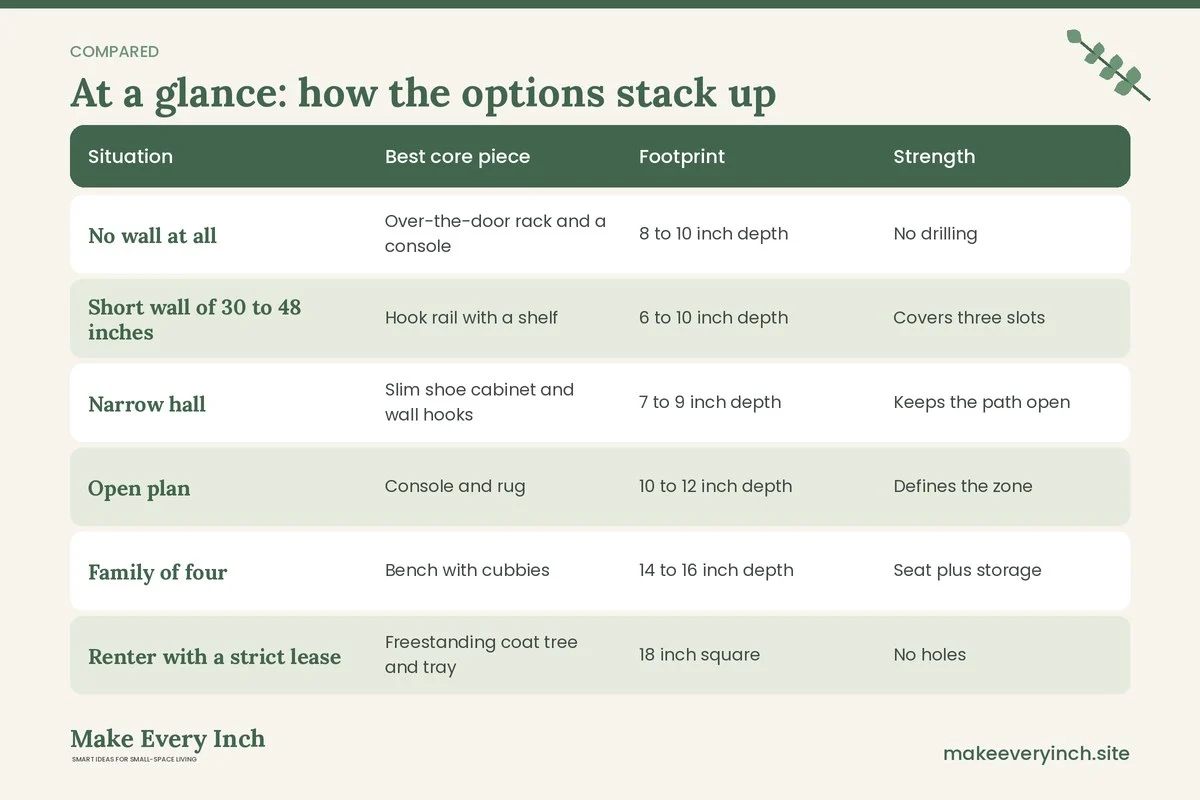
Comparison table: choose by wall space and household
| Situation | Best core piece | Footprint | Strength | Watch out for |
|---|---|---|---|---|
| No wall at all | Over-the-door rack and a console | 8 to 10 inch depth | No drilling | Door rubbing, weight limits |
| Short wall of 30 to 48 inches | Hook rail with a shelf | 6 to 10 inch depth | Covers three slots | Hook strength, anchoring |
| Narrow hall | Slim shoe cabinet and wall hooks | 7 to 9 inch depth | Keeps the path open | Tipping if unanchored |
| Open plan | Console and rug | 10 to 12 inch depth | Defines the zone | Mail spreading to the sofa |
| Family of four | Bench with cubbies | 14 to 16 inch depth | Seat plus storage | Too much stuff, not enough rotation |
| Renter with a strict lease | Freestanding coat tree and tray | 18 inch square | No holes | Top-heavy tipping |
| Pet owner | Hook and tray by the door | 12 inch square | Contains leash and towel | Treats within reach of pets |
Three example entries
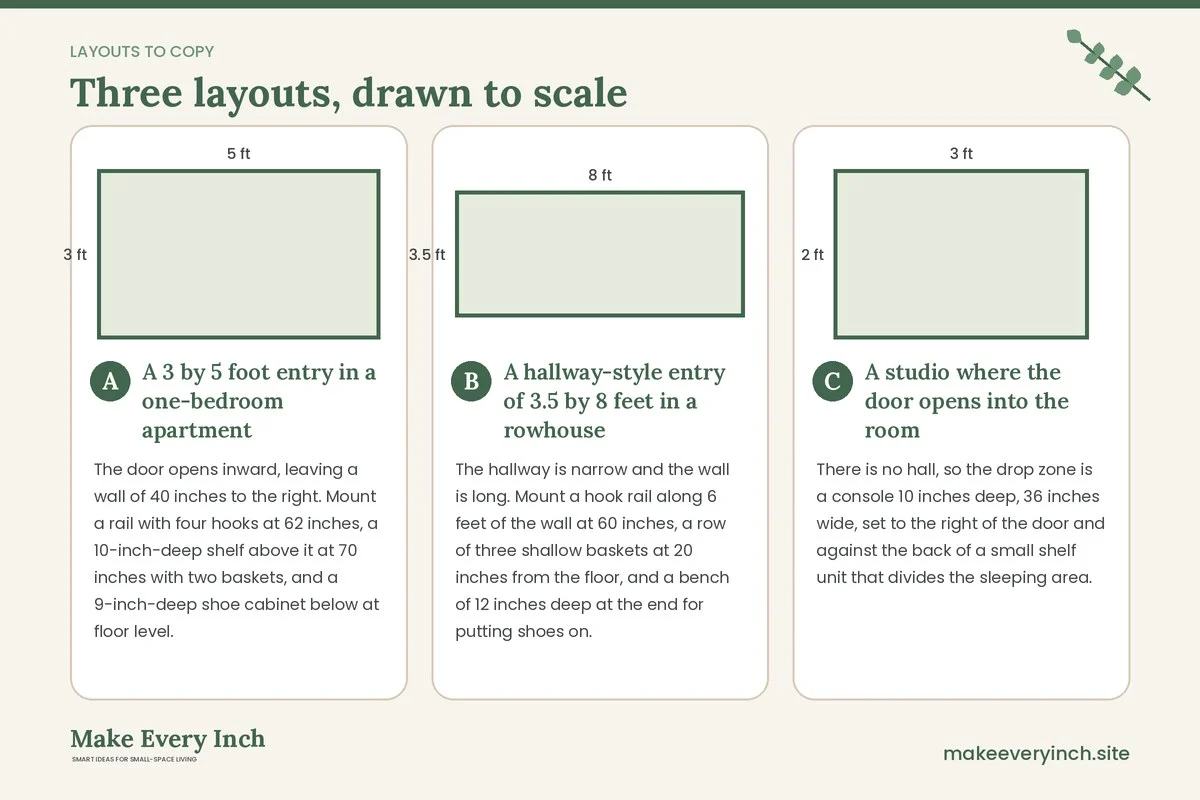
A 3 by 5 foot entry in a one-bedroom apartment
The door opens inward, leaving a wall of 40 inches to the right. Mount a rail with four hooks at 62 inches, a 10-inch-deep shelf above it at 70 inches with two baskets, and a 9-inch-deep shoe cabinet below at floor level. Put the key dish and a small mail slot on the cabinet top. The clear path stays at 32 inches. If the lease forbids drilling, use a freestanding rack with a heavy base and a narrow shelf on the floor, and keep the door-back rack as a second option.
A hallway-style entry of 3.5 by 8 feet in a rowhouse
The hallway is narrow and the wall is long. Mount a hook rail along 6 feet of the wall at 60 inches, a row of three shallow baskets at 20 inches from the floor, and a bench of 12 inches deep at the end for putting shoes on. The path stays at 30 inches. Use our guide on narrow entryway ideas for better flow for the rhythm of storage in a long passage, and add a lamp for the dark end. The guide on small hallway lighting ideas covers the options.
A studio where the door opens into the room
There is no hall, so the drop zone is a console 10 inches deep, 36 inches wide, set to the right of the door and against the back of a small shelf unit that divides the sleeping area. The console holds a key dish, a lamp and a mail tray. A tall hook rail on the shelf’s side holds two coats. Shoes live in a tray on the floor beneath. A rug 2 by 3 feet marks the space. Our studio apartment entryway ideas show other ways to mark an entry without a wall.
A time-based routine that keeps it working
A drop zone only works if the habits match it. Divide the day into three moments.
Arrival, about 30 seconds. Keys in the dish. Bag on its hook. Shoes off and placed on the shelf. Coat on the rail. Mail in the slot or in the recycling bin. If there are children, set a rule that the bag goes on the hook before the snack.
Evening reset, about two minutes. Before you go to bed, straighten the shoes, empty the mail slot, and put any stray item back in its basket. Take the day’s mail to be sorted. Charge phones in the shelf rather than at the bedside, if your household has a charging shelf.
Weekly sweep, about ten minutes. Wipe the shelf, shake out the mat, remove the shoes that are out of season, and recycle the old mail. A weekly sweep prevents the slow buildup that ruins most drop zones.
Compare this with the longer routines in our guide on small entryway organization for families if you have children, because families need one more step to check school items and sports bags.
Safety and lease notes
A drop zone sits next to the door, so safety matters for everyone who passes.
- Anchoring: tall or narrow shoe cabinets and shelves can tip, especially with children or pets. Anchor them to a wall stud where permitted, use the hardware supplied, and keep heavy items low.
- Never drill without permission: in a rental, read the lease and ask in writing. If drilling is not allowed, use freestanding pieces, tension poles within their ratings or over-the-door racks. Our guide on no-drill storage ideas for renters lists options.
- Weight limits: every hook, shelf and rack has a rating. Add up the weight of wet coats and full bags, which are heavier than they look, and stay under the limit.
- Electrical: keep power strips off the floor where water from wet shoes can reach them, never daisy-chain strips, and never run cords under mats or rugs. Use only one device per outlet that is rated for it.
- Trip hazards: a mat should lie flat. Use non-slip backing, and keep shoes in the tray, not in the walkway.
- Child and pet safety: keep small items such as coins, batteries and medications out of reach. Pet treats and cleaning products should not live in open baskets at floor level.
- Door swing and egress: do not block the path to the door. In an emergency, the route out must be clear.
- Wet areas: if the entry is tiled or near a radiator, place a tray under wet boots and do not store leather goods against a heater.
Common mistakes to avoid
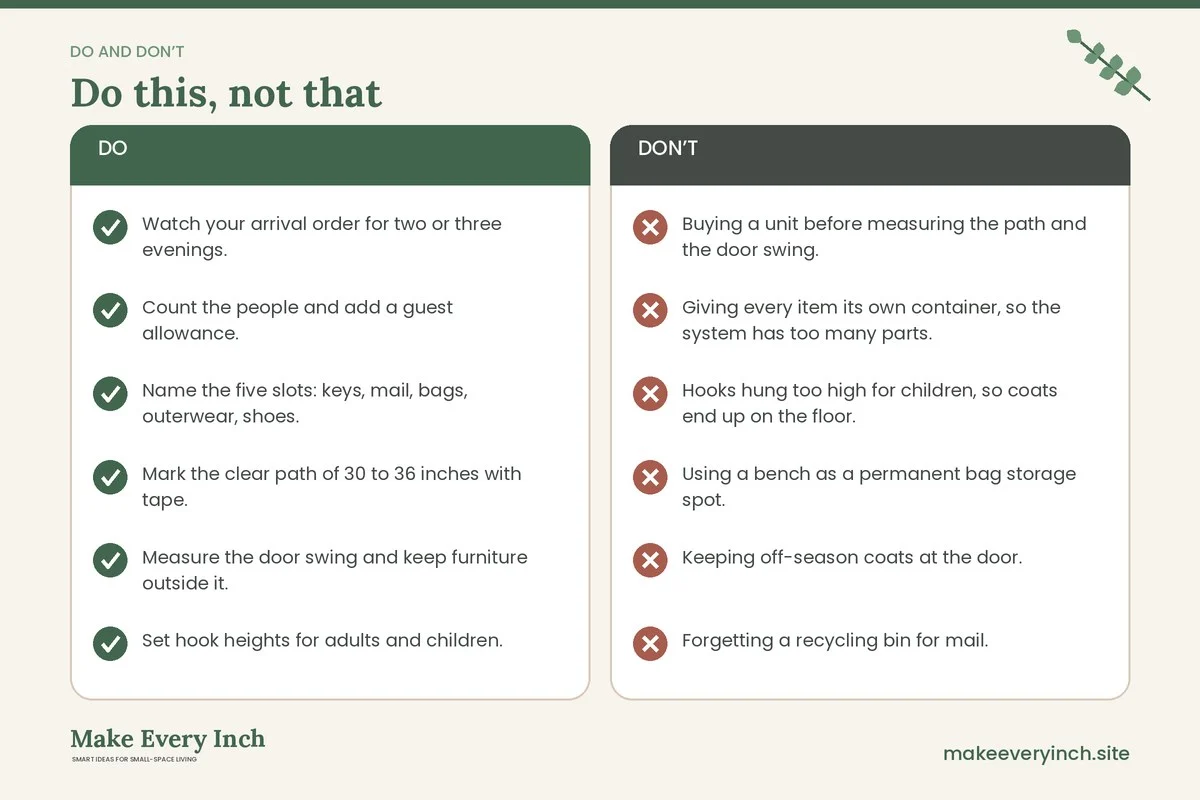
- Buying a unit before measuring the path and the door swing.
- Giving every item its own container, so the system has too many parts.
- Hooks hung too high for children, so coats end up on the floor.
- Using a bench as a permanent bag storage spot.
- Keeping off-season coats at the door.
- Forgetting a recycling bin for mail.
- Leaving a charging cable across the floor.
- Skipping the two-minute reset.
Entry drop zone checklist
- Watch your arrival order for two or three evenings.
- Count the people and add a guest allowance.
- Name the five slots: keys, mail, bags, outerwear, shoes.
- Mark the clear path of 30 to 36 inches with tape.
- Measure the door swing and keep furniture outside it.
- Set hook heights for adults and children.
- Choose one piece to hold shoes and one to hold keys and mail.
- Rotate off-season coats away from the door.
- Add a recycling bin for mail.
- Check weight ratings and anchoring.
- Ask permission before drilling, and photograph the wall before you start.
- Set a two-minute evening reset and a weekly sweep.
FAQ
What is an entryway drop zone?
It is a small area just inside the door where you put keys, mail, bags, coats and shoes in set places. The aim is to empty your hands quickly and keep the clutter from reaching the rest of the home.
How much space does a drop zone need in a small home?
A wall of 30 to 48 inches and a depth of 8 to 12 inches is enough for one or two adults. Larger households can use a bench or a second wall, as long as the floor path stays 30 to 36 inches wide.
Can I make a drop zone without drilling?
Yes. Use an over-the-door rack, a freestanding coat tree, a narrow console, adhesive hooks within their ratings for light items and tension-based pieces where they are safe. Read the lease and ask first if you are unsure.
How do I stop mail from piling up?
Give it one vertical slot and a nearby recycling bin, and sort it during the evening reset. If the slot is full, sort it that day.
What height should hooks be for children?
Roughly 36 to 48 inches, depending on age, so a child can hang a coat or a bag alone. Raise them as the child grows.
Is a bench necessary?
No. A bench helps if you sit to put on shoes, but a narrow entry may do better with a wall-mounted shelf and a stool you can move aside.
How is this different from a mudroom?
A mudroom is a room. A drop zone is a system that fits in a few square feet. Our post on small mudroom ideas without a mudroom shows how to borrow ideas from a mudroom in a small space.
Keep going: Keep planning with our small entryway storage ideas, the companion guide to a small entryway mirror and our renter friendly entryway organization ideas.
Save this guide for later
Pin the ideas you like to Pinterest so you can come back to them when you plan your space.