20 Small Space Furniture Ideas That Do Double Duty
Quick answer: Small space furniture do double duty best when the two jobs never need to happen at the same moment. Pair a surface with storage, a seat with a bed, or a table with a desk, check that the moving part is stable and easy to operate, measure the open and closed footprint, and anchor anything tall. Pick one hard-working piece per room before you buy a second.
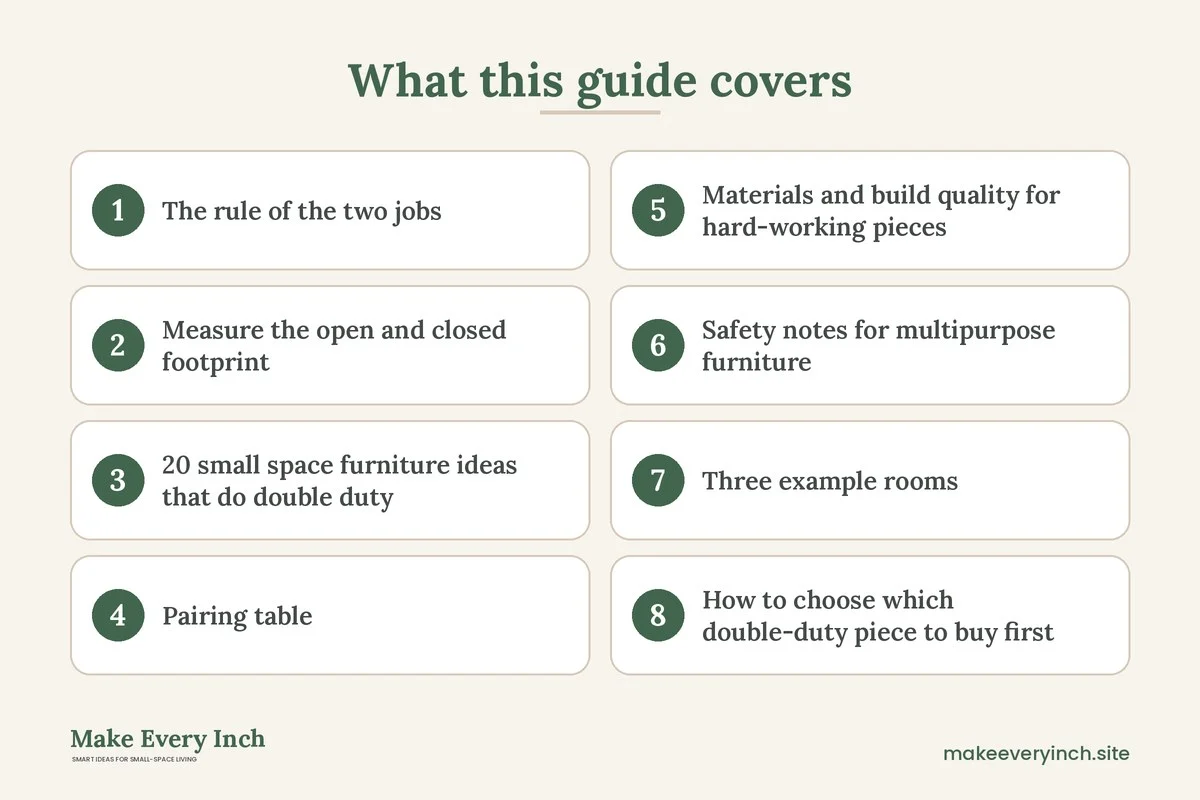
Small space furniture do double duty in the homes where every square foot has to earn its place, and the idea sounds simple: one piece, two jobs, half the floor space. In practice it is easy to buy a multipurpose item that does two things badly. A bench that is a poor seat, a desk that wobbles when it folds out, or a bed that is a pain to open will end up as clutter. This guide explains how to choose pairs of functions that really suit each other, how to measure the open and closed footprint, which mechanisms to treat with caution, and how to plan three example rooms. It also includes a pairing table, a safety section, a list of mistakes and a checklist. For a wider buying overview, read our pillar on the best furniture for small apartments, and for the companion post on seating, see our guide to the best sofa alternatives for small living rooms.
The rule of the two jobs
A multipurpose piece works when the two jobs are separated by time, by height or by position. Time means the jobs happen at different moments, such as a sofa that is a seat by day and a bed at night. Height means one job lives on top and the other inside, such as a bench with a lidded storage box. Position means the piece has two faces, such as a console that is a desk on one side and a bookshelf on the other.
Problems begin when both jobs want the same thing at once. A coffee table that lifts into a desk is useful if you only work in the evening, and annoying if you eat at the same table at the same time. Before buying, write the two jobs on paper and ask when each one happens. If the answers overlap, choose two separate pieces or choose a different pairing.
A useful second test is the fold-away test. If the second job needs you to move objects, flip a latch or clear a surface, count how many steps it takes. Anything over about three steps tends to stop being used. A drop-leaf table that opens with one hand will stay a table. A bed that needs two people and a floor cleared in advance will stay a sofa forever.
Measure the open and closed footprint
Every double-duty piece has two footprints, and you need to know both. Measure the closed size, the open size and the swing space between them. A sofa bed may be 80 inches wide closed, but need another 60 to 80 inches of floor depth when open. A wall-mounted desk may need 18 to 24 inches of knee clearance below the work surface once it is down. A drop-leaf table may be 12 inches deep closed and 36 inches wide open.
Use painter’s tape on the floor to mark both footprints. Open the imaginary piece and walk around it. Plan for roughly 30 to 36 inches of walkway where you move often, and about 24 inches in less used paths, which are hedged rules of thumb and not building code. If the open footprint blocks a door, a closet or a radiator, change the position or choose a smaller piece. Also check clearance for doors, drawers, the swing of the lid and any heating vent that should not be covered.
20 small space furniture ideas that do double duty
Seating that stores or sleeps
1. A storage ottoman
A lidded ottoman is a footrest, extra seat, side table with a tray and a hidden box for blankets or remotes. Look for a firm lid, a lid that is supported when open so it cannot drop on fingers, and a size that fits under a console when not needed. For features to compare, read our guide to the best storage ottomans.
2. A bench with a lift-up seat
At an entry or a dining table, a bench with a hinged seat stores shoes, bags or table linens. A bench pushed under a table also saves the floor space that two chairs would take. Choose a bench with a soft-close or supported lid so it does not slam.
3. A daybed with a trundle
A daybed is a sofa during the day and a bed at night, and many have a pull-out trundle for a second sleeper. This suits a guest room that doubles as an office. Check the depth of the frame, the height of the trundle and the space needed to pull it out fully.
4. A sofa bed or a futon
These make sense in a studio or a guest room. Choose a mechanism that is simple to operate, and ask about the seated comfort as well as the sleeping comfort, since you will use it as a sofa most of the time. For seating comparisons, see our guide to the best sofas for small apartments.
5. A sofa with a chaise that stores
A sectional with a storage chaise gives you a place to lounge and a place to hide a throw or board games. Measure the chaise length carefully, since it adds depth to the room. See our guide to the best sectionals for small living rooms.
Tables that become something else
6. A drop-leaf table
A drop-leaf table is a narrow console or a slim desk when closed and a four-person table when open. Look at the leaf supports, because a leaf that sags or a support that swings loose is a common complaint. Our post on the best small dining tables goes through shapes and sizes.
7. An extending table
A table with a pull-out or butterfly leaf stays small for two and expands for guests. Check where the extra leaf is stored so it does not end up behind a door or under a bed.
8. A nesting set
Two or three tables of graduated size stack to the footprint of one. Each can sit by a chair, serve as a laptop surface or line up as one long table. They work well in a living room where guests come occasionally.
9. A coffee table with a lift top
A lift-top coffee table rises to a laptop height and often hides a shelf. It is useful in a studio where the sofa is also the office chair. It is less useful if you eat or work at the same moment, because the mechanism takes up knee room.
10. A console that becomes a desk
A narrow console against the wall can hold a lamp and keys, and sometimes a fold-out panel turns it into a desk. A slim stool tucks underneath.
Beds and bedroom pieces
11. A bed with drawers
A platform bed with drawers under the mattress replaces a dresser in a small bedroom. Check the clearance needed to open the drawers fully. See our guide to the best beds with storage.
12. A lift-up storage bed
A bed whose base lifts on gas struts gives you one large box for seasonal bedding. It is excellent for bulky items and awkward for things you need daily. Keep the lifting area clear and learn how the struts hold the base before you load it.
13. A wall bed
A wall bed or Murphy bed frees the floor in a studio, but it is a heavy piece that must be fixed to the structure. It should be installed according to the maker’s instructions, preferably by a professional, and only with your landlord’s permission in a rental. Never lean on or hang things from a bed that is down.
14. A dresser that doubles as a nightstand
In a narrow bedroom, a tall slim chest at the bed’s head holds clothes and a lamp, and replaces both a nightstand and a bulky dresser. Our guide to the best small dressers covers drawer sizes.
Work, kitchen and entry pieces
15. A wall-mounted fold-down desk
A fold-down desk can hide behind a panel or a mirror, which suits a living room or a bedroom. It must be fixed to studs with fasteners rated for the load, and only with permission in a rental. See the section on safety below, and our guide to the best desks for small apartments.
16. A bookshelf that divides the room
A bookcase set perpendicular to the wall divides a studio into zones while storing books. Pick an open-back shelf, so that light passes through, and anchor it to the wall or floor.
17. A rolling kitchen cart
A cart is extra counter, a serving trolley and a bar. In a small kitchen it parks beside the stove while you cook and rolls to the dining table to serve. Locking casters help it stay put. See the best rolling kitchen carts.
18. A shoe cabinet with a seat
At the entry, a slim cabinet topped with a cushion gives you a place to sit while you put on shoes, and stores several pairs. It may not suit very heavy daily use, so check the top rating. See the best narrow shoe cabinets.
19. A mirror cabinet
A mirror that is also a cabinet gives you storage for jewelry or toiletries and a place to check your outfit. In a rental, a leaning or freestanding model avoids drilling.
20. A bar cart that is a plant stand
A narrow cart can host a coffee setup in the morning, a bar in the evening and plants by day. It is a good second job for a piece that already moves.
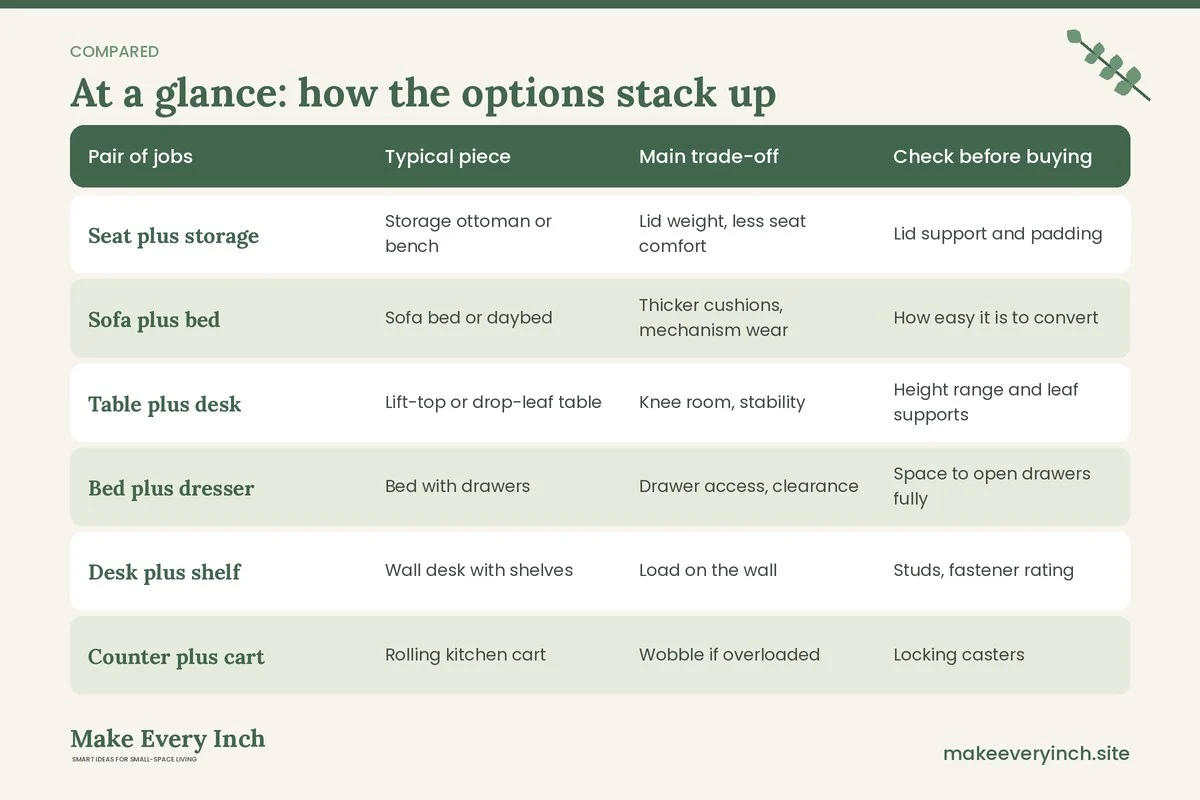
Pairing table: which two jobs go together
Use this table to decide whether a pair of functions suits your routine. It lists the habit, the piece, the main trade-off and the point to check before buying.
| Pair of jobs | Typical piece | Main trade-off | Check before buying |
|---|---|---|---|
| Seat plus storage | Storage ottoman or bench | Lid weight, less seat comfort | Lid support and padding |
| Sofa plus bed | Sofa bed or daybed | Thicker cushions, mechanism wear | How easy it is to convert |
| Table plus desk | Lift-top or drop-leaf table | Knee room, stability | Height range and leaf supports |
| Bed plus dresser | Bed with drawers | Drawer access, clearance | Space to open drawers fully |
| Desk plus shelf | Wall desk with shelves | Load on the wall | Studs, fastener rating |
| Counter plus cart | Rolling kitchen cart | Wobble if overloaded | Locking casters |
| Divider plus bookcase | Open-back shelving | Tipping | Anchoring to wall |
| Mirror plus cabinet | Mirror cabinet | Weight on wall | Freestanding or mounting plan |
Materials and build quality for hard-working pieces
A piece that does two jobs is used twice as often, so build quality matters more than for a single-purpose item. Look at the frame first. Solid wood or a well made engineered board with a thick edge tends to hold screws better than very thin particle board. Check joints and hardware: metal brackets, cam locks and bolts are common, and a piece that is easy to retighten will last longer. Moving parts, such as hinges, gas struts, drawer slides and casters, are the first things to wear out. Ask whether they can be replaced.
Finishes matter as well. A table that doubles as a desk and a dining surface will meet hot mugs, laptops and spills. A wipeable, low-sheen surface is easier to maintain than a delicate veneer. Upholstered pieces such as ottomans and daybeds benefit from removable or spot-cleanable covers. If you rent, choose materials that tolerate being moved, since double-duty furniture is often shifted around.
Weight is a trade-off. A heavy piece feels stable but is difficult to move, and a light piece moves easily but can tip. For tall items, choose stability first and plan to anchor them.
Safety notes for multipurpose furniture
Multipurpose furniture has moving parts, and moving parts create risks. These notes are general guidance, so follow the maker’s instructions for each piece.
- Anchor tall furniture. Bookcases, tall dressers and shelving units can tip, especially when drawers are open or a child climbs. Anchor them to the wall with the hardware designed for the wall type, and avoid placing heavy items on high shelves. In a rental, ask your landlord first, or choose anti-tip options that do not require drilling.
- Respect wall-mount load limits. A fold-down desk or a floating shelf is only as strong as the studs or anchors behind it. Find studs with a stud finder, use fasteners rated for more than the expected load, and do not exceed the stated weight. If you are unsure, hire a professional.
- Watch for pinch points. Folding tables, drop leaves, sofa bed frames, Murphy beds and lift-up lids have hinges and scissor joints that can pinch fingers. Keep children and pets away while operating them, and use the supports as designed.
- Check lid and strut support. A lid that falls shut can injure fingers, so choose models with soft-close hinges or locking stays.
- Do not drill without permission. Read the lease first. If drilling is not allowed, use freestanding versions or ask in writing.
- Keep exits and vents clear. A bed that opens in front of a door, or a cabinet that covers a heating vent, can be a hazard. Keep walking routes and ventilation open.
- Weight limits on beds and seats. Check the stated limit, particularly for loft frames and fold-out beds that carry two people.
Three example rooms
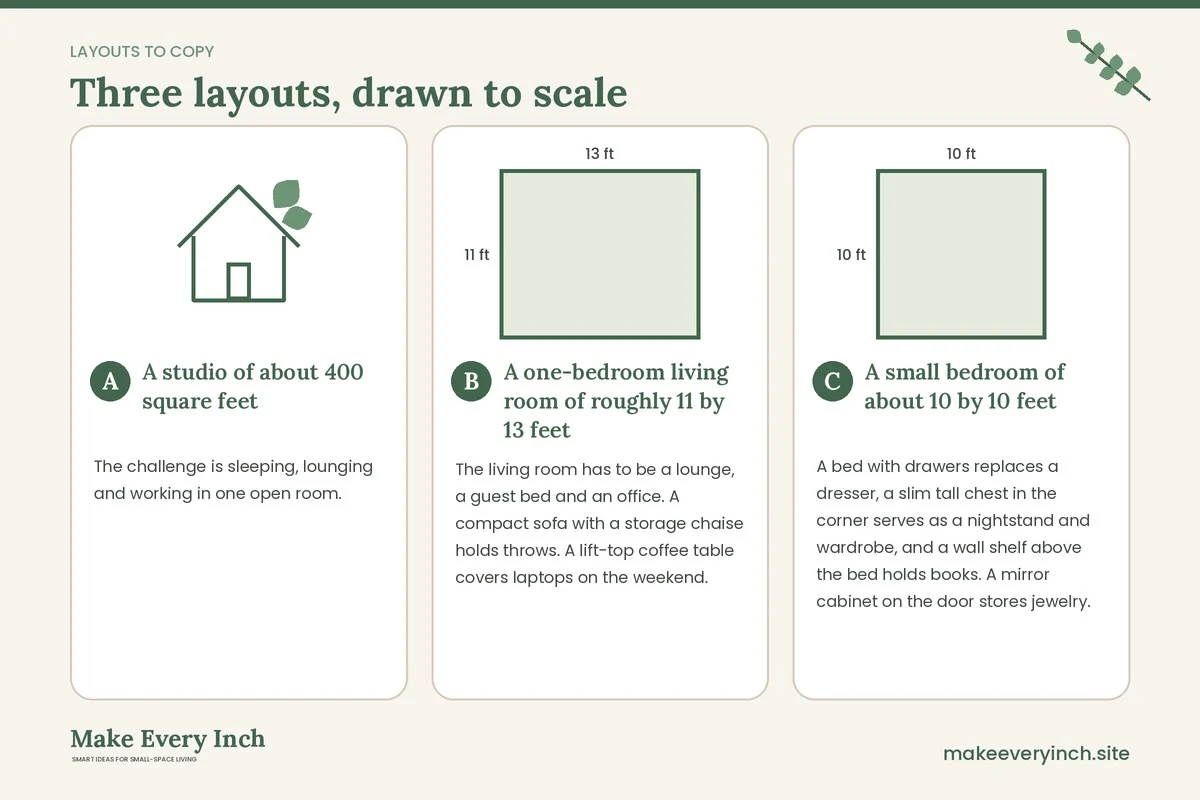
A studio of about 400 square feet
The challenge is sleeping, lounging and working in one open room. Choose a daybed or a sofa bed as the main seat, put a drop-leaf table by the window that serves as a desk and a dining spot, and use a bed with drawers if you have a separate bed. A rolling cart sits beside the kitchen counter. An open bookcase set across the room divides the sleeping area from the living area, and it is anchored to the wall with permission. The result is that every major piece has a second job, but the fold-away steps remain at one or two each.
A one-bedroom living room of roughly 11 by 13 feet
The living room has to be a lounge, a guest bed and an office. A compact sofa with a storage chaise holds throws. A lift-top coffee table covers laptops on the weekend. A console against the wall hides a fold-out panel that turns into a desk on weekdays. A pair of poufs or a storage ottoman provides extra seating when friends visit. The key is to protect a walkway of 30 to 36 inches, which is a hedged guideline, and to keep the desk area clear of the entry door.
A small bedroom of about 10 by 10 feet
A bed with drawers replaces a dresser, a slim tall chest in the corner serves as a nightstand and wardrobe, and a wall shelf above the bed holds books. A mirror cabinet on the door stores jewelry. A small desk that folds against the wall is used for occasional work. The bedroom stays calm because the clutter has drawers to live in. If the room has low ceilings, keep tall units at a safe distance from the bed and anchor them.
How to choose which double-duty piece to buy first
Do not buy five multipurpose pieces at once. Start with the room that annoys you most and ask which function is missing. If you lack a place to put things, start with storage-led pieces such as an ottoman or bed with drawers. If you lack a place to work, start with a table or a wall desk. If you lack a place for guests, start with a daybed or sofa bed. Live with the first piece for a few weeks and note whether you use both jobs. If you do not use the second job, the piece is not earning its footprint.
For additional ideas on budget-friendly choices, see our guide to budget friendly furniture ideas for small apartments. For more on storage pieces that look like furniture, read about small space storage furniture.
Common mistakes
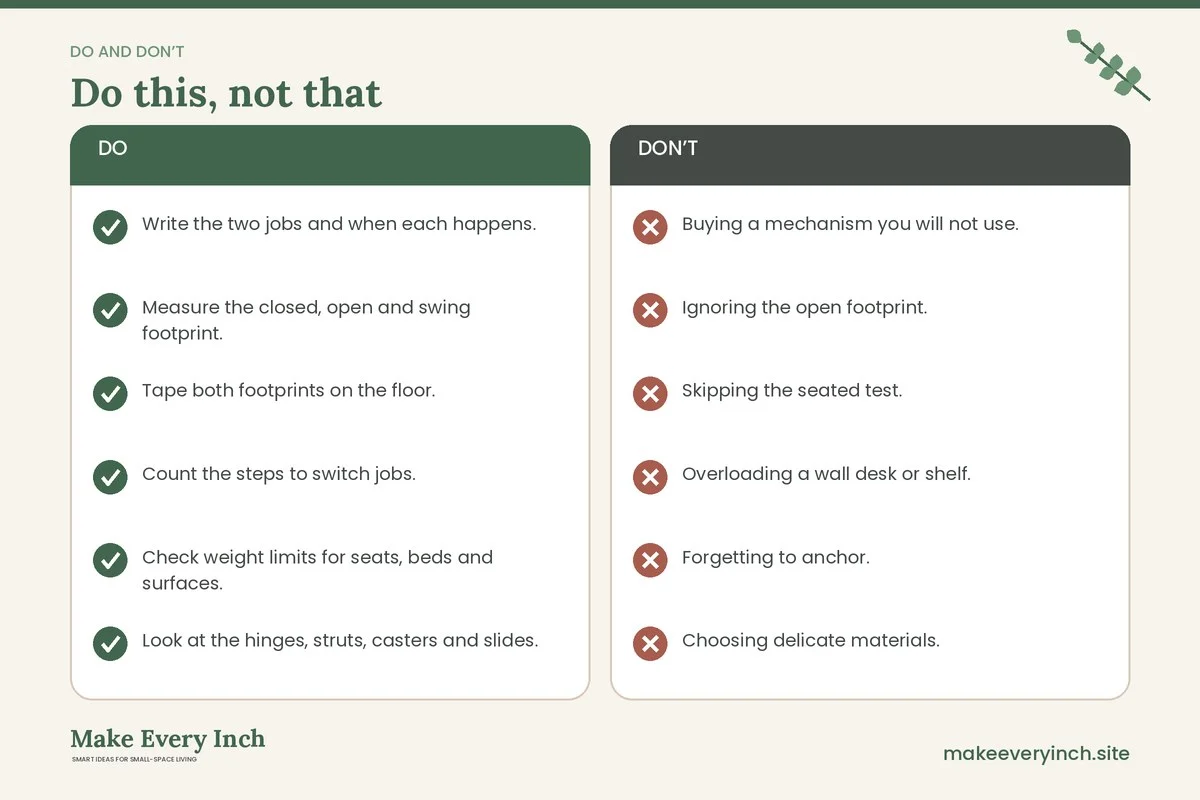
- Buying a mechanism you will not use. If it is a hassle, it will not be used. Choose simple.
- Ignoring the open footprint. The piece fits closed and blocks the door when open.
- Skipping the seated test. A sofa bed that is a poor sofa is a poor choice.
- Overloading a wall desk or shelf. Respect load limits and studs.
- Forgetting to anchor. Tall pieces need anchoring, even when they seem stable.
- Choosing delicate materials. Pieces with two jobs get twice the wear.
- Buying too many. Several multipurpose pieces can look busy, so keep the style consistent.
- Blocking vents or exits. Keep heating, cooling and doors clear.
Buying checklist
- Write the two jobs and when each happens.
- Measure the closed, open and swing footprint.
- Tape both footprints on the floor.
- Count the steps to switch jobs.
- Check weight limits for seats, beds and surfaces.
- Look at the hinges, struts, casters and slides.
- Plan anchoring for anything tall.
- Find studs for any wall-mounted piece.
- Get written permission before drilling in a rental.
- Test the seat or surface comfort in the position you will use it.
- Keep a walkway of about 30 to 36 inches where you can.
- Pick one piece first and add others later.
FAQ
What does it mean when small space furniture do double duty?
It means one piece serves two purposes, such as a bench that stores shoes, a bed with drawers or a table that becomes a desk. The pairing works best when the two jobs happen at different times.
Which double-duty piece is best for a studio apartment?
A sofa bed or daybed, a drop-leaf table and an open bookcase divider usually give the most benefit. Our guide to studio apartment furniture ideas goes further into layouts.
Is a sofa bed comfortable enough to use every day?
It depends on the mattress and mechanism, so check both the seated and sleeping comfort when you shop. Many people use a sofa bed for guests and a regular sofa for daily seating.
Are wall beds safe?
They can be, when installed according to the instructions and fixed to the structure. They are heavy, so use a professional installer, and check your lease first.
How do I stop tall multipurpose furniture from tipping?
Use the anti-tip hardware that comes with the piece, anchor it to the wall into a stud or with suitable anchors, and keep heavy items low. Where drilling is not allowed, ask permission or choose shorter units.
Can double-duty furniture look stylish?
Yes. Keep the colors and materials consistent and choose pieces with clean lines, so the room looks designed instead of improvised.
Keep going: Keep planning with our small living room layout ideas, studio apartment ideas and small space organization ideas.
Save this guide for later
Pin the ideas you like to Pinterest so you can come back to them when you plan your space.