12 Renter Friendly Closet Upgrades That Change the Closet Itself
Quick answer: The best renter friendly closet upgrades change the closet itself, not just what sits inside it. Add a tension or hanging rod for a second level, a plug-in or battery light, a curtain or door swap you can undo, a peel-and-stick or rolled floor cover, and wall liners held with removable strips. Ask for written permission before anything touches paint, screws or the door, and keep every original part so you can put it back.
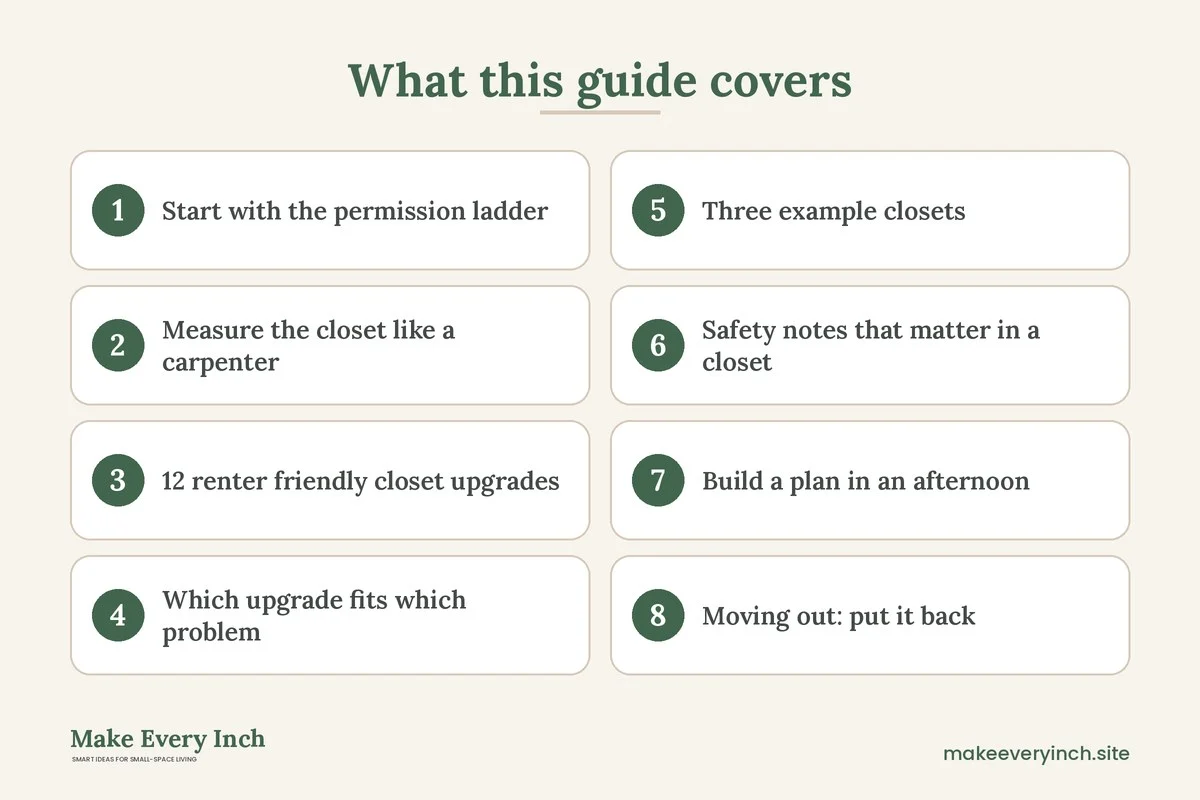
Renter Friendly closet upgrades are different from closet organization. Organizing is about the shirts, shoes and boxes; an upgrade changes the box they live in: the light, the rod, the door, the floor, the walls and the dead space above the shelf. Most rental closets were built for a landlord’s convenience, with one bare bulb, one rod at one height and a door that hides a mess rather than helping you find things. This guide is about the second kind of project. It covers a permission ladder that tells you how much you can change, how to measure a closet properly, 12 upgrades with sizes and steps, a comparison table, three example closets, safety notes and a move-out plan. If you want the wider approach to making a rental feel like yours, start with our hub on renter-friendly apartment decorating ideas, and for the contents of the closet, read our guide to closet shelf organization ideas.
Start with the permission ladder
Not every change carries the same risk. Sort your ideas into four rungs, and climb only as high as your lease and your landlord allow.
- Rung 1, free standing or resting: things that sit on the floor, on the shelf or on the rod you already have. A shelf tower, a stackable bin, a rolling rack and a floor mat belong here. These almost never need permission, though you should still check that nothing blocks a smoke alarm or a heating vent.
- Rung 2, tension and hang-over: a tension rod, a hang-over door rack, an over-the-rod organizer. They press or hook without fixing to anything. Check that they do not scratch the frame or the door.
- Rung 3, removable adhesive: strips, hooks, peel-and-stick sheets and liners. They can lift paint if the surface is flat, fresh or damp, so test a hidden spot and ask first if the lease mentions adhesive.
- Rung 4, fixings: screws, anchors, a new rod bracket, a swapped door or a repaint. Never do these without written permission, and keep any original part you remove in a labeled bag.
Photograph the closet before you start, with the door open, the shelf and the floor visible. Date-stamped photos protect your deposit and make a request easier to write. A short message works well: describe the change, say it is reversible and offer to restore the original at move-out.
Measure the closet like a carpenter
Closet upgrades fail on a quarter inch more often than on style. Measure each of these twice, and write the numbers on a card in your phone.
- Width and depth of the opening: a typical reach-in is 24 inches deep and ranges from 36 to 96 inches wide. Measure the opening itself, because a door frame can steal an inch on each side.
- Height to the shelf and to the ceiling: many rods sit around 66 to 72 inches off the floor, with the shelf a few inches above. The dead space between shelf and ceiling is often 12 to 24 inches.
- Clear space behind the door: with the door open, note how far it swings and whether it hits a bed, a dresser or a wall.
- Distance from the rod to the back wall: hangers need roughly 12 inches of clearance on each side of the rod’s center, so a shallow closet can force hangers to turn sideways.
- Floor condition: note carpet, vinyl or bare concrete, plus any cracks or damp patches. A floor upgrade starts with knowing what is under it.
Draw the closet as a rectangle on paper and mark the studs or the places the shelf bracket reaches only if the lease lets you touch them. For everything else, a tape measure and a level are enough.
12 renter friendly closet upgrades
Light and air
1. A plug-in or battery light you can see by
Most rental closets have a single ceiling bulb or none at all, and clothes look different in the dark. A slim battery light with a motion sensor sticks to the underside of the shelf with a removable strip or sits in a magnetic base on the rod bracket. A plug-in strip light with a switch near the door runs along the shelf edge. Keep cords tidy with clips on the frame, and read our guide to renter-friendly lighting ideas for more options. Safety note: use low-heat bulbs, keep any light at least a few inches from fabric and never cover a bulb with clothing. Do not run cords through the door gap where they can be pinched.
2. A louvered or breathable door cover
If the closet is musty, a heavy curtain is the wrong upgrade. Look for a door or panel with slats, or leave the door slightly open while clothes air. Ventilation matters most in damp rentals, where a closed, packed closet can grow mildew. A small moisture absorber on the floor helps, and a shallow gap between clothes and the wall lets air move. If you see mold, tell the landlord rather than hiding it.
3. A scent-safe, low-VOC refresh
A new paint color inside a closet is tempting, but paint is rung 4. If you get written permission, choose a low-VOC paint, open a window, keep children and pets out until the smell clears and wait for the cure time on the can before putting clothes back. If you do not have permission, a peel-and-stick wallpaper on a test square may be possible, but treat it as rung 3 and remove it carefully.
The rod and the vertical space
4. A second rod without screws
A hanging double rod drops from the existing rod using adjustable straps or hooks and gives you a lower bar for shirts, skirts and folded pants. The top rod keeps long coats, and the lower rod sits roughly 38 to 42 inches below it for short items. This is the quickest way to double capacity, as shown in our deeper guide on how to double hanging space in a closet. Check the weight rating of the existing rod: a thin tube bends, so spread weight over its full length, and never hang heavy coats on the outer ends.
5. A tension rod across the closet
A tension rod pressed between two walls works for a short run of hangers or a hanger for belts and scarves. It holds best in a closet with solid, flat sides and a rod set at a height that keeps tension even. Wipe the walls, twist until firm, then test with a light load. Because a tension rod relies on friction, keep the load low and check it after a week. Do not use it for heavy garments or as a handhold.
6. A shelf lift above the shelf
The 12 to 24 inches between the closet shelf and the ceiling is usually wasted. A freestanding riser with its own legs or a stack of lidded boxes uses it for off-season items. Put the lightest boxes at the top and label the front. If the top shelf is the only one, keep the load under the shelf’s rating and never stack past the point where a box can tip toward you. In a shared household, store heavy items low.
Doors, curtains and fronts
7. A curtain instead of a bifold door
If your lease lets you lift a bifold or sliding door off its track, a curtain on a tension rod or an adhesive-free track can open the closet and give you an extra 12 to 18 inches of working room. Store the original door flat in a safe place, wrapped in a blanket, so it does not warp. Do not remove a door without written permission, and ask whether the hardware must stay in place. A curtain also lets you choose a calm color that matches the room, which helps the bedroom feel calmer. If you have no door at all, a curtain is the easiest answer.
8. An over-the-door organizer for the back
The back of the door is a rung 2 location. A hang-over rack holds shoes, scarves or accessories. Choose one with a padded hook so it does not scratch the door, and keep the load below the rack’s rating so the door still closes. See our guide to small closet door storage ideas for layouts.
Floor and walls
9. A floor cover that protects what is under it
Cold, scuffed or stained floors are common in closets. A rolled vinyl or a thin foam tile that clicks together covers the floor without glue. Cut it to fit with a utility knife, keep the edges flat so no one trips and leave a gap at the wall for movement. In a damp closet, skip anything that traps moisture and use a breathable mat. A cover also gives shoes a clean place to rest, which pairs well with our ideas for shoe storage in small closets.
10. A wall liner that keeps the paint safe
If the back wall is rough or marked, a peel-and-stick liner covers it, and a sheet of thin hardboard leaned against it can hold hooks. Use removable strips along the edge, rated for the weight you plan to load, and test a hidden square first. Liners can pull paint when they come off, so remove them slowly with gentle heat from a hair dryer on low and peel at a shallow angle.
11. A small shelf unit that fills the corner
When a closet has no shelves below the rod, a narrow freestanding unit fills the corner. Pick one that is 10 to 14 inches deep so hangers still clear. For a closet with no built-in shelves at all, our guide on how to organize a closet with no built-in shelves walks through the options. Safety note: anchor a tall, narrow unit to the wall with the anti-tip strap if the lease allows a screw, and if not, choose a low, wide unit that cannot tip.
12. A mirror and a hook strip inside the door
Add a lightweight mirror to the inside of the door so you can dress without crossing the room. A strip with three or four hooks inside the frame holds the next day’s outfit and a bag. See our advice on handbag storage ideas for small closets for ways to stop bags from crushing. Use a mirror made of safety-backed material, and mount it low enough that nothing falls onto a child or a pet.
Which upgrade fits which problem
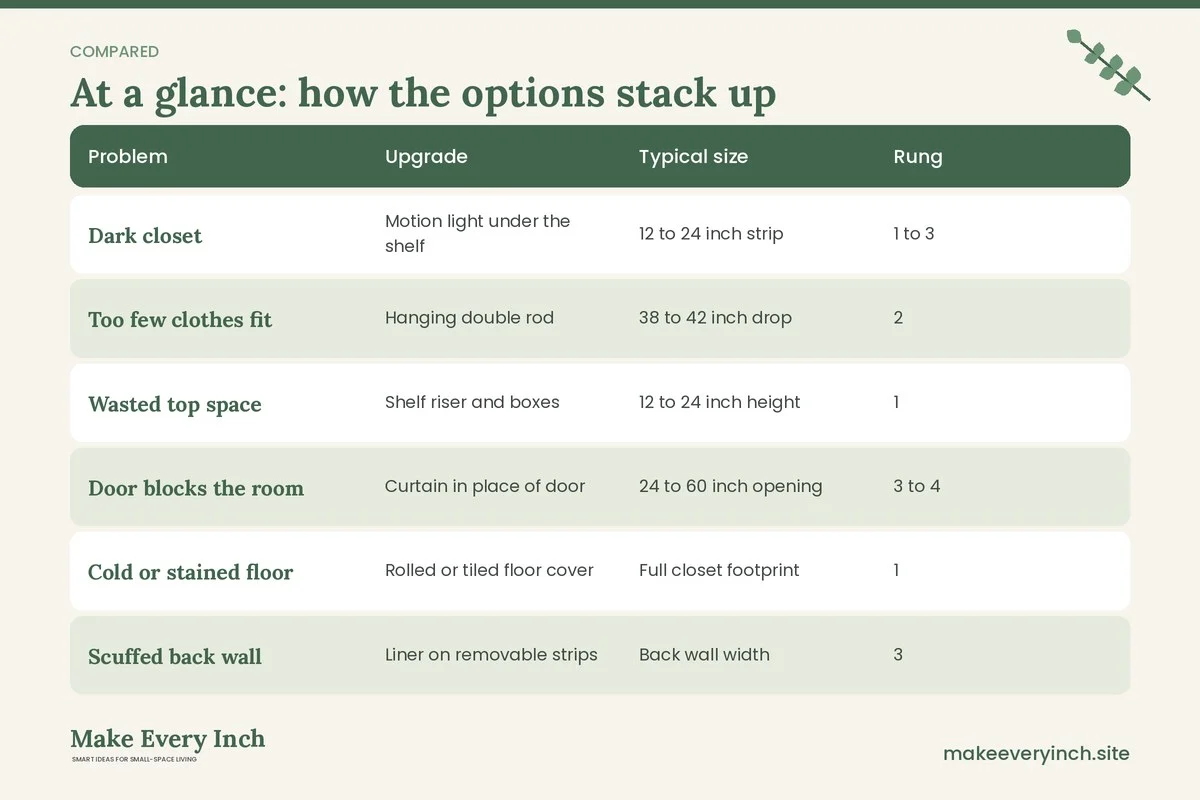
Use the table to choose the fix that matches the complaint. The last column shows the rung on the permission ladder.
| Problem | Upgrade | Typical size | Rung |
|---|---|---|---|
| Dark closet | Motion light under the shelf | 12 to 24 inch strip | 1 to 3 |
| Too few clothes fit | Hanging double rod | 38 to 42 inch drop | 2 |
| Wasted top space | Shelf riser and boxes | 12 to 24 inch height | 1 |
| Door blocks the room | Curtain in place of door | 24 to 60 inch opening | 3 to 4 |
| Cold or stained floor | Rolled or tiled floor cover | Full closet footprint | 1 |
| Scuffed back wall | Liner on removable strips | Back wall width | 3 |
| Bags and shoes pile up | Over-the-door rack | 12 to 16 inch width | 2 |
| Closet smells musty | Open door, airflow, absorber | Whole closet | 1 |
Three example closets
A 6 foot reach-in with bifold doors
A bedroom closet that is 72 inches wide and 24 inches deep with one rod and one shelf is the most common rental closet. Hang a double rod on one half of the rod, which gives two levels for shirts and trousers, and keep the other half single height for dresses and coats. Add a battery light under the shelf, a narrow shelf unit on the floor and a hanging organizer on the back of the bifold door, if the door is rated for it. Leave the doors in place unless the lease allows lifting them off. This plan stays at rungs 1 and 2, so permission is rarely needed.
A 3 foot closet with a sliding door
A small sliding door closet only opens half the width at a time, so the upgrade is about access. Replace what you see with open stacking bins that pull forward on the open side, and use the closed side for off-season boxes. A motion light under the shelf makes the dark half visible. A tension rod across the narrow end adds a place for belts and scarves. If the sliding door sticks, ask the landlord to fix the track instead of forcing it. Never remove a sliding door yourself, because it is heavy and can fall.
A bedroom with no closet at all
When there is no closet, a freestanding wardrobe or a corner rail with a curtain acts as one. Pick a frame that is stable and no taller than the width of the base, and place it away from a doorway and a heater. A curtain on a tension rod gives it the feel of a built-in closet, and a floor mat marks the zone. Our guide on small bedroom ideas without a closet goes deeper on this layout, and renter-friendly bedroom storage ideas has more options. Always anchor tall furniture to the wall when the lease allows, or choose a low unit if it does not.
Safety notes that matter in a closet
- Tall furniture: anchor any wardrobe, tall shelf or drawer tower to a wall stud with the supplied strap, if you have permission to screw. If not, choose a low, wide piece and keep heavy items on the bottom.
- Electrical: use plug-in lights only on outlets you can reach safely, avoid daisy-chained power strips and keep cords out of door gaps. Never run a cord under a rug or a mat.
- Heat and fire: keep fabric away from bulbs, heaters and the water heater if one shares the closet. Do not block a vent or a panel marked for service.
- Moisture: if the closet is next to a bathroom or an outside wall, watch for damp. Mold is a landlord issue, so report it.
- Weight limits: read the rating on every hook, strip and rod. Spread weight, keep heavy items low and check strips after a few days.
- Children and pets: keep small items, cords and dangling pulls out of reach, and secure anything that could tip or fall.
- Paint and adhesives: use low-VOC paint if you have permission, open a window while it dries and let it cure before storing clothes.
Build a plan in an afternoon
Start with a two-hour pass. Empty the closet and sort clothes into keep, move and donate piles, then measure and photograph. Choose two upgrades that address the loudest complaint, such as a dark closet and a short rod. Order or gather the parts, and install the light first, because it makes the rest easier. Hang the second rod next, then add the floor cover. Put back what you wear most at eye level, and move off-season items to the top.
Live with the new closet for two weeks. Notice what you reach for and what you ignore. If a change keeps annoying you, adjust it. If the closet works, add one more upgrade. Small, reversible steps are the heart of renter friendly closet upgrades, and they cost little time. For more on avoiding common traps, see our list of small closet mistakes that waste space.
Moving out: put it back
The goal of a reversible upgrade is a clean exit. Two weeks before you move, take everything out. Peel strips and liners slowly, using a hair dryer on low heat to loosen the adhesive and pulling the strip tab straight down along the wall. Wipe any residue with a damp cloth and mild soap. Take down the curtain rod and refit the original door or rod if you removed one. Fill any approved holes only if your lease says you should. Vacuum the floor and the shelf, take new photos and compare them with the originals. Keep the photos and any written permission with your lease papers.
Renter Friendly closet upgrades checklist
- Read the lease and note what it says about adhesive, screws and doors.
- Photograph the closet with the door open.
- Measure width, depth, rod height, shelf height and door swing.
- Sort ideas by the permission ladder, rungs 1 to 4.
- Ask in writing before any rung 4 change.
- Test adhesive on a hidden spot for a few days.
- Check the weight rating of every rod, strip and hook.
- Add a safe light before anything else.
- Add a second rod or a shelf riser to use vertical space.
- Cover the floor and protect the walls where needed.
- Anchor tall furniture when you have permission.
- Label and store any original parts you removed.
- Review the closet after two weeks.
- Photograph it again before you move out.
FAQ
What are the easiest renter friendly closet upgrades to start with?
A battery light, a hanging double rod and a floor cover. They sit at the lowest rungs of the permission ladder, need no tools and come out in minutes.
Can I remove my closet door in a rental?
Only with the landlord’s written permission. Doors are part of the property, so keep every piece and the hardware, store the door flat and refit it before you leave.
How do I add light to a closet without wiring?
Use a battery or plug-in light with a motion sensor, attached to the shelf with a removable strip or placed on the shelf itself. Keep it away from fabric and never cover it.
Will adhesive strips damage my closet walls?
They can lift paint, especially on fresh, flat or damp walls. Test a hidden square, follow the weight rating and remove the strip slowly by pulling it straight down along the wall.
How can I stop a musty closet smell?
Improve airflow with the door open for part of the day, leave a gap between clothes and the wall and use a moisture absorber on the floor. If the smell persists or you see mold, tell the landlord.
Is a tension rod strong enough for coats?
Usually not. Tension rods rely on friction, so they suit light items. Hang coats on the main rod, and spread weight along its full length.
Do I need to anchor a wardrobe in a rental?
Anchoring is the safest option for any tall piece, so ask the landlord about a single screw into a stud. If the answer is no, choose a low, wide unit instead.
Keep going: Keep upgrading with our guides to no-drill storage ideas for renters, small closet ideas and renter-friendly small space upgrades that make a difference.
Save this guide for later
Pin the ideas you like to Pinterest so you can come back to them when you plan your space.