How to Stop Clutter from Building Up in a Small Home
Quick answer: To stop clutter from building up small home owners and renters should control what comes in, give every recurring item a landing spot, and run a short daily reset. Add a one-in-one-out rule, a weekly sweep of the usual hot spots and a monthly check of storage that is more than 80 percent full. Clutter is a flow problem, so fix the flow, not just the shelves.
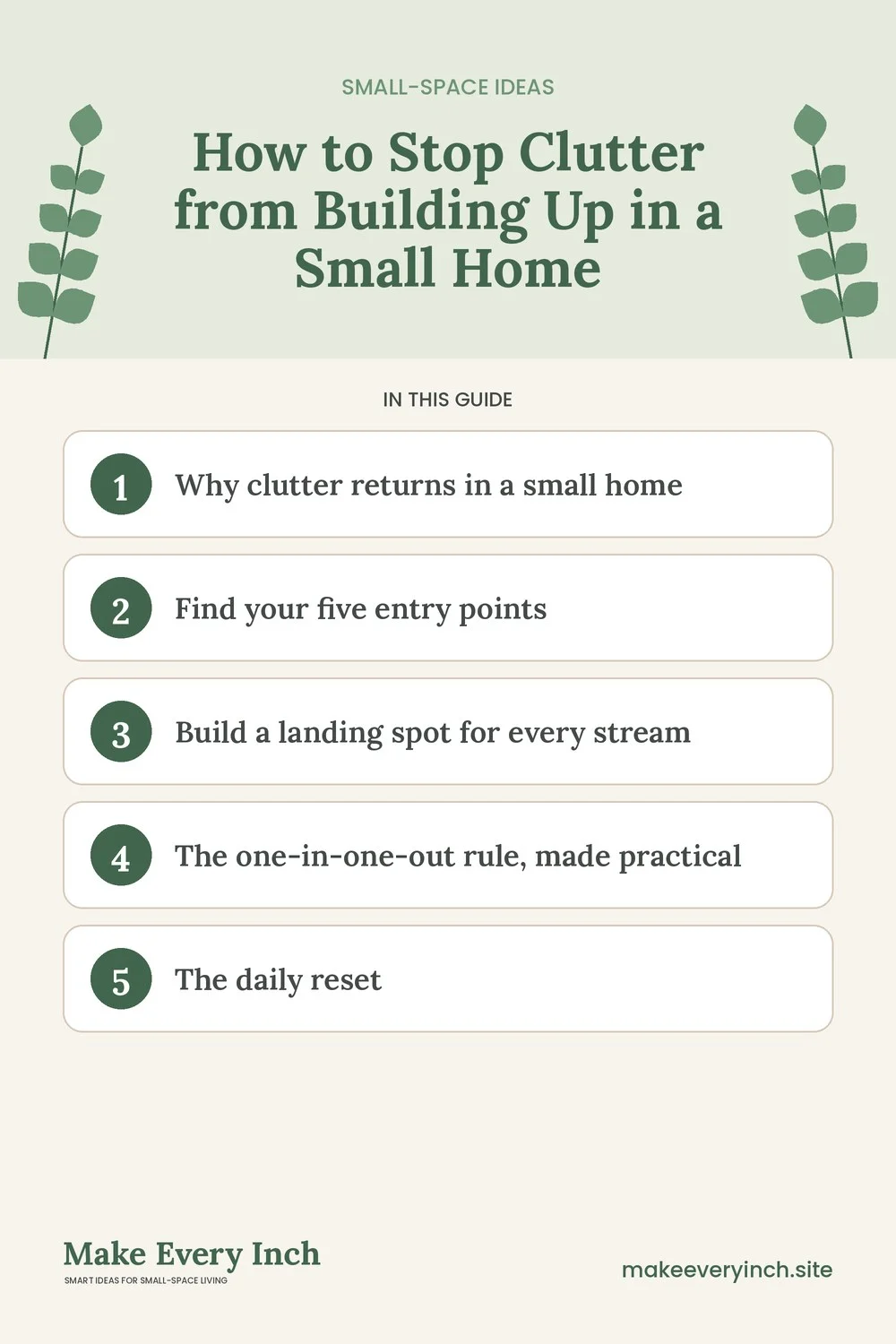
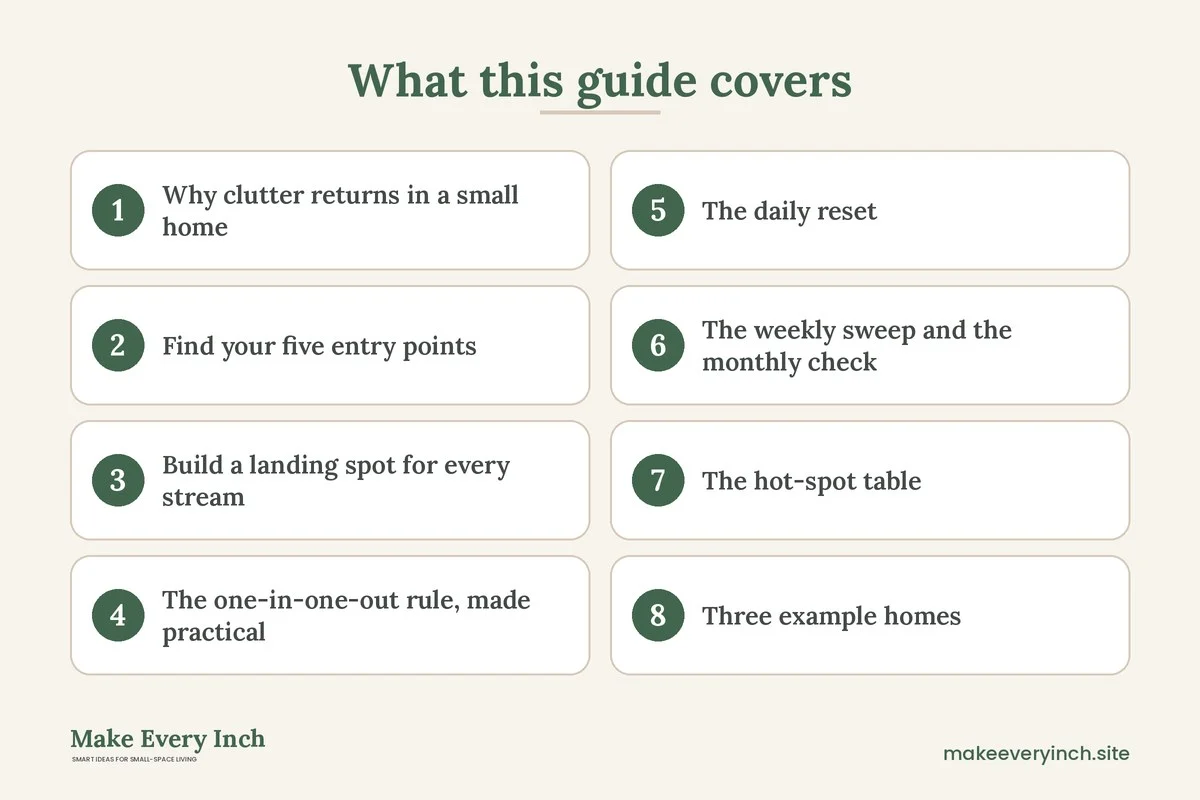
If you want to stop clutter from building up small home life needs a different approach from a big house. In a large home, clutter spreads out and hides in spare rooms. In a small home, it has nowhere to hide, so a single week of mail, bags, laundry and online orders can change how the whole place feels. The usual advice is to declutter once and buy bins, but that treats clutter as a pile when it is really a stream. Things arrive every day, and unless each one has a place to go and a way to leave, the pile returns. This guide explains the flow model, the five points where clutter enters a small home, the landing spots that catch it, daily, weekly and monthly routines, a hot-spot table, three example homes, safety notes and a FAQ. For the wider topic, see our pillar guide on small space organization ideas, and for a room-by-room tick list, use the companion small home organization checklist.
Why clutter returns in a small home
Clutter is not an object, it is the gap between what arrives and what leaves. Imagine a bathtub with the tap running. You can scoop out water with a cup all weekend, but the tub fills again on Monday unless you turn the tap down or widen the drain. In a small home, the tub is shallow. A studio or one-bedroom might have the storage volume of one large walk-in closet spread across the whole space, so the tub overflows faster.
That is why decluttering days feel good and then fade. A big purge lowers the water level, but it does not change the tap or the drain. Three habits quietly refill the tub. The first is surplus arrival, such as free items, bulk buys, packaging and gifts. The second is homeless items, which have no fixed place, so they sit on the nearest flat surface. The third is slow exit, where things you no longer use stay because removing them takes effort, such as a trip to a donation point or a listing for sale.
The fix has three parts. Slow the inflow, give everything a home, and make leaving easy. The rest of this guide turns those three parts into routines you can run in minutes. If you have already done a big clear-out, our guide to small apartment decluttering ideas covers the one-time purge, and the decluttering rules for small homes give a sorting method. This post is about what comes after, which is the maintenance that keeps the space clear.
Find your five entry points
Walk through your home and trace where clutter actually starts. In most small homes, it enters through five points.
- The front door. Bags, shoes, keys, jackets, parcels and mail land here first. If the entry has no landing spot, they move to the sofa or the table.
- The mail and paper stream. Letters, flyers, school notices and receipts arrive daily. Paper is the most common source of the pile on the counter. Our guide to small home paper organization ideas shows how to sort it.
- Deliveries and packaging. Boxes, padding and the item itself arrive together. If the box sits for days, it becomes furniture.
- Laundry. Clean clothes waiting to be folded and worn clothes that are not dirty enough to wash are the biggest source of bedroom clutter.
- Your own pockets and hands. Coins, receipts, cups, chargers, glasses and half-read books are carried in and put down wherever you stop.
Rank these five by how much mess each makes in your home. For many people, the front door and the laundry cause most of it. Start there, because fixing the top two entry points often removes more than half of the weekly pile.
Build a landing spot for every stream
A landing spot is a small, defined place where an item type goes by default. Not storage, not a shelf of bins, just a spot with an edge. The edge matters because it tells you when the spot is full. A tray holds six items, so on the seventh day you notice and sort it.
The entry landing spot
Use a wall hook or two for the bag and jacket, a shallow tray or bowl for keys and wallet, and a small shoe rack or mat for the shoes in current use. Limit shoes at the door to one pair per person, plus guests. Anything more goes to the closet. For narrow halls, our guide to small entryway ideas that keep clutter under control shows slim options, and the post on renter-friendly entryway organization ideas covers no-drill versions. Always get permission before drilling into a wall, and use adhesive hooks only within their rated weight.
The paper landing spot
Use one upright file or a single tray for incoming paper, kept near where you open the mail. Open mail standing up, next to the recycling bin, and recycle junk immediately. Keep only what needs action in the tray. Once a week, empty the tray. This one habit removes the most common counter pile.
The delivery landing spot
Break down boxes the same day and put them in the recycling area or a tall slim bag by the door. Do not store boxes for returns beyond the return window, and put a date on a sticky note if you do. Keep packing material out of the house unless you really reuse it.
The laundry landing spot
Give worn-but-not-dirty clothes a hook or an open chair-back rack, not the chair seat. A hook holds about three items, which is a natural limit. Dirty clothes go to a hamper with a lid or a fabric bag. For small laundry zones, our post on how to organize laundry supplies in a small home shows how to keep the supplies tidy.
The pocket landing spot
Choose one small bowl or dish near the door or the bed for loose items. Empty your pockets into it at the end of the day. Once a week, it gets emptied into its real homes.
The one-in-one-out rule, made practical
The rule is simple. When something new comes into a category, something leaves the same category. It works best for categories that grow quietly, such as clothes, mugs, towels, books, toys, pens and cables. It does not need to be applied to consumables like food.
To make the rule work in a small home, follow these steps.
- Set a visible limit. Decide how many of each item you want, such as six mugs, two sets of sheets per bed or one shelf of books. A limit that you can see on a shelf is easier to hold than a number in your head.
- Keep a leaving box. Place one box or bag in a closet. When you notice an item you do not use, drop it in immediately, without debating. When the box is full, it leaves the house within a week.
- Plan the exit. Know where donations go, which day pickups run and which items need a listing. If leaving needs a trip, schedule it on a day you are already going out.
- Pause before buying. For non-urgent buys, wait 48 hours. If you still want it, check whether you have a place for it. If not, either choose a smaller version or skip it.
This rule is a guide, not a punishment. A small home can hold a limited number of things comfortably, and the rule is how you stay inside that number without ongoing effort.
The daily reset: ten minutes that save an hour
A daily reset is a short sweep that returns every item to its landing spot or its home. It does not need to be deep. The aim is to make tomorrow start from a clear surface. Try this ten-minute order.
- Minutes 1 to 2: Clear the main surface, such as the table or the counter, into the correct landing spots. Carry cups and plates to the sink.
- Minutes 3 to 4: Collect loose items from the sofa, floor and bed into one basket, then return each to its place.
- Minutes 5 to 6: Sort the paper tray, recycle junk and pick one action item for tomorrow.
- Minutes 7 to 8: Hang or fold worn clothes. Put the dirty ones in the hamper.
- Minutes 9 to 10: Check the entry. One pair of shoes per person, bags on hooks, keys in the tray.
Set a timer. The time limit matters, because it makes the task small enough to do on tired evenings. Many people find it easiest to attach the reset to something that already happens, such as after dinner or just before the evening show. If the reset keeps getting skipped, shorten it to five minutes and clear only the surface that bothers you most.
The weekly sweep and the monthly check
The daily reset keeps the surfaces clear, but a weekly sweep catches the slower build-up. Choose a fixed day and spend 20 to 30 minutes.
- Empty the pocket dish, the paper tray and any basket that catches strays.
- Check the fridge and pantry for expired food, and plan the next shopping with what is left.
- Clear the bathroom counter and the bedside tables.
- Look at the leaving box and decide whether it is ready to go.
- Wipe the surfaces you cleared. A clean surface is a visual cue that the job is done.
Once a month, take ten minutes to review storage. Open each closet, cabinet and drawer, and judge how full it is. Aim to keep storage at about 80 percent. At 100 percent, nothing new has a home, so clutter returns to the surfaces. When a space exceeds 80 percent, remove the least used items until it falls back.
The hot-spot table
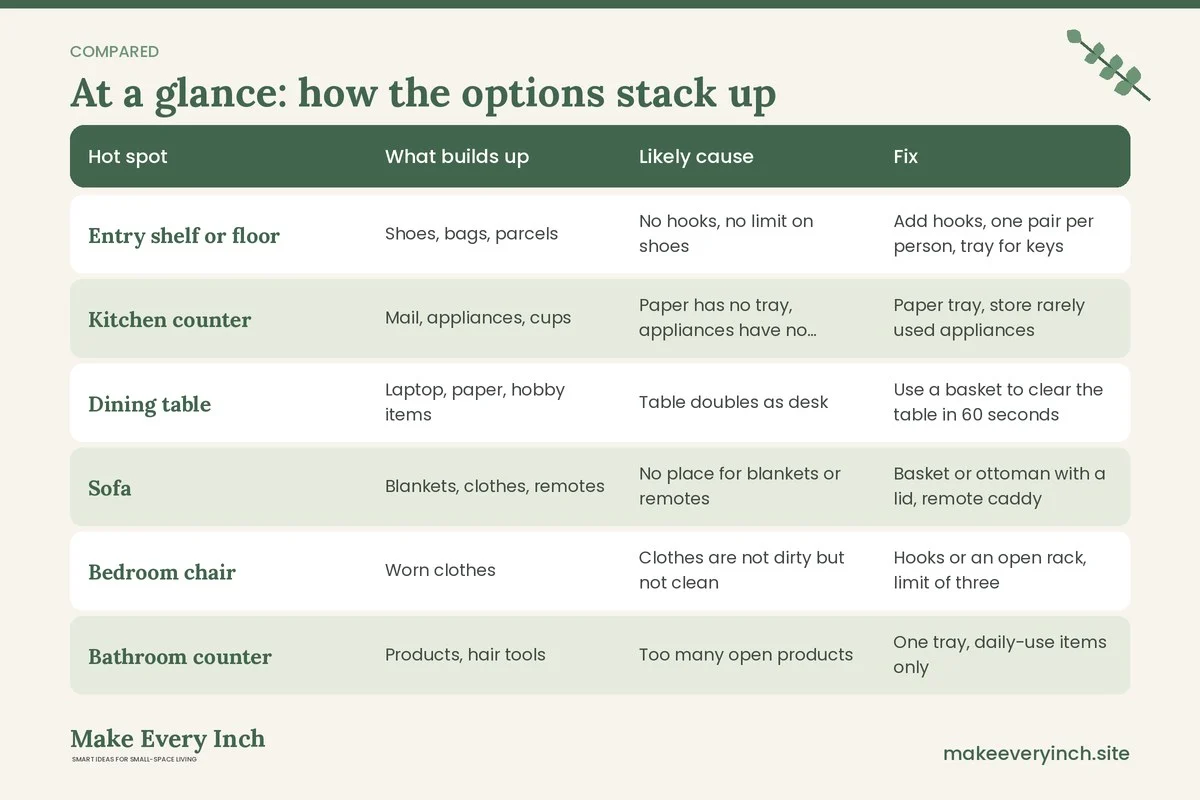
Every small home has a handful of places where clutter gathers. The table below lists common hot spots, what builds up, the likely cause and a fix.
| Hot spot | What builds up | Likely cause | Fix | |
|---|---|---|---|---|
| Entry shelf or floor | Shoes, bags, parcels | No hooks, no limit on shoes | Add hooks, one pair per person, tray for keys | |
| Kitchen counter | Mail, appliances, cups | Paper has no tray, appliances have no cabinet | Paper tray, store rarely used appliances | |
| Dining table | Laptop, paper, hobby items | Table doubles as desk | Use a basket to clear the table in 60 seconds | |
| Sofa | Blankets, clothes, remotes | No place for blankets or remotes | Basket or ottoman with a lid, remote caddy | |
| Bedroom chair | Worn clothes | Clothes are not dirty but not clean | Hooks or an open rack, limit of three | |
| Bathroom counter | Products, hair tools | Too many open products | One tray, daily-use items only | |
| Desk | Cables, paper, cups | No cable box, no paper tray | Cable box, tray, one cup rule | |
| Floor by the bed | Books, chargers, shoes | No bedside shelf | Wall-mounted or slim bedside shelf |
Fixing the top three hot spots in your home usually solves most of your daily mess. If you are not sure where to start, begin with the one you see first when you walk in.
Three example homes
A 450 square foot studio for one
The studio owner sees clutter on the dining table and at the foot of the bed. The entry has one hook, so bags land on the chair. The plan is to add two hooks inside the door, a tray on the shelf, and a lidded basket at the foot of the bed for loose clothes and blankets. The table gets a basket that holds the laptop and papers, and the owner clears it every night in under one minute. A leaving bag sits in the closet. After two weeks, the owner adds a weekly 20-minute sweep on Sunday morning. The key change is that every item that previously landed on the table now has a defined spot.
A one-bedroom for a couple
Two people double the inflow. The couple splits categories, so each person owns one hook, one tray and one half of the bathroom counter. They also agree on a shared paper tray and a weekly check. Because they both use the kitchen, they choose a ten-minute evening reset in which one person clears the kitchen and the other clears the living room, then they swap the next day. Their monthly check focuses on the closet, which is shared and always full. They set a limit of two sets of sheets per bed and one drawer of cables, and they give a shared leaving box a spot behind the door.
A two-bedroom with a child
Kids create clutter quickly. A toy that has no home becomes a floor item. The family sets up a small toy rotation, with one bin in the living room and the rest stored. Each week, they swap the bin for another, which also reduces new buys. Art and school paper go to a single clip rail or tray, with a monthly choice of what to keep. The child has a low hook for the bag and a low shelf for shoes, so the child can put things away independently. For more family ideas, see small home organization for families.
Common mistakes to avoid
- Buying storage before cutting stuff. Bins make a pile look neater but do not reduce it. For other approaches, read our guide to small home organization without buying bins.
- Having no limit. A shelf with no edge fills without notice. Give every shelf, hook and tray a visible capacity.
- Putting things in a temporary spot. The temporary spot becomes the permanent one.
- Doing everything at once. A weekend overhaul leads to burnout. Smaller daily habits last longer. Our small home organization mistakes to avoid post covers more traps.
- Ignoring vertical space. Walls and door backs are underused. See vertical storage ideas for safe ways to use them.
Safety notes for small-home storage
Clutter control often involves adding shelves and hooks, so take care.
- Anchor tall furniture. Bookcases, dressers and tall cabinets should be fixed to the wall using the hardware that fits your wall type, particularly where children or pets live. If you rent, ask permission before drilling, and consider furniture with a low center of gravity if you cannot anchor.
- Respect weight limits. Adhesive hooks and over-door racks list a maximum load. Stay well under it, and remember that wet coats weigh more than dry ones.
- Keep exits and vents clear. Do not stack items against heaters, radiators, electrical panels, furnace doors or vents. Leave the access path to a panel free.
- Watch cords and outlets. Do not overload power strips, and keep cords out of walkways. Keep storage away from the area around a stove.
- Store chemicals safely. Keep cleaners, laundry pods and medicines out of reach of children and pets, in a closed cabinet or a high shelf. Ventilate when you use strong products, and consider low-VOC paint if you repaint storage.
- Bathrooms and wet areas. Keep electrical items away from sinks, and use outlets protected by a GFCI near water.
- Under-bed boxes. Make sure they do not block an exit route or a heater. See under-bed storage ideas for a safe layout.
A four-week starter plan
- Week 1: Trace the five entry points, pick the top two and build landing spots for them.
- Week 2: Start the ten-minute daily reset and the leaving box.
- Week 3: Add the weekly sweep and measure your storage fullness.
- Week 4: Apply the one-in-one-out rule to one category, such as clothes or mugs, and review what changed.
After four weeks, note which hot spots remain. Adjust the landing spots rather than adding more discipline. If the same spot keeps filling, the system is wrong, not you.
FAQ
How long does it take to stop clutter from building up?
Most people notice a difference in two to four weeks after the landing spots and the daily reset are in place. Habits take longer to settle, so expect to adjust for about two months.
What if I live with people who do not help?
Start with spots that each person owns. A hook or a tray with someone’s name is easier to keep than a shared surface. Keep the shared rules short, and focus on the common areas first.
Is it better to declutter first or build systems first?
Do a light declutter first, so the landing spots are not overloaded, then build the systems. If you declutter without systems, the pile returns, and if you build systems without decluttering, there is no room for them.
How many items should I own per category?
There is no universal number. Set a limit based on your space and your routines, and base it on what you use in a typical week.
What about sentimental items?
Give them one defined box or shelf, so they do not spread. When the box is full, choose which items matter most.
Can this work in a rental?
Yes. Most of the landing spots need only trays, baskets, freestanding racks and adhesive hooks used within their limits. Check your lease before using any fixing in the wall.
Keep going: Keep going with the small space organization ideas pillar, run the room-by-room small home organization checklist, and read small home organization ideas that actually last for habits that stick.
Save this guide for later
Pin the ideas you like to Pinterest so you can come back to them when you plan your space.