Best Hampers for Small Laundry Areas: Sizes, Types and Layouts
Quick answer: The best hampers for small laundry areas are the ones sized to your wash cycle, not your wardrobe. Measure the space, count how many loads you do a week, and choose a slim tilt-out, a tall narrow bag on a frame, a door-hung bag or a stackable sorter. Allow 10 to 14 inches of open floor to reach it, let damp items dry before they go in, and keep it clear of the dryer vent and heaters.
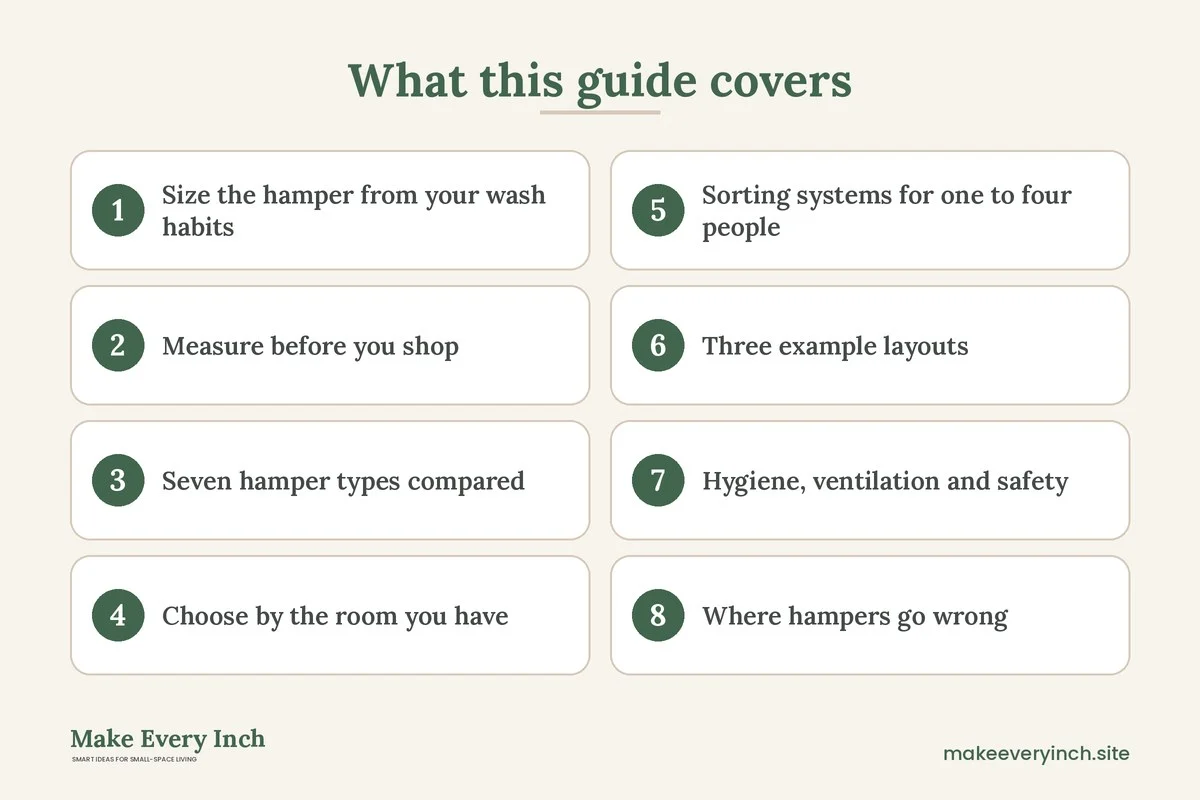
Choosing hampers small laundry areas can actually use is harder than it sounds. A hamper looks simple, but in a closet, a hallway nook or a corner of a bathroom, a bad one blocks the door, hides behind the machine or fills so fast that clothes end up on the floor. The right model depends on how many people use it, how often you wash and where the dirty clothes start their journey. This guide is a decision tool. It covers how to size a hamper from your wash habits, a comparison of seven types, measurements to take before you buy, sorting systems for one to four people, three example layouts, hygiene and safety, mistakes and a checklist. For the full picture of the room, read our main guide to small laundry room ideas, and for the sorting side see our post on small laundry room organization. If your laundry area is a closet, our guide to laundry closet organization ideas is a good companion.
Size the hamper from your wash habits
Most people buy a hamper by looks and then find it overflows or sits half empty. Start with numbers instead.
A typical small washing machine takes a load of around 6 to 10 pounds of dry clothes. A medium T-shirt weighs a few ounces, jeans around a pound and a bath towel a pound or two. A rough guide is that one load fills around 1.5 to 2.5 cubic feet of loosely packed laundry, though it varies with fabrics. Count the loads you do a week. Then decide how many days you want to store dirty clothes between wash days.
- One person, one load a week: one container of about 1.5 to 2.5 cubic feet, or around 15 to 25 gallons, is a start.
- A couple, two loads a week: around 3 to 5 cubic feet in total, usually split into two sections such as lights and darks.
- A family of three or four, four to six loads a week: 6 to 10 cubic feet in total, often best handled with a sorter that lets you carry out one section at a time, or a smaller hamper in each bedroom that feeds a main sorter.
Capacity labels differ between makers, and some use liters, some gallons and some a size name. When in doubt, compare the outer dimensions and imagine filling the space with loosely packed clothes. If you lean toward a smaller hamper, you will do laundry more often, which suits some households and annoys others. Decide which one you are.
Measure before you shop
In a small space, the footprint and the reach are as important as the capacity. Take these measurements.
- Available width and depth: Measure the floor space at the widest and narrowest points. Many small laundry nooks are 24 to 36 inches deep.
- Height under any shelf or counter: Subtract an inch so you can lift out the bag.
- Door swing: Mark the arc of the door on the floor with tape. A hamper that sits in the arc will block the door or be knocked.
- Reach clearance: Leave 10 to 14 inches in front of a hamper that tilts, slides or has a lid that flips up.
- Distance to the machine: Leave at least 24 inches in front of a front-loading washer for the door and for you to bend. See your manual for the exact clearances the maker requires.
- Clearance from the dryer, vent and heater: Keep fabric items away from hot surfaces, vents and anything that radiates heat. Check the manual of your dryer for the recommended clearance.
- Weight limit: If the hamper hangs on a door, a rod or a hook, check the stated weight. A full hamper of wet or damp towels can be much heavier than dry clothes.
Mark each footprint on the floor with painter’s tape and leave it for a day. Walk through your normal laundry routine. If you trip, bump or step around the tape, adjust before you buy.
Seven hamper types compared
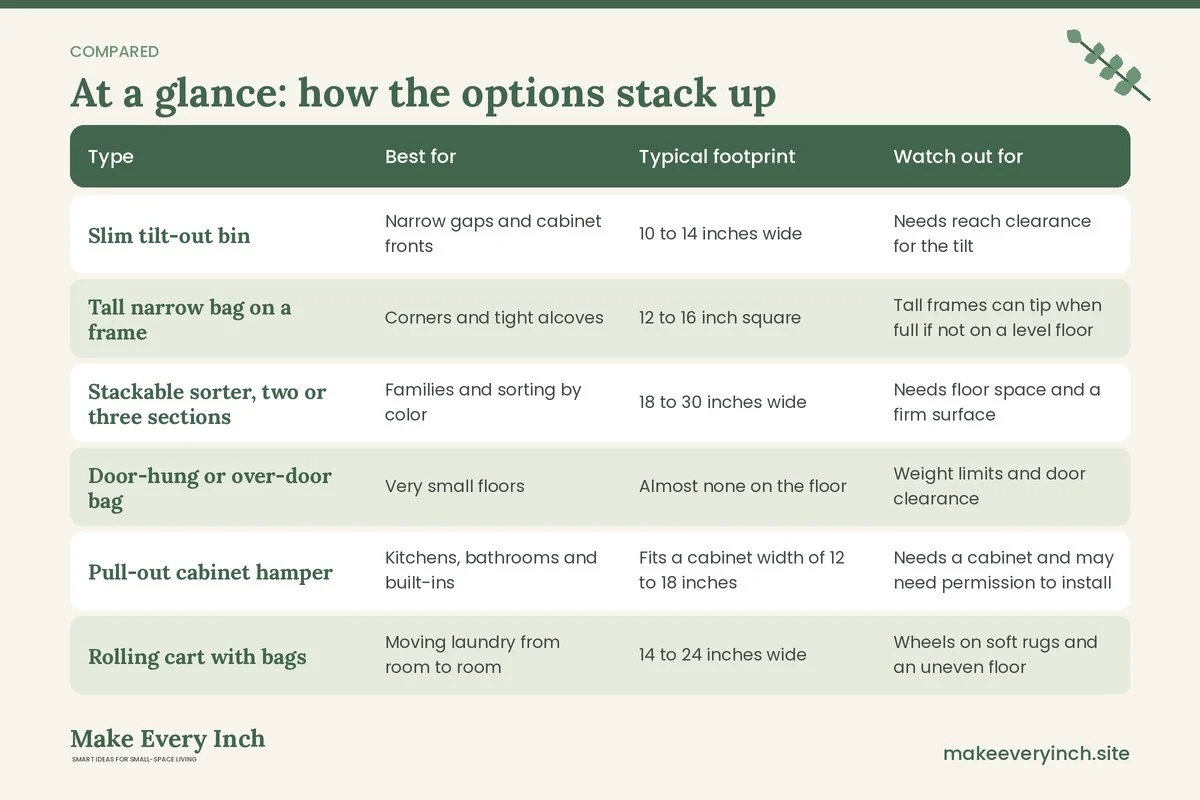
Each type solves a different problem. The table gives general guidance, and your space may differ.
| Type | Best for | Typical footprint | Watch out for |
|---|---|---|---|
| Slim tilt-out bin | Narrow gaps and cabinet fronts | 10 to 14 inches wide | Needs reach clearance for the tilt |
| Tall narrow bag on a frame | Corners and tight alcoves | 12 to 16 inch square | Tall frames can tip when full if not on a level floor |
| Stackable sorter, two or three sections | Families and sorting by color | 18 to 30 inches wide | Needs floor space and a firm surface |
| Door-hung or over-door bag | Very small floors | Almost none on the floor | Weight limits and door clearance |
| Pull-out cabinet hamper | Kitchens, bathrooms and built-ins | Fits a cabinet width of 12 to 18 inches | Needs a cabinet and may need permission to install |
| Rolling cart with bags | Moving laundry from room to room | 14 to 24 inches wide | Wheels on soft rugs and an uneven floor |
| Collapsible basket or bag | Renters and shared spaces | Folds flat | Can lack structure and may be hard to load |
Slim tilt-out bin
A slim tilt-out hamper has a front that swings open, so you can drop items in and still keep the footprint narrow. It suits a gap between a machine and a wall or the end of a counter. Because the front tips outward, you need floor space to open it. Check that the hinge is firm and that the lid does not catch your fingers. For a narrow room, our post on small laundry room ideas for narrow spaces shows where such bins fit.
Tall narrow bag on a frame
This is a fabric bag on a metal or wood frame, tall rather than wide. It fits a corner and holds a lot for its footprint. The bag lifts out, so you can carry it to the machine. Make sure the frame sits flat, and do not overfill it so the stack stays stable. A tall frame beside a doorway can be a knock hazard for children, so check the height and the corners.
Stackable sorter
A sorter has two or three bins in a row or stacked. It gives you pre-sorted loads, which cuts the time at the machine. In a small area, a stacked version uses height instead of width. Stacked units should be on a level floor and ideally rest against a wall. Do not climb on it, and keep children away from the top section. Our post on small laundry room organization for families explains sorting by person or by load.
Door-hung bag
An over-door bag hangs on the top edge of a door and uses almost no floor. It is a smart answer to an apartment with no floor space, but it has limits. A door-hung bag adds weight and bulk to the door, so check that the door still closes and that the hinges are not strained. Avoid a door that sees heavy traffic, and never use one on a door to a bathroom if it prevents it from opening fully. Never hang one on a door that is a fire exit or part of an escape route.
Pull-out cabinet hamper
Some kitchens and bathrooms have a base cabinet that can host a pull-out hamper with one or two bins. It hides the laundry, so it keeps a room tidy. Fitting one can require changing the cabinet, and a rental may not allow it, so ask first. If you cannot change the cabinet, a freestanding unit that sits in the same gap is a way to get a similar effect. For this kind of arrangement, see our guide to laundry room ideas in a bathroom.
Rolling cart with bags
A rolling hamper carries laundry from the bedroom to the machine. It is useful in a home where the washer is far from the bedrooms. Choose wheels that lock, and park it on a hard floor. Check that it fits through every doorway on the route.
Collapsible basket or bag
A collapsible bag or basket stores flat, so it suits a renter who moves often or a shared room where space changes. It works well as a second hamper for guests or a travel bag. It tends to be less sturdy, so it may not stand up on its own when empty.
Choose by the room you have
Different small laundry areas call for different answers. Use this quick guide.
- A hallway closet with stacked machines: a tall narrow bag beside the machine or a door-hung bag inside the door.
- A kitchen alcove: a slim tilt-out bin or a pull-out unit, so the laundry is hidden when guests visit.
- A bathroom corner: a narrow bag on a frame with a breathable fabric. Keep it away from splashes and the shower.
- A bedroom corner: a stackable two-section hamper for lights and darks, and a lid that closes to hide the clothes.
- A balcony or utility porch: a ventilated plastic bin that tolerates humidity, kept off the floor on feet if the surface gets wet.
Sorting systems for one to four people
A hamper works best when it matches how you sort. The simplest systems are below.
One person
Use a single hamper for everyday clothes and a small bag for delicates. Wash towels and sheets separately, as these load types are different in weight and temperature. A single container also keeps the area simple. A door-hung bag may be enough.
Two people
Use a two-section sorter or two hampers: lights and darks. Or use one hamper per person and combine them on wash day. If you share a bedroom, a hamper in the bedroom and a bag in the laundry area is easier than a long trip.
A family of three or four
Give each person a small bedroom hamper, and have a main three-section sorter near the machine for towels, lights and darks. A weekly schedule reduces the volume. For example, assign each person a day. Younger children can drop their own clothes in a low hamper. Keep any laundry products and bags out of reach of toddlers and pets. Our guide to how to organize laundry supplies in a small home shows how to keep detergents out of reach.
Three example layouts
These are illustrative layouts with typical dimensions, not records of real homes.
Layout 1: A 30 inch wide closet with stacked machines
The closet is 30 inches wide and 30 inches deep. A stacked washer and dryer fill the width. The only free space is the inside of the door and a 6 inch gap on one side. The plan: a door-hung bag with a stated weight limit that the door can take, plus a flat collapsible bag stored on a shelf above the machines for a second load. The door must still close fully, and the bag must not touch the dryer. In the bedroom, a small hamper holds clothes until wash day, so the closet is only a place for the final sorting.
Layout 2: A 4 by 6 foot kitchen alcove for a couple
A front-loading washer sits under the counter on one side, with 20 inches of floor beside it. The plan: a slim tilt-out hamper with two sections, 12 inches wide, sits in the gap, one section for lights and one for darks. A shelf above holds detergent in a closed box, out of reach of pets. The tilt front needs 12 inches of clearance, so the washer door is checked to be sure both can open at the same time. A small basket on the counter holds socks that lost their match, which avoids using the hamper as storage. For more ideas in this setting, read our post on small laundry room ideas in a kitchen.
Layout 3: A bathroom corner for a family of four
A bathroom has a stacked pair in one corner and a 14 inch square floor space beside the door. The plan: a tall narrow bag on a frame holds towels. Each child has a small hamper in the bedroom, so only the towels are in the bathroom. A rolling cart carries the bedroom hampers to the machine on wash day. Because the bathroom is humid, choose breathable fabric and let wet towels dry before they go in the bag, to avoid mildew. All plug-in appliances stay away from water, and any outlet in the bathroom should have GFCI protection. If it does not, ask a qualified electrician to assess it.
Hygiene, ventilation and safety
A hamper holds damp and soiled items, so a few habits keep the area clean.
- Do not put wet items in. Damp towels and swimsuits can grow mildew in a closed bin. Let them dry first, or wash them at once.
- Let air in. Choose a hamper with mesh sides, vent holes or breathable fabric, especially in a closet or bathroom.
- Keep it away from heat. Never place a hamper against a dryer vent, a water heater, a furnace or a radiator. Lint is flammable, so clean the lint trap before each load, and see your dryer manual for vent care.
- Wash the hamper too. Fabric liners can go in the machine, and plastic can be wiped with a mild solution. Do this every month or two.
- Check items before washing. Remove lighters, batteries, tissues and anything flammable from pockets. Items that have soaked up cooking oil or certain cleaning products need special care, so read the label and the guidance from the manufacturer of the product.
- Protect small children and pets. A tall, narrow hamper can tip if a child climbs it. A deep bin can be a hazard for a toddler, so use a lid or keep it out of reach. Keep detergents and pods locked away.
- Mind the weight. Do not hang a heavy bag from a hook or door that is not rated for it. Wet laundry is heavy.
- Lease and permission. Do not drill into walls or cabinets to mount a hamper without permission. Many options need no tools at all.
Where hampers go wrong
- Choosing by looks, not capacity. A pretty bin that holds only half a load leads to overflow.
- Ignoring the lid. A lid that blocks the access or that you cannot lift with one hand will stay open and spoil the look.
- Placing it in the path. A hamper that is hit every day will eventually be moved to a worse spot.
- Choosing one big bin for a family. A single heavy bin is hard to carry. Smaller bags are easier to lift.
- Forgetting to wash the bag. Smells come from the bag, not just the clothes.
- No plan for the overflow. Keep one empty bag folded on a shelf for the day a load runs over.
Our post on small laundry room mistakes to avoid covers other common errors in the whole room.
Style, material and noise
Appearance matters when the hamper sits in view. A few things make it blend in.
- Material: Woven natural fiber looks warm, but it can trap odors if it stays damp. Cotton canvas bags wash easily. Plastic is simple to wipe clean. Metal frames add sturdiness.
- Color: In a small area, match the hamper to the wall or cabinet color so it recedes, or use it as a pop of color.
- Lid or no lid: A lid hides clothes and blocks dust, but a no-lid design is quicker to use and lets air in. Choose by your habits.
- Noise: Hard plastic lids can bang. A soft-closing lid or a fabric cover is quieter in a shared apartment.
- Handles: Strong handles make it easier to carry. Check that stitching is firm on fabric ones.
If you rent
Renters should look for options that need no fixings. Freestanding bags on frames, tilt-out bins, rolling carts and collapsible baskets all work. If you want a door-hung bag, choose one that hangs over the top without screws, and check that it will not mark the paint. Keep any adhesive hooks within their rating. For more ideas, see our guides to small laundry room ideas for renters and small laundry area ideas for apartments.
If your laundry area doubles as a drying space, also read our post on small laundry room drying rack ideas, so the hamper and the rack share the room without competing for the floor.
Before you buy: a short test at home
You can do a dry run without buying anything. Fill a large trash bag or a laundry basket with one typical load of clothes and place it in the planned spot. Live with it for a week. Notice whether you can reach it with the door open, whether it blocks the walk and how full it feels at the end of the week. If it is overflowing, you need more capacity or a second container. If it is half empty, a smaller one is enough. This costs nothing and often changes the shopping list. When you are ready to improve the rest of the room, try our ideas in small laundry room storage ideas, and, if you want a visual idea of how the room can change, small laundry room ideas before and after.
A matching decor idea
If you are also giving the room a fresh look, the hamper is a good place to start, since it is a large object in a small space. Many people like to plan the look of a whole room at the same time. Our sibling post, small room decor before and after ideas, explains how to document and plan a change room by room, and the method works for a laundry nook too.
Checklist
- Count the loads you do each week.
- Choose capacity for the number of days between wash days.
- Measure width, depth, height and door swing.
- Leave 10 to 14 inches of reach in front of a tilt or pull-out model.
- Keep fabric away from the dryer vent and heat.
- Choose breathable material in a damp room.
- Check the weight rating on any hook, rod or door.
- Pick a sorting system that matches the household.
- Keep detergents and pods out of reach of children and pets.
- Ask permission before drilling or changing cabinets.
- Do a one-week dry run with a bag or basket.
- Wash the hamper regularly.
FAQ
What size hamper do I need for a small laundry area?
Match it to the number of loads you do and the number of days between washes. One person doing a single weekly load often does well with 15 to 25 gallons, and larger households need sections.
Is a tall or wide hamper better in a small space?
Tall and narrow usually saves floor space, but check stability and the height of the shelf above. A wide hamper is easier to load but eats floor.
How do I stop a hamper from smelling?
Do not put wet items in, choose a breathable material and wash the hamper regularly. Keep the area ventilated.
Can I use a hamper inside a bathroom?
Yes, if the material is breathable, it is kept away from direct splashes and you let towels dry first. Electrical items must stay away from water.
Is a door-hung bag safe?
It can be, if the door and hinges can support the weight, the door closes fully and it is not on an escape route. Keep the load light.
What if I have no floor space at all?
Try a door-hung bag, a collapsible bag stored on a shelf or a hamper in the bedroom that you carry on wash day. Our small laundry room ideas on a budget post has more ways to cut clutter without spending much.
Keep going: Keep going with our small laundry room ideas, small laundry room ideas for narrow spaces and small laundry room shelf ideas.
Save this guide for later
Pin the ideas you like to Pinterest so you can come back to them when you plan your space.