14 Laundry Room Ideas in a Kitchen, Washer Beside the Stove
Quick answer: A laundry room kitchen works when you separate food zones from laundry zones, give the dryer proper venting and clearance, keep the washer’s water and power connections accessible and use doors, curtains or paneling to hide the machines between loads. Keep chemicals away from food and out of reach of children and pets, check each appliance manual for clearances, and get written permission before changing plumbing, wiring or cabinets in a rental.
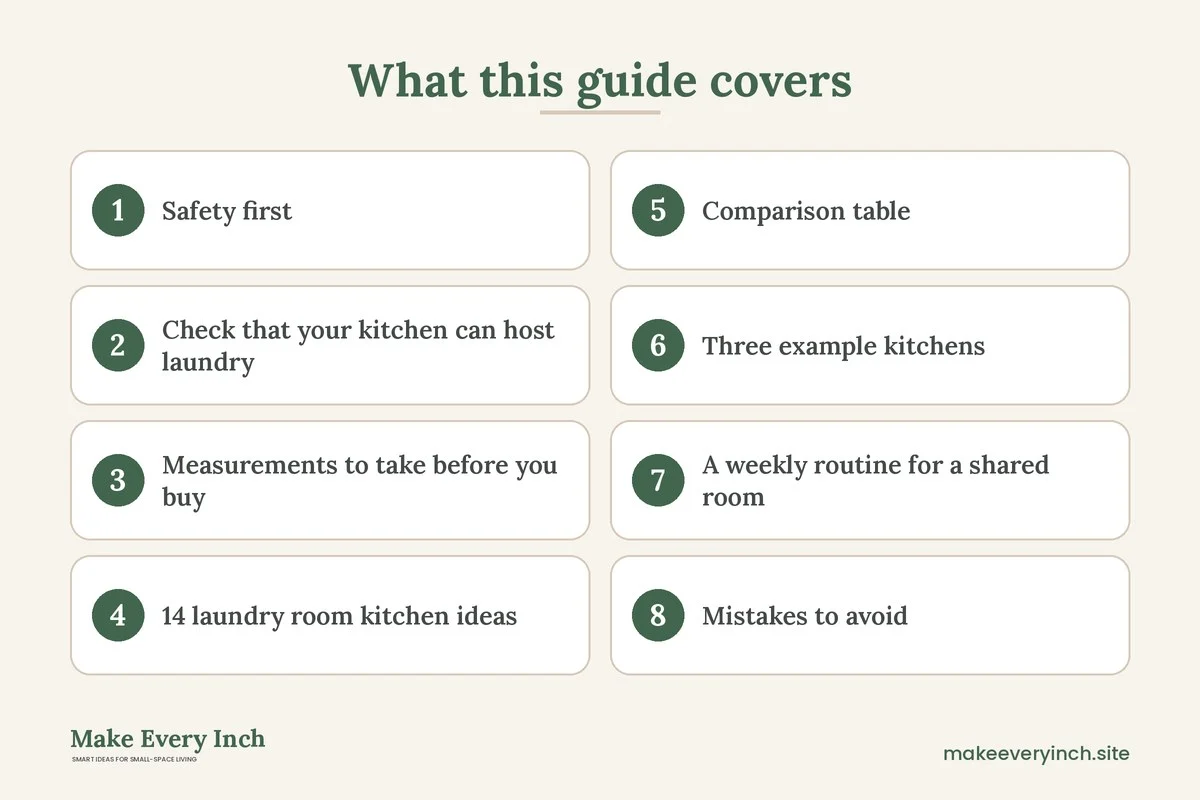
A laundry room kitchen is what many small apartments and older homes already have, whether by design or by accident. The washer lives next to the dishwasher, the dryer hides behind a door at the end of a galley and the folding happens on the same counter where dinner is prepared. Done well, this arrangement is efficient, because the kitchen already has water lines, drains and electrical outlets. Done badly, it mixes lint with food, steam with cooking heat and detergent with the pantry. This guide shows how to plan the room so each job gets its own place. It covers the rules that matter, the measurements to take, 14 ideas, a table comparing common arrangements, three example kitchens, a weekly routine, mistakes and a checklist. For the full overview, read our main guide to small laundry room ideas, the companion post on laundry room ideas in a bathroom and our broader guide to small kitchen ideas.
Safety first: what changes when laundry joins the kitchen
A kitchen is already a place with heat, water and electricity. Adding laundry equipment means you need to think about food hygiene, fire risk and ventilation together. The points below are questions to settle with your appliance manuals, local rules and, where needed, a licensed professional.
- Dryer venting and lint: a vented dryer must exhaust hot, moist, lint-filled air outdoors through the duct type, length and bends its manual allows. Never vent into the kitchen, a cabinet or a crawlspace. Clean the lint screen after every load and inspect the duct from time to time. Lint is flammable, and a kitchen has plenty of ignition sources.
- Clearance around heat: keep the dryer, towels and baskets well away from the stove, oven and toaster. Manuals list required clearances, and the cooking appliance has its own. A common sense rule is never to stack laundry piles or hang drying items near open flames or hot burners.
- Gas appliances: a gas range and a gas dryer share some of the same concerns about ventilation and combustion air. If you have any gas appliance, ask a qualified professional about installation and keep the manual’s clearance ranges.
- GFCI and outlets: kitchen outlets near the sink normally require ground-fault protection. Large appliances should plug directly into an outlet rated for them, never into an extension cord or power strip. If you are unsure about the circuit, ask a licensed electrician.
- Water leaks and shutoff valves: washers and dishwashers often share supply lines and drains. Know where each shutoff valve is, keep it reachable and check hoses for bulges or kinks. A drain pan, where allowed, can limit damage.
- Weight and vibration: stacked units are heavy, and a spinning washer can shake cabinets and make dishes rattle. Ask about the floor before stacking, and keep fragile items off any surface the washer touches.
- Chemicals: laundry detergent, bleach and stain remover must be stored away from food, high up or in a latched cabinet away from children and pets. Never mix cleaning products, and especially never mix bleach with anything containing ammonia or an acid, because the fumes can be harmful. Keep all products in their original, labeled containers.
- Food hygiene: laundry baskets and wet clothes should not sit on counters where food is prepared. Wipe surfaces before cooking.
- Lease and permission: in a rental, adding a washer connection, changing a vent, replacing a cabinet or drilling into walls typically needs written approval. Ask before you start.
Check that your kitchen can host laundry
Four questions decide whether this is realistic.
- Is there a hookup? A washer needs hot and cold supply valves, a drain connection or standpipe and a dedicated outlet. Some kitchens have a spare connection capped for exactly this reason. Do not open or modify one yourself.
- Can you vent a dryer? If there is no way to run a duct to the outside, consider a ventless or combination unit, or air-dry on a rack. Check the manual for what each type needs.
- Is the floor level and strong? A washer rocks if the floor slopes, and a stacked unit adds weight. Ask a professional if the floor feels springy.
- Is the path wide enough? Measure doors, hallways and corners. Many machines need 24 to 30 inches or more of clear opening, plus space to turn.
If you cannot answer yes to these, a closet or hallway unit may suit you better. See small laundry room organization for ideas that fit elsewhere.
Measurements to take before you buy
Sketch the kitchen on paper and write down the following in inches.
- Counter run: the length of the usable wall, from corner to corner. A standard counter is around 36 inches high and 24 inches deep, and a front-loading washer is often a similar height, so it may fit beneath the counter.
- Aisle width: a comfortable single-cook aisle is often around 36 to 42 inches, and a two-cook aisle is wider. A washer door that swings open into the aisle uses up to 25 to 30 inches while open.
- Appliance size: a standard washer is often around 27 inches wide and 30 to 34 inches deep, and compact models are smaller. Use the numbers on your model.
- Clearances: check the manual for space behind and beside each machine, usually a few inches. Heat from the dryer and stove must not trap each other.
- Upper cabinet height: the bottom of a wall cabinet is often 18 inches above the counter. If you plan to stack, measure the total height of both units plus the room needed above.
- Window and ventilation: note where a window, hood or vent sits, because it affects how you route a duct.
Tape the footprint of each machine on the floor and open every door and drawer in the room. Walk the route from fridge to sink to stove with a laundry basket in your arms. If you have to turn sideways, change the plan.
14 laundry room kitchen ideas
Hiding the machines
1. Tall cabinet doors in front of the pair
Build or buy a cabinet front that matches the kitchen and covers a stacked washer and dryer. Doors should open fully and have ventilation, because a dryer needs air and heat to escape. Keep the doors open while the dryer runs unless the manual says otherwise.
2. A curtain or roll-up screen
In a rental, a fabric curtain on a tension rod or a track can cover the machines without cabinet work. Keep fabric away from the dryer exhaust and from the stove, and choose a material that is easy to wash. It is a fast, removable fix.
3. Under-counter washer with a continuous counter
A front-loading washer below the counter makes it look like another cabinet. Ensure the counter material tolerates heat and moisture, and leave the gaps the manual requires. Do not store anything on a surface that sits directly over a vibrating machine.
4. A pocket or bifold door
A door that folds or slides out of the way saves swing space in a narrow kitchen. Louvered panels help airflow if a dryer is behind them. Ask your landlord before replacing a door, and check the weight rating of any track.
Making the layout work
5. A galley arrangement with laundry at the end
In a galley kitchen, the washer and dryer can sit at the far end, opposite the door. The cooking and prep run stays in the middle, and the laundry corner keeps traffic away from the stove. See our guide to galley kitchen ideas for more layout thinking.
6. A stacked unit in a corner alcove
A corner alcove or former pantry can take a stacked pair. Check the vent path and the clearances, and use the shelf above for lidded bins. Keep the alcove free of towels and boxes, because lint and heat build up in tight spaces.
7. A washer-dryer combination unit
An all-in-one machine can fit where a vented dryer cannot. Cycles are often longer and loads smaller. It suits a small apartment kitchen when you already have water and drain connections.
8. A slim cart that doubles as a folding table
A narrow rolling cart parks beside the machine and rolls out on laundry day. Lock the wheels before loading it. See our guide to small kitchen cart ideas for sizes that work in tight aisles.
9. A fold-down counter above the machines
A wall-mounted drop-leaf shelf folds flat when not in use and gives a clean surface for folding. It must be anchored to studs or with the right hardware, and it should have a support rated for the weight. In a rental, check with the landlord before mounting anything.
Storage that keeps things separate
10. A dedicated laundry shelf in a different color or material
Use one open shelf or a bin for detergent and dryer sheets, and keep it visually different from the pantry. When the two zones read as separate, you are less likely to reach for the wrong bottle. Keep chemicals on the highest shelf or in a latched bin.
11. Pull-out drawers for baskets and supplies
Pull-out drawers in the base cabinet next to the washer hold cloths, spot cleaners and a small basket. Check that the drawer front does not hit the machine door when opened. Our guide to small kitchen organization ideas shows how to divide drawers by zone.
12. Hooks and rods for air drying
A tension rod across a window or a retractable line above the sink area lets you dry delicates without a dryer. Check the weight limit, keep damp items away from light fixtures and the stove, and take it down when not in use.
13. A lidded bin for dirty laundry
A tall lidded hamper tucked beside the machine keeps clothes out of sight and away from food. Choose washable fabric or plastic and empty it before it overflows.
14. A rubber mat and a small drain tray
A mat under the washer or in front of it catches drips and reduces slipping. Check the edges for tripping and wipe the floor regularly. It is an inexpensive way to protect the floor from slow leaks.
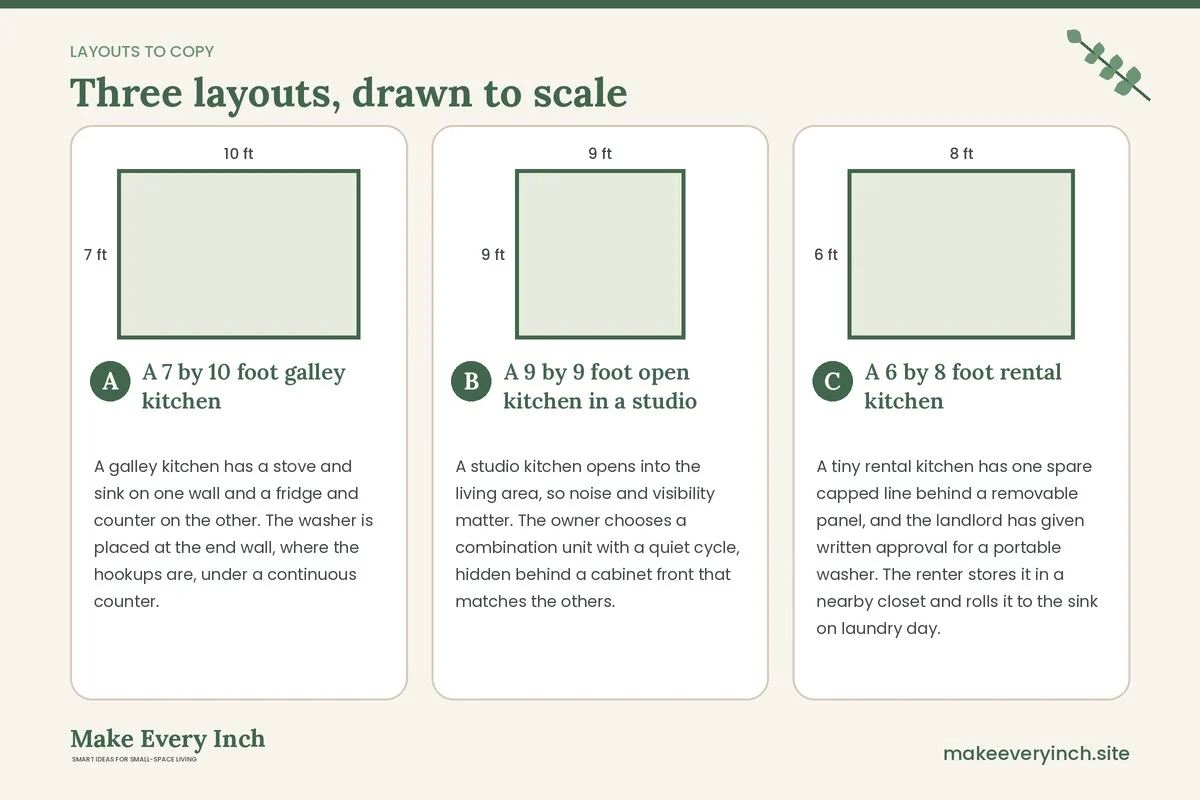
Comparison table: common kitchen laundry arrangements
| Arrangement | Best for | Space needed | Main concern | Rental-friendly? |
|---|---|---|---|---|
| Under-counter washer | Kitchens with an existing hookup | Width of machine plus a few inches | Heat and vibration near cabinets | Often with approval |
| Stacked pair behind doors | Corner alcoves and pantries | About 30 inches wide plus height | Venting and weight | Rarely without approval |
| Combination unit | Kitchens with no outside vent | Width of machine | Longer cycles and ventilation | Sometimes |
| Galley end laundry | Long narrow kitchens | 24 to 30 inches at the end | Traffic and noise | Often |
| Portable washer on a cart | Rentals with no hookup | A corner when in use | Hose and drain placement | Yes, with care |
| Washer in a nearby hallway closet | Kitchens with a small adjoining space | A closet about 30 inches deep | Distance to water and power | Often with approval |
These are rough ranges only. Always check the figures for your own model.
Three example kitchens
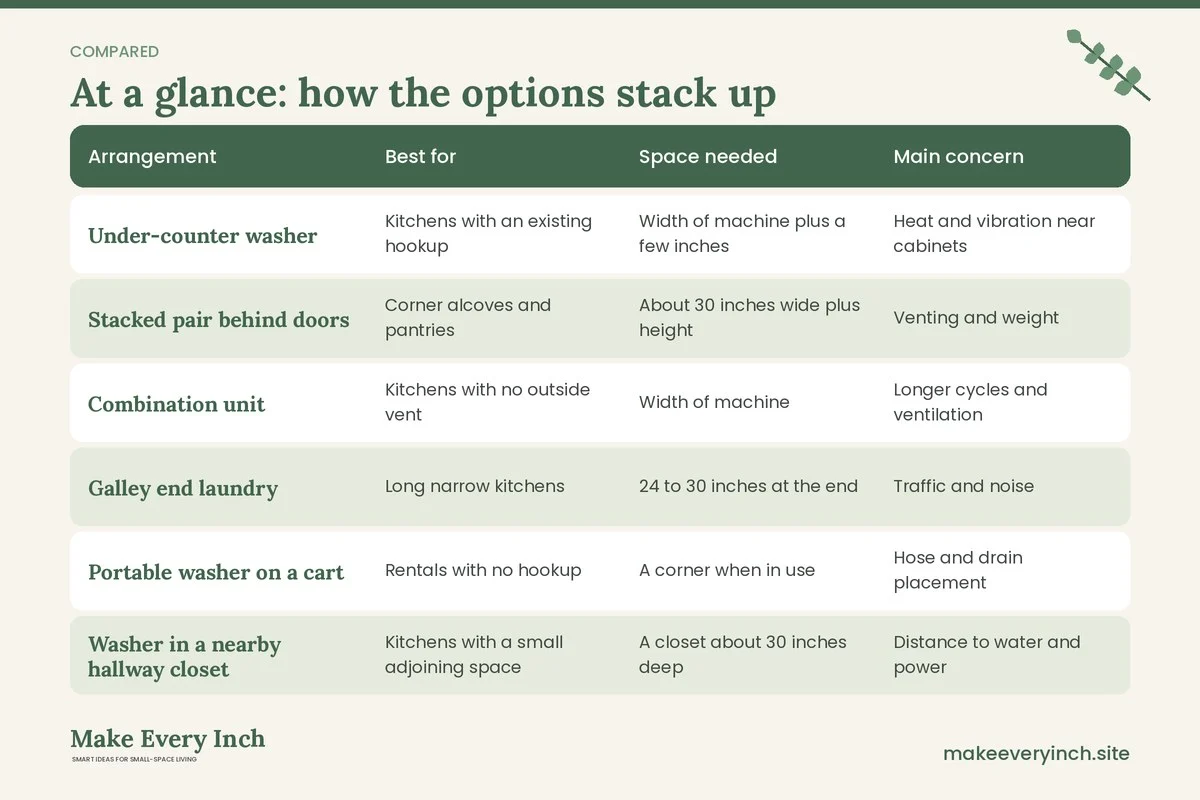
A 7 by 10 foot galley kitchen
A galley kitchen has a stove and sink on one wall and a fridge and counter on the other. The washer is placed at the end wall, where the hookups are, under a continuous counter. A bifold louvered door hides the dryer position in the corner. The aisle stays about 36 inches wide, the stove is kept clear of the laundry corner and the detergent is stored in a high, lidded cabinet. The cook never steps over a basket.
A 9 by 9 foot open kitchen in a studio
A studio kitchen opens into the living area, so noise and visibility matter. The owner chooses a combination unit with a quiet cycle, hidden behind a cabinet front that matches the others. Because the machine is open to the room, laundry is scheduled during the day and the cabinet door is closed afterward. A drying rod above the window handles sweaters, and a rug stops water from reaching the wood floor.
A 6 by 8 foot rental kitchen
A tiny rental kitchen has one spare capped line behind a removable panel, and the landlord has given written approval for a portable washer. The renter stores it in a nearby closet and rolls it to the sink on laundry day. A slim cart provides a folding surface, a tension rod handles hanging, and all cleaning products live in a latched bin on the high shelf. Nothing is drilled, and everything can be removed at move-out.
A weekly routine for a shared room
- Before a load: clear the counter, wipe it and keep food out of the way.
- During a load: avoid frying or boiling on the burner nearest the dryer, and keep towels away from heat.
- After a load: wipe the washer door seal, leave the door ajar, clean the lint screen and wipe the counter again.
- Weekly: empty the hamper, wipe the area behind the cart and check for water under the sink.
- Monthly: inspect hoses and the vent, clear lint from the duct opening and vacuum the back of the machine if the manual allows.
Mistakes to avoid
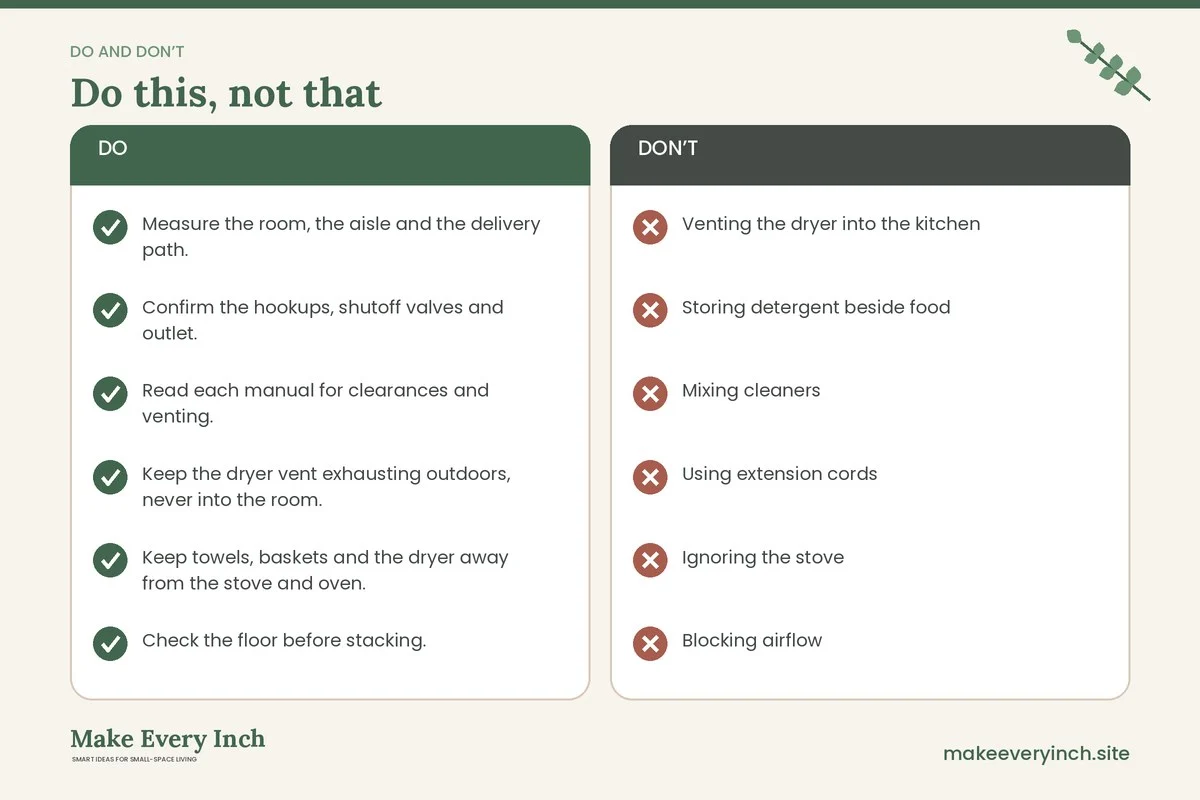
- Venting the dryer into the kitchen: this adds moisture and lint to a room that also has heat and food.
- Storing detergent beside food: keep chemicals separate and out of reach of children and pets.
- Mixing cleaners: never combine bleach with ammonia or acids.
- Using extension cords: plug large appliances directly into a suitable outlet.
- Ignoring the stove: keep towels, baskets and the dryer away from burners and the oven.
- Blocking airflow: closed cabinet doors on a running dryer can trap heat unless the manual allows it.
- Skipping the manual: it lists clearances, hose rules and load limits.
- Drilling without permission: a rental’s walls, cabinets and tile are not yours to change without approval.
Budget and shopping approach
Start with the safety basics, such as a vent check, a lidded chemical bin and a GFCI-protected outlet. Then add the pieces that make the room easier to use, such as a cart and a rod. If funds are limited, our guide to budget small space ideas shows how to prioritize, and how to organize a small kitchen helps you free cabinet space for supplies. Choose finishes that wipe clean, because both laundry and cooking leave marks.
Renter notes
Ask in writing whether a washer is allowed, who pays for any plumbing or wiring and what you may change. Choose no-drill options like tension rods, freestanding carts and adhesive hooks rated for the weight. Our guide to no-drill storage ideas for renters and renter-friendly kitchen storage ideas list more. Photograph the kitchen before you begin so you can restore it when you leave.
Checklist for a laundry room kitchen
- Measure the room, the aisle and the delivery path.
- Confirm the hookups, shutoff valves and outlet.
- Read each manual for clearances and venting.
- Keep the dryer vent exhausting outdoors, never into the room.
- Keep towels, baskets and the dryer away from the stove and oven.
- Check the floor before stacking.
- Anchor shelves and tall cabinets.
- Store chemicals away from food, high and latched, and never mix cleaners.
- Add a mat or tray for drips.
- Plan a clean-up routine so laundry never sits on a food counter.
- Get written permission before any change in a rental.
- Tape the plan on the floor before you buy.
FAQ
Can I put a washer in my kitchen?
Often yes, when water, drain and power are available and the machine is installed per its manual. Check local rules and ask a licensed professional if you are unsure.
Can a dryer share a kitchen with a stove?
It can, if the dryer is vented outside and you keep clearances and avoid placing laundry near heat. A combination or ventless model may suit a kitchen with no duct path.
How do I hide the machines?
Use cabinet doors with ventilation, a louvered bifold door, a curtain or a screen. Make sure the dryer has airflow and nothing blocks the vent.
Where do I keep detergent?
High up or in a latched cabinet, away from food, children and pets, in original containers.
Will laundry make the kitchen smell?
It can if moisture lingers. Run a vent fan, leave the washer door ajar and wipe surfaces. Persistent smells may point to a leak.
What if I rent?
Ask for permission in writing before installing a machine, changing cabinets or running new lines. A portable washer may be easier to approve.
Keep going: Keep planning with our small laundry room ideas, small closet ideas and small entryway ideas.
Save this guide for later
Pin the ideas you like to Pinterest so you can come back to them when you plan your space.