17 Small Balcony Lighting Ideas for Safe, Cozy Evenings
Quick answer: Good small balcony lighting uses three low layers instead of one bright bulb: a soft overhead or wall glow for safety, a warm table or floor light for tasks, and a few small accents such as lanterns or a string of lights. Choose outdoor-rated, low-heat or battery and solar fixtures, keep cords off walkways, never leave open flame unattended, and check your lease and building rules before you attach anything.
Small balcony lighting decides whether your outdoor space gets used after sunset or sits dark from October to April. A balcony may be only 4 feet deep, yet the right glow can make it feel like an extra room, a place to drink tea, read for twenty minutes or talk with a friend after dinner. The wrong glow does the opposite. A single harsh bulb flattens the space, shines into the neighbours’ windows and draws every insect in the building. This guide shows how to plan small balcony lighting in layers, how to choose a power source, how to hang lights without drilling, and how to keep the whole setup safe. It covers 17 ideas, a comparison table, three example balconies, a safety section, a seasonal plan, mistakes and a checklist. For the full picture of the space, start with our pillar guide to small balcony ideas, and for rental rules see renter friendly small balcony ideas and the hub on renter friendly apartment decorating ideas.
Read the rules before you plug anything in
Balconies are shared structures, and many leases and building rules limit what you can attach, plug in or leave outside. Before you buy lights, read the lease and any house rules for three things. First, whether you may attach hooks, clips or adhesive to the railing, the wall or the ceiling above you. Second, whether there is an outdoor outlet that is yours to use, since some buildings forbid running extension cords through doors. Third, whether open flames, including candles and grills, are banned on balconies. Many are, and that single rule will decide a lot of your choices. If the rules are unclear, ask the landlord or the building manager in writing and keep the reply.
Next, look at the balcony itself. Stand outside at dusk and notice where the existing light comes from, such as a window, a lamp post or a neighbour’s porch. Notice where you sit, where you walk and where the door opens. Notice what is above you: a roof overhang gives you a place to hang lights out of the rain, and a bare sky means every fixture must be weather-rated. Note any outlet and whether it has a protective cover. This ten-minute walk-through is the cheapest part of the project, and it prevents most purchasing mistakes.
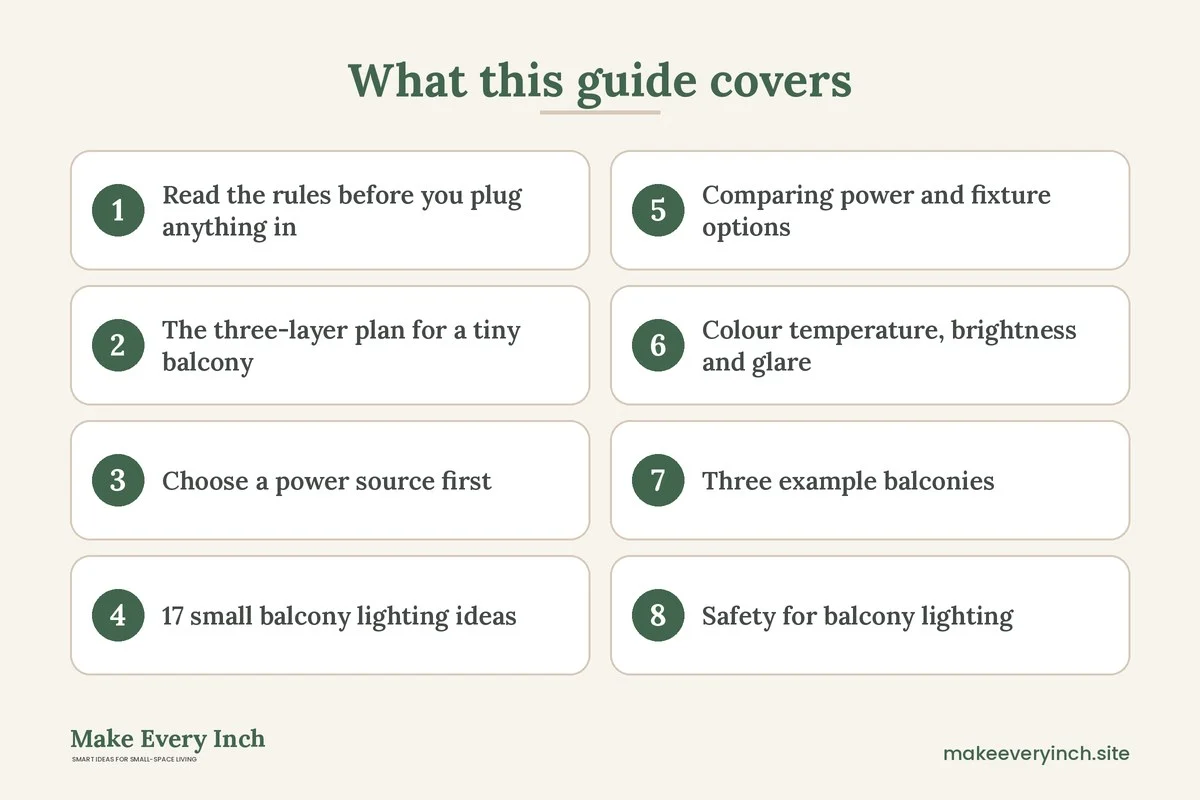
The three-layer plan for a tiny balcony
Professional lighting plans use layers, and the idea scales down well. On a balcony of 30 to 60 square feet, three layers are plenty. They also echo the approach we describe in layered lighting ideas for small apartments, so the indoor and outdoor glow can feel related when the door is open.
Layer one: ambient glow
This is the gentle background light that lets you see steps, the door threshold and the edge of the floor. It should be soft, warm and low. Options include a wall-mounted light powered from an approved outlet, a string of lights along the ceiling or a lantern that sits in a corner. The goal is not to brighten the space, but to remove dark spots where you might trip.
Layer two: task light
This is the light you need when you actually do something, such as read, play a card game or cook at a small table. It should be shielded so it does not glare in your eyes. A small table lamp rated for outdoor use, a clip-on reading light or a rechargeable lantern on the table all work. Keep it at or below eye level while seated and aimed at the table, not outward at the neighbours. The same glare rules apply indoors, as in our guide to small dining room lighting ideas.
Layer three: accents
Accents add the mood. A few candle-style lanterns, a small string of lights tucked among plants or a glowing cylinder in a corner create depth and make the space feel larger. Keep accents small and few. On a tiny balcony, three accent points are usually the maximum before the space feels busy.
Choose a power source first
The power source shapes everything else, so decide it before you decide on style. There are four realistic choices, and each has trade-offs.
- Solar: no cord and no outlet, which suits renters. Output depends on the sun, so a north-facing or shaded balcony may give weak and short-lived light. Solar works best on balconies with direct sun for several hours.
- Battery: flexible and cord-free. Use rechargeable cells where you can, and check how long a set lasts before you count on it. Choose fixtures with a timer or a switch you can reach.
- Rechargeable USB: lanterns and table lights that recharge indoors and sit outside in the evening. They are portable and often dimmable.
- Plug-in low voltage: a reliable choice if you have an approved outdoor outlet. A low-voltage system uses a small transformer that stays dry, and the cord on the balcony carries less power than a standard cord.
Whatever you choose, look for a rating on the packaging that says the product is meant for outdoor use. An indoor string of lights is not made for rain, dew or temperature swings, and using it outside can create a shock or fire risk. We cover the rules in detail in the safety section below.
17 small balcony lighting ideas
Overhead and string light ideas
1. A single swag across the ceiling
One string of outdoor-rated lights in a gentle curve from corner to corner is the classic choice. It lights the whole space evenly and draws the eye upward. Hang it from hooks that the building allows, or from a tension rod or a freestanding pole that stays in a pot.
2. A zig-zag canopy
If the balcony has a roof overhang, run lights back and forth across it to create a glowing ceiling. Keep the spacing even and leave a few inches between the strands. This works best when the lights are low-heat, since the roof traps warmth.
3. Lights along the back wall
Run a string of lights along the base or the top of the back wall, using removable clips if the lease allows. This leaves the center of the balcony open and washes the wall with warm light, which makes the space feel deeper.
4. A light curtain on the door side
Hang a curtain of lights from a tension rod near the door so you see a soft glow from inside. It works as a privacy layer and a decoration. Check that the cord stays out of the doorway and does not catch when the door closes.
5. A pole with lights on a planter
A tall pole set in a heavy planter with lights wrapped around it makes a freestanding light with no wall attachment. Weigh the base so the pole cannot tip in the wind, and see our guide to small space plants and planters ideas for stable planter choices.
Lanterns and table lights
6. A cluster of lanterns on the floor
Group three lanterns of different heights in a corner. Use battery-powered or rechargeable candle-style bulbs rather than real flames. A cluster makes a focal point and keeps the walkway clear.
7. A lantern on the table
A single lantern on the table gives a gentle task light and a centerpiece. Pick a lantern with a closed base so it cannot tip over easily.
8. A rechargeable table lamp
A cordless table lamp with a weighted base gives enough light for reading. Look for a lamp that is rated for outdoor use, and bring it inside in heavy rain.
9. A hanging lantern from a hook
A lantern hanging from a plant hook or a freestanding stand lights the corner from above. Make sure whatever it hangs from is rated for the weight, and that it cannot swing into the railing or a neighbour’s space.
10. A glowing planter or cube
A light-up cube or planter doubles as a seat or a side table. It is stable, low and bright enough to mark the floor. Choose one with a sealed, weather-rated housing.
Wall and railing lighting
11. A plug-in or battery wall light
A small wall light near the door lights the threshold and the door handle. If you cannot drill, choose a battery-powered light with adhesive that is rated for outdoor use, and test it in an inconspicuous place first.
12. A motion-sensor light by the door
A motion light turns on when you step outside, so you can see without fumbling for a switch. It is useful when you carry a tray or a bag. Aim it downward so it does not shine into neighbours’ windows.
13. Clip-on lights for a railing planter
Small clip-on lights on a planter box mark the edge of the balcony with a faint glow. Fasten the planter securely, and never place a heavy planter on the top of a railing. Planters and shelves must be secured so nothing can fall to the street.
14. A low-level strip along the floor edge
A flexible weather-rated strip along the base of a wall gives a faint path of light and makes the floor feel wider. Use it only where the strip is sealed and the power supply stays dry and off the floor.
Accents and mood
15. Lights inside a tall plant
Wrap a short string of lights inside a large potted shrub or a tall grass. The glow through the leaves looks soft and natural. Keep lights away from dry leaves, and unplug them when you leave.
16. A fabric shade or a paper-style shade for glare
Cover a bright bulb with a shade made for outdoor use, such as a fabric, woven or frosted plastic shade. This softens the light and reduces glare. Avoid real paper outdoors, since it warps in damp air and can be a fire risk near heat.
17. A mirror to double the glow
A weather-safe mirror leaned or secured on the back wall reflects light and makes a narrow balcony look wider. Secure it so it cannot fall, and keep it away from the railing, where a gust could knock it. Do not aim a reflection into a neighbour’s window.
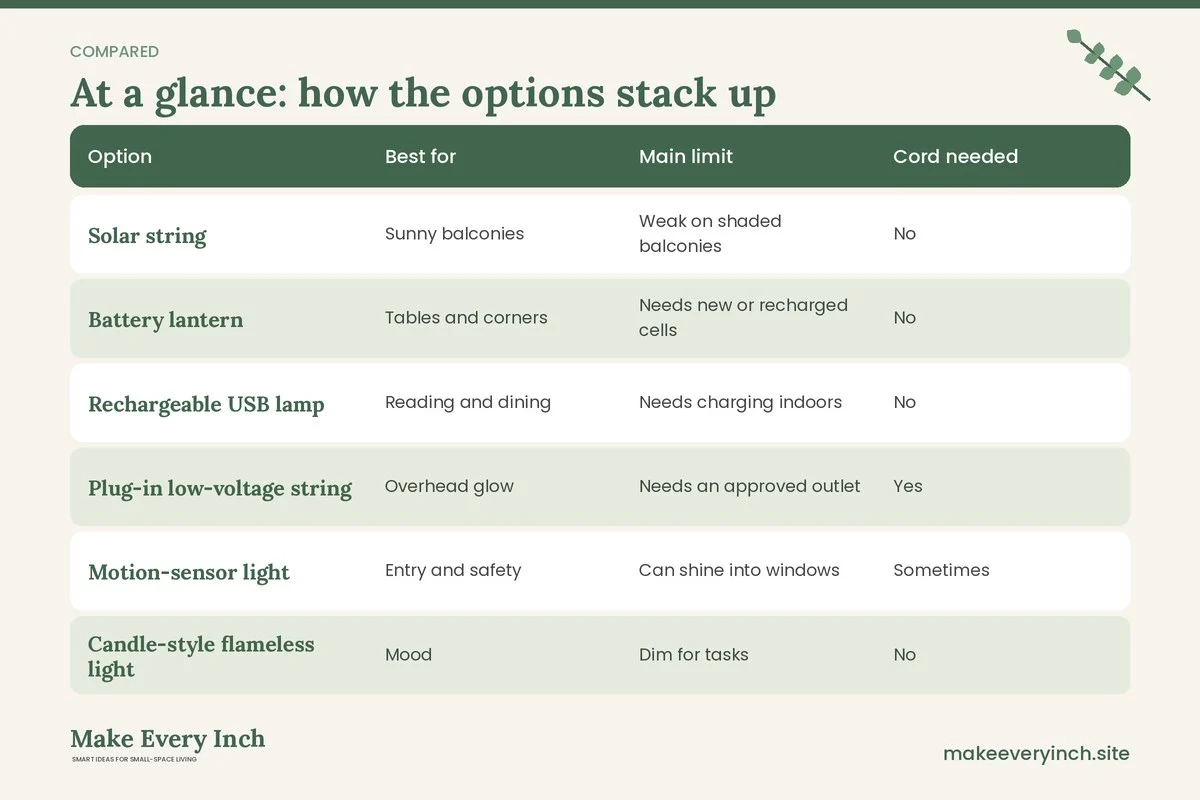
Comparing power and fixture options
| Option | Best for | Main limit | Cord needed | Notes |
|---|---|---|---|---|
| Solar string | Sunny balconies | Weak on shaded balconies | No | Place the panel where it gets direct sun |
| Battery lantern | Tables and corners | Needs new or recharged cells | No | Choose a timer or switch you can reach |
| Rechargeable USB lamp | Reading and dining | Needs charging indoors | No | Bring in during heavy rain |
| Plug-in low-voltage string | Overhead glow | Needs an approved outlet | Yes | Use a weather-rated cord and cover |
| Motion-sensor light | Entry and safety | Can shine into windows | Sometimes | Aim downward |
| Candle-style flameless light | Mood | Dim for tasks | No | Safer than open flame |
| Wall light | Door area | May need attachment | Sometimes | Ask before attaching anything |
Colour temperature, brightness and glare
If you want the balcony to feel like part of your home, borrow the logic from small room lighting ideas for every corner and treat each corner as its own small pool of light.
Light colour affects mood more than brightness does. For a cozy evening, choose bulbs described as warm white, often around 2200 to 2700 kelvin, which look amber and flattering on skin. Cool white bulbs around 4000 kelvin or higher feel clinical outside and attract more insects. Mixing colour temperatures on one balcony makes the space look uneven, so keep all your fixtures in the same warm range.
On a balcony, less brightness is usually better. A total of a few hundred lumens across all fixtures is often plenty for a small space, because your eyes adjust quickly outside in the dark. Too much brightness makes the balcony look like a stage and erases the sense of privacy. Dimmable fixtures give you the most control, since you can lower the light for conversation and raise it for reading.
Glare is the enemy of a good evening. Position bulbs so you cannot see the bare light source from your seat. Use shades, frosted covers or bulbs inside lanterns. Aim any task light down at the table. Keep lights below eye level when you sit, since a bare bulb at eye level makes everything else look dim in contrast.
Also think about the neighbours. A balcony is partly public, and a bright light that shines into the unit above, below or beside yours can cause disputes. Choose shielded fixtures, aim them downward, and switch them off or dim them late at night. Many buildings have quiet hours that also cover bright outdoor lighting.
Three example balconies
The narrow 4 by 10 foot balcony
This long, thin balcony has room for a bistro table and two chairs at one end. The plan is one swag of string lights along the ceiling, a rechargeable lantern on the table and a battery wall light by the door. The floor stays clear, so there are no cords across the walkway. A mirror leans on the back wall to reflect the string lights and make the space look wider. The total is three fixtures, and the owner uses a power strip indoors only to charge the lantern.
The shaded north-facing balcony
Solar lights do poorly here, so the plan relies on rechargeable lamps and flameless lanterns. A cluster of three lanterns in a corner gives the ambient glow. A cordless table lamp with a weighted base provides the task light, and a small battery motion light near the door handles safety. The owner brings the lamps inside to charge each day and checks the weather before leaving them out. Plants with pale leaves bounce light around the space.
The covered balcony with an outdoor outlet
With a roof overhang and an approved outlet, this balcony can use a plug-in low-voltage system. A zig-zag canopy of weather-rated lights goes under the overhang. A cord cover protects the lead along the wall, and all connections sit off the floor on a shelf under the roof. The outlet has a weatherproof cover, and the circuit is protected by a ground-fault device, which the owner confirms with the building manager. A timer turns the lights off at a set hour so nothing is left on overnight.
Safety for balcony lighting
A balcony is an exposed, shared and high place, so lighting safety goes beyond choosing a pretty fixture. Work through the points below before you light up.
Electrical and weather safety
- Use only fixtures and cords marked for outdoor use. Indoor lights and extension cords are not designed for damp air, rain or frost.
- Plug outdoor equipment into an outlet protected by a ground-fault circuit interrupter (GFCI). If the outlet is not protected, ask the building manager what is allowed. Do not modify wiring yourself.
- Do not overload sockets or daisy-chain several extension cords or power strips. Read the maximum number of connected strings on the packaging.
- Keep plugs, connections and transformers off the floor and out of puddles. Raise them on a shelf under cover, and use a drip loop so water cannot run down the cord into the socket.
- Do not run a cord through a closed door or window in a way that crushes it. A damaged cord is a shock and fire risk, and many buildings ban it.
- Inspect cords every season, and discard any with cracks, bare wire or loose plugs.
- Unplug lights during storms and when you are away. Use a timer so they do not stay on all night.
Fire and heat safety
- Many leases, building rules and local codes prohibit grills, fire pits and open flames, including candles, on balconies. Check before you light anything. Choose flameless candles and battery lanterns as a safe default.
- Keep heat sources away from cushions, curtains, dry plants and fabric shades. Bulbs, including some lanterns and string lights, can warm up.
- Never leave a lit candle, if allowed at all, unattended, and keep it away from wind, fabric and the railing.
- Know where your nearest exit and smoke alarm are, and keep the balcony door clear.
Falling objects and railings
- Keep furniture and lanterns away from the railing. A chair or a table near a railing gives children and pets a step to climb, and an object near the edge can fall or be knocked over the side.
- Secure every hanging lantern, planter and shelf so wind cannot shake it loose. Falling objects can injure people below, and you are responsible for what leaves your balcony.
- Do not hang heavy items from railings unless the building allows it and the fixture is rated for the weight.
- Keep children and pets supervised on a balcony. Check the railing height and gap spacing, and add only the barriers that the building permits.
Weight, wind and tip-over
- Balconies and decks have weight limits, which depend on construction and local rules. Check your building’s rules and do not overload the surface with heavy planters, tall poles and furniture. Spread out heavy items rather than stacking them.
- Wind can tip a pole, a lantern or an unweighted lamp. Choose low, wide-based fixtures, weigh down tall poles in heavy bases and bring light items inside during storms.
- Do not drill into railings, walls or ceilings without permission. Use freestanding fixtures, tension rods, weighted bases and clips approved by the landlord.
Water, plants and neighbours
- Water from watering plants or cleaning can drip onto balconies below and damage them. Use saucers, empty them often and do not hose the floor.
- Some common balcony plants are toxic to pets and children. Check each plant before you place it near lights and seats.
- Hot surfaces in the sun, such as metal railings or dark floors, can burn skin. Be cautious with bare feet and pets on warm days.
A simple seasonal plan
If money is tight, spread the purchases over a season. Our guide to budget small space ideas explains how to prioritise, and small space organization ideas helps you store lanterns and spare cells so nothing clutters the floor.
Lighting needs change through the year, so a good setup adjusts with the seasons.
Spring and summer
Evenings are long, so you need less light and more atmosphere. Use a single swag of warm lights and a lantern on the table. Keep the colour warm to avoid attracting insects. Choose fixtures that handle heat, and move them out of direct hot sun when not in use.
Autumn
Dusk arrives earlier, so safety light at the door matters more. Add a motion light near the entry and a second string of lights. Clear leaves from the floor, since wet leaves are slippery in low light.
Winter
Cold shortens battery life, so rechargeable fixtures may run for less time. Bring portable lamps inside between uses. Use a timer on plug-in strings so you can enjoy a glow from the window without going outside. Check for ice on the floor before you step out, and keep lights and cords off the surface.
Common mistakes to avoid
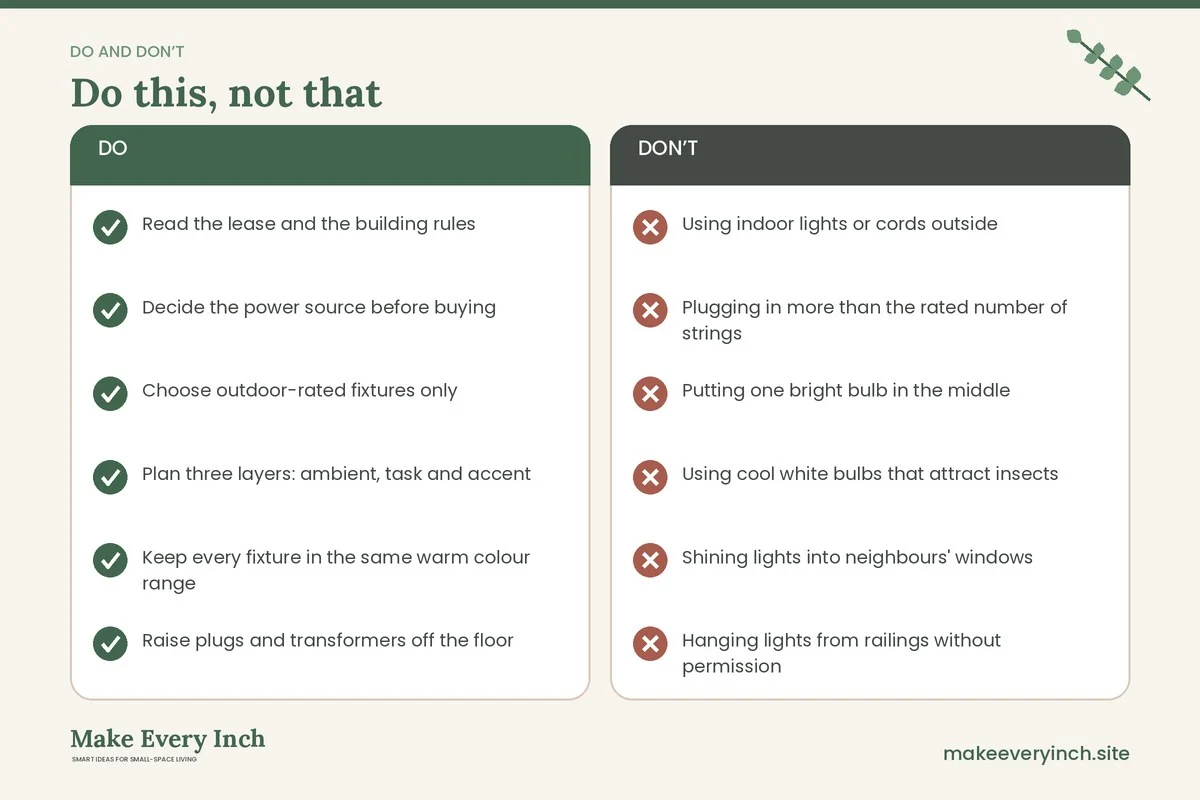
- Using indoor lights or cords outside
- Plugging in more than the rated number of strings
- Putting one bright bulb in the middle
- Using cool white bulbs that attract insects
- Shining lights into neighbours’ windows
- Hanging lights from railings without permission
- Leaving cords across the walkway
- Using open flame where it is banned
- Forgetting a timer or a switch
- Placing lanterns near the edge where they can fall
Small balcony lighting checklist
- Read the lease and the building rules
- Decide the power source before buying
- Choose outdoor-rated fixtures only
- Plan three layers: ambient, task and accent
- Keep every fixture in the same warm colour range
- Raise plugs and transformers off the floor
- Use a timer and check cords each season
- Keep furniture and lanterns away from the railing
- Secure everything that hangs or stands tall
- Aim lights down, away from neighbours
- Choose flameless candles over real ones
- Bring portable lights inside in storms
FAQ
What is the best small balcony lighting for renters?
Battery, solar and rechargeable lights, because they need no drilling and no outlet. Add a freestanding pole or a tension rod to hang string lights, and ask your landlord before you attach anything to the railing or the ceiling.
Can I use indoor string lights on a balcony?
No. Indoor lights are not built for rain, damp air or cold. Look for products marked for outdoor use, and follow the instructions on the packaging.
How many string lights do I need for a small balcony?
For a balcony of 30 to 60 square feet, one or two strings are usually enough. Measure the length you want to cover, and add a little for the curve.
Are candles allowed on balconies?
Often not. Many leases and local codes prohibit open flames and grills on balconies. Check the rules, and use flameless candles if in doubt.
How do I keep bugs away from my lights?
Use warm white or amber bulbs, which attract fewer insects than cool white bulbs. Keep the light low and away from doors, and switch off lights you do not need.
Will balcony lights bother my neighbours?
They can if they shine into windows. Use shielded fixtures, aim them downward and turn them off or dim them late at night.
Do solar lights work on a shady balcony?
Poorly, as a rule. Solar lights need direct sun for several hours. On a shaded balcony, choose rechargeable or battery fixtures instead.
Is it safe to leave lights on overnight?
It is safer to use a timer or to switch them off. Leaving lights on unattended increases electrical, heat and battery risks, and it disturbs neighbours.
Keep going: Plan the whole space with our guide to small balcony ideas, compare furniture layouts in small balcony ideas for two people and find more rental-safe ideas in renter friendly lighting ideas.
Save this guide for later
Pin the ideas you like to Pinterest so you can come back to them when you plan your space.