How to Fit a Desk into a Studio Apartment
Quick answer: To fit a desk into a studio apartment, choose the location first, then the desk. Good spots are a window wall, the end of the sofa, a wall beside the bed, a closet niche or the back of a floated sofa. Then pick a style: a fold-down wall desk for 6 to 10 inches of depth, a console desk for 12 to 16 inches, or a small standing desk for 20 to 24 inches. Set the top near 28 to 30 inches high, leave 30 inches behind the chair and gather the cords in one place.
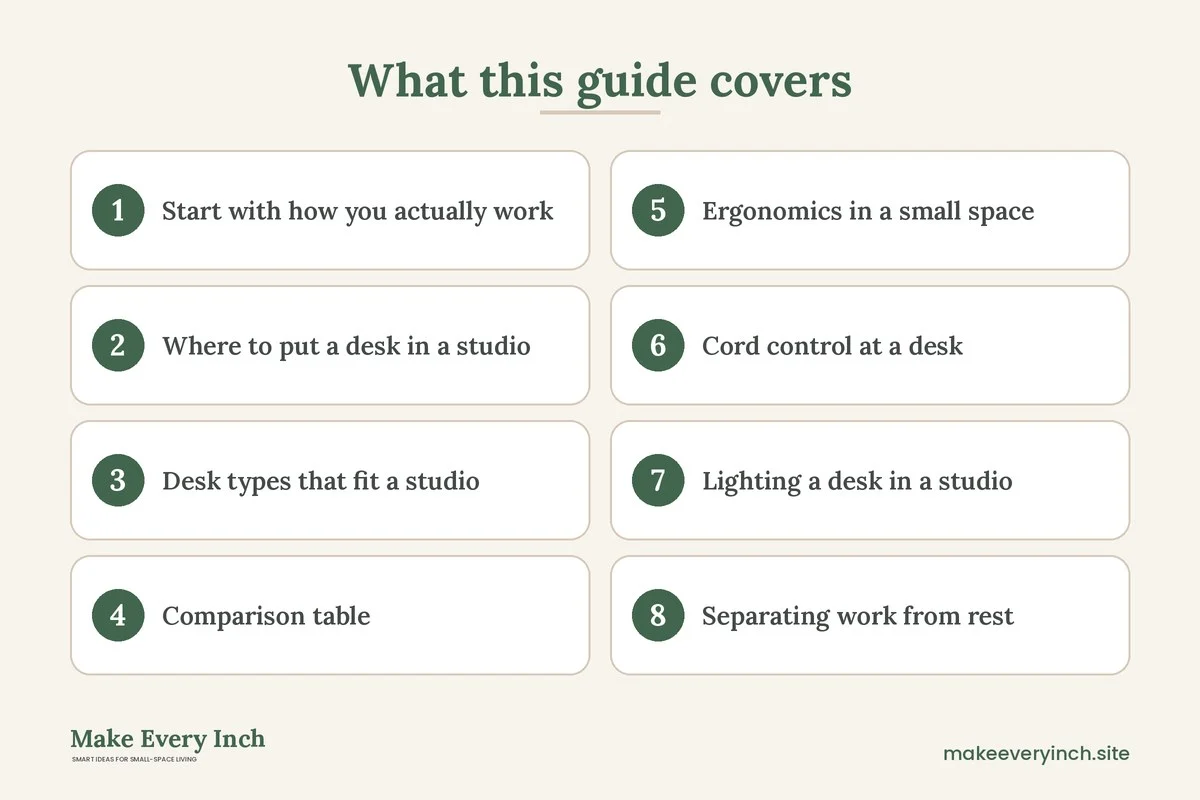
Figuring out how to fit a desk into a studio apartment is a puzzle of inches, light and habit. The room already holds a bed, a sofa and a kitchen, so any desk must earn its footprint twice, once in space and once in how it feels when you sit there. A well placed desk can disappear at the end of the day, while a badly placed one makes the whole studio feel like an office that you sleep in. This guide walks through locations, desk types, a comparison table, ergonomic measurements, cord control, lighting, three example layouts, daily habits and a checklist. For the wider topic, see our main guide on studio apartment ideas, the sister post on studio apartment ideas for working from home and the companion piece on how to make a studio apartment feel organized.
Start with how you actually work
Before you measure, spend a few days noticing how you use a desk. The answers decide which of the options below suits you.
- Hours per day. Two hours of email is very different from eight hours of screen work. Long days call for a proper chair and a real surface.
- Equipment. A laptop alone needs about 24 by 12 inches. A laptop with a monitor needs 30 inches or more of width and 20 inches or more of depth. A printer, a second screen or a drawing tablet adds more.
- Calls and noise. If you take video calls, the background matters and so does the sound. A wall behind you looks better than the bed.
- Paper. If you handle paper every day, you need a drawer or a box. If you are digital, you need less.
- Standing or sitting. A few people prefer to stand. A fold-down or wall shelf desk can suit standing.
- Whether it stays out. A desk that stays set up is easier to start working at. A desk that folds away protects your downtime.
Write your answers down. They help you rule out options that look good but do not match your day.
Where to put a desk in a studio
Location matters more than the desk model. These are the spots that tend to work in a one-room home, with notes on the trade-offs.
1. Along a window wall
Daylight is kind to eyes and mood, and a window wall is often the longest unbroken wall in a studio. Place the desk perpendicular to the window or beside it, so that glare does not land on the screen. A desk directly facing the window can look out onto a view, though it can also fight reflections. If the window has a radiator or a baseboard heater under it, leave a gap of several inches for airflow and do not block it.
2. At the end of the sofa
A narrow desk can stand where the sofa ends and the wall begins. The sofa arm becomes a divider, and the desk reads as part of the living zone. This works well for a small console desk. Check that the sofa still opens or reclines if it has a mechanism.
3. Behind a floated sofa
If the sofa floats in the room, its back creates a boundary. A console desk 12 to 16 inches deep fits behind it, and you can sit on a slim stool or chair. The sofa blocks the view of your work from the main room, which helps you switch off. Keep a path at least 30 inches wide behind the desk if it is a walkway.
4. Beside the bed
A desk next to the bed saves floor space, since the bed clearance and the desk clearance overlap. The downside is that work and sleep sit close, so a screen or curtain is helpful. A fold-down desk is a good fit here because it clears the bedside.
5. In a closet or alcove
A shallow closet or recess becomes a desk niche. Remove the doors or fold them back, add a shelf for a surface and a lamp, and close the doors at the end of the day. This is the strongest option for people who want work to vanish. Closets are often 20 to 24 inches deep, which is enough for a laptop and a slim shelf. Add a small lamp because closets are dark, and leave air gaps so devices do not overheat.
6. By the kitchen peninsula or counter
If the studio has a breakfast counter, one end of it can become a desk with a stool. This saves buying any desk at all. Keep the work area away from the stove and sink, and use the other end for meals.
7. In the entry
A wall near the entrance can hold a slim shelf desk. The entry is the zone that people pass through, so choose this only for short sessions. Make sure it does not block the front door, a closet or the exit route.
8. At the foot of the bed
If the bed is placed in an alcove, the space at its foot can hold a desk against the wall. This works if you can still walk around the bed and open drawers. Keep at least 24 to 30 inches of clearance, and do not block a window that serves as an exit.
Desk types that fit a studio
Once you know where, choose a type. Each has a typical depth and a best use.
Fold-down wall desk
A hinged panel mounts to the wall and folds up when you finish. It can be 6 to 10 inches deep when closed and 16 to 24 inches deep when open. It holds a laptop and little else. A wall desk must be secured into studs or with proper anchors, and it needs the landlord’s permission if you rent. Never drill into a wall without approval, and check the wall for wires and pipes before you start. If you cannot drill, consider a freestanding fold-away table that leans against the wall.
Console desk
A console is a narrow table 10 to 16 inches deep and about 30 inches high. It holds a laptop and a lamp, and it looks like furniture when you are not working. A console suits a floated sofa, an entry and a hallway. If you need a monitor, check that the depth is enough for the screen and keyboard.
Wall shelf desk
A long shelf mounted at desk height gives you a work surface with no legs, so the floor under it stays free. This works well in a rental only if you may drill. A freestanding alternative is a wall-leaning ladder desk, which has shelves above and a surface at the bottom.
Secretary or drop-leaf desk
This is a cabinet with a lid that folds down into a writing surface. When closed it is storage. It suits people who want everything hidden, including papers and chargers.
Corner desk
A corner desk uses a wedge of dead space. It can be good in a studio with an awkward corner, but the L shape can swallow floor area. Measure carefully.
Small standing desk or riser
A compact stand-up desk, or a riser that sits on a table, lets you alternate between sitting and standing. A riser is cheaper and stores in a closet, while a full desk takes a footprint. Check stability, and do not stack unstable items to raise a screen.
Dual-purpose table
A dining table or a bar table can double as a desk, and a drop-leaf version expands for guests. For many studios this is the most flexible answer, because the table is always out and always useful. The cost is that you must clear it each evening.
Rolling cart desk
A cart on wheels carries a laptop, a lamp and a few supplies. Roll it to the window in the day and into a corner at night. It is not ideal for long hours, since it can wobble, so lock the wheels.
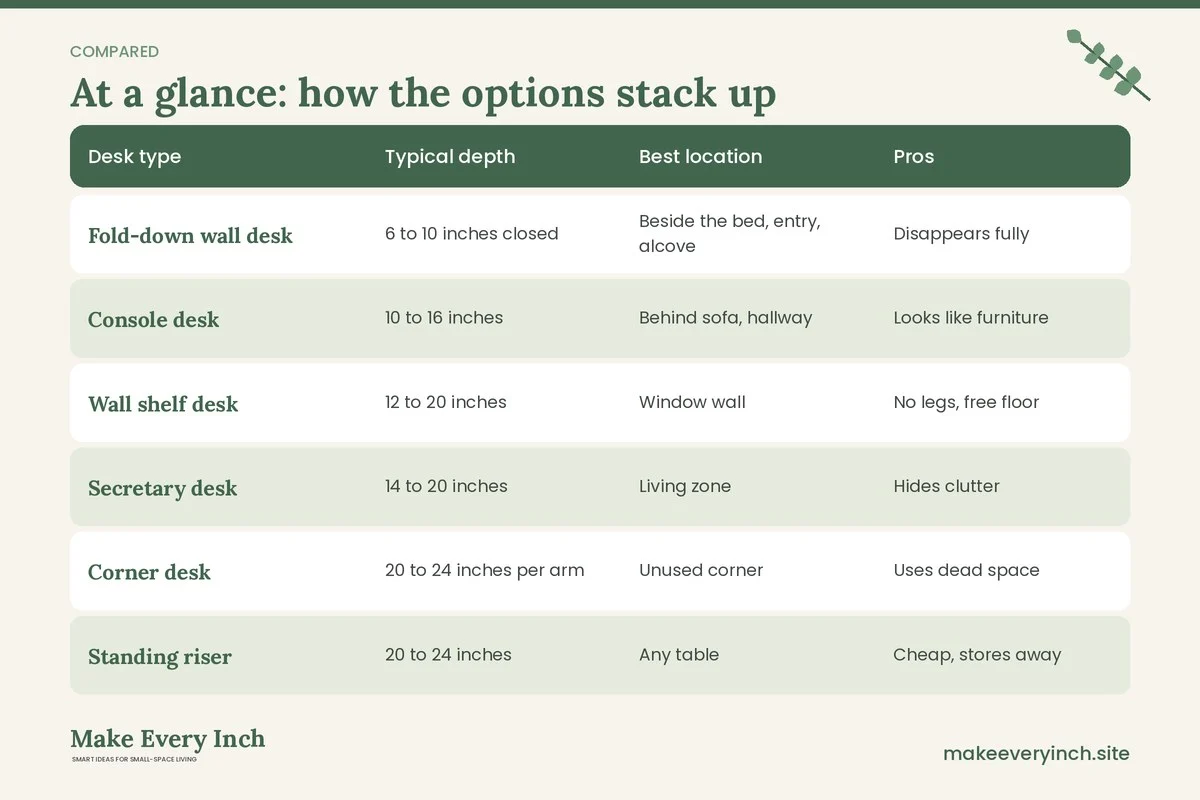
Comparison table: desk types for a studio
Depths and heights below are typical ranges. Check each product’s own measurements.
| Desk type | Typical depth | Best location | Pros | Trade-offs |
|---|---|---|---|---|
| Fold-down wall desk | 6 to 10 inches closed | Beside the bed, entry, alcove | Disappears fully | Needs wall fixing and permission |
| Console desk | 10 to 16 inches | Behind sofa, hallway | Looks like furniture | Tight for a monitor |
| Wall shelf desk | 12 to 20 inches | Window wall | No legs, free floor | Needs drilling |
| Secretary desk | 14 to 20 inches | Living zone | Hides clutter | Small surface |
| Corner desk | 20 to 24 inches per arm | Unused corner | Uses dead space | Bulky shape |
| Standing riser | 20 to 24 inches | Any table | Cheap, stores away | Needs a table |
| Dining table desk | 30 to 36 inches | Eating zone | Always useful | Must clear daily |
| Rolling cart | 14 to 18 inches | Anywhere | Moves around | Less stable |
For more picks, see our roundup of the best desks for small apartments and the guide to DIY desk ideas for small spaces.
Ergonomics in a small space
A desk that fits the room but hurts your back is not a win. A few basic measurements help you work comfortably, even in a tiny corner. They are general guidance, not medical advice, and a person with pain should seek professional input.
- Desk height: many adults find a surface between about 28 and 30 inches comfortable. If you are shorter or taller, adjust the chair first, then use a footrest or a riser.
- Chair height: your feet should rest flat on the floor, and your knees should sit near a right angle. A cushion can help.
- Elbows: forearms should rest roughly parallel to the floor, with shoulders relaxed.
- Screen height: the top of the screen should sit near eye level, and the screen about an arm’s length away. For a laptop, a stand and a separate keyboard help, because a laptop at the right height for the eyes is too high for the hands.
- Knee room: at least 18 inches of width and 24 inches of depth under the desk allow you to sit with ease.
- Chair clearance: 30 inches behind the chair allows you to push back and stand up. In very tight spaces, 24 inches is a minimum.
- Lighting: place a lamp on the side opposite your writing hand, and avoid a bright window behind the screen.
- Breaks: stand and move at regular intervals, whatever the desk.
Choosing a chair for a studio
The chair is the part of a desk setup that people ignore. A studio chair must look good in the living area and still support you. Options include a small upholstered chair with arms, a compact task chair that tucks fully under the desk, a stool that slides beneath a console and a dining chair with a cushion. If the chair is visible all day, choose one with a finish that matches the room. If you work long hours, spend your effort on a chair with support, even if the desk is small.
Cord control at a desk
A desk adds cables. Without a plan they hang from the surface and tangle on the floor. Here is a process that stays safe.
- Use fewer cables. A laptop with wireless accessories needs only a charger.
- Group them. Use clips, sleeves or a cable box. Keep them off the walkway.
- Plug into a surge protector with an on-off switch. Switching it off at night reduces clutter and standby power use.
- Do not overload an outlet. Do not daisy-chain strips, and do not cover a strip with fabric or boxes.
- Leave space for heat. Chargers and adapters warm up. Give them air and keep them away from paper and fabric.
- Hide the run. Route cables along baseboards with adhesive clips, or behind the desk. In a rental, adhesive clips are usually gentler than staples or nails.
- Label the ends. A small tag on each plug saves time when something fails.
Our guide to renter-friendly ways to hide cords has more methods that avoid drilling.
Lighting a desk in a studio
Most studios have limited windows and a single ceiling light. Add a task lamp with a narrow beam so the work area is lit without lighting the bed. A warm light in the evening helps you relax when work ends. A lamp on a flexible arm keeps the surface clear, and a plug-in wall light removes the lamp from the desk if you may mount it. See our guides on renter-friendly lighting ideas and the best floor lamps for small rooms. If you take video calls, put the light in front of you, not behind.
Separating work from rest
In a studio, the hardest part of working at home is not the desk. It is the lack of a door. Use visual cues to mark the end of the day.
- Fold, close or cover. Fold the desk, close the cabinet, or drape a cloth over the setup.
- Change the light. Switch off the task lamp and turn on a softer one.
- Use a divider. A curtain, a shelf unit or a folding screen blocks the view. Our posts on DIY room divider ideas for studio apartments and renter-friendly ways to divide a studio apartment give options. Never block the path to the front door, a window that serves as an exit or a smoke alarm.
- Put the laptop away. A box, a drawer or a bag with a regular home helps.
- Change position. After work, move to a different seat so your body gets the signal.
Three example layouts
A 400 square foot studio with a window wall
The bed sits in an alcove, and the sofa faces the kitchen. The window wall holds a 48-inch console desk, 16 inches deep, set at right angles to the window to avoid glare. A task lamp sits on the far side, and a small chair tucks fully under the console. The cables run down the back leg to a power strip on the floor, held in a box. At the end of the day, the laptop goes into the drawer of the console, and the surface holds a plant and a bowl. The desk looks like a hall table.
A 300 square foot studio with no spare wall
There is no wall left, so the desk moves into the closet. The doors come off, a shelf at 29 inches high and 20 inches deep becomes the desk, and a plug-in light is attached to the wall or shelf. A stool slides underneath. When work ends, a curtain on a tension rod closes the niche. The user checks the lease before changing the closet doors, and stores them neatly. The closet remains a closet in the lease sense because nothing is permanently altered.
A 500 square foot studio with a floated sofa
The sofa divides the sleeping area from the living area. Behind it stands a 14-inch deep console, about 55 inches long. A slim chair sits at one end. The user has a clear 36-inch path along the wall. The rug under the sofa makes the zone feel finished, and the sofa back shields the desk from the bed. On days with long calls, the user sits at the console, and on short days, they work from the sofa with a lap tray. The desk adds no new furniture footprint beyond the console.
Making the desk disappear
If you want the desk to vanish after hours, use one of these tactics.
- Close the lid. A secretary desk or a cabinet desk closes into a single plane.
- Fold the panel. A wall-mounted fold-down desk becomes a wall shelf or a mounted board.
- Hide the equipment. Store the monitor, the keyboard and the papers in a basket, then place the basket in a cabinet.
- Use a tray. Everything on the desk goes into one tray, which lifts away.
- Dress the surface. A lamp, a plant and a tray of books make the console look like decor.
- Match the finish. A desk in the same wood or color as the sofa table blends with the room.
For more ideas on keeping the whole room calm, read small space organization ideas.
Storage for desk items
A desk needs a few places to hold paper, cables and supplies. Choose from these.
- A drawer under the desk, if the model has one.
- A wall file or shelf above, if you may drill. Anchor any shelf properly.
- A lidded box on the desk or beside it, which acts as a drawer.
- A rolling cart, which tucks under or beside the desk.
- A basket in the closet, for the items you rarely use.
Keep only what you use daily within reach. Everything else goes behind a door. See also no-drill storage ideas for renters for options that need no tools, and our post on small bedroom desk ideas for ideas that carry over to a sleeping area. If your studio’s bedroom area is the best place, the guide to small bedroom ideas with a desk explores layouts.
Safety and lease notes
- Anchor tall furniture. A tall bookcase or shelf above a desk can tip. Use the right anchors, and ask permission first if you rent. Never drill without approval, and check for wires and pipes in the wall.
- Fold-down desks need strong fixings. A wall desk carries a load every time you lean on it. Follow the maker’s weight rating and fix it into studs or appropriate anchors.
- Keep exits clear. The desk, the chair and any divider must not block the path to the door, a window used as an exit or an alarm.
- Mind the electrical load. Do not overload a strip, and do not hide one under fabric. Unplug heaters and devices that run hot when you leave.
- Ventilate the closet desk. Leave the door open while devices run, and let air move around chargers.
- Use low-VOC paint if you refinish. Open a window when painting a desk or a shelf.
- Check the lease. Many landlords limit changes to walls and doors. Freestanding choices are safer.
Measure before you buy
Follow these steps so you do not buy a desk that will not fit.
- Measure the wall, the floor and the height of any window sill.
- Mark the desk footprint on the floor with painter’s tape.
- Mark the chair too, pushed back, at least 30 inches behind the desk.
- Sit at the tape and pretend to work for 10 minutes.
- Walk the path to the door, the kitchen and the bathroom.
- Check the swing of any door, drawer or window.
- Check the outlet location, since cords must reach it without crossing a path.
- Check the light, at the time of day you work.
Mistakes to avoid
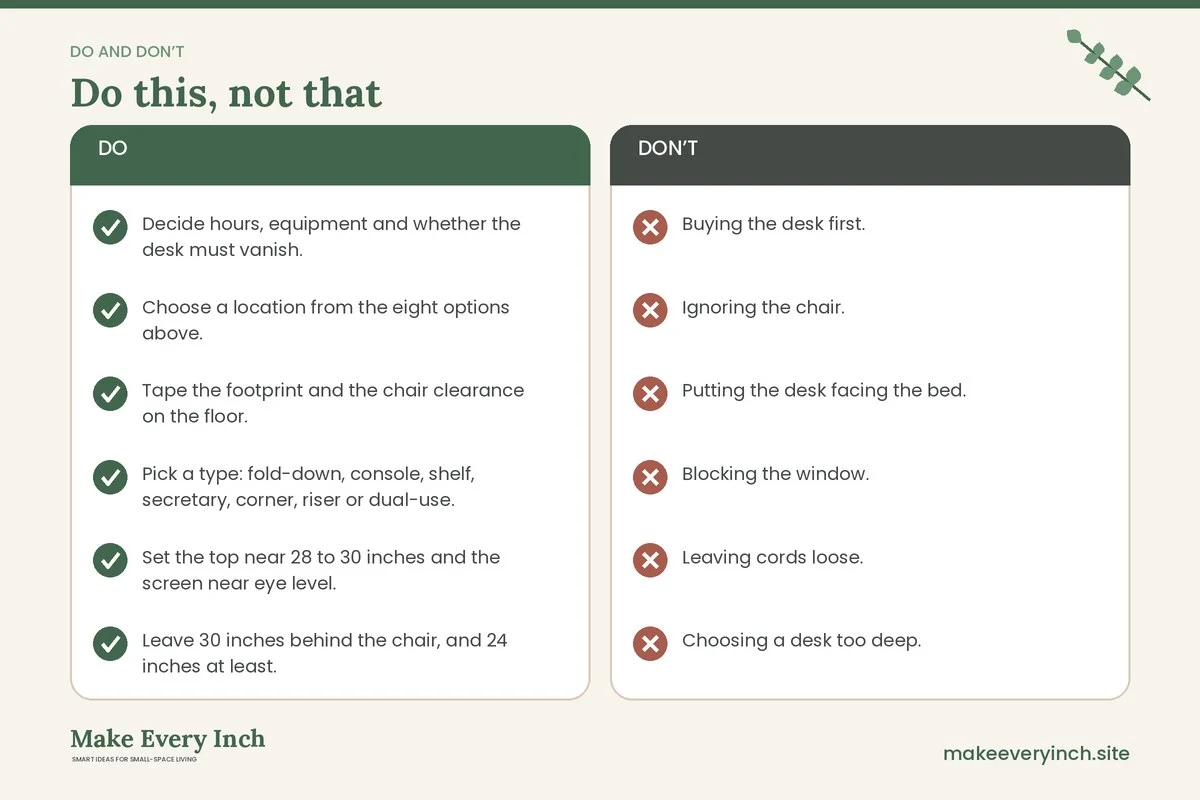
- Buying the desk first. Decide on the place and the depth, then shop.
- Ignoring the chair. The chair decides comfort, and it needs a place to live.
- Putting the desk facing the bed. It makes the sleeping zone feel like part of the office.
- Blocking the window. Light is a resource in a studio.
- Leaving cords loose. They trip and tangle.
- Choosing a desk too deep. In a studio, 20 inches of extra depth may take a whole walkway.
- Skipping the end-of-day reset. A pile of papers makes the studio feel like work all night.
Desk-fitting checklist
- Decide hours, equipment and whether the desk must vanish.
- Choose a location from the eight options above.
- Tape the footprint and the chair clearance on the floor.
- Pick a type: fold-down, console, shelf, secretary, corner, riser or dual-use.
- Set the top near 28 to 30 inches and the screen near eye level.
- Leave 30 inches behind the chair, and 24 inches at least.
- Add a task lamp and keep glare off the screen.
- Gather cords into a box and route them along the edge.
- Plan a drawer, box or tray for paper and supplies.
- Check the lease before drilling, and anchor tall pieces.
- Keep exits and windows clear.
- Plan a daily close-down routine.
FAQ
How much space do I need for a desk in a studio?
A laptop-only desk can work in about 24 by 12 inches of surface, plus around 30 inches of clearance for the chair. A monitor setup needs more, often 30 by 20 inches or beyond.
What is the best desk for a very small studio?
A fold-down wall desk, a closet desk or a console behind a sofa tends to use the least floor. The right choice depends on the lease, the wall and how many hours you work.
Can I use the dining table as a desk?
Yes, and it is often the simplest option. Clear it each evening so meals feel separate from work, and keep a box for the laptop and papers.
How do I set up a desk in a studio without drilling?
Use a freestanding console, a rolling cart, a ladder desk or a fold-away table. Our post on diy desk ideas for small spaces has more options.
How do I stop work from taking over my studio?
Use a divider or cover, change the lighting at the end of the day and put equipment into a box or drawer. A physical close-down ritual helps your mind switch off.
Where should the desk go relative to the bed?
Out of direct view if you can manage it. A curtain, a shelf or the back of a sofa helps, and a closet or alcove is better still.
Keep going: Keep going with our studio apartment ideas for working from home, studio apartment ideas and small apartment living room ideas for studios.
Save this guide for later
Pin the ideas you like to Pinterest so you can come back to them when you plan your space.