15 Budget-Friendly Ways to Make a Room Look Bigger
Quick answer: The most budgetfriendly ways room look bigger are free or nearly free: clear the floor and sightlines, move furniture off the walls that block light, hang curtains high and wide, add a mirror opposite a window, use one calm color family, and swap heavy pieces for leggy ones. Start with a floor-and-window audit, fix what blocks light first, and only then spend on small upgrades.
Budgetfriendly ways room look bigger tend to work for one reason: a room feels large when your eye travels far, when light reaches every corner and when the floor looks open. None of that requires new furniture or a renovation. It requires a few measurements, a few rearrangements and a handful of small, low-cost changes. This guide ranks 15 fixes by effort, from ten-minute resets to weekend projects, and gives you a way to test each one before you commit. You will also find a sightline test, a before and after table, three example rooms, safety notes and a checklist. It sits under our pillar on budget small space ideas, and it differs from our posts on colors that make small rooms look bigger and furniture that makes small rooms feel bigger because it is organized by effort and by test rather than by one category.
Understand what makes a room feel small
Rooms feel small for four reasons, and each has a different fix.
- Blocked light: dark corners and heavy window coverings make walls seem to close in.
- Visual clutter: many small items on every surface force the eye to stop again and again.
- A busy floor: furniture touching every wall leaves no open ground, so the room looks full.
- Broken sightlines: a tall piece in the middle of the view cuts the room into two smaller rooms.
Before you buy anything, name which of the four affects your room most. A narrow room with a dark curtain is mostly a light problem. A bedroom with a chest, a stool, a basket and a stack of boxes is mostly a clutter problem. Fixing the biggest cause first gives the most visible change for the least effort.
The three-minute sightline test
Stand in the doorway and take a photo from eye level. Then do the same from the spot where you sit most. Look at the two photos for the following.
- Where does your eye land first? If it lands on a pile or a tall dark piece, that is the thing to move or reduce.
- Can you see the floor continuing under or between furniture? A visible floor reads as more space.
- Can you see the window from the doorway? A clear path to daylight is the single biggest boost.
- Do you see more than three colors or textures competing? If so, simplify.
Take new photos after each change. Comparing them is the best way to keep only the fixes that work, and it stops you from spending on things that make no difference.
15 budgetfriendly ways room look bigger
Free resets that take under an hour
1. Clear the floor first
Pick up everything that lives on the floor and give each item a home or let it go. Shoes, bags, laundry baskets and stray boxes shrink a room more than any piece of furniture. Aim for a floor where you can see at least two thirds of the surface.
2. Open the window path
Move anything taller than 30 inches away from the window and the wall beside it. A bookcase, a plant stand or a chair blocking the glass cuts daylight. If furniture must stay, push it against the wall at a right angle to the window instead of in front.
3. Pull furniture a few inches off the wall in the right places
Sofas and beds often look best fully against a wall in a small room, since it gives one clean edge. But lamps, chairs and small tables benefit from a tiny gap of 2 to 4 inches, which shows the wall behind and creates depth. Test both ways with the photo trick.
4. Group small items on trays
Ten small items spread across a shelf look messy. The same items on two trays look like two objects. Trays also make dusting easier. Use what you already own, such as a cutting board or a plate.
Light and reflection
5. Hang curtains high and wide
Mount the rod 4 to 6 inches above the window frame, or just below the ceiling, and let the rod extend 8 to 12 inches past each side of the glass. The curtains then stack beside the window and leave the glass clear. Floor-length panels make the walls look taller. See small space curtain ideas to add height and, if you rent, renter friendly window treatment ideas. Use a tension rod or ask permission before you drill, and keep cords out of reach of children and pets.
6. Put a mirror across from the window
A mirror opposite or beside a window bounces daylight into the room and doubles the view. A large leaning mirror needs no hardware, but it must be secured so it cannot tip, so anchor tall mirrors to the wall with the right hardware if you have permission, or place them in a spot where children and pets will not knock them. Avoid placing a mirror where it reflects clutter. For ideas, see small bathroom mirror ideas and small entryway mirror ideas.
7. Replace one dim bulb
Swap a weak or yellow bulb for a brighter, neutral or warm white one that suits your fixture, and check the wattage rating on the fixture so you do not overload it. Add a floor lamp that points up toward the ceiling, which makes the room feel taller. Read layered lighting ideas for small apartments for the full approach.
8. Clean the glass
Dirty windows and dusty bulbs cut light. A clean window can brighten a room more than a new lamp. Do it on a dry day with a streak-free method and open the window for ventilation if you use a cleaner.
Color and surfaces
9. Use one color family
Pick a main color for walls, curtains and large furniture, and add two accent colors. A calm palette lets the eye glide. Pale, warm neutrals and soft blues and greens open a space, but dark colors can also work if they are used all over, since they blur the corners. If you paint, choose a low-VOC paint, open windows and keep the room ventilated until the smell fades. For renters, ask first, and see removable wallpaper ideas.
10. Paint the trim, doors and ceiling to match
When the walls, trim and ceiling are close in tone, the edges of the room blur and it reads as larger. This is a small paint project if you choose one color for everything.
11. Use a rug that fits
A tiny rug floats like an island and makes a room look broken up. A larger rug, with the front legs of the sofa resting on it, ties the furniture together. See how to choose rug size for a small living room.
Furniture and layout
12. Choose leggy over blocky
Furniture raised on legs shows the floor beneath it, and visible floor reads as space. If you cannot replace a piece, you can sometimes add legs, or lift a heavy chest on slim risers. Avoid skirted or boxy pieces in tiny rooms.
13. Reduce the number of pieces
Try removing one item, such as a side chair or a small table, for a week. If you don’t miss it, store it or sell it. Fewer large pieces beat many small ones.
14. Go vertical and keep it quiet
Use tall, narrow shelves or wall shelves to take items off the floor, but keep the shelves tidy. One cluttered bookcase can cancel the effect of everything else. Our small space styling rules for open shelves show how, and a bookcase more than about 30 inches tall should be anchored to the wall to prevent tipping.
15. Hide cords and visual noise
Cords snaking across a wall add clutter. Use clips or a cover to route them, and keep any adhesive off delicate paint. See renter friendly ways to hide cords. Keep cords away from heat, do not run them under rugs, and never overload an outlet.
Fixes ranked by effort
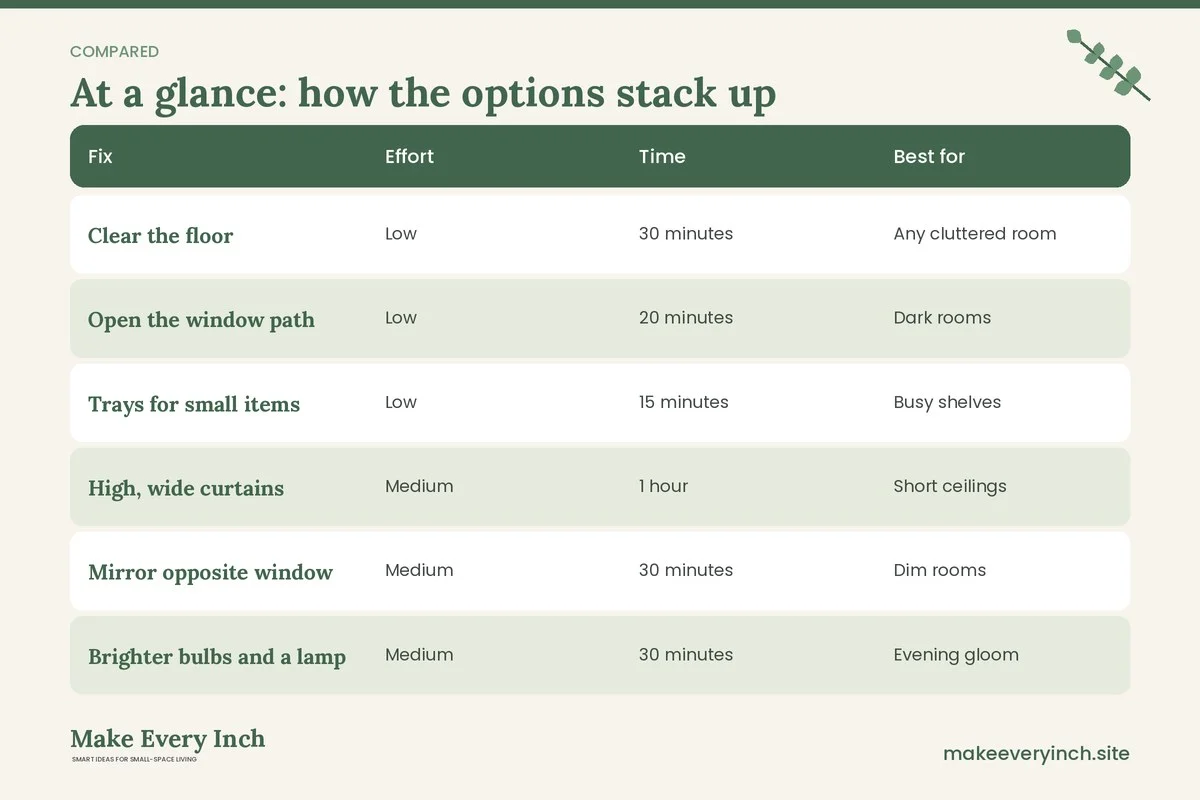
| Fix | Effort | Time | Best for | |
|---|---|---|---|---|
| Clear the floor | Low | 30 minutes | Any cluttered room | |
| Open the window path | Low | 20 minutes | Dark rooms | |
| Trays for small items | Low | 15 minutes | Busy shelves | |
| High, wide curtains | Medium | 1 hour | Short ceilings | |
| Mirror opposite window | Medium | 30 minutes | Dim rooms | |
| Brighter bulbs and a lamp | Medium | 30 minutes | Evening gloom | |
| One color family | Medium to high | Weekend | Mismatched rooms | |
| Matching trim and ceiling | High | Weekend | Sharp edges | |
| Right-size rug | Medium | 1 hour | Floating furniture | |
| Leggy furniture | Medium to high | Varies | Heavy pieces | |
| Fewer pieces | Low | 1 hour | Crowded rooms |
The table is a guide. Costs vary a lot by area and by what you already own, so use it to sequence your work rather than to set a figure. Start at the top, and stop when the room looks right.
Before and after: what to expect
| Area | Before | After | |
|---|---|---|---|
| Floor | Items on three sides | Clear paths and visible floor | |
| Window | Blocked by a chair | Open, with curtains stacked beside it | |
| Walls | Many small frames | One large piece or a group | |
| Surfaces | Many small items | Trays and a few objects | |
| Color | Four or five clashing tones | One family and two accents |
You may see more daylight, a calmer view and easier movement. Results depend on the room, so judge by your own photos.
Measurements worth knowing
A few numbers keep the fixes from going wrong.
- Walkways: keep main paths 30 to 36 inches wide, and secondary paths at least 24 inches, so the room reads as open rather than obstructed.
- Curtain length: panels should skim the floor or stop about half an inch above it. Puddled fabric collects dust and looks heavy.
- Mirror size: a mirror about half the width of the furniture beneath it, or a tall one at least 48 inches high, usually looks balanced.
- Rug size: a 5 by 8 foot rug suits most small living rooms, and a 8 by 10 foot suits a larger one, with at least the front legs of seating on it.
- Art height: the center of a piece sits near 57 inches from the floor, and a large piece looks better than many tiny ones.
- Lamp reach: keep a lamp within reach of an outlet, and do not stretch a cord across a walkway.
A seven-day plan
If you want a simple order, spread the work over a week.
- Day 1: take photos, clear the floor and remove anything you do not use.
- Day 2: clear the window path, clean the glass and move tall pieces.
- Day 3: raise and widen the curtains, using a tension rod if you rent.
- Day 4: add a mirror opposite the window and brighten the lighting.
- Day 5: group small items on trays and simplify the shelves.
- Day 6: choose a color family, and swap or remove the outliers.
- Day 7: retake the photos, compare, and decide what, if anything, is worth buying.
Stopping after day 7 is a good outcome. Many rooms look noticeably bigger with no purchases at all, and anything you do buy afterward is chosen against a clear gap.
Three example rooms
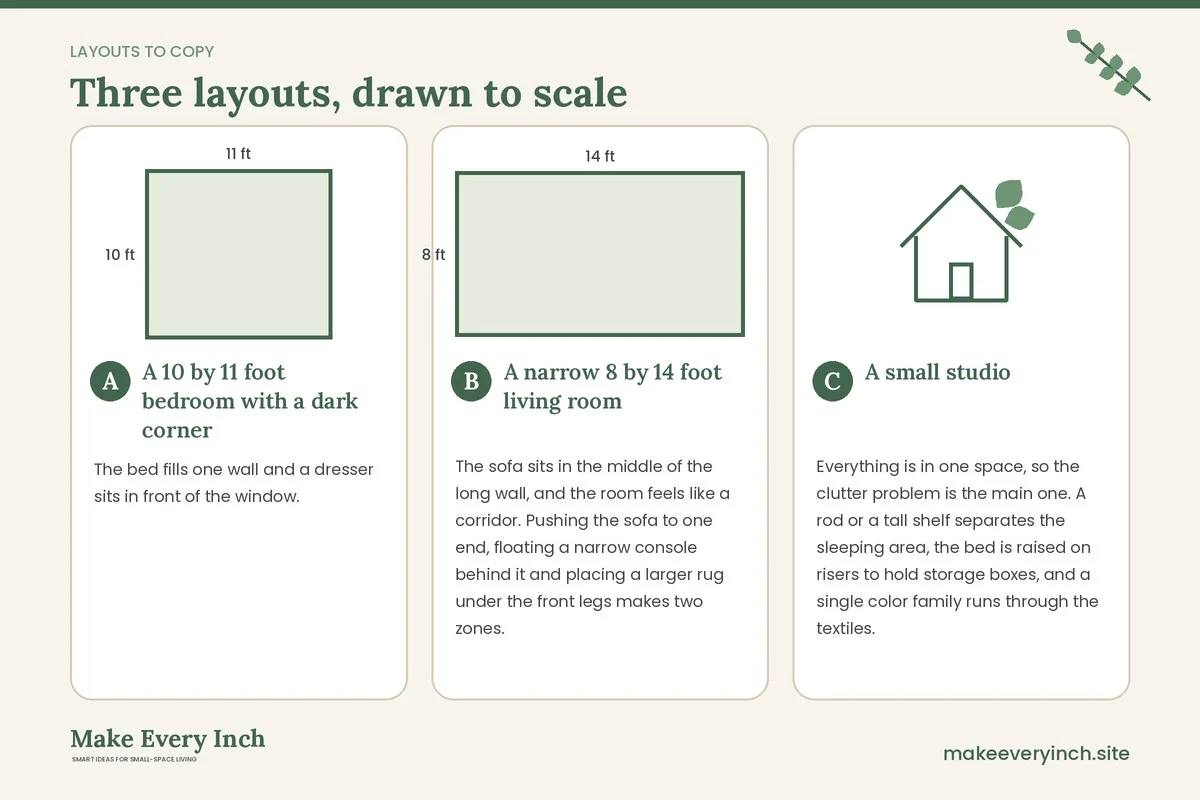
A 10 by 11 foot bedroom with a dark corner
The bed fills one wall and a dresser sits in front of the window. The fix is to move the dresser to the wall beside the window, raise the curtains to 6 inches below the ceiling, swap a heavy comforter for a pale one and add a mirror opposite the window. The corner is lit by a lamp aimed upward. The bed gets two small shelves in place of nightstands. See small bedroom ideas that make the room feel bigger for more.
A narrow 8 by 14 foot living room
The sofa sits in the middle of the long wall, and the room feels like a corridor. Pushing the sofa to one end, floating a narrow console behind it and placing a larger rug under the front legs makes two zones. A long mirror at the far end draws the eye. Curtains run the full width of the short wall. For layout ideas, read narrow living room ideas on a budget.
A small studio
Everything is in one space, so the clutter problem is the main one. A rod or a tall shelf separates the sleeping area, the bed is raised on risers to hold storage boxes, and a single color family runs through the textiles. The kitchen counter is cleared except for a tray. See studio apartment ideas for making space feel bigger for the next step.
Common mistakes
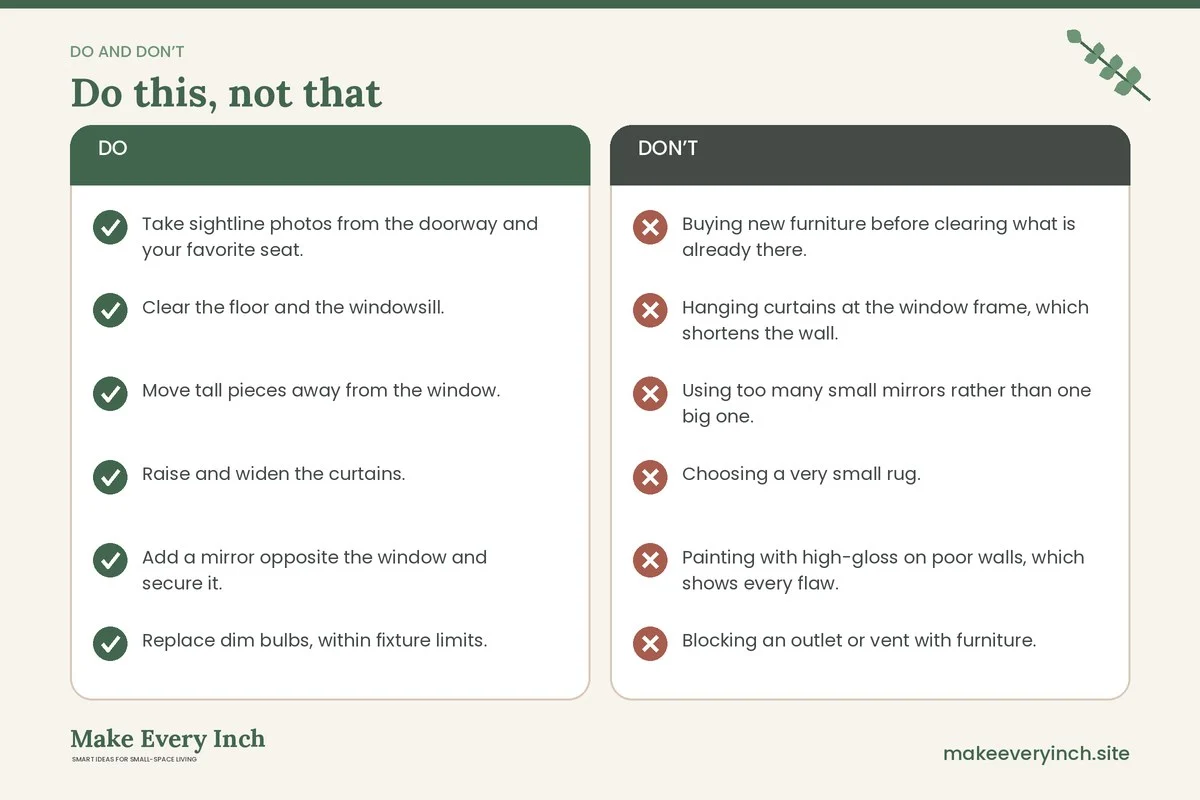
- Buying new furniture before clearing what is already there.
- Hanging curtains at the window frame, which shortens the wall.
- Using too many small mirrors rather than one big one.
- Choosing a very small rug.
- Painting with high-gloss on poor walls, which shows every flaw.
- Blocking an outlet or vent with furniture.
- Overloading shelves.
- Painting without ventilation.
Safety notes
Anchor tall bookcases, dressers and mirrors to the wall if you have permission to drill, and otherwise use freestanding, low pieces that cannot tip. Never block a heater, a vent or an exit path. Do not run cords under rugs or across walkways, and avoid daisy-chaining extension leads. In a bathroom or kitchen, keep electrical items away from water and use GFCI-protected outlets. Check the lease before drilling, painting or using strong adhesives, and respect weight limits on shelves and hooks. Choose low-VOC paint, and keep children and pets out of the room while it dries.
A weekend checklist
- Take sightline photos from the doorway and your favorite seat.
- Clear the floor and the windowsill.
- Move tall pieces away from the window.
- Raise and widen the curtains.
- Add a mirror opposite the window and secure it.
- Replace dim bulbs, within fixture limits.
- Choose a color family and remove the outliers.
- Remove one piece of furniture for a week.
- Take new photos, and compare.
FAQ
What is the cheapest way to make a room look bigger?
Clearing the floor and the windowsill costs nothing and often makes the largest difference. After that, moving furniture away from windows and raising the curtains are next.
Do mirrors really make a room look bigger?
They reflect light and the view, so a large mirror opposite a window can brighten a room and add depth. Place it where it reflects something pleasant, and secure it.
Should I paint a small room white?
Light colors reflect more daylight, but warm neutrals, pale greens and soft blues can work as well. A single color across walls, trim and ceiling is often more important than the exact shade.
How high should I hang curtains?
Mount the rod 4 to 6 inches above the window frame or just under the ceiling, and let the panels reach the floor. This makes the wall look taller.
Can I do this in a rental?
Yes. Most of these fixes need no drilling. Use tension rods, leaning mirrors, lamps and removable decor, and ask before painting. Our renter friendly small space upgrades post has more.
Does decluttering count as a design change?
Yes. A cleared floor and clear surfaces are the cheapest way to look larger. See decluttering rules for small homes.
Keep going: Keep going with our guides to budget small space ideas, DIY floating shelf ideas for small rooms and how to make a small house feel bigger.
Save this guide for later
Pin the ideas you like to Pinterest so you can come back to them when you plan your space.