Small Bedroom Ideas with Low Ceilings
Quick answer: The best small bedroom ideas with low ceilings add visual height without adding bulk: a low platform or standard-height bed, vertical stripes or tall narrow art, ceiling-colored trim and walls that blend upward, wall-mounted or flush lighting, and curtains hung close to the ceiling. Skip bunks and tall canopies, measure fan clearance first, and keep the tallest furniture away from the bed.
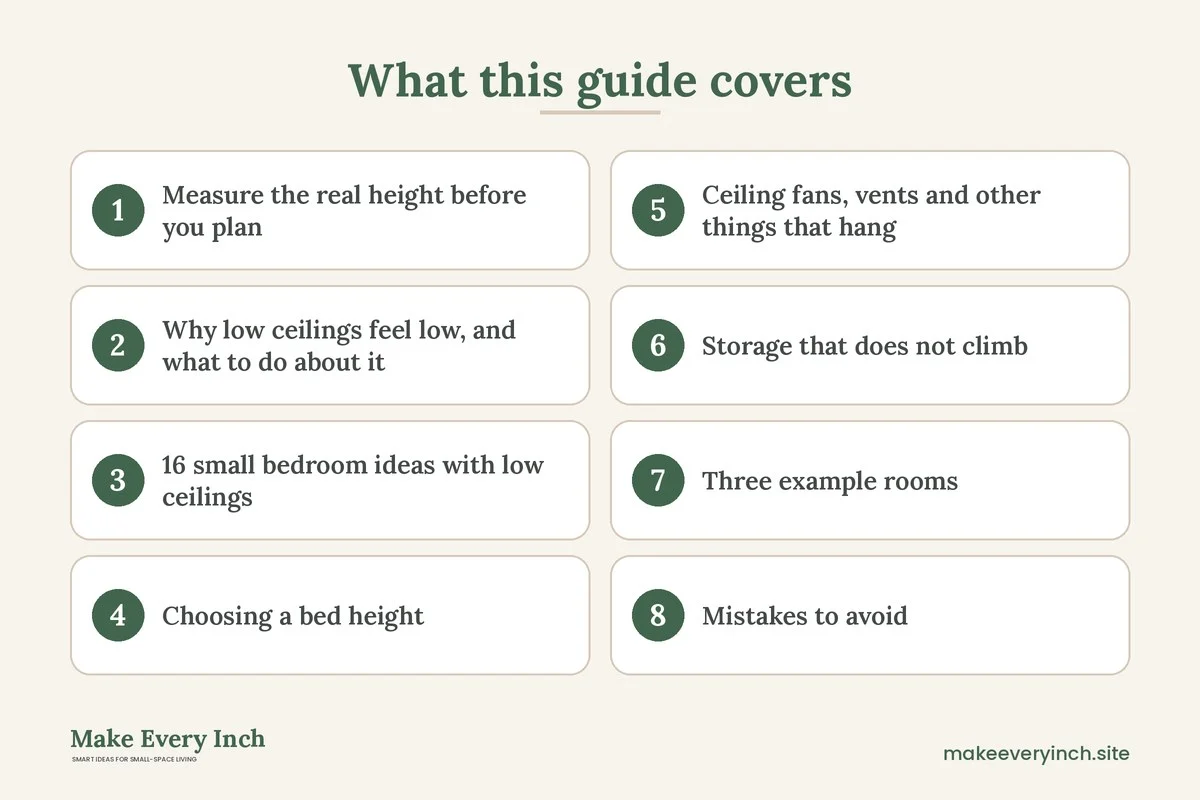
Small bedroom ideas with low ceilings face two problems at once: not much floor and not much air above it. A ceiling at 7 feet or lower makes a bed, a dresser and a light fixture compete for the same limited volume, and a room that is also small can start to feel like a box. The good news is that height is mostly a matter of perception, and a handful of decisions about the bed, the lines, the color and the lighting can change how tall the room feels. This guide covers how to measure what you really have, the visual tricks that work, how to choose a bed, where lights and fans can go safely, what to avoid, a clearance table, three example rooms, a weekend plan and a checklist. For the wider topic, start with our pillar guide to small bedroom ideas, then pair this post with the small bedroom storage ideas and small bedroom layout ideas guides.
Measure the real height before you plan
Low is relative. Many older homes, basements, converted garages and some apartments have ceilings between 7 feet and 7 feet 6 inches, and a few are lower. Standard modern ceilings are often 8 feet, so a room at 7 feet can feel noticeably squat even though nothing is wrong with it. Before you buy anything, take a tape measure and record three numbers.
- Ceiling height at the center and at the walls. Floors and ceilings are rarely perfectly level, and an old room can differ by an inch or two across its width.
- Lowest obstruction. Note any beam, duct, soffit, pipe or light fixture. The lowest point along your walking path matters more than the average height. Door frames in some homes are only about 6 feet 6 inches.
- Window head height. The distance from the floor to the top of the window frame tells you how high a curtain can reasonably rise and how much daylight reaches the ceiling.
Draw a quick side-view sketch of the room with these numbers. A sketch makes it obvious that a tall headboard, a tall wardrobe and a hanging pendant would all land in the same band of air. It also shows you where the highest part of the ceiling is, which is where the tallest piece of furniture should go.
If your ceiling is very low, local building rules may set minimum heights for habitable rooms, and the rules differ by place. This matters for sleeping areas in basements and attics, so if you rent or are converting a space, check with the landlord or the local authority rather than assuming a room is approved for sleeping.
Why low ceilings feel low, and what to do about it
A ceiling feels low when the eye meets it quickly and when strong horizontal lines cut the wall into short bands. Dark, heavy elements near the top add to the squashed effect. Fixing this means moving the eye upward and softening the line where wall meets ceiling. Four principles guide every idea in this post.
- Draw the eye up. Tall vertical features, such as stripes, narrow tall art and slim floor lamps, lead the eye toward the ceiling.
- Blur the ceiling line. Painting the wall and ceiling in the same or very close tone removes the sharp edge that tells you where the room stops.
- Keep the middle of the room low. A low bed and low seating make the wall above them look taller by contrast.
- Keep the top of the room empty. Hanging fixtures, tall canopies and loaded high shelves fill the air that you want to look open.
16 small bedroom ideas with low ceilings
Use color and line to add visual height
1. Paint walls and ceiling in the same light tone
When the wall color continues over the ceiling, the corner softens and the room reads as one volume. A light, warm white or a pale neutral tends to work best because it reflects light. Use low-VOC paint, ventilate while painting and while it dries, and check your lease or ask for written permission before repainting a rental.
2. Try a slightly lighter ceiling than the walls
If painting the ceiling the same color feels flat, use a ceiling color one or two shades lighter than the walls. The contrast stays soft, and the ceiling appears to recede.
3. Add vertical stripes or a tall pattern
Narrow vertical stripes on one wall, especially behind the bed, stretch the wall visually. Removable wallpaper works in a rental, and our guide to removable wallpaper ideas covers how to apply and remove it. Keep stripes tonal, with only a small contrast between the two colors, so the effect stays calm for a bedroom.
4. Skip the heavy picture rail and thick crown molding
Wide, dark molding creates a strong horizontal band exactly where you want a soft edge. If the room already has it, paint it the same color as the wall and ceiling so it fades.
5. Use tall, narrow art in groups
A column of three small frames, or one tall slim print, pulls the eye up. Avoid a long, low row of frames over the bed, which stresses the horizontal. For hanging without nails, see our guide to renter friendly wall decor ideas.
Choose a bed that keeps the room open
6. Pick a low platform or a standard frame, not a tall one
A bed with a low frame leaves more wall visible above it, and a lower sleeping surface makes the whole room feel taller. Aim for a mattress top that sits around 18 to 24 inches off the floor, and avoid high frames with a thick mattress unless you need the under-bed storage. If you do, a drawer-style frame keeps the height reasonable. Our guide to the best beds with storage compares options.
7. Choose a low or no headboard
A tall, upholstered headboard eats into the wall space that makes a room feel high. A slim headboard, a painted headboard shape on the wall or no headboard at all lets the wall do the work. If you want something behind your head, a flat wall-hung panel or a row of pillows is lighter.
8. Avoid bunks, lofts and tall canopies
A bunk or a loft bed puts a second sleeper surface into the already limited air. Sitting up on the top bunk can become impossible when the ceiling is under about 8 feet, and the risk of hitting your head or of falling is higher. A four-poster or a tall canopy frame has the same problem as it fills the top of the room. If a child shares the room, a trundle bed or two low beds are safer choices.
9. Float the bed away from tall furniture
Place the bed under the lowest or most open part of the ceiling, and put the tallest dresser or wardrobe on the opposite side. When tall furniture sits next to the bed, its top may sit close to the ceiling and make the whole side look cramped.
Light the room from the middle and the sides
10. Use flush or semi-flush ceiling fixtures
A pendant that hangs 12 inches or more takes up scarce air and can be a head hazard near the bed. A flush mount sits against the ceiling and keeps the volume open. If a hanging light is the only option, choose a slim one and hang it over the foot of the bed or in a corner, not above your head. Our guide to small bedroom lighting ideas goes deeper on layers.
11. Bounce light off the ceiling
Uplights, wall sconces that cast light upward, and a floor lamp with an upward-facing shade wash the ceiling with soft light. A bright ceiling looks higher than a dark one. Plug-in wall sconces avoid hardwiring, and our post on renter friendly lighting ideas lists no-drill options. Keep cords tidy, never run cords under rugs or through places where they can be pinched, and do not exceed an outlet’s rating.
12. Replace bedside lamps with wall-mounted or clip-on lights
Table lamps with tall shades reach toward the ceiling. Wall-mounted reading lights free the nightstand and add a vertical element. In a rental, plug-in versions with a cord cover keep things tidy without wiring.
Hang curtains and dress windows to stretch walls
13. Mount the rod high and wide
Install the curtain rod close to the ceiling, or just below any molding, and extend it 6 to 10 inches beyond each side of the window frame. The curtains then draw the eye upward and make the window look taller. Floor-length panels that just touch the floor strengthen the line. If drilling is not permitted, a tension rod works for lightweight panels in a window recess.
14. Choose simple, light fabric
Heavy, dark, pleated curtains add visual weight. Light linen-look or cotton panels in a color close to the wall let the window fade into the wall.
Keep the floor and the walls working
15. Use a large, low-pile rug in a pale tone
A rug that extends beyond the bed on both sides keeps the floor from looking chopped up. A pale rug reflects light upward. Choose a flat weave to avoid tripping and to leave clearance under doors.
16. Mirror the tall wall
A tall, narrow mirror leaning on a wall or hanging on a hook extends height and doubles light. Place it where it reflects a window or a lamp, and not directly across the bed if that bothers you. Anchor any heavy mirror to the wall with the right hardware, or lean it so it cannot tip, and only drill if you have permission.
Choosing a bed height: a clearance table
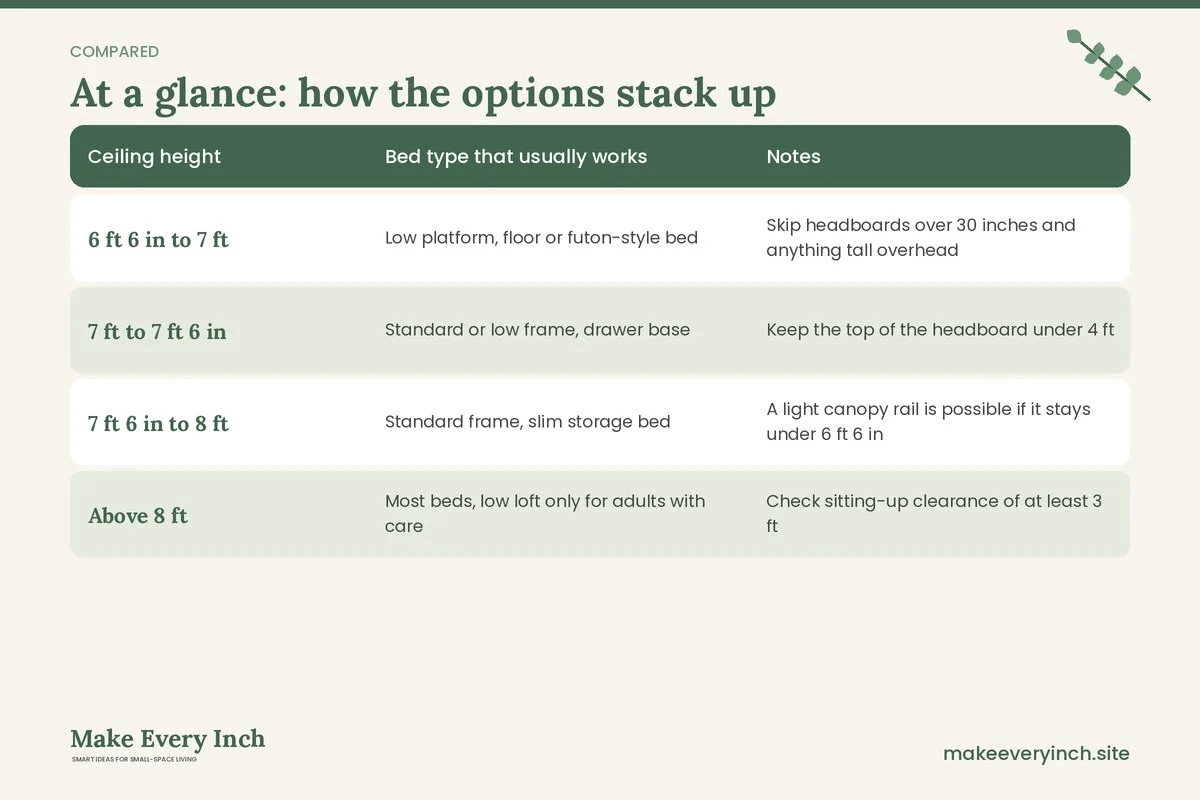
The numbers below are rules of thumb, not building code. Use them to check whether a bed plan suits your ceiling height. Always measure your own room and consider the tallest person who sleeps there.
| Ceiling height | Bed type that usually works | Notes |
|---|---|---|
| 6 ft 6 in to 7 ft | Low platform, floor or futon-style bed | Skip headboards over 30 inches and anything tall overhead |
| 7 ft to 7 ft 6 in | Standard or low frame, drawer base | Keep the top of the headboard under 4 ft |
| 7 ft 6 in to 8 ft | Standard frame, slim storage bed | A light canopy rail is possible if it stays under 6 ft 6 in |
| Above 8 ft | Most beds, low loft only for adults with care | Check sitting-up clearance of at least 3 ft |
For a sleeper to sit up comfortably in bed, plan for about 3 feet of free air above the mattress surface at the head end. Add the mattress top height to that number to see the minimum ceiling height. For example, with a mattress top at 20 inches, a 7-foot ceiling still leaves roughly 64 inches of air, which is plenty to sit up. A bunk’s top mattress, by contrast, can leave under a foot of headroom in the same room, which is why bunks are not suitable.
Ceiling fans, vents and other things that hang
A ceiling fan is the biggest problem in a low room. Many building and safety guides advise keeping fan blades at least 7 feet above the floor, and some fans need more clearance below the ceiling to run properly. If your ceiling is 7 feet or lower, a standard fan may not be suitable at all. Check the manufacturer’s instructions, and have a qualified electrician review any fan install or swap, because the weight and the wiring box must be rated for a fan.
Alternatives for low rooms include a flush-mount fan designed for low ceilings, a wall-mounted or oscillating fan, a slim tower fan on the floor, or a window fan. Keep cords away from the bed and out of walking paths. If your bedroom has a smoke detector on the ceiling, never block or cover it, and keep furniture and decor clear of its surroundings.
Other overhead items need the same attention.
- Ducts and soffits: Do not wrap or cover vents. Paint them the wall color to blur them.
- Pipes and beams: Avoid placing the head of the bed where you could hit one when sitting up. Pad exposed hazards if they cannot be moved.
- Sprinklers: If your room has a fire sprinkler head, keep items well below it. Local rules often require clear space around it, so ask your landlord or building manager.
Storage that does not climb
In a low room, storage cannot simply go up. Use the volume under and beside the bed instead, and keep the top 12 inches of any wall clear or very light.
- Under the bed: Shallow rolling bins, or a bed with drawers, use space that is otherwise empty.
- Low dressers: A long, low dresser under a window keeps the top edge below the sill and adds a surface for a lamp without stretching toward the ceiling.
- Wall storage at mid-height: Shelves between 30 and 60 inches look neat and stay out of the ceiling zone. Avoid shelves right under the ceiling, which can look top-heavy.
- Bench or ottoman at the foot: A storage bench keeps blankets or shoes out of view. See our best storage ottomans guide.
- Hidden spots: Use the hidden storage ideas post for ideas such as lift-up beds and wall niches.
Safety note: if you use tall furniture anywhere in the room, anchor it to the wall with the right hardware, and only drill after you have permission to do so. A tall wardrobe near a low ceiling can also be harder to tip back into place, so anchoring matters even more. Never stack heavy items on the top shelves, which raises the tipping risk.
Three example rooms
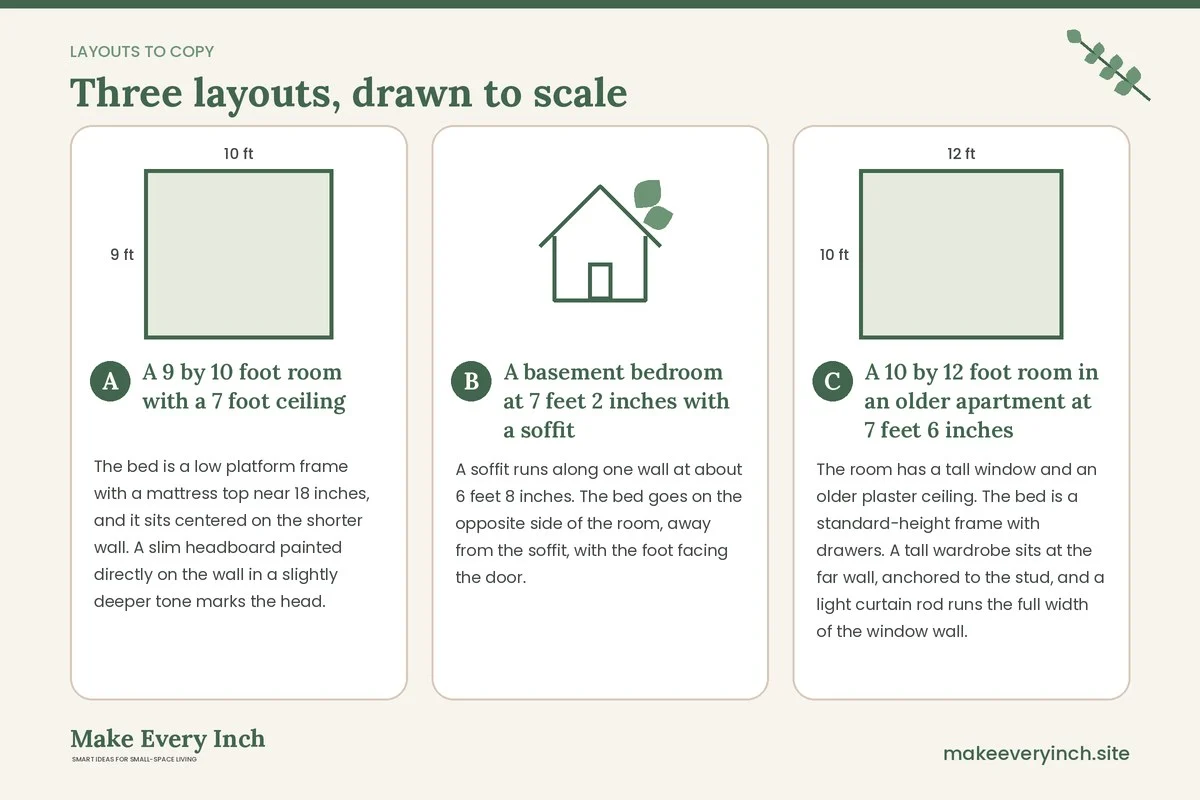
A 9 by 10 foot room with a 7 foot ceiling
The bed is a low platform frame with a mattress top near 18 inches, and it sits centered on the shorter wall. A slim headboard painted directly on the wall in a slightly deeper tone marks the head. Walls and ceiling are painted the same warm white, and curtains hang from a rod just under the ceiling line. Plug-in sconces on each side replace the bedside lamps, and a flush ceiling light fills the center. A low dresser, about 30 inches tall, runs under the window. The result is a room where the walls feel continuous and the bed does not compete with the ceiling.
A basement bedroom at 7 feet 2 inches with a soffit
A soffit runs along one wall at about 6 feet 8 inches. The bed goes on the opposite side of the room, away from the soffit, with the foot facing the door. The soffit is painted the same color as the wall to blur it, and a row of narrow vertical frames sits on the wall below it. A flat-weave rug in a pale tone extends 18 inches beyond the bed on each side. A wall-mounted or oscillating fan replaces a ceiling fan. Ventilation and a working smoke and carbon monoxide detector matter in any lower-level room, so check them regularly. If a window is the only exit, it should also be clear and openable. For more on storage in rooms like this, see small bedroom ideas without a closet.
A 10 by 12 foot room in an older apartment at 7 feet 6 inches
The room has a tall window and an older plaster ceiling. The bed is a standard-height frame with drawers. A tall wardrobe sits at the far wall, anchored to the stud, and a light curtain rod runs the full width of the window wall. A tall, slim mirror leans near the window to bounce light. The layout keeps the bed away from the wardrobe, and a narrow floor lamp with an upward shade adds soft light on the ceiling. A matched pair of low nightstands finishes the bed. For a similar mood, see our take on minimalist small bedroom ideas.
Mistakes to avoid
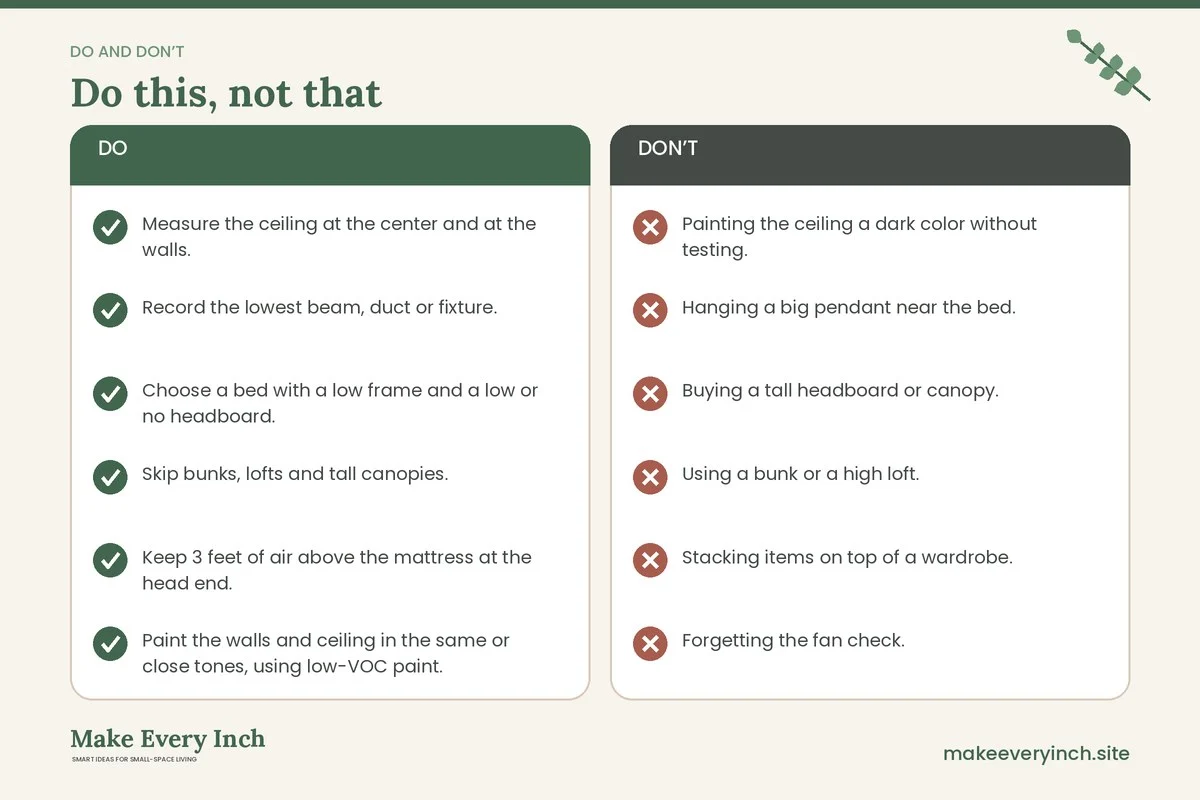
- Painting the ceiling a dark color without testing. A deep ceiling can work in a large, well-lit room, but in a small, low one it often presses down. Test a sample first.
- Hanging a big pendant near the bed. It takes up air and can be hit by a head or an arm.
- Buying a tall headboard or canopy. They fill the wall that should stay open.
- Using a bunk or a high loft. Headroom shrinks to unsafe levels.
- Stacking items on top of a wardrobe. It adds visual weight at the ceiling and can fall.
- Forgetting the fan check. Blades too close to the ceiling or to a head are a safety problem.
- Covering a vent or detector. Never block either with decor.
A weekend plan
Day one: measure and clear
Measure the ceiling, the lowest obstruction and the window. Sketch the room. Remove anything that hangs from the ceiling zone, such as plants on hooks or paper lanterns, and pick the bed position. Clear the top of the wardrobe and the tops of the shelves.
Day two: lines, light and layers
Swap the pendant for a flush light or add lamps at low level. Move the curtain rod high and wide. Add a tall mirror and a column of narrow frames. If you have permission to paint, apply low-VOC paint with the windows open, and let it dry fully before sleeping in the room. Finish with a pale rug and tidy cords. For a larger overhaul, our small bedroom makeover ideas guide gives a longer plan.
Low-ceiling checklist
- Measure the ceiling at the center and at the walls.
- Record the lowest beam, duct or fixture.
- Choose a bed with a low frame and a low or no headboard.
- Skip bunks, lofts and tall canopies.
- Keep 3 feet of air above the mattress at the head end.
- Paint the walls and ceiling in the same or close tones, using low-VOC paint.
- Hang curtains close to the ceiling and extend the rod past the window.
- Use flush lights and sconces instead of pendants.
- Check fan clearance and have an electrician review any install.
- Add tall, narrow art and a leaning mirror.
- Anchor tall furniture and avoid heavy items on high shelves.
- Keep vents, sprinklers and detectors clear.
FAQ
What is the best bed for a low ceiling?
A low platform or standard-height frame with a short or absent headboard. It keeps the mattress and the wall below the zone where the room feels cramped.
Should I paint a low ceiling white?
A light color usually helps, because it reflects light. Painting walls and ceiling the same tone can blur the edge, but test a sample in your own light.
Can I use a ceiling fan with a low ceiling?
Many guides recommend blades at least 7 feet above the floor, so a standard fan may not suit a ceiling at or below that height. Ask an electrician about a low-profile fan or use a wall or floor fan.
Are bunk beds safe in a low-ceiling room?
Usually not. The top sleeper may have very little headroom, and a fall risk exists. A trundle or two low beds are safer choices.
Do dark colors make a low ceiling feel lower?
Often, yes, especially on the ceiling. Some people use dark walls to create a cozy feel, but they work best when the room has plenty of light.
How can I add light without hanging fixtures?
Use plug-in sconces, floor lamps with upward shades, wall-mounted reading lights and clip lights. Check the load on the outlet and keep cords clear of walkways.
Keep going: Keep planning with our small bedroom ideas for renters, small bedroom furniture ideas and small bedroom ideas for attic rooms.
Save this guide for later
Pin the ideas you like to Pinterest so you can come back to them when you plan your space.