Small Home Office Ideas in a Living Room
Quick answer: The best small home office ideas in a living room let the workspace share the room politely. Use a console desk behind the sofa or against a wall, a cabinet or armoire that closes over the laptop, a screen or curtain to mark the zone, and a ten-minute evening reset that returns the room to living space. Plan for noise with rugs, soft panels and headphones, and keep a 30 to 36 inch walkway clear.
Small home office ideas in a living room have a different challenge from a bedroom or a spare room. The living room belongs to everyone. It is where a partner watches television, children play, friends visit and the sofa is the center of the evening. A work area has to coexist with all of that without making anyone feel that the office has taken over. This guide focuses on shared living: how to choose between a console desk and a cabinet desk, how to place the workspace so it does not clash with the television, how to manage noise and calls, and how to run an evening reset that gives the room back. It includes measurements, a comparison table, three example rooms, a checklist and a FAQ. For the overall topic, read our pillar on small home office ideas, and for the sleep-focused version, read the companion post on small home office ideas in a bedroom.
The shared-room problem
A bedroom office has one person to please. A living room office has several, and each of them uses the room differently. One person might work from nine to five at a laptop, while another watches television in the afternoon, or a child does homework on the floor. The best plan comes from asking three questions before you move anything.
- Who uses the room during work hours? If the room is empty from nine to five, you have more freedom. If someone else is home, noise and sightlines matter more.
- What does the room need to do in the evening? If it is a place for dinner, television and guests, the office must disappear or look like furniture.
- How loud is your work? Quiet writing is different from video calls all day. Calls need a plan for sound and for what appears behind you.
Write the answers on paper. They decide whether you need a permanent desk, a hide-away cabinet or a portable setup.
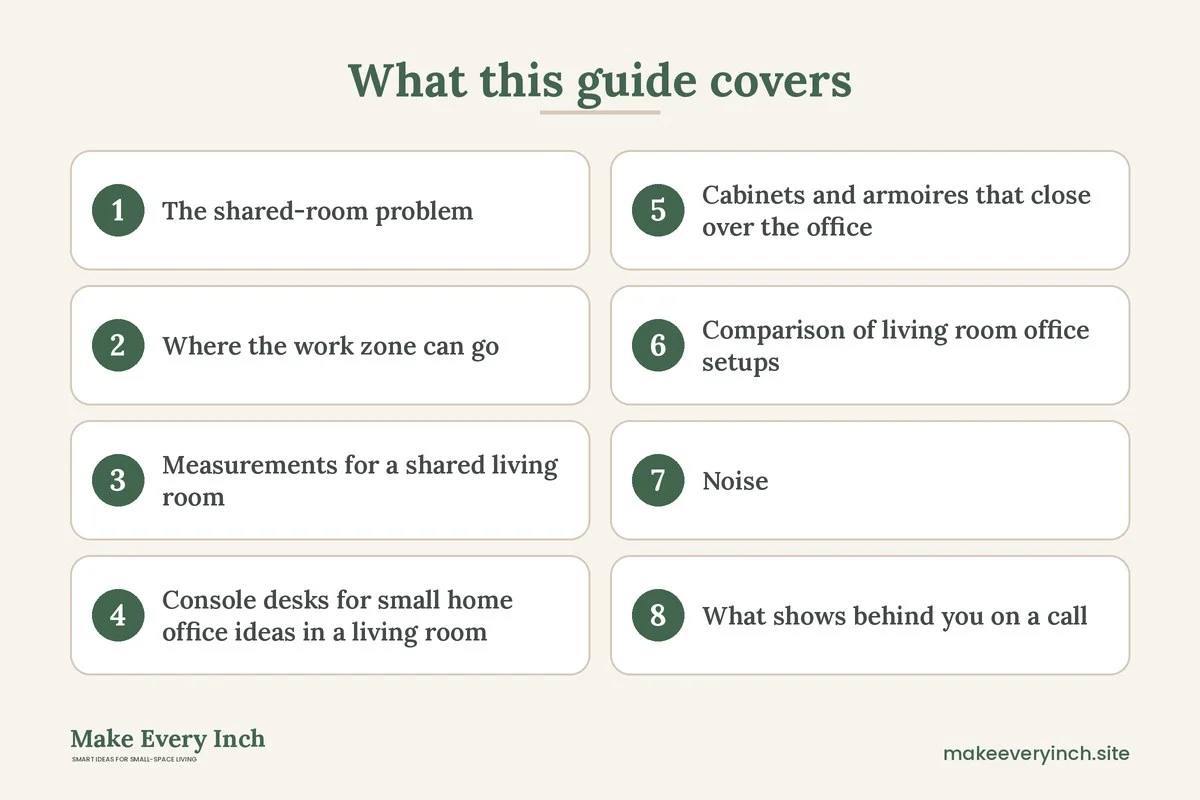
Where the work zone can go
Behind the sofa
If the sofa floats away from the wall, a console desk behind it makes a workspace that faces the room’s back wall or window. The sofa back acts as a divider, and the desk is out of sight from the front of the room. Leave 30 to 36 inches behind the console for the chair, and at least 24 inches between the sofa back and the desk edge if people must pass.
Against a long wall
A slim desk or a console along a wall that is not the television wall keeps the workspace out of the entertainment sightline. A wall of 6 to 8 feet holds a desk, a shelf above and a lamp.
In a window bay or by a window
Daylight helps work, and a desk by a window can double as a side table in the evening. Place the screen at right angles to the window to limit glare, and keep curtains or blinds that you can adjust.
In an alcove or niche
Shelving niches, spaces beside a chimney breast and the area under a staircase can hold a small desk. They give you a built-in boundary, and a curtain can close them off.
At the dining table
If the living room includes a dining area, the table can serve as a desk. Use a rolling cart or a lidded box for the laptop, papers and charger so you can clear the table for dinner. Our guide to studio apartment ideas for working from home has more on combined spaces.
In the corner
A corner desk or an L-shaped arrangement uses space that rarely serves another purpose. Keep the corner away from a door swing, and make sure the chair does not block a walkway.
Measurements for a shared living room
These numbers are starting points. Tape the footprint on the floor before buying anything.
- Main walkway: 30 to 36 inches clear between the work zone and the seating.
- Desk depth: 14 to 18 inches for a console used with a laptop, and 20 to 24 inches for a monitor and a notebook.
- Desk width: 36 to 48 inches suits one person with a laptop and a lamp.
- Chair clearance: 30 to 36 inches behind the desk edge so the chair slides out and someone can pass.
- Sofa to console: 24 to 30 inches between the back of the sofa and the front of the console, or the console backs directly against it.
- Cabinet depth: 16 to 24 inches for an armoire or a cabinet that houses a laptop and a printer.
- Sofa to television: about 7 feet or more, so a desk placed to the side does not intrude on viewing.
- Distance from the television: keep the work screen out of the sightline from the main seat to avoid glare and distraction.
Console desks for small home office ideas in a living room
A console desk is a narrow table, usually 12 to 18 inches deep, that looks like a hall table or a sofa table. It earns its place in a living room because it can pass as furniture.
Why console desks work
They take up little floor, they match the style of a living room better than an office desk, and they can sit behind a sofa or against a wall. Many have a drawer that holds a charger, a notebook and a mouse. A console with a shelf below stores a laptop bag or a basket of papers.
How to use one with a laptop
Raise the laptop with a stand and use a separate keyboard so your arms stay comfortable. Keep a small stool or a slim chair that tucks fully under the console. If the console is shallow, a laptop on a stand and a keyboard on your lap tray works for short sessions. Ergonomics vary, so choose what feels comfortable and take regular breaks. This post is not medical advice.
Styling it as furniture
Place a lamp, a plant and a tray on one end. When you finish work, the laptop goes in a drawer or a basket, and the console reads as a decorative table. Our guide to small living room furniture ideas has more ideas for pieces that serve two purposes.
Cabinets and armoires that close over the office
A cabinet or armoire solves the biggest living room problem: the visual presence of work. Close the doors, and the office is gone.
The desk armoire
A tall cabinet with a fold-out or pull-out writing surface holds a laptop, a printer, files and stationery. Choose one with ventilation for equipment, or leave the doors open while devices are on. The shelves above hold books and supplies.
A cabinet with a shelf at desk height
Some cabinets have a pull-out shelf that doubles as a desk. These are shallower than a full armoire and work well in a narrow room.
A sideboard with a desk top
A low sideboard in front of a wall can hold a laptop at standing height. Add a tall stool, and you have a stand-up workspace that disappears when you close the doors. See our guide to hidden storage ideas for more.
Safety for tall pieces
Tall cabinets and armoires can tip, especially when doors or drawers are open. Anchor them to the wall with straps or brackets. In a rental, ask the landlord before drilling, or choose a lower, heavier piece. Keep cords away from the opening where doors close, so you do not pinch them. Allow airflow around a closed cabinet when a printer or router is inside, since heat can build.
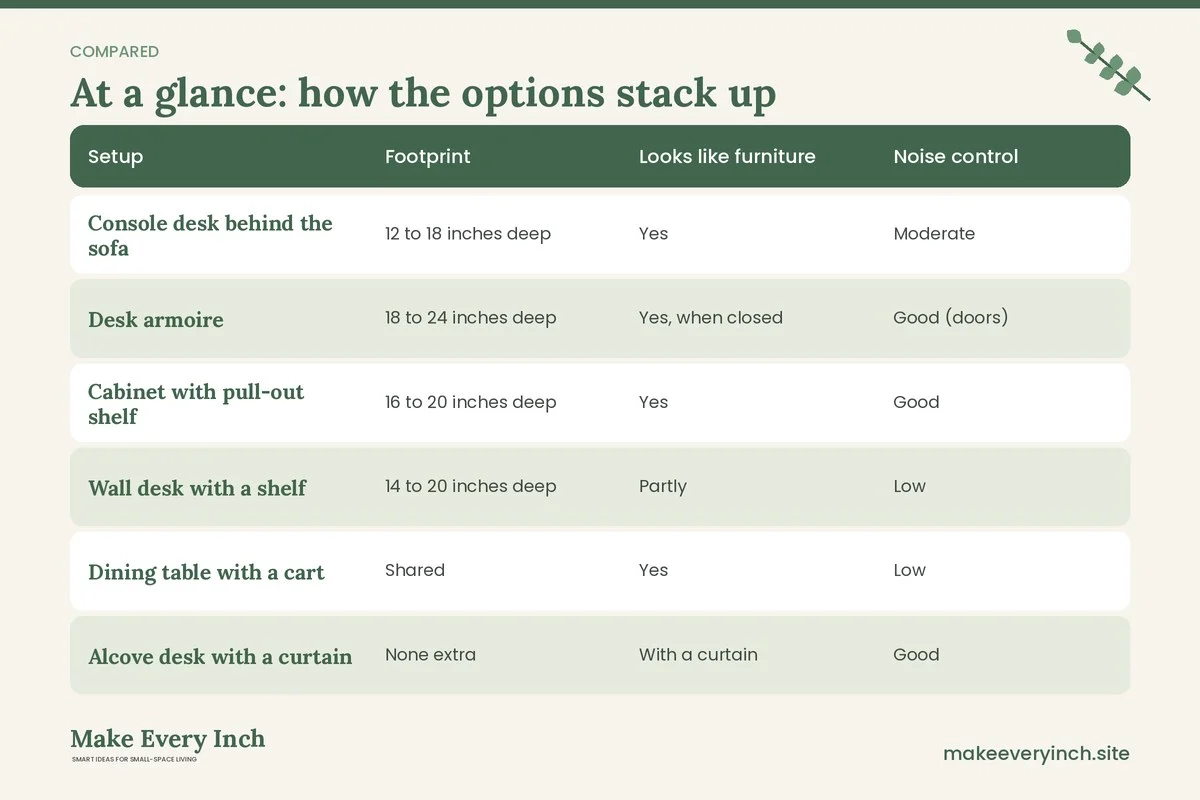
Comparison of living room office setups
| Setup | Footprint | Looks like furniture | Noise control | Best for |
|---|---|---|---|---|
| Console desk behind the sofa | 12 to 18 inches deep | Yes | Moderate | Open rooms with a floating sofa |
| Desk armoire | 18 to 24 inches deep | Yes, when closed | Good (doors) | Daily work with equipment |
| Cabinet with pull-out shelf | 16 to 20 inches deep | Yes | Good | Narrow rooms |
| Wall desk with a shelf | 14 to 20 inches deep | Partly | Low | Short sessions |
| Dining table with a cart | Shared | Yes | Low | Combined living and dining |
| Alcove desk with a curtain | None extra | With a curtain | Good | Rooms with a niche |
| Open desk by the window | 20 to 24 inches deep | No | Low | A room that is empty in the day |
Noise: calls, keyboards and shared sound
Noise is the second big issue in a shared room. It moves both ways: your calls bother others, and the room’s noise reaches your microphone.
- Rugs and soft furnishings. A rug under the work zone and curtains at the windows absorb sound. Hard floors and bare walls make echo worse.
- Soft panels. Fabric-covered panels or a thick wall hanging behind your chair reduce echo. In a rental, hang them with approved methods or lean them on a shelf.
- A bookcase as a baffle. Shelves filled with books help scatter and absorb sound, and also work as a divider.
- Headphones. A good headset keeps your voice close to the microphone and cuts what others hear. Noise-canceling headphones can help you with background sound from television.
- Schedule calls. Agree with housemates on call times, and put a sign on the door or a light outside the work area. A simple signal, such as a small lamp, tells others that you are in a meeting.
- Quiet keyboards and mats. A felt mat under the keyboard softens typing noise.
- Mute and test. Check your microphone before an important call, and use the mute button when you are not speaking.
Be realistic. A living room office will not be silent. If you need quiet for focused work or sensitive calls, consider alternative spots such as a bedroom, a quiet corner of a library or a co-working space for those moments.
What shows behind you on a call
In a living room, the background can be a sofa, a television or a pile of laundry. Plan a neat backdrop.
- Face a blank wall or a tidy bookshelf if you can.
- Avoid sitting with a window directly behind you, since the camera will turn you into a silhouette.
- Put the main light in front of you or to the side, not behind you.
- Keep the background simple. A plant, a framed print and a lamp are enough.
- If the layout gives you no good wall, use a folding screen behind your chair, or a neutral digital background.
The evening reset
The reset is what makes a living room office work in a shared home. It takes about ten minutes, and it returns the room to people who want to relax.
The ten-minute routine
- Save and shut down. Close your work and power down the laptop. Add tomorrow’s top three tasks to a notebook.
- Clear the surface. Papers go in a folder, pens in a cup, and the laptop in a drawer or on a shelf.
- Close the office. Shut the cabinet, pull the curtain, fold the leaf or push the chair under.
- Collect cables. Coil the charger and put it in the basket. Leave only the lamp.
- Reset the room. Return cushions and throws, and straighten the rug.
- Change the light. Turn off the task lamp and switch on the soft lamps, so the room reads as living space.
- Do a quick tidy. Wipe the console or the table and pick up any cups.
Keep the reset small
The smaller the office, the shorter the reset. A laptop and a notebook take two minutes to clear, while a monitor, a printer and a pile of files take much longer. If the reset feels like a chore, simplify the setup.
Make it shared
If other people live in the room, agree on a few simple rules. For example, nobody leaves cups on the console, and the television goes on after the reset. A clear agreement prevents arguments.
Lighting and glare
A living room often has soft, warm lighting that is poor for work. A good work setup needs enough light on the desk without glare.
- Use a task lamp with an adjustable head. Position it opposite your writing hand to avoid shadows.
- Place the monitor so that windows are to the side, not behind or in front.
- Avoid placing the screen where the television or a lamp reflects in it.
- Use a dimmer or separate switches so you can lower the room light for evening viewing while keeping the task lamp on if needed.
- Choose bulbs of about 3500 to 4000 kelvin for the desk and 2700 kelvin for living lamps.
For more ideas, read our guide to small living room lighting ideas.
Cords, power and electrical safety
A living room office adds a laptop, a monitor, a lamp and chargers to a room that already has a television and a router. Keep the load in mind.
- Check the rating. Do not overload a power strip. Avoid plugging heaters or other high-draw appliances into the same strip as electronics.
- Do not daisy-chain strips. Use one rated strip with surge protection and a switch.
- Keep cords out of walkways. Run them along the wall, under furniture or through cable clips. Avoid running a cord under a rug or across a path.
- Hide cords sensibly. Use sleeves, clips and cord covers that suit a rental. Our guide to renter-friendly ways to hide cords covers options.
- Give equipment airflow. Routers, printers and chargers produce heat, so keep them uncovered when running.
- Watch for warning signs. If a plug or a strip is hot, smells of burning or shows marks, unplug it and call an electrician.
Think about the mix of people in the room as well. Children and pets can pull cords and chew cables, so tuck them away and use covers where needed.
Storage for a small living room office
Keep supplies in a few containers instead of spreading them around the room.
- A lidded box or basket for chargers, headsets and small gadgets.
- A file box or a drawer for the papers you need often. Scan the rest and recycle.
- A wall shelf or bookcase for books and a printer, anchored if tall.
- A tray for the day’s tools, which you carry to and from the table.
- A rolling cart that moves from the work area to a closet.
For more ideas, see our guide to small living room storage ideas and the wider post on small space organization ideas.
Three example living rooms
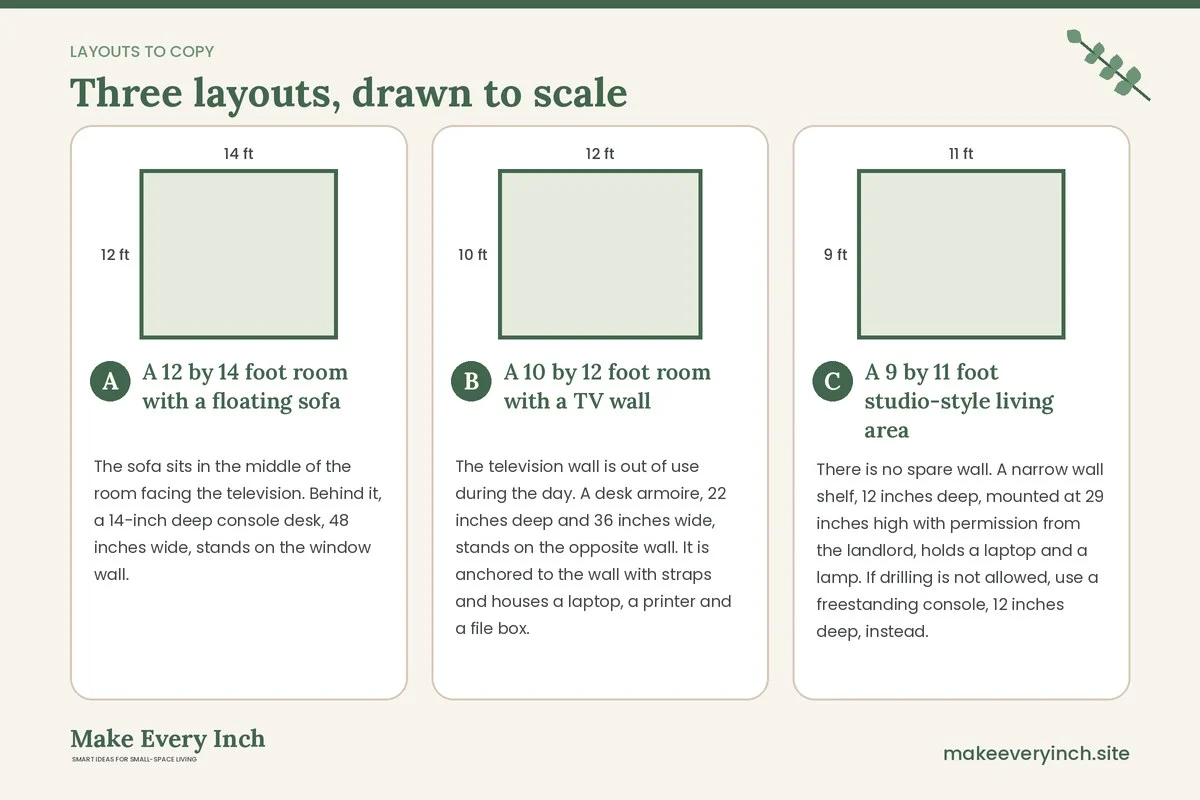
A 12 by 14 foot room with a floating sofa
The sofa sits in the middle of the room facing the television. Behind it, a 14-inch deep console desk, 48 inches wide, stands on the window wall. The chair has 34 inches behind it, and the sofa back is 30 inches from the console edge. A rug under the desk area softens noise. In the evening, the laptop goes into a basket on the shelf below, and the console holds a lamp and a plant. This plan suits a couple who both work from home at different times.
A 10 by 12 foot room with a TV wall
The television wall is out of use during the day. A desk armoire, 22 inches deep and 36 inches wide, stands on the opposite wall. It is anchored to the wall with straps and houses a laptop, a printer and a file box. When the doors close, the room has a tall cabinet and a sofa. The walkway is 36 inches wide. The cabinet doors stay open while the laptop is on, so air can move. For the layout of the rest of the room, read our guide to small living room layout ideas.
A 9 by 11 foot studio-style living area
There is no spare wall. A narrow wall shelf, 12 inches deep, mounted at 29 inches high with permission from the landlord, holds a laptop and a lamp. If drilling is not allowed, use a freestanding console, 12 inches deep, instead. A stool tucks under it. A folding screen stands in the corner and is pulled across the console at the end of the day. For more combined ideas, see our post on how to fit a desk into a studio apartment.
Working with children, partners and pets
A shared room has people in it. Plan for them.
- Partners: agree on blocks of time and signals. A closed screen or a lamp tells the other person that you are in a meeting.
- Children: set up a homework spot next to yours, so they can work at the same time. Keep scissors, glue and small items out of reach of toddlers.
- Pets: tuck cords out of reach, and keep chewable chargers off the floor. Place the chair so a pet cannot be trapped behind it.
- Guests: the reset is the signal that the room is free. If guests arrive during work hours, a cabinet or screen helps you hide the office until you finish.
Common mistakes
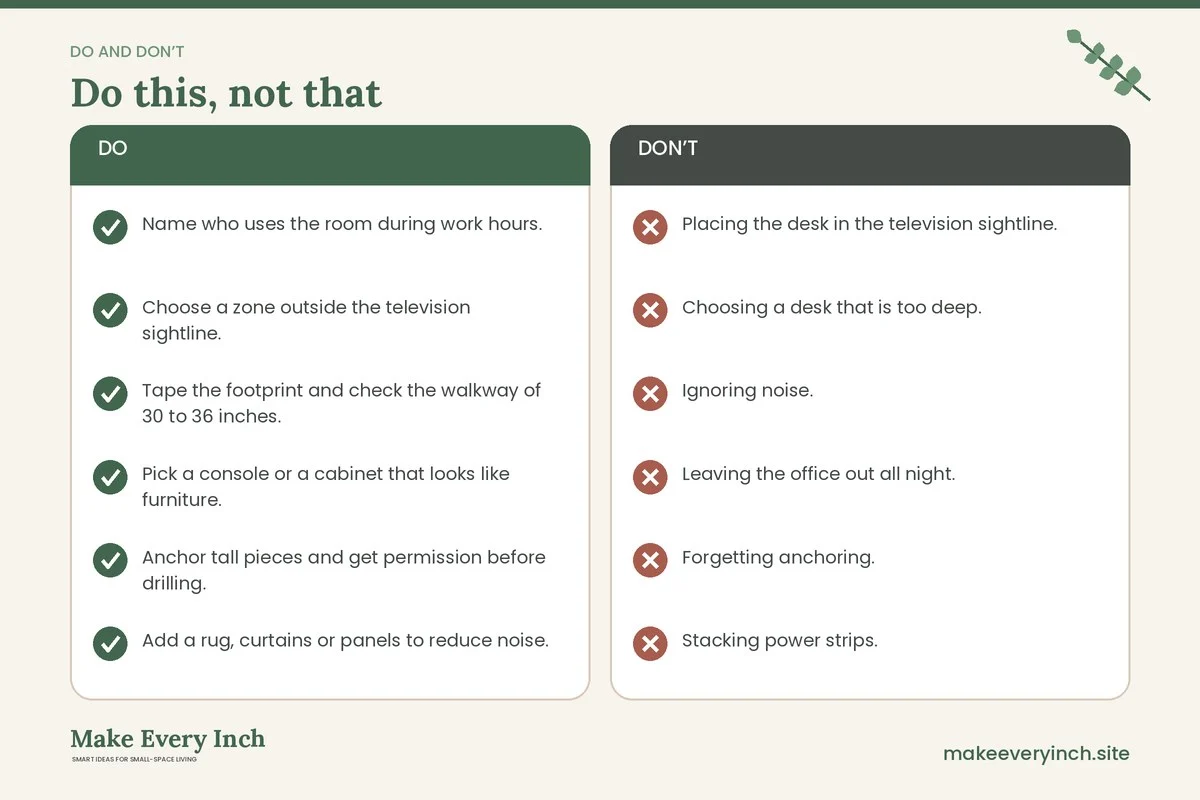
- Placing the desk in the television sightline. It forces the two functions to compete.
- Choosing a desk that is too deep. A 24-inch desk can swallow a small room. Try a console.
- Ignoring noise. Hard floors and bare walls amplify calls. Add soft materials.
- Leaving the office out all night. A visible workstation prevents the room from relaxing.
- Forgetting anchoring. Tall cabinets need straps.
- Stacking power strips. Overloads create a fire risk.
- Working on the sofa. It is comfortable at first, but may cause strain over a long day.
Budget and phasing
Start with the cheapest changes. Move the desk, add a rug and a lamp, and set up the evening reset. Next, add a basket, a tray and a headset. Then consider a cabinet or a console. Second-hand furniture shops and online marketplaces often have consoles, cabinets and armoires at lower cost. Measure the doorway and the stairs before buying a tall piece.
Living room office checklist
- Name who uses the room during work hours.
- Choose a zone outside the television sightline.
- Tape the footprint and check the walkway of 30 to 36 inches.
- Pick a console or a cabinet that looks like furniture.
- Anchor tall pieces and get permission before drilling.
- Add a rug, curtains or panels to reduce noise.
- Plan a tidy background for video calls.
- Use a task lamp and avoid glare on the screen.
- Use one rated power strip and keep cords out of the path.
- Keep supplies in a basket, a box and a drawer.
- Agree on call times and signals with others.
- Run the ten-minute evening reset every day.
FAQ
How do I set up a home office in a living room?
Choose a zone away from the television, use a console or a cabinet that looks like furniture, and add a routine that clears the area each evening.
What is the best desk for a small living room?
A console desk, 12 to 18 inches deep, or a desk armoire that closes. Both look like furniture and take little floor space. See our guide to the best desks for small apartments.
How do I hide a home office in a living room?
Use a cabinet or armoire with doors, a folding screen, a curtain on a tension rod or a lidded basket for the laptop and cables.
How can I reduce noise in a living room office?
Add rugs, curtains and soft panels, use a headset, and schedule calls. A bookcase behind or beside you also helps.
Can I put a desk behind the sofa?
Yes, if there are about 30 inches of room between the sofa back and the desk, and the chair has space. A console that is 12 to 14 inches deep works best.
Should I mount a desk to the wall in a rental?
Only with written permission. If you cannot drill, choose a freestanding console or a cart. Our guide to no-drill storage ideas for renters has more options.
How do I stay focused when the television is on?
Place the desk out of sight of the screen, wear headphones, and agree on quiet times. If needed, move to another room for focus tasks.
Is it fine to work on the sofa?
For short periods, yes. For long days, a desk and a supportive chair are usually more comfortable. Ergonomics vary, so consult a qualified professional if you have pain.
Keep going: Keep planning with our small home office ideas pillar, the guide to small living room ideas and the sibling post on small home office ideas in a bedroom.
Save this guide for later
Pin the ideas you like to Pinterest so you can come back to them when you plan your space.