16 Small Living Room Ideas Without a Coffee Table Budget Fixes That Cost Little
Quick answer: The cheapest small living room ideas without a coffee table budget plans are to use what you already own: a stool, a stacked-crate cube, a lap tray, a thrifted nesting table, a plank-on-cubes shelf or a clip-on sofa tray. Most of these cost somewhere between nothing and a modest sum, take an afternoon or less, and free up 12 to 20 inches of floor depth. Start with a free trial using a stool and a tray, then spend only on the piece you keep reaching for.
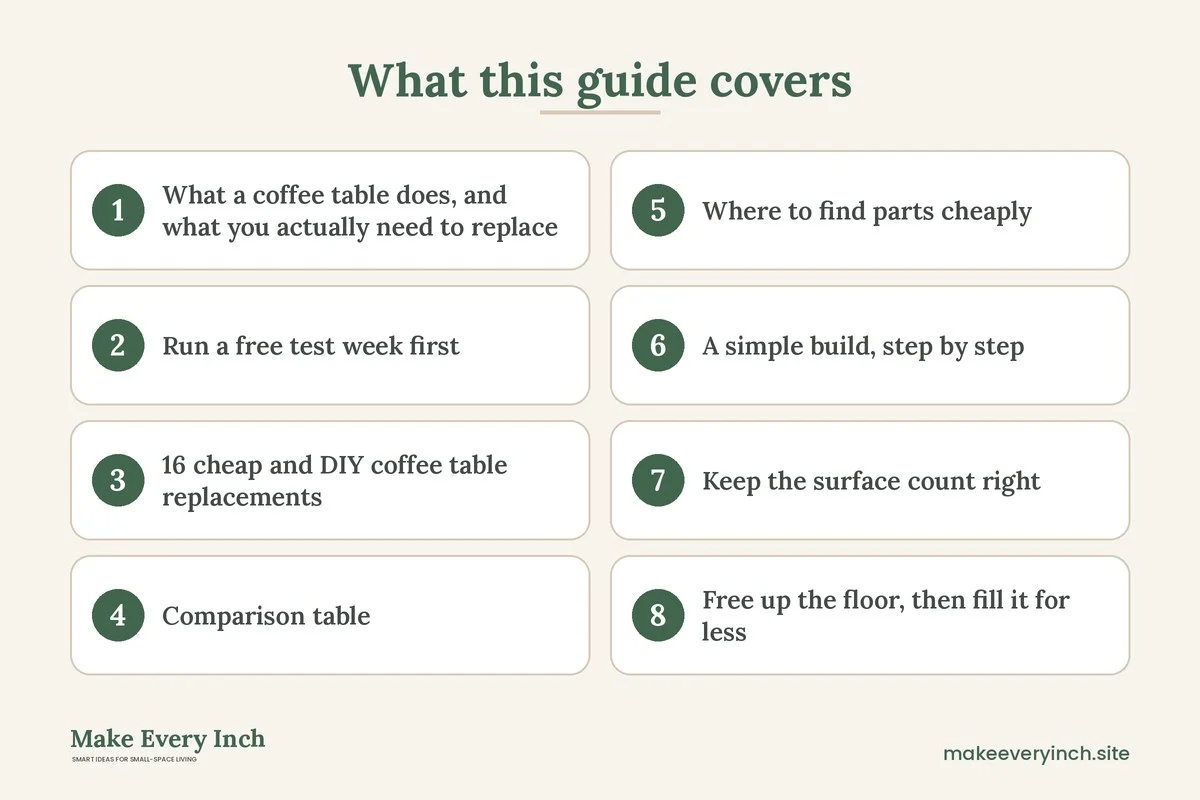
Small living room ideas without a coffee table budget searches usually come from one of two situations. Either the coffee table you own is too big and you want it gone, or you cannot afford a new one and you want to know whether the room can work without it. Both are good reasons, because a coffee table is one of the easiest pieces to replace with something cheaper, smaller or homemade. This guide covers what a coffee table actually does for you, how to test life without one for free, 16 low-cost and DIY replacements with rough cost ranges, build steps with measurements, a comparison table, where to hunt for secondhand pieces, a spend-in-order plan and a checklist. Every price in this post is a loose range, since costs vary by city, season and store, so treat the numbers as planning guides and not quotes. For the full overview of the topic, see our pillar guide on small living room ideas without a coffee table, and for the wider picture see small living room ideas.
What a coffee table does, and what you actually need to replace
Before you spend anything, list the jobs the table does for you. Most people use a coffee table for four things: a landing spot for drinks, a place for the remote and a book, a spot for a laptop or a snack, and a bit of display with a plant or a candle. Very few people use all four every day. If you only rest a mug on it, a tiny side table or a tray handles the whole job for a fraction of the money and floor space.
The second question is how much room it takes. A typical coffee table runs around 40 to 48 inches long, 20 to 26 inches deep, and 15 to 18 inches high. In a 10 by 12 foot room, that footprint, plus the 14 to 18 inches you leave between sofa and table, eats up to 3 feet of depth. Removing it can change a walkway from 24 inches to 36 inches, and that is the real saving. Budget decor works best when you spend money on the jobs you need and skip the ones you do not.
The third question is what the room does without it. Some rooms feel emptier with a bare rug in the middle. Others feel bigger and calmer. A free test, described in the next section, answers this before you buy a thing.
Run a free test week first
The cheapest decision is the one you make before shopping. Move the coffee table out for seven days, to a bedroom or a closet, and live in the room as normal. Keep a note on your phone each time you wish you had it. After a week, count the notes and read them.
If you wrote “no spot for my drink” five times, you need a small surface within arm’s reach of each seat, and that points to side tables, stools or a clip-on tray. If you wrote “no place for the laptop,” you need a lap desk or a tray with legs. If you wrote nothing, the room is fine and you can stop here, and the saved money goes elsewhere. During the test, use free stand-ins: a sturdy stool, an upturned laundry basket with a board on top, a cutting board on a pouf, a chair pulled alongside the sofa. These cost nothing and show you which height and position feel right. Measure the spot where the stand-in felt best, since that measurement will guide a purchase or a build.
16 cheap and DIY coffee table replacements
Each idea lists a rough cost range, a rough build time and the situation where it works best. Ranges are hedged on purpose. Secondhand prices swing widely, and new prices shift from store to store.
Free and near-free
1. A stool with a tray on top
A kitchen stool or a step stool, topped with a serving tray, works as a movable surface. Cost: free if you own both, or a low amount for a tray. Keep the stool seat 16 to 20 inches high, close to sofa arm height, so a mug is easy to reach. Move it away when you want the floor clear.
2. A stack of hardcover books and a board
Three to five large books stacked to about 16 inches, with a cutting board or a wood offcut on top, makes a rough side surface. Cost: free to very low. This is a stopgap and a test, not a long-term piece, because stacks can slide. Fix the pile with a few dots of removable putty between layers.
3. A laundry basket or storage bin turned over
A sturdy plastic bin, turned upside down with a board on top, gives you a hollow stand. Cost: free if you own the bin. Hide it under a throw or a scarf, and use it only for light items. It works well for a trial week.
4. A floor cushion and a lap tray
Skip the table and sit lower. A floor cushion or a pouf with a lap tray turns the rug into a snack zone for guests. Cost: free to low if you already own cushions. It suits informal rooms, and it keeps the center of the room open.
5. A kitchen chair pulled alongside the sofa
An extra dining chair beside the sofa arm holds a drink and a book on its seat. Cost: free. It looks casual, but it needs no purchase, and you can slide it back to the table when guests leave.
Thrifted and secondhand
6. A thrifted nesting table
Nesting tables pull apart to give you two or three small surfaces and tuck together when you want space. Cost: often a low to modest amount at thrift shops or secondhand marketplaces. Check that the legs are even and that the top has no wobble. A coat of paint or a wipe of furniture oil can change the look completely.
7. A small round side table
A round top, around 16 to 22 inches across, has no corners to bump. Cost: low to modest secondhand. Place it at the sofa arm, at about 20 to 24 inches high, so you can reach it without leaning. Two of them, one on each side of the sofa, serve the same purpose as one big table.
8. A vintage trunk or a small chest
A trunk at the foot of the sofa gives you a flat top and a hidden compartment for blankets. Cost: varies widely, from low at a yard sale to higher at an antique shop. Look for a lid that closes flat and hinges that work. It doubles as storage, so it replaces two pieces.
9. A thrifted stool or a plant stand
A short plant stand or a wooden stool holds a lamp, a candle or a mug. Cost: low. Scan the plant section of a secondhand store, since the stands are often lightweight and narrow, between 10 and 14 inches wide, perfect for a tight room.
10. A small bench or a footstool
A bench at the sofa end can hold a tray and also seat a guest. Cost: low to modest secondhand. Choose one with a flat, hard top at 17 to 19 inches high, or add a tray to make a hard surface on a soft ottoman. For storage versions, see our guide to the best storage ottomans.
DIY builds
11. A plank on two cubes
Two square storage cubes or two sturdy crates, spaced about 24 inches apart, with a smooth plank across the top, make a bench-height table with open shelves below. Cost: low to modest, depending on the wood. Plan the plank at 36 to 42 inches long and 12 to 16 inches deep. Sand the edges, then seal the top with a clear finish so mugs do not leave rings.
12. A stacked-crate cube
Two or three wooden crates screwed or glued together create a cube with open compartments. Cost: low. Aim for a final size near 16 by 16 inches and 16 to 18 inches tall. Sand the rough spots, add felt pads under the base, and set a tray on top. The open slots hold magazines or a basket.
13. A tree-stump or log-slice table
A thick slice of wood, 14 to 20 inches across and 14 to 18 inches high, makes a rustic side table. Cost: free if you have the wood, or low to modest to buy a cut round. Sand it, seal it and add felt feet. It suits cozy, natural rooms, and it needs no assembly.
14. A spool or a pallet-style coffee cube
A cable spool or a small pallet-wood box can be sanded, sealed and set on casters. Cost: low to modest. Check that the wood is clean and untreated before you bring it indoors, and avoid anything that smells strongly of chemicals. A coat of paint can match the room.
15. A hairpin-leg tabletop
Buy a pre-cut round or oval board and a set of hairpin or screw-in legs, and you can build a simple side table in under an hour. Cost: low to modest for the parts. Legs of 14 to 16 inches give you a low table, and 20 to 24 inches suits a side table. Pre-drilled plates make this a screwdriver job, with no special tools.
16. A clip-on or hooking tray
A tray that hooks over the sofa arm, or a flat board with a lip, gives you a surface with no floor footprint at all. Cost: low. Measure your sofa arm width, since arms range from 3 to 8 inches wide. Use a felt strip under the tray to protect the fabric. This is the cheapest way to reclaim the floor while still having a spot for a drink.
Comparison table: cost, effort and floor space
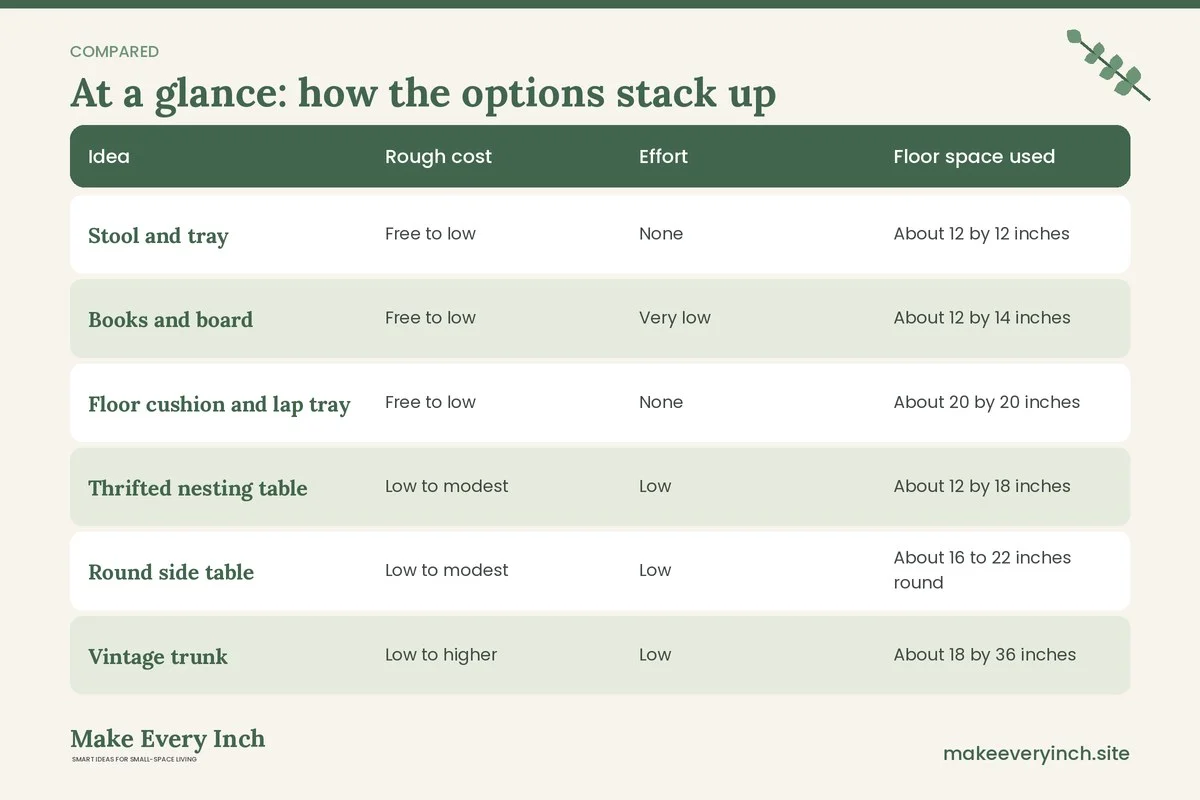
This table compares the ideas by rough cost, effort and the floor space each one takes. Cost bands are relative and approximate: “free” means items you already own, “low” means a small spend, and “modest” means a bit more than that. Your local prices may differ.
| Idea | Rough cost | Effort | Floor space used | Best for |
|---|---|---|---|---|
| Stool and tray | Free to low | None | About 12 by 12 inches | Trial week |
| Books and board | Free to low | Very low | About 12 by 14 inches | Short-term stopgap |
| Floor cushion and lap tray | Free to low | None | About 20 by 20 inches | Casual rooms |
| Thrifted nesting table | Low to modest | Low | About 12 by 18 inches | Flexible rooms |
| Round side table | Low to modest | Low | About 16 to 22 inches round | Sofa arms |
| Vintage trunk | Low to higher | Low | About 18 by 36 inches | Hidden storage |
| Small bench | Low to modest | Low | About 14 by 36 inches | Sofa end |
| Plank on cubes | Low to modest | Medium | About 14 by 40 inches | Shelf and surface |
| Stacked-crate cube | Low | Medium | About 16 by 16 inches | Open storage |
| Log slice | Free to modest | Low | About 14 to 20 inches round | Cozy rustic rooms |
| Hairpin-leg top | Low to modest | Low | About 16 to 24 inches | Clean modern look |
| Clip-on tray | Low | None | None | Tightest rooms |
Where to find parts cheaply
Thrift stores, charity shops, estate sales, curb-side days, neighborhood groups and online secondhand listings are the usual hunting grounds for small tables. Go early in the day, and go on the same weekday each week if a store restocks regularly. Search with several words, such as “side table,” “nesting table,” “plant stand,” “stool,” “trunk” and “end table,” since sellers label the same piece differently.
When you inspect a piece, check four things. Press on the top to test for a wobble. Look underneath for water damage or loose joints. Sniff for smoke or damp, which can be hard to remove from wood. Measure the height against your sofa arm. A small flaw can be fixed with wood glue, a screw or a felt pad, while smoke odor often cannot be fixed cheaply, so walk away from that one.
For DIY parts, a hardware store cut service often trims a board to size for little or nothing, and offcut bins can have bargains. Ask about sanding blocks and a clear sealer in the same visit, since a finished top matters more than the legs. For more hunting ideas, see our guide on thrifted apartment decor ideas.
A simple build, step by step: plank on cubes
This build suits a beginner and needs few tools. Here is a typical plan, with the measurements you can adjust.
- Choose two cubes or crates, each about 12 to 14 inches square, and a plank about 36 to 42 inches long and 12 to 16 inches deep.
- Place the cubes about 24 to 28 inches apart on the floor, and set the plank across to check the height. For most sofas, a total height of 16 to 18 inches works well.
- Sand the plank edges and the top with medium and then fine sandpaper until smooth.
- Wipe off the dust, then apply a clear sealer or a wipe-on finish. Let it dry as the product label says.
- Stick felt pads on the underside of the cubes to protect the floor, and place a strip of non-slip grip between the plank and the cubes.
- Set the plank on the cubes, and add a basket in the open space for blankets or magazines.
If you are not sure the build will hold, test it with a few heavy books before you use it. Never stand on a homemade table, and avoid it entirely in a home with small children who climb, unless you fix the plank to the cubes with brackets.
Keep the surface count right
A budget plan can fail by overspending on surfaces. The usual target is one surface within reach of each seat, and no more. A sofa for two needs a surface at each arm or one in the middle. An armchair needs one within a short reach. If you count more than one surface per seat, you have bought too many.
Match heights as well. A surface at the sofa arm height, or a little below it, is easy to use. A surface that sits much higher than the seat forces your arm up, and a surface that sits much lower means you bend. Aim for 16 to 24 inches, with 18 to 22 inches as the sweet spot for most sofas.
Free up the floor, then fill it for less
When the table leaves, the center of the room opens up. Use it well, and cheaply. A larger rug is often the best use of money here. A rug of 5 by 8 feet under the front legs of the sofa and chairs makes the group feel planned, and it can often be found secondhand or in an end-of-season sale. See our guide to small living room layout ideas on a budget for rug sizes and placement.
Other cheap fillers include a floor lamp in a corner, a basket of throws, a pouf for extra seating, and a plant on a stand. Lighting helps most. A lamp with a warm bulb at seat height makes the room look finished at little cost. For ideas, see small living room lighting ideas. If storage was the real job of your old table, a basket or an ottoman picks it up, and the small living room storage ideas guide has low-cost options.
Renting? Keep it removable
If you rent, choose pieces that leave no marks. Freestanding tables, trays, stools and baskets cost nothing to remove, while anything you screw into a wall belongs to the landlord’s rules. Felt pads protect floors, and a rug pad keeps a rug from sliding. Clip-on trays rest on the sofa and cause no damage. For more ideas that respect a lease, read our guide to renter-friendly apartment decorating ideas and the notes on DIY apartment upgrades.
Three budget plans by room size
These are examples, not prescriptions. Adjust to your own measurements, and treat every figure as approximate.
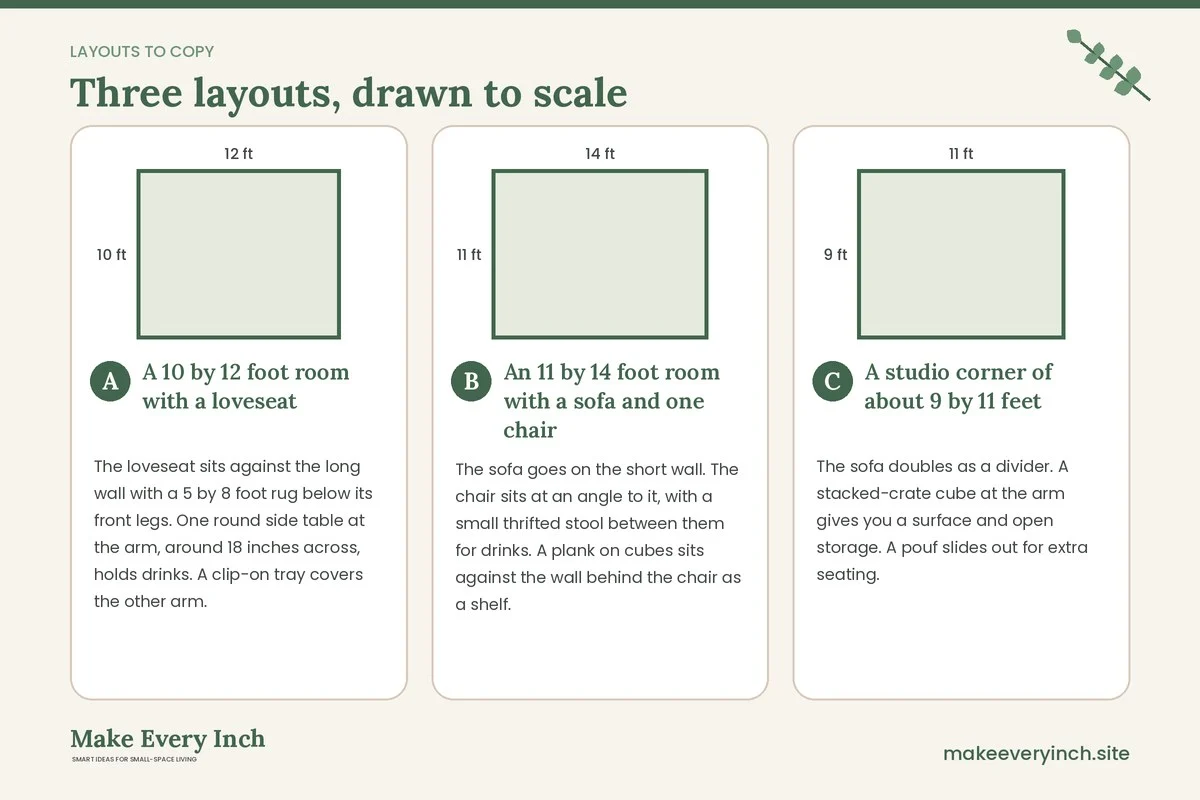
A 10 by 12 foot room with a loveseat
The loveseat sits against the long wall with a 5 by 8 foot rug below its front legs. One round side table at the arm, around 18 inches across, holds drinks. A clip-on tray covers the other arm. A floor lamp sits in the corner. Total spend can stay low if the side table is secondhand and the tray is simple. The center floor stays open for walking, with about 36 inches of clearance.
An 11 by 14 foot room with a sofa and one chair
The sofa goes on the short wall. The chair sits at an angle to it, with a small thrifted stool between them for drinks. A plank on cubes sits against the wall behind the chair as a shelf. A rug of 6 by 9 feet ties the group together. Most of the budget goes to the rug, and the rest to a lamp.
A studio corner of about 9 by 11 feet
The sofa doubles as a divider. A stacked-crate cube at the arm gives you a surface and open storage. A pouf slides out for extra seating. For more ideas on studios, see small apartment living room ideas for studios. Everything here can be moved or removed easily when the lease ends.
Common budget mistakes
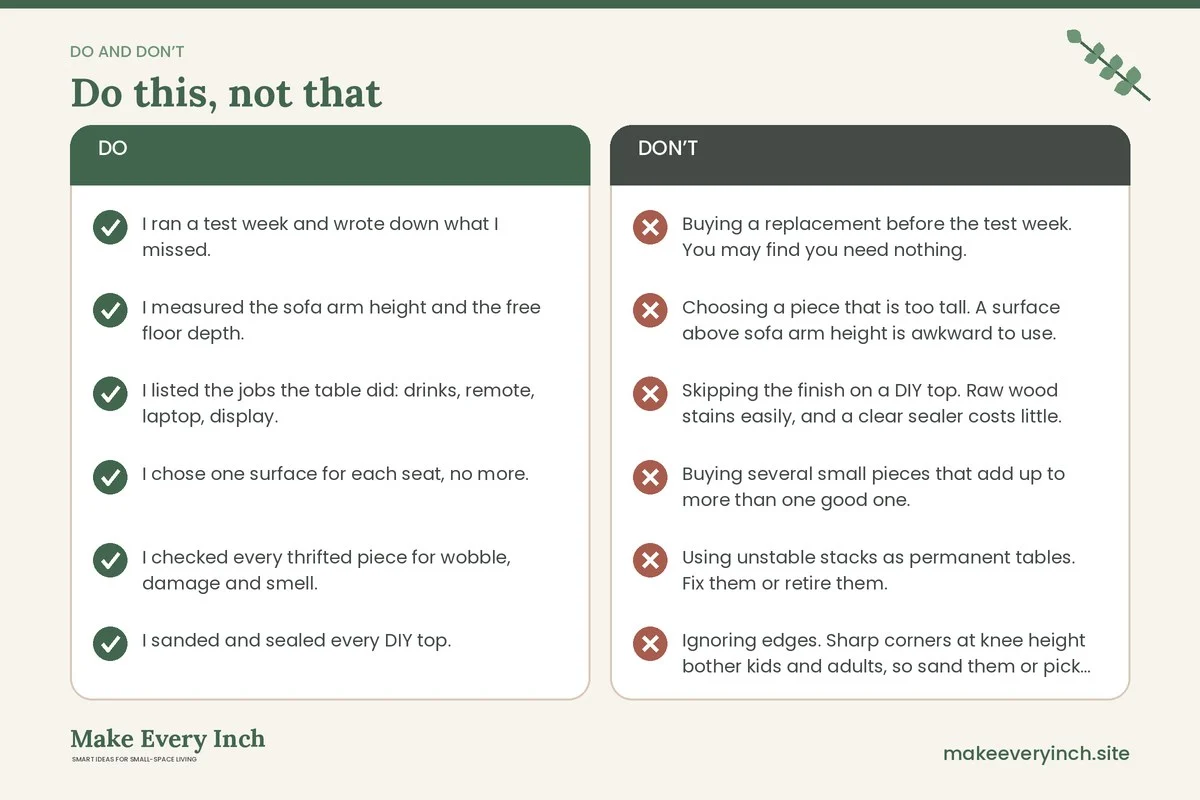
- Buying a replacement before the test week. You may find you need nothing.
- Choosing a piece that is too tall. A surface above sofa arm height is awkward to use.
- Skipping the finish on a DIY top. Raw wood stains easily, and a clear sealer costs little.
- Buying several small pieces that add up to more than one good one.
- Using unstable stacks as permanent tables. Fix them or retire them.
- Ignoring edges. Sharp corners at knee height bother kids and adults, so sand them or pick round tops.
- Forgetting the rug. A small rug floats, and a rug of the right size makes cheap furniture look deliberate.
Spend in this order
If you have a small budget, spend in this order, and stop when the room works.
- First, nothing. Run the test week with stand-ins.
- Second, a surface for each seat: a tray, a thrifted side table or a stool.
- Third, a rug that reaches under the front legs of the seats.
- Fourth, a lamp at seat height with a warm bulb.
- Fifth, a basket or ottoman to catch the clutter the old table used to hide.
- Last, small decor such as a plant or a candle.
For a more detailed plan with a total target, see our small living room makeover under 500 and the wider small apartment living room ideas on a budget guide.
Pairing the budget approach with a style
Budget pieces take on the style of the room, so choose finishes to match. For a warm, layered look, see the cozy version of these ideas and our cozy small living room layout ideas. For a pared-back approach, the minimalist approach shows how fewer pieces can look intentional, and the Japandi version suits natural wood and low lines. If you prefer clean shapes, read the modern take.
Budget checklist
- I ran a test week and wrote down what I missed.
- I measured the sofa arm height and the free floor depth.
- I listed the jobs the table did: drinks, remote, laptop, display.
- I chose one surface for each seat, no more.
- I checked every thrifted piece for wobble, damage and smell.
- I sanded and sealed every DIY top.
- I added felt pads under every leg.
- I left 30 to 36 inches for the main walkway.
- I chose a rug that reaches under the front legs.
- I placed a lamp at seat height.
- I kept receipts and notes so I can return what does not work.
FAQ
Can I really live without a coffee table on a tight budget?
Yes, for many rooms. Side tables, trays, stools and ottomans cover the same jobs. Many people find they rarely used the table beyond drinks. Run the free test week, then spend only on the gaps.
What is the cheapest coffee table replacement?
Items you already own cost nothing: a stool with a tray, a kitchen chair beside the sofa, a basket with a board. After that, clip-on trays and thrifted stools are often among the lowest-cost options, though prices vary by area.
What height should a replacement be?
Aim for 16 to 24 inches, close to or just below the sofa arm height. Anything much higher is awkward to reach from a seated position.
How do I stop a DIY wood top from staining?
Sand it smooth, then apply a clear sealer or a wipe-on finish according to the label. Use coasters as well. A sealed top wipes clean much more easily.
Are crates and pallets safe to use indoors?
Often yes, if the wood is clean, dry and untreated. Avoid wood with a chemical smell, stains or signs of mold. Sand all splinters, and seal the surface. If you are unsure, buy a pre-cut board instead.
Where can I put a laptop without a table?
Use a lap desk, a tray with legs or a plank on cubes at about 24 inches high. A bench at the sofa end can also work as a perch for a short session.
What if I need storage the table used to provide?
Use a lidded basket, a trunk, a storage ottoman or a cube with open shelves. These replace the table and the storage in one purchase. Our cheap storage ideas for apartments guide has more.
How do I know when to stop buying?
Stop when every seat has a surface within reach, the walkway measures 30 to 36 inches and the room feels calm. More pieces after that add clutter, not comfort.
Keep going: Ready to plan the room? Start with the small living room ideas without a coffee table pillar guide, then see the small living room layout ideas cozy plans and the small living room ideas hub for more.
Save this guide for later
Pin the ideas you like to Pinterest so you can come back to them when you plan your space.