14 Small Foyer Ideas for Apartments With No Entry Hall
Quick answer: In small foyer apartments, start with the door swing and the walkway, not the decor. Keep a clear 30 to 36 inches in front of the door, mount or place storage only on the wall the door does not hit, and give every daily item (keys, mail, shoes, one coat) one home within arm’s reach. Then add a mirror, a light and a mat to make the space feel finished.
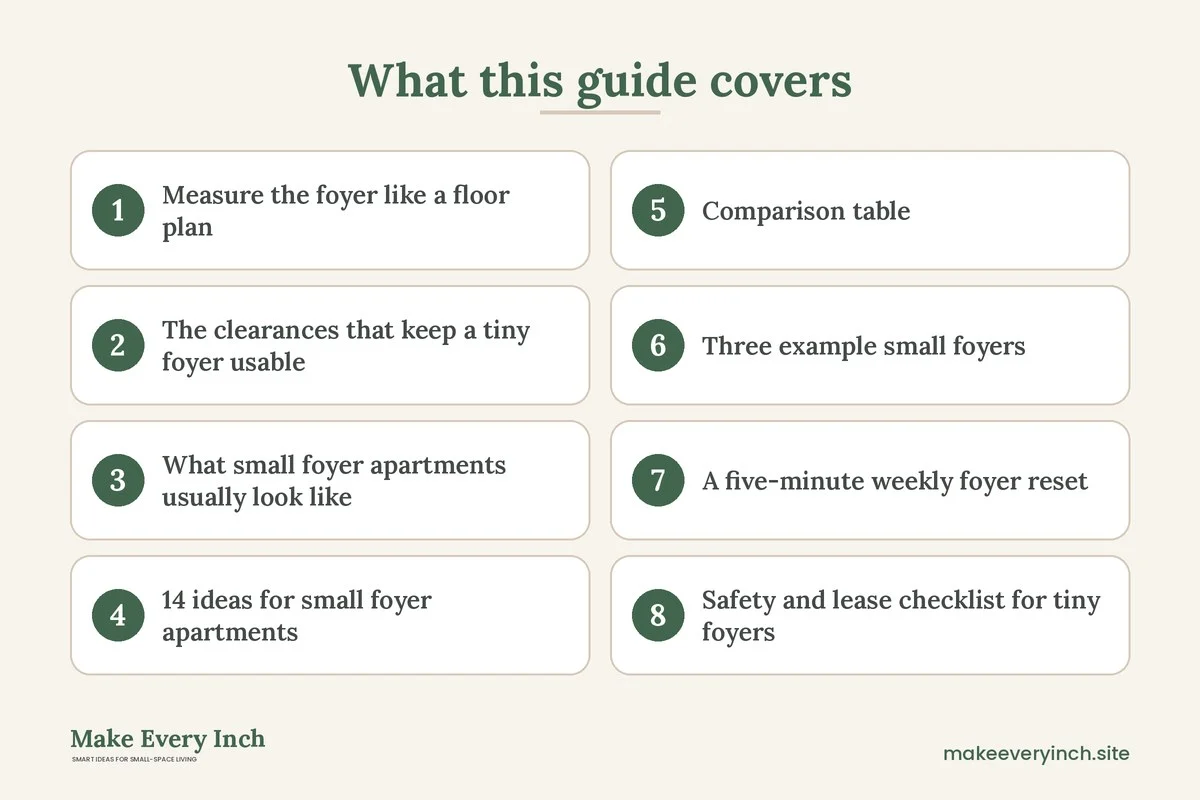
Small foyer apartments share a quirk that bigger homes do not have: the front door often opens straight into the room, or into a pocket of floor that is only 3 or 4 feet square. There is no hall, no closet, and sometimes a view of the bed or the sofa the moment the door swings wide. This guide is about that exact situation. It does not repeat general entryway advice. Instead it walks through the door swing, the sightline, the clearance numbers and the few pieces of furniture that fit a 12 to 20 square foot landing. You will find 14 ideas, a comparison table, three example foyers, a weekly routine, a checklist and an FAQ. For the broader picture, read our main guide to small entryway ideas, then compare it with our post on tiny foyer ideas and the plan for a no entryway apartment.
Measure the foyer like a floor plan
A small foyer is a geometry problem before it is a design problem. Three measurements decide almost everything, so take them before you buy a single basket.
- The landing: the clear floor between the door and the first piece of furniture or the first wall. Measure the width and depth in inches. Many apartment landings are 36 by 48 inches or smaller.
- The door swing: open the door fully and note where it stops. Mark the arc on the floor with painter’s tape. Anything inside the arc will be hit by the door, and anything just outside it is where you can safely put a rug, a stool or a shoe tray.
- The hinge wall and the latch wall: the wall behind the open door (the hinge side) is usually dead space and the best place for a slim hook rail or a narrow shelf. The latch side often has a light switch, a thermostat or an intercom panel, so check before you place anything there.
Also note the ceiling light position, the nearest outlet and the height of any switch. A foyer tends to have one outlet at most. If you plan a lamp, check where the cord can run without crossing the walking path.
The clearances that keep a tiny foyer usable
These numbers are common starting points for adults with outdoor clothes and bags. Adjust them for strollers, wheelchairs or walkers, which need more room.
- Front of the door: 30 to 36 inches of clear floor so you can open the door, step in and close it without bumping furniture.
- Standing room: about 24 by 24 inches to remove shoes while holding a bag. If you sit to put shoes on, add the footprint of a stool or bench.
- Shelf depth: 6 to 10 inches deep is enough for keys, mail and a small tray. Deeper than 12 inches in a foyer under 4 feet wide starts to catch shoulders.
- Hook height: 60 to 66 inches for adult coats, 40 to 48 inches for children, and a lower row for bags.
- Mirror height: the center at about 57 to 60 inches, or a long mirror leaning at a slight angle.
- Wall protrusions: keep anything that sticks out more than 10 inches clear of the main walking line.
Tape the real footprint of every item on the floor before buying. Walk in with your usual bag and a coat on. If you turn sideways, the plan is too tight.
What small foyer apartments usually look like
Not every small foyer is the same, and the right fix depends on the type. Check which of these fits your door.
- The open-door foyer: the door opens directly into the living area or the kitchen. You need a visual boundary, not a wall.
- The pocket foyer: a 3 by 4 foot alcove with a wall on one or two sides. Wall storage is easy, floor space is not.
- The corridor foyer: a short entry hall of 3 feet wide and 6 to 8 feet long. There is room for a slim console, but shoulders are close to the walls.
- The shared-landing foyer: the apartment door opens onto a building hallway. Your entry may be only a mat and a shelf inside, with strict rules about what can sit outside.
If you rent, read the lease for rules about the corridor. Many buildings do not allow shoe racks, mats or decor outside the unit for fire safety reasons, so keep everything inside your front door.
14 ideas for small foyer apartments
Define the landing without a wall
1. A rug that marks the edge of the foyer
A flat, low-profile rug, about 2 by 3 feet or 2 by 4 feet, tells the eye where the entry ends and the living room begins. Choose a thin, non-bulky weave so the door does not catch on it, and use a grip pad so the corners do not curl. A rug also gives wet shoes somewhere to land. If the door opens over the rug, test it after tucking the edges flat.
2. A line of paint or tape in a different color
If you may paint, a half-wall color or a rectangular panel painted around the door can make a landing feel like a room of its own. Choose a low-VOC paint, open a window while painting and keep it ventilated while it dries. If you may not paint, use removable wallpaper on a single panel or a simple frame made from renter-safe tape. Our guide to removable wallpaper ideas covers how to apply and take it off.
3. A tall, narrow console that doubles as a divider
In an open-door foyer, a console 10 to 12 inches deep placed perpendicular to the door can screen part of the living room. Make sure it does not sit in the door’s arc and that it is stable. Tall or top-heavy pieces should be anchored to the wall only with your landlord’s permission, so choose low, wide-based pieces if you cannot drill.
Use the hinge wall
4. A slim hook rail behind the open door
The wall behind the open door is often wasted. A single rail with three to five hooks at 60 to 66 inches can hold coats and a bag. Because the door stops short of the wall, hooks that project less than 4 inches are safest. Use adhesive hooks within their stated weight limit, and check the surface first. Painted drywall is usually fine, but textured or freshly painted walls may peel. See renter friendly entryway organization ideas for adhesive tips.
5. An over-the-door organizer on the inside
An organizer that hangs over the door can hold hats, gloves and a leash. Check the door thickness and make sure it does not stop the door from closing or scratch the frame. Never hang heavy items on a fire door. If the door is a fire-rated door, read your building rules first.
6. A narrow wall shelf above the hooks
A 6 to 8 inch shelf at about 70 inches holds a tray for keys and a small plant. Keep the top clear of fragile glass, because the door and shoulders can bump it. Mount it only if you have permission or use a renter-safe method rated for the weight.
Seat and shoe solutions
7. A shoe tray that holds just the week’s pairs
In a tiny foyer, a full shoe rack will not fit. Use a 24 to 30 inch tray beside the door for the two or three pairs you actually wear this week. Move the rest to a closet or under the bed. If a rack is essential, choose a slim, tilted design 7 to 9 inches deep. Our small shoe storage ideas post shows more layouts.
8. A wall-hung or fold-down seat
If you cannot fit a bench, a fold-down seat or a stool that tucks under the shelf serves for putting on shoes. A stool with a flat top also works as a place for a bag. Keep the folded seat within the door’s clear zone, and test it with a person sitting down.
9. A bench that doubles as storage
When the landing is 4 feet or wider, a bench 12 to 14 inches deep and about 36 inches wide can hold baskets underneath. Check the corners for sharp edges, and place it where the door will not hit it. For ideas, read our small entryway bench ideas.
Light, mirror and air
10. A mirror that opens the sightline
A mirror opposite or beside the door reflects light and makes a small foyer feel larger. Place it so it does not reflect the bed or a cluttered corner. A leaning mirror must be secured, so use the manufacturer’s anti-tip hardware only where you have permission, or hang a lightweight one with a removable adhesive rated for its weight.
11. Warm lighting where the ceiling light does not reach
Many foyers have a single harsh bulb. A plug-in wall sconce or a rechargeable light near the hooks makes the landing feel welcoming. Keep cords off the floor and out of the walking path, and use cord covers that do not damage the wall. Our small hallway lighting ideas guide describes safe options for dark entries.
12. A hidden ventilation plan
Wet coats and shoes can make a closed foyer smell. Let shoes dry on a tray near a window or a vent, never in front of a heater, and avoid blocking air vents, radiators or electrical panels with furniture. Leave at least 3 feet of clear space in front of an electrical panel if one is in the entry.
Keep it quiet and tidy
13. A single catch-all for keys, mail and packages
Pick one shallow tray or bowl for keys and one small box for mail. A foyer with a dozen decor items feels more cramped than one with three. If you receive packages, set a rule to open them within a day and take the cardboard out, since boxes pile up quickly in a tiny landing.
14. A wall decor piece that adds height
Tall, narrow art or a vertical row of three small frames draws the eye up, which makes the ceiling feel higher. Use removable strips within their weight limit. For layouts, see our guide to small entryway wall decor ideas.
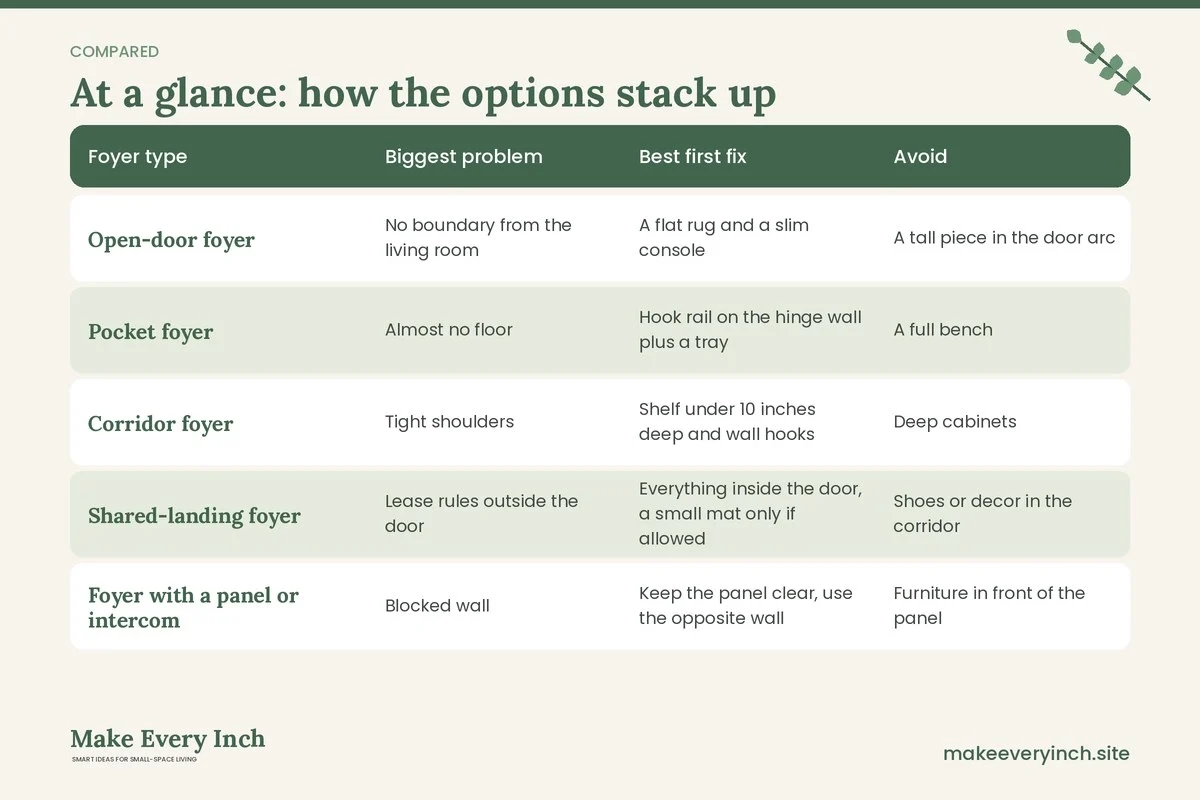
Comparison table: which fix suits which foyer
| Foyer type | Biggest problem | Best first fix | Avoid | |
|---|---|---|---|---|
| Open-door foyer | No boundary from the living room | A flat rug and a slim console | A tall piece in the door arc | |
| Pocket foyer | Almost no floor | Hook rail on the hinge wall plus a tray | A full bench | |
| Corridor foyer | Tight shoulders | Shelf under 10 inches deep and wall hooks | Deep cabinets | |
| Shared-landing foyer | Lease rules outside the door | Everything inside the door, a small mat only if allowed | Shoes or decor in the corridor | |
| Foyer with a panel or intercom | Blocked wall | Keep the panel clear, use the opposite wall | Furniture in front of the panel |
Three example small foyers
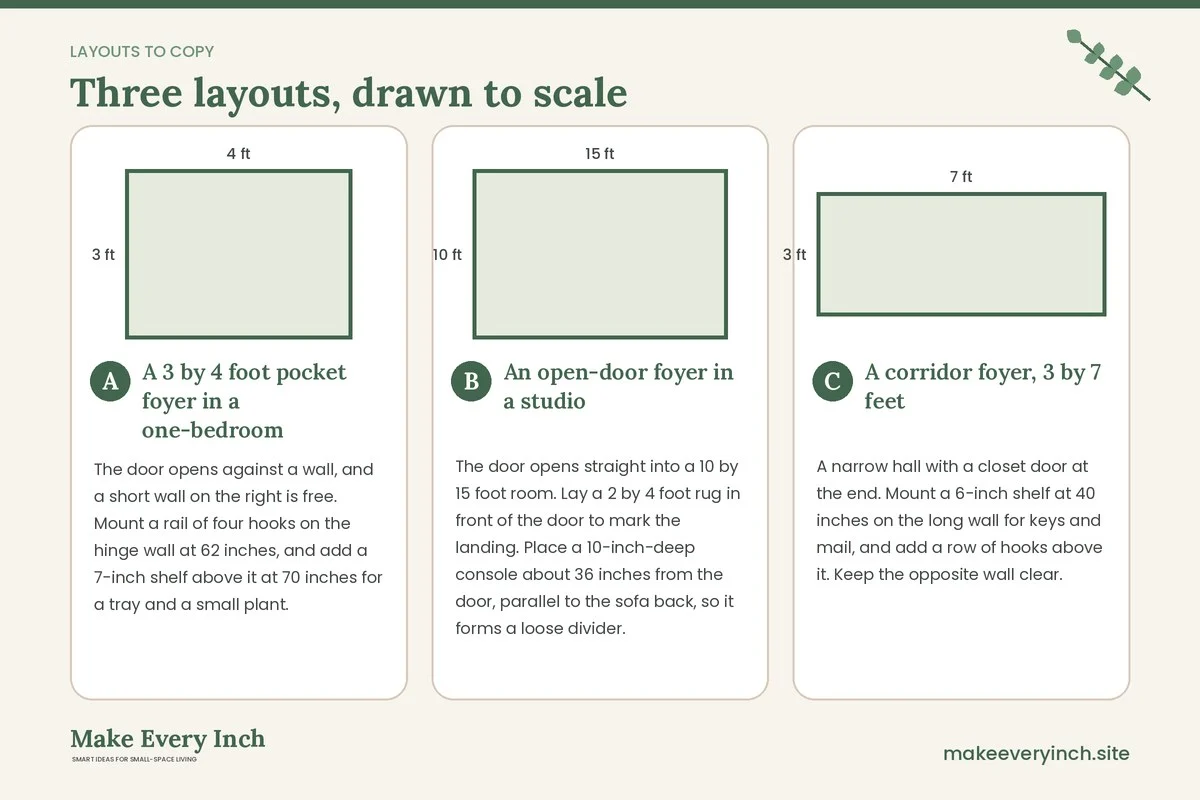
A 3 by 4 foot pocket foyer in a one-bedroom
The door opens against a wall, and a short wall on the right is free. Mount a rail of four hooks on the hinge wall at 62 inches, and add a 7-inch shelf above it at 70 inches for a tray and a small plant. Place a 24 by 18 inch tray on the floor for two pairs of shoes. A thin rug sits just outside the door’s arc. A leaning mirror would not fit, so a small round mirror hangs above the shelf with removable strips rated for its weight. The walkway stays at 34 inches.
An open-door foyer in a studio
The door opens straight into a 10 by 15 foot room. Lay a 2 by 4 foot rug in front of the door to mark the landing. Place a 10-inch-deep console about 36 inches from the door, parallel to the sofa back, so it forms a loose divider. Put a tray for keys and a basket for shoes underneath. Add a plug-in light on the side wall. The console stays low (about 32 inches) so it does not block the window. See studio apartment entryway ideas for more studio-specific plans.
A corridor foyer, 3 by 7 feet
A narrow hall with a closet door at the end. Mount a 6-inch shelf at 40 inches on the long wall for keys and mail, and add a row of hooks above it. Keep the opposite wall clear. A runner 24 inches wide sits on the floor, with a grip pad. A mirror at the end of the hall bounces light back. Because the path is under 36 inches, avoid benches and place a stool in the closet instead. For more ideas, read our narrow entryway ideas for better flow.
A five-minute weekly foyer reset
A small foyer collects clutter faster than any other part of the home, because everything passes through it. A short routine keeps it clear.
- Mondays: return any shoes you are not wearing this week to the closet.
- Midweek: empty the mail tray into the recycling and file anything important.
- Weekend: wipe the floor mat or rug, shake it outside if the building allows, and wipe the hooks.
- Monthly: check that adhesive hooks and shelves are still firm and have not slipped.
- Seasonally: swap the heavy coats and boots for lighter items and store the rest elsewhere. Our small coat storage ideas post shows how.
Safety and lease checklist for tiny foyers
- Never drill without permission. Read your lease, ask the landlord and photograph the wall before you start. Use adhesive products only within their weight limit.
- Anchor tall furniture. Any tall shelf or cabinet should be anchored to the wall to prevent tipping, but only with permission. If you cannot anchor, choose low pieces.
- Keep the exit clear. The foyer is your escape route. Do not block the door swing, the floor path or any exit with furniture or bags.
- Mind electrical safety. Do not run cords under rugs, do not daisy-chain extension cords and keep clutter off any electrical panel.
- Choose low-VOC finishes. If you paint a panel or refinish a bench, use low-VOC paint and ventilate until the smell fades.
- Watch trip hazards. A rug that curls or a cord across the floor is a fall risk, especially for children and older adults.
- Mind the corridor rules. Many buildings restrict items outside the unit, so keep everything inside the door.
Mistakes people make in small foyers
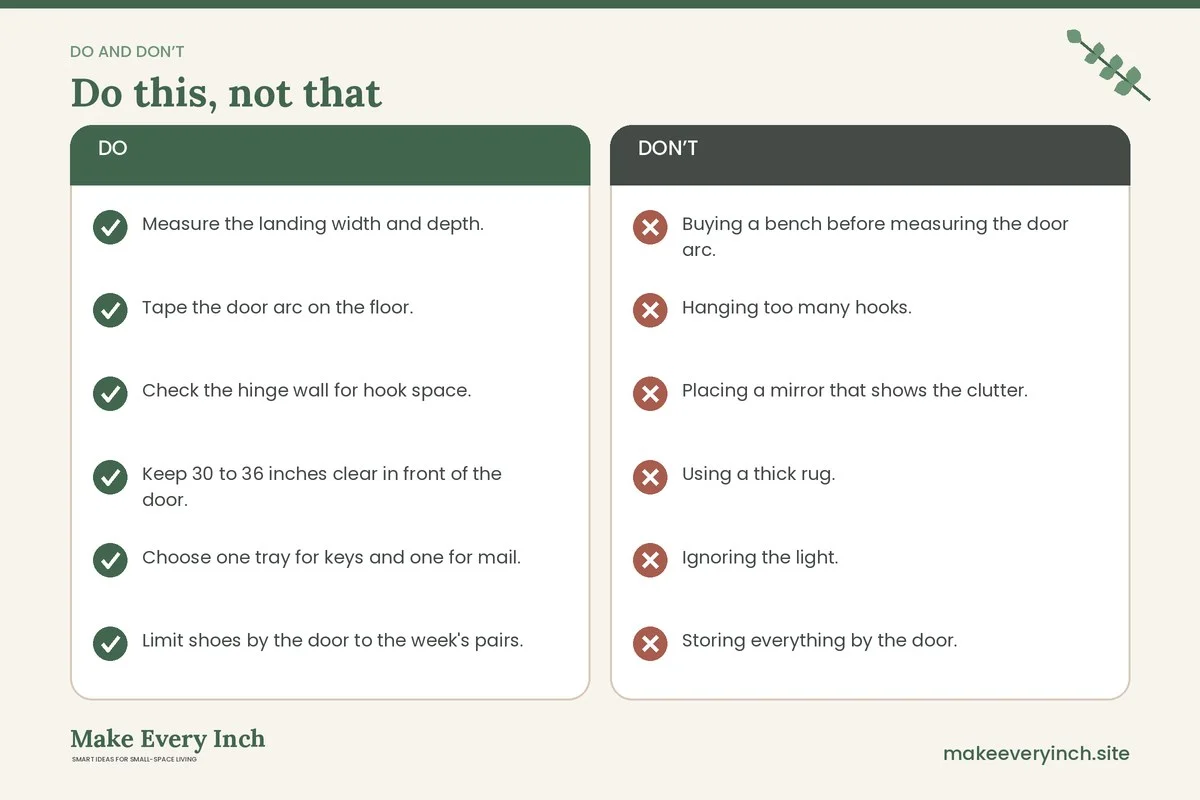
- Buying a bench before measuring the door arc. A bench that sits in the swing will be hit every day.
- Hanging too many hooks. Five hooks hold five coats, and nobody has time to sort them. Two or three is calmer.
- Placing a mirror that shows the clutter. Check what the mirror reflects from the doorway.
- Using a thick rug. Thick pile catches the door and gathers dirt.
- Ignoring the light. A dark foyer feels smaller than it is.
- Storing everything by the door. Keep only what you use this week by the door. The rest belongs in the closet.
Quick shopping notes
Start with what you own. A small tray, a basket and a few adhesive hooks solve most problems, and you can add a console or a bench later. When you shop, bring your tape measurements and the door arc. Look for pieces that are narrow rather than short, because a 10-inch-deep piece 40 inches tall holds more than a 20-inch-deep piece that blocks the walkway. Choose rounded corners, stable bases and finishes that wipe clean. Check weight limits on hooks and shelves, and keep the load well under them.
Foyer checklist
- Measure the landing width and depth.
- Tape the door arc on the floor.
- Check the hinge wall for hook space.
- Keep 30 to 36 inches clear in front of the door.
- Choose one tray for keys and one for mail.
- Limit shoes by the door to the week’s pairs.
- Add a rug with a grip pad, or skip it if it catches the door.
- Add a mirror that reflects light, not clutter.
- Add a light near the hooks.
- Check lease rules for corridor items and drilling.
- Anchor tall furniture only with permission.
- Set a five-minute weekly reset.
FAQ
How do I make a small foyer apartment feel bigger?
Keep the floor clear, use a mirror and a light near the door, and store only the week’s items by the entry. A narrow console and wall hooks free the floor.
What do I do if my door opens straight into the living room?
Mark a landing with a flat rug and a low console or tray. These give the eye a boundary without blocking light. Our small home entryway ideas when there is no foyer post covers this layout in more detail.
Can I add a bench to a tiny foyer?
Only if the landing is about 4 feet wide and the bench stays outside the door arc. Otherwise use a stool, a fold-down seat or a tray.
What can I hang on the wall without drilling?
Adhesive hooks and shelves within their weight limits, a tension rod or an over-the-door organizer. Our guide to no-drill storage ideas for renters explains the options.
How much floor do I need in front of the door?
Aim for 30 to 36 inches of clear floor. Wheelchair and stroller users need more.
What should I avoid putting in a foyer?
Avoid blocking the door, any exit path, electrical panels or radiators, and avoid tall furniture that is not anchored where children live.
Keep going: Keep planning with our small entryway storage, small entryway organization and small home drop zone ideas.
Save this guide for later
Pin the ideas you like to Pinterest so you can come back to them when you plan your space.