14 Small Living Room TV Wall Ideas for Women That Fit Real Routines
Quick answer: The best small living room tv wall ideas for women start with what you actually do in the room, not with a style label. Choose the wall plan by activity: a swivel arm for workouts and cooking along, a shelf ledge for a laptop and video calls, a closed cabinet for hobby supplies and a lamp that suits reading. Keep the screen center near seated eye level, plan a viewing distance of 6 to 9 feet, and follow the TV and mount instructions for a safe, secure install.
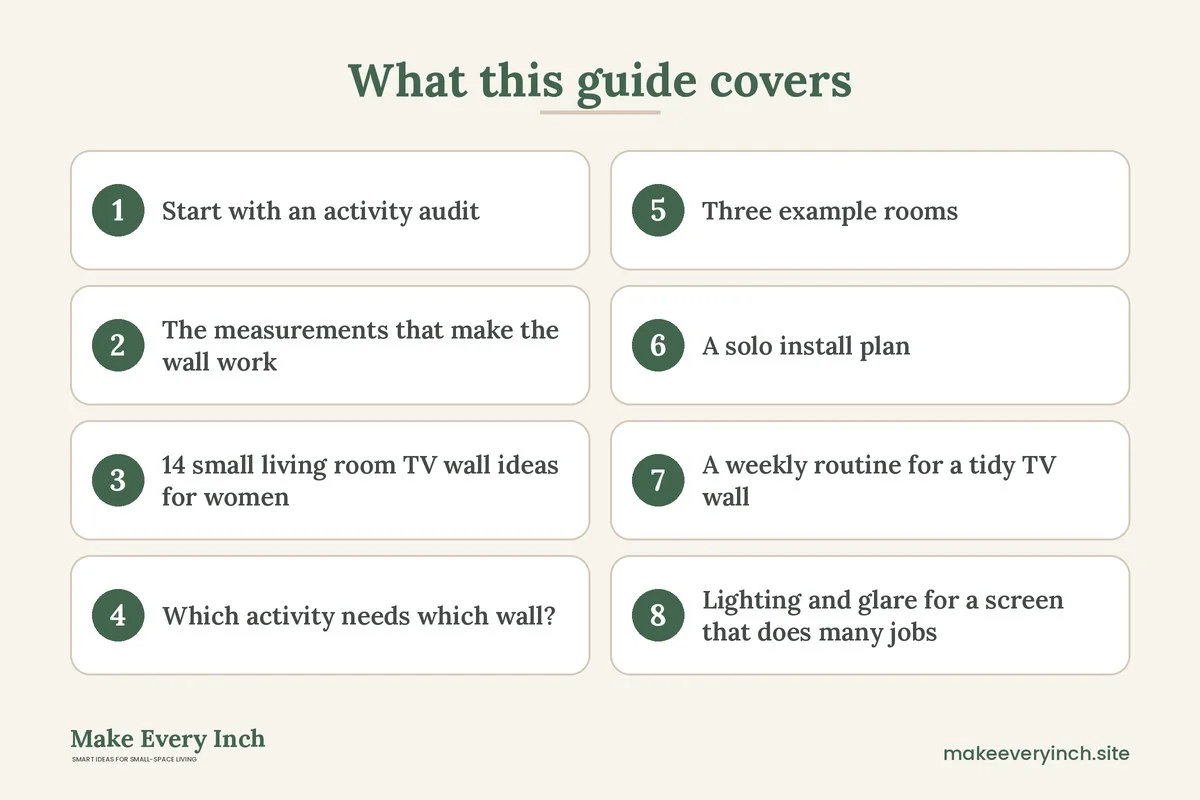
Small living room tv wall ideas for women are best built around routines, not around cliches. A living room is where one person does yoga with a video in the morning, takes a call at noon, folds laundry in front of a show at night and reads with the screen off on Sunday. The TV wall has to serve all of that in a small space. This guide skips the idea that a style belongs to one gender, and focuses on the measurable things: where you sit, what you do, how high the screen hangs, how the cords hide and how a wall can be installed safely, even if you are living alone. It covers an activity audit, the measurements, 14 wall ideas, an activity table, three example rooms, a solo install plan, a routine and a checklist. For the broader topic, start with our main guide on small living room TV wall ideas and the wider small living room ideas pillar.
Start with an activity audit
Before choosing a stand, a mount or a color, spend a week noticing what the TV wall really does. Keep a short note on your phone. Most people find that the screen is on for a surprisingly small part of the day, and that the wall around it is used for other things, such as a workout space, a work area or a hobby corner.
Ask these questions.
- What do you do facing the screen? Watching, working out, following a recipe, learning a language, gaming, video calls, craft projects or a second monitor for work.
- Where do you do it from? The sofa, the floor, a chair or a standing spot in the middle of the room.
- What do you need within reach? A mat, weights, a laptop, a notebook, a remote, a charger or a drink.
- When is the room busiest? Morning, lunch or evening, and whether the light is bright or dim.
- Who else uses the room? A roommate, a partner, kids, a pet or guests.
Circle the one or two activities that matter most. Those decide the wall. A person who does workouts at home needs floor space and a screen that can be seen from the floor. A person who works from home needs a ledge, an outlet and a screen that swivels. A person who reads a lot needs good light and a place where the screen disappears. The wall plan should not try to serve all of them equally.
The measurements that make the wall work
A small room leaves little margin, so use numbers. These are typical ranges, not strict rules, and you should adjust them to your own body and room.
- Viewing distance: about 6 to 9 feet from a 43 to 55 inch screen suits most small rooms. For workouts, you may want the screen farther back, around 8 feet, so you have floor space in front of it.
- Screen center height: about 40 to 46 inches from the floor for a seated viewer. For workouts on the floor, hang it a little lower, near 36 to 40 inches, or choose an arm that tilts down.
- Floor space for workouts: a clear area of about 6 by 7 feet fits a yoga mat and a few moves. Mark it with tape and test it.
- Ledge or shelf below the screen: 6 to 10 inches deep holds a laptop stand, a router and a plant. Mount it at least a hand’s width below the screen.
- Side clearance for a swivel arm: 24 to 30 inches on the swing side, so the screen can turn without hitting a lamp or a door.
- Walkway in front of the wall: 30 to 36 inches when the main path runs there.
- Lamp height: a reading lamp should put its bulb at about eye level when seated, or around 40 to 42 inches from the floor.
Stand where you will use the screen for each activity and check the angle. If you must tilt your head up, the screen is too high. If you must squint, it is too far or too small.
14 small living room TV wall ideas for women
Walls for movement and workouts
1. A swivel arm that turns toward the open floor
A full-motion arm lets the screen face the sofa in the evening and the open floor in the morning. Check the arm’s weight and size rating against your screen, fix it into studs or into rated anchors, and follow the mount instructions. Leave 24 to 30 inches on the swing side.
2. A low screen height for floor sessions
If most of your sessions happen on a mat, hang the screen a little lower so you do not strain your neck. A tilt of 5 to 10 degrees helps. Keep the bottom edge high enough that a stray weight or a ball cannot hit it.
3. A wall that stores the mat and the gear
A tall, narrow cabinet or a wall hook set beside the screen holds the mat, a resistance band and a small set of weights. Store heavy items low, and anchor any tall cabinet to the wall using the kit supplied. See our guide on small living room storage ideas for more.
4. A mirror beside the screen
A mirror on the side wall or leaning against the wall lets you check your form without blocking the screen. It also bounces light through a small room. Keep it away from direct sunlight and secure it according to the maker’s guidance, since a leaning mirror must be stable.
Walls for work and calls
5. A shelf ledge that doubles as a laptop spot
A narrow, wall-mounted ledge below the screen serves as a standing desk for an hour or a place for a laptop on a video call. Choose one rated for the weight, and mount it into studs. A ledge of about 8 inches deep is enough for a laptop stand and a mug.
6. A screen that doubles as a second monitor
A TV with the right ports can serve as a big monitor for a laptop. Place the sofa or a small table at the right distance, and keep a keyboard on a tray. This idea suits a studio where there is no room for a desk.
7. A call-friendly corner with soft light
A lamp beside the screen lights your face for video calls. Choose a warm, diffused bulb, around 2700 kelvin, and position it to the side so it does not glare on the screen. Keep a neat, plain backdrop behind your chair.
8. A hidden desk in a cabinet
A cabinet with a fold-down front acts as a desk, and it closes when you are finished. This hides the paperwork and the cables, and makes the living room feel like a living room again.
Walls for hobbies and downtime
9. A craft cabinet below the screen
A closed cabinet with deep drawers holds yarn, paper, paints and a sewing kit. The top stays clear for projects. Add a small tray on the top for tools, and a lamp for close work.
10. A bookcase wall with the screen inset
Build or arrange shelves around the screen, so it becomes part of the bookcase. Place books and a few plants at the sides. When the TV is off, the wall reads as a library. Anchor all tall shelves to the wall, and keep heavy books on the lower shelves. See our guide to the best narrow bookshelves.
11. A frame TV look with art around it
Use a gallery of lightweight frames around the screen to soften the black rectangle. Use adhesive strips rated for the weight, or hang from rails, and keep the frames a few inches from the edge of the screen. Our guide to renter friendly wall decor ideas lists no-damage options.
12. A reading nook that faces away from the screen
Place a chair and a floor lamp on the side wall, angled away from the TV. When you want to read, you do not see the screen. A small side table holds a book and a mug.
Walls that suit solo living and rentals
13. A low, wide stand with anti-tip straps
If you cannot drill, a low, wide stand with the supplied straps or brackets keeps the screen stable. Follow the TV and stand instructions, and choose a stand rated for the screen’s weight. A stand also avoids the need to lift a screen overhead, which is hard to do alone. For more, read our small living room ideas for renters.
14. A mount with a two-person plan
If you want to hang a TV on the wall, plan the install with a helper. Lifting a screen onto a bracket is a two-person job for most sizes, and a helper also watches the level. Use a stud finder, follow the mount instructions, and ask a qualified installer if you are unsure about the wall.
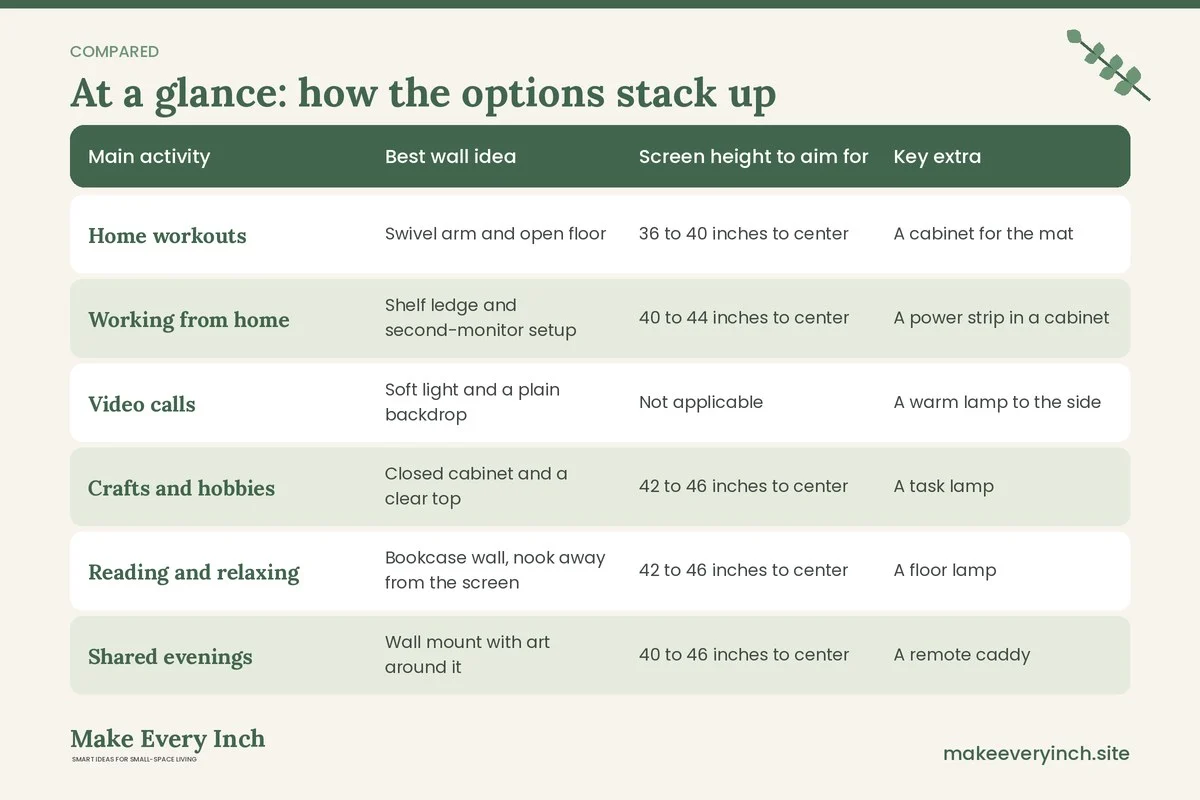
Which activity needs which wall?
Use this table to match a main activity to a layout. It does not replace the instructions for your TV and mount, which always take priority.
| Main activity | Best wall idea | Screen height to aim for | Key extra |
|---|---|---|---|
| Home workouts | Swivel arm and open floor | 36 to 40 inches to center | A cabinet for the mat |
| Working from home | Shelf ledge and second-monitor setup | 40 to 44 inches to center | A power strip in a cabinet |
| Video calls | Soft light and a plain backdrop | Not applicable | A warm lamp to the side |
| Crafts and hobbies | Closed cabinet and a clear top | 42 to 46 inches to center | A task lamp |
| Reading and relaxing | Bookcase wall, nook away from the screen | 42 to 46 inches to center | A floor lamp |
| Shared evenings | Wall mount with art around it | 40 to 46 inches to center | A remote caddy |
| Renting | Low stand with anti-tip straps | Depends on the stand | A cord cover |
Three example rooms
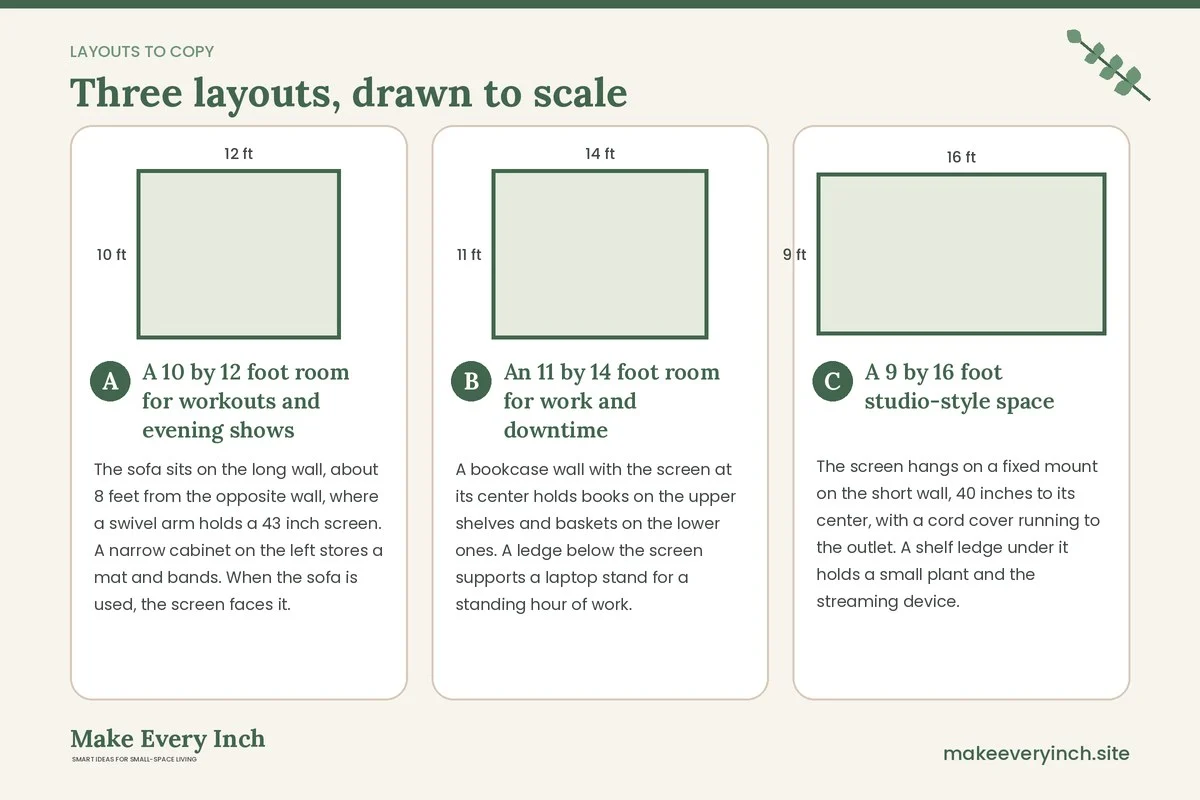
A 10 by 12 foot room for workouts and evening shows
The sofa sits on the long wall, about 8 feet from the opposite wall, where a swivel arm holds a 43 inch screen. A narrow cabinet on the left stores a mat and bands. When the sofa is used, the screen faces it. In the morning, the arm turns toward a clear 6 by 7 foot patch of floor. A rug is not necessary there, so a mat goes straight onto the floor. A floor lamp sits in the far corner.
An 11 by 14 foot room for work and downtime
A bookcase wall with the screen at its center holds books on the upper shelves and baskets on the lower ones. A ledge below the screen supports a laptop stand for a standing hour of work. A power strip and a router live in a closed cabinet. The sofa sits about 7 feet away, and a reading chair stands at the side, angled away from the screen with a small table and a lamp.
A 9 by 16 foot studio-style space
The screen hangs on a fixed mount on the short wall, 40 inches to its center, with a cord cover running to the outlet. A shelf ledge under it holds a small plant and the streaming device. A narrow console behind the sofa works as a desk when you need one, and a folding chair tucks under it. The path along the wall stays at 30 inches. A screen like this serves a studio well because it avoids bulky furniture.
A solo install plan
Many people hang a TV on their own or with one friend. These steps keep the process safe, and they do not replace the instructions that come with your TV and mount.
- Read the manuals first. Check the screen weight, the mounting pattern and the hardware supplied.
- Find the studs. Use a stud finder, and mark the positions. If you cannot find a solid fixing, use anchors rated for the load, or ask a qualified installer.
- Mark the height. Use painter’s tape to mark the center of the screen at about 40 to 46 inches from the floor, and check from your seat.
- Fix the bracket. Use a level, and tighten the fixings fully. Do not skip any holes.
- Lift with a helper. A screen is awkward and fragile, so do not lift it alone if it is large or heavy.
- Test the hold. Gently push and pull at the screen’s edge to confirm it is secure.
- Tidy the cords. Use a cord cover or a bundle behind the screen, and keep the power strip off the floor.
If you rent, ask in writing before drilling, and consider a stand instead.
A weekly routine for a tidy TV wall
A wall that serves many activities needs a short reset. These habits take only a few minutes.
- The after-workout reset: wipe the mat, store the gear and turn the arm back to the sofa.
- The evening clear: put the laptop, the mug and the notebook away so the ledge is clear for the morning.
- The weekly cord check: look behind the screen for bent or pinched cords.
- The monthly dust: wipe the screen with a soft, dry cloth, and dust the shelves.
- The seasonal check: push on the mount and the shelves to be sure nothing is loose.
Lighting and glare for a screen that does many jobs
A screen that changes roles needs light that changes too. Place the screen at a right angle to the window when possible, and add blinds or curtains that you can close without a long cord. Use a warm lamp for evenings and a brighter, cooler bulb for work during the day. A dimmable lamp at the side gives you both. A small light behind the screen reduces eye strain in a dark room. For more, see our small living room lighting ideas.
Mistakes to avoid
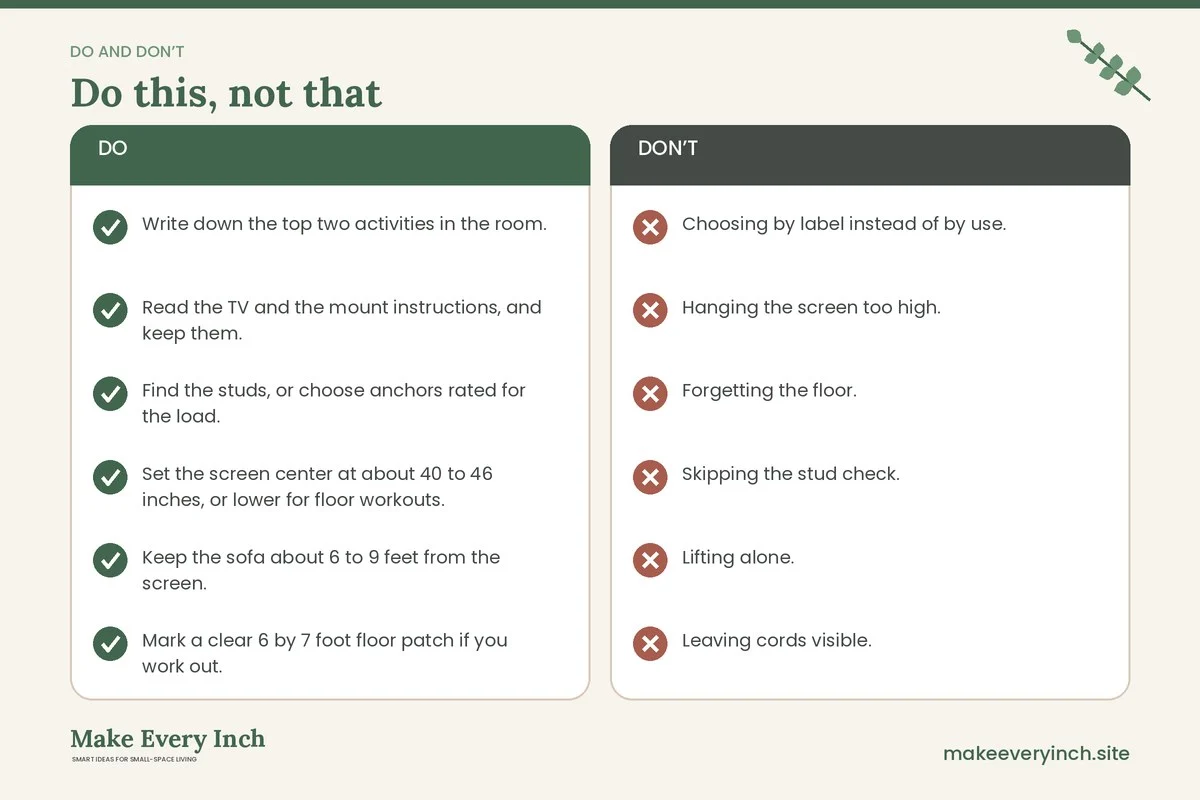
- Choosing by label instead of by use. A wall built for a stereotype rarely fits a real routine, so start with the activity audit.
- Hanging the screen too high. A high screen strains the neck. Keep the center near eye level.
- Forgetting the floor. If you work out, protect the open floor and keep it clear.
- Skipping the stud check. A TV needs a secure fixing, so find the studs or use rated anchors.
- Lifting alone. Large screens are heavy and delicate, so ask for help.
- Leaving cords visible. A cord cover is inexpensive and makes a small room feel calmer.
- Ignoring the lamp. A dark room makes the screen harsh, so add a warm lamp.
Budget and shopping approach
Start with the part that makes the wall safe and useful: a proper mount or stand, a cord cover and an anchoring kit. Then add storage for the activity that matters most, such as a cabinet for gear or a ledge for a laptop. Finally add decor. Use what you own first, such as a basket, a tray or a small plant. Measure the wall and the screen, and keep a note of the weight and the mounting pattern, so the bracket matches. Second-hand furniture is often a good choice, but check its stability and anchor it.
Women’s TV wall checklist
- Write down the top two activities in the room.
- Read the TV and the mount instructions, and keep them.
- Find the studs, or choose anchors rated for the load.
- Set the screen center at about 40 to 46 inches, or lower for floor workouts.
- Keep the sofa about 6 to 9 feet from the screen.
- Mark a clear 6 by 7 foot floor patch if you work out.
- Add a shelf ledge or a cabinet for the activity gear.
- Hide cords behind a cover, and keep the power strip off the floor.
- Add a warm lamp, and avoid glare from the window.
- Anchor every tall unit to the wall.
- Plan the install with a helper.
- Do a short check each season.
FAQ
What is the best TV wall idea for a small living room?
It depends on what you do there. A swivel arm suits workouts, a shelf ledge suits work, and a closed cabinet suits hobbies. Start with an activity audit.
How high should I hang the TV?
Aim for the screen center at about 40 to 46 inches from the floor for seated viewing. For workouts on the floor, a little lower, around 36 to 40 inches, can be more comfortable.
Can I install a TV wall mount on my own?
It is possible for small screens, but lifting a screen is usually a two-person job. Follow the TV and mount instructions, find the studs or use rated anchors, and hire a qualified installer if you are unsure.
How do I hide the cords?
Use a paintable cord cover on the wall, bundle extra length behind the screen and put the power strip in a cabinet. For in-wall wiring, use a qualified installer.
What if I cannot drill into the wall?
Use a low, wide stand with anti-tip straps that follow the TV and stand instructions. Our post on renter friendly shelving lists freestanding options for the rest of the wall.
How do I make the TV wall less dominant?
Surround the screen with shelves, art or a bookcase, and choose a wall color that is close to the screen’s frame. A closed cabinet hides it altogether.
How much space do I need for a home workout?
A clear area of about 6 by 7 feet fits most mat sessions. Mark it with tape and test it.
Keep going: Keep planning with our small living room layout ideas, small living room furniture ideas and small living room storage ideas for women.
Save this guide for later
Pin the ideas you like to Pinterest so you can come back to them when you plan your space.