Apartment Decorating Styles: How to Choose, Mix and Try 12 Looks in a Small Space
Quick answer: The best apartment decorating styles for small spaces are the ones that match how you live, not the ones that look best in photos. Pick a main style, add one supporting style in a smaller dose, keep a palette of three to five colors, and test the look with removable pieces such as textiles, lamps, art and plants before you commit to larger purchases.
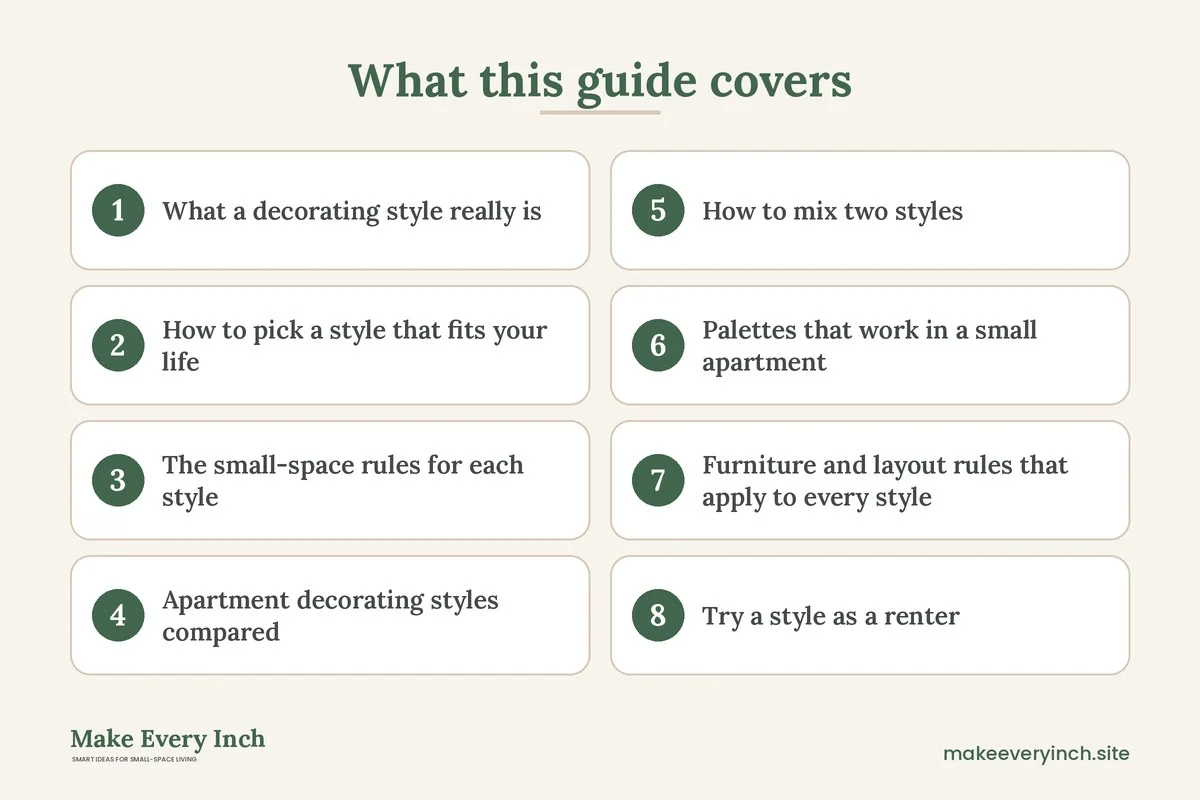
Apartment decorating styles can feel overwhelming. Every feed shows a different look, every look has a name, and a small apartment leaves little room for mistakes. The good news is that style is easier to choose than it seems, because a small space naturally narrows your options. Square footage, natural light, storage and your lease all push you toward certain looks and away from others. This guide explains how to pick a style by lifestyle rather than by trend, how to mix two styles without chaos, what the small-space rules are for twelve popular looks, how to compare them in a table, how to build a palette, and how to try a style as a renter without losing your deposit. Every section links to a deeper guide, and the final section lists all of them in one place. If you are starting with a specific room, our hubs on small living room ideas, small bedroom ideas and small kitchen ideas pair well with this one.
What a decorating style really is
A decorating style is a set of repeating choices. It is a consistent answer to a few questions: how much stuff is visible, which colors dominate, which materials appear, what shapes the furniture has and how much pattern the room carries. A Japandi room answers those questions with calm, natural and low. A playful maximalist room answers them with bold, layered and bright. Neither is better. They are simply different answers, and a room feels coherent when the answers agree with each other.
In a small apartment, coherence matters more than it does in a large house. Large rooms can absorb a few contradictions because there is distance between objects. A small room puts everything within one glance. A single clashing piece is visible from the sofa, the bed and the doorway at once. That is why choosing a style, even loosely, is one of the most effective things you can do for a small home. It gives you a filter for every purchase and a reason to say no.
Style is also not the same as a shopping list. You do not need to buy a particular sofa or a particular lamp to have a style. You need a handful of repeated qualities. A thrifted dresser can sit happily in a minimalist room if its lines are clean. A patterned rug can belong in a calm room if its colors are soft. Think of a style as a direction rather than a uniform, and you will avoid the showroom look that makes an apartment feel like a set instead of a home.
How to pick a style that fits your life
Start with how you live, because a beautiful style that fights your habits will fail within a month. Ask these questions before you look at a single photo.
- How much do you own? If you have a lot of belongings and little storage, a strict minimal look will feel like a daily argument. A layered or collected look may suit you better, as long as you give everything a home.
- How much light do you get? A north-facing room with one window handles pale, airy palettes badly and can look cold. It may suit deep, saturated colors or warm, cozy layers. A bright south-facing room can carry almost anything.
- How do you use the room? A living room that doubles as an office needs hidden storage and calm surfaces. A bedroom used only for sleeping can be moodier and softer.
- Do you rent? If you cannot paint or drill, the styles that depend on wall color or built-ins are harder, and the styles that depend on textiles, lamps and movable furniture are easier.
- How much upkeep will you accept? White surfaces, open shelves and clear counters need constant tidying. Textured, patterned and darker looks forgive daily life.
- What do you already love? Look at what you own and what you saved. If your favorite objects are warm wood, plants and woven baskets, you are already leaning toward a natural look.
Use a three-photo test
Save ten photos of rooms you like, then remove any that you only admire from a distance. From the rest, write down three words that describe each one. Repeated words tell you what you are really drawn to. If calm, wood and simple appear again and again, look at Japandi apartment ideas and Scandinavian small apartment ideas. If warm, layered and soft appear, start with cozy apartment ideas. If bold, pattern and color keep showing up, explore playful maximalist apartment ideas.
Match style to room size
Very small rooms, such as a studio of around 300 square feet, reward styles that keep floor and surfaces clear. Clean lines, legs that show floor, wall-mounted lighting and a limited palette make a room feel larger. Moderately small rooms can handle more layering. Whatever your size, the rule is the same: let the style decide what is visible, and store the rest. Our guide to small apartment decluttering ideas helps you edit before you decorate.
The small-space rules for each style
Each style has its strengths and its traps in a small apartment. The sections below summarize twelve popular looks, give the rule that matters most in a compact home and point to a full guide.
Japandi
Japandi blends Japanese restraint with Scandinavian comfort. It uses low furniture, light wood, soft neutral colors, paper or linen shades and very few objects. Small-space rule: choose fewer, better pieces and let negative space do the decorating. The look suits small rooms because it values empty floor. Read Japandi apartment ideas, and for rooms, see small apartment living room ideas in a Japandi style, small bedroom ideas in a Japandi style and small living room ideas with a Japandi sectional.
Scandinavian
Scandinavian style is bright, practical and friendly. Think white or pale walls, light wood floors, simple furniture, cozy textiles and plenty of lamps. Small-space rule: layer light sources and keep the palette pale so a small room feels open. It is forgiving and welcoming, which is why it works for first apartments. Read Scandinavian small apartment ideas.
Minimalist
Minimalism removes everything that does not serve a purpose. Surfaces are clear, the palette is limited and storage is hidden. Small-space rule: minimal does not mean empty. It means every item earns its spot, and storage is built into the furniture. It works best if you are willing to edit regularly. Read minimalist apartment ideas, and for rooms, see small apartment living room ideas, minimalist and small bedroom ideas, minimalist.
Modern
Modern style uses clean lines, simple shapes, a restrained palette and a few contrasting materials such as metal, glass and wood. Small-space rule: choose furniture with slim profiles and visible legs, and avoid bulky arms and skirts. Read modern small apartment ideas, then see small apartment living room ideas, modern and small bedroom ideas, modern.
Organic modern
Organic modern keeps the clean shapes of modern design and adds natural texture: rounded forms, rattan, stone, linen, plants and warm neutrals. Small-space rule: use texture instead of pattern, so the room feels rich without feeling busy. It is a good choice if modern feels cold and boho feels crowded. Read organic modern apartment ideas.
Cozy
Cozy is less a strict style than a feeling: warm light, soft fabrics, comfortable seating and a sense of shelter. Small-space rule: build coziness with lighting and textiles first, and add furniture last, because a small room fills up fast. Read cozy apartment ideas, then see cozy small living room ideas, small apartment living room ideas, cozy and cozy apartment bedroom ideas.
Boho
Boho layers pattern, plants, woven pieces, vintage finds and global textiles. Small-space rule: layer vertically and keep the floor clear, using hanging plants, wall textiles and stacked baskets, but keep one calm zone so the eye can rest. Read boho apartment ideas.
Afrohemian
Afrohemian is a blend of African-inspired textiles and art with the layered, collected approach of boho design. It tends to feature rich color, handcrafted objects, woven and printed fabrics, plants and art that tells a story. Small-space rule: choose a few meaningful pieces and give each piece room to stand out, instead of covering every surface. Buy textiles and art from makers when you can, and learn about the pieces you bring home. Read Afrohemian apartment ideas.
Vintage
Vintage style mixes older furniture, classic patterns, aged wood and collected accessories. Small-space rule: choose smaller-scale antiques, because large traditional pieces swamp a compact room, and let one vintage piece be the star. Secondhand shopping also keeps the look affordable. Read vintage apartment ideas, and for sourcing, see thrifted apartment decor ideas.
Dark and moody
Dark style uses deep greens, charcoal, navy, plum and warm black, usually with rich textures and layered lighting. Small-space rule: commit to the color and add plenty of lamps, because a dark room with a single ceiling light feels like a cave, while a dark room with five warm lights feels like a hug. Read dark apartment ideas.
Neo Deco
Neo Deco takes the glamour of Art Deco, such as geometry, curves, brass tones, velvet and mirrors, and updates it with calmer proportions. Small-space rule: use it in accents, such as a sunburst mirror, a curved sofa or a geometric lamp, because full glamour can overwhelm a small room. Read Neo Deco apartment ideas.
Playful maximalist
Playful maximalism embraces color, pattern, art and humor. Small-space rule: give the chaos an order by repeating a few colors, grouping objects by theme and keeping furniture simple, so the decoration becomes the star. Read playful maximalist apartment ideas.
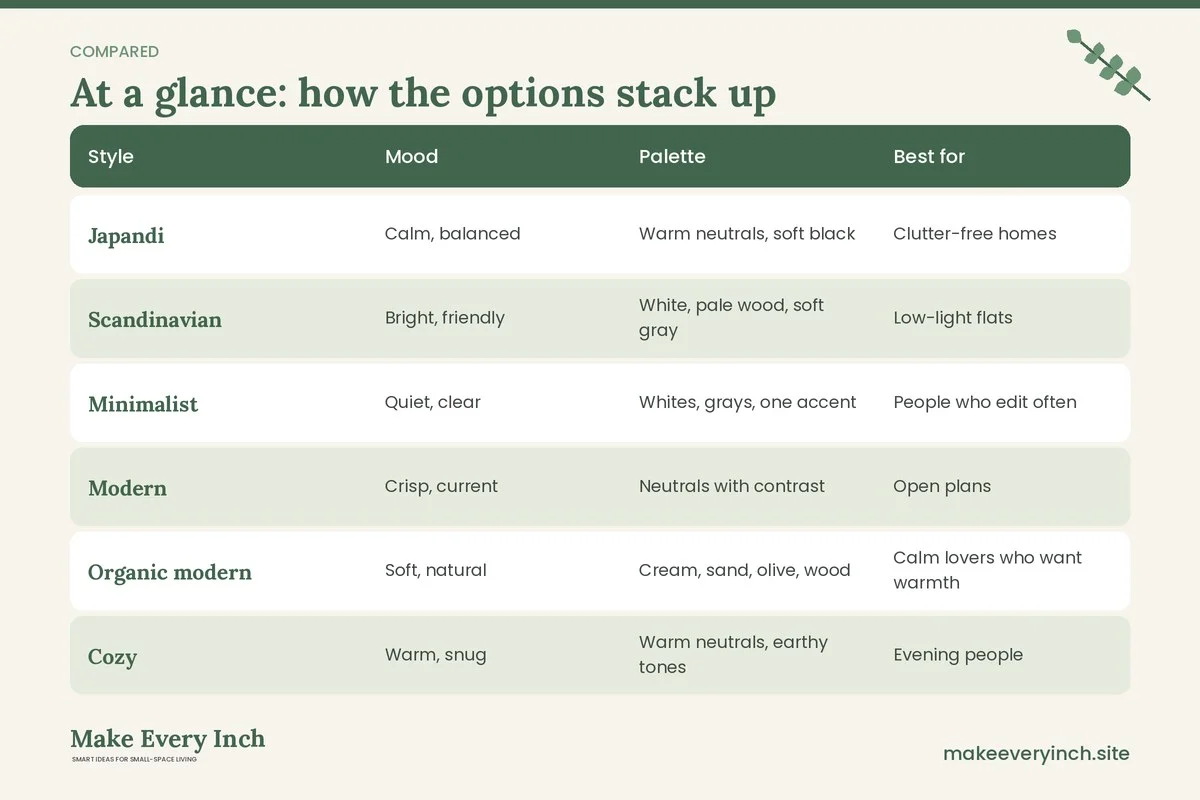
Apartment decorating styles compared
Use this table for a first filter. It is a guide, not a rulebook, and many rooms land between two columns.
| Style | Mood | Palette | Best for | Main small-space trap |
|---|---|---|---|---|
| Japandi | Calm, balanced | Warm neutrals, soft black | Clutter-free homes | Looking empty without texture |
| Scandinavian | Bright, friendly | White, pale wood, soft gray | Low-light flats | Feeling flat or cold |
| Minimalist | Quiet, clear | Whites, grays, one accent | People who edit often | Hidden storage overflow |
| Modern | Crisp, current | Neutrals with contrast | Open plans | Hard, cold surfaces |
| Organic modern | Soft, natural | Cream, sand, olive, wood | Calm lovers who want warmth | Too many beige layers |
| Cozy | Warm, snug | Warm neutrals, earthy tones | Evening people | Too much soft furniture |
| Boho | Relaxed, layered | Terracotta, mustard, green | Plant and craft lovers | Visual clutter |
| Afrohemian | Rich, collected | Earth tones with bold color | Textile and art lovers | Overfilling surfaces |
| Vintage | Characterful | Aged wood, muted color | Secondhand shoppers | Oversized antiques |
| Dark | Moody, intimate | Deep green, navy, charcoal | Night lovers | Too few lights |
| Neo Deco | Glamorous | Jewel tones, brass tones | Entertainers | Shiny overload |
| Playful maximalist | Bold, joyful | Bright and varied | Collectors | No resting place |
How to mix two styles
Few real apartments sit in one pure style. Most are a mix, and that is healthy. The secret is to mix on purpose, not by accident. Use these rules to keep a blend looking intentional.
Use the 70, 20, 10 split
Choose a main style for about 70 percent of the room, a supporting style for about 20 percent and a wild card for the last 10 percent. For example, a Scandinavian base with cozy textiles and one vintage mirror. The base style sets furniture and color. The supporting style adds texture and accessories. The wild card is a single surprise.
Share a thread
Two styles blend well when they share a quality. Japandi and organic modern share natural materials. Boho and vintage share a love of collected objects. Modern and Neo Deco share clean geometry. Find the shared thread, and repeat it in color, material or shape, so the mix feels like a decision. Both Japandi apartment ideas and organic modern apartment ideas lean on the same warm wood and soft linen, which makes them easy partners.
Keep one thing constant
Pick one element that never changes, such as a wood tone, a metal finish or a white. If every shelf, frame and lamp base uses the same brass tone, then the styles around it can vary a lot. Constants quiet the noise of mixed styles.
Put contrast in small objects
If you are nervous about mixing, keep the large items consistent and let the small ones differ. Sofa, bed, rug and curtains stay in your main style. Cushions, art, lamps and vases bring in other influences. Small objects are cheap to change if the mix does not work.
Avoid mixing three strong styles at once
A pair of statement styles needs a calm third element. For instance, dark and playful maximalist together need a neutral rug or plain walls somewhere, or the room has too many voices. When in doubt, let the styles compete in separate zones, not in the same corner.
Palettes that work in a small apartment
Color does more than any other element to set a style, and it is the easiest thing to control in a small home. A palette also keeps a mix of styles coherent. The numbers below are a starting point for a main room.
- Three to five colors in total. Count walls, large furniture and textiles. Add accents beyond that sparingly.
- One dominant, one supporting, one accent. A common split is 60 percent dominant, 30 percent supporting and 10 percent accent.
- Repeat each color in at least two places. A color that appears once looks like a mistake. A color that appears twice or three times looks like a plan.
- Mix undertones with care. Warm whites and warm woods go together, as do cool grays and cool blues. Mixing warm and cool is possible, but it needs a bridge such as a neutral rug.
Palette ideas by style
- Japandi and Scandinavian: warm white, oatmeal, light oak, soft black and a muted green.
- Organic modern: cream, sand, olive, clay and natural wood.
- Cozy: warm beige, caramel, rust and deep brown.
- Boho and Afrohemian: terracotta, mustard, deep green, indigo and warm brown, with patterns in the same family.
- Dark: deep green, navy or charcoal, with brass tones and warm wood.
- Neo Deco: emerald, burgundy or navy with brass tones and cream.
- Playful maximalist: a bright main color, such as pink or blue, with two supporting colors and a lot of white to rest the eye.
Use light and dark wisely
Light colors reflect light and make a room feel larger, but a very pale room with little daylight can feel flat. Dark colors absorb light and make a room feel enclosed, yet they can blur corners, so the walls seem to disappear. Choose your depth on purpose. If you pick dark, plan lamps at several heights. If you pick light, add texture so the room does not look sterile.
Test colors in your own light
Hold paint cards or fabric swatches against your wall for at least a day. Look at them in the morning, at noon and in the evening with lamps on. A color changes dramatically with the direction of the window, so a swatch that looked calm in the shop might look gray or yellow at home.
Furniture and layout rules that apply to every style
Whatever you choose, a few small-space rules do not change. They keep a room comfortable, and style rests on top of them.
- Choose slim, leggy furniture. Visible floor under a sofa, bed or console makes a room feel larger.
- Leave walkways of about 30 to 36 inches. A beautiful room that you cannot walk through is not a success.
- Scale rugs to the room. A rug that is too small shrinks a space. In many living rooms, a 5 by 8 or 6 by 9 foot rug under the front legs of the sofa works well.
- Hang curtains high and wide. Mount the rod near the ceiling to draw the eye up, and extend it past the window frame.
- Use mirrors across from light. A mirror opposite a window doubles the daylight.
- Layer three kinds of light. Ambient, task and accent lighting make any style feel finished. See our small living room lighting ideas.
- Hide the daily mess. Closed storage beats open shelves for small homes. See small living room storage ideas and hidden storage ideas.
If you need layout help, our guide to small living room layout ideas shows how to place furniture in a compact plan, and small bedroom layout ideas does the same for sleeping spaces.
Try a style as a renter
Renters often believe that style belongs to owners. In fact, most styles are built from movable pieces. The sequence below lets you test a look in stages, with little risk to a deposit.
Stage one: textiles and light
Swap pillow covers, throws, curtains and lamp shades. These changes are the cheapest and the fastest, and they show you immediately whether a palette suits your light. See renter-friendly lighting ideas for plug-in options.
Stage two: art and walls
Use adhesive strips, leaning art, tension rods and fabric hangings to change the walls without damage. Our guide to renter-friendly wall decor ideas lists safe methods, and removable wallpaper ideas covers a bolder step. Always test on a hidden spot and read your lease first.
Stage three: small furniture
Add a side table, a stool, a lamp or a chair. These pieces are easy to move, to resell and to reuse in a future home. Shop secondhand for character, using our thrifted apartment decor ideas.
Stage four: anchor pieces
Only after you have lived with the palette for a few weeks should you commit to a sofa, a rug or a bed. These large items define the style, and they are the hardest to change.
For the full renter playbook, read our hub on renter-friendly apartment decorating ideas, then security-deposit-safe apartment upgrades and budget renter upgrades.
Which styles are easiest for renters
Styles built on textiles, plants and objects suit rentals well, such as boho, cozy, Scandinavian and playful maximalist. Styles that rely on architecture, such as a strong Neo Deco look with paneling, need creative stand-ins, such as mirrors, lamps and freestanding screens. Dark style usually needs wall paint, so check the lease, or use large dark fabric panels, leaning art and deep-colored furniture to get a similar mood. Minimalist and modern looks work well because they depend on editing, not on adding.
Style by room
Style does not need to be identical in every room, but the rooms should speak to each other. A common approach is to keep the palette and one material consistent across the apartment, and then let each room lean into its own mood.
Living room
The living room carries the most visual weight, so choose the main style here first. It should handle guests, television and daily clutter. See small living room ideas, small apartment living room ideas and cozy small living room ideas for starting points. If you want a style-specific plan, small apartment living room ideas in Japandi and small living room ideas with a sectional in Japandi show how one look adapts to different furniture.
Bedroom
Bedrooms can take a softer, moodier or more personal version of your style, because only you see them. Dark, cozy and Japandi looks all thrive here. See small bedroom ideas, cozy apartment bedroom ideas and small bedroom ideas, cozy.
Kitchen
Kitchens are the hardest to restyle in a rental, but small changes help: hardware, lighting, a rug, open displays and a cart. Match the palette to the living area. See small kitchen ideas and renter-friendly kitchen upgrades.
Bathroom
Use towels, a shower curtain, a mat and plants to carry your style into the bathroom. See small bathroom ideas.
Entry
The entry sets the tone for the whole home. A mirror, a hook rail and one lamp can echo the style that waits inside. See small entryway ideas.
Common mistakes when choosing a style
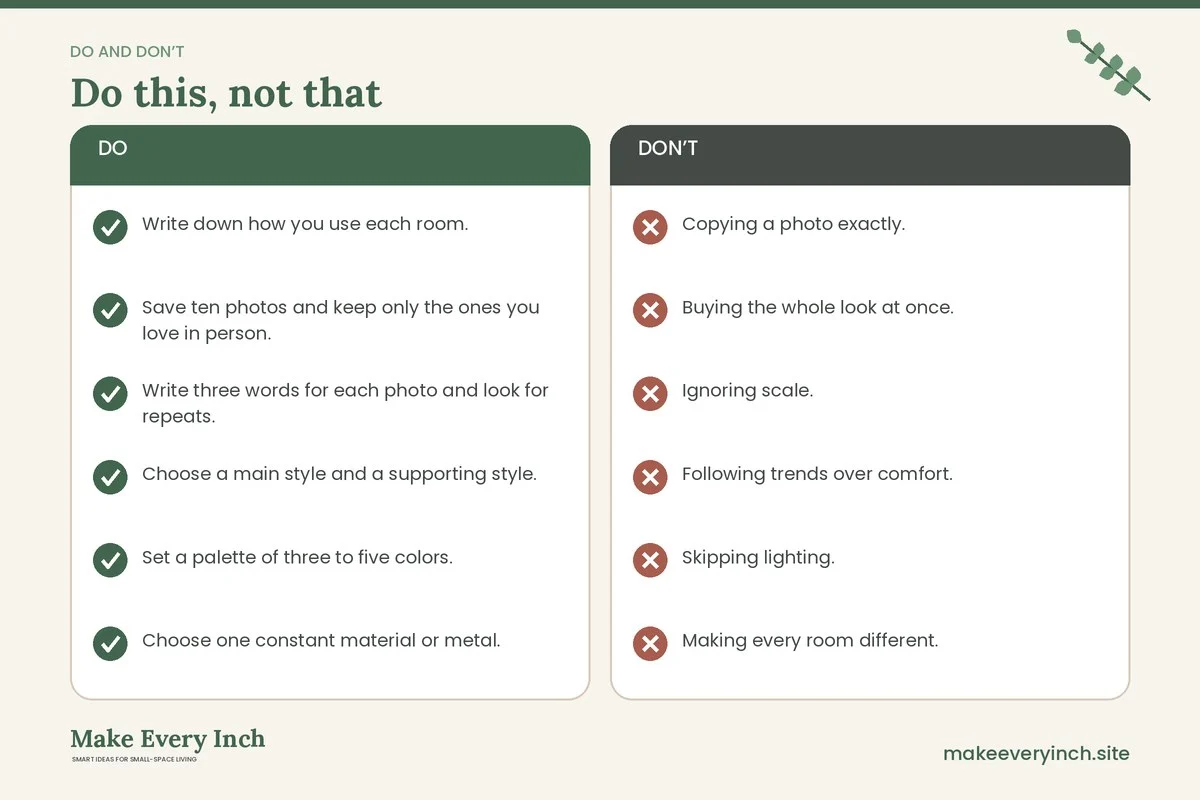
- Copying a photo exactly. Photos hide the clutter, the cords and the real light. Use them as a mood, not a blueprint.
- Buying the whole look at once. Without time to live with it, you cannot tell what you really need.
- Ignoring scale. A pretty sofa that fills half the room ruins every style.
- Following trends over comfort. If you never sit on the sculptural chair, it is storage for clothes.
- Skipping lighting. A single overhead light flattens every style. Lamps do more for mood than any purchase.
- Making every room different. A home with six unrelated looks feels like six small apartments.
- Forgetting storage. Every style needs a place for the mess, whether it is hidden or displayed.
- Choosing a style for guests. You live there every day, so choose for yourself.
Budget-friendly ways to shift a style
You do not need a large budget to change the mood of a room. The cheapest changes also give the most information about what you like.
- Change the color of cushions and throws.
- Swap lamp shades or add a plug-in lamp.
- Move furniture to clear a wall.
- Frame prints or use your own photos.
- Add plants in simple pots.
- Shop secondhand for frames, mirrors and small tables.
- Rearrange shelves by color or material.
- Edit decor by removing a third of it, then adding back only what you love.
Our guides to small apartment decor under 100, small apartment makeover on a budget and DIY apartment upgrades give more detail, and cheap storage ideas for apartments helps keep the look tidy while you experiment.
Apartment style checklist
- Write down how you use each room.
- Save ten photos and keep only the ones you love in person.
- Write three words for each photo and look for repeats.
- Choose a main style and a supporting style.
- Set a palette of three to five colors.
- Choose one constant material or metal.
- Edit belongings before buying anything new.
- Test color swatches in morning and evening light.
- Start with textiles and lamps.
- Check the lease before changing walls.
- Keep walkways at 30 to 36 inches.
- Add three layers of light.
- Wait a few weeks before buying anchor furniture.
- Review the room after a month and adjust.
All our apartment decorating styles guides
Every style guide in our library is listed here, with a short note on what it covers.
- Japandi apartment ideas: calm, natural, low-profile rooms that blend Japanese restraint with Nordic comfort.
- Scandinavian small apartment ideas: bright, practical rooms with pale wood, soft textiles and layered light.
- Minimalist apartment ideas: clear surfaces, limited palettes and storage that disappears.
- Modern small apartment ideas: clean lines, slim furniture and a restrained palette.
- Organic modern apartment ideas: modern shapes warmed up with natural texture and plants.
- Cozy apartment ideas: warm light, soft fabrics and a sheltering feel.
- Boho apartment ideas: layered patterns, plants and woven pieces.
- Afrohemian apartment ideas: African-inspired textiles and art blended with boho layering.
- Vintage apartment ideas: older furniture, classic patterns and collected accessories.
- Dark apartment ideas: deep colors, rich texture and layered lamps.
- Neo Deco apartment ideas: geometric glamour with updated, calmer proportions.
- Playful maximalist apartment ideas: bold color, pattern and art with a plan.
For style-specific room guides, try small bedroom ideas in Japandi, small living room ideas with a sectional in Japandi, cozy small living room ideas and small apartment living room ideas, modern.
FAQ
How do I find my apartment decorating style?
Save photos of rooms you like, remove the ones you only admire, and write three words for each one. Repeated words show your style. Then compare your daily habits, your light and your storage to the style guides above, and choose the one that fits both your taste and your life.
Can I mix apartment decorating styles?
Yes. Choose a main style for most of the room, a supporting style for accents and one wild card. Share a color, a material or a shape across the styles so the mix looks planned, and keep large furniture consistent while small objects vary.
Which style is best for a very small apartment?
Japandi, Scandinavian, minimalist and modern work especially well because they keep floors and surfaces clear and use pale or restrained palettes. Cozy and organic modern also work if you edit objects carefully. Any style can work if you control scale and storage.
What is the easiest style for renters?
Cozy, Scandinavian, boho and playful maximalist rely on textiles, plants, lamps and art, which you can change without touching the walls. Minimalist and modern also suit rentals because they depend on editing. Dark and Neo Deco are possible with removable pieces, but check your lease before painting or installing anything.
How many colors should a small apartment use?
Aim for three to five colors in total, using a dominant color, a supporting color and an accent. Repeat each color at least twice so the palette looks intentional. A shared wood tone or metal finish can tie everything together.
How do I try a style without spending much?
Start with cushion covers, throws, lamp shades, plants and framed prints. Shop secondhand for frames, mirrors and small tables. Live with the changes for a few weeks, and buy larger furniture only when you are sure of the direction.
Do all rooms in the apartment need the same style?
No, but they should relate. Keep the palette and one material, such as a wood tone or metal, consistent through the apartment, and let each room lean into its own mood. This is especially helpful in an open plan, where rooms are visible together.
How do I avoid a room that looks like a showroom?
Add personal items such as books, photos, art you love and objects with a story. Mix new and secondhand pieces, and leave a little imperfection. A style is a direction, not a uniform.
Keep going: Keep planning with our small living room ideas, small bedroom ideas and renter-friendly apartment decorating ideas.
Save this guide for later
Pin the ideas you like to Pinterest so you can come back to them when you plan your space.