19 Small Apartment Living Room Ideas Without Drilling Anywhere
Quick answer: The best small apartment living room ideas without drilling put the TV on a console or floor stand, use low freestanding shelves with a heavy base, add plug-in sconces and a tension pole for light and height, and style walls with rugs, curtains and leaning art. Keep cords tidy with adhesive clips, respect every weight limit and ask your landlord about one small anchor for tall furniture.
Small apartment living room ideas without drilling have to answer a harder question than most decorating guides admit: what holds up the heavy things? A living room contains the TV, the tallest furniture and the most cords in your home, and each of those traditionally relies on a screw in a wall. This guide covers only the living room and works through each of those jobs without a drill. It explains why a console beats a wall mount for a rental, how to choose shelving that will not tip, how to light and style the room with plug-in and leaning pieces, and where one tiny, approved anchor is worth asking for. For the wider picture, see our pillar guides on small living room ideas and small apartment living room ideas.
Start with the three heavy jobs
Before you buy anything, list the three jobs that normally need a drill: holding the TV, holding books and objects, and holding light. Each has a no-hole answer, and solving them first leaves the decorative choices easy. Everything else in the room, from rugs to curtains to art, is light enough to hang from adhesive, rest on furniture or stand on the floor.
Next, check the lease and photograph the walls. Some leases allow small nail holes, some ban anything that touches the wall, and many say nothing about adhesive. Note which rules apply, because they decide whether adhesive strips are an option or whether you should stay strictly freestanding. Ask in writing if the wording is vague.
Finally, find the load path. Anything tall or heavy needs a stable base, a low center of gravity and a place to sit that is not a doorway. A small room tempts people to stack things high, which is exactly where no-drill setups fail. Plan weight low, and let height come from light, art and plants.
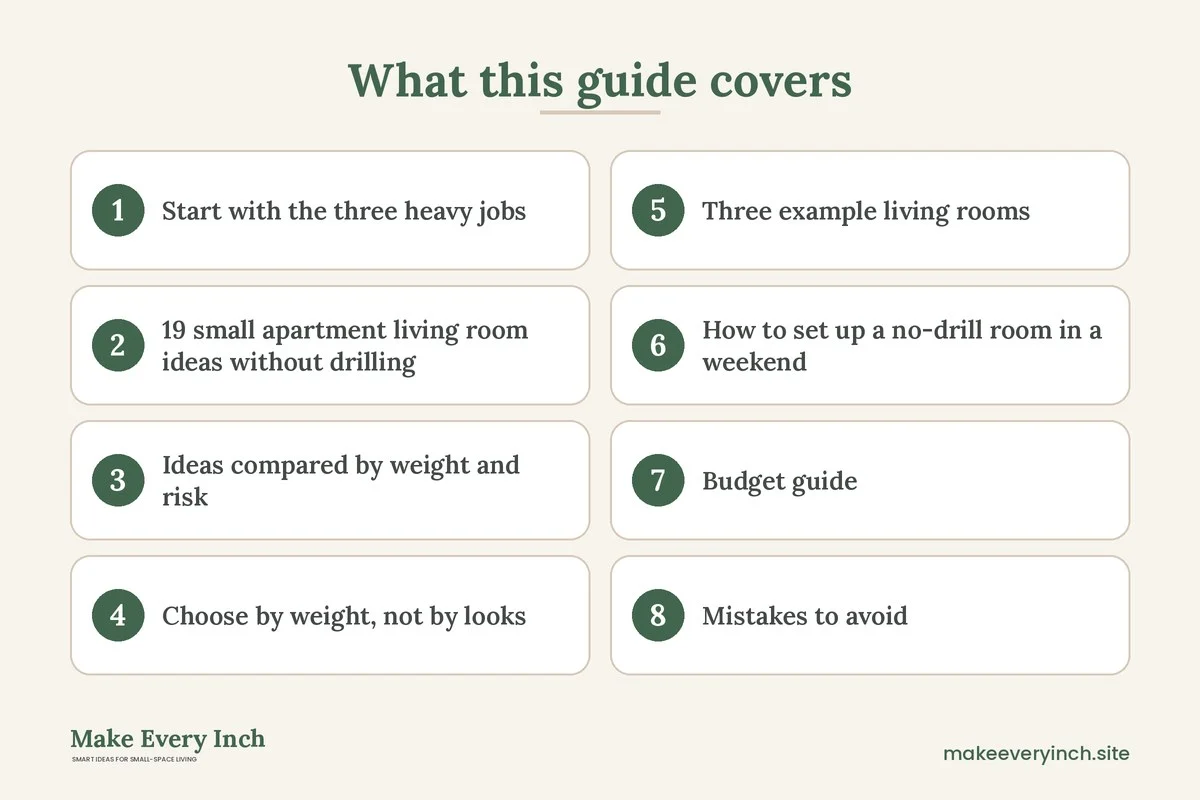
19 small apartment living room ideas without drilling
The TV: skip the wall mount
1. Put the TV on a low console
A console 14 to 18 inches deep and 24 to 30 inches tall holds most TVs up to about 55 inches on its feet. The TV sits well below the eyeline of a standing person, which looks calm, and the shelf below holds a router, a game console and baskets. Check that the TV’s own feet sit fully on the top, with no overhang.
2. Choose a floor stand with a swivel
A floor stand puts a TV on a pole above a weighted base, which suits a corner or a room where the TV must turn between the sofa and the desk. Pick a base heavier than the TV, with a wide footprint, and pull the TV forward of any radiator. Keep it out of walkways, since a pole stand gets bumped more than a console does.
3. Place the TV on a shelf unit that is wider than it is tall
A low, wide cube unit or a media bench spreads weight over a large footprint. It is much harder to tip than a tall bookcase with a TV on top, which is the combination to avoid. Put the heaviest items on the lowest shelf.
4. Hide the TV with a cover or a curtain
In a room where the TV is on for only a few hours, a linen throw on a rod or a roll-down fabric cover reduces the black rectangle. Never cover a TV while it is on, and leave space for heat to escape.
Shelving that stands up by itself
5. Use low freestanding shelving for heavy items
Books weigh far more than people expect, and a full foot of paperbacks can reach 20 pounds. Keep a bookcase under about 36 inches tall for no-drill use, and put the books on the bottom two shelves. Use the top for light baskets and a plant.
6. Choose a heavy base and a wide stance
Look for a shelf with a base wider than its upper section, or one with a solid back panel, which resists racking. A bookcase that is deeper at the bottom is safer than one with thin legs. Shake it gently before you load it, and if it moves, add weight at the bottom.
7. Use a ladder shelf only with light loads
A leaning ladder shelf rests against the wall and stays up through its angle, not through anchors. That makes it good for plants, candles and folded textiles, and poor for heavy books. Keep the load under what the maker states, and place it where no child or pet will climb it.
8. Stack two short units instead of one tall one
Two 30-inch cubes side by side, or two stacked, give you storage with a lower center of gravity than a single 72-inch case. They also move more easily when you do. Use the connector clips supplied with the units, which join them without touching the wall.
9. Try a tension pole for plants and light items
A spring-loaded floor-to-ceiling pole with small shelves can hold plants, a lantern and a small speaker. It relies on friction between floor and ceiling, so confirm the ceiling is flat and sturdy, not textured popcorn that crumbles. Keep each shelf load to the stated limit, usually only a few pounds.
Light without wiring
10. Plug-in wall sconces with cord covers
A sconce with a plug and a switch on the cord gives a pool of light at head height. Hang it on an adhesive hook rated for its weight, run the cord down a paintable cover and tuck the plug into a nearby outlet. Choose a lightweight shade, not a heavy glass globe.
11. An arc floor lamp above the sofa
An arched lamp reaches over the seat from a weighted marble or steel base and replaces a wall light for reading. Keep the arc from hitting your head, and put the base behind the arm of the sofa. See our guide to floor lamps for small rooms for what to check.
12. Clip-on and stick-on lights for shelves
Battery puck lights and LED bars with adhesive backs light a shelf or the bottom of a cabinet. They stay within a few ounces of weight and peel off cleanly when tested first. For more, see renter friendly lighting ideas.
Walls styled without holes
13. Lean oversized art on a console or the floor
A large frame or canvas leaned behind a console reads as a deliberate gallery. Put the bottom on a thin rubber pad, so it does not slide, and lean it at a slight angle against the wall. Keep leaned frames on a stable surface, not on a narrow ledge.
14. Use a rug to define the wall
A flat-woven rug hung from a rod on strips looks intentional in a quiet corner, but only if it is light. A heavy wool rug will pull strips off a wall within days. A lightweight kilim or a cotton dhurrie is a safer choice.
15. Hang curtains on a tension rod
Inside a window recess, a tension rod holds light curtains, and a longer rod across a bare wall can carry a fabric panel for color. Choose a rod rated for the weight of the fabric, and test it for a day before hanging the full curtain.
16. Lay a rug to anchor the seating
A rug is the only large decor item that needs no wall at all. In a small living room, choose a size where the front legs of the sofa and chairs sit on the rug. See rug and layout advice for sizing.
Cables and anchors
17. Manage cables with clips and sleeves
A cable sleeve or a cord cover in the wall color tames a bundle of power and HDMI leads, and adhesive cable clips hold the run to a console leg or the back of a shelf. Test the adhesive on a hidden spot, and avoid clips on soft paint.
18. Use a power strip with a switch behind the console
A strip with a switch and surge protection fits behind a media console and lets you turn off the TV, speaker and charger together. Mount it with a self-adhesive strip on the back of the console, not on the wall, and keep it clear of curtains.
19. Ask about one approved anchor for tall furniture
Tall furniture can tip, and the safest fix is a strap into a stud. Ask your landlord whether they will allow one small anchor in a wall, or ask for a written yes to fill the hole at move-out. If the answer is no, keep tall furniture under about 36 inches and choose wide, low pieces.
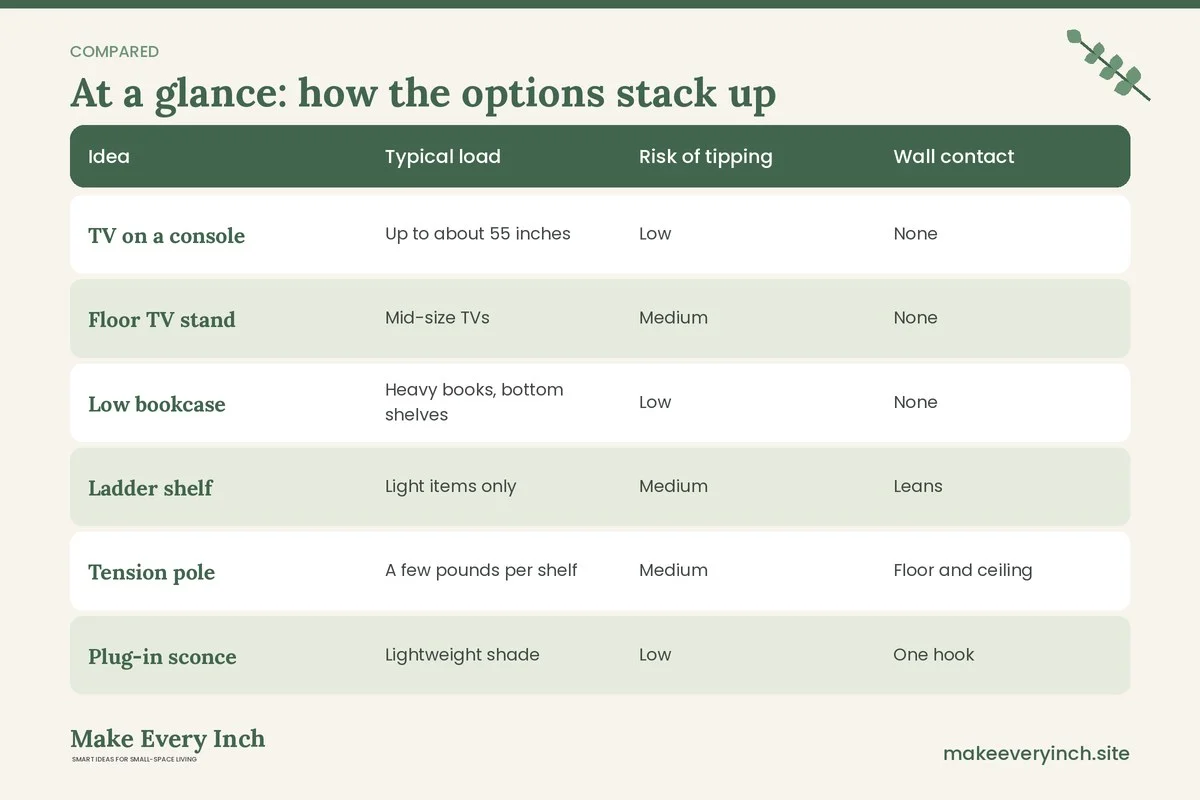
Ideas compared by weight and risk
| Idea | Typical load | Risk of tipping | Wall contact | Best for |
|---|---|---|---|---|
| TV on a console | Up to about 55 inches | Low | None | Most rooms |
| Floor TV stand | Mid-size TVs | Medium | None | Corners |
| Low bookcase | Heavy books, bottom shelves | Low | None | Storage |
| Ladder shelf | Light items only | Medium | Leans | Plants |
| Tension pole | A few pounds per shelf | Medium | Floor and ceiling | Plants |
| Plug-in sconce | Lightweight shade | Low | One hook | Reading |
| Leaned art | Large frames | Low | Leans | Focal wall |
| Fabric on a rod | Light curtains | Low | None | Color |
| Adhesive clips | Cords only | None | Light | Cable tidy |
Choose by weight, not by looks
Every no-drill choice is a trade between weight, height and footprint. A heavier object needs a wider base, and a taller object needs a lower load. Use this order when you decide: first, put the heaviest item on the floor or on a wide console. Second, keep anything above shoulder height light, such as a frame or a plant. Third, spread loads sideways instead of upward, so two short units replace one tall one.
Read the weight limit on every product, and treat the number as a ceiling for a new, clean surface, not as a target. Adhesive ratings assume smooth, dry, well-cured paint, and a textured wall or a damp room will carry much less. When the limit is close to the weight of the item, pick a different method.
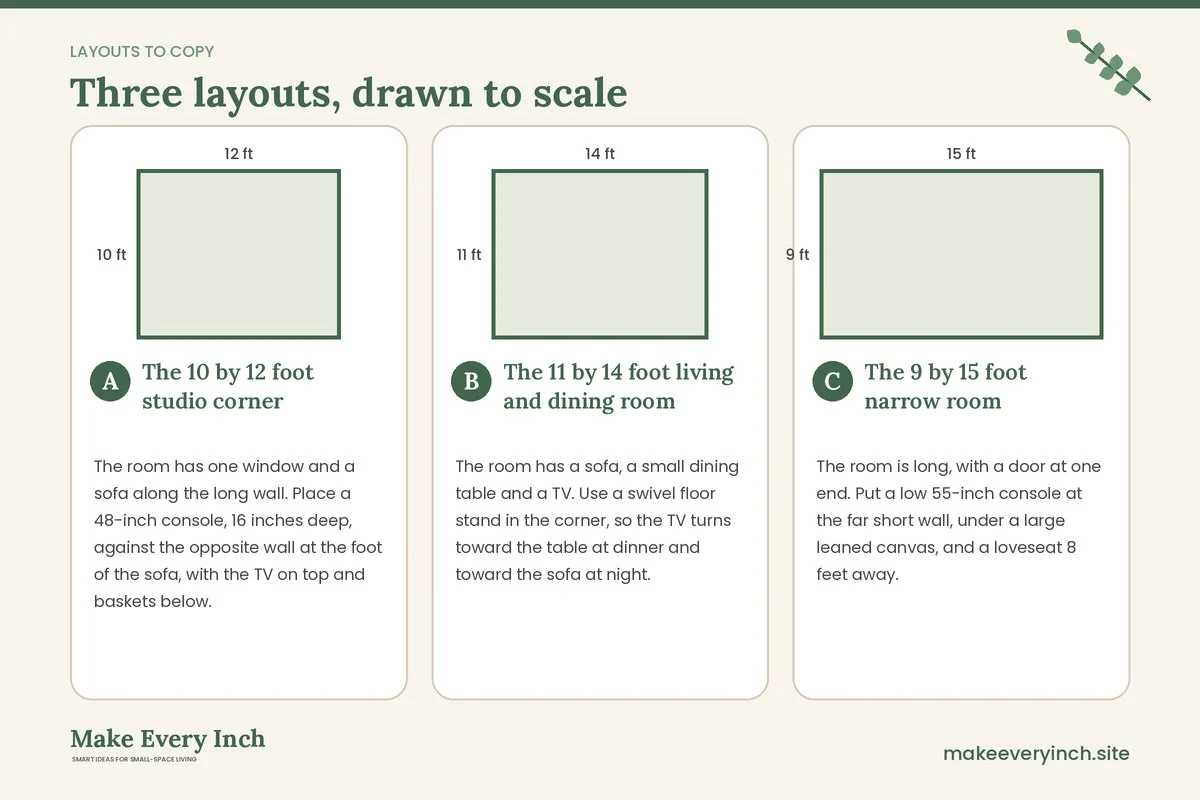
Three example living rooms
The 10 by 12 foot studio corner
The room has one window and a sofa along the long wall. Place a 48-inch console, 16 inches deep, against the opposite wall at the foot of the sofa, with the TV on top and baskets below. Add a 30-inch bookcase beside the window loaded with books on the bottom shelf, an arc lamp behind the sofa arm and a 5 by 8 foot rug under the front legs of the sofa. Leave 36 inches between the sofa and the console for walking.
The 11 by 14 foot living and dining room
The room has a sofa, a small dining table and a TV. Use a swivel floor stand in the corner, so the TV turns toward the table at dinner and toward the sofa at night. Add two stacked 30-inch cubes as a room divider behind the sofa, a floor-to-ceiling tension pole holding plants near the window and a plug-in sconce over the reading chair. Keep a 30 to 36 inch path between the table and the cubes.
The 9 by 15 foot narrow room
The room is long, with a door at one end. Put a low 55-inch console at the far short wall, under a large leaned canvas, and a loveseat 8 feet away. Add a slim bench with baskets along one long wall, and run cords down the console’s rear in a sleeve. Keep one long path at least 30 inches wide down the side.
How to set up a no-drill room in a weekend
Saturday morning: measure and clear
Measure the room and mark the walls, doors and outlets on a sketch. Mark out the furniture footprint with painter’s tape on the floor. Clear the room except for the sofa, and take photos of each wall.
Saturday afternoon: place the heavy pieces
Set the TV console, then the sofa, and check the sightline from the seat. Add the rug and bookcase, and load the bookcase from the bottom up. Test every unit by pushing it at shoulder height, and add weight or move it if it rocks.
Sunday: light, cables and styling
Plug in the lamps and sconces, then trace and tidy the cables with sleeves and clips. Lean the art, hang the curtain rod and finish with plants and baskets. Photograph the finished room, and keep the receipts and instructions for move-out.
Budget guide
Prices vary by region and retailer, so treat these as rough US ranges.
Under $100
Cable sleeves and clips, a power strip, battery lights, a tension rod with light curtains and a secondhand frame to lean.
About $300
A console in the $100 to $200 range, a flat-weave rug and a plug-in sconce. These three cover TV, floor and light.
$600 and up
A quality swivel floor stand, a solid wood low bookcase, an arc lamp and a large leaned canvas.
Mistakes to avoid
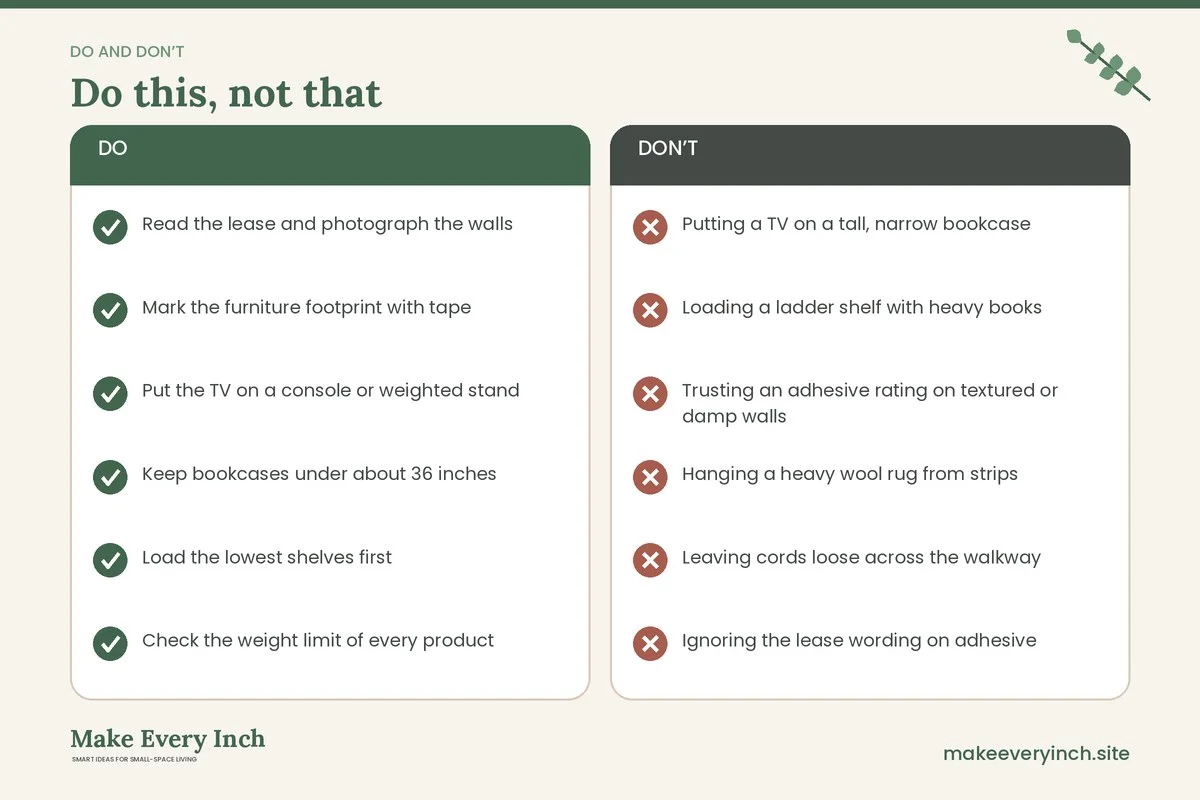
- Putting a TV on a tall, narrow bookcase
- Loading a ladder shelf with heavy books
- Trusting an adhesive rating on textured or damp walls
- Hanging a heavy wool rug from strips
- Leaving cords loose across the walkway
- Ignoring the lease wording on adhesive
- Placing tall furniture beside a door that swings into it
- Skipping the shake test after loading a shelf
Living room no-drill checklist
- Read the lease and photograph the walls
- Mark the furniture footprint with tape
- Put the TV on a console or weighted stand
- Keep bookcases under about 36 inches
- Load the lowest shelves first
- Check the weight limit of every product
- Test adhesive on a hidden spot
- Add a plug-in light at the seat
- Tidy cords with clips and sleeves
- Ask the landlord about one approved anchor
- Leave 30 to 36 inches for walkways
- Photograph the finished room
FAQ
Is it safe to put a TV on a console instead of mounting it?
Yes, if the console is stable and the TV’s feet sit fully on the top. Keep the TV near the back, and keep cords from being pulled by children or pets. A low, wide console is safer than a tall unit.
How tall can a freestanding bookcase be without drilling?
There is no universal number, but about 36 inches is a cautious limit for a room with children or pets. Taller cases need a wall strap. If you cannot strap them, use two short units.
Do adhesive strips work in a living room?
They work for light frames, sconces and small hooks, on smooth, dry, cured paint. Follow the weight chart, and use more strips than the minimum. Avoid them on textured walls.
What if my landlord says no to every hole?
Stay fully freestanding. Choose a console, low shelving, a floor lamp, leaned art and curtains on tension rods.
Can I use a tension pole for a TV?
No. A tension pole is for light items such as plants and small decor, and a TV is far too heavy and valuable to trust to friction.
How do I hide cords without drilling?
Use cord covers in the wall color, adhesive clips on furniture and a sleeve for bundles. Run cords behind the console, and keep them off the walkway.
What should I ask my landlord about?
Ask whether a single small anchor for tall furniture is allowed, and whether you may fill the hole at move-out. Get the answer in writing.
Will a leaned mirror or canvas slip?
It can, on a smooth floor. Put a rubber pad under the bottom edge, lean it at a slight angle and keep it away from a door.
Keep going: Explore our small living room layout ideas, renter friendly shelving ideas and small living room TV wall ideas.
Save this guide for later
Pin the ideas you like to Pinterest so you can come back to them when you plan your space.