15 Small Living Room TV Wall Ideas for Families That Keep Kids Safe
Quick answer: The best small living room tv wall ideas for families put safety first: mount the screen to the wall or anchor the stand and furniture so nothing can tip, route every cord out of reach, keep the lowest edge of the screen above small hands, and give kids their own low shelf for remotes, games and books. Follow the TV and mount instructions, find the studs or use rated anchors, and plan 8 to 10 feet of viewing distance when you can.
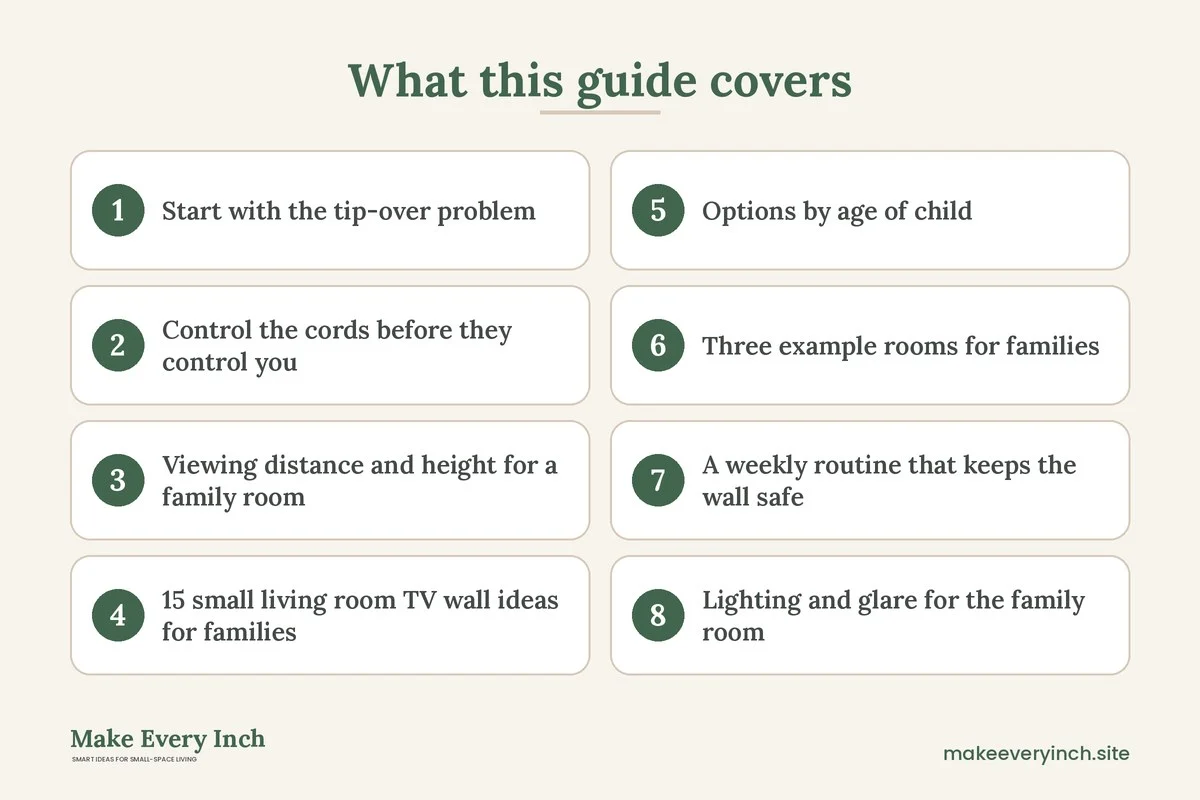
Small living room tv wall ideas for families have a different job from the ones in a design magazine. The wall has to look good, but it also has to survive toddlers who climb, kids who throw balls, teenagers who pile up game consoles and adults who just want to find the remote. In a small room the TV wall is also the busiest wall, because it usually holds the screen, the media storage, the cords and half of the family’s stuff. This guide is built around the realities of a house with children. It covers the tip-over problem first, then cord control, viewing distances, 15 wall ideas, a table of options by age, three example rooms, a weekly routine and a checklist. For the broader topic, start with our main guide on small living room TV wall ideas and the wider small living room ideas pillar.
Start with the tip-over problem
Falling televisions and toppling furniture injure children every year, and the risk is highest with toddlers, who climb, pull and grab. This is the part of the plan that deserves the most care, so deal with it before choosing any decor.
There are three safe routes for a family room, and the right one depends on the wall, the TV and the rental rules.
- Wall mount: the screen hangs on a bracket fixed to the wall, with nothing underneath for a child to climb. This is usually the best option for small rooms because it frees the floor.
- Stand with anchoring: the screen sits on a low, wide, stable unit, and both the TV and the unit are secured to the wall or to each other with the straps and brackets the makers supply.
- Closed cabinet with the TV fixed to it: a heavy, low cabinet with doors that stay shut, and a TV that is attached to it according to the manual.
Whichever route you choose, follow the instructions that come with the TV and the mount, and use the hardware supplied for your model. Check the weight and size limits printed on the bracket against the screen. Fix a wall mount into studs, or into masonry or solid backing using anchors rated for the load, and do not rely on plain drywall. If you are not sure what is behind your wall, or if the wall is plaster, brick or concrete, ask a qualified installer, because the right fixing differs for each. Tall dressers, bookcases and media units should also be anchored to the wall with the anti-tip kit that comes with them, since children climb drawers like stairs.
Test your work gently. Push the unit and the screen from the side, and pull at the top edge. Nothing should shift. Repeat this check once a season, because fixings loosen and families rearrange furniture.
Control the cords before they control you
A small room has fewer places to hide wires, and wires are a hazard for children as well as a visual mess. Loose cords can be pulled, chewed or tripped over, and cords for blinds and curtains deserve the same attention as TV cables.
- Shorten and bundle. Use cable ties or hook-and-loop straps to gather extra length, and tuck the bundle behind the unit or the screen.
- Use a cord cover on the wall. A paintable channel runs from the TV down to the outlet and hides the wires behind a single slim strip. Many are removable, which helps renters.
- Keep power strips out of reach. Mount a power strip on the back of a cabinet or inside a closed unit, and choose one with a cover or a sturdy case. Do not daisy-chain strips.
- Cover outlets. Plug caps or sliding outlet covers protect curious fingers.
- Hide the consoles. Game consoles, streaming sticks and routers sit in a closed cabinet with a vented back, so heat can escape and small hands cannot reach the buttons.
- Check the blind cords. Keep window cords wound up and out of reach, or choose cordless blinds, because cords near the TV wall are often within a child’s grasp.
A cable that runs inside the wall is tidy, but it needs the right in-wall rated cable and a proper installation, so ask a qualified installer if you want that route. Do not simply push an ordinary power cord through a hole in the wall.
Viewing distance and height for a family room
In a small room, the sofa is often only 7 to 9 feet from the screen. That distance is fine, and it gives kids a good view if the screen is at the right height.
- Viewing distance: for a 43 to 55 inch screen, about 6 to 9 feet suits most families. Larger screens look best from 8 to 10 feet, but in a small room it is better to choose a smaller screen than to push the sofa against the wall.
- Screen height: the middle of the screen should sit about at seated eye level, usually 40 to 46 inches from the floor. Sitting low on the floor, kids tilt their heads upward if the screen is too high.
- Bottom edge of the screen: keep it at least 30 to 36 inches above the floor if the floor is a play zone. This keeps it out of reach of small hands and flying toys.
- Tilt: a slight downward tilt of 5 to 10 degrees helps when the TV hangs higher than eye level, but tilt arms add depth and weight, so check the mount limits.
- Side angle: keep the family within about 30 degrees of the center line, or the picture looks washed out from the edge seats.
If the TV must hang high, over a fireplace for example, consider a different wall or a lower arrangement, because a high screen strains the neck during long sessions.
15 small living room TV wall ideas for families
Mount it and clear the floor
1. A wall-mounted screen with nothing below
A flat, fixed mount keeps the screen tight to the wall and removes any furniture a child could climb. Install it into studs or with rated anchors, and follow the mount instructions. Add a shallow shelf below, mounted into studs, for the router and the streaming device.
2. A mount with a low profile and a recessed outlet
If you can get an electrician to install an outlet behind the screen, the power cord disappears completely, and there is nothing dangling. This is a job for a qualified person, not a DIY project.
3. A swing-arm mount for the open-plan room
A swing arm lets you turn the screen toward the kitchen or toward the sofa. It adds weight and leverage on the wall, so confirm the arm and fixings are rated for your screen and wall type, and keep the screen well above reach.
Low and stable furniture
4. A wide, low media unit anchored to the wall
Choose a low unit that is deeper at the base than at the top. Anchor it with the supplied kit, and fix the TV to the unit as the manual directs. A wide base spreads weight, and drawers with soft-close slides protect fingers.
5. A closed cabinet with a TV lift hidden inside
When the TV is not in use, a cabinet that closes hides the screen from small hands and from the glare of a dark living room. Check that the cabinet is anchored and that the lift has a safety lock.
6. A sideboard under a wall-mounted screen
A sideboard with doors can hold games and blankets. Its top should hold nothing heavy or breakable, and the TV should not rest on it unless it is fixed in place.
7. A ladder shelf that is anchored
A slim shelf unit with open cubbies can sit beside the screen as a bookcase, but anchor it to the wall. Do not let kids climb it, and keep heavy things on lower shelves.
Kid-friendly storage around the screen
8. A low shelf for the kids on the same wall
Mount or place a low shelf, 12 to 24 inches from the floor, with baskets for toys, books and controllers. When children have their own shelf, they stop pulling things from the adult media unit. See our guide to small living room storage ideas for families for more.
9. A remote and controller caddy
A wall pocket or a basket by the sofa keeps remotes, controllers and chargers off the floor and out of couch cushions. Label it, and make “return to the caddy” the closing step of every show.
10. A cabinet with a latch
A latch on the cabinet with the consoles keeps small fingers out of buttons and discs. Choose a child-lock that works without tools for adults.
Make the wall work as a family space
11. A magnetic or chalk panel beside the screen
A framed board or a paint-on panel beside the TV holds the weekly chores, the school schedule and a kid’s drawing. It turns the wall into a family hub, and it distracts from the black screen when the TV is off.
12. A gallery of lightweight frames
Use acrylic or plastic frames instead of glass near the screen, because balls and toys fly. Hang them high enough to keep them out of reach of small hands, or use adhesive strips rated for the weight.
13. Soft acoustic panels or a thick rug
Kids make noise, and a small room echoes. A large rug and a fabric panel or a padded wall hanging soften the sound. A rug also protects knees if the family sits on the floor to watch.
Layouts that cope with kids and guests
14. A TV wall with a play corner
Dedicate the corner beside the TV wall to a play mat or a small table, so toys stay in one place. Choose a mat that wipes clean. Keep the zone within eyesight of the sofa, so a parent can watch while a child plays. For more, read our small living room layout ideas.
15. A shared wall of shelves in a rental
In a rental, use freestanding shelves and floor-based storage instead of drilling, and check the lease before mounting a screen to the wall. A heavy TV should always be fixed securely, so if you cannot drill, use a low, wide stand with anti-tip straps that follow the manual. Our post on renter friendly shelving lists options.
Options by age of child
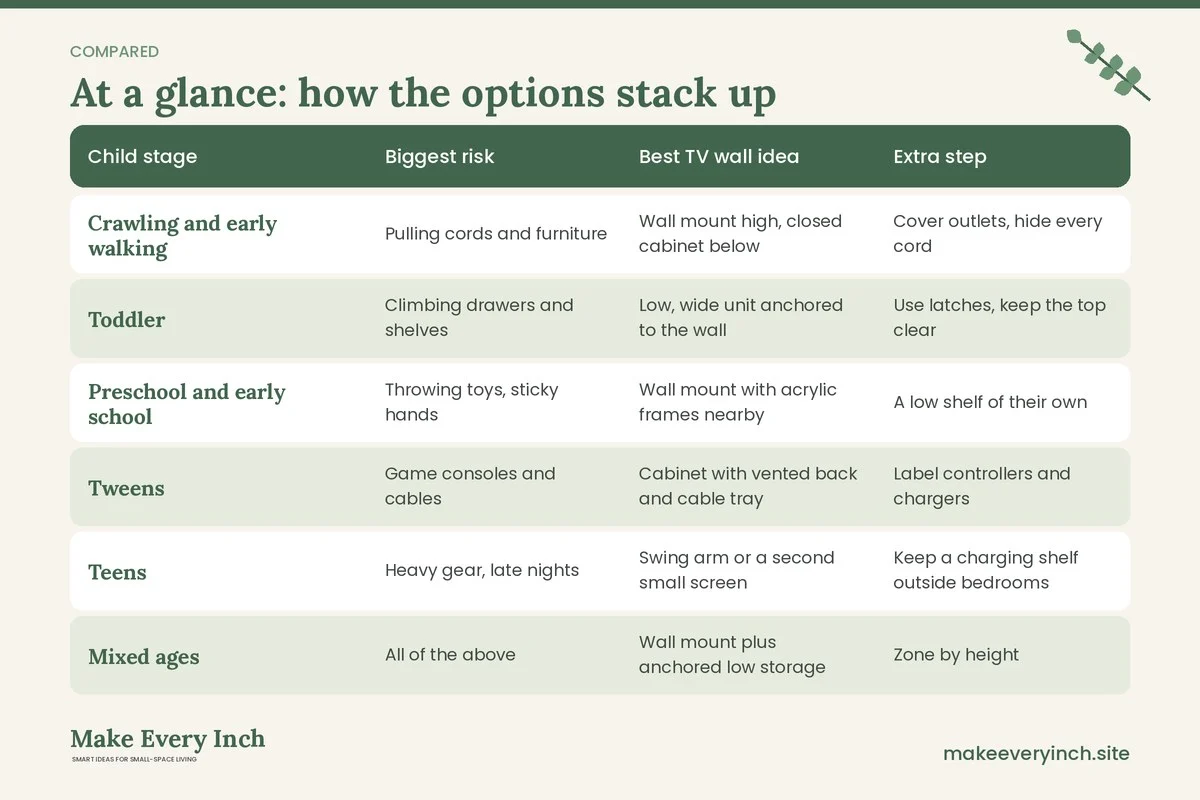
The best wall changes as children grow. This table matches typical stages to a layout. Use it as a starting point, and adapt it to your own household.
| Child stage | Biggest risk | Best TV wall idea | Extra step |
|---|---|---|---|
| Crawling and early walking | Pulling cords and furniture | Wall mount high, closed cabinet below | Cover outlets, hide every cord |
| Toddler | Climbing drawers and shelves | Low, wide unit anchored to the wall | Use latches, keep the top clear |
| Preschool and early school | Throwing toys, sticky hands | Wall mount with acrylic frames nearby | A low shelf of their own |
| Tweens | Game consoles and cables | Cabinet with vented back and cable tray | Label controllers and chargers |
| Teens | Heavy gear, late nights | Swing arm or a second small screen | Keep a charging shelf outside bedrooms |
| Mixed ages | All of the above | Wall mount plus anchored low storage | Zone by height |
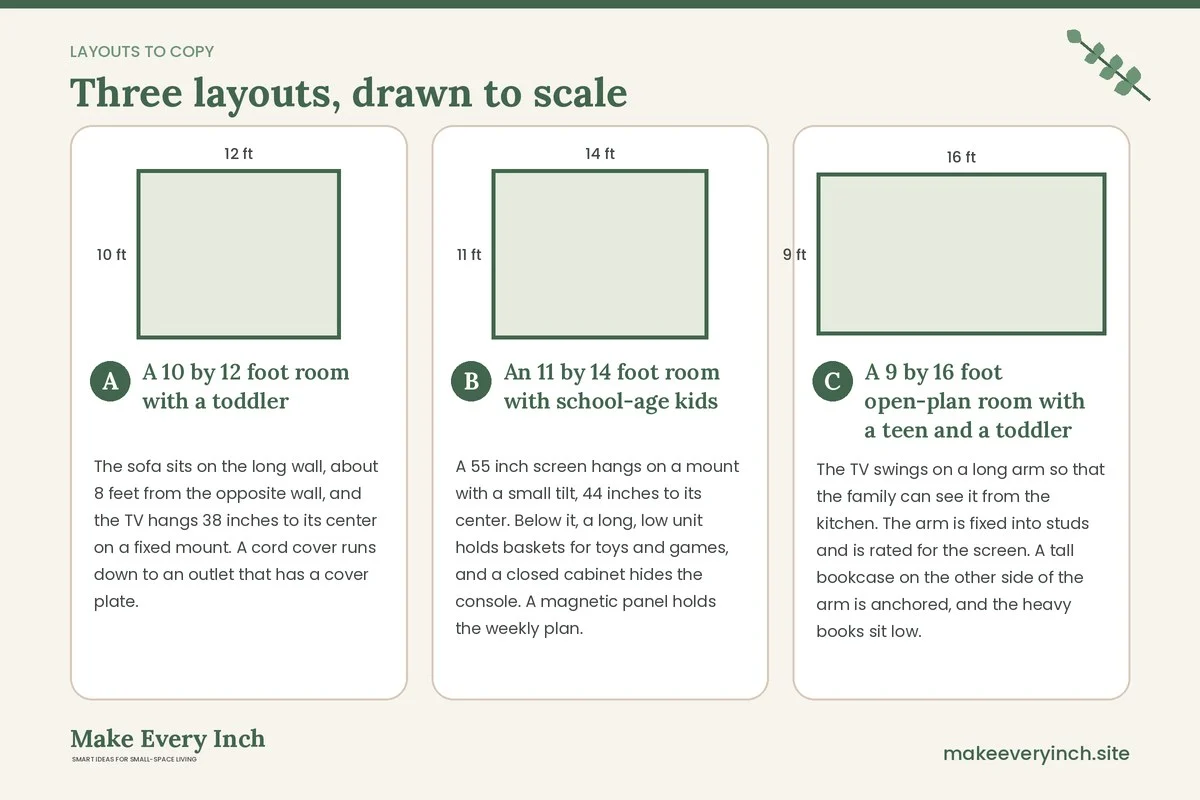
Three example rooms for families
A 10 by 12 foot room with a toddler
The sofa sits on the long wall, about 8 feet from the opposite wall, and the TV hangs 38 inches to its center on a fixed mount. A cord cover runs down to an outlet that has a cover plate. A low cabinet sits below the TV and is anchored to the wall, with a latch on the door that hides the router and the streaming box. The play mat and a basket sit in the corner, in view of the sofa. A rug of about 5 by 8 feet softens the floor.
An 11 by 14 foot room with school-age kids
A 55 inch screen hangs on a mount with a small tilt, 44 inches to its center. Below it, a long, low unit holds baskets for toys and games, and a closed cabinet hides the console. A magnetic panel holds the weekly plan. A remote caddy sits at the end of the sofa, and the family has a “return it” rule. The walkway in front of the unit stays at about 30 to 36 inches.
A 9 by 16 foot open-plan room with a teen and a toddler
The TV swings on a long arm so that the family can see it from the kitchen. The arm is fixed into studs and is rated for the screen. A tall bookcase on the other side of the arm is anchored, and the heavy books sit low. The console and the router live in a closed cabinet, and an outlet cover limits access. The toddler zone is a rug and a basket within sight of the kitchen.
A weekly routine that keeps the wall safe
Safety is not a one-time job, and a short weekly routine keeps the wall in order.
- The five-minute reset: each evening, return remotes and controllers to the caddy, and put toys in baskets.
- The Sunday check: push on the TV and the unit, and look for loose screws or straps.
- The cord scan: look behind the unit for chewed, bent or pinched cords, and replace damaged ones.
- The cabinet check: make sure latches work, drawers close and nothing heavy sits on top.
- The dust and wipe: wipe the screen with a soft, dry cloth, and follow the maker’s guidance for cleaning.
Lighting and glare for the family room
A TV wall in a small room often fights the window. Place the screen at a right angle to the main window, or use blinds that you can close without a long cord. Add a lamp with a warm bulb, about 2700 kelvin, on a side table out of reach. A light behind the screen, such as a small bias light, reduces eye strain during long sessions. For more, read our small living room lighting ideas.
Mistakes families make
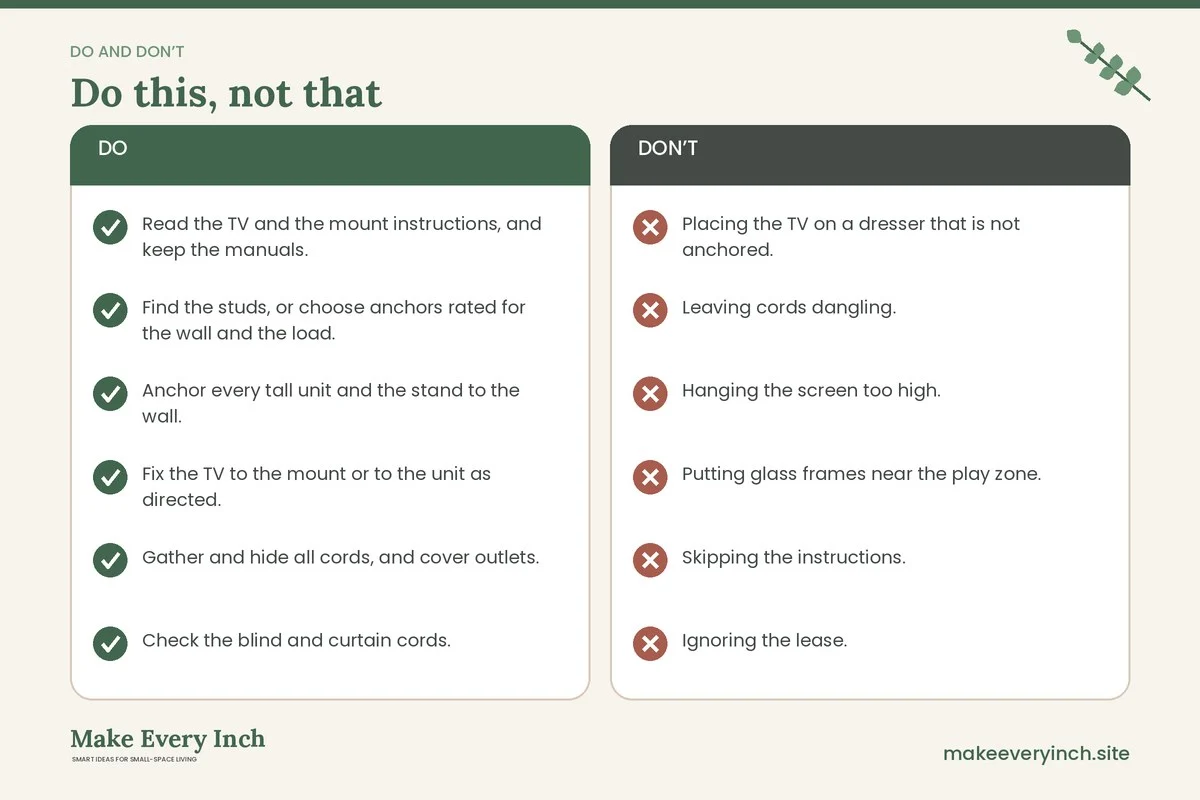
- Placing the TV on a dresser that is not anchored. Drawers act as steps, and a dresser can tip. Anchor it, and fix the TV in place.
- Leaving cords dangling. A dangling cord invites pulling. Use a cover and a bundle.
- Hanging the screen too high. A high screen strains necks, and the wall mount adds leverage. Keep the center near eye level.
- Putting glass frames near the play zone. Balls and toys break glass, so use acrylic or hang frames higher.
- Skipping the instructions. Mounts and stands come with weight limits and fixings for a reason, so read them.
- Ignoring the lease. Check the rules before drilling, and ask the landlord in writing if needed.
- Forgetting the remote. Without a home, remotes disappear, so give them a caddy.
Budget and shopping approach
You do not have to change the whole wall at once. Start with safety, which usually costs little: anchoring kits, cord covers, outlet caps and latches. Then add storage, and finally add decor. Used furniture is often a good choice for a family room, but check it for stability, and anchor it before use. Choose rounded edges, sturdy joints and finishes that wipe clean. Measure the wall and the room before buying, and keep a note of the screen’s weight and mounting pattern so any bracket you buy matches it.
Family TV wall checklist
- Read the TV and the mount instructions, and keep the manuals.
- Find the studs, or choose anchors rated for the wall and the load.
- Anchor every tall unit and the stand to the wall.
- Fix the TV to the mount or to the unit as directed.
- Gather and hide all cords, and cover outlets.
- Check the blind and curtain cords.
- Keep the screen center at about 40 to 46 inches from the floor.
- Keep the sofa about 6 to 9 feet from the screen when possible.
- Give kids a low shelf of their own.
- Put a caddy near the sofa for remotes and controllers.
- Choose acrylic frames and soft materials near the play zone.
- Do a short check each week.
FAQ
What is the safest way to set up a TV in a small living room with kids?
A wall mount fixed into studs or rated anchors is usually the safest choice, because it removes furniture a child could climb. If you use a stand, anchor it and fix the TV to it, following the instructions for both.
How high should I hang the TV in a family room?
The middle of the screen should be near seated eye level, about 40 to 46 inches from the floor. If kids play on the floor, keep the bottom edge at least 30 to 36 inches up.
How do I hide the cords with kids around?
Use a paintable cord cover on the wall, bundle extra length behind the unit, and put the power strip inside a closed cabinet. For in-wall wiring, use a qualified installer.
Can I mount a TV in a rental?
Check the lease, and ask your landlord in writing. If drilling is not allowed, use a low, wide stand with anti-tip straps, and look at our guide to small living room ideas for renters.
How far should the sofa be from the TV?
For many family rooms, 6 to 9 feet works well. A smaller screen in a small room is better than a large one in a cramped space.
Where do the game consoles go?
Put them in a closed cabinet with a vented back, so heat can escape and small hands cannot reach the buttons.
What if my kids keep climbing the media unit?
Anchor it, remove the top clutter, and give the kids a low shelf or a climbing alternative elsewhere. Latches help too.
Keep going: Keep planning with our small living room storage ideas, small living room furniture ideas and small living room ideas with a sectional for families.
Save this guide for later
Pin the ideas you like to Pinterest so you can come back to them when you plan your space.