12 Small Space Furniture Before and After Swaps That Change a Room
Quick answer: The best small space furniture before after changes come from swapping, not adding: replace a bulky sofa with a shallower one, a dresser with a taller narrow chest, a coffee table with nesting tables, and a fixed desk with a fold-down or wall-hugging one. Keep walkways at 30 to 36 inches, lift pieces on legs so floor shows, and anchor anything tall.
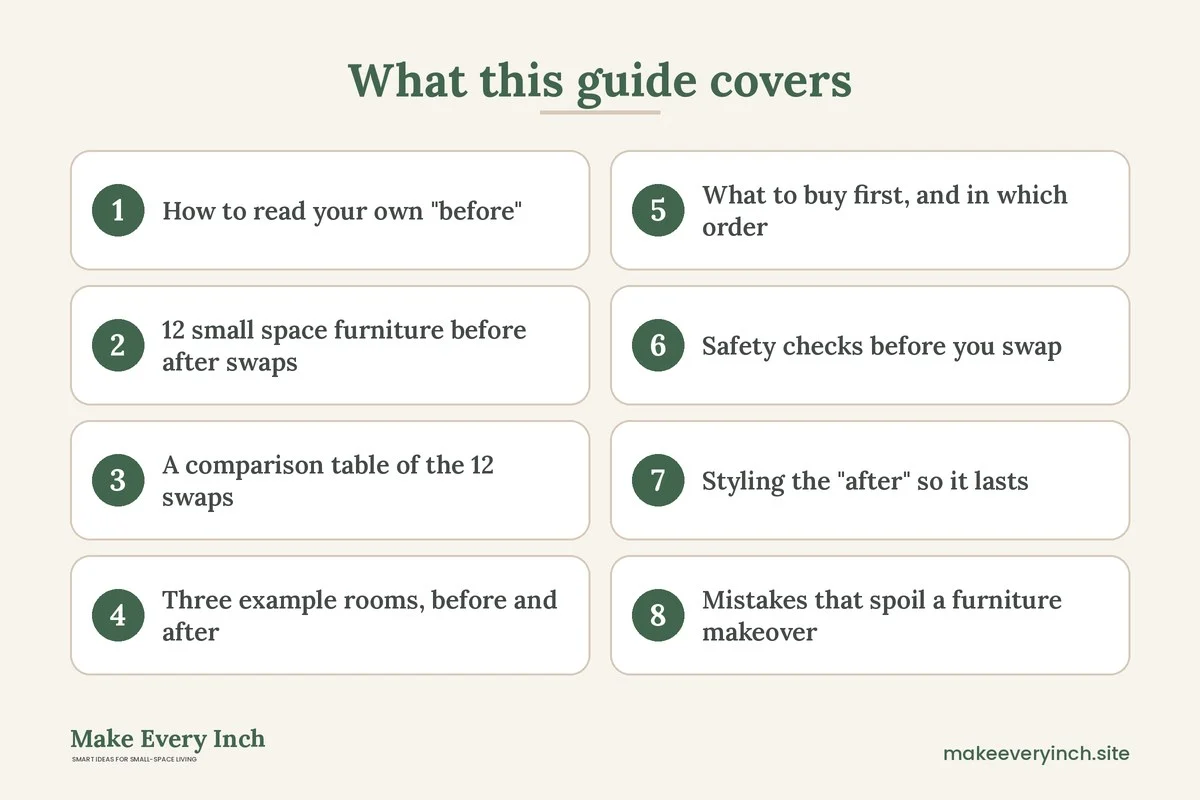
A small space furniture before after story usually starts the same way. A room feels crowded, so the owner buys more storage, and the room feels more crowded. The turning point is almost always a swap: one oversized piece goes out, a better-proportioned piece comes in, and the room opens up without a single wall changing. This guide is about furniture alone. It does not rely on new paint, new floors or a renovation. It covers how to read your own “before”, 12 specific swaps with example measurements, three illustrative room scenarios, a table that compares each swap, the safety checks that matter, the order to make changes in, and a checklist. For the full buying guide behind these ideas, see our pillar on the best furniture for small apartments. If you want to see kitchen, bathroom and dining makeovers, our posts on small kitchen before and after ideas, small bathroom ideas before and after and small dining room before and after ideas cover those rooms.
A note on the examples below. Every room in this post is an illustrative scenario with ordinary dimensions, built to show how a swap works. They are not records of real homes or tested results, and your own results will depend on your layout, your habits and your budget.
How to read your own “before”
Before you swap anything, take photos of the room from the doorway and from the far corner. Photos show what your eye has stopped noticing. Then ask four questions.
- What blocks the path? Walk from the door to each main spot, such as the window, the bed and the sofa. Note every place you turn sideways.
- What is the biggest piece? The largest item sets the feel of the room. If it is bigger than it needs to be, it is the first swap to consider.
- What has no job? Pieces that hold only decor or empty space are candidates to go.
- What is the floor doing? If you see almost no floor, the room feels smaller. Raised legs and open bases return floor to the eye.
Then measure. Our step by step guide on how to measure furniture for a small room explains how to record walls, doors, swings and walkways. Keep those numbers beside you while you read the swaps.
12 small space furniture before after swaps
Each swap below has a “before” problem, an “after” fix, and a note on what to measure. Ranges are hedged. Adjust them for your home.
1. Deep sofa to shallow sofa
Before: A sofa 38 to 40 inches deep pushes into the room and leaves a narrow walkway behind or beside it.
After: A sofa 32 to 35 inches deep with a slimmer arm gives back 4 to 6 inches of floor. Choose a seat depth that still supports your legs, since a very shallow seat can feel perched.
Measure: Total depth, seat depth and arm width. Leave 30 to 36 inches for the main path. Our guide to how to choose a sofa for a small living room goes deeper on proportions.
2. Big coffee table to nesting tables
Before: A coffee table 24 by 48 inches sits in the middle and leaves little room for feet.
After: Two nesting tables, one larger and one smaller, stay stacked when not needed and spread when guests arrive. A single round table with no sharp corners is also friendly in tight rooms.
Measure: Keep 14 to 18 inches between the sofa edge and the table. See our list of best nesting tables for small apartments and our guide to the best coffee tables for small living rooms.
3. Wide dresser to tall narrow chest
Before: A dresser 60 inches wide and 18 inches deep eats a full wall and its open drawers block the bed path.
After: A chest 30 to 36 inches wide and 48 to 54 inches tall holds a similar number of items by using wall height. Drawers pull out into a smaller area.
Measure: Drawer pull-out depth, ceiling height and the path beside the bed. Tall pieces must be anchored to the wall using the supplied hardware, and only with permission if you rent. If you cannot drill, pick a lower piece instead.
4. Bed on the floor to a bed with storage underneath
Before: A low bed leaves a hidden strip of dust and a cluttered closet floor with boxes.
After: A bed frame with drawers or a lifted frame with bins uses the footprint you already paid for. See our guides to best storage beds for small bedrooms and best beds with storage.
Measure: Drawer pull-out depth at the foot and sides. Make sure drawers can open fully without hitting a wall or dresser. Check the weight limit of the frame and slats.
5. Nightstand to wall shelf or narrow stool
Before: A nightstand 20 inches wide fills the gap beside a bed and leaves only a few inches at the wall.
After: A slim shelf, a stool or a wall-mounted ledge takes 8 to 12 inches. Mount only where the lease allows drilling. Otherwise a clip-on or freestanding option works.
Measure: Bed height and the height of your hand when you lie down. See our ideas for nightstand alternatives for small bedrooms.
6. Bulky desk to fold-down or console desk
Before: A desk 60 by 30 inches sits in a bedroom corner and is used two hours a day.
After: A wall-hugging console 36 by 16 inches or a fold-down desk gives you a surface that vanishes when you are not using it. See our posts on small space ideas with fold-down furniture, best desks for small apartments and how to fit a desk into a studio apartment.
Measure: Knee space, chair depth and the swing of any door. A fold-down desk needs a secure anchor into studs, so it is a landlord question in a rental.
7. Armchair to ottoman or pouf seating
Before: A large chair in the corner is rarely used and blocks a window.
After: Two poufs or lightweight stools tuck under a table or against a wall, then come out for guests. See our guide to small space seating ideas for guests.
Measure: Stored footprint and the weight a pouf can safely hold if someone sits on it.
8. Bookcase to leaning ladder shelf or wall-hung shelves
Before: A bookcase 14 inches deep pushes into a narrow living room.
After: A ladder-style shelf is shallow at the top and deeper at the bottom, so it feels lighter. Wall shelves use even less floor space. See our posts on renter friendly shelving ideas without drilling and small space ideas with built in storage.
Measure: Shelf depth against walkway width. Ladder shelves lean, so anchor them if a child or pet could climb. Keep heavy items low.
9. Fixed dining table to drop-leaf or round table
Before: A rectangular table 30 by 60 inches uses a whole wall, even when only one person is eating.
After: A drop-leaf table folds to a narrow strip, and a round table 30 to 36 inches across seats two with no corners. See our guide to the best small dining tables.
Measure: Chair pull-out space of 24 to 30 inches and the folded width of the table.
10. TV stand to wall mount or slim console
Before: A TV stand 18 inches deep pushes the screen into the walkway.
After: A wall mount frees the floor, if the lease and wall type allow it. Otherwise, a console 10 to 12 inches deep keeps the screen close to the wall.
Measure: Screen size, viewing distance and cable routes. Use a mount rated for the TV’s weight and fix it into studs or suitable anchors. Ask the landlord before drilling.
11. Closet-sized wardrobe to rail plus bins
Before: A free-standing wardrobe 24 inches deep crowds a small bedroom.
After: A freestanding open rail with bins below and a shelf above uses the same wall but looks lighter, and you see what you own. See our guide to small bedroom closet organization ideas.
Measure: Hanging length and the total weight on the rail. Do not overload.
12. Standard bed to a daybed, sofa bed or Murphy bed
Before: A bed in a studio takes 60 by 80 inches all day.
After: A sofa bed, daybed or wall bed gives a living room by day and a bedroom by night. See our posts on best Murphy beds for small homes and convertible furniture ideas for studio apartments.
Measure: Open and closed footprints, ceiling height and the extra clearance needed to open it. Wall beds must be anchored to the wall structure following the maker’s instructions. Check the lease.
A comparison table of the 12 swaps
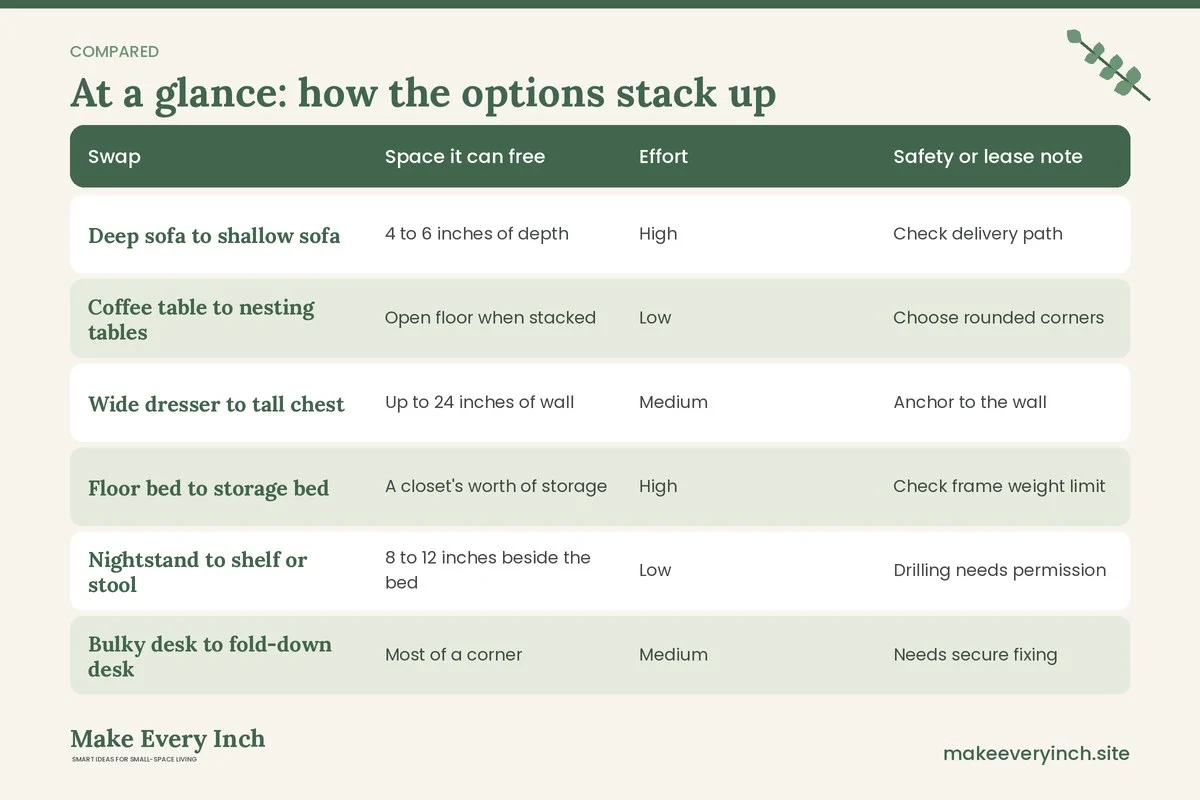
Use this to decide which swaps give the most space for the least trouble.
| Swap | Space it can free | Effort | Safety or lease note | |
|---|---|---|---|---|
| Deep sofa to shallow sofa | 4 to 6 inches of depth | High | Check delivery path | |
| Coffee table to nesting tables | Open floor when stacked | Low | Choose rounded corners | |
| Wide dresser to tall chest | Up to 24 inches of wall | Medium | Anchor to the wall | |
| Floor bed to storage bed | A closet’s worth of storage | High | Check frame weight limit | |
| Nightstand to shelf or stool | 8 to 12 inches beside the bed | Low | Drilling needs permission | |
| Bulky desk to fold-down desk | Most of a corner | Medium | Needs secure fixing | |
| Armchair to poufs | A corner | Low | Check seat weight limit | |
| Bookcase to ladder or wall shelves | 6 to 10 inches of depth | Medium | Anchor, keep heavy items low | |
| Fixed table to drop-leaf | A wall when folded | Medium | Check hinge strength | |
| TV stand to mount or slim console | 6 to 10 inches of depth | Medium | Studs, weight rating, permission | |
| Wardrobe to rail and bins | 8 to 10 inches of depth | Low | Do not overload the rail | |
| Bed to wall or sofa bed | A full bed footprint | High | Anchor, ceiling height, lease |
Three example rooms, before and after
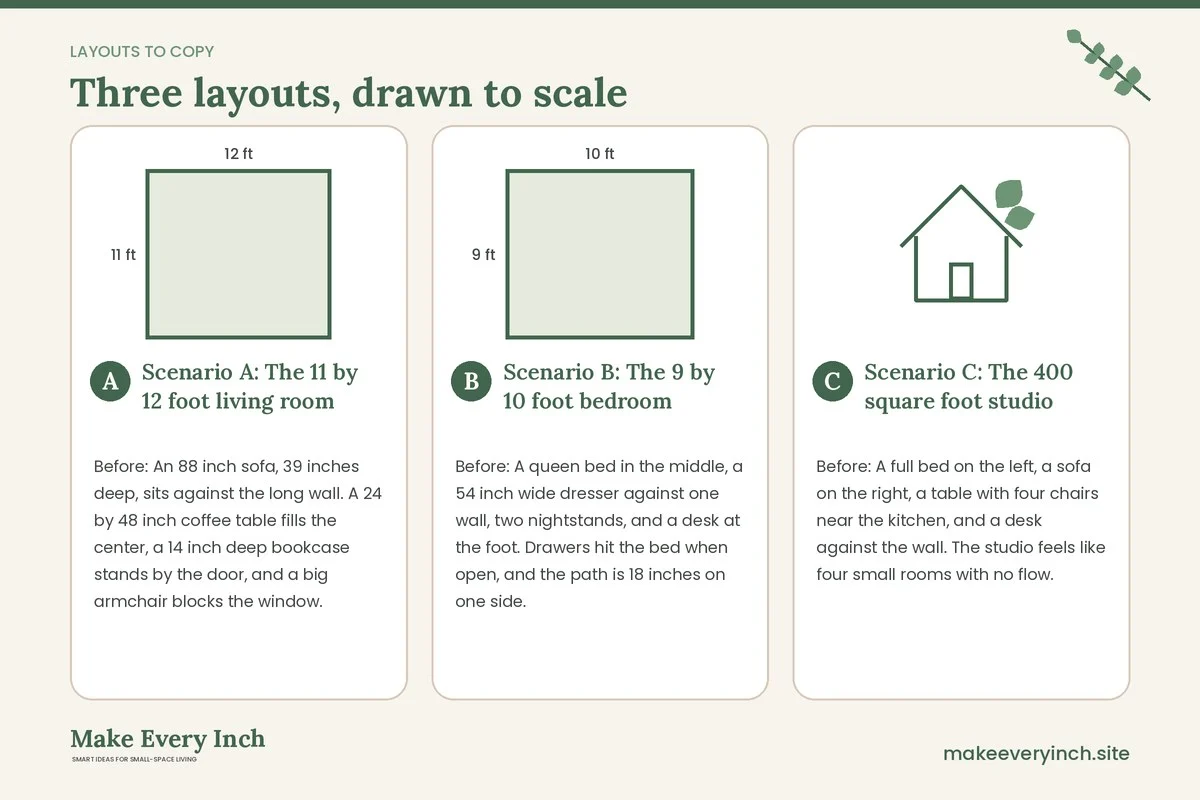
Again, these are illustrative scenarios with ordinary numbers.
Scenario A: The 11 by 12 foot living room
Before: An 88 inch sofa, 39 inches deep, sits against the long wall. A 24 by 48 inch coffee table fills the center, a 14 inch deep bookcase stands by the door, and a big armchair blocks the window. The walkway from door to window is about 22 inches.
After: The owner swaps the sofa for one 76 inches wide and 34 inches deep, which gives back 12 inches of length and 5 inches of depth. The coffee table becomes a nest of two round tables. The bookcase moves to a ladder shelf, and the armchair goes to a pair of poufs that store under the window ledge. The path from door to window is now about 34 inches. The room did not get larger, but the floor became visible.
Scenario B: The 9 by 10 foot bedroom
Before: A queen bed in the middle, a 54 inch wide dresser against one wall, two nightstands, and a desk at the foot. Drawers hit the bed when open, and the path is 18 inches on one side.
After: The bed is pushed to one wall, which turns one side path into a 30 inch walkway. The dresser is replaced by a tall chest 32 inches wide, anchored to the wall with permission. One nightstand is replaced by a shelf at the wall, and the desk becomes a fold-down unit mounted on the wall, if allowed. If the lease bans drilling, a slim console takes its place. Storage moves under the bed in bins. The room now has a clear route from the door to the window.
Scenario C: The 400 square foot studio
Before: A full bed on the left, a sofa on the right, a table with four chairs near the kitchen, and a desk against the wall. The studio feels like four small rooms with no flow.
After: The owner replaces the bed and sofa with a sofa bed that serves both jobs, or a Murphy bed if allowed. The dining set becomes a drop-leaf table with two chairs, and the desk becomes a console that doubles as the dining sideboard. A rug marks the living zone. See our post on renter friendly ways to divide a studio apartment for dividing ideas that do not need drilling. The room now has one big clear area in the middle.
What to buy first, and in which order
Swaps are easier to manage in a sequence. A good order keeps you from buying a piece that no longer fits after the next change.
1. Declutter first. Remove items you do not use. Our guide to small apartment decluttering ideas helps you decide what stays.
2. Choose the anchor piece. The sofa or the bed sets the rest of the room.
3. Place storage next. Decide what must be stored, then fit the storage to the wall space left.
4. Add small tables and seating last. These fill gaps and are the easiest to change.
5. Layer lighting and rugs. A floor lamp and a rug finish a layout without taking floor area.
If your budget is tight, start with the lowest effort swaps in the table. Our posts on budget friendly furniture ideas for small apartments and small apartment makeover on a budget offer ways to spread cost over time. Secondhand pieces can work well, but check joints and drawers, and always measure before you carry anything home.
Safety checks before you swap
Furniture changes affect more than looks. Take a few minutes to check the following.
- Anchor tall furniture. Dressers, bookcases, wardrobes and TVs can tip and cause serious injury, especially to children. Use the provided anti-tip hardware, and drill only with the landlord’s written permission. If you cannot drill, choose lower, wider pieces.
- Respect weight limits. Shelves, loft beds, wall mounts, fold-down desks and hooks all have rated loads. Do not exceed them, and add up the weight of what you will store.
- Keep walkways and exits clear. Do not block bedroom exits, windows or the path to the door.
- Mind electrical safety. Keep outlets reachable, do not cover power strips with fabric, and do not overload sockets. Use cords that are intact. Call a qualified electrician if outlets are warm, loose or scorched.
- Mind ventilation. Leave gaps behind large pieces for air, and do not block vents or radiators. Furniture pressed against a cold outside wall can trap moisture.
- Use low VOC finishes. If you refinish a secondhand piece, choose low VOC paint or sealant, work with the windows open and let it air out before using the room. Flat-pack and new furniture can also give off odors at first, so air the room.
- Protect children and pets. Choose rounded corners, secure rugs with a non-slip pad, and keep cords and small parts out of reach. Check for gaps where a small child or pet could get stuck.
- Check the lease. Do not drill, paint or rehang doors without permission. Our guides to no drill storage ideas for renters and renter friendly apartment decorating ideas show options that leave no trace.
Styling the “after” so it lasts
The best swap can slip back into clutter in a month. A few habits help the new layout stay open.
- Give each surface one job. If a side table is for a lamp and a drink, keep the pile of mail elsewhere.
- Use one in, one out. When something new comes in, something else leaves.
- Keep the floor sacred. Avoid storing bags, boxes and laundry on the open floor, since floor space is what makes the swaps visible.
- Repeat materials. Using two or three finishes across the furniture makes the room feel calm. Our post on furniture that makes small rooms feel bigger explains how leg height, color and scale work together.
- Take an “after” photo. Photograph the room from the same doorway as your “before”. It helps you see what worked, and what to change next.
Mistakes that spoil a furniture makeover
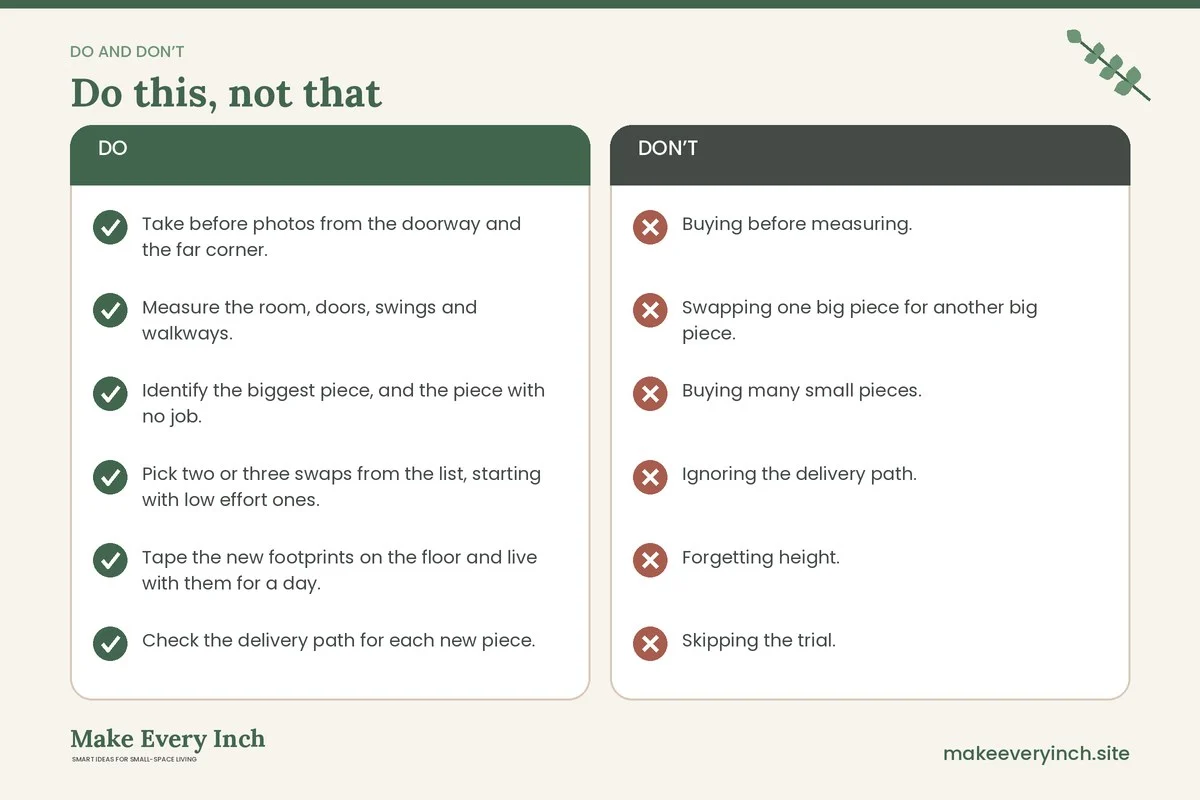
- Buying before measuring. A swap that does not fit is a return, or a regret.
- Swapping one big piece for another big piece. Smaller footprints matter more than style.
- Buying many small pieces. Lots of tiny items can look cluttered. Fewer, better proportioned pieces are calmer.
- Ignoring the delivery path. Check doors, stairs and elevators first.
- Forgetting height. Tall pieces are efficient but need anchoring, and they can overwhelm a low ceiling.
- Skipping the trial. Tape the new footprint on the floor before you commit. Our post on small space furniture mistakes to avoid covers more.
A before after furniture checklist
- Take before photos from the doorway and the far corner.
- Measure the room, doors, swings and walkways.
- Identify the biggest piece, and the piece with no job.
- Pick two or three swaps from the list, starting with low effort ones.
- Tape the new footprints on the floor and live with them for a day.
- Check the delivery path for each new piece.
- Confirm the lease before drilling, mounting or rehanging doors.
- Plan to anchor tall pieces and check weight ratings.
- Keep 30 to 36 inches for main paths where possible.
- Keep outlets, vents and radiators clear.
- Let new or refinished pieces air out with the windows open.
- Take after photos and note what to change next.
Frequently asked questions
What is the quickest small space furniture swap?
Replacing a coffee table with nesting tables or a pouf takes minutes, costs little effort and frees floor right away. Moving the bed or sofa to a better wall can also change a room without buying anything.
Do I need to buy new furniture for a before after change?
Not always. Rearranging, removing a piece or moving storage under the bed can give a large visual change. Swap in new furniture only where a piece is too big or does not do a job.
How much floor space should I aim to free?
Aim for main paths of 30 to 36 inches and a clear area where the eye can see floor. Even a few inches gained in several places can make a room feel noticeably more open.
Are tall narrow pieces better than wide low ones?
They use less floor, but they add visual weight and need anchoring. In a room with a low ceiling or a child at home, lower pieces may be a better fit.
Can renters do these swaps?
Most swaps need no tools. Those that need drilling, such as wall mounts, fold-down desks and wall beds, need written permission. Freestanding, no drill options are listed in our guide to renter friendly storage ideas for small apartments.
How do I keep the room looking good after the swap?
Give every surface one job, keep floors clear and follow a one in, one out rule. Review the room every few months.
Should I buy furniture in a set?
Sets can be convenient, but matching pieces are not always the right size for a small room. Choose each piece by its footprint first.
Keep going: Plan your own room makeover with our guide to the best furniture for small apartments, check measurements with how to measure furniture for a small room, and see what to avoid in small space furniture mistakes to avoid.
Save this guide for later
Pin the ideas you like to Pinterest so you can come back to them when you plan your space.