16 Small Bedroom Ideas Cozy Enough to Sleep In Every Night
Quick answer: The best small bedroom ideas cozy enough for real sleep layer soft textiles on the bed, use warm dimmable lamps at two or three low heights, set up a bedside zone you can reach from a pillow, and keep the floor clear on at least one side of the bed. Aim for about 24 to 30 inches of walkway where you can, stay within the limits on plugs and cords, and choose low-VOC paint or washable fabric changes before anything permanent.
Small bedroom ideas cozy enough to relax in have one job that no other room has: they must help you fall asleep. A living room can be bright, busy and full of surfaces. A bedroom has to go quiet at the end of the day. That means soft light, soft surfaces, a bed that feels like a nest and a floor you can cross in the dark without bumping into anything. This guide is about the bedroom and only the bedroom. For the broader overview, start with our parent guide to small bedroom ideas, and if you rent, see small bedroom ideas for renters. Here we focus on the cozy part: textiles, warm light, bedside setups, measurements, a table, three example rooms and a four-week plan.
What cozy actually means in a bedroom
Cozy is a feeling made from a few physical things. It is warmth, softness, low light, enclosure and order. In a small bedroom you get enclosure for free, because the walls are close. The task is to make that closeness feel like a hug rather than a squeeze.
Warmth comes from layers you can add or remove, such as a quilt, a throw and a heavier blanket at the foot of the bed. Softness comes from fabric at every touch point: the bed, the floor beside it and the window. Low light comes from lamps rather than a ceiling fixture. Order comes from a plan for where small things go at night, so that your bedside is calm when you lie down.
It helps to be honest about what cozy is not. It is not more stuff. A bed piled with eight decorative pillows is lovely for a photo and tiring at ten at night, when you have to move them all. A room crowded with baskets and frames has no visual rest. The cozy bedrooms that work in small spaces are layered but edited, and each layer earns its place.
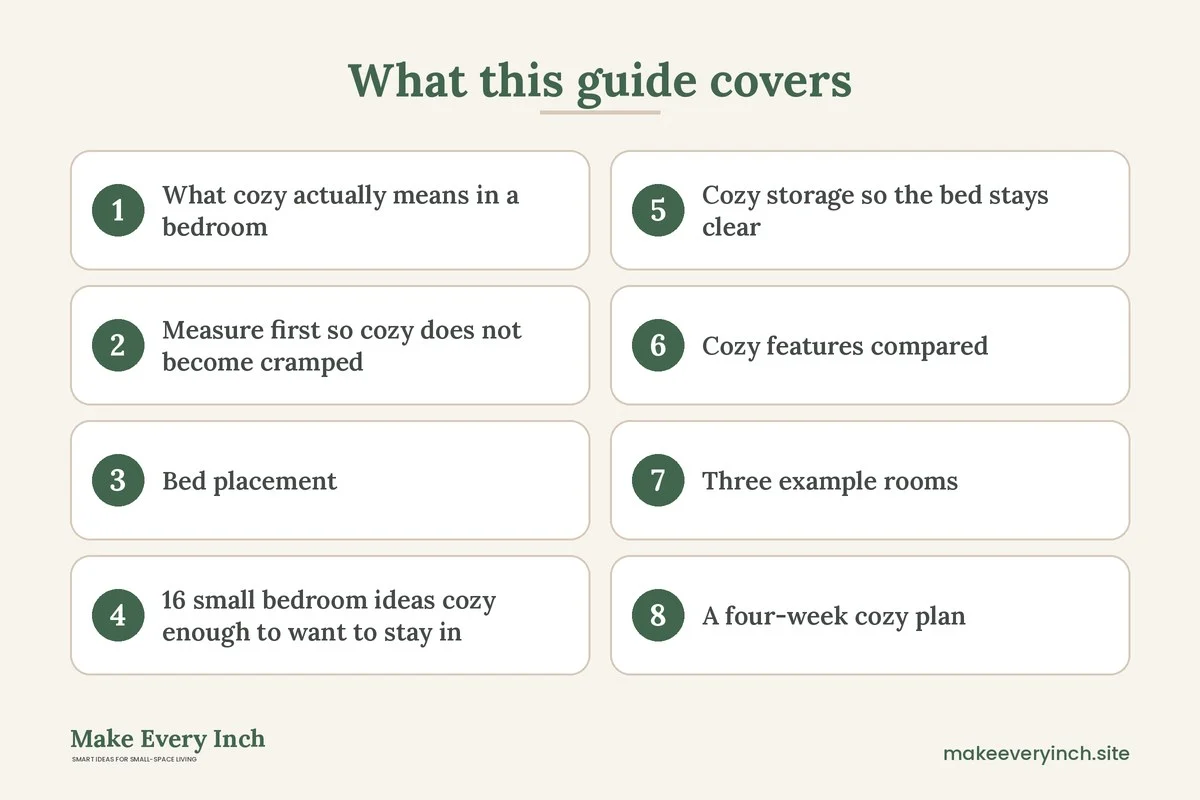
Measure first so cozy does not become cramped
Before you buy a blanket or a lamp, measure the room. Small bedrooms often fail on a few numbers, and those numbers decide how cozy you can go. Treat the figures below as typical guidance, and adjust for your own body, bed and habits.
- Walkway beside the bed: about 24 to 30 inches on at least one side, so you can get in and out and make the bed. If you can only manage 18 to 22 inches, keep that side clear of anything on the floor.
- Bed to dresser: about 30 to 36 inches if drawers pull toward the bed, since you need to stand in front of an open drawer.
- Nightstand height: within about 2 inches of the top of the mattress, so you can reach a glass of water without lifting your whole arm.
- Nightstand width: 12 to 18 inches in a small room. A narrow table still holds a lamp, a glass and a book.
- Lamp height: the bottom of the shade near eye level when you are sitting up in bed, often 24 to 30 inches above the mattress for a wall light or a tall lamp.
- Curtain rod: mounted 4 to 8 inches above the window frame and 6 to 10 inches wider on each side, so the curtains frame the window rather than covering it.
- Rug under the bed: large enough that at least 18 to 24 inches shows on the sides and foot, or small runners on each side if the room is tight.
Mark the footprints with painter’s tape on the floor and sit on the bed for a few minutes. If you feel boxed in, the answer is usually to remove one piece of furniture instead of adding something cozy to fix it.
Bed placement: the base of every cozy plan
Where the bed goes sets the mood. In a small room you have four realistic options, and each changes how the room feels.
Headboard on the longest solid wall
This is the default and for good reason. Placing the head of the bed against the longest uninterrupted wall keeps the floor clear in the middle and gives you a backdrop for softness, such as a fabric headboard or a wall hanging. Leave a few inches between the bed and a radiator or heater, and do not block a vent.
Bed in a corner
Pushing one side of the bed to the wall frees up the walkway on the other side and gives a snug, cave-like feeling. It is cozy for one person, and it is less practical for two, because one person has to climb over the other. If you choose this, make sure the wall side has a washable bumper, such as a fabric headboard or a cushion, so nothing scrapes the paint.
Bed under a window
Many small rooms have only one wall that works for the bed, and it has a window. This is workable if you hang a curtain that can fully cover the window at night and avoid placing the bed where a draft hits your face. Check that the window can still be opened, and that nothing blocks an escape route.
Bed centered with side tables
Centering the bed gives the best symmetry but needs the most width. As a rule, you need about 9 to 10 feet of room width for a queen with two narrow nightstands and a walkway. Smaller rooms usually cannot do this comfortably, so choose a corner or wall layout.
For more layout options, see small bedroom layout ideas, and if you have a larger mattress, small bedroom ideas with a queen bed.
16 small bedroom ideas cozy enough to want to stay in
Textiles that make the bed the star
1. Build the bed in three layers
Start with a fitted sheet and flat sheet in a natural fabric such as cotton or linen. Add a mid-weight blanket or quilt. Finish with a throw folded across the foot. Three layers give you warmth you can adjust through the seasons, and they keep the bed looking finished with little effort. Fold the throw in thirds so it is easy to pull up at night.
2. Limit pillows to what you will actually move
Two sleeping pillows, two standard pillows for sitting up and one small accent is a comfortable cap for a small bed. More than that and the morning routine turns into a chore. Choose pillow covers with zips so they can be washed often.
3. Add texture instead of pattern
In a small room, many patterns look busy. Texture adds depth without noise. Try a waffle blanket, a knit throw, a quilted coverlet or a tufted cushion. Keep the palette to two or three related colors so the bed looks calm from the door.
4. Choose a headboard that is soft
A padded or upholstered headboard gives a soft place to lean when you read, and it warms a bare wall. If you rent or want to avoid screws, use a freestanding headboard that leans on the wall, or a fabric panel hung from a tension rod. Make sure any tall freestanding headboard is secured so it cannot tip. Anchor it to a stud or use the bed frame’s own attachment points, following the maker’s instructions.
Warm, low light that signals bedtime
5. Swap the ceiling light for lamps
A single bright ceiling fixture flattens a small room. Two or three lamps at different heights make it glow. Use a table lamp on one side, a wall light or a swing-arm on the other, and a small low lamp on the dresser. See small bedroom lighting ideas for a deeper look at layering light, and renter-friendly lighting ideas if you cannot rewire.
6. Choose warm bulbs, and keep the brightness low
Look for bulbs labeled warm white, usually in the range of about 2,200 to 2,700 kelvin. In the hour before bed, keep light low and indirect. Many sleep guides suggest that dimmer, warmer light in the evening is easier on the eyes than bright, cool light, though responses vary from person to person.
7. Add a dimmer or a plug-in dimming switch
A dimmer lets you move from reading light to sleep light without getting up. Use a dimmer that matches the bulb type, because some LED bulbs do not dim, and check the load rating. Plug-in dimmers are an option for renters, provided you stay within the stated wattage.
8. Use a string of lights with care
A string of warm lights along a headboard wall or a shelf adds a soft glow. Choose a set labeled for indoor use, keep it away from fabric that could trap heat and never cover it with a blanket. Turn it off when you sleep, or put it on a timer.
Bedside setups you can reach from the pillow
9. A narrow nightstand with a closed drawer
A 12 to 16 inch table with one drawer hides chargers, tissues and lotion. The top holds a lamp, a glass and one book. If anything else wants to live there, it needs a home elsewhere.
10. A wall shelf as a floating nightstand
When floor space is tight, a shelf mounted beside the bed gives you a surface without legs. If you can drill, fix it into studs or use the right wall anchors for the load. If you cannot drill, see renter-friendly shelving.
11. A tray on a stool or a small cube
A tray keeps small things together and can be carried away in a second. Use a stool, a cube or a nesting table underneath. Keep the total height close to the top of the mattress.
12. Cord management at the bed
Run chargers along the bed frame with adhesive clips, and keep cords out of the walkway. Use outlet covers and power strips with surge protection that match your load, and do not plug a high-wattage heater into a strip. If an outlet or cord feels hot, stop using it and have it checked.
Floors, windows and walls
13. A rug that meets your feet
Put a rug under the lower two thirds of the bed so the first step in the morning lands on softness. Use a non-slip pad, and choose a flat weave if the door sits close to the rug. Wash or air it regularly, as rugs hold dust.
14. Curtains that actually darken
Lined or blackout curtains help the room feel secluded and block early light. Hang them high and wide, and let them fall to the floor or just above it. A curtain that skims the floor can pool in dust, so a small gap is easier to clean.
15. Color on the walls, in a form you can reverse
Soft, muted colors feel cozy in a small bedroom, such as warm white, greige, sage, clay or dusty blue. If you paint, choose a low-VOC or zero-VOC paint, open windows during and after painting, run a fan and allow it to cure before sleeping there. If you rent, try removable wallpaper on the wall behind the bed, after testing a hidden spot and checking your lease.
16. A reading corner built into the bed
If there is no space for a chair, make the bed the reading spot. Add a wedge pillow, a wall light and a small shelf. This costs nothing in floor space and puts everything within reach.
Cozy storage so the bed stays clear
Cozy dies when clutter piles up. The simplest fix is to store more under, behind and above the bed. Use under-bed boxes for off-season blankets, which also keeps dust off them. See under-bed storage ideas for sizes and lids that work. If you are buying a new frame, check best beds with storage. Use a tall, narrow dresser or a wall of hooks to take clothes off chairs, and read small bedroom storage ideas for more.
Any tall furniture needs to be anchored. A tall dresser, a bookcase or a wardrobe can tip, especially if children or pets climb on it or when drawers are open. Use the anti-tip kit that comes with the item, and fasten it to a stud where you can. In a rental, ask whether small anchor holes are acceptable, and use a strap fixed to the wall in the least visible spot. Never place heavy items on top of a tall unit.
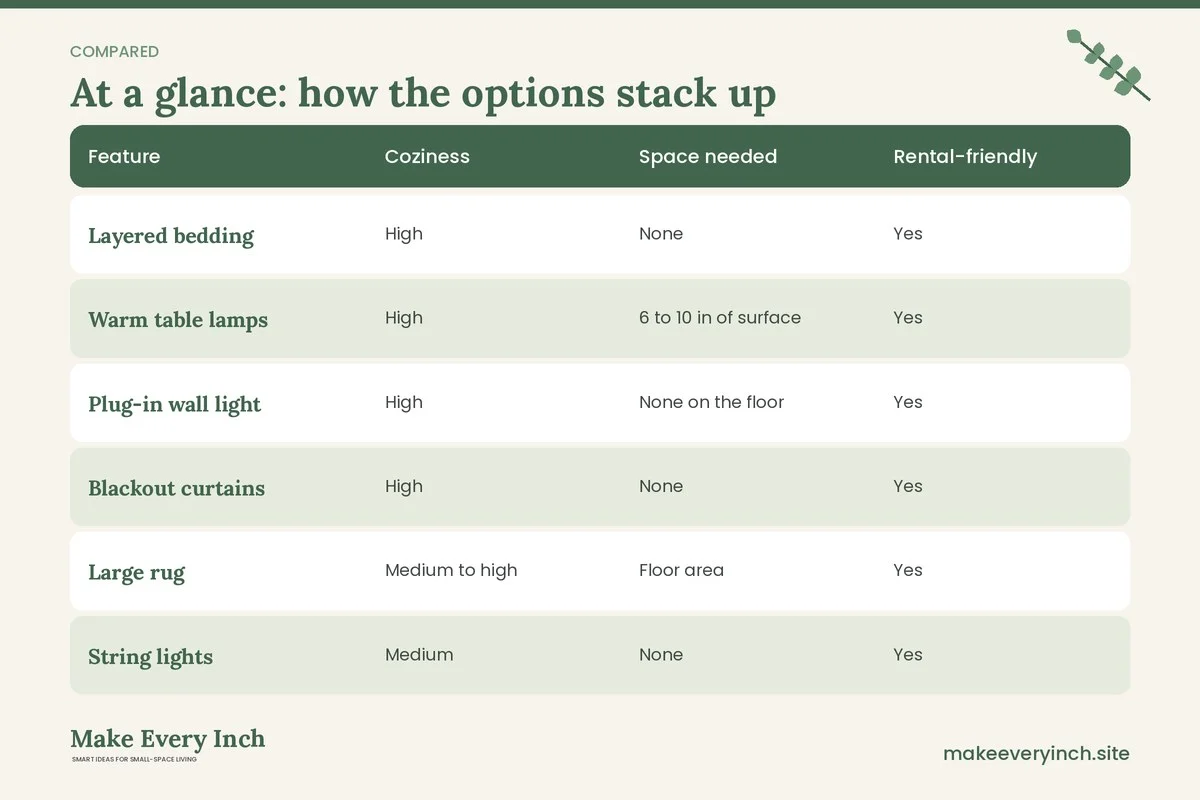
Cozy features compared
| Feature | Coziness | Space needed | Rental-friendly | Safety note |
|---|---|---|---|---|
| Layered bedding | High | None | Yes | Wash often |
| Warm table lamps | High | 6 to 10 in of surface | Yes | Match bulb wattage |
| Plug-in wall light | High | None on the floor | Yes | Hide the cord, do not run under rugs |
| Blackout curtains | High | None | Yes | Secure the rod |
| Large rug | Medium to high | Floor area | Yes | Use a non-slip pad |
| String lights | Medium | None | Yes | Indoor-rated, never covered |
| Floating shelf | Medium | None on the floor | Check lease | Use correct anchors |
| Fabric headboard | High | 2 to 4 in | Yes if freestanding | Anchor tall panels |
| Painted wall | Medium to high | None | Rarely | Low-VOC, ventilate |
Three example rooms
These examples are sketches, not prescriptions. Sizes are approximate, and your measurements will differ.
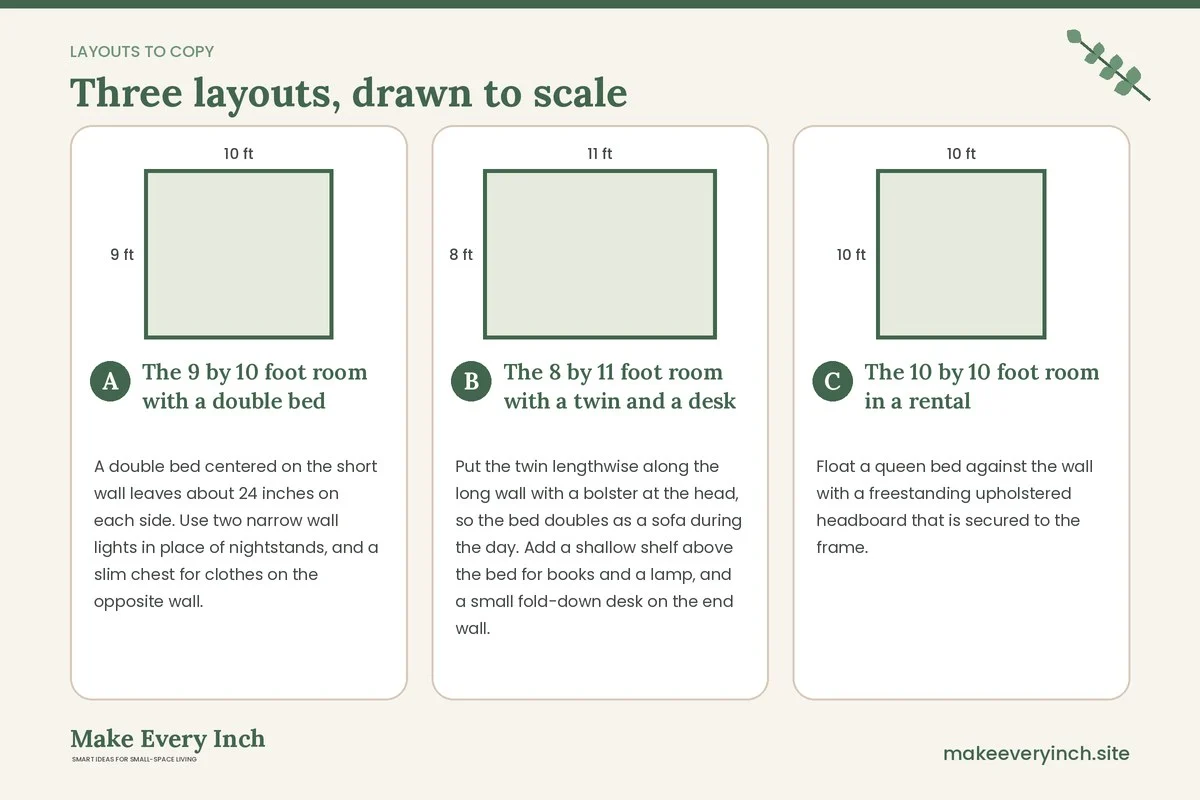
The 9 by 10 foot room with a double bed
A double bed centered on the short wall leaves about 24 inches on each side. Use two narrow wall lights in place of nightstands, and a slim chest for clothes on the opposite wall. Add a flat-weave rug with 18 inches showing, lined curtains and a soft headboard panel. Keep the top of the dresser to a lamp and a tray. This room is cozy because it is symmetrical and quiet, and because nothing sits on the floor on either side of the bed.
The 8 by 11 foot room with a twin and a desk
Put the twin lengthwise along the long wall with a bolster at the head, so the bed doubles as a sofa during the day. Add a shallow shelf above the bed for books and a lamp, and a small fold-down desk on the end wall. A round rug and a thick curtain make the corner feel like a nook. Keep a 30 inch walkway along the open side, and see small bedroom desk ideas for more ways to fit a desk.
The 10 by 10 foot room in a rental
Float a queen bed against the wall with a freestanding upholstered headboard that is secured to the frame. Use plug-in wall sconces with covered cords, a tension rod with a fabric panel above the headboard, and two matching lamps on slim tables. Choose a rug large enough to anchor the bed. Store extra blankets in lidded boxes under the bed. This setup leaves no marks and takes about a day to reverse.
A four-week cozy plan
Week 1: edit and measure
Empty the floor and surfaces. Take everything off the nightstand, the dresser top and the chair, and put it in a box. Measure the room and the furniture, and tape the footprints. Decide where the bed goes. Return only what you use every week.
Week 2: lighting and bedside
Swap your main source of light for lamps with warm bulbs. Add a dimmer or a plug-in switch. Set up the bedside with a glass, a lamp and one book, and clip cords out of the way. Check cords and plugs for heat or damage.
Week 3: textiles
Add the three bed layers, the rug and the curtains. Wash everything first so the room smells fresh. Add a headboard or a hanging panel and secure anything tall. Pick one accent color and stay with it.
Week 4: storage and finishing
Add under-bed boxes, hooks and a tidy dresser top. Paint or add removable wallpaper if the lease allows, with open windows and low-VOC products. Style the room last, with one plant, one frame and one candle substitute such as a battery light. For a budget version, see a budget small bedroom makeover.
The cozy bedroom checklist
- The bed is on the longest solid wall, or in a corner with a washable barrier.
- At least 24 inches of walkway on one side, if possible.
- Three lamps or lights at different heights, with warm bulbs.
- A dimmer or a way to lower the light before bed.
- A nightstand or shelf within reach, with a lamp, a glass and one book.
- Cords tied up and no cords under rugs.
- A rug with a non-slip pad.
- Curtains that block light and hang high and wide.
- Three layers of bedding, washed regularly.
- Tall furniture anchored to the wall.
- Low-VOC paint and ventilation if you paint.
- No more than one accent color.
- Under-bed storage for blankets.
- Nothing on the floor on the side you use to get up.
Common cozy mistakes
Too many pillows is the most common mistake. If you need more than 30 seconds to make the bed, you will stop making it. Another mistake is a bright, cool ceiling light that fights the lamps. A third is choosing a rug that is too small, which makes the bed look as if it is floating. Fourth, many people put a bedside lamp on a table that is too low, so the light shines in their eyes. Finally, do not hide clutter under the bed in open piles. Use boxes with lids, or the soft look turns into a dust problem.
Cozy without a lot of money
You can build most of this with thrifted and basic pieces. Buy second-hand lamps and change the shades, or use fabric to cover a plain shade (keep the fabric away from the bulb). Buy sheets in natural fabrics and layer them with blankets you already have. Use a long scarf or a quilt as a throw. Dye old curtains. A modest budget goes furthest on lighting and bedding, because those two things touch you every night. For a related list of cheap ideas, see small bedroom makeover ideas.
Frequently asked questions
How do I make a small bedroom cozy without making it feel smaller?
Keep the floor clear, use a limited color palette and put soft light at low and mid heights. Layers that sit on the bed or on the wall do not take floor space. Avoid large pieces of furniture that are only decorative.
What is the best color for a cozy small bedroom?
Warm, muted colors such as warm white, sage, clay or dusty blue work well, and dark colors can feel enclosing in a good way if the room has enough light. Test a sample on the wall and look at it morning and night before you decide.
Is it safe to use string lights near the bed?
Only if they are rated for indoor use and not covered by bedding or fabric. Turn them off while you sleep or use a timer, and replace any set with frayed wires or warm connectors.
How many pillows should a small bed have?
Two for sleeping, two for sitting up and one accent are a practical limit. Fewer works too.
Can I make my rental bedroom cozy without paint?
Yes. Use textiles, lamps, curtains and a rug. A fabric panel, a freestanding headboard and plug-in lights add warmth with no damage. See small bedroom ideas for renters.
What if my bedroom has no closet?
Use a wardrobe or a rail on the side wall, and keep clothes off chairs. See small bedroom ideas without a closet.
Should I paint the room or change bedding first?
Change bedding and lighting first, since they cost less and make the biggest difference. Paint after you know what colors you like.
Keep going: Ready to keep going? Plan your layout with small bedroom layout ideas, light the room with small bedroom lighting ideas and make room for everything with small bedroom storage ideas.
Save this guide for later
Pin the ideas you like to Pinterest so you can come back to them when you plan your space.