Renter Friendly Ways to Hide Cords
Quick answer: The best renter friendly ways to hide cords use removable adhesive raceways, cable clips, furniture routing, cord covers on the floor and a properly rated power strip tucked behind a console. Never staple or nail a cord, never bury a plugged-in strip under a rug or fabric, keep total load within the strip’s rating and check the lease before attaching anything to a wall.
Renter friendly ways to hide cords start with a small observation: the cords are usually the messiest thing in a tidy room. A lamp, a television, a router, a phone charger and a speaker can turn a calm wall into a tangle, and in a rental you cannot open the wall, drill a hole for an outlet or hire an electrician to move anything. The good news is that you can hide most cords with removable products and a little layout planning. The trick is to do it safely, because cords carry electricity, and hiding them badly creates heat and trip hazards. This guide covers the lease check, a cord map, a table of methods, 15 specific ideas, electrical safety rules, three example rooms, removal steps and a checklist. For the wider topic, read our hub guide on renter-friendly apartment decorating ideas. If you also want to dress the windows that cords often cross, see our companion guide to renter friendly window treatment ideas.
Check the lease and photograph the walls
Cord solutions attach to walls, baseboards or the floor, and leases treat those surfaces differently. Read the clauses on adhesive, nails, screws and paint. If the lease is silent, ask the landlord in writing whether adhesive products on walls and trim are acceptable. A short email is enough, and the answer protects your deposit.
Before you stick anything down, photograph the area. Take a wide shot of each wall and close-ups of the baseboard, the outlet plate and the paint around it. Note any existing chips or stains. When you move out, take the same photos again and compare them. This record is the best protection for your deposit.
Then apply a few ground rules to every cord project.
- No staples, nails or tacks through or around a cord. They can cut the insulation, which is a shock and fire risk, and they leave holes.
- Test adhesive on a hidden spot, such as inside a closet, and leave it for several days before you commit to a visible wall.
- Avoid fresh paint. Paint can take weeks to cure, and adhesive can lift it. If the unit was painted recently, ask or wait.
- Never open an outlet, cut a wall or run a cord through a wall. That is work for a licensed electrician, with the landlord’s approval.
- Keep everything reversible. If you cannot undo it in a few minutes, it is not a rental solution.
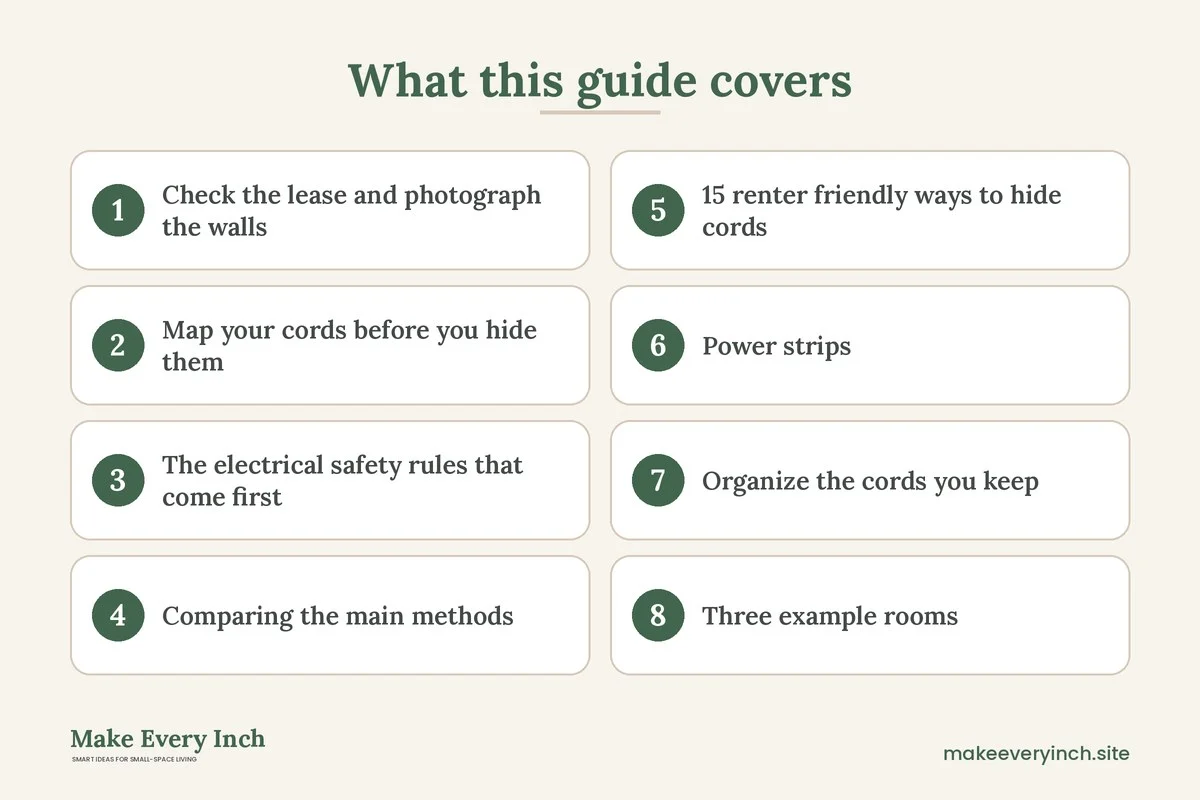
Map your cords before you hide them
Hiding cords is easier when you know what you have. Spend ten minutes making a simple map, and the rest of the project goes quickly.
- List every device in the room that needs power: lamps, a television, a console, a router, speakers, chargers, a fan and a desk setup.
- Note where each outlet is and how many sockets it has. Count the outlets on each wall, and note whether any are switched.
- Measure each cord run from the device to the outlet. Measure the route the cord will follow, not the straight line. Add a few inches for slack so the cord is not pulled tight.
- Mark what must stay reachable. Chargers and lamps need quick access, and a router needs airflow. Others, such as a television box, can sit out of reach.
- Sort the cords into three groups: short cords that can be bundled, long cords that can be shortened by routing, and cords that must stay visible, such as a lamp cord.
The map shows where cords cross, where they bunch and where a single move could remove several. Most rooms have two or three pinch points, such as the television wall, the desk and the bedside. Solve those first.
The electrical safety rules that come first
Hiding a cord changes how it cools and how likely it is to be damaged. These rules apply to every idea in this guide. If you are unsure about a setup, ask a qualified electrician.
- Do not overload an outlet or a strip. Add up the wattage of the devices on a strip and keep it well below the strip’s rating, which is printed on the label. High-draw items, such as space heaters, hair dryers, microwaves and air conditioners, should go straight into a wall outlet, not onto a power strip.
- Do not daisy-chain strips. Plugging one power strip into another multiplies the load on a single cord and is a common cause of overheating.
- Do not cover a cord or strip with a rug, a carpet or a heavy fabric. Cords produce a little heat, and covering them traps it. A flat floor cover made for the job is fine, but a rug is not.
- Never staple, nail or tack a cord. Damaged insulation can lead to shock or fire.
- Keep cords away from heat. Do not run them across radiators, heaters, stoves or in direct sun for long periods.
- Do not coil a working cord tightly. A coiled cord holds heat. Loop long cords loosely, or use a shorter cord.
- Inspect cords regularly. Replace any cord with cracks, fraying, bent plugs or a warm plug. A warm plug can be a sign of a poor connection.
- Use cords rated for the job. An extension cord is for temporary use, and it should not replace permanent wiring. Choose a cord with a rating that matches the device.
- Keep cords away from water. Do not run them near sinks, tubs or damp floors, and do not use a power strip in a bathroom.
- Protect children and pets. Loose cords can be chewed or pulled. Guard low outlets with covers, and use cord covers that block access.
- Look for safety certification marks on strips and cords, and buy from reputable sources.
- Keep smoke alarms working and know where your breaker panel is.
If a strip feels hot, smells of burning or trips a breaker, unplug it and stop using it. Tell your landlord if an outlet is loose, scorched or sparks, because repairs to the building’s wiring are their responsibility.
Comparing the main methods
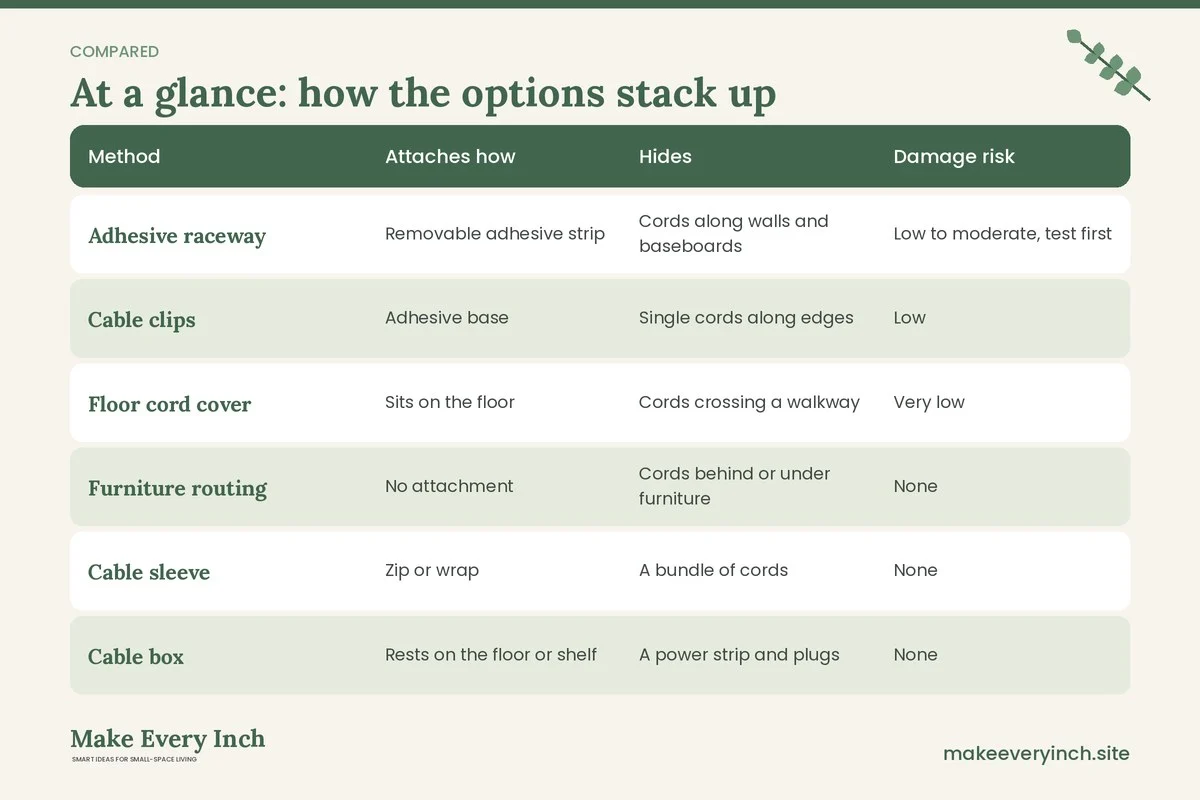
The table below compares the most common methods on the points that matter in a rental. Use it as a quick filter before you read the detailed ideas.
| Method | Attaches how | Hides | Damage risk | Safety note | Best for |
|---|---|---|---|---|---|
| Adhesive raceway | Removable adhesive strip | Cords along walls and baseboards | Low to moderate, test first | Do not exceed the cord count on the label | TV walls and desk walls |
| Cable clips | Adhesive base | Single cords along edges | Low | Do not pinch the cord | Lamps, chargers, desk cords |
| Floor cord cover | Sits on the floor | Cords crossing a walkway | Very low | Check ramp edges for trips | Doorways and hallways |
| Furniture routing | No attachment | Cords behind or under furniture | None | Keep air flow around plugs | Consoles, beds and desks |
| Cable sleeve | Zip or wrap | A bundle of cords | None | Do not bundle high-heat cords | Behind a TV or a desk |
| Cable box | Rests on the floor or shelf | A power strip and plugs | None | Needs vents for heat | Media centers |
| Power strip with long cord | Plug into a wall outlet | Cuts the number of cords | None | Respect the load limit | Desks and bedside tables |
| Wireless options | None | Replaces cords | None | Use an approved charger | Speakers and phone chargers |
| Fabric or plant cover | Placed in front | Visual only | None | Never cover plugs or strips | Short visible runs |
15 renter friendly ways to hide cords
Run cords along edges with removable products
1. A removable adhesive raceway
A raceway is a narrow channel that holds cords and snaps shut. Some versions stick to the wall with a removable adhesive. Choose the width for the number of cords, and read the label for how many it holds. Paint-matching versions blend into a wall, or you can use a white one on a white wall. Stick it up following the maker’s directions, and press for the full time. Before attaching it to painted drywall, test a small piece on a hidden area, because a strong adhesive can lift paint when you remove it. Raceways are ideal for a television wall, where several cords run from the screen to the outlet.
2. A raceway on the baseboard
Running a channel along the top edge of the baseboard hides cords at the point where the wall meets the floor. It is less visible than a channel in the middle of the wall. This route keeps the cord low, protects it from being pulled and is good for long runs between rooms.
3. Adhesive cable clips
Small clips with an adhesive base hold single cords along a baseboard, a desk edge or a shelf. Space them every 8 to 12 inches so the cord does not sag. Use clips for lamp cords, phone chargers and a router cable. A neat line of clips looks tidier than a loose cord, even if it is not hidden.
4. A cord running up a door frame
For a lamp near a door, tuck the cord into the corner between the wall and the frame with clips. Keep the cord clear of the door’s swing, and do not run it where it will be pinched by the hinge side.
5. A raceway painted to match
Many channels are paintable. Use low-VOC paint, open a window and let the paint dry fully before you stick the channel to the wall. A painted channel blends with the wall and is nearly invisible. Ask first if the lease limits paint, and paint the channel off the wall so no paint touches the surface.
Use furniture as cover
6. Route cords behind a console
A console or a narrow table placed along a wall hides the outlet and most of the cord behind it. Leave a gap of at least 2 to 3 inches between the furniture and the wall so air can move around plugs. Use a cable clip on the back to hold the cord against the furniture.
7. A desk with a cable tray
Many desks have a space behind them for a tray, which you can attach with clamps. If you do not want to drill, choose a clamp-on tray that grips the desk edge, or a basket that sits on the floor behind the legs. A strip in the tray keeps plugs off the floor and off the desk top.
8. Cords behind a bed frame
A bed frame often has space behind the headboard. Run the bedside lamp cords along the back and tuck them into a clip. Keep cords clear of mattress movement and away from a pillow, and do not tuck a plugged-in strip between a mattress and a wall.
9. A bookcase back-run
A bookcase placed against a wall can hide a cord along its back edge. Leave a small gap and anchor the bookcase to the wall if the lease allows. If it does not, choose a lower bookcase that is stable, and do not load the top. For more on this topic, read our guide to renter-friendly shelving.
10. A sofa with a cord channel behind
A sofa floated slightly from the wall allows a cord to run behind it to a floor lamp. Keep the gap at least 3 inches for air, and make sure the cord is not under a sofa leg.
Bundle and conceal
11. A cable sleeve for a bundle
A fabric sleeve or a split loom wraps several cords into one, and a zipper makes it easy to add or remove one. Use it behind a television or a desk. Do not bundle a high-draw cord with low-draw ones, and leave the plugs accessible. Do not wrap the sleeve over the power strip itself.
12. A cable box for the power strip
A box with vents hides a power strip and the extra length of cord. Choose a box with slots for the cords and air holes, and keep it on a hard floor away from curtains. Do not stuff cords inside, because a full box traps heat. Keep a small gap around the strip.
13. A floor cord cover across a walkway
When a cord must cross a path, a flat cover that sits on the floor protects both the cord and your feet. Use one with a low ramp so people do not trip, and stick it down with removable tape only on hard flooring. It should lie flat, and it should never be covered by a rug.
14. A fabric panel or a plant in front
A short run of visible cord can be hidden behind a plant, a basket or a picture frame. This is a visual measure only. Never place fabric or a plant over a plugged-in strip or a plug, since both trap heat.
15. Fewer cords through wireless options
The best cord is the one you remove. A wireless speaker, a wireless charger, a streaming stick and a battery lamp can replace several cords. Keep a short cord for the charger base and tuck it behind the furniture. Use only chargers made for the device.
Power strips: choosing and placing them well
A power strip is the hub of most cord setups, so it is worth getting right. Choose a strip with enough outlets for your devices, plus a spare or two. Look for a surge protection rating and a built-in circuit breaker, and check the label for a safety certification mark. A strip with a long, flat cord can tuck behind furniture. A strip with widely spaced outlets takes bulky plugs without blocking neighbors.
Place the strip where it can breathe. A good spot is on the floor behind a console, on a small shelf or on the back of a desk, with a few inches of clear space around it. Avoid a position under a bed, inside a closed cabinet or beneath a pile of blankets. If the strip must hang, use an adhesive strip rated for its weight, or let it rest on a shelf. Never nail or screw it to the wall without permission.
Add up the load before you plug in. Most small electronics draw little power, and a lamp with an LED bulb draws less. Problems begin with heat-producing devices. As a rule, never plug a space heater, a toaster, a kettle or a hair dryer into a strip. Plug them into a wall outlet directly, and check that the outlet is in good condition.
Organize the cords you keep
Hidden cords still need labels, because you will have to unplug something eventually.
- Label each plug with a small tag, a strip of tape or a color. Write the device name, such as router or lamp.
- Group cords by room zone, such as desk, bedside or television.
- Keep spare lengths loose and off the floor. Loop the extra and tie it with a soft fastener, not a tight wrap.
- Leave a service loop of a few inches behind furniture so you can pull a device out without yanking the plug.
- Draw a quick diagram and keep it on your phone, and update it when you change a device.
Three example rooms
A living room television wall
A renter has a 55-inch television on a stand, with a streaming box, a console and a soundbar. Five cords drop in a bundle to a wall outlet 4 feet away. The renter checks the lease and gets a yes for removable adhesive. They stick a white raceway to the wall, paint it with low-VOC paint to match, and run the cords inside it to a strip hidden in a ventilated box behind the stand. The soundbar cord goes through a cable sleeve behind the stand, and the router sits on the shelf with space around it. The total load is well below the strip’s rating. If you plan the rest of the room, see our ideas for small living room TV wall ideas for renters.
A bedroom with bedside lamps
A small bedroom has an outlet on one side of the bed only. The renter runs a longer lamp cord behind the headboard with adhesive clips every 10 inches, and uses a short strip with a switch at the base of the nightstand. Phone chargers plug into the strip, and the cords drop into a small basket. The strip sits where it cannot be kicked, and nothing is tucked under the mattress. A second option for darker rooms is a plug-in wall light with a cord cover, described in our renter friendly lighting ideas.
A desk corner in a studio
A studio desk holds a laptop, a monitor, a lamp and a printer. The renter buys a clamp-on cable tray, runs a strip inside it, and bundles the cords into a sleeve that runs down the desk leg to the wall outlet. The printer cable is shorter than before, since the printer now sits closer. The strip has a surge protector and a switch, and the tray keeps plugs off the floor. For more on desk setups, see our small bedroom desk ideas.
Removing everything cleanly
When you move out, undo the work in reverse order. Unplug the devices first. Peel off raceways slowly and parallel to the wall, following the maker’s directions, and warm a stubborn adhesive strip with a hair dryer on low heat for a few seconds. Do not scrape. Wipe off any residue with a damp cloth and a mild soap, and test the cleaner on a hidden spot first. Remove cable clips the same way. Compare the walls with your move-in photographs. If paint lifted, note the size and location, and ask your landlord about a touch-up before it is charged to you. Keep the raceways and clips if they are in good condition, since they can go on the next wall.
Common mistakes
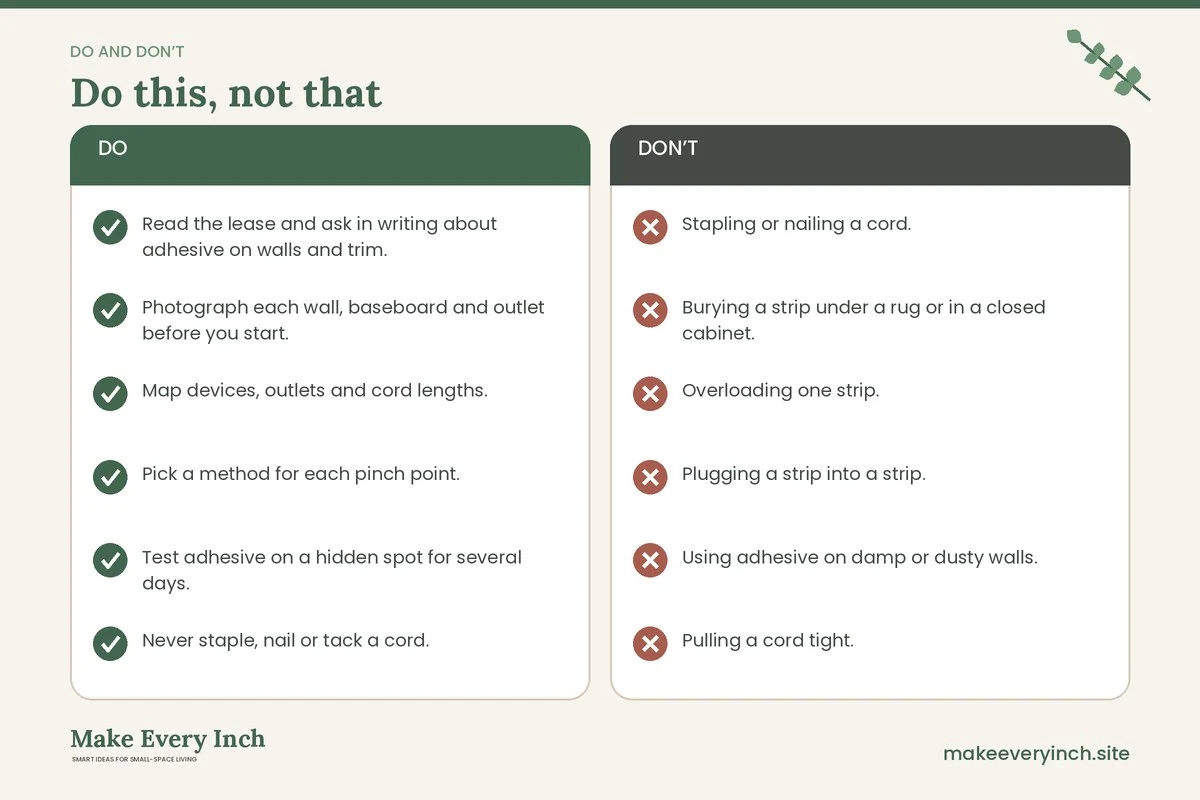
- Stapling or nailing a cord. It is the fastest way to damage insulation.
- Burying a strip under a rug or in a closed cabinet. Heat builds up where air cannot move.
- Overloading one strip. Add up the wattage and leave a margin.
- Plugging a strip into a strip. Daisy-chaining is a hazard.
- Using adhesive on damp or dusty walls. It will fail, and a failed cord run can drag a plug.
- Pulling a cord tight. A tight cord strains the plug and the socket. Leave a little slack.
- Painting a raceway while it is on the wall. Paint the channel off the wall, let it dry, then attach it.
- Skipping labels. An unlabeled bundle is a hassle to fix.
- Ignoring warm plugs. Heat is a sign of trouble.
Cord-hiding checklist
- Read the lease and ask in writing about adhesive on walls and trim.
- Photograph each wall, baseboard and outlet before you start.
- Map devices, outlets and cord lengths.
- Pick a method for each pinch point.
- Test adhesive on a hidden spot for several days.
- Never staple, nail or tack a cord.
- Keep strips ventilated, uncovered and well under their rated load.
- Plug heating devices into a wall outlet, not a strip.
- Avoid daisy-chaining strips.
- Keep cords clear of heat, water, doors and walkways.
- Label plugs and leave a service loop.
- Take move-out photographs and compare.
FAQ
What is the easiest way to hide cords in a rental?
A raceway or cable clips with removable adhesive, combined with furniture placed in front of the outlet, hides most cords. Test the adhesive first and ask the landlord if the lease is unclear.
Can I hide cords behind the wall in a rental?
No. Running cords inside a wall means cutting or opening it, and that needs the landlord’s approval and a licensed electrician. Stick to surface methods.
Is it safe to hide a power strip behind furniture?
It can be, as long as there is airflow around it, the load is within the strip’s rating, and the strip is not covered by fabric or a rug. Check it now and then for warmth.
Can I paint a cord cover?
Many are paintable, but check the product label. Use low-VOC paint, ventilate the room, and paint the cover before you attach it so no paint touches the wall.
How do I hide cords across a doorway?
Use a low-profile floor cover made for the purpose, and place it flat on hard flooring. Do not cover it with a rug, and keep it out of the swing of the door.
Will adhesive products damage my walls?
They can lift paint on some surfaces, especially if the paint is fresh or the wall is dusty. Test first, remove slowly with gentle heat, and compare with your move-in photographs.
Keep going: Keep going with our guides to no-drill storage ideas for renters, organization ideas for renters and security deposit safe apartment upgrades.
Save this guide for later
Pin the ideas you like to Pinterest so you can come back to them when you plan your space.