Shoe Storage Ideas for Small Closets
Quick answer: The best shoe storage ideas for small closets work by shrinking the footprint of each pair. Angled shelves and stacked racks use roughly 40 to 70 square inches of floor per pair, over-door pockets use none, and drawers hide everything at 8 to 12 inches of wall depth. Count your pairs, measure the floor and door, pick two systems, and keep only what you wear.
Shoe storage ideas for small closets matter more than almost any other closet upgrade, because shoes are the one category that eats floor space, makes dust and refuses to stack. A single pair of everyday sneakers can take up about 100 square inches when it is dropped by the door, while the same pair on a well-planned rack can take half that. This guide treats the problem as a footprint problem. It shows how to count your pairs, how to measure what a closet can hold, how racks, shelves, over-door pockets, angled shelves and drawers compare, and how to combine them in three example closets. It also covers shoe care, safety and a checklist. For the full approach to the whole space, start with our pillar on small closet ideas, then read the broader guide to small closet organization ideas. If your collection is bigger than your closet, the guide to small shoe storage ideas covers other rooms of the home, and the companion post on handbag storage ideas for small closets handles the accessories that share the same shelves.
Count your pairs and measure your space
Before buying anything, take every pair out and sort them into four piles: worn weekly, worn seasonally, worn rarely and not worn at all. Most households find that a small group of pairs does most of the work. Pairs that are broken, painful or no longer fit your life are better donated or recycled than stored, because every pair you keep costs floor or shelf space that you pay for in a small closet.
Then count the pairs by type, because type decides how much room each one needs. As a rough guide, and with ranges that vary a lot by size and style:
- Flats, sandals and loafers: about 4 to 5 inches wide and 10 to 12 inches long per pair when set side by side.
- Sneakers and everyday shoes: about 5 to 6 inches wide per shoe, so 10 to 12 inches per pair side by side, or 5 to 6 inches if stored toe to heel.
- Heels: a similar footprint to flats, but they need 4 to 6 inches of height clearance, and more for tall heels.
- Boots: ankle boots need about 8 to 10 inches of height, and tall boots can need 14 to 18 inches, which is why they often live on a different shelf or a separate system.
Now measure the closet. Write down the floor depth, the floor width, the height from the floor to the lowest shelf, the door width and the clearance between the door and whatever the door hits when it opens. Measure twice, and sketch the closet on paper with the numbers on it. A sketch lets you test ideas at no cost before you buy.
The per-pair footprint idea
The most useful number in a small closet is the footprint per pair, meaning the floor or wall area that one pair occupies in its storage spot. When a closet holds 20 pairs, saving 20 square inches per pair frees 400 square inches, which is about the floor of a small basket plus a laundry bag.
Here is a typical way to think about it, with figures that are approximate and depend on your shoe sizes:
- Pairs on the floor in a loose row: about 80 to 110 square inches each, plus wasted space around them.
- Pairs side by side on a flat shelf: about 50 to 70 square inches each.
- Pairs on an angled shelf, toe forward: about 35 to 55 square inches of shelf each, because the slope lets the shoes sit closer together.
- Pairs stacked toe to heel on a two-tier rack: about 30 to 45 square inches of floor each, because two pairs share one footprint.
- Pairs in over-door pockets: zero floor area, with a door depth cost of about 1 to 3 inches.
- Pairs in a shallow drawer or under-bed box: about 25 to 45 square inches each, with the advantage that the pair is hidden.
Use these ranges to compare options, not to promise exact capacity. The lesson is that vertical and angled storage usually beats a flat floor row by a wide margin, and that hiding shoes in a drawer helps a closet look calm.
Shoe storage ideas for small closets
Racks on the floor
1. A stackable two-tier rack
A rack that holds one row above another gives you two pairs per floor footprint. Choose a rack with a stable base and a depth that matches your shoes, usually 8 to 12 inches. In a small closet, place it along one side wall instead of the back wall so you can still reach the hanging rail.
2. An adjustable-height rack
Adjustable racks let you set a high shelf for boots and low tiers for flats. They suit a changing collection and reduce wasted vertical space. Check the weight rating if you plan to store heavy boots.
3. A narrow rack under hanging clothes
Short hanging items, such as folded pants or shirts, leave 30 inches or more of open floor beneath them. A shallow rack under that rail turns dead space into storage. Keep the rack 2 to 3 inches from the garments so fabric does not drag on the shoes.
4. A tall slim shoe cabinet beside the closet
If the closet cannot hold everything, a narrow cabinet outside it keeps shoes dust-free and looks tidy. For options, see our guide to best narrow shoe cabinets. Anchor tall cabinets to the wall with the hardware that comes with them, and only after you have permission to drill if you rent.
Shelves and angled storage
5. Angled shoe shelves
Shelves with a built-in slope hold each shoe with the toe down and the heel up. This shows the shoes and fits more pairs into the same width. An angled shelf near eye level is a nice display for a favorite few.
6. A shoe ladder
A ladder-style rack leans against a wall and holds shoes on rungs. It takes very little floor space but needs wall support, so make sure the shoes cannot knock it over. A small stopper or an anchor is useful in a home with children.
7. A deep shelf with dividers
A closet shelf at knee or waist height can hold shoes if you divide it into slots. Foam or cardboard dividers keep pairs from tumbling and make it obvious where each pair belongs.
8. A bottom shelf turned into a shoe shelf
The lowest shelf in many closets is wasted. Slide in a sturdy board or a shelf liner and use it for flats and sneakers. Check the weight limit of the shelf before loading it, because many light shelves are rated for clothing, not for rows of boots.
Over-door and wall-mounted ideas
9. Over-door pockets
Pocket organizers hang from the top of the door and hold one pair per pocket. They suit lightweight flats, sandals and kids’ shoes. They add very little bulk, though a door that is packed too full may not close, so measure the clearance first.
10. An over-door rack with hooks
A metal rack that hooks over the door holds shoes on bars. It is useful for sandals and flats but can scratch a door if the contact points are not padded. Add felt or rubber to protect the finish.
11. A wall-mounted shoe cubby
Wall cubbies take shoes off the floor but require mounting. In a rental, ask first and use anchors that match the wall material. If you cannot drill, look at our guide to no drill storage ideas for renters for options that rely on tension or adhesive.
12. Hooks for heels
Special heel hooks let shoes dangle from a shelf edge or a rod. They are small and can double your capacity on a shelf, but they are best for light shoes and for a short time.
Drawers and hidden storage
13. Shoe drawers in a closet system
A shallow drawer 5 to 7 inches tall holds flats and sneakers neatly. Drawers keep shoes dust-free and make a closet look tidier than any open rack. They cost more floor depth than a shelf, so check the closet depth before choosing.
14. Under-bed shoe boxes
Under-bed boxes suit seasonal and rarely worn pairs. Measure the clearance under your bed frame first, because many frames leave 6 to 10 inches. Use boxes with a lid and a label, and stay away from damp rooms.
15. Storage benches and ottomans
A bench with a lift-up lid doubles as a seat and a shoe store near the door. See our guide to small entryway storage for how to place one without blocking the walkway.
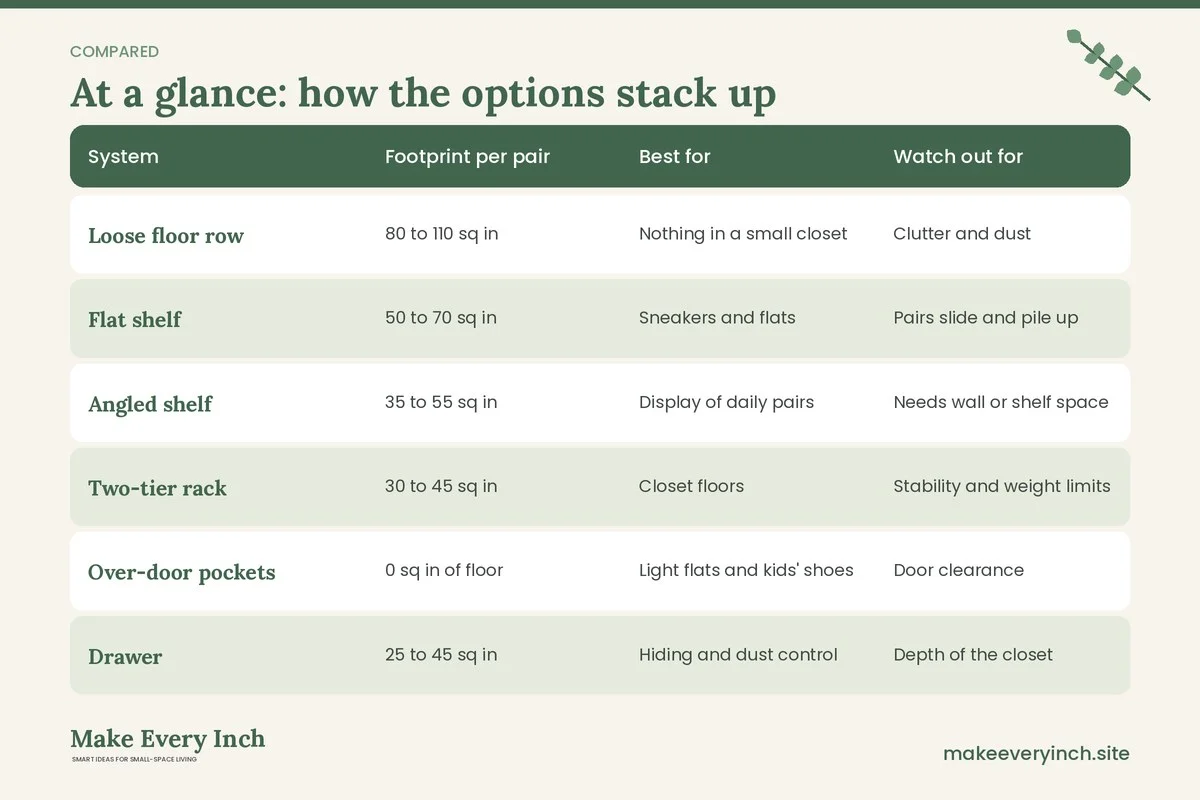
Comparison table: which system fits your closet
| System | Footprint per pair | Best for | Watch out for |
|---|---|---|---|
| Loose floor row | 80 to 110 sq in | Nothing in a small closet | Clutter and dust |
| Flat shelf | 50 to 70 sq in | Sneakers and flats | Pairs slide and pile up |
| Angled shelf | 35 to 55 sq in | Display of daily pairs | Needs wall or shelf space |
| Two-tier rack | 30 to 45 sq in | Closet floors | Stability and weight limits |
| Over-door pockets | 0 sq in of floor | Light flats and kids’ shoes | Door clearance |
| Drawer | 25 to 45 sq in | Hiding and dust control | Depth of the closet |
| Under-bed box | 25 to 45 sq in | Seasonal pairs | Frame height and humidity |
| Bench with storage | 40 to 60 sq in | Entry zone | Takes room floor space |
The numbers are approximate and meant for comparison. A rack that holds twelve pairs in one closet may hold ten in another because of shoe size and shelf spacing.
Three example closets
A reach-in closet of 4 feet by 2 feet
This is a small bedroom closet with a single rod and one shelf. With 14 pairs, put a two-tier rack along one side wall of the floor for 8 pairs, and hang an over-door pocket set for 6 lightweight pairs on the inside of the door. Check that the door still closes. Use the top shelf for seasonal boots in boxes. Keep sneakers at the front of the rack, because they are worn most often. Leave the other half of the floor open for a laundry bag or a small bin.
A narrow walk-in of 3 feet by 6 feet
The back wall can hold angled shelves from knee to eye level, which suits 12 to 18 pairs in the width of one wall. A pair of shallow drawers below the shelves hides rarely worn shoes. The hanging rail on the side wall keeps its 30 inches of floor open, and a narrow rack under short hanging clothes picks up another 6 to 8 pairs. Light the closet well so you can see the shoes, and keep the aisle at 24 to 30 inches.
A closet with no room, in a studio apartment
When the closet is a coat cupboard, move most shoes outside it. Use a slim cabinet near the door for daily pairs, a bench with a lift-up lid for guests’ shoes, and under-bed boxes for off-season pairs. Keep only two or three pairs in the closet itself. Read our guide to small space organization ideas for ways to share storage across rooms.
Step-by-step plan for a shoe reset
- Step 1: empty the closet. Take every pair out and put them on a bed or a floor sheet.
- Step 2: clean. Wipe shoes, sweep the closet and let leather and canvas dry before storing.
- Step 3: sort. Keep, donate, repair or recycle. Repair pairs that you love but that need new soles or heels.
- Step 4: group. Divide by frequency and season.
- Step 5: measure. Mark shelf and rack dimensions on your sketch.
- Step 6: choose two systems. One main system and one overflow are enough in a small closet.
- Step 7: place by frequency. Daily pairs at knee to waist height, and seasonal pairs high or hidden.
- Step 8: label. A small label on a box or a drawer front helps everyone in the home.
- Step 9: set a one-in, one-out rule. When a new pair arrives, an old one leaves.
Care and shape: keeping shoes in good condition
Good storage protects shoes as well as space. Leather and suede dislike heat, damp and direct sun, so keep them away from radiators and from a closet wall that gets condensation. Let shoes air for a day after wearing them before putting them in a closed drawer or box. Use shoe trees or stuffed paper in boots and structured shoes, and avoid dyed newsprint that can transfer ink to light interiors.
For boots, a boot shaper or a rolled magazine inside the shaft stops the leg from folding over. Store boots standing or lying, never hanging by the heel for months. Keep rubber and plastic soles away from soft leather and from light fabrics, because some soles can stain or stick over a long time.
If you use cedar blocks or similar scented aids, keep them out of reach of children and pets, and avoid strong chemical products in a small closed space. Do not use mothballs. They contain chemicals that are harmful when inhaled or swallowed, and the smell can cling to shoes and clothing. If you see signs of moths, vacuum, wash and ask a pest professional for safe options.
Safety and installation notes
- Weight limits: closet shelves and rods have limits. A row of boots can weigh a surprising amount, so check the rating of any shelf, rack or over-door unit and keep the load below it.
- Anchoring: tall cabinets, narrow towers and ladder racks can tip. Anchor them to the wall with the hardware that comes with them, into studs or with the correct anchors for the wall type.
- Drilling: never drill or screw into a wall in a rental without permission. Use freestanding and tension-based options if you do not have it.
- Doors: over-door products can bend hinges and block closing. Do not overload a door, and keep a gap so small fingers are not pinched.
- Finishes: if you paint or seal a shelf, use a low-VOC finish and ventilate the room until the smell fades. Let it cure fully before loading it with shoes.
- Children: keep small shoe accessories, polish tins and cleaning products out of reach, and make sure racks cannot be climbed.
Mistakes to avoid
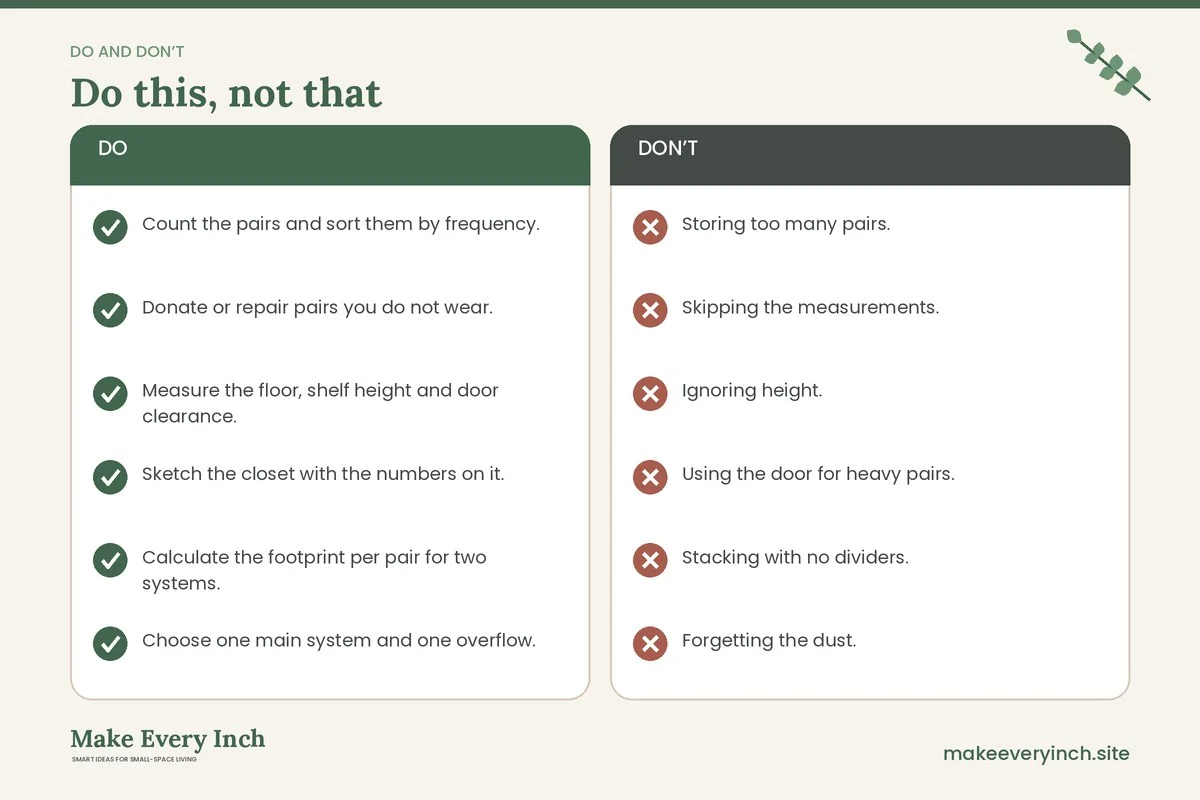
- Storing too many pairs. The best system is smaller than the collection. Edit first.
- Skipping the measurements. A rack that does not fit the closet door is a very common return.
- Ignoring height. Tall boots do not fit on a shelf that is 8 inches high.
- Using the door for heavy pairs. Over-door pockets are for light shoes only.
- Stacking with no dividers. Piles collapse, and the bottom pair gets crushed.
- Forgetting the dust. Open racks look tidy but collect dust, so schedule a quick wipe each season.
- Putting wet shoes in a closed closet. Dry them first to avoid odor and mildew.
Budget approach
You do not have to buy a full system. A few lengths of lumber, a set of dividers and a roll of shelf liner can improve a closet, as can a basic rack and a set of boxes. Spend first on the item that solves your biggest problem, such as a rack for daily pairs, and add more later. Reuse shoe boxes with clear labels for off-season pairs. Compare options by footprint per pair rather than by the look of the product.
Checklist
- Count the pairs and sort them by frequency.
- Donate or repair pairs you do not wear.
- Measure the floor, shelf height and door clearance.
- Sketch the closet with the numbers on it.
- Calculate the footprint per pair for two systems.
- Choose one main system and one overflow.
- Check weight ratings on every shelf and rack.
- Anchor tall units and get permission before drilling.
- Place daily pairs between knee and waist height.
- Store boots upright with shapers.
- Add dividers or labels.
- Schedule a seasonal dust and dry check.
- Set a one-in, one-out rule.
FAQ
How many pairs of shoes can a small closet hold?
It depends on the closet and the system, but a reach-in closet of 4 feet wide can often hold around 12 to 20 pairs with a two-tier rack, over-door pockets and one shelf. Walk-ins with angled shelves may hold more. Count your own space with a sketch instead of relying on a general number.
What is the best shoe storage for a very small closet?
A combination often works best: a two-tier floor rack for daily pairs, over-door pockets for light shoes and boxes on the top shelf for seasonal pairs. This keeps most of the floor open.
Are over-door shoe organizers bad for doors?
They are fine for light shoes if the door is solid and has clearance. Heavy loads can strain hinges and stop the door from closing. Add padding where hooks contact the door and keep the weight low.
How do I store boots in a small closet?
Stand them upright with shapers on a high shelf or a tall section of a rack, or lay them flat in a drawer. Avoid folding the shafts, because the creases can become permanent.
Is it better to hide shoes or display them?
Hide the rarely worn pairs and display the daily ones. Open storage is quick to use, while closed drawers or boxes keep dust off and make the closet feel calmer.
How do I stop shoes from smelling in a closed closet?
Let them air out after wearing, keep the closet dry and ventilated and use a baking soda sachet or a cedar block that is out of reach of children and pets. Avoid mothballs and strong chemical sprays in a small space.
Keep going: Keep planning with our diy closet organization for small spaces, small bedroom storage ideas and vertical storage ideas.
Save this guide for later
Pin the ideas you like to Pinterest so you can come back to them when you plan your space.