Linen Storage Ideas Without a Linen Closet
Quick answer: The best linen storage ideas without a linen closet split your linens by where you use them. Keep one spare sheet set per bed under the mattress or in a low under-bed box, bath towels on a bathroom shelf or over-door rack, guest bedding in a lidded bench, and the overflow on a rolling cart. Store everything clean, fully dry and loosely folded, and let air reach the stack.
Linen storage ideas without a linen closet matter more than most people expect, because sheets and towels are bulky, soft and used every week. A typical household owns two or three sheet sets per bed, a stack of bath towels, hand towels, washcloths, a few blankets and perhaps a set for guests. In a home with a hallway closet, that all sits on one tall shelf. In a small apartment, it ends up squeezed into a dresser drawer, piled on top of a wardrobe or stuffed under the sink. This guide shows how to build a linen system with no dedicated closet. It covers a quick inventory, the right amount to keep, seven storage zones, a comparison table, the airing and moisture rules that keep fabric fresh, three example homes, folding methods, mistakes and a checklist. For the wider topic, read our hub on small closet ideas, plus the guides on small closet organization ideas and small bedroom storage ideas.
Start by counting what you own
Pull every sheet, towel, blanket and pillowcase into one pile on the bed. Sort it into five groups: sheets, bath towels and hand towels, blankets and throws, guest linens, and items you no longer use. Be honest about the last group. Thin towels with frayed edges, sheets that no longer fit a mattress you replaced and the pillowcase with no partner belong in the rag bag or a textile donation bin, not in your storage plan.
Then decide how many of each you actually rotate. A common rule is two sets of sheets per bed, one on and one in the wash, plus a third only if you swap seasonally between cotton and flannel. For towels, many households settle on two bath towels per person plus one extra for a guest, and a hand towel per bathroom sink with a spare. Keeping to these numbers shrinks the space you need before you buy a single basket. A pile that took up a full closet shelf often becomes a single under-bed box once the extras leave.
Write the final quantities on a sticky note and keep it on the inside of a cabinet door. When you buy new towels, the note reminds you to retire an old one.
Match linens to where you use them
The most useful idea in a closet-free home is to stop treating linens as one category. Store each type at the point of use. Sheets belong in the bedroom, towels in or beside the bathroom, and table linens near the table. This is the same logic as keeping tools near the job, and it removes the daily walk to a distant hallway shelf.
Where a room has no space, borrow from the next one. A bedroom with a spare wall can host a towel shelf for a bathroom that has none. A hallway with an unused 12-inch alcove can host a narrow cart for guest bedding. The goal is a linen route that matches your laundry route, so a clean set goes from the dryer to a shelf within a few steps.
Measure the volume before you choose storage
Linens are surprisingly consistent in size, which makes planning easy. These rough ranges help you choose a container, and they will vary by thickness and fabric, so measure your own stack.
- One folded sheet set (flat, fitted and two pillowcases): often a bundle around 10 to 14 inches wide, 12 to 16 inches long and 3 to 6 inches thick, depending on the bed size and fabric weight.
- One folded bath towel: roughly 10 to 12 inches wide and 12 to 14 inches deep when folded in thirds, about 2 to 3 inches thick.
- A stack of four bath towels: often 10 to 12 inches high.
- A folded blanket or duvet: can be 12 to 20 inches in each dimension. This is the bulkiest item and the usual reason a closet is needed in the first place.
- Under-bed clearance: measure from the floor to the lowest slat or frame rail. Many bed frames leave 6 to 18 inches, and a box that is 2 inches shorter than the gap slides easily.
Lay the stack on the floor and measure it with a tape. Add 1 to 2 inches of air on each side for the container you choose. This avoids the typical mistake of buying a bin that fits on paper and then compresses the linens into a dense block.
Seven linen storage ideas without a linen closet
Under the bed
1. Shallow lidded boxes on the floor
The under-bed space is the largest unused volume in most bedrooms. Choose a shallow box with a fabric or breathable lid, and keep one clean sheet set per bed, folded flat, in each box. A box with wheels slides out without dragging, which also reduces scraping on floors. Choose a box that is at least 2 inches shorter than the clearance so it moves freely.
2. A dust ruffle or skirt as a curtain
If your bed has a legged frame, a bed skirt hides the boxes and keeps dust off the lids. Pick a skirt that hangs 1 to 2 inches above the floor so air can move under the bed. A skirt that touches the floor all the way around can trap humidity, which matters in the airing section below.
3. A storage bed with drawers
If you are choosing a new frame, a storage bed turns the base into drawers for bedding, which is the cleanest option for linens. Our guide to the best beds with storage compares the main styles. Check that the drawers open fully in your room, since a drawer that hits the wall is not much help. Do not stack heavy items on the slats beyond the bed’s weight rating.
On the door
4. An over-door rack for towels
An over-door rack hangs towels on a door in a bathroom or bedroom with no drilling. Look for a design that fits the thickness of your door, and use a padded hook so it does not mark the paint. Hang towels loosely, with a gap between them, so each one dries between uses. An over-door rack works best for daily bath towels, not for a spare stack. Never overload it with wet towels, since the weight can strain the door’s hinges.
5. An over-door organizer for small linens
A hanging organizer with clear pockets holds washcloths, hand towels, pillowcases and small blankets. Place it on the inside of a closet or bedroom door. Folded items sit upright in a pocket, so you can see what you have. It is a good option where floor space is zero.
On the wall and shelf
6. A bathroom shelf above the toilet or door
Bathrooms rarely have a linen closet, yet they are where towels are used. A narrow shelf above the toilet holds a rolled stack of towels, and a ladder-style shelf leans against a wall without drilling. If you must mount anything on the wall, ask your landlord first, and use the right anchors for the wall type. Our guides to small bathroom shelving ideas and small bathroom storage ideas for tight spaces show more layouts. Keep the top shelf for light, dry items, because steam rises.
On a seat or wheels
7. A lidded bench and a rolling cart
A bench at the foot of the bed or in the entry can hold a spare duvet and guest sheets in a lidded interior. Choose one with a soft-closing hinge or a lid stay so it cannot slam on small fingers. A slim rolling cart, about 6 to 10 inches wide, tucks beside a dresser or washer and holds towels on open shelves. See our guides to the best storage ottomans and small entryway bench ideas for more seat options.
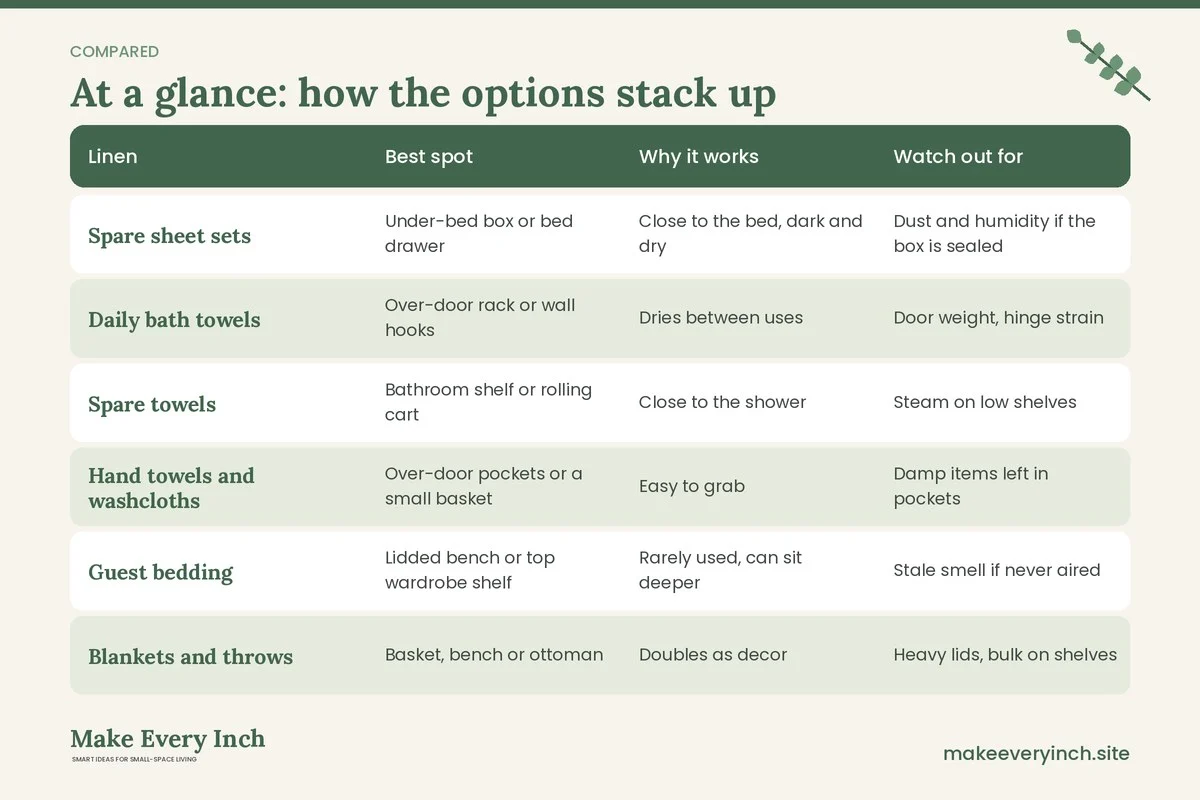
Comparison table: where each linen type fits best
| Linen | Best spot | Why it works | Watch out for |
|---|---|---|---|
| Spare sheet sets | Under-bed box or bed drawer | Close to the bed, dark and dry | Dust and humidity if the box is sealed |
| Daily bath towels | Over-door rack or wall hooks | Dries between uses | Door weight, hinge strain |
| Spare towels | Bathroom shelf or rolling cart | Close to the shower | Steam on low shelves |
| Hand towels and washcloths | Over-door pockets or a small basket | Easy to grab | Damp items left in pockets |
| Guest bedding | Lidded bench or top wardrobe shelf | Rarely used, can sit deeper | Stale smell if never aired |
| Blankets and throws | Basket, bench or ottoman | Doubles as decor | Heavy lids, bulk on shelves |
| Duvet or comforter | Vacuum-free breathable bag on a top shelf | Seasonal, rarely moved | Compressing the filling |
Read the table as a starting map. Most homes use three or four of these zones, not all seven.
Airing and moisture: the part most people skip
Linens are porous, and they absorb humidity from the air around them. A closed closet is the classic setup for musty smell, and many of the places we use instead, such as under-bed boxes and benches, are closed as well. A few habits solve most problems.
Store only fully dry linens
Never fold towels that feel even slightly damp. Let them dry completely, then let them cool for a few minutes after the dryer so retained heat and moisture escape. Damp fabric folded into a stack is the most common cause of a sour smell. If a towel was used once and hung up, give it at least a day to dry before it joins the stack.
Leave room for air
Pack boxes and shelves loosely. A tightly packed stack does not release moisture, and a bin pushed against a wall limits airflow. Leave a finger’s width between a shelf stack and the wall. Choose containers with ventilation holes, mesh sides or a breathable fabric rather than sealed plastic, especially in humid rooms or basements.
Air your stored linens on a schedule
Once a season, pull everything out, shake it, and hang it for a few hours in a dry, ventilated spot. Open a window on a dry day, or run a fan. Wash any item that smells stale. This is the single most useful habit for guest bedding and out-of-season blankets, which sit longest. Put a reminder in your phone on the first day of each season.
Watch the humidity of the room
Bathrooms, basements and rooms against exterior walls hold more moisture. If a room feels damp, a small humidity gauge helps you see a trend. Many people aim for indoor humidity somewhere in the 30 to 50 percent range, though comfort and local climate vary. Run the bathroom fan during and after showers, and leave the door ajar so steam can leave. Keep towels away from the shower spray, and keep the lowest shelf off the floor so it stays away from splashes and dust.
Be careful with fragrance and chemical products
Many people add scent to linens to cover a stale smell. Solving the cause is better than masking it. If you do use cedar blocks, lavender sachets or other scent products, keep them in a small cloth pouch rather than touching the fabric, since oils can stain. Avoid mothballs in a home where children or pets live, because they contain chemicals that are hazardous if handled or swallowed, and their smell is hard to remove. Do not use any strong chemical product in a closed bench or box where you sleep. If a stain or mildew spot appears, wash the item according to its care label.
Three example homes
Studio apartment with no closet, one bed
A studio owner keeps two sheet sets, four bath towels and two blankets. One sheet set sits in a shallow box under the bed, and the other is on the mattress. The towels hang from an over-door rack in the bathroom, with two spares rolled on a shelf above the toilet. Blankets live in a basket at the foot of the sofa. Nothing needs a closet, and the whole system fits inside a few feet of floor. Once a season the owner pulls the under-bed box out, airs it and washes the spare sheet set.
One-bedroom with a guest room that doubles as an office
The household keeps its own linens in the bedroom, with a storage bed drawer for sheets. Guest bedding sits in a lidded bench in the office, beside the sofa bed. A rolling cart in the hallway holds towels for both bathroom visits and guests. When visitors arrive, the owner airs the guest set for an hour, makes the bed, and swaps in fresh towels. After the visit the used items go straight to the wash and return to the bench dry.
Small family rental with one bathroom and two children
A family of four needs more towels, and the bathroom has room for just one shelf. They choose a wall-mounted shelf, installed with the landlord’s permission, for rolled bath towels, plus hooks on the back of the door for daily towels, one color for each child. Extra sheets live in under-bed boxes in each bedroom. Because of the children, they keep any scent product out of reach and avoid stacking heavy things on a low shelf where a child could pull them down. The bench in the hallway holds winter blankets, with a lid stay to protect fingers.
Folding methods that save space and air
How you fold affects both volume and freshness. Try these simple methods.
- Fitted sheet: tuck the corners into each other, fold in thirds, and then fold to a neat rectangle. A fitted sheet folded square stacks better than a ball.
- Sheet set in a pillowcase: put the flat sheet, the fitted sheet and a spare pillowcase inside one of the pillowcases. The set stays together, and you never hunt for the missing piece.
- Towels in thirds, then in half: gives a neat block for a shelf. For a narrow shelf, fold in thirds and then roll.
- Rolled towels: stand them upright in a basket or on a shelf. Rolls take a little more width but are easy to grab, and they look tidy.
- Blankets in quarters: fold with the finished edge out so the stack looks clean on an open shelf.
- Labels: a small tag on the edge of a box with the bed size and season saves time. Label by size, not by color, in case you change bedding.
Safety notes for small-space linen storage
Tall units such as narrow bookcases and rolling carts with several shelves can tip, especially when children climb them. Anchor any tall unit to a wall stud with the anchor made for your wall type, and ask your landlord before drilling. If you cannot drill, choose a low, wide piece instead. Keep heavy items on low shelves. Check the weight limit of any over-door rack, shelf or storage bed before loading it, and stay well under the limit. Do not hang wet towels on a bathroom shelf that is mounted with adhesive, because the weight and moisture can loosen it. Keep cords, plugs and heaters away from linen stacks. Never place fabric on a space heater or radiator. If you use a low-VOC finish on a new shelf or bench, let it cure and air out before putting linens inside. Keep cedar and scent products out of children’s reach.
Common mistakes to avoid
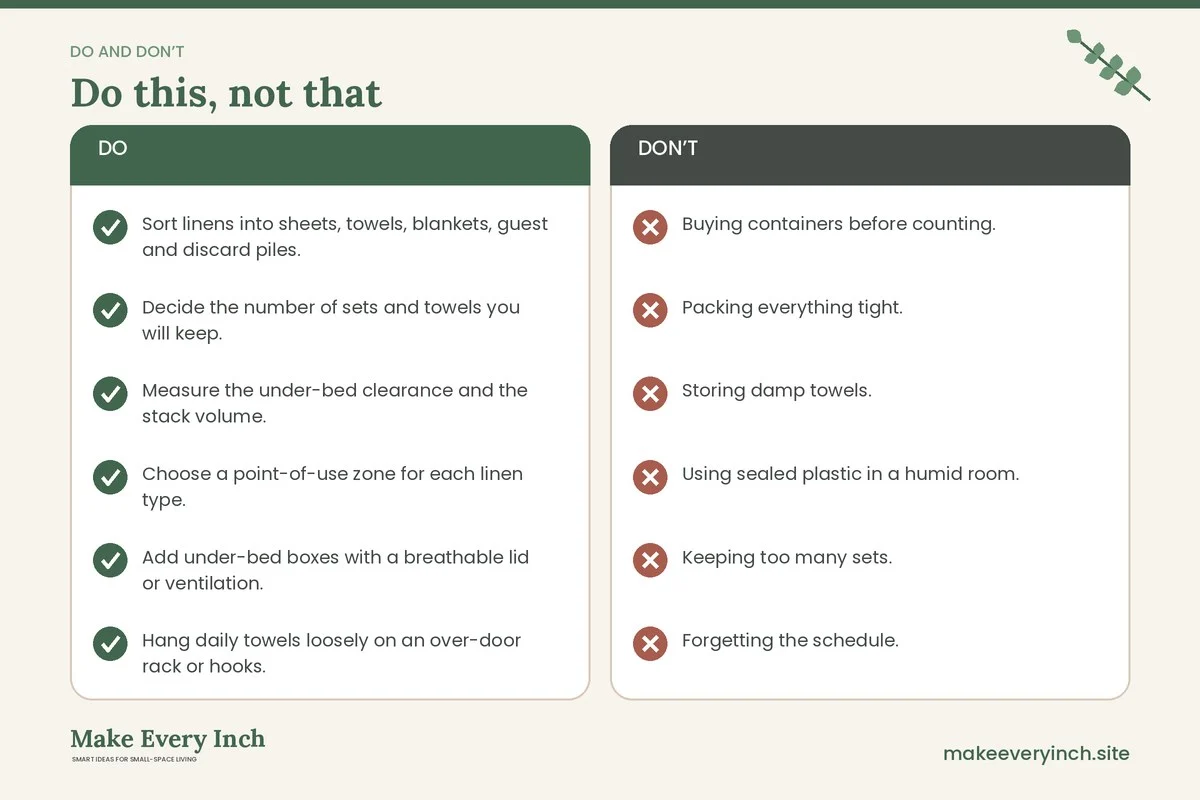
- Buying containers before counting. Start with the quantities, then choose the box.
- Packing everything tight. Dense stacks hold moisture and flatten the fibers.
- Storing damp towels. One damp towel can make the stack smell.
- Using sealed plastic in a humid room. Choose a breathable material or a vented bin.
- Keeping too many sets. The more you keep, the more air and space you need.
- Forgetting the schedule. A seasonal airing takes ten minutes and prevents a stale smell.
- Hiding linens far from where they are used. Store at the point of use.
- Overloading an over-door rack. Check the rating for the door and the rack.
A weekend plan
On Saturday morning, empty every drawer and shelf of linens and sort the pile. Wash anything you will keep, and let it dry completely. In the afternoon, measure the under-bed gap, the bathroom wall and the space beside the dresser. Make a list of containers, and buy only what you need. On Sunday, set up the zones, label the boxes and write your quantity note. Finish by making the bed with the freshest set and putting the old one in the wash. By evening the system is running, and you can see at a glance whether anything is missing.
Checklist
- Sort linens into sheets, towels, blankets, guest and discard piles.
- Decide the number of sets and towels you will keep.
- Measure the under-bed clearance and the stack volume.
- Choose a point-of-use zone for each linen type.
- Add under-bed boxes with a breathable lid or ventilation.
- Hang daily towels loosely on an over-door rack or hooks.
- Place spare towels on a bathroom shelf or cart, off the floor.
- Store guest bedding in a lidded bench with a lid stay.
- Fold everything fully dry and leave gaps for air.
- Air stored linens each season.
- Anchor tall furniture and ask permission before drilling.
- Keep mothballs and strong scent products away from children and pets.
FAQ
How many sheet sets do I need if I have no linen closet?
Many households keep two sets per bed, one on the mattress and one clean spare. Add a third only if you change between seasonal fabrics. Fewer sets mean less storage.
Can I store sheets in a vacuum bag?
You can for out-of-season blankets, but compressing them for a long time can flatten fibers, and sealed bags can trap moisture if the item was not fully dry. For everyday sheets, a breathable box is usually a better choice.
How do I stop towels from smelling musty in a small bathroom?
Run the fan during and after showers, hang towels loosely so they dry fully, wash them regularly, and keep the stack off the floor. If a smell persists, the room may need more ventilation.
What is the best place for guest bedding?
A lidded bench, a top wardrobe shelf or a deep under-bed box. Choose a spot you can reach without a ladder, and air the set before guests arrive.
Can I use cedar to keep linens fresh?
Cedar blocks or sachets can be used in a pouch, away from direct contact with fabric. Avoid mothballs, which contain chemicals that are hazardous around children and pets.
Do I need to drill to store towels in a rental?
No. Over-door racks, freestanding ladder shelves and rolling carts work without drilling. If you want a wall shelf, ask your landlord first.
How often should I air stored linens?
Once a season is a practical rhythm. Pull them out, shake them and hang them in a dry, ventilated spot, then refold loosely.
Keep going: Ready to build your plan? Start with our hub on small closet ideas, then look at small closet organization ideas, DIY closet organization for small spaces and small space organization ideas.
Save this guide for later
Pin the ideas you like to Pinterest so you can come back to them when you plan your space.