Small Closet Door Storage Ideas
Quick answer: The best small closet door storage ideas use the door as a thin vertical shelf: an over-door organizer, a slim inside-door rack, hooks or a hook rail on the outside, and a mirror on the face. Measure the gap between the door and the shelves or rod first, keep the added thickness to about 3 inches or less, spread the weight, and test that the door closes before you load it.
Small closet door storage ideas turn the one surface that almost every closet wastes into useful space. A door is usually 24 to 36 inches wide and 78 to 80 inches tall, which is more than 12 square feet of unused surface on each side. In a small closet or a tiny bedroom, that area can hold shoes, scarves, belts, bags, cleaning tools, jewelry and a mirror, and it frees the shelves and floor for bulkier things. The catch is clearance. A door that does not close, or that hits a rod, a shelf or a hanging coat, makes the closet worse than before. This guide shows how to measure the gaps, how to choose between over-door, inside-door and outside-door storage, how to add a mirror and a hook rail, how to manage weight, and how to keep the door working. It includes a comparison table, three example scenarios, a checklist and an FAQ. For the full approach to closets, see our pillar guide to small closet ideas, and for the shelves behind the door, read our companion post on closet shelf organization ideas.
First, understand what kind of door you have
Door storage depends on the door type. Check yours before you buy anything.
- Hinged swing door: the most common. The inside face faces the closet, and the outside face faces the room. Over-door hooks, inside racks and outside hooks all work, subject to clearance.
- Bifold door: two panels fold in the middle. These have light panels and tracks, so heavy loads can pull them off. Use only very light items on bifold doors, and avoid over-door hooks that interfere with the fold.
- Sliding door: panels slide on a track, so over-door organizers and inside racks usually do not fit. The outside face of a mirrored slider may still work with light items, but check with the owner first.
- Pocket door: the door slides into the wall, so nothing can be attached to the edge that disappears. Use the face only, and only with permission.
- Curtain or no door: a curtain can hold light pockets or hooks on a rod, but the weight limit is low.
Also note the material. A hollow-core door is light, with thin skins and a cardboard honeycomb inside. It will not hold screws well, and a heavy load can dent it or pull hardware loose. A solid or solid-core door holds more weight. In a rental, assume you may not drill or screw into a door, and ask your landlord in writing before you attach anything permanent.
Measure the clearance before you shop
The single most common failure in door storage is that the door stops closing. Take five measurements.
1. Door thickness: most interior doors are about 1.375 inches thick. This matters for the hook depth of an over-door organizer.
2. Gap above the door: the space between the top of the door and the frame. Over-door hooks need a small gap, often around a quarter to a half inch, so the door can still close over the hooks.
3. Depth to the nearest obstacle: with the door open, measure from the door face to the nearest shelf edge, rod or hanging garment when it is closed. This is the maximum thickness you can add on the inside. A hanging coat can take up 5 to 8 inches from the rod, so measure with clothes in place.
4. Swing space outside: on the room side, measure from the door face to the nearest furniture when open at 90 degrees. Outside storage must not block the swing.
5. Hinge side gap: the door swings about the hinges, and items near the hinge edge move less than those near the handle. Mount heavier or thicker items closer to the hinge side where they sweep through less space.
A practical rule is to keep added thickness to around 3 inches on the inside of a small closet, and to leave at least 1 inch between the stored items and any hanging garment. If you measure less than 2 inches of clearance, choose a flat solution such as a thin hook rail or a fabric organizer with shallow pockets.
Small closet door storage ideas: over-door organizers
An over-door organizer hangs from the top of the door on two hooks and has pockets, shelves or rails on the front. It needs no drilling, which makes it popular for renters.
What goes in the pockets
Clear pockets suit shoes, small accessories, cleaning supplies, toiletries, hair tools and craft items. Mesh pockets let air through, which is helpful for damp items such as swimwear. Narrow pockets work for scarves, ties and belts. Keep heavy items, such as full bottles, in the lowest pockets, where they pull less on the hooks.
Limits to respect
- Weight: read the manufacturer’s weight rating, and treat it as a maximum, not a target. Fill the organizer to well under that figure.
- Door movement: a loaded organizer swings when the door opens. A bumper or a strip of felt on the back of the lower edge stops it from banging the door.
- Hook fit: hooks that are too thick will stop the door from latching. Test with the organizer empty, then loaded.
- Door damage: hooks can mark paint and rub on the top edge. Pad them with felt, and check the paint monthly.
Over-door storage on the closet side is often the most space-efficient choice, because the pockets use the dead space between the shelves and the door.
Inside-door storage that mounts to the door
When clearance allows, a rack or rail on the inside face can hold more than a hanging organizer. This includes slim shoe racks, spice-style racks used for accessories, tie and belt racks, and small shelves.
Hanging versus fixed
Some inside-door racks hang from the top edge, like over-door organizers, and need no drilling. Others attach with screws or strong adhesive. Screws give the best hold, but they need permission and a solid door. Adhesive products are rated for a specific weight per piece and need a clean, smooth surface. A painted door that flakes will let go, and a textured surface weakens the bond. Test on a hidden spot, and follow the cure time before loading.
What to store
- Shoes: a flat rack holds pairs on their sides. Make sure heels do not touch hanging clothes.
- Belts, ties and scarves: slim rails or hooks work, and you can see everything at a glance.
- Jewelry and watches: a flat pocketed panel or a shallow tray holds them, and keeps necklaces untangled.
- Cleaning tools: a long closet that doubles as a utility closet can hold a mop and a brush on a narrow rack. Keep chemicals in closed bottles and in a place that children cannot reach.
- Bags: hooks hold light bags and totes. Avoid hanging a heavy bag on a thin hook.
Outside-door storage
The room-facing side of a closet door is the most visible, so use it for items you want to see or reach as you leave the room.
Hooks and hook rails
A hook rail is a thin bar with several hooks, and it gives a place for robes, bags, hats and the outfit for tomorrow. Mount it at about 60 to 66 inches from the floor for adults, and lower for children, at around 40 to 48 inches. Space the hooks 4 to 6 inches apart so items do not overlap. A rail is slimmer than a set of single hooks, because it holds more with one fixing. Choose rounded hooks for kids, and make sure no sharp ends are at eye level.
If you cannot drill, an over-door hook rail rests on the door top. Keep the loads light, and note that the swing of the door will make hanging items move. Our guide to small coat storage ideas covers how to plan a hook zone for outerwear and how many coats a rail can reasonably carry.
A mirror on the door
A full-length mirror makes a small room feel larger and saves wall space. Choose a mirror designed for doors, with shatter-resistant backing or film. Large glass is heavy and can be dangerous if it falls, so check the weight rating of the door, the hinges and the hardware. Many hollow-core doors are not suited to a heavy glass mirror. A lighter acrylic or a mirror film is an option. Do not use adhesive that is not rated for the weight, and never hang a heavy mirror on a pair of hooks that only touch the top edge. If in doubt, lean a floor mirror against the wall beside the closet instead.
Pegboard or slim panels
A pegboard, an iron grid or a slim cork board gives flexible storage on the outside face, but it needs fixings or strong adhesive. Do these only with permission. They suit a home office closet or a craft corner, where you want tools within reach.
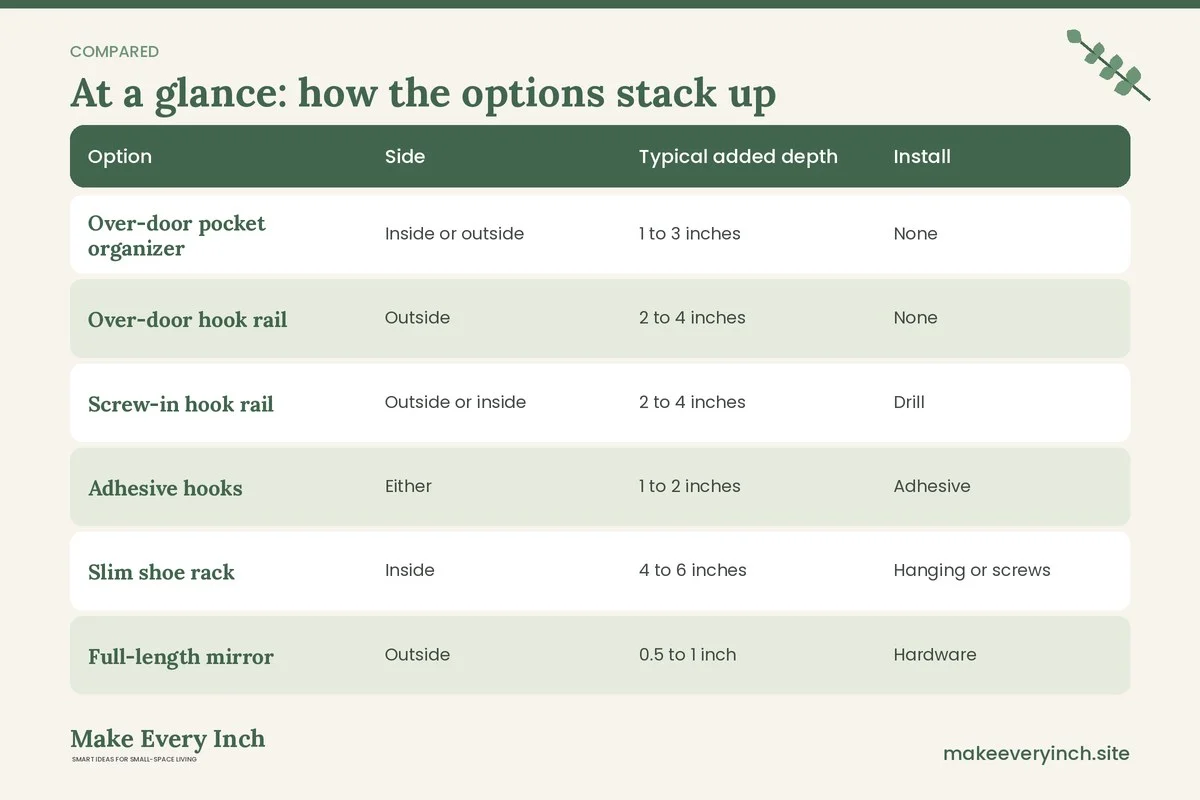
Table: door storage options compared
| Option | Side | Typical added depth | Install | Best for | Watch out for | |
|---|---|---|---|---|---|---|
| Over-door pocket organizer | Inside or outside | 1 to 3 inches | None | Shoes, accessories, supplies | Weight rating, door latch | |
| Over-door hook rail | Outside | 2 to 4 inches | None | Robes, bags, hats | Swing, noise, paint rub | |
| Screw-in hook rail | Outside or inside | 2 to 4 inches | Drill | Heavier coats, bags | Needs permission and solid door | |
| Adhesive hooks | Either | 1 to 2 inches | Adhesive | Light items | Weight rating, wall finish | |
| Slim shoe rack | Inside | 4 to 6 inches | Hanging or screws | Shoes | Clearance from clothes | |
| Full-length mirror | Outside | 0.5 to 1 inch | Hardware | Dressing, light | Weight, glass safety | |
| Door-mounted shelf | Inside | 4 to 8 inches | Screws | Small bins | Only if clearance is wide | |
| Fabric hanging organizer | Inside | 2 to 4 inches | None | Sweaters, bags | Rod weight limit |
Keep the door working
A door that sticks, scrapes or will not latch undoes the benefit. Check these things after you install anything.
- Close and latch test: close the door slowly and make sure it latches without force.
- Swing test: open the door fully and check that nothing hits a wall, a bed or a dresser.
- Hinge check: after a week, look at the hinges. If they look bent or the screws loosen, remove some weight.
- Rattle check: items that clink against the door annoy people at night. Add felt or a pocket liner.
- Dust and moisture: keep damp towels or wet shoes out of door pockets, because moisture can damage the finish and grow mold.
If a door starts to sag or rub on the frame, remove the storage and ask for the hinges to be tightened. Do not tighten or adjust hinge screws if you are unsure, and in a rental, tell the owner or manager.
Three example scenarios
A tiny reach-in closet with a hinged door
A bedroom closet 30 inches wide is packed with a hanging rod and a shelf. There is about 3 inches between the closed door and the hanging clothes. Use a slim over-door organizer with shallow pockets on the inside for belts, scarves and socks. Add a single hook rail on the outside at about 62 inches from the floor for tomorrow’s outfit and a robe. Place heavier items, such as shoes, on the floor of the closet instead of in the door.
A studio apartment with a shared closet
Two adults share a closet next to the entry. The outside of the door holds a full-length mirror in a lightweight frame, which saves wall space and lets both people check their outfit. The inside holds two over-door organizers, one per person, in different colors. Each person has a hook on the rail for a daily bag. To prevent swing damage, the closet door opens toward a bare wall, and nothing stands within 36 inches.
A kid’s closet with a bifold door
A bifold door cannot carry much weight. Leave the doors bare, and put a low over-the-rod hanging organizer on the rod inside. On the wall next to the door, add a short row of hooks at 40 to 48 inches for backpacks and jackets, with permission from the owner. Use soft, rounded hooks, and anchor any tall units. Our guide to small bedroom storage ideas covers more ways to plan storage around a bed and a closet.
Safety notes
- Weight and fixings: never exceed the stated rating of a hook, a rail or an adhesive. Spread weight across several fixings.
- Drilling: do not drill into a door, frame or wall without permission, particularly in a rental.
- Heavy glass: mirrors can break. Use shatter-resistant products and secure them properly.
- Children: keep cords, belts and hanging loops out of reach of small children, since they can become strangulation hazards. Use round-ended hooks and keep sharp objects out of low pockets.
- Chemicals: store cleaning products in their original closed bottles, out of reach of children and pets. Avoid mothballs in a closet door pocket, because their fumes are harmful.
- Paint and finishes: use low-VOC products if you paint a door, and ventilate until it cures.
- Fire exits: never block a door that serves as an exit or a path of escape.
Combine door storage with the rest of the closet
Door storage works best as the final layer. Start with the rod and shelves, since those hold the most. Our guide to small closet organization ideas covers rods, doubling the hanging space and sorting clothes. The article on DIY closet organization for small spaces covers low-cost builds. If the room has little storage overall, the wider small space organization ideas guide and the guide to small bedroom ideas without a closet show how to spread storage around the room.
Mistakes to avoid
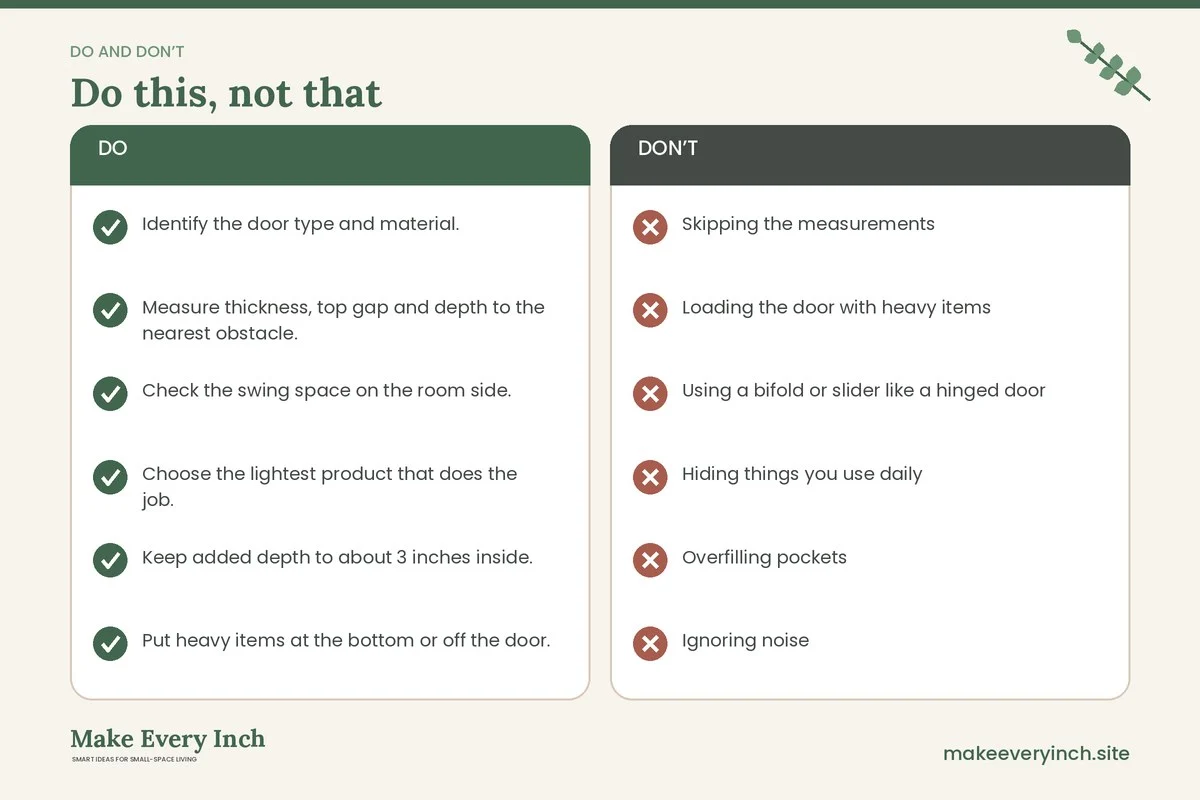
- Skipping the measurements: a door that will not close is the most common problem.
- Loading the door with heavy items: shoes and bottles belong on the floor or shelves.
- Using a bifold or slider like a hinged door: these doors have limits.
- Hiding things you use daily: the most-used items should be at eye level.
- Overfilling pockets: items that bulge stop the door from closing.
- Ignoring noise: a rattling door is annoying and a sign of poor fit.
- Buying before checking permission: screws and strong adhesive can cost you a deposit.
Quick checklist
- Identify the door type and material.
- Measure thickness, top gap and depth to the nearest obstacle.
- Check the swing space on the room side.
- Choose the lightest product that does the job.
- Keep added depth to about 3 inches inside.
- Put heavy items at the bottom or off the door.
- Check weight ratings, and stay well under.
- Ask permission before drilling or using strong adhesive.
- Test the latch and the swing, empty and loaded.
- Pad hooks and pockets to stop noise and paint rub.
- Review the door after a week.
FAQ
How much weight can a closet door hold?
It depends on the door type, the hinges and the hardware. Hollow-core doors hold less than solid ones. Treat any weight rating as a maximum, spread the load, and check hinges after a week.
Will an over-door organizer stop my door from closing?
It can. Measure the gap above the door and the depth behind it, then choose a slim model and test the door both empty and loaded.
Can I hang a mirror on a hollow-core door?
Often not safely if the mirror is heavy glass. A lightweight acrylic mirror or a floor mirror is safer. Check the door and the mirror ratings, and get permission for any fixings.
What can I store on a bifold or sliding door?
Very little. Their tracks and hinges are not built for weight. Use the wall beside the door or the inside of the closet instead.
How high should I mount hooks on a closet door?
About 60 to 66 inches from the floor for adults and 40 to 48 inches for children. Adjust to the reach of the people who use them.
Is door storage safe for a rental?
Over-door and adhesive options usually leave fewer marks than screws, but all can affect paint. Ask the owner, test in a hidden spot and keep the loads light.
Keep going: Keep going with our pillar on small closet ideas, the guide to closet shelf organization ideas and our small coat storage ideas.
Save this guide for later
Pin the ideas you like to Pinterest so you can come back to them when you plan your space.