Small Entry Closet Organization Ideas
Quick answer: The best small entry closet organization ideas split the closet into four zones: hanging coats at the rod, bags and daily items on hooks, shoes and boots on trays at the floor, and seasonal gear in labeled bins on the top shelf. Keep the daily zone between 20 and 60 inches off the floor, leave one open hanger section for guest coats, and respect the weight limit on every rod and shelf.
Small entry closet organization ideas matter because the front hall closet takes more daily abuse than any other storage space in the house. Every person who walks in the door drops a coat, a bag, a pair of wet shoes and a handful of keys or mail into the same few square feet. A closet that is only 24 inches deep and 30 to 48 inches wide can hold all of it, but only if each category has a defined place. This guide shows how to plan a front hall closet by zone. It covers what to empty and what to keep, the measurements for every level, 15 ideas, a comparison table, three example closets, a seasonal rotation plan, safety notes, mistakes and a checklist. For the wider entry area, see our guide to small entryway ideas, and for the whole category, read the main guide to small closet ideas.
Start by emptying the closet and sorting by who uses what
Take everything out. It feels like a bigger job than it is, but an entry closet collects odd items over the years, such as a vacuum, spare light bulbs, gift wrap, a broken umbrella and a stack of reusable shopping bags. Put everything on a sheet or a rug in the nearest room, and sort it into five piles: daily outerwear, daily shoes and bags, seasonal items, guest and event items, and things that do not belong in the entry closet at all.
That last pile is the one to be honest about. A front hall closet is prime real estate because it is the closest storage to the door. Holiday decorations, tools and off-season sports gear take up that space whether or not anyone uses it during the week. Move whatever you can to a bedroom closet, a basement shelf or under-bed storage. Our guide to under bed storage ideas lists places where the overflow can go.
Now sort the daily piles by person. If four people live in the home, each person gets a hook, a shoe spot and a bin. If it is a couple, the sorting is simple, and you can use the extra space for guests. The principle is that every item should have a home that is the easiest place to put it, not the easiest place to find it later. If hanging a coat takes three steps, it ends up on the floor.
Measure the closet before buying anything
Measure the width, the depth, the height of the ceiling or the header, and the position of the door. Write the numbers on a sketch. A standard reach-in closet is often 24 inches deep, though older homes may have 18 to 20 inches. Note the shape of the door, because a bifold, a sliding door and a hinged door each block a different part of the opening.
These measurements guide a good layout.
- Rod height: place the main rod at about 60 to 66 inches from the floor for coats of average length. Long coats need 66 to 70 inches to clear the floor, and a child’s rod can sit at 40 to 48 inches.
- Hanging depth: a hanger needs about 22 inches of depth to hang straight. In a shallower closet, turn the hangers sideways or use slim hangers and a front-facing rod.
- Hook height: adult hooks work best at 60 to 66 inches, child hooks at 36 to 48 inches. Check the numbers against the people who use the closet.
- Shelf clearance: leave 12 to 14 inches of space above the rod to the shelf, and a total of 10 to 12 inches for each shelf bin.
- Floor zone: a pair of adult shoes needs roughly 10 to 12 inches of width on a tray, and tall boots need up to 16 inches of height.
- Door swing: keep 30 to 36 inches of clear floor in front of the closet so a person can step back and open the door.
If the closet is shallower than 20 inches, consider swapping a hinged door for a curtain, or removing the door entirely, only if you own the home or have written permission. Never remove or drill a rental closet’s door or hardware without asking the landlord first.
The four-zone system
A small closet works when it is divided into zones that match how people move. Think of the closet as a vertical map from the ceiling to the floor.
Zone 1: the top shelf for seasonal and rare items
The top shelf is above eye level, so use it for things you touch a few times a year. Hats and gloves in winter, sun hats and beach bags in summer, spare blankets and picnic gear all belong here. Use lidded bins that fit the shelf depth, label them on the front, and keep the heaviest item on the lowest shelf, never on the highest. Do not stack bins more than two high on a shelf you have to reach over your head, because a falling bin is a hazard.
Zone 2: the rod for coats
The rod holds the weight of the coats. Make sure it can handle the load. A closet rod can be rated for anywhere from 30 to over 100 pounds depending on the material, the length and the brackets. A winter coat can weigh 3 to 6 pounds, so a row of ten can reach 30 to 60 pounds. If the rod bows, add a center support bracket, ideally screwed into a stud, but only if you have permission to modify the closet.
Zone 3: the hook rail for bags and daily items
Hooks on the closet’s side wall or the back of the door hold the items that people grab on the way out: a bag, a leash, a tote, a scarf. Hooks keep these items off the hangers, which saves rod space. Choose hooks that are rounded and rated for the weight of a loaded bag. A bag with a laptop can weigh 10 pounds or more.
Zone 4: the floor for shoes and boots
The floor is where wet, dirty items live, so give it a tray, a shelf or a mat that can be wiped. A boot tray that is 30 inches long fits three to four pairs. A low shoe rack that stacks two levels doubles the capacity without stealing hanging space.
15 small entry closet organization ideas
Coat ideas
1. Match hangers
Use slim, uniform hangers for the whole row. Mixed hangers waste an inch or two each, and in a 36 inch closet that adds up to several coats. Slim hangers also let the coats hang closer without crushing. Avoid velvet-coated or heavy wooden hangers if you need to save space.
2. Put the daily coats at the front
The coats everyone wears now go at the door end of the rod, and the rest go farther back. When the season changes, swap them. A rod that has everything in it every month is a rod that is too full.
3. A double rod for children’s coats
If children live in the home, a lower second rod at 40 to 48 inches lets them hang their own jackets. Child-height hooks work the same way. Anything a child can reach should be light and secure, so keep heavy items out of the child zone.
4. A hanging organizer for hats and gloves
A fabric organizer with pockets hangs from the rod or the back of the door. It holds hats, gloves and scarves in one place. Choose the sort that is lightweight and does not push the door open.
5. A tall single hook for long coats
Long coats that touch the floor pick up dirt. A hook at the highest comfortable level gives them room to hang. A hanger on a hook is also a good place for a coat that was worn today and might be worn again tonight.
Bag and accessory ideas
6. A hook rail on the side wall
A rail with four to six hooks on the side wall of the closet holds bags in a row. Mount it where the door will not hit the bags. If drilling is not an option, use adhesive hooks rated for the weight, and check the weight limit twice. Our guide to no-drill storage ideas for renters covers the options.
7. Over-the-door hooks and pockets
A hook rack that hangs over the top of the door adds capacity without any holes. Use hooks for bags and a pocket organizer for small items, such as sunscreen, a mask or a pet waste bag. Test the door for a clean close before you load it, and avoid heavy items, which strain the hinges.
8. A basket for the daily drop
A small basket or tray on a middle shelf holds keys, wallet and sunglasses. It sits at eye level so that nobody has to guess where things are. If the closet is deep, the basket should be at the front so you can reach it.
9. A bag bin on the shelf
Tote bags and reusable shopping bags flop and spread. A shelf bin keeps them upright and in one place. Fold each bag flat and stand them on edge, as you would files in a drawer.
Shoe and boot ideas
10. A boot tray in the floor corner
A low, waterproof tray at the floor catches meltwater and mud. Pick one with a raised edge about 1 inch high. It slides out for cleaning, and it protects the floor of the closet. For wider ideas, see our guide to small shoe storage ideas.
11. A two-level shoe shelf
A stackable shelf holds a pair of shoes on each level. Angle the front of the shoes toward the door so you can see which pair is which. If you need slim options, see our list of the best narrow shoe cabinets.
12. A bench with a lid
If the closet is wide enough, a short bench or a stool fits inside and gives a person a place to sit while putting on shoes. A bench with an open shelf below holds a pair per person. See our ideas for a small entryway bench when the closet is too tight.
Guest and seasonal ideas
13. Reserve a guest section
Keep the last 12 to 18 inches of the rod empty, with five or six spare hangers waiting. When guests arrive, you can hang coats without a rearranging session. The empty section looks like wasted space, but it is the difference between a hosting evening that goes smoothly and a pile of coats on a bed. If the closet is too full, use a freestanding rack or the hooks in the next room for the overflow.
14. A shelf bin per season
Use two bins on the top shelf: one for the current season and one for the next. At the change of season, swap them. Label the front with the contents, such as “winter: hats, gloves, scarves.” That way you never have to pull everything down to find a pair of gloves.
15. A narrow cart or rolling bin
If the floor has room, a rolling bin under the coats holds umbrellas, dog gear or sports equipment. It wheels out to the door when you need it. Check the weight and keep the wheels locked when the bin is loaded.
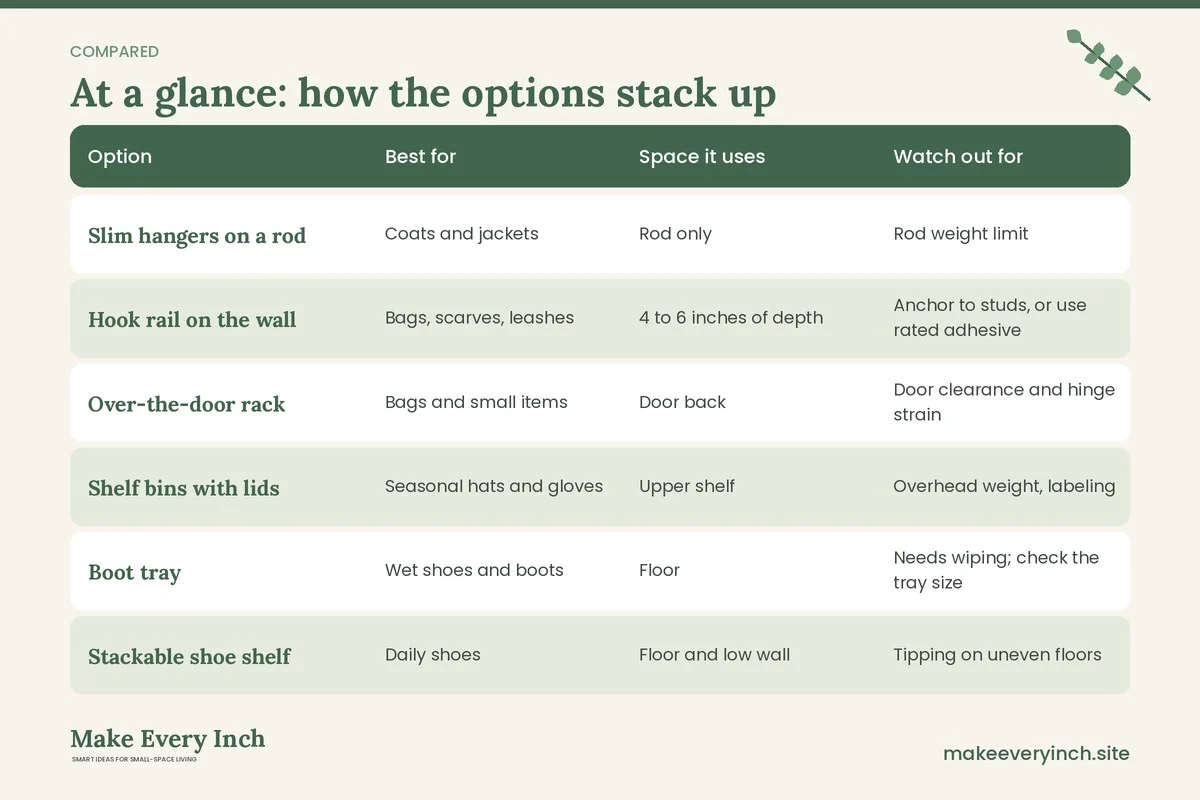
A comparison table for the main storage choices
Use this table to choose between the common closet organizers. The notes are general, not a ranking.
| Option | Best for | Space it uses | Watch out for |
|---|---|---|---|
| Slim hangers on a rod | Coats and jackets | Rod only | Rod weight limit |
| Hook rail on the wall | Bags, scarves, leashes | 4 to 6 inches of depth | Anchor to studs, or use rated adhesive |
| Over-the-door rack | Bags and small items | Door back | Door clearance and hinge strain |
| Shelf bins with lids | Seasonal hats and gloves | Upper shelf | Overhead weight, labeling |
| Boot tray | Wet shoes and boots | Floor | Needs wiping; check the tray size |
| Stackable shoe shelf | Daily shoes | Floor and low wall | Tipping on uneven floors |
| Hanging pocket organizer | Gloves, hats, small items | Rod or door | Bulk and door swing |
Three example closets
Example 1: the 30 inch reach-in for a couple
The closet is 30 inches wide and 22 inches deep, with a single rod and one shelf. The couple wants room for six coats, four bags, two pairs of boots and some seasonal accessories. They install slim hangers on the rod, leaving the last 8 inches empty for a guest or two. A hook rail on the side wall holds two bags, and an over-the-door rack takes the umbrella and the tote. A boot tray on the floor holds both pairs of boots, and a single lidded bin on the shelf holds hats and gloves. The result is a closet that holds the daily load, with space for a visitor.
Example 2: the 48 inch closet for a family of four
The closet is 48 inches wide and 24 inches deep. The family splits the rod into two sides: adult coats on the left at 62 inches and a child rod on the right at 44 inches. Each person has a labeled hook on the back wall and a shoe cubby on the floor. The top shelf holds one bin per season. The family keeps a basket by the door for mail and keys. For more family-focused ideas, read our guide to small entryway organization for families.
Example 3: the shallow 18 inch closet in an older home
The closet is 36 inches wide and only 18 inches deep, so coats do not hang straight. The owner replaces the hinged door with a curtain on a tension rod, with permission from the landlord, so the coats can hang slightly into the opening. Slim hangers turn sideways to fit, and the wall hooks take the heavier jackets. A narrow shoe shelf sits on the floor, and the bags go in a shelf bin. For more renter-safe ideas, see renter friendly entryway organization ideas.
A seasonal rotation plan
An entry closet works best when it changes with the weather. Pick two dates a year, such as the first cold week of autumn and the first warm week of spring, and run through the same short routine.
- Pull out the off-season coats and check each for stains, loose buttons and pockets with forgotten items.
- Clean or air the coats before storing them. Wash what can be washed, and dry everything fully, because damp fabric grows mildew in a closed bin.
- Move the stored coats to a bedroom closet, a garment bag in a dry area or an under-bed container. Use breathable bags instead of sealed plastic for wool.
- Bring in the new season’s hats, gloves and boots from the top shelf.
- Wipe the shelves and the floor tray, vacuum the corners, and check the hooks and rod for any sign of loosening.
- Count the hangers and remove any extras, so the rod stays at a comfortable fill level.
Keep moth protection simple. Clean fabric, good airflow and tightly woven storage bags go a long way. If you use cedar, treat it as a light scent, not a pest solution, and avoid mothballs in small, closed spaces. Mothballs release strong fumes, and they should never be used where children or pets can reach them or where people breathe the air all day. Read the label of any chemical product, ventilate the closet, and keep it out of reach of children.
Safety notes for an entry closet
- Know the load limits. A rod, a shelf and a hook each have a limit. Heavy winter coats, wet gear and loaded bags are heavier than they look. If the rod bends or a shelf bows, remove weight and add support.
- Anchor tall units. A tall shoe cabinet or a freestanding shelf inside a closet should be anchored to a wall stud using a tip-over strap or bracket, particularly when children are in the home.
- Do not drill without permission. In a rental, ask in writing before adding a bracket, a rod or a hook rail. Use adhesive and tension solutions where allowed.
- Keep the floor clear. A closet door that opens onto a pile of shoes is a tripping hazard. Keep the floor path in front of the closet free.
- Choose low-VOC finishes. If you paint the inside of the closet or refinish a shelf, choose a low-VOC product, ventilate the area and let it cure before loading it. A closed closet holds fumes longer than an open room.
- Watch the lighting. If you add a battery puck light or a plug-in light, follow the manufacturer’s instructions, and keep fabric away from any heat source.
- Child safety. Keep small items, chemicals and heavy objects out of a child’s reach, and do not let children climb the shelves.
Common mistakes to avoid
- Overfilling the rod. If you cannot slide the hangers freely, the rod is too full, and coats wrinkle and slip to the floor. Aim to leave about 20 percent of the rod empty.
- Using the floor as a catch-all. Loose shoes, bags and boxes on the floor turn the closet into a heap. Give each item a tray, a hook or a bin.
- Storing heavy items high. Put the heaviest bin on the lowest shelf, and keep the top shelf for light, bulky items such as hats and blankets.
- Skipping labels. If you have to open every bin, you will stop using the system. A label on the front of each bin takes seconds and saves time every week.
- Forgetting the guests. A closet with no guest room means coats on the bed. Keep a short section open.
- Buying before measuring. An organizer that is 2 inches too deep will block the door. Measure the width, the depth and the door swing first.
- Ignoring the daily route. If the closet is far from where people take off their shoes, they will drop them elsewhere. Put the shoe tray where the feet are, and the hooks where the hands are.
A one-hour setup checklist
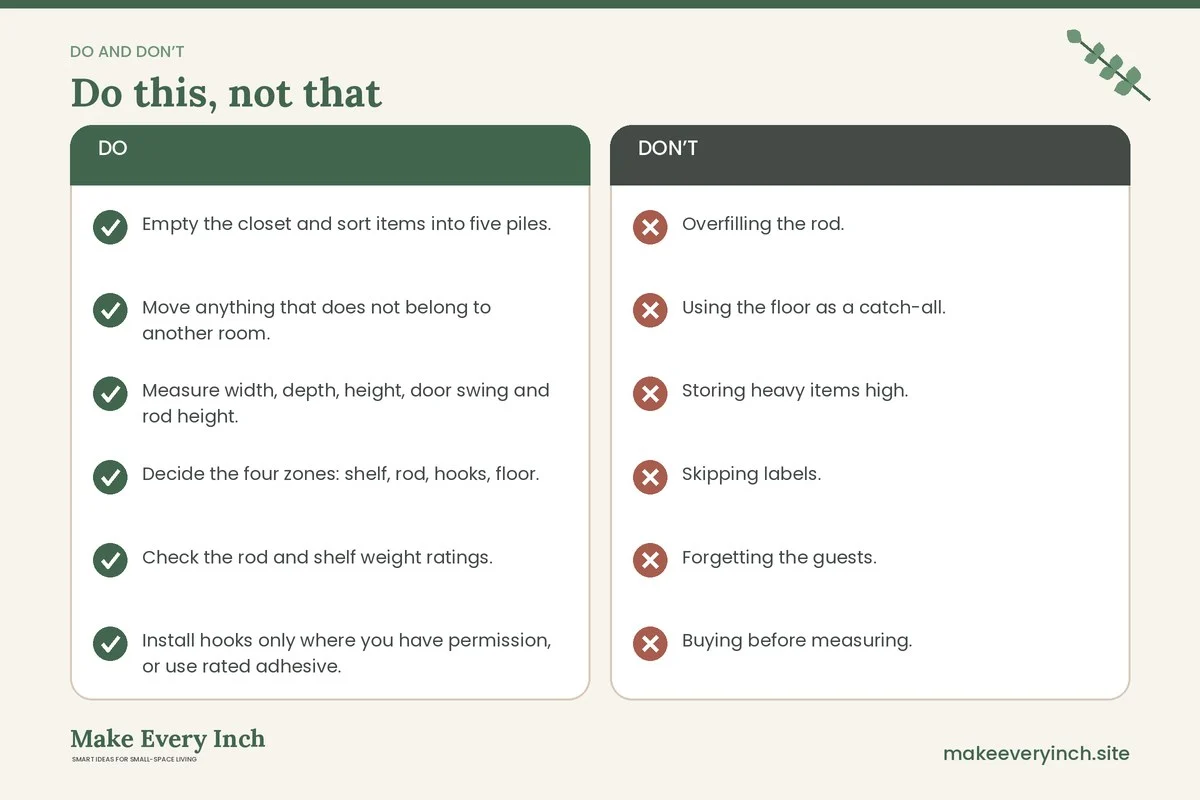
- Empty the closet and sort items into five piles.
- Move anything that does not belong to another room.
- Measure width, depth, height, door swing and rod height.
- Decide the four zones: shelf, rod, hooks, floor.
- Check the rod and shelf weight ratings.
- Install hooks only where you have permission, or use rated adhesive.
- Add slim hangers and set the daily coats nearest the door.
- Place a boot tray and a shoe shelf on the floor.
- Fill two labeled bins on the top shelf: this season and next.
- Reserve a guest section on the rod with spare hangers.
- Anchor any tall unit to the wall.
- Wipe the surfaces and check that the door closes freely.
- Set a calendar date for the next seasonal rotation.
FAQ
How much space should I leave for guest coats?
Leave 12 to 18 inches of rod for five or six hangers. If you host often, plan for more, or add a freestanding rack or a row of wall hooks nearby for the overflow.
What is the best way to store boots in a small closet?
Use a waterproof tray on the floor and stand the boots upright. For tall boots, use boot shapers or rolled cardboard to keep them from folding. If the floor is tight, store the off-season pairs in a bedroom closet.
Can I add storage to an entry closet without drilling?
Yes. Over-the-door hooks, tension rods, freestanding shelves, stacking bins and adhesive hooks rated for the weight all work without holes. Always check your lease and test adhesive in a hidden spot. See our vertical storage ideas for more.
How do I keep the closet from smelling damp?
Let wet coats and boots dry in the open before putting them away, wipe the tray often, and leave the door ajar on rainy days if you can. A bit of airflow does more than any scent. Avoid mothballs and other strong chemicals in the closet.
Should coats go on hangers or hooks?
Hang structured coats on hangers so they keep their shape, and use hooks for light jackets, bags and items you reach for often. Heavy knitwear is better folded on a shelf than hung, because it stretches.
What if my entry closet is only 18 inches deep?
Turn hangers sideways, use slim hangers, or swap to wall hooks inside the closet. A curtain in place of a door, where permitted, gives coats a little extra room. You can also move the off-season coats to another closet.
Keep going: Keep going with our main guide to small closet ideas, the practical small closet organization ideas and our tips for small coat storage ideas, then widen the plan with small space organization ideas.
Save this guide for later
Pin the ideas you like to Pinterest so you can come back to them when you plan your space.