Small Home Office Ideas in a Bedroom
Quick answer: The best small home office ideas in a bedroom keep work and sleep visibly apart. Put the desk where you cannot see it from the pillow, use a fold-away or closable setup so the workday has an end, keep screens and bright light out of the last hour before bed, and add a short shutdown ritual. Position the desk at least 3 feet from the bed if you can, and never let a laptop live on the mattress.
Small home office ideas in a bedroom have to solve two jobs that pull in opposite directions. A workspace asks for focus, light and a little pressure to finish things. A bedroom asks for calm, dimness and permission to stop. When both live in one room, the trick is not finding a clever desk. It is building clear visual and behavioral boundaries so your brain can tell the two apart. This guide covers the sleep and work conflict, where to place a desk, ways to hide an office, screen and lighting rules, a comparison table, three example rooms, a shutdown routine, safety notes and a checklist. For the broader picture, start with our pillar on small home office ideas, and for the living room version of this problem, read the companion post on small home office ideas in a living room.
This post is general home guidance and not medical advice. If you have ongoing trouble sleeping, talk to a qualified professional.
Why a bedroom office is a different problem
Most desk guides assume the room is just a room. A bedroom is not. It is the place your body learns to associate with rest, and many people find that working from bed, or even working in sight of it, makes both work and sleep feel worse. The common pattern is simple. The laptop sits near the pillow, the day never quite ends, and the bedroom becomes the place where unanswered email lives.
Sleep researchers often talk about sleep hygiene, which means the habits and conditions that support a regular night. Widely repeated advice includes keeping the bedroom dark, cool and quiet, keeping a consistent wake time, and limiting bright screens in the last hour or so before bed. You do not need to follow every rule perfectly, but a bedroom office makes several of them harder. A desk lamp is bright light, a monitor is a screen, and a pile of paperwork is a reminder of tasks. The aim of your plan is to reduce each of those cues at bedtime.
Think of it as three separations.
- Visual separation: you cannot see the desk, or at least the work parts of it, from where you sleep.
- Physical separation: the desk is as far from the bed as the room allows, and the bed is never the work surface.
- Time separation: a clear start and stop, with a ritual that closes the workday.
If you can only achieve two of the three, choose visual and time separation first, since they cost the least and matter most in a tiny room.
Where the desk can go in a bedroom
Placement does more than any product choice. Walk the room and test these spots in order.
Facing away from the bed
If the desk must sit in view of the bed, turn it so your chair faces a wall or a window, not the bed. When you sit down to work, your back is to the place you sleep. When you lie in bed, you see the back of a chair or a closed screen, not a glowing workstation.
The window wall
A desk under or beside a window gives you daylight, which is helpful for alertness during the day. Keep the desk off the wall directly beside the head of the bed, since that places the screen close to your face at night. Use a curtain or blind so you can cut glare on the monitor during the day and block light at night.
The closet or alcove
A shallow closet with the doors removed, or an alcove beside a chimney breast, holds a small desk and can be closed off with a curtain or a folding door. This is the strongest option because it gives you a true edge to the workspace. Ventilation and lease permission matter here, so see the safety section below.
The foot of the bed
A narrow desk across the foot of the bed works in some very small rooms. It puts the desk close to the bed, so use it only with a hide-away strategy and a strict rule about the shutdown routine.
The corner behind the door
A corner desk tucked behind an open door can be shielded from the bed by the door itself. Check that the door still opens fully and that the swing does not hit the chair.
Measurements that keep a bedroom office usable
Small bedrooms are often 10 by 10 to 11 by 12 feet. These numbers keep the room workable without hunting for exact products.
- Clearance beside the bed: 24 to 30 inches along at least one long side and the foot, so you can make the bed and get out.
- Chair space: 36 inches behind the desk edge for a chair to slide back and for someone to walk past, or 30 inches at the least.
- Desk depth: 16 to 24 inches is enough for a laptop, and 24 to 30 inches fits a monitor comfortably.
- Desk width: 30 to 42 inches covers a laptop, a notebook and a lamp. A wall-hung or fold-down version can be as narrow as 24 inches.
- Desk height: about 28 to 30 inches is standard. Adjust the chair, and use a footrest if your feet do not rest flat.
- Monitor distance: roughly an arm’s length, with the top of the screen near eye level. Ergonomics vary from person to person, so treat these as starting points.
Tape the footprint on the floor and live with it for a day before buying anything. If the tape blocks a dresser drawer or the closet door, move it.
Small home office ideas in a bedroom that hide at bedtime
Hiding the office is the single biggest move you can make. The goal is to turn a workstation into a piece of furniture or a blank wall in under a minute.
A fold-down wall desk
A drop-leaf panel that mounts to the wall closes into a flat board, which can be decorated like any other wall. It needs secure fixings into studs or proper anchors, and drilling needs the landlord’s permission in a rental. For a no-drill approach, see our no-drill storage ideas for renters.
A secretary desk or a cabinet desk
A tall cabinet with a fold-out writing surface closes into a cupboard. It holds the laptop, a notebook and a charger behind doors. Because it stands on the floor, it needs no drilling, but tall furniture should be anchored to the wall to prevent tipping, with the lease in mind.
A desk behind a folding screen
A three-panel screen, about 60 to 72 inches tall, hides a desk in a corner of the room. Pull it across at the end of the day. It also softens light from the screen and the lamp, which helps the bedroom feel darker.
A curtain on a tension rod
Hang a floor-length curtain from a tension rod across an alcove or closet. Close it when you finish. This is a renter-friendly approach and costs little in effort. Use a rod suited to the width and weight, and test it first.
A dresser desk
Use the top of a dresser as a standing or stool-height desk. Slide a laptop into a drawer or a shelf below when you finish. It combines storage with a small workstation. Give the dresser enough free space for drawers to open.
A lid or a cover
A simple fabric cover or a wooden lid over the monitor and keyboard turns the desk into a table. It is a visual cue that the workday ended, which makes the difference more than the product itself.
A rolling cart office
Put the laptop, notebook, a lamp and a charger on a cart with wheels. Roll it into the closet or behind the door when you finish. This approach suits very small rooms because the office occupies no floor space at night.
Comparison of bedroom office setups
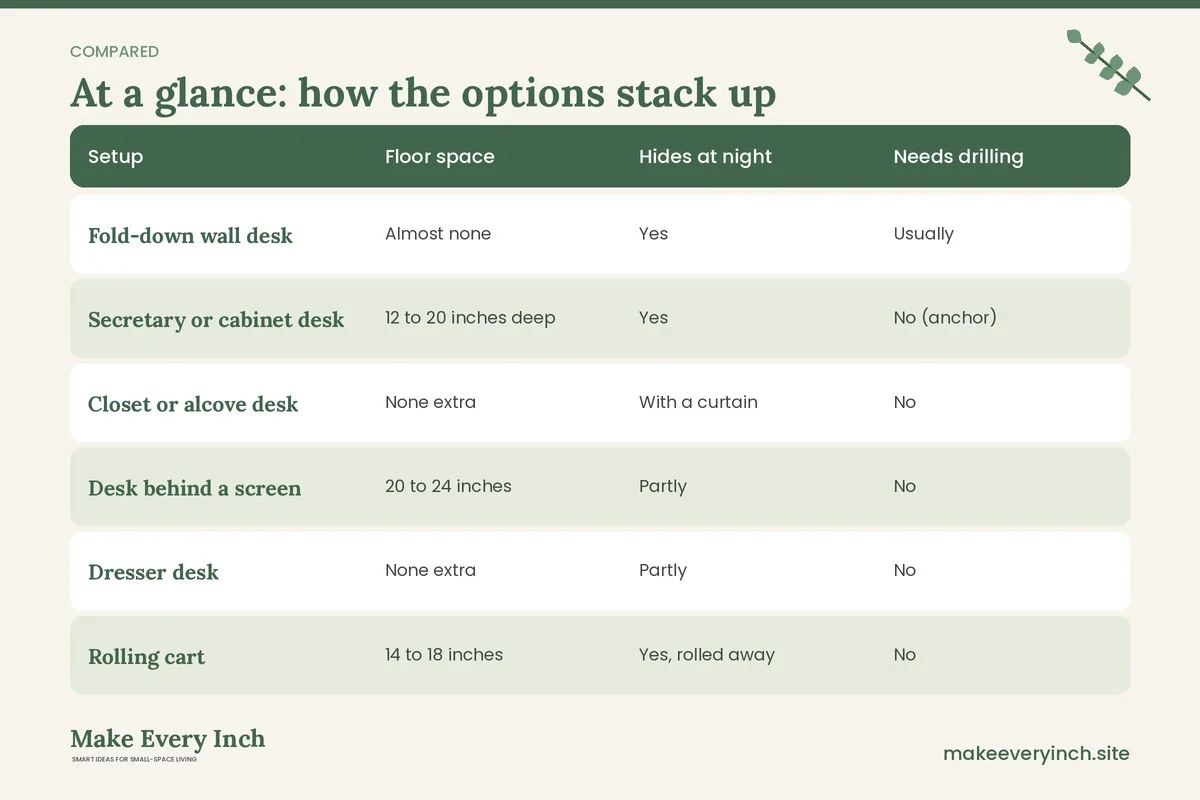
| Setup | Floor space | Hides at night | Needs drilling | Best for |
|---|---|---|---|---|
| Fold-down wall desk | Almost none | Yes | Usually | Daily work in a tiny room |
| Secretary or cabinet desk | 12 to 20 inches deep | Yes | No (anchor) | A neat, closed look |
| Closet or alcove desk | None extra | With a curtain | No | A true boundary |
| Desk behind a screen | 20 to 24 inches | Partly | No | Renters |
| Dresser desk | None extra | Partly | No | Short sessions |
| Rolling cart | 14 to 18 inches | Yes, rolled away | No | Very small rooms |
| Open desk at the window | 20 to 30 inches | No | No | Full-time work with a strict routine |
Screen rules that protect your sleep
Screens are the main source of conflict in a bedroom office. Here are practical rules that many people find useful, adjusted to your own schedule.
- Set a screen curfew. Choose a time, often 60 minutes before bed, after which the work screen is off or closed. Some people use a timer or a smart plug on a schedule.
- Keep the laptop off the bed. The bed is for sleep and rest. If you must sit on the bed, use a lap desk and put it away straight afterward.
- Use night modes. Warm display settings and lower brightness in the evening are common advice, though they do not replace a real stopping time.
- Silence work notifications. Turn off email and chat alerts on your phone after hours, or use a focus mode.
- Charge devices away from the bed. Put the phone and laptop on the desk or in the cabinet to charge. A phone across the room also means you must stand to turn off an alarm.
- Cover the standby lights. A small piece of tape or a power strip with a switch removes the glow of standby indicators in a dark room.
Lighting for both work and rest
A bedroom office needs two light settings that feel very different. For work, you want a bright, even light on the desk and little glare on the screen. For evening, you want warm, low light that does not make the room feel like an office.
- Use a task lamp for work. A lamp with an adjustable head lights paper and keyboard without flooding the room. Point it so the light does not reflect on the screen.
- Place the screen at right angles to a window. This reduces glare. Use a sheer curtain for daytime control.
- Choose warm bulbs for the bed zone. Bulbs around 2700 kelvin feel restful. Cooler bulbs between 3500 and 4000 kelvin suit the desk during the day.
- Put the desk lamp on a switch you can reach from the chair, not from the bed. The act of turning it off should be part of the shutdown.
- Use blackout curtains if your window faces a bright street. They help the room stay dark at night.
For more, read our guide to small bedroom lighting ideas.
Cords, chargers and electrical safety
A bedroom office adds a laptop, a monitor, a lamp and chargers to a room that often has few outlets. Keep these basics in mind.
- Respect the load. Do not plug several high-draw devices, such as a heater, a space heater or a hair dryer, into the same power strip as your computer equipment. Check the rating on the strip and the circuit.
- Use a strip with a built-in switch and overload protection. Do not daisy-chain strips.
- Keep cords off walkways. Tape or clip them along the wall base, and avoid running them under rugs where they can overheat or trip you. Our guide to renter-friendly ways to hide cords has non-damaging options.
- Keep power away from bedding. Do not charge devices under pillows or blankets, and keep chargers off soft surfaces where heat can build up.
- Leave airflow around equipment. Do not cover a laptop or a power adapter with fabric while it is on. The decorative cover from the hide-away list goes on after you power down.
If you see scorch marks, smell burning or feel a plug that is hot, stop using it and ask a qualified electrician to check.
Ergonomics on a small footprint
A bedroom desk is often a compromise in height and depth. These tips are general, and people differ, so adjust to what feels comfortable.
- Sit with your feet flat on the floor or on a footrest, with your knees near a right angle.
- Raise a laptop on a stand or a stack of books, and use a separate keyboard so your wrists and shoulders can stay relaxed.
- Take a short break every hour to stand, stretch and rest your eyes.
- Use a chair with back support, or add a small cushion. A dining chair can work for short sessions, but a long day may need something more supportive.
- Avoid working on the bed or sofa for long periods, since awkward positions can cause discomfort.
If you have pain that continues, consult a qualified professional rather than relying on a blog post.
Three example bedrooms
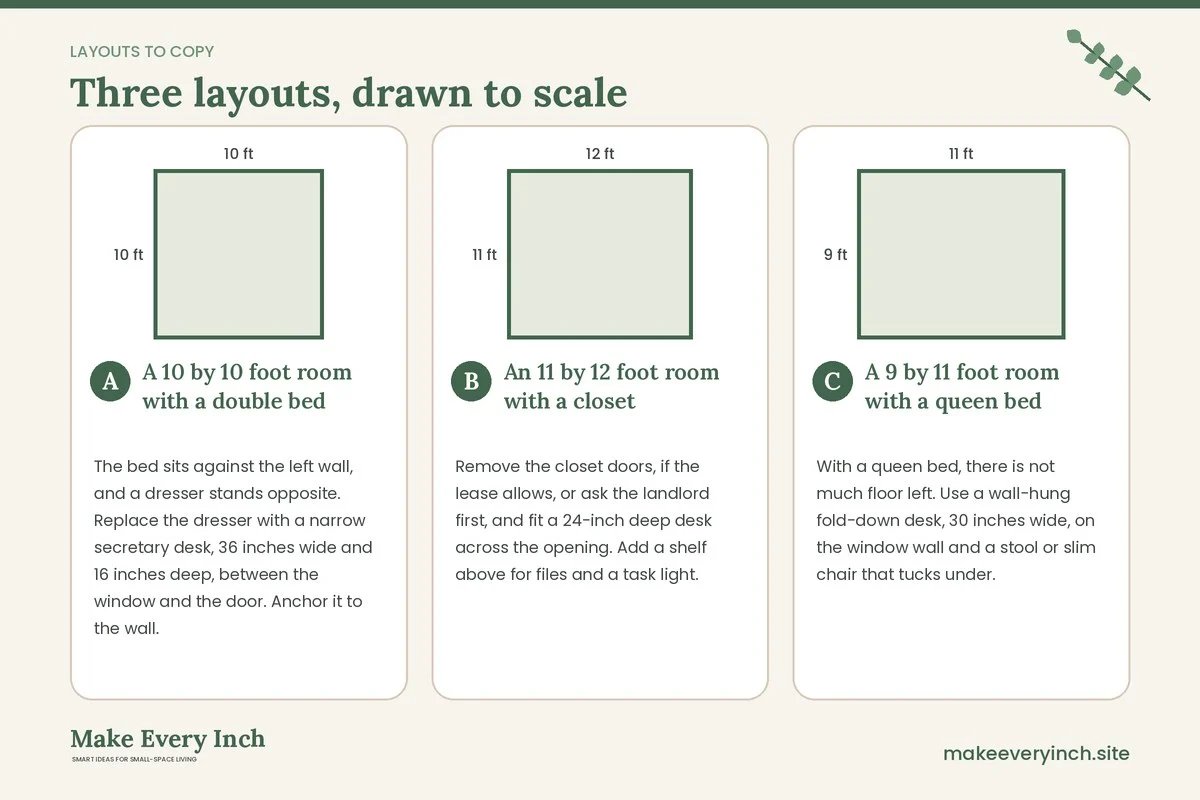
A 10 by 10 foot room with a double bed
The bed sits against the left wall, and a dresser stands opposite. Replace the dresser with a narrow secretary desk, 36 inches wide and 16 inches deep, between the window and the door. Anchor it to the wall. In the evening, close the fold-out leaf, which hides the laptop and papers, and switch off the task lamp. The path beside the bed stays 30 inches wide. This plan works for someone who works a few days each week and wants the room to look like a normal bedroom.
An 11 by 12 foot room with a closet
Remove the closet doors, if the lease allows, or ask the landlord first, and fit a 24-inch deep desk across the opening. Add a shelf above for files and a task light. Hang a floor-length curtain on a tension rod, and close it at the end of the day. The bed stays free of any office cues. Clothes move to a rolling rack or to under-bed storage. For related ideas, see our guide to clothing storage ideas for small bedrooms.
A 9 by 11 foot room with a queen bed
With a queen bed, there is not much floor left. Use a wall-hung fold-down desk, 30 inches wide, on the window wall and a stool or slim chair that tucks under. A three-panel screen stands in the corner and can be pulled across the desk in the evening. The desk lamp plugs into a switched strip. The result is a room that works as an office for six hours and a bedroom for the other eighteen. For a different approach with a bed-based layout, read our post on small bedroom ideas with a desk.
A shutdown routine that ends the workday
Furniture helps, but a ritual closes the loop. Try a five-minute routine and adapt it.
- Write tomorrow’s top three tasks. A short list on paper moves unfinished work out of your head.
- Close apps and shut down. Power down the laptop rather than leaving it asleep.
- Clear the desk. Put papers in a folder, pens in a cup and cables in a tray.
- Cover or close the desk. Pull the curtain, shut the cabinet, fold the leaf or roll the cart away.
- Turn off the desk lamp and any strip switches.
- Change something sensory. Open a window for a minute, change your clothes, light a low lamp or play a calm track. A small change tells your brain that the room has shifted modes.
Do the same steps each day so they become automatic.
Cleaning and ventilation
A desk in a bedroom adds dust catchers such as paper, cables and electronics. Wipe the desk and screens weekly, and vacuum behind the desk when you can. Keep the room well ventilated, since a closed room with a person and electronics can feel stuffy. Open a window briefly in the morning and after work. If you paint a closet or an alcove to mark the work zone, choose low-VOC paint, ventilate during and after painting, and check the lease first.
Safety and lease notes
- Anchor tall furniture. Cabinets, secretary desks and tall shelves can tip. Use anti-tip straps or brackets, and get permission before drilling in a rental.
- Do not drill without permission. Fold-down desks, wall shelves and brackets need fixings. If the lease forbids it, choose freestanding furniture or a cart.
- Check weight limits. A wall-hung desk must be rated for the weight of a monitor and a person leaning on it.
- Keep an exit clear. Do not block the bedroom door or a window that serves as an escape route.
- Keep heat sources away. Do not put a space heater under a desk.
Common mistakes
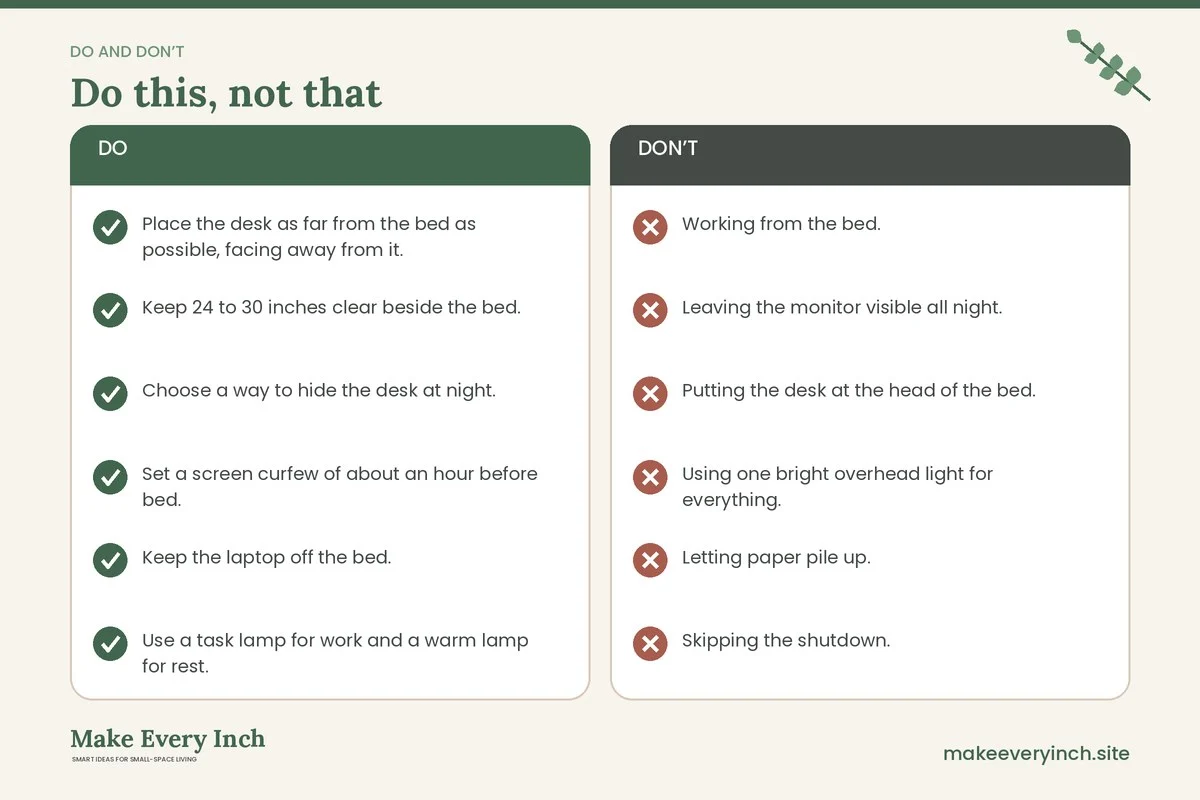
- Working from the bed. It blurs the line between sleep and work, and may harm posture.
- Leaving the monitor visible all night. Even a dark screen is a reminder. Cover or close it.
- Putting the desk at the head of the bed. It is the worst place for light and noise.
- Using one bright overhead light for everything. Layer a task lamp and a warm lamp.
- Letting paper pile up. Give every sheet a folder or a bin, and empty the folder weekly.
- Skipping the shutdown. Without a ritual, the workday spreads into the evening.
Budget and phasing
You do not need a full setup on day one. Start with free changes, such as moving the desk, adding a curtain and setting a screen curfew. Next, add a task lamp and a switched power strip. After that, consider a fold-away or cabinet desk if the open desk still bothers you. Second-hand furniture shops and online marketplaces often have cabinets, screens and small desks. Measure first, and check that each piece fits through the door and can be carried by two people.
Bedroom office checklist
- Place the desk as far from the bed as possible, facing away from it.
- Keep 24 to 30 inches clear beside the bed.
- Choose a way to hide the desk at night.
- Set a screen curfew of about an hour before bed.
- Keep the laptop off the bed.
- Use a task lamp for work and a warm lamp for rest.
- Charge devices away from the pillow.
- Use a switched, rated power strip and keep cords off walkways.
- Anchor tall furniture and get permission before drilling.
- Write tomorrow’s tasks and shut down at the end of the day.
- Ventilate the room daily.
- Review the setup after two weeks and adjust.
FAQ
Is it bad to have a desk in your bedroom?
It is not bad in itself, and many people have no choice. The risk is that work cues leak into your rest. Separate the desk visually, set a screen curfew and use a shutdown routine to reduce that risk.
How far should a desk be from the bed?
There is no fixed rule. Farther is better, and at least 3 feet gives you room to move. If space is tight, face the desk away from the bed and hide it at night.
How do I stop thinking about work in my bedroom?
Write down tomorrow’s tasks, close the desk and leave the room’s work cues out of sight. If you still struggle, consider a short break outside before bed.
Can I use a laptop in bed?
You can, but many people sleep better and work with less strain when the bed is kept for rest. If you do use it, use a lap desk, keep it brief, and put it away afterward.
What is the best desk for a very small bedroom?
A fold-down wall desk, a secretary cabinet or a rolling cart suit the smallest rooms, since they disappear when you finish. Our guide to the best desks for small apartments covers more types.
How do I hide cords in a bedroom office?
Gather them with clips or sleeves, run them along the baseboard and use a cover that suits a rental. See our post on renter-friendly ways to hide cords.
Should I use blue-light glasses or filters?
Evidence is mixed, and they do not replace a regular schedule. A screen curfew and lower brightness are simpler habits to start with.
Can I paint a closet to make an office nook?
If the lease allows, yes. Use low-VOC paint and ventilate well. A removable option, such as a fabric panel, avoids the question.
Keep going: Keep planning with our small home office ideas pillar, the guide to small bedroom desk ideas and the sibling post on small home office ideas in a living room.
Save this guide for later
Pin the ideas you like to Pinterest so you can come back to them when you plan your space.