Small Room Mirror Placement Ideas: 15 Spots That Add Light and Depth
Quick answer: Good small room mirror placement starts with what the mirror will reflect. Put a mirror opposite or beside a window to double daylight, hang it so the center sits near eye level (often around 57 to 60 inches), and avoid reflecting clutter or a bare wall. Anchor leaning mirrors to the wall and use hardware rated well above the mirror’s weight.
Small room mirror placement is the difference between a mirror that makes a space feel twice as big and one that just shows you a messy corner. A mirror is not decor so much as a tool: it moves light, repeats views and creates the feeling of another room. Where you place it decides what it repeats. This guide explains how reflection works, the rules for height and size, 15 placements for different rooms, a comparison table, three example rooms, hanging and safety rules, mistakes and a checklist. For the full approach to making a compact home look and feel better, read our pillar on small room decor ideas, and for lighting that works with mirrors, see our guide to layered lighting small apartments.
How a mirror actually changes a room
A mirror does two things. First, it bounces light. A mirror across from a window sends daylight deeper into the room, which brightens dark corners. Second, it repeats a view. A mirror placed so that it shows a doorway, a plant or a window creates an illusion of extra space beyond the wall.
The key rule follows from this: you get what the mirror faces. A mirror facing a pleasant view or a bright window helps. A mirror facing a pile of laundry, a bare wall or a harsh ceiling light adds nothing, or adds problems. Before choosing a spot, stand where the mirror would hang and look at what it would see from the main seating or entrance. That image is what you are decorating.
Mirrors also reflect glare. A mirror directly facing a bright, uncovered window can throw a strong beam on the opposite wall or in your eyes at certain hours of the day. Observe the room at different times before you commit, and stay flexible by leaning the mirror first.

Size and height rules that work
There is no single perfect size, but a few measurements prevent most mistakes.
- Center height. Hang a mirror so its center is near eye level, commonly around 57 to 60 inches from the floor. For a mirror over furniture, leave about 4 to 8 inches between the furniture and the bottom edge.
- Width over furniture. A mirror above a console, dresser or sofa often looks balanced at roughly two thirds to three quarters of the furniture’s width.
- Floor mirrors. A full-length mirror usually stands about 60 inches tall or taller, and angles back slightly against the wall. Leave about 20 to 36 inches in front for comfortable viewing.
- Distance from a window. A mirror placed on the wall perpendicular to a window, or directly opposite it, catches more light than one on the same wall as the window.
- Edge clearance. Leave a few inches between a mirror and the ceiling, a doorframe or a light fixture so it has room to look intentional.
These are rules of thumb, not laws. If your ceiling is low, hang a wide, low mirror to stretch the room sideways. If your ceiling is high or the room is narrow, a tall mirror makes it feel taller.
15 small room mirror placement ideas
Windows and light
1. Directly opposite a window
This is the classic way to double daylight. Make sure the mirror reflects the window and the sky or trees, not a neighbor’s wall. Check the glare at different times of day.
2. On the wall beside a window
A mirror on the wall perpendicular to the window catches light at an angle and spreads it along the room without a harsh beam.
3. Between two windows
A tall mirror in a pier between two windows reflects both and makes the wall disappear. Keep the frame slim.
4. Leaning near a dark corner
Lean a large mirror in the darkest corner that has some daylight nearby. It can bring light into the area without any new lamp.
5. Behind a lamp
A table lamp in front of a mirror looks like two lamps, which doubles the glow. Keep the bulb clear of the mirror edge and use a low-heat LED.
Entryways and halls
6. Above an entry console
A mirror over a slim console is the classic entry move. It lets you check your appearance and reflects the door. See apartment entryway decorating for more entry plans.
7. At the end of a hall
A mirror at the end of a hallway adds apparent length. Choose one that reflects light, not a dim door. Pair it with ideas from our small hallway decorating ideas.
8. Beside the front door
A narrow full-length mirror next to the door gives you a last-check spot and takes almost no floor space.
Living areas
9. Above the sofa
A wide, low mirror above a sofa spreads light across the room. Hang it with hardware rated for the full weight. Keep it clear of heads leaning back and consider a lightweight frame.
10. Across from a favorite view
Place a mirror so it reflects art, a plant shelf or a bookcase. The repeated view adds depth. Browse small living room ideas for layouts that suit it.
11. As part of a gallery wall
One or two mirrors mixed with frames add shine to a gallery wall. Use a mix of shapes. For layout tips, see hallway gallery wall ideas for small homes.
Bedrooms, dining and work areas
12. Beside the bed
A tall mirror beside a bed or on a closet door doubles as a dressing mirror. Avoid placing a mirror directly facing the pillow if reflections or light at night bother you.
13. Over a dresser
A mirror over a dresser works as both a dressing aid and a light bouncer. See small bedroom ideas for more bedroom plans.
14. In the dining area
A mirror on the wall beside a dining table reflects candlelight or a pendant and makes the meal feel larger. Our small dining room lighting ideas show how to light the table to go with it.
15. Near a desk
A small mirror behind or beside a desk lamp bounces light back onto the work surface. Keep it out of the line of your screen to avoid glare.
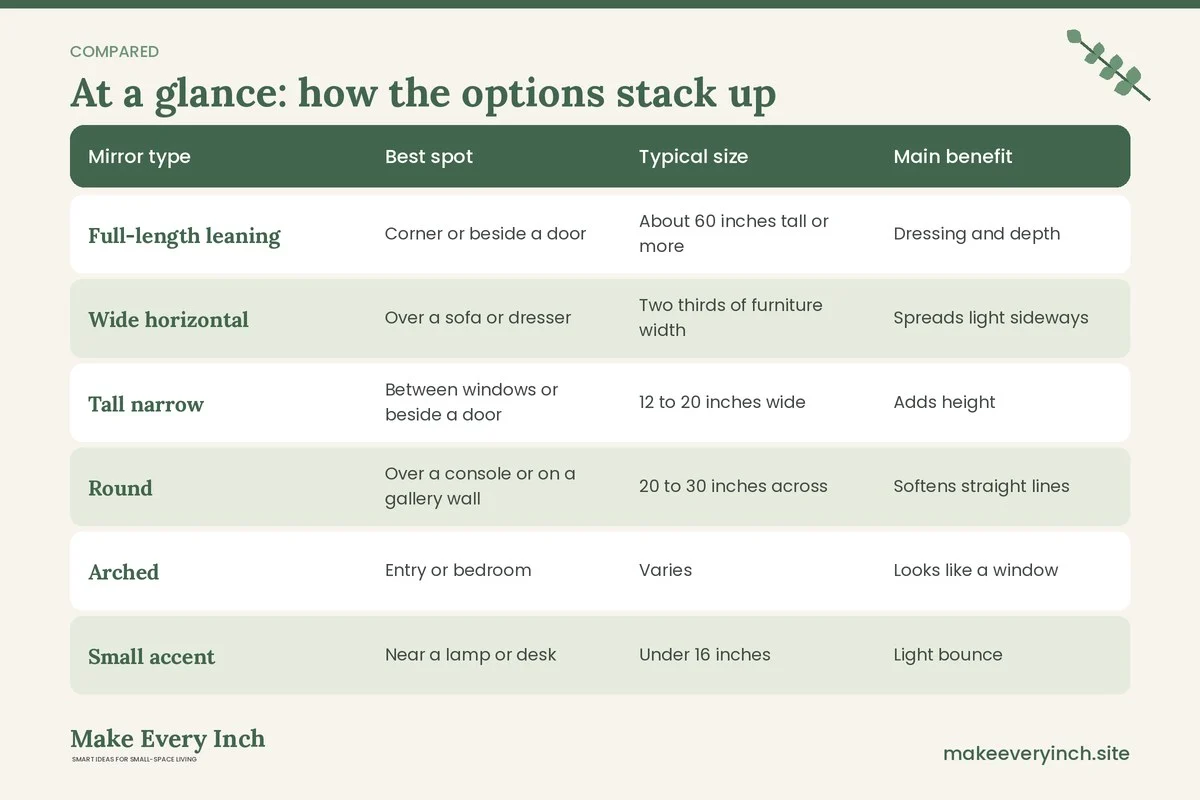
A comparison table of mirror types and placements
| Mirror type | Best spot | Typical size | Main benefit | Watch out for | |
|---|---|---|---|---|---|
| Full-length leaning | Corner or beside a door | About 60 inches tall or more | Dressing and depth | Tipping, so anchor it | |
| Wide horizontal | Over a sofa or dresser | Two thirds of furniture width | Spreads light sideways | Heavy, needs rated hardware | |
| Tall narrow | Between windows or beside a door | 12 to 20 inches wide | Adds height | Reflecting clutter | |
| Round | Over a console or on a gallery wall | 20 to 30 inches across | Softens straight lines | Weight on one hook | |
| Arched | Entry or bedroom | Varies | Looks like a window | Reflecting a bare wall | |
| Small accent | Near a lamp or desk | Under 16 inches | Light bounce | Too many looks busy |
Three example rooms
Example 1: A dim studio with one window
The studio has one window on the short wall and a bed on the other side. A large leaning floor mirror sits opposite the window, angled back so it reflects the sky and the plant shelf, not the bed. A round mirror hangs over the small desk to bounce lamp light. Result: the darker end of the room gets daylight, and the room reads as a deeper space. The mirror is anchored to the wall with an anti-tip strap.
Example 2: A narrow entry and living room
The apartment has a long, narrow hall that opens into a living room. A tall arched mirror stands at the end of the hall, reflecting a lamp rather than a closed door. Over the console by the entry hangs a smaller round mirror. In the living room, a wide mirror above the sofa faces the window wall. Together they spread light along the whole length. A small tray on the console holds keys so the mirror does not reflect a messy surface.
Example 3: A small bedroom with a low ceiling
The bedroom has a low ceiling and a window beside the bed. A wide, low mirror over the dresser stretches the room sideways. A slim full-length mirror stands beside the closet. No mirror faces the bed, which keeps the room restful. The window curtains stay light so the mirror does its job. See our guide to small bedroom ideas that make the room feel bigger for related ideas.
How to test a spot before you hang anything
You can try a placement for free before you pick up a tool.
1. Lean first. Stand the mirror on the floor where you plan to hang it, and move it around for a day or two.
2. Look from three places. Check the view from the sofa, the doorway and the bed.
3. Check the light. Look at the room in the morning, afternoon and evening, with and without lamps on.
4. Tape the outline. Use painter’s tape on the wall to mark the mirror size, and live with it for a day.
5. Mark the hang height. Measure to the center of the mirror and mark that point.
6. Decide on hardware. Only then choose a hook or an anchor, and make sure you have permission to use it.
Hanging, leaning and safety rules
Mirrors are heavy, breakable and sharp when broken, so safety matters more here than for most decor.
- Know the weight. Check the product weight or weigh the mirror. Choose hardware rated well above it, and read the packaging for the wall type, since drywall, plaster and masonry need different anchors.
- Use the right anchors. For heavy mirrors, hang into a stud or use a rated wall anchor. A nail in drywall alone may not hold a large mirror.
- Do not drill without permission. In a rental, ask in writing before putting holes in walls. If the answer is no, lean the mirror, use a freestanding mirror, or hang a light one with adhesive hooks rated for its weight and follow the instructions for surface prep.
- Use two points. A wide mirror hung from two hooks or a French cleat spreads the load and stops it tilting.
- Anchor leaning mirrors. A tall leaning mirror can tip, especially with children or pets. Use an anti-tip strap or a wall bracket where allowed, and keep the base on a non-slip surface.
- Keep the mirror away from heat. Do not hang a mirror directly above a heater, a stove or a radiator. Heat can damage the backing and frame.
- Mind direct sun. A mirror can concentrate sunlight. Do not place one where it could focus a bright beam on curtains, furniture or a plant.
- Do not hang above a bed or a crib without checking. A mirror above a sleeping area should be lightweight, securely anchored and preferably a safer, shatter-resistant type.
- Handle with care. Lift a large mirror with two people, wear gloves, and keep the corner cushioned. If one breaks, wear shoes and sweep up carefully.
- Keep cords away. If you pair a mirror with lights, keep cords flat and away from the glass, and never overload an outlet.
Mirrors and color
A mirror reflects the color of the room, so the surrounding walls matter. A mirror facing a warm, pale wall adds warmth, while one facing a dark wall adds depth but less light. If you plan to paint, choose a low-VOC paint, ventilate the room well while painting and drying, and ask for written permission first. For help choosing, see our guides to small dining room color schemes and studio apartment color schemes. Frame finish matters too. A thin metal frame feels light, a wood frame adds warmth, and a frameless mirror disappears into the wall.
Common mistakes
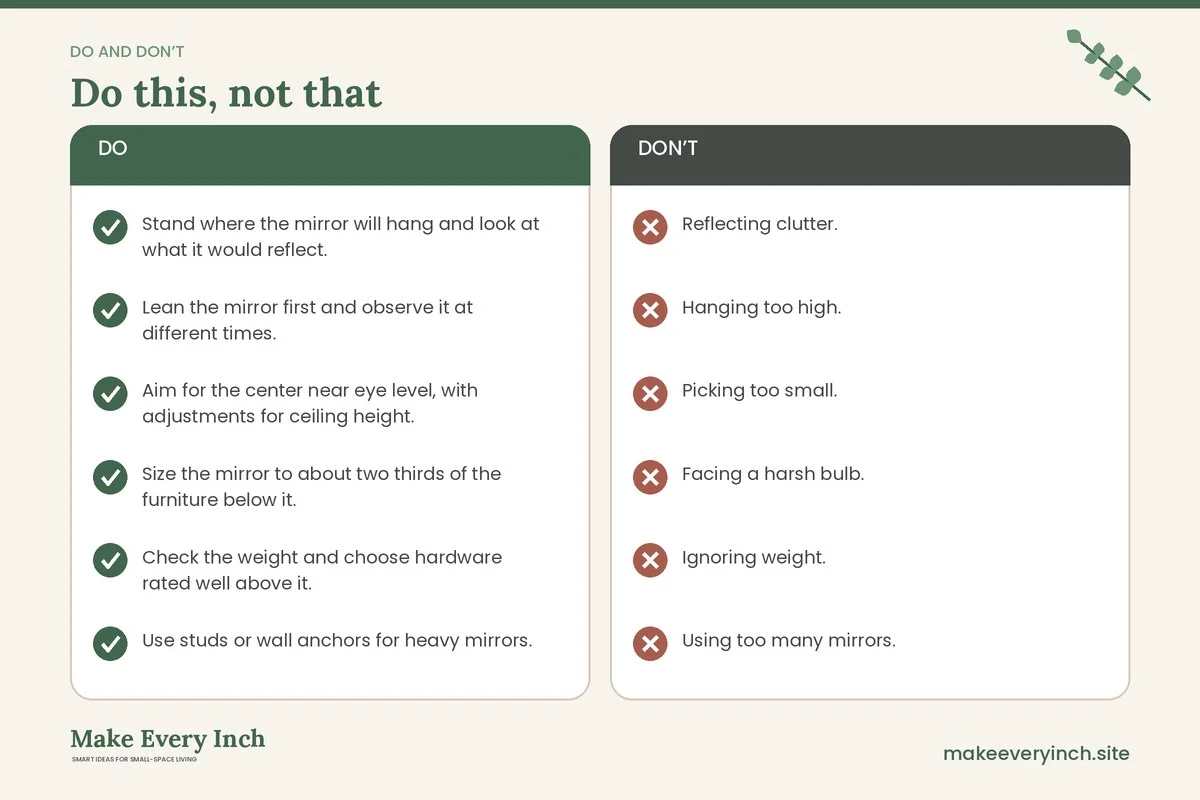
- Reflecting clutter. Check what the mirror sees before hanging.
- Hanging too high. If you only see the ceiling, move it down.
- Picking too small. A tiny mirror on a large wall looks lost. Go wider.
- Facing a harsh bulb. A bare bulb reflected in a mirror creates glare.
- Ignoring weight. Use proper anchors and rated hardware.
- Using too many mirrors. Two or three well-placed pieces beat a wall of them.
- Hanging without permission. Ask first, or lean.
- Forgetting kids and pets. Anchor any freestanding mirror.
Checklist
- Stand where the mirror will hang and look at what it would reflect.
- Lean the mirror first and observe it at different times.
- Aim for the center near eye level, with adjustments for ceiling height.
- Size the mirror to about two thirds of the furniture below it.
- Check the weight and choose hardware rated well above it.
- Use studs or wall anchors for heavy mirrors.
- Get written permission before drilling.
- Anchor leaning and floor mirrors to prevent tipping.
- Keep mirrors away from heat sources and direct focused sun.
- Do not face the mirror toward clutter, glare or bare walls.
- Pair with lamps so the light is doubled safely.
- Keep cords tidy and outlets unloaded.
FAQ
Where is the best place for a mirror in a small room?
Often across from or beside a window, since it doubles daylight. If the room has no good window, place it where it reflects a lamp or a pleasant view.
Will a mirror make a small room look bigger?
It can, by reflecting light and repeating the view. The effect is strongest when the mirror is large enough, hung near eye level and reflecting something appealing.
How high should I hang a mirror?
A common guideline is to place the center near eye level, around 57 to 60 inches from the floor. Adjust for who uses it most, and for the furniture beneath.
Can I hang a mirror in a rental?
Check your lease and ask in writing. If holes are not allowed, lean a floor mirror and anchor it where permitted, or use adhesive hooks rated for the weight, following the instructions for the wall type.
Is it bad to put a mirror in a bedroom?
There is no universal rule. Many people prefer to avoid a mirror that faces the bed because of reflections at night. Choose a spot beside the bed, on a closet door or over a dresser.
How many mirrors are too many?
Usually more than one or two in a small room starts to feel busy. Let one large mirror lead and add a small one only if it serves a clear purpose.
Final thought
Small room mirror placement is about choosing what to double. Face the mirror toward light or something lovely, hang it near eye level, anchor it properly and keep it safe. Start by leaning one mirror in the darkest corner for a few days, and you will see the result before you commit to a hook.
Keep going: Keep building the room with the pillar guide on small room decor ideas, add warm light with layered lighting small apartments, and fill the walls safely with renter friendly wall decor ideas.
Save this guide for later
Pin the ideas you like to Pinterest so you can come back to them when you plan your space.