Small Bedroom Ideas That Make the Room Feel Bigger
Quick answer: The best small bedroom ideas that make the room feel bigger work on perception, not square footage. Keep wall, trim and ceiling in close, light tones, hang curtains high and wide, choose furniture on visible legs, keep the floor clear, add layered light and place a mirror to reflect a window or a lamp. Fix the visual weight first, then add storage.
Small bedroom ideas that make the room feel bigger are not about knocking down walls or buying a smaller bed. They are about how the eye reads the room. A bedroom that is 9 by 10 feet can feel calm and open, while a room of 12 by 12 can feel cramped, and the difference is almost always visual. Dark blocks, heavy furniture, cluttered floors, low curtains and a single harsh ceiling light all shrink a room in the mind long before they take up any real space. This guide explains the perception tricks that work: color and contrast, mirrors, light, visual weight, leggy furniture, a clear floor and curtain height. It includes a table that ranks each trick by effort, three example rooms, mistakes to avoid and a checklist. For the wider picture, read our main guide on small bedroom ideas, then pair this post with the companion guide on small bedroom layout ideas for better flow once the look is sorted.
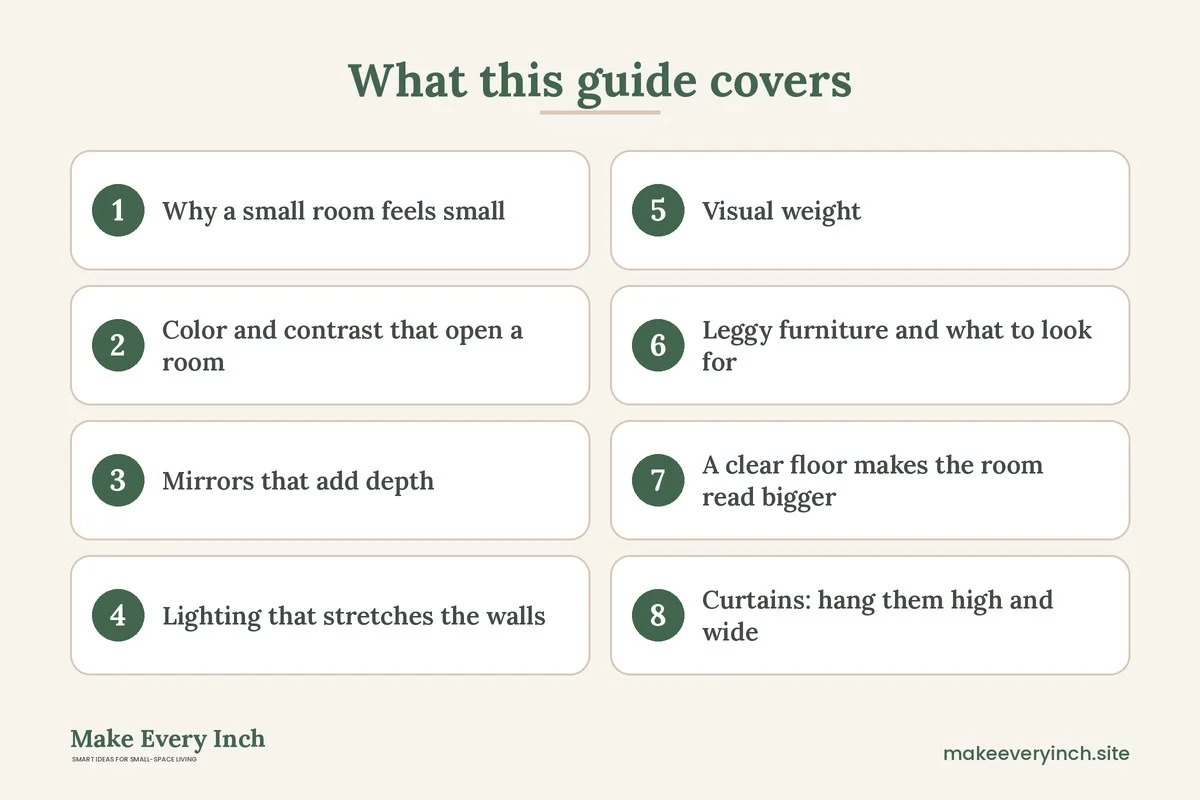
Why a small room feels small
Before changing anything, it helps to know what the eye is doing. People judge the size of a room from a handful of cues. The first is how far the eye can travel before it hits an obstacle. A bare wall, a long sightline and an open floor all read as roomy. A tall wardrobe near the door, a bulky dresser and stacked boxes all shorten the sightline. The second cue is contrast. When the walls, bed, curtains and rug are all different strong colors, the eye jumps from one edge to the next and the room breaks into small pieces. The third cue is the number of separate objects. Ten small items scattered around feel busier than three larger ones placed with care.
The fourth cue is light. A room lit only from one ceiling fixture has dark corners, and dark corners look like the walls are closer. The fifth is the height of the tallest lines. If the eye stops at the top of a low curtain or a low headboard, the ceiling appears to sit lower than it is.
This is good news, because all five cues can be changed without construction. Work through them in order, because color and clutter give the biggest change for the least effort, and the finishing touches such as mirrors and lamps work best once the foundation is calm.
Color and contrast that open a room
Keep the palette tight
A small bedroom looks larger when the walls, bedding and large furniture sit within a narrow range of tones. This does not mean everything must be white. It means the difference between the lightest and the darkest large surface should be modest. A soft warm white wall, an oatmeal duvet, a pale wood bed frame and a light rug read as one calm field. Add a single deeper accent, such as a charcoal throw or a navy cushion, and it works as a focal point instead of a barrier.
Light does not always mean white
Many people paint a small room stark white and find it feels cold or flat. Slightly warm whites, pale greige, soft sage and pale blue all reflect a good amount of light and feel gentler at night. Check a color in the room at morning, noon and evening before committing, because north-facing rooms pull colors cooler and south-facing rooms pull them warmer. Dark colors are not banned. A deep color on all four walls and the ceiling can make the corners disappear and give a cozy, cocoon effect, but it works best in a room with decent natural light and a very controlled amount of furniture. If your priority is a bigger feel, lighter is the safer route.
Paint the trim, doors and ceiling in close tones
Strong contrast between walls and trim draws a line around every edge and makes the room look boxed. Painting the trim and the door in the same color as the wall, or in a very close shade, makes the edges soften and the walls seem to continue. A ceiling one shade lighter than the walls lifts the eye upward. A tint of the wall color on the ceiling, instead of bright white, often feels softer and still reads as high.
Use a single color story for the large pieces
The bed, the dresser and the wardrobe are the largest objects in the room. If the dresser is dark brown, the bed frame is white and the wardrobe is black, the room splits into three blocks. Choosing one tone for the largest pieces, or painting or covering one to match the others, reduces the break-up. If you rent, a removable option such as peel-and-stick covering on a flat wardrobe door can help, and our guide to removable wallpaper ideas covers how to test it first.
Safety note: when you repaint, choose a low-VOC paint, open windows during and after painting and follow the label for drying time. Ask your landlord before painting any rental wall.
Mirrors that add depth
A mirror does not add square footage. It adds a second view. The trick is to place it so that the second view is worth seeing.
- Opposite or beside a window. A mirror that reflects the window doubles the daylight in the room and adds the sense of a second window. Placing it directly opposite can be glary on a very bright day, so a slight angle or a placement on the adjacent wall is gentler.
- Reflecting a lamp or a plant. Mirrors that show a lit lamp at night add a glow to the dark corner. Mirrors that show a bed with its clutter or a pile of laundry add nothing, so check what the mirror will show.
- Tall and leaning. A tall floor mirror leaned against a wall stretches the eye vertically, and the lean means no drilling. Anchor it with a wall strap or a safe bracket if it could tip, particularly with children or pets in the home.
- On a wardrobe door. A full-length mirror on a wardrobe door saves wall space and reflects the room. Check the weight limit of the door and hinges first.
- A cluster of small mirrors. In a narrow bedroom, a group of mirrors in similar frames scatters light, though one large mirror is usually calmer.
Avoid placing a mirror directly facing the bed if you find it unsettling when waking, since this is a personal comfort matter more than a rule. Also avoid mirrors that reflect a busy storage shelf, which doubles the visual noise.
Lighting that stretches the walls
Lighting is the most underrated tool in a small bedroom. A single overhead light at the center creates harsh shadows and leaves the corners dim. Layering light from three levels removes the shadows and pushes the walls outward.
Three layers
- Ambient: a ceiling fixture or a floor lamp bouncing light up to the ceiling. Choose a warm, dimmable option so the room can shift from bright in the morning to soft in the evening.
- Task: a reading light at the bed, either a wall-mounted swing arm or a small table lamp. Our guide to small bedroom lighting ideas goes deeper on fixtures and placement.
- Accent: a small lamp on the dresser, a plug-in strip behind the headboard or a lamp in a dark corner. These small pools of light define depth.
Washing the walls
Light that grazes a wall makes the wall look farther away. A floor lamp that points up at a corner, or a plug-in wall light that bounces upward, brightens the ceiling line and lifts the room. If you rent and cannot hardwire anything, our overview of renter-friendly lighting ideas shows plug-in solutions that leave no trace.
Color temperature and bulbs
A mix of cool and warm bulbs makes a room look patchy. Keep the bulbs in one family, usually warm white for a bedroom. Make sure each fixture is rated for the bulb you use, and never exceed the wattage printed on a lamp. Do not run cords under rugs or through high-traffic paths, and keep cords away from curtains and bedding.
If your room is also dim by nature, the ideas in our guide to dark apartment ideas can help you bring in more brightness.
Visual weight: what the eye sees as heavy
Visual weight is how heavy an object looks, which is not the same as how heavy it is. Dark, solid, tall and bulky objects have high visual weight. Light, transparent, low and slim objects have low visual weight. A small room can only hold so much heavy-looking furniture before it feels crowded.
Balance heavy and light
Start with the bed, the largest and heaviest item. A platform or a bed on visible legs weighs less than a box-style frame that sits to the floor. A slim headboard weighs less than a tall upholstered one. If the bed must be bulky, balance it with lighter pieces: a thin nightstand, an open shelf and a light curtain.
Spread weight around the room
If all the heavy pieces sit on one wall, the room feels tilted. Put the tall wardrobe on one side and a slim dresser or a low bench on the other. Hang art or a mirror on the lighter side to balance it. Avoid placing the heaviest item directly in view from the door, because it greets you like a wall.
Use negative space
Empty wall is not wasted. Leave some blank areas between furniture so the eye can rest. A wall with a single large artwork looks more spacious than a wall of ten small frames, a principle that works in any bedroom.
Leggy furniture and what to look for
Furniture raised on legs shows the floor beneath it, and visible floor reads as more space. This is among the easiest swaps for a small room.
- Bed frame: a frame with legs at least 8 to 10 inches tall lets light and the eye pass beneath. Under-bed storage still works if you use low boxes, and our guide to under-bed storage ideas explains how to keep it neat. If you want built-in storage instead, compare options in the best beds with storage.
- Nightstands: wall-mounted shelves, slim tables on thin legs or a stool with a tray all show more floor than a boxy cabinet. A floating shelf must be mounted into studs or with the right anchors, and ask permission before drilling in a rental.
- Dressers: a dresser on tapered legs looks lighter than one that sits flat. Tall and narrow can be better than wide and low in a short room. See the best small dressers for sizing ideas.
- Seating: a chair with an open back, thin arms and slim legs looks smaller than a chunky armchair. Or skip the chair and use a bench at the foot of the bed.
- Materials: glass, acrylic, metal frames, rattan and slatted wood let light and sight pass through. Solid dark slabs block it.
Leggy furniture does come with a trade-off. You lose the closed storage you would have on a base that sits to the floor. If storage matters more than airiness, keep one solid piece, such as a tall dresser, and make everything else leggy. The balance is the point. For more on choosing pieces, see our guide to small bedroom furniture ideas.
Safety note: always anchor tall furniture such as a wardrobe, bookshelf or tall dresser to the wall using the hardware that comes with it, especially in homes with children. Check with your landlord before drilling.
A clear floor makes the room read bigger
The floor is the largest surface in the room. The more of it you can see, the bigger the room feels. This is also the quickest, free change.
Get things off the floor
Shoes, bags, laundry baskets, workout gear and stacks of books are the usual culprits. Give each a home off the floor. Hooks on the back of the door, an over-door organizer, a slim shoe rack inside a closet or a wall shelf are all options. The ideas in our guide to small bedroom storage ideas and in vertical storage ideas show where to put things so they stay off the floor.
Choose the right rug
A rug that is too small looks like a postage stamp and breaks the floor into pieces. In a small bedroom, a rug large enough to sit under the lower two thirds of the bed, with 18 to 24 inches showing at the sides and foot, makes the floor look continuous. A light, low-contrast rug blends with the floor. A very busy pattern splits the floor into patches. Use a non-slip pad, and keep the edges flat to prevent trips.
Keep the path visible
Walk in from the door. If you can see a straight line of floor to the window or to the far wall, the room feels longer. Avoid putting a tall item right inside the door. If you do need a clear plan, our post on small bedroom layout ideas for better flow covers circulation in detail.
Curtains: hang them high and wide
Curtain placement changes the proportions of the whole wall, and it is one of the cheapest tricks.
- Height: mount the rod 4 to 6 inches below the ceiling, or even closer to the ceiling if the room allows. This draws the eye up and makes the window look taller. Hanging the rod just above the window frame makes the ceiling look lower.
- Width: extend the rod 8 to 12 inches beyond each side of the window, so the panels stack off the glass when open. This lets all the glass show and brings in more light, and it makes the window look wider.
- Length: let the curtains touch the floor or just skim it, about half an inch above. A hem hovering 4 inches off the floor shortens the wall. A little pooling is a style choice, but it can catch dust.
- Fabric: light, soft fabrics in a color close to the wall blend in. Sheer layers filter daylight. For privacy and sleep, add a lined panel or a blackout liner behind a sheer, and open the sheer in the day.
- Fullness: use panels with enough width, about 1.5 to 2 times the rod length, so they hang in soft folds rather than as flat strips.
If you cannot drill, a tension rod in a recess or an adhesive-hung track may fit, but check the weight limits and the surface. Heavy lined drapes need solid support.
Which trick gives the most for the effort
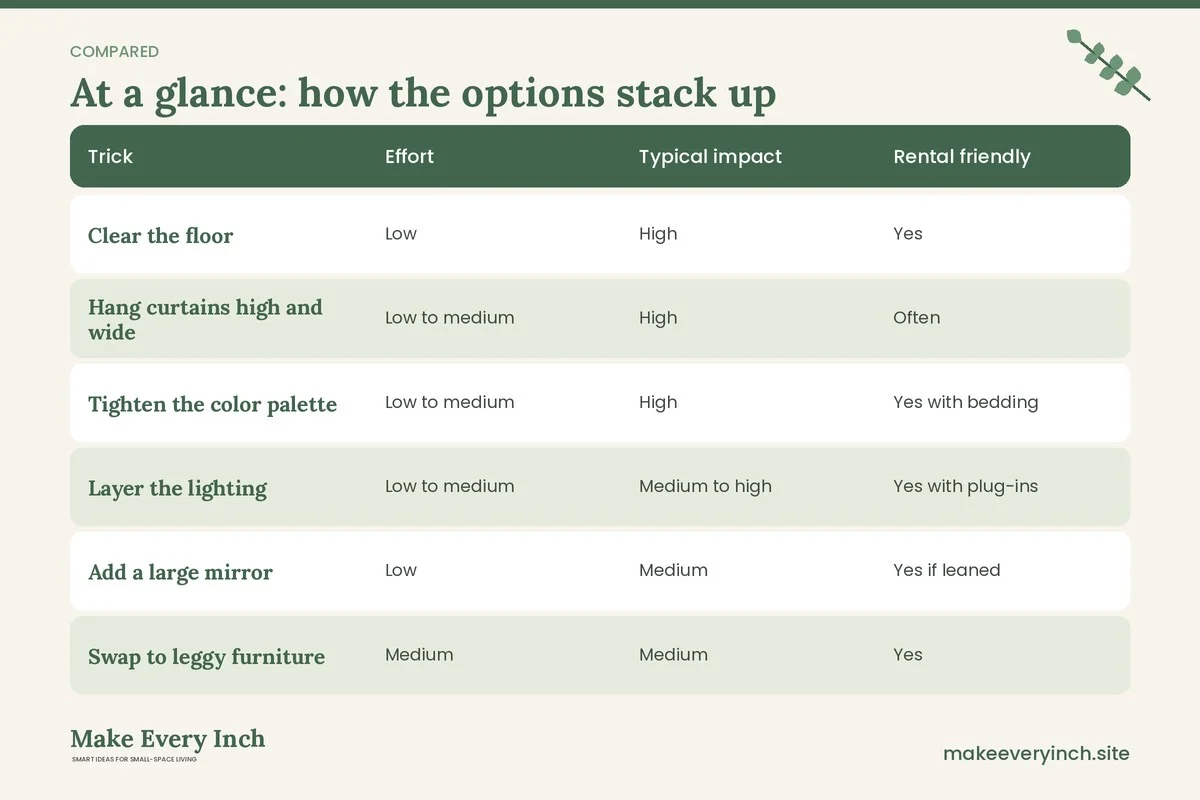
The table ranks each approach by effort and impact, with hedged ranges. Time and cost vary by home, so treat it as a guide.
| Trick | Effort | Typical impact | Rental friendly | Best for |
|---|---|---|---|---|
| Clear the floor | Low | High | Yes | Every small bedroom |
| Hang curtains high and wide | Low to medium | High | Often | Short ceilings, small windows |
| Tighten the color palette | Low to medium | High | Yes with bedding | Busy, mixed-color rooms |
| Layer the lighting | Low to medium | Medium to high | Yes with plug-ins | Dim or shadowy rooms |
| Add a large mirror | Low | Medium | Yes if leaned | Rooms with a window |
| Swap to leggy furniture | Medium | Medium | Yes | Heavy, boxy rooms |
| Paint walls, trim and ceiling | Medium to high | High | Needs permission | Owners, or approved rentals |
| Right-size the rug | Low to medium | Medium | Yes | Rooms with a small rug |
Three example rooms
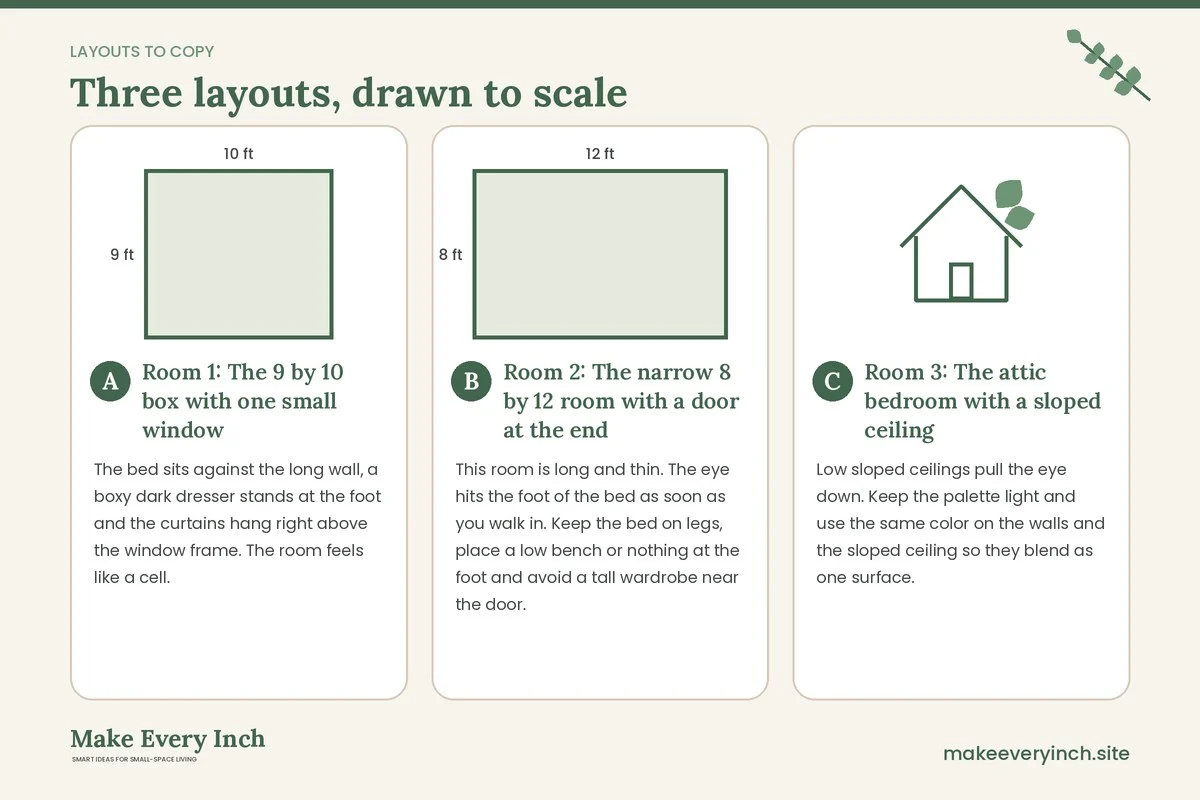
Room 1: The 9 by 10 box with one small window
The bed sits against the long wall, a boxy dark dresser stands at the foot and the curtains hang right above the window frame. The room feels like a cell. The fix starts with the curtains: raise the rod to about 5 inches below the ceiling, widen it past the frame and use a light, floor-length panel in a color near the wall. Swap the dark dresser for a lighter, leggy one, or paint the existing one to match the wall. Add a leaning floor mirror on the wall beside the window and a warm lamp on each side of the bed. Change the rug to one large enough to sit under the lower part of the bed. None of this changes the square footage, but the room looks wider, taller and brighter.
Room 2: The narrow 8 by 12 room with a door at the end
This room is long and thin. The eye hits the foot of the bed as soon as you walk in. Keep the bed on legs, place a low bench or nothing at the foot and avoid a tall wardrobe near the door. Put the tallest piece against the short wall at the far end to draw the eye through the room. Use a runner-style rug along one side if the bed leaves a path, or one rug sized to the bed. Mount a mirror on the long wall to widen the view and use a plug-in wall light above the bed instead of bedside tables, which frees floor space.
Room 3: The attic bedroom with a sloped ceiling
Low sloped ceilings pull the eye down. Keep the palette light and use the same color on the walls and the sloped ceiling so they blend as one surface. Place low furniture, such as the bed and a low dresser, under the slope and keep the tallest pieces where the ceiling is highest. Use a light fixture that grazes the slope rather than a hanging pendant that cuts into the headroom. Hang curtains as high as the slope allows. If the window is in a dormer, add a simple roman shade or a light curtain and keep the sill clear.
Common mistakes that shrink a room
- Painting only one wall dark in a room with no matching accent elsewhere, which can make the room look lopsided.
- Mounting curtains right at the window frame, which cuts the height and width of the wall.
- Choosing a rug that stops at the bed, leaving a thin edge of floor that looks like a gap.
- Using many small decor pieces instead of a few larger ones.
- Relying on one overhead light, which leaves the corners dim.
- Filling the space under the bed with visible clutter when the frame has legs. Use matching boxes or a valance if you want to hide it.
- Pushing every piece to the wall, which leaves a hollow center that feels empty. A little breathing space around key pieces looks intentional.
- Placing a mirror where it reflects a mess.
A weekend plan to make the room feel bigger
Saturday morning: clear and edit
Remove everything that does not belong on the floor, the bed or the surfaces. Make three piles: keep here, keep elsewhere and let go. Aim to see at least two thirds of the floor. Our guide to small bedroom organization ideas can help with the sorting.
Saturday afternoon: curtains and light
Raise the curtain rod, widen it and hang full-length panels. Move lamps so there are at least three light sources at different heights. Swap any cool and warm bulbs so they match.
Sunday: color, mirror and rug
Add or swap bedding in a calmer palette. Lean a mirror where it reflects the window or a lamp. Replace or reposition the rug. Step back at the end and view the room from the door, because that is the view that sets the first impression.
Checklist
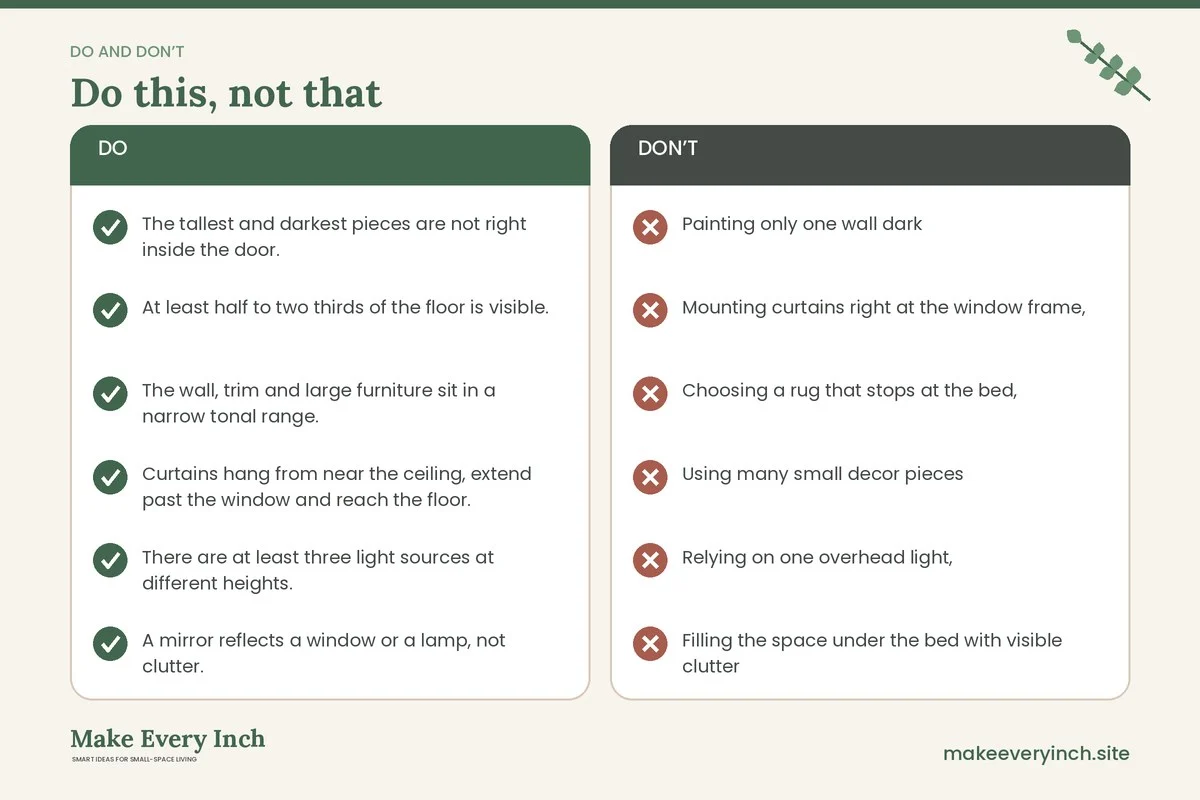
- The tallest and darkest pieces are not right inside the door.
- At least half to two thirds of the floor is visible.
- The wall, trim and large furniture sit in a narrow tonal range.
- Curtains hang from near the ceiling, extend past the window and reach the floor.
- There are at least three light sources at different heights.
- A mirror reflects a window or a lamp, not clutter.
- The bed and at least one other major piece sit on visible legs.
- The rug is large enough to sit under the bed’s lower part.
- Tall furniture is anchored to the wall.
- Electrical cords are tidy and away from beds and curtains.
- Any painting is done with low-VOC paint, good ventilation and landlord approval.
FAQ
Does painting a small bedroom white make it look bigger?
Light, warm tones usually reflect more light and help the room feel open, but white is not required. A pale greige or soft sage works as well. The close match between wall, trim and ceiling matters as much as the color itself.
Do mirrors really make a small bedroom look bigger?
A mirror reflects a second view, so it can add depth and brightness if placed to reflect a window or lamp. It cannot change the actual size, and it may add clutter if it faces a messy area.
How high should I hang curtains in a small bedroom?
Many designers suggest mounting the rod 4 to 6 inches below the ceiling and extending it 8 to 12 inches past each side of the window. This makes the window look larger and the ceiling higher. Adjust for your wall and rod type.
Is dark paint ever a good idea in a small bedroom?
It can be, especially if you want a cozy, enclosed feel. A deep color on walls, trim and ceiling can blur the corners. It works best with good light and little furniture. If you want the room to feel bigger, lighter tones are the safer choice.
What furniture makes a small bedroom feel bigger?
Pieces on visible legs, with slim profiles and open or light materials, show more floor and let light pass. Keep one or two solid pieces for storage and make the rest light.
What if I rent and cannot paint or drill?
Focus on bedding, curtains on a tension or existing rod, a leaned mirror, plug-in lights, a right-sized rug and a clear floor. Our guide to small bedroom ideas for renters covers more no-drill options.
How is this different from storage or layout advice?
Storage and layout change what you can fit and how you move. These tricks change how the room looks. For the first two, see small bedroom storage ideas and the main small bedroom layout ideas guide.
Keep going: Ready to keep going? Plan how you move through the room with small bedroom layout ideas for better flow, build more light into the space with small bedroom lighting ideas, or find a place for everything with small bedroom storage ideas.
Save this guide for later
Pin the ideas you like to Pinterest so you can come back to them when you plan your space.