15 Small Space Wallpaper Ideas That Do Not Overwhelm
Quick answer: For small space wallpaper that does not overwhelm, limit the pattern to one wall or one zone, choose a small to medium scale in soft contrast, keep the ceiling and trim light, and repeat one color from the paper elsewhere in the room. Test a sample on the wall in daylight and at night, confirm the lease allows it, and ventilate the room while paper and paste dry.
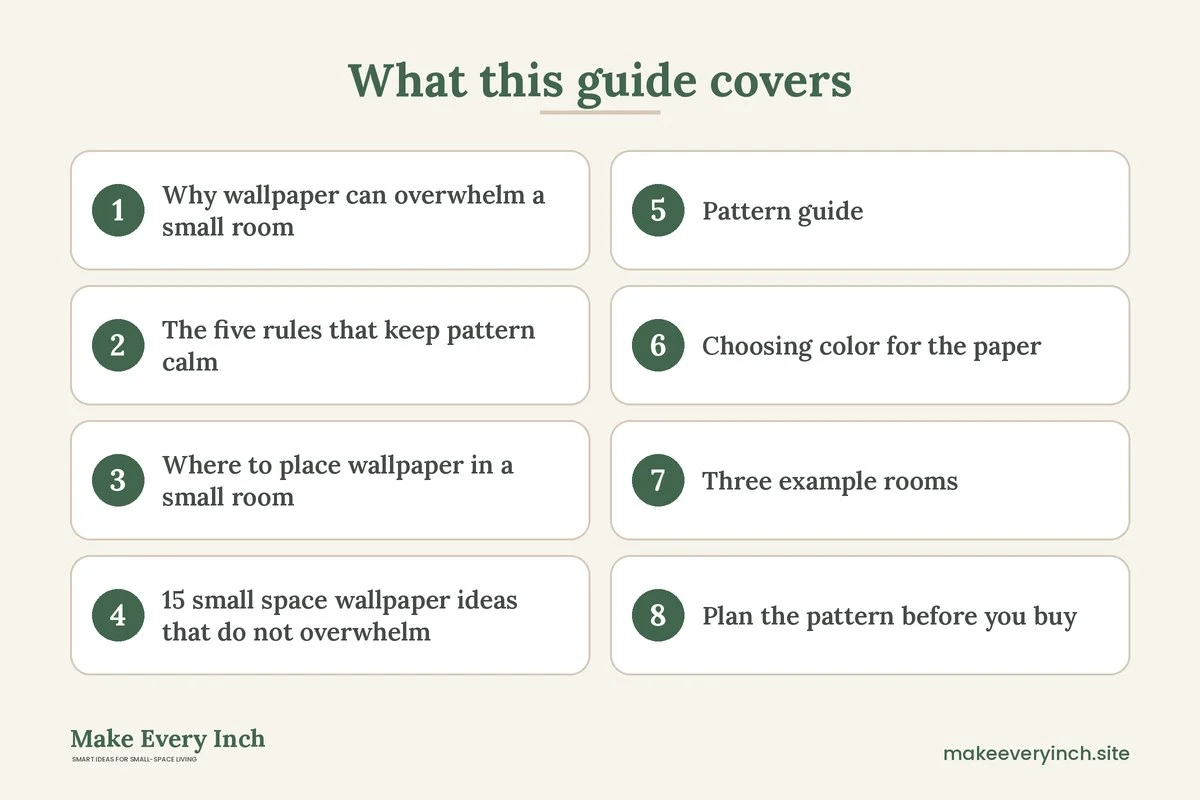
Small space wallpaper do not overwhelm is really a question of dosage. A little pattern in a tiny room adds depth, personality and a focal point, while too much pattern, too much contrast or the wrong scale can make four walls feel as if they are closing in. The goal is not to avoid wallpaper in a small room. The goal is to decide how much of it you need, where it should go and how loud it should be. This guide covers the rules of scale and contrast, a placement plan, 15 ideas that keep the effect calm, a comparison table, three example rooms, installation and safety notes, a checklist and a FAQ. For the wider approach to styling compact rooms, start with our pillar guide on small room decor ideas.
Why wallpaper can overwhelm a small room
A small room has less wall area, shorter sight lines and fewer places for the eye to rest. Wallpaper adds visual information to every surface it covers. When the paper is busy, dark or high in contrast, the eye has to process a lot of detail at close range, and the room can feel tighter than it measures. Three things drive that feeling.
The first is scale. A big, bold motif can look dramatic on a large wall, but in a room where you sit close to every wall the repeat may be larger than the space between your furniture. You see only a fragment of the design, and the pattern reads as noise instead of rhythm.
The second is contrast. A pattern with strong differences between background and motif, such as dark ink on a pale ground, demands more attention than a tone-on-tone design. Soft contrast lets the pattern behave like a texture.
The third is coverage. Wrapping all four walls, the ceiling and the trim in pattern leaves nowhere to rest. Restricting the paper to a single wall or a small zone gives the eye a clear focal point and a quiet counterweight.
None of this means a small room needs plain walls. Light, narrow rooms such as a hallway, an entryway, a powder room or a bedroom alcove often take pattern very well, because you pass through them or look at them in short bursts. The rules below help you decide what is right for yours.
The five rules that keep pattern calm
Rule 1: Choose a scale that suits your viewing distance
As a rough guide, small and medium repeats, roughly the size of a hand to a dinner plate, tend to sit calmly in compact rooms. Very large motifs can work on a single feature wall, but they need enough distance for the eye to take in a full repeat. Stand where you will normally sit or stand, and check that you can see the whole motif at a glance. If you can only see a leaf, the scale is probably too large for that wall.
Rule 2: Keep the contrast soft
Look for papers where the motif and background are close in value. Think of a warm white pattern on a light cream ground, or a pale sage on a soft gray. Soft contrast reads as texture, and texture is restful. If you love a high-contrast design, use it in a small, bounded space, such as the back of a bookcase, a niche or a single narrow wall.
Rule 3: Limit the coverage
A good starting point is one wall, usually the wall you see first when you enter or the wall behind the bed or sofa. In an especially small room, consider a half wall, a panel, an alcove or the inside of a closet. Leave the other walls in a calm, light color that picks up one shade from the paper.
Rule 4: Keep ceiling, trim and floors quiet
Light ceilings and trim help a papered wall read as a deliberate accent. A bold ceiling plus bold walls closes the room in. Keep the floor treatment simple, or use a rug in a plain or finely textured weave, so the wallpaper does the talking.
Rule 5: Repeat one color
Pick one color from the paper, and repeat it two or three times in the room, such as in a pillow, a lampshade or a framed print. This ties the wall to the rest of the room and prevents the paper from looking like an isolated patch.
Where to place wallpaper in a small room
Placement matters as much as pattern. These are the most reliable spots.
- The wall behind the bed. It frames the sleeping area and is behind you when you are in bed, so it is rarely too busy.
- The wall behind the sofa. It creates a backdrop, and the furniture in front breaks up the pattern.
- The entry wall. A short wall near the door gives a first impression without surrounding you.
- An alcove or a niche. A recess gives the pattern a natural frame.
- The back of open shelves. Papering the back panel adds depth and makes objects stand out.
- A powder room or a closet interior. These are small, short stays, so a bolder choice often feels fun instead of heavy.
- A hallway. A narrow corridor can take a vertical stripe or a delicate repeat if the lighting is bright enough.
- A slanted or low ceiling wall. In an attic bedroom, a subtle paper can soften an awkward angle. Keep it light so the slope does not feel lower.
Be careful about wallpapering a wall that holds the main window, because glare and contrast can make the pattern hard to look at. Avoid papering around many doors or built-in elements unless you have patience for lots of cuts.
15 small space wallpaper ideas that do not overwhelm
Soft patterns that behave like texture
1. A tone-on-tone botanical
A leaf or branch pattern in two close shades of the same color gives movement without noise. It suits bedrooms and living rooms.
2. A fine geometric
Small diamonds, tiny trellis lines or gentle grids work like linen. The repetition is regular and calming.
3. A subtle stripe
A narrow stripe with low contrast adds height when it runs vertically. Keep the stripes thin and the colors close.
4. A grasscloth look
Textured, woven-style paper adds warmth without a motif. It works well behind a bed or a sofa.
5. A watercolor wash
A soft gradient or cloudy wash gives color without a clear repeat. It can make a wall look deeper.
Controlled use of bolder designs
6. A feature wall behind the bed
One patterned wall, with the other three in a light neutral, is the classic way to keep pattern contained.
7. A half wall with a rail
Paper the lower half or upper half of a wall and finish with a rail or a painted edge. This reduces the amount of pattern by half and gives a tailored look.
8. A papered niche
Line a recess or the back of a bookcase with a bolder design. The frame makes it feel intentional.
9. A panel in a frame
Mount a section of paper in a frame or on a board and lean or hang it. This works for renters who cannot paper the wall, and it can be removed easily.
10. A bold design in a powder room
A small room with a short visit time can handle strong color. Light the room well, and keep the fixtures simple.
Removable and low-commitment options
11. Peel-and-stick on one wall
Removable paper is a common choice for rentals. Test a hidden spot, read the lease and see our guide to removable wallpaper ideas for the details.
12. Peel-and-stick on furniture backs
Line the back of a bookcase, the inside of a cabinet or a drawer. These areas are not part of the wall, so they carry no lease risk.
13. A headboard panel
Cover a board with paper and place it behind the bed. It looks like a papered wall and moves with you.
Using color and light to help
14. A pale ground with a pop of color
A cream or soft white background with a small colored motif reflects light and keeps the room open.
15. A reflective or metallic accent
A paper with a gentle sheen can bounce light, but keep the effect subtle, since a high-shine pattern can feel busy. Pair it with warm lighting.
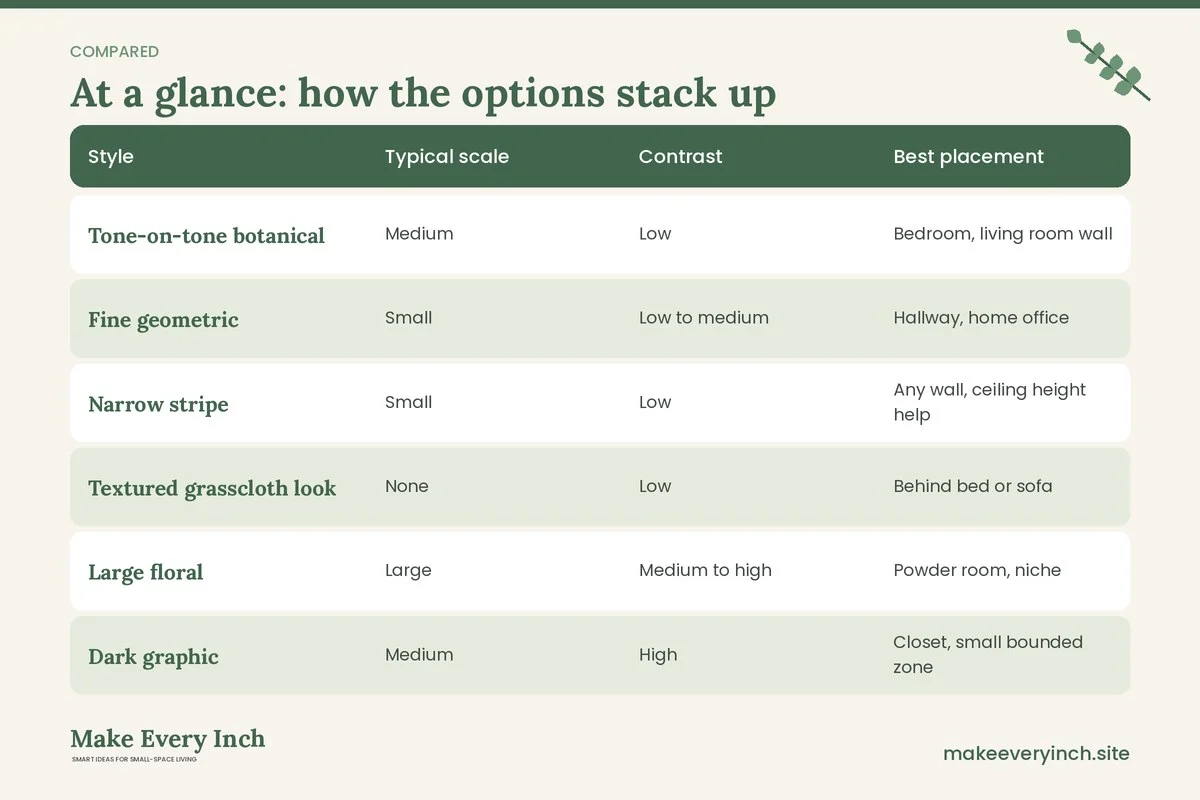
Pattern guide: scale, contrast and room type
Use this table to match a style to a space. The ratings are general and depend on light, furniture and personal taste.
| Style | Typical scale | Contrast | Best placement | Overwhelm risk |
|---|---|---|---|---|
| Tone-on-tone botanical | Medium | Low | Bedroom, living room wall | Low |
| Fine geometric | Small | Low to medium | Hallway, home office | Low |
| Narrow stripe | Small | Low | Any wall, ceiling height help | Low |
| Textured grasscloth look | None | Low | Behind bed or sofa | Very low |
| Large floral | Large | Medium to high | Powder room, niche | Medium to high |
| Dark graphic | Medium | High | Closet, small bounded zone | High if used widely |
| Metallic accent | Small to medium | Medium | One wall with soft lighting | Medium |
| Mural scene | Large | Varies | Single wall facing a seat | Medium |
Choosing color for the paper
Light colors reflect more light and generally keep a room open. Pale blues, soft greens, warm whites, creams and light grays are dependable. Warm tones such as blush or sand add comfort in a bedroom. Dark colors can work, but they tend to make walls recede in a way that feels cozy instead of large, so they suit rooms you use in the evening, like a bedroom or a den, and they need good lighting.
Think about the light in your room. A north-facing room gets cooler, steadier light, and cool papers can look flat there. Warmer papers tend to look better. A south-facing room gets warmer light and handles cooler colors. Look at your sample at several times of day, and under your evening lamps, because many patterns shift when the light changes. See our small bedroom ideas and studio apartment color schemes guides for more palette thinking.
Three example rooms
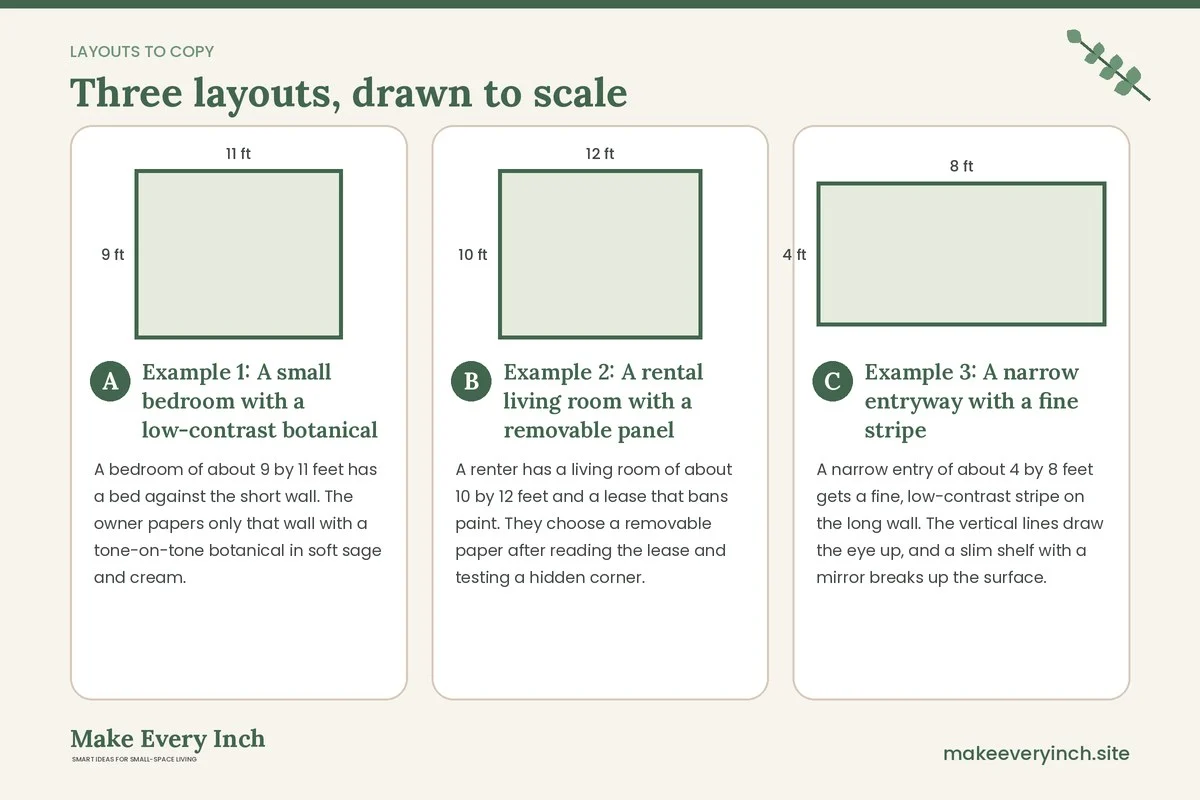
Example 1: A small bedroom with a low-contrast botanical
A bedroom of about 9 by 11 feet has a bed against the short wall. The owner papers only that wall with a tone-on-tone botanical in soft sage and cream. The other walls stay a warm white, and the bedding repeats the sage in a plain weave. A pair of small lamps flank the bed. The wall behind the bed becomes the focal point, and the rest of the room stays calm. Because the pattern sits behind the headboard, it is not in your direct view when you lie down.
Example 2: A rental living room with a removable panel
A renter has a living room of about 10 by 12 feet and a lease that bans paint. They choose a removable paper after reading the lease and testing a hidden corner. They cover only the wall behind the sofa, from the baseboard to the ceiling, and leave the rest of the room white. A floor lamp and a plant sit in front of the pattern to break it up. On move-out day the strips peel away slowly, which is why the first test matters. For more renter ideas, see renter-friendly wall decor ideas.
Example 3: A narrow entryway with a fine stripe
A narrow entry of about 4 by 8 feet gets a fine, low-contrast stripe on the long wall. The vertical lines draw the eye up, and a slim shelf with a mirror breaks up the surface. A brighter bulb in the ceiling fixture, within the fixture’s labeled wattage, keeps the corridor from feeling dim. The effect is a tidy, welcoming space instead of a busy tunnel.
Plan the pattern before you buy
Start with a sample. Many suppliers sell small samples or sheets, and you can tape them to the wall. Leave them for a few days. Look at the sample in morning light, in afternoon light and under lamps. Step back to the distance you will normally see the wall from, and ask whether the pattern feels calm or busy. A pattern that looks wonderful in a catalog can look very different in your actual room.
Next, measure the wall. Measure the width and height, and note any windows, doors and outlets. Wallpaper is sold in rolls with a stated coverage, and patterns with a large repeat usually need extra length for matching. Check the roll’s stated width, repeat and match type, and calculate how many rolls you need with a margin for waste. If you are unsure, ask the supplier or a professional.
Also decide how you will handle outlets and switches. Always turn off the power at the breaker before removing a cover plate to paper around it, and make sure the paper does not cover the opening of the box or touch any live parts. If you are not comfortable working near electrical fixtures, ask a qualified person to help.
Installation, lease and safety notes
Check the lease first
Many leases forbid painting, wallpaper or adhesives without written permission. Even removable products can pull paint off if the wall is not in good condition. Ask your landlord in writing, keep the reply, and photograph the wall before you start. If permission is not given, use a freestanding option, such as a framed panel, a papered headboard board or a papered shelf back.
Prepare the wall
Clean the wall, repair small holes with filler, let it dry and sand lightly if needed. Glossy or freshly painted walls may need a waiting period before paper sticks, so follow the product’s instructions. Never apply paper to a damp wall, because moisture can cause bubbles, mold and peeling.
Ventilate and dry
Pastes, primers and adhesives can release fumes. Open windows, run a fan if you can, and take breaks. Look for low-VOC products, and follow the label directions. Keep children, pets and anyone with breathing sensitivities out of the room while the materials cure. If you are working in a bathroom, make sure the room is well ventilated, since constant steam can lift paper.
Be careful with tools
Use a sharp blade with care. Cut away from your body, change blades often and work on a stable surface. Use a stable step stool or ladder rated for your weight, and do not overreach.
Heat and lighting
Keep wallpaper away from direct heat. Do not hang paper directly behind a radiator or heater without checking the product’s guidance. Use lamps and bulbs within their labeled wattage, and keep bulbs a safe distance from paper, since heat from a hot bulb can discolor or damage paper over time. LED bulbs generally run cooler than older types, but always follow the fixture’s rating.
Hanging things on papered walls
Mirrors, shelves and heavy art need proper anchoring into studs or rated wall anchors, and the weight depends on the wall type. Never drill without permission if you rent. If you want to hang art on a papered wall, use rated hooks and check the weight limits, and be aware that adhesive hooks on some papers can tear the surface when removed. For lighter items, leaning frames on a shelf or console avoids the problem. Our guide to renter-friendly lighting ideas shows how to light a wall without hardwiring anything.
Cords and plug-in lights
Do not run cords under rugs or across walkways, and do not staple or nail cords to a papered wall. Do not overload sockets or power strips, and follow the labeled limits.
Mistakes to avoid
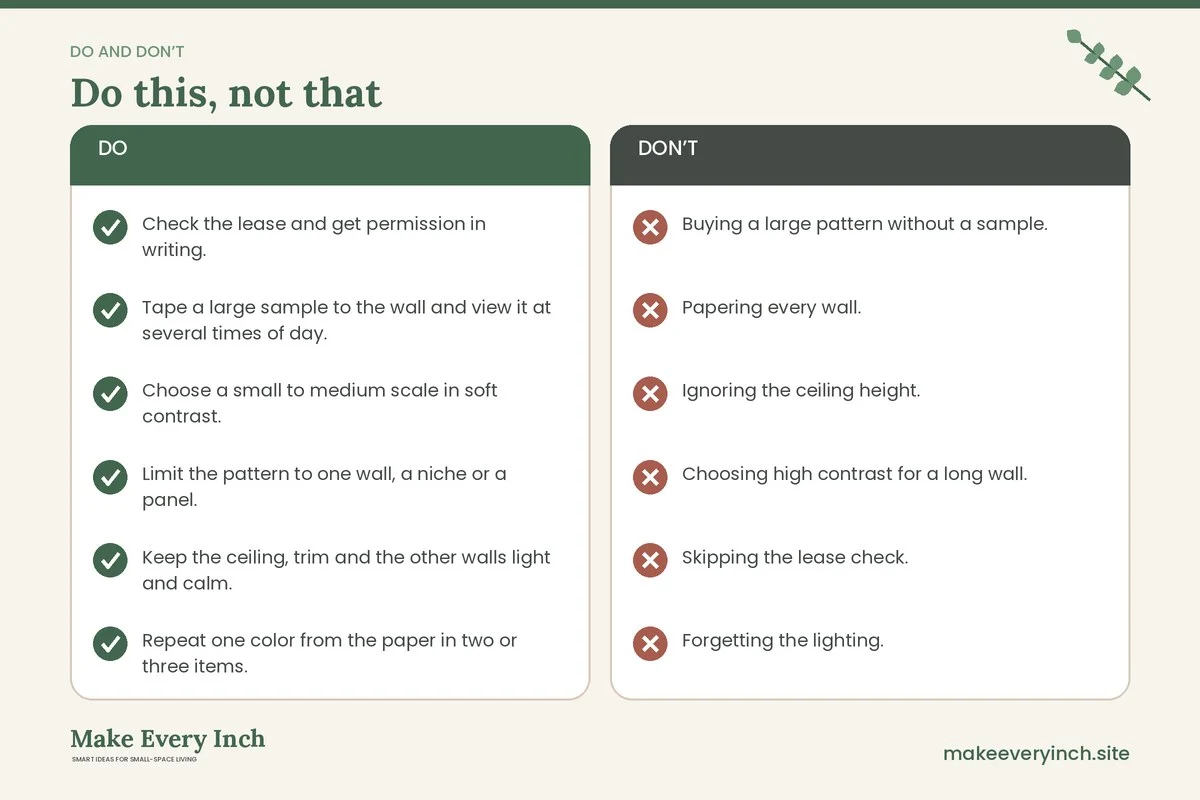
- Buying a large pattern without a sample. A small swatch can mislead, so tape a larger piece up.
- Papering every wall. Four patterned walls leave no rest for the eye.
- Ignoring the ceiling height. A busy pattern on a low ceiling can feel heavy.
- Choosing high contrast for a long wall. A strong pattern across a long wall can feel like a wall of noise.
- Skipping the lease check. Even peel-and-stick can cause damage.
- Forgetting the lighting. Dark or dim lighting makes patterned walls feel closed in.
- Not repeating the color. Without a tie-in, the paper feels isolated.
- Using paper in a steamy bathroom without ventilation. Moisture can lift edges and cause mold.
How to balance wallpaper with the rest of the room
Think of the paper as one voice in a conversation. Everything else should speak at a lower volume.
Keep the furniture simple. A plain sofa or bed against a patterned wall stands out, while a heavily patterned sofa will compete. Use solid or lightly textured textiles and pick up one color from the paper.
Use one or two mirrors or pieces of art, not a dense gallery. A patterned wall already carries visual weight, and adding a large cluster of frames could be too much. If you want a gallery, pick a nearby plain wall.
Pay attention to light. A lamp near the papered wall washes the surface and makes the pattern glow. Dimmable, warm bulbs can reduce harsh contrast. For more on lighting a small room, read our companion guide on small room lighting corner plans.
Mind the proportions. If you have a low ceiling, choose vertical stripes or a light design. If the room is narrow, put the paper on a short end wall to make the room seem wider. If the room is square, a single feature wall adds direction.
Quick decision guide
- If you are nervous, start with an alcove, a shelf back or a framed panel.
- If you rent, choose removable paper only with written permission, or use freestanding options.
- If the room is dark, choose a pale ground and add bright, warm lighting.
- If the room is bright, you can try a medium-contrast pattern.
- If the room is tiny, choose a small scale and soft contrast.
- If the room is a short-visit space like a powder room, you can go bolder.
Checklist: small space wallpaper without the overwhelm
- Check the lease and get permission in writing.
- Tape a large sample to the wall and view it at several times of day.
- Choose a small to medium scale in soft contrast.
- Limit the pattern to one wall, a niche or a panel.
- Keep the ceiling, trim and the other walls light and calm.
- Repeat one color from the paper in two or three items.
- Turn off power before working near outlets and switches.
- Prepare the wall: clean, dry and repaired.
- Ventilate the room and choose low-VOC adhesives where available.
- Use a stable step stool and a sharp blade with care.
- Anchor heavy items properly and never drill without permission.
- Keep cords tidy and sockets within their labeled limits.
- Keep hot bulbs at a safe distance from the paper.
- Photograph the finished wall for your records.
FAQ
Can you use wallpaper in a very small room?
Yes. Small rooms often suit wallpaper well, as long as you choose the scale, contrast and coverage with care. One wall or a niche is usually enough.
What size pattern is best for a small room?
Small to medium repeats usually look calm up close. Large motifs can work on one wall if there is enough distance to see the whole design.
Does a dark wallpaper make a small room feel smaller?
Not always. Dark paper can make walls recede and create a cozy mood, but it needs good lighting and works best in rooms used in the evening. If you want an open feeling, pale colors are safer.
Will vertical stripes make my ceiling look higher?
They can create that impression, especially when the stripes are narrow and the contrast is soft. Results depend on the room and the light.
Can renters use wallpaper?
Only with the landlord’s permission, and removable products can still affect paint on removal. If permission is not given, try a framed panel or a papered shelf back instead.
How do I stop a patterned wall from feeling busy?
Keep the other walls plain, repeat one color from the paper, use simple furniture and avoid crowding the wall with art.
Is wallpaper safe in a bathroom?
Only if the room is well ventilated and the product is rated for humid spaces. Steam can lift edges and cause mold, so check the label and use an extractor fan or open a window.
What should I do about outlets and switches?
Turn off the power at the breaker before removing any cover plate, keep paper away from live parts and ask a qualified person if you are unsure.
Keep going: Keep planning with our small room decor ideas, small bedroom ideas and small living room ideas.
Save this guide for later
Pin the ideas you like to Pinterest so you can come back to them when you plan your space.