Small Home Ideas for Pet Owners: 12 Whole-Home Tips for Pets
Quick answer: Small home pet owners get the best results by planning the whole home, not one room at a time. Give each pet a feeding spot, a resting spot and a toilet or exit route that sit away from the main walkway, keep paths between rooms clear (roughly 30 to 36 inches where you can), anchor tall furniture, keep cords and toxic plants out of reach, and check your lease before adding gates or fixtures.
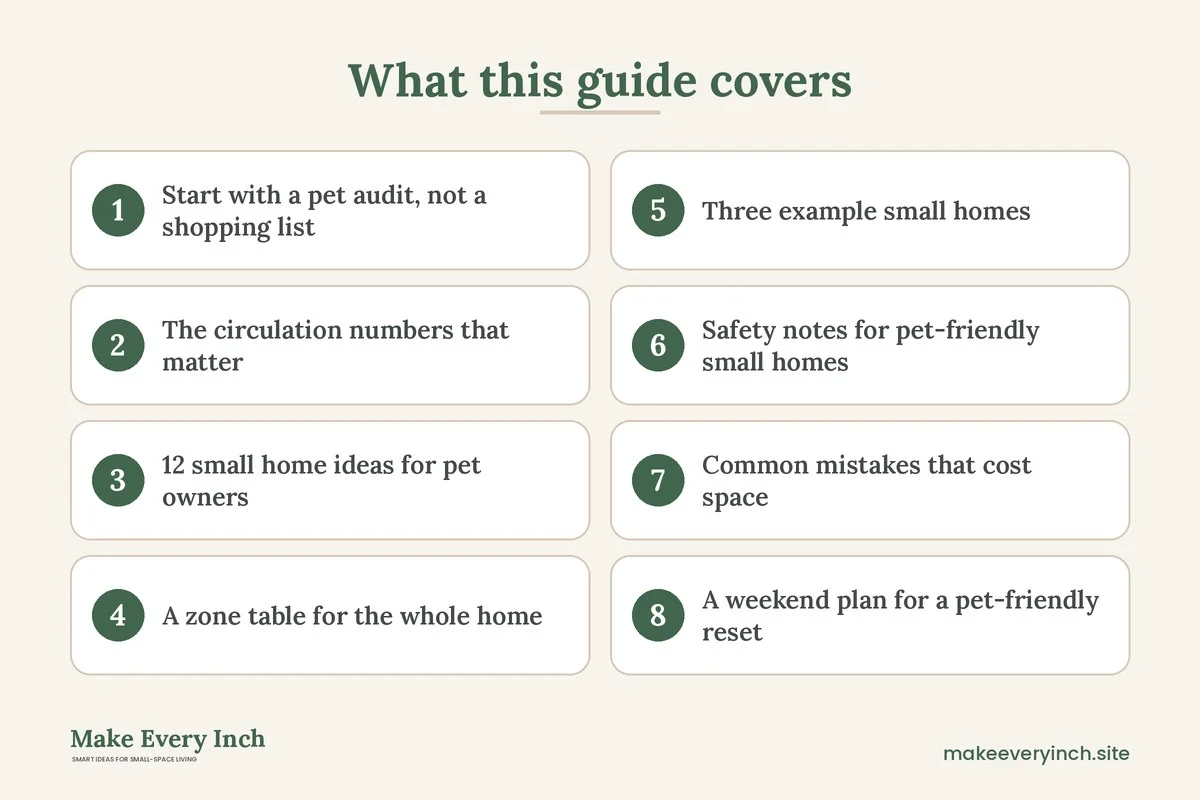
Small home pet owners face a particular puzzle. The same few hundred square feet must work for people who cook, sleep, work and host, and for animals who eat, nap, play, scratch and need a place to go to the toilet. When everything is crowded into one room, the result is tripped feet, scattered bowls, hair on the sofa and a pet who never quite settles. This guide takes a whole-home view. Instead of buying a pet bed for the living room and a bowl for the kitchen, you will look at how the animal moves through the home, where it likes to rest, which sightlines calm it, and how its things can live in the same storage system as everyone else’s. It covers a pet audit, the circulation numbers, 12 ideas, a zone table, three example homes, safety notes, a checklist and a FAQ. For the bigger picture, start with our pillar guide to small home ideas, and for the surrounding rooms see small living room ideas and small space organization ideas.
Start with a pet audit, not a shopping list
Spend three or four days watching what your animal really does. Note where it sleeps in the morning, where it waits when you cook, which window it watches, where it hides when the doorbell rings, and which route it takes from bed to bowl to door. Write the answers on a rough floor plan. A cat often picks a high perch with a view and a quiet corner away from foot traffic. A dog often wants to be near you but out of the main path, with a clear view of the entry door.
Then list the objects that go with the animal. Most small homes need to find a place for bowls and a mat, food storage, a litter tray or a leash and waste bags, a bed or two, toys, a brush and grooming gear, a carrier or crate, and cleaning supplies. Count them honestly. A surprising number of small homes hold more pet gear than kitchen gear. Once you know the list, you can assign each item a home near where it is used, rather than parking it all in one closet.
Finally, note what the pet cannot be near. That list usually includes the stove, open balcony doors, dangling cords, medicine, cleaning products, chocolate and other human food, and certain houseplants. Safety comes first in a small home because there is less room to keep risky things apart, so build this list before you build the layout.
The circulation numbers that matter
Whole-home planning is mostly about paths. The numbers below are general guides, and the right figure depends on your animal’s size and your own mobility, so treat them as starting ranges and adjust.
- Main walkways: roughly 30 to 36 inches wide wherever people and a pet pass each other. A large dog may need more, and a small cat much less.
- Beside the bed: about 24 to 30 inches on at least one side so a person and a dog can both step out without a collision.
- In front of the door: an open floor area of roughly 36 inches square so people can remove shoes and leash a dog without tripping over a bowl.
- Feeding station: a floor mat about 18 by 24 inches is typical for one or two bowls, and it should sit outside the main path and away from the stove.
- Litter area: a spot with a clear approach of about 18 to 24 inches in front, ventilation nearby and a door or screen that keeps the area from dominating the room.
- Cat route: a continuous run of surfaces at about 12 to 18 inch steps between levels, if you build a vertical path.
- Sightline to the door: a dog often relaxes when it can see the entry from its bed, so aim for a clear view without placing the bed in the doorway.
Mark each of these with painter’s tape on the floor and live with it for a day. If you trip, bump or step over something three times, move it.
12 small home ideas for pet owners
Plan the pet zones
1. A feeding corner outside the traffic lane
Choose a wall segment that is not between the fridge and the sink, the sofa and the door, or the bed and the bathroom. A corner of the kitchen or a bit of floor beside a cabinet works. Put a washable mat under the bowls, and use a wall-side placement so a person does not step into the bowls while carrying a hot pan. Keep it away from the stove for both safety and hygiene.
2. One main rest spot with a view
Pick a place where the pet can see the room’s main activity but is not in the way. For dogs this might be a bed beside the sofa or at the end of a hallway with a view of the front door. For cats it might be a window seat or a shelf. A rest spot that sits within sight of the family usually feels more secure than one hidden in a bedroom, and it keeps the pet from lying across a doorway.
3. A second, quieter retreat
Animals need somewhere to go when guests arrive or the vacuum comes out. A crate with a cover, a bed under a console table or a corner behind the sofa can serve. Keep it away from the main path, and make sure the pet can come and go freely. If a crate has a door, never leave it closed for long stretches, and never place it where the pet cannot breathe easily.
4. A litter zone with ventilation
For cat owners, the litter area is the hardest part of a small home. Look at rooms that already have ventilation, such as a bathroom with a fan or a hall closet with a vent in the door. If you use a cabinet to hide the tray, make sure the cat can enter and exit easily, cut or buy ventilation openings, and keep it clean often. Avoid placing the tray beside the feeding area or next to the washing machine, where noise can scare the cat. Never put a litter tray where it blocks an exit route.
Make circulation pet-friendly
5. Keep the entry flat and clear
The doorway is the most dangerous area of a small home for escape and for tripping. Leave a clear square of floor, install a hook for the leash at a height you can reach easily, and keep a washable mat for paws. If you use a gate or a screen to keep a pet away from the door, make sure it never blocks the way out for people, and that it can be opened quickly in an emergency.
6. Soft-edge the corners
Pets tend to run corners tightly. Rounded furniture, low-profile ottomans and rugs with non-slip backing lessen the number of bumps and slides. A rug that slips on a hard floor is a hazard for both older dogs and quick turns, so use a pad or a backing designed for the floor type.
7. Use vertical routes for cats
A series of wall shelves, a tall cat tree or a window perch can double a cat’s usable space without taking floor area. If you add anything to a wall, check your lease and never drill without permission, and use freestanding towers if you rent. Anchor tall units to the wall or to a stable base so they cannot tip when a cat jumps. Leave the top of any tower a safe distance from ceiling fans, lights and window blinds.
Store pet things with the rest of the home
8. One pet station instead of scattered baskets
Pick a drawer, a basket or a section of a closet near the entry and keep the leash, bags, towel, brush and treats together. In a studio, a narrow cabinet near the door can hold all of them. Put a lid on food storage to keep pests away and to block the animal’s access. See our guide to small home drop zone ideas for ways to fold pet items into the same system as keys and bags.
9. Furniture that hides pet gear
Storage benches, ottomans and consoles with doors can hold toys and blankets, and a cabinet with a built-in cat door can hide a litter tray. Look at best storage ottomans for ideas that double as seating. Keep a basket low enough for a dog to drop a toy into, and you may find tidying becomes part of play.
10. Wash-friendly textiles everywhere
Choose throws, rugs and covers that go through the washing machine, and keep two sets of pet bedding so one can be washed while the other is in use. Tight-weave fabrics usually shed hair more easily than loose weaves. A washable rug in the busiest zones, rather than wall-to-wall coverage, makes cleaning faster in a small home.
Protect the home and the animal
11. Hide and cover every cord
Chewing cords is a risk for pets, and it is a fire and shock risk for the home. Use cord covers, cable boxes or furniture placed to block access, and unplug devices that are not in use. Do not run cords under rugs, where heat can build up. For ways to tidy cables, see renter-friendly ways to hide cords.
12. Pet-proof the plants, windows and balcony
Many common houseplants are toxic to cats and dogs, so check each one with a reliable pet-safety list from a veterinarian before bringing it home. Keep window screens secure, since a screen is not a barrier against a determined jump or fall, and never leave a pet unsupervised on a balcony. For an outdoor perspective, read our guide on small balcony ideas for pet owners.
A zone table for the whole home
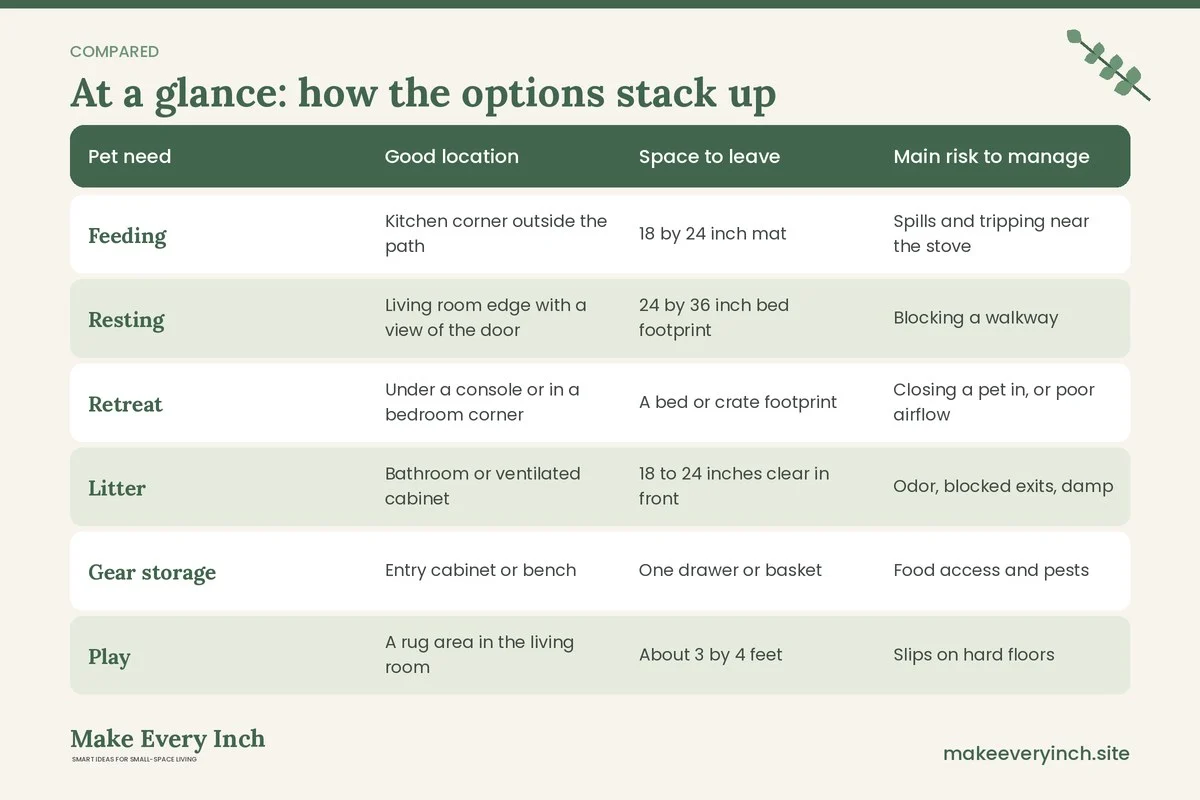
Use the table below as a planning worksheet. It lists each pet need, a good location, the floor space to leave around it, and the main risk to manage. The numbers are rough ranges, so adjust them for the size of your animal.
| Pet need | Good location | Space to leave | Main risk to manage |
|---|---|---|---|
| Feeding | Kitchen corner outside the path | 18 by 24 inch mat | Spills and tripping near the stove |
| Resting | Living room edge with a view of the door | 24 by 36 inch bed footprint | Blocking a walkway |
| Retreat | Under a console or in a bedroom corner | A bed or crate footprint | Closing a pet in, or poor airflow |
| Litter | Bathroom or ventilated cabinet | 18 to 24 inches clear in front | Odor, blocked exits, damp |
| Gear storage | Entry cabinet or bench | One drawer or basket | Food access and pests |
| Play | A rug area in the living room | About 3 by 4 feet | Slips on hard floors |
| Perching | Window shelf or cat tree | A stable base, anchored | Tipping and window falls |
| Grooming | Near a sink or tub | Standing room for one person | Slippery floors and hair in drains |
Three example small homes
A one-bedroom with a medium dog
Imagine a one-bedroom of roughly 550 square feet, with a medium dog who follows its owner from room to room. The entry has about 36 inches of clear floor, with a hook for the leash and a bench with storage for bags and a towel. The dog bed sits at the end of the sofa, with a view of the front door and a rug under it. The feeding mat sits on the wall beside the end of the kitchen counter, away from the stove. At night the dog sleeps beside the bed, where there are about 28 inches of floor on that side. The result is that the dog has three predictable stations, and the human paths between bedroom, bathroom and kitchen stay open.
A studio with two cats
Now picture a studio of roughly 420 square feet with two cats. The litter tray lives in a ventilated cabinet in the bathroom, and the room has an extractor fan. A tall cat tree stands beside the window, anchored to a stable base, and a row of floating shelves is replaced by a freestanding shelving unit if the lease forbids drilling. The feeding mat sits under a narrow table by the kitchen. A sofa with washable covers sits on a rug, and a basket of toys stays beside the sofa. Because there is no separate bedroom, a folding screen separates the bed from the cat area at night, so the owner can sleep without a cat in the face. This layout works because the cats have vertical space, and the floor stays free for people.
A two-bedroom with a dog, a cat and a toddler
A third scenario is a small two-bedroom of about 850 square feet with a dog, a cat and a toddler. Safety drives the plan. The cat’s litter and food are in the second bedroom closet, which is a spot the toddler cannot reach, behind a door with a cat flap or a gate that lets the cat through. The dog bowls are on the kitchen floor, but the dog’s water is on a mat that is wiped often. Toys are sorted into two baskets, one for the toddler and one for the pets, so small pieces stay away from the animals and chew toys stay away from the child. All the tall furniture is anchored. The entry is wide enough for a stroller, a leash and shoes, and a gate across a hallway keeps the toddler from the litter. In an emergency, every gate opens quickly, and no door is blocked.
Safety notes for pet-friendly small homes
- Exits stay clear. Gates, crates and furniture should never block a door, a window or an escape route. Keep a clear path from every bed to an exit, and make sure everyone in the home knows how to open each gate quickly.
- Anchor tall furniture. Bookcases, cat trees and tall cabinets should be anchored to the wall or to a base. A jump from a cat or a lean from a dog can tip an unsecured unit. If you rent, use anchoring methods your landlord allows and never drill without permission.
- Electrical load. Do not overload outlets with heating pads, water fountains, air purifiers and chargers. Use a power strip with a built-in protection feature, keep cords out of reach, and unplug items that heat up when you are away.
- Ventilation and paint. If you repaint or refresh a room, choose low-VOC paint and ventilate well before the animal returns. Keep litter areas ventilated, and avoid strong air fresheners and scented sprays near pets with sensitive airways.
- Load-bearing walls. If a layout feels tight, do not remove or alter a wall without a qualified professional and the right permits. You can often win space with furniture, not demolition.
- Lease and pet rules. Check pet policies, gate rules and hardware restrictions before you install anything. Put permission in writing.
- Children and pets together. Never leave a young child alone with an animal, and keep food, medication and small toys out of reach of both.
- Cleaning products. Store them in a cabinet with a latch that pets and children cannot open, and rinse floors well after cleaning.
Common mistakes that cost space
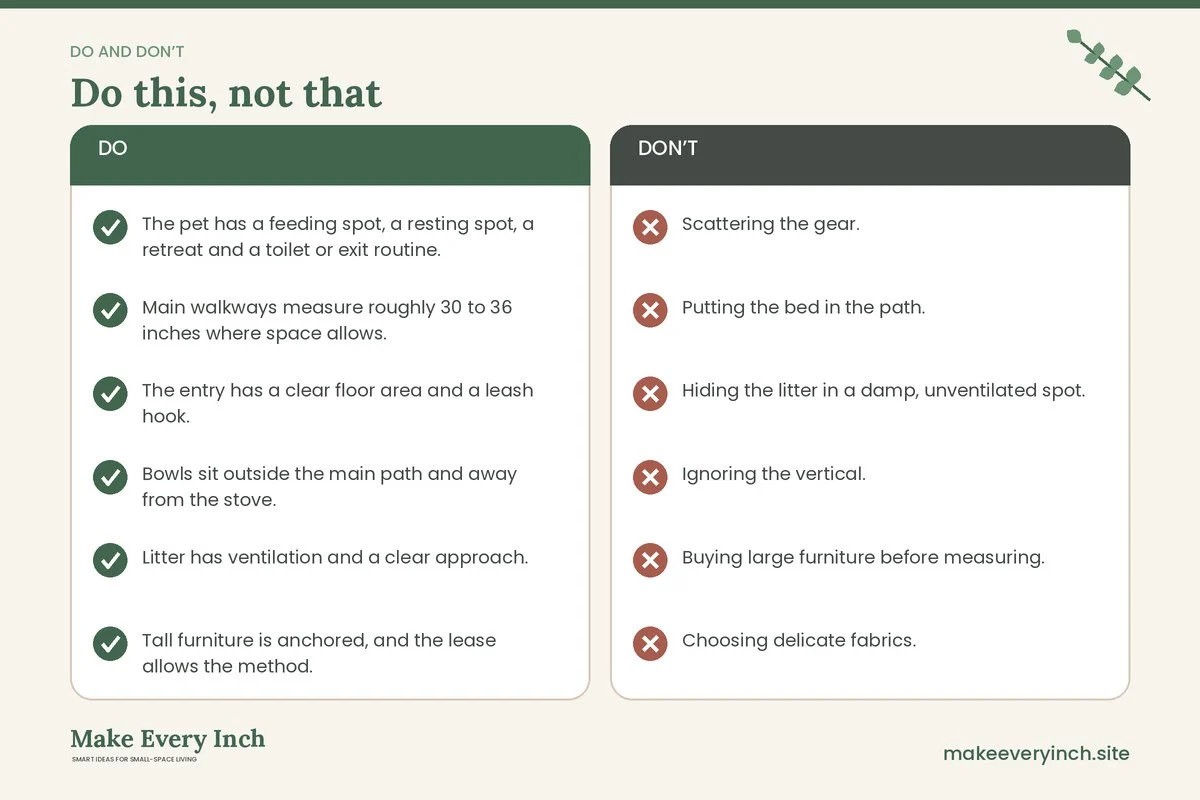
- Scattering the gear. When bowls, toys, brushes and bags live in four places, they end up on the floor. Pull them into one or two stations.
- Putting the bed in the path. A pet bed at the edge of a walkway becomes an obstacle. Move it half a foot back and see how traffic changes.
- Hiding the litter in a damp, unventilated spot. A cabinet with no airflow holds odors and moisture.
- Ignoring the vertical. Cats in particular use height. A shelf or a tree can free up floor space.
- Buying large furniture before measuring. A big dog bed or a bulky cat tree can swallow a room. Measure first and tape the footprint.
- Choosing delicate fabrics. Loose weaves and light colors show claw marks and hair quickly. Pick tighter weaves and washable covers.
A weekend plan for a pet-friendly reset
- Friday evening: do the pet audit, sketch the floor plan and list the pet gear.
- Saturday morning: tape out the zones and the walkways. Move furniture to open the main paths. Decide the feeding, resting and gear stations.
- Saturday afternoon: clean and relocate the litter or the waste routine. Set up the entry station. Cover cords and secure tall furniture.
- Sunday: wash bedding and rugs, check plants against a pet-safety list, test the gates and the exits, and live in the layout for a day. Adjust anything that causes a trip or a bump.
Checklist
- The pet has a feeding spot, a resting spot, a retreat and a toilet or exit routine.
- Main walkways measure roughly 30 to 36 inches where space allows.
- The entry has a clear floor area and a leash hook.
- Bowls sit outside the main path and away from the stove.
- Litter has ventilation and a clear approach.
- Tall furniture is anchored, and the lease allows the method.
- Cords are covered, and outlets are not overloaded.
- Toxic plants, cleaning supplies and medicines are out of reach.
- Gates and crates never block an exit.
- Textiles can be washed, and there are spare sets.
- Pet gear has a home next to where it is used.
- Paint and finishes are low-VOC, and the room is ventilated.
FAQ
How much space does a pet need in a small home?
There is no single number, because it depends on the animal. A common approach is to give a pet a resting spot sized to its body, a feeding mat of roughly 18 by 24 inches and an open floor area of a few square feet for play. Cats can use vertical space to make up for a small floor, while dogs generally need clear floor and daily exercise outside the home.
Where should I put a litter tray in a studio?
Look for a ventilated spot away from where you eat and sleep and away from the feeding area. A bathroom with a fan is a common choice. Keep a clear approach, clean the tray often, and never place it where it blocks an exit.
Can I use baby gates in a rental?
Pressure-mounted gates avoid drilling, but check your lease and the wall surface. Make sure they open easily, do not block an exit and are not used for climbing. Ask for permission in writing if you want a hardware-mounted gate.
How do I keep pet hair under control in a small home?
Use washable covers and throws, choose a tight-weave fabric, keep a brush and a handheld vacuum in the pet station, and give the pet a bed that you can launder. Brushing the animal regularly reduces hair on the furniture.
What is the safest way to add a cat tree?
Choose a stable unit with a wide base, place it away from fans and blinds, and anchor it where the lease allows. Check it regularly for loose parts, and replace it if it wobbles.
Do I need a separate room for the pet?
Usually not. A small home works well when the animal has predictable stations in shared rooms, a quiet retreat and a safe path to the door. A separate room can help for a particular situation, such as a nervous animal or a new puppy, but it is not required.
Keep going: Keep planning with our pillar guide to small home ideas, our small space organization ideas and our best furniture for small apartments.
Save this guide for later
Pin the ideas you like to Pinterest so you can come back to them when you plan your space.