How to Create Privacy in a Small Home Where Layouts Fall Short
Quick answer: To create privacy small home occupants can rely on, separate three kinds of privacy: visual (what can be seen), acoustic (what can be heard) and personal (time and space alone). Use soft, reversible tools such as floor-length curtains, bookcase backs, rugs and door seals for sight and sound, then agree simple household routines for personal time. Keep exits clear, anchor tall furniture and never alter walls without a professional and permits.
When people ask how to create privacy small home layouts rarely provide, they usually mean one of three different things, and mixing them up is why many fixes disappoint. Sometimes the problem is that neighbors can see in. Sometimes the problem is that sound travels, so a phone call in the kitchen is a public event in the bedroom. And sometimes the problem is simply that no one in the household can be alone for ten minutes. A single divider does not solve all three. This guide treats them separately, then pulls them together into a whole-home plan that works for couples, families, roommates and people who work from home.
The focus here is the whole home: how rooms relate, who walks past what, and where the quiet places can go. For single-room advice, our guides to small bedroom ideas, small bathroom ideas and small home office ideas go deeper. For the wider picture of living well in limited space, see our pillar guide to small home ideas.
The three kinds of privacy
Be clear about which one you are fixing before you buy anything.
Visual privacy
This is about sightlines. Can someone outside see in through the window? Can someone at the front door see straight into the bedroom? Can you see the dishes from the sofa and the laundry from the bed? Visual privacy is the easiest to improve because it relies on blocking or softening lines of sight.
Acoustic privacy
This is about sound. Footsteps, voices, TV, a washer on spin and a fan in the bathroom all travel. Sound privacy is harder, because hard surfaces reflect and thin walls transmit. You cannot soundproof a small home on a budget, but you can reduce the worst of it with soft materials and smart placement.
Personal privacy
This is about time and mental space. Even with good curtains and a thick rug, a household that has no rules about alone time will feel crowded. Personal privacy is mostly about agreements, signals and a retreat spot that each person can claim, even if it is only a chair and a pair of headphones.
Step 1: Audit your home’s privacy weak points
Spend a day, or a few evenings, noticing when you wish you had more privacy. Write down the moment, the room and the type of privacy. Typical entries:
- “On video calls, the family walks behind me.” (Visual and acoustic)
- “I can hear the TV in the bedroom.” (Acoustic)
- “Anyone at the door sees the whole living room.” (Visual)
- “I never have a quiet half hour.” (Personal)
- “Neighbors can see into the bathroom window.” (Visual)
Group the entries. Most small homes have two or three repeat offenders. Fix those first, and leave the rest alone.
Walk the sightlines
Stand at the front door and look in. Then stand at each window from the outside if you can, or ask a friend to look. Note what is visible: beds, desks, valuables, the bathroom door. Then walk each interior line, from the sofa to the bed, from the kitchen to the desk. Mark in your notes the places where a single piece of furniture or fabric could cut a line.
Listen to the sound paths
Sound travels along hard, straight paths: hallways, shared walls, floors, and gaps under doors. Ask each person to talk at a normal volume in a different room while you listen elsewhere. Note which walls and doors let the most sound through. These are the places where soft materials or seals matter most.
Tools for visual privacy
The best tools are layered, which means you can adjust them through the day.
Window layers
A window needs both light and privacy, which are not the same thing. Combine layers.
- Sheer or lightweight curtain that lets in daylight and blurs the view from outside.
- Heavier curtain or lined drape for evenings and sleeping, floor-length for a clean look. See small space curtain ideas to add height for rod and fabric tips.
- Blinds or shades that tilt or lift in small steps.
- Window film that frosts the lower half of a pane. Check the lease and the product instructions, and clean the glass well before applying.
For a ground-floor home, treat the bottom half of a window with a cafe curtain or frosted film, and leave the top half clear for light.
Interior sightline breaks
Inside, you want to interrupt the line without building a wall.
- Sofa back or bookcase back turned toward the entry, so a visitor does not see the whole living room.
- Console and tall plant that fill the line of sight from the door to the bedroom.
- Floor-to-ceiling curtain on a ceiling track that closes off a sleeping or working corner.
- Folding screen that you can open for guests and fold flat when you do not need it.
- Open shelving at an angle that blocks the straight line but lets light through.
For specific ideas, see our guides to DIY room divider ideas for studio apartments and renter friendly ways to divide a studio apartment.
Safety checks for visual dividers
- Keep at least one clear, wide route from every sleeping area to the exit, and never block a window used as an emergency exit.
- Anchor tall shelves, and ask permission before drilling.
- Keep fabric away from heaters, candles and stove burners.
- Avoid dangling cords on blinds and curtains if children or pets are around, and use cordless designs where possible.
Tools for acoustic privacy
You cannot make a small home silent, but you can make it quieter. Think in three layers: absorb, block and mask.
Absorb
Soft, thick, uneven surfaces take the edge off echo.
- Rugs with a pad on hard floors, especially where footsteps are heard downstairs. Check the lease for flooring rules.
- Curtains that are heavy and lined, which help with voices and street noise to a modest degree.
- Upholstered furniture and padded headboards, which soak up conversation.
- Books and textiles on shelves that break up flat reflective walls.
- Wall hangings or fabric panels where drilling is not allowed, using lease-safe adhesives rated for the weight.
Block
Blocking means closing gaps and adding mass.
- Door seals and draft strips around the door edges and a sweep at the bottom. A gap you can slide a finger through lets a surprising amount of sound pass.
- Bookcase against a shared wall, filled with books, adds mass. Anchor it and keep heavy items low.
- Solid doors are better than hollow ones, but changing doors usually needs landlord approval.
- Closing a door is the cheapest tool, so make it a habit.
Mask
Masking covers sound with a steady, pleasant one.
- Fans and white noise machines that cover speech.
- Soft music at low volume, especially in a shared bedroom.
- Headphones for calls and TV. A good pair gives personal privacy without a wall.
Remember ventilation. If you close off a room with a seal, keep a way for fresh air to move, especially if a fuel-burning appliance or a gas stove is in the home. Never block vents or fans that serve a fuel-burning appliance, and check that carbon monoxide and smoke alarms are working.
Tools for personal privacy
Visual and sound tools help, but a household also needs agreements.
- Give every person a home base. It can be a bed, a chair, a corner of a table or a shelf. It is a place where their things live and where others knock or ask first.
- Agree on signals. Headphones on, a curtain closed or a door partly shut can all mean “I need a few minutes”.
- Schedule quiet. A fixed hour in the evening when one person has the living area and the other goes out, reads in bed or takes a walk makes alone time predictable.
- Use the whole home. A bath, a balcony, a hallway chair or a library visit all count as privacy if the home cannot provide it.
- Protect the bedroom. If you can, keep work, clutter and the TV out of it so it remains a retreat.
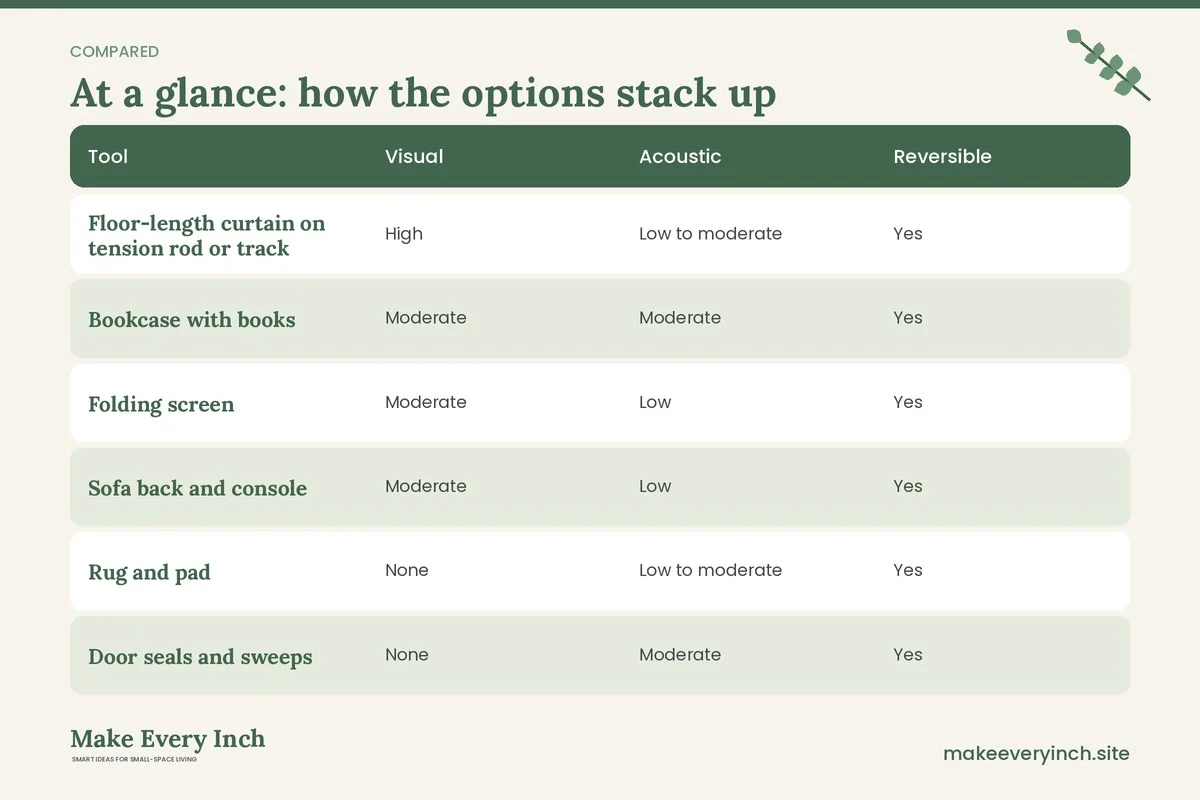
Privacy tools compared
| Tool | Visual | Acoustic | Reversible | Renter-friendly | Notes |
|---|---|---|---|---|---|
| Floor-length curtain on tension rod or track | High | Low to moderate | Yes | Usually | Check rod weight limits and fabric near heat |
| Bookcase with books | Moderate | Moderate | Yes | Yes if freestanding | Anchor with permission, heavy items low |
| Folding screen | Moderate | Low | Yes | Yes | Not a barrier to sound |
| Sofa back and console | Moderate | Low | Yes | Yes | Needs a clear walkway |
| Rug and pad | None | Low to moderate | Yes | Yes | Reduces echo and footfall noise |
| Door seals and sweeps | None | Moderate | Yes | Often | Check for vents and gas appliances |
| Window film | High | None | Mostly | Check lease | Clean the glass first |
| White noise or fan | None | Masks | Yes | Yes | Keep volume low and cords tidy |
| Headphones | None | High for you | Yes | Yes | Be aware of safety alerts and doorbells |
Three example households
Example 1: A couple in a one-bedroom, one works from home
The home has a living room, a kitchen, a bedroom and a bath. One person works from home three days a week.
- Problem: Calls happen in the living room, the other person watches TV, and neither can focus or relax.
- Plan: Move the desk to the bedroom window wall if there is space, or place it in the living room corner with a bookcase at an angle behind it. Add a rug and a heavy curtain on the nearest window to cut echo. Put a door sweep on the bedroom door.
- Routine: The non-working partner uses headphones and a lamp on call days, and the two of them agree on a break at lunch.
- Result: The living room stays a shared room and the desk has a boundary, both visual and acoustic.
Example 2: A family of four in a two-bedroom
Two adults, two children aged under ten, one shared bedroom for the children and one for the adults.
- Problem: Everyone is always in sight. The adults have no evening, and the children have no space of their own.
- Plan: Give each child a bed nook with a curtain on a track or a tidy privacy panel at the head of each bed, and a single drawer for their own things. Use a sofa-back console to separate the living zone from the entry. Keep the adult bedroom for rest, not for toys or laundry.
- Safety: Anchor dressers and bookcases, use cordless curtains and keep paths to the exit clear.
- Routine: After the children are in bed, the adults take the living room, and a weekend hour gives each parent solo time.
- Result: Everyone has a small territory, and the home feels like several places.
Example 3: Two roommates in a two-bedroom with a shared living room
Both bedrooms open off the living room, and the walls are thin.
- Problem: Sound moves freely, and guests walk past a bedroom door to reach the kitchen.
- Plan: Place a bookcase against the shared wall, add a rug and heavy curtains in the living room, and fit a door seal to each bedroom. Move the sofa so that its back faces the bedroom doors, which cuts the sightline.
- Routine: A shared calendar for guests, quiet hours and a “headphones mean busy” rule.
- Result: Each roommate has a retreat, and the shared space feels more courteous.
Room-by-room privacy, from a whole-home view
Rather than fixing each room in isolation, look at how privacy changes as you walk through the home. The best layouts move from public to private, which is called a gradient of privacy.
- Entry: The most public zone. Keep it tidy and give it a bench or hooks. Use a console or screen to block the view to the rest of the home. See small entryway ideas.
- Living and dining: Semi-public. Allow guests here, with sightlines to the kitchen softened.
- Kitchen: Shared, noisy. Keep a door or curtain near the sleeping zone if sound or smell is an issue. Our small kitchen ideas cover layout.
- Work zone: Semi-private. Use a screen, a bookcase or a ceiling curtain, plus a rug.
- Bedroom: Private. Keep it simple, with good curtains and a door that closes.
- Bathroom: The most private room. Check the lock, the window film and the fan. Our small bathroom ideas have layout advice.
Place the noisiest, most public functions at one end of the home and the quietest at the other. If your layout cannot do that, use furniture and fabrics to fake the gradient.
Privacy for studio apartments and one-room homes
When the whole home is one room, use time and fabric as your walls. A ceiling-mounted curtain around the bed turns it into a sleeping cabin. A bookcase or low screen behind the sofa creates a living zone and hides the bed from the door. For more help, read our studio apartment ideas and the guide on how to make a studio apartment feel organized.
Make sure there is a clear route from the bed to the exit, and do not box the bed in with tall furniture that might tip. Leave a gap between a curtain track and any smoke detector, so that the detector can sense smoke.
Privacy on a budget and as a renter
You do not need to spend much to improve privacy.
- Start with what you own: move the sofa, close a door more often and use blankets as temporary curtains.
- Use tension rods, freestanding screens and adhesive hooks rated for the weight, after checking your lease.
- Add rugs, then curtains, then door seals, in that order.
- Take photos before you change anything, so you can restore it before moving out.
For more affordable ideas, see budget small space ideas and small room decor ideas. If you need extra storage to keep the clutter out of sight, check small space organization ideas.
Do not take out, cut into or alter any wall to gain privacy without a qualified professional and the proper permits, since walls can be load-bearing or carry wiring and pipes. Do not drill into a rented wall without written permission. Do not overload sockets with extra lamps, fans and noise machines, and use a strip rated for the load.
Common mistakes
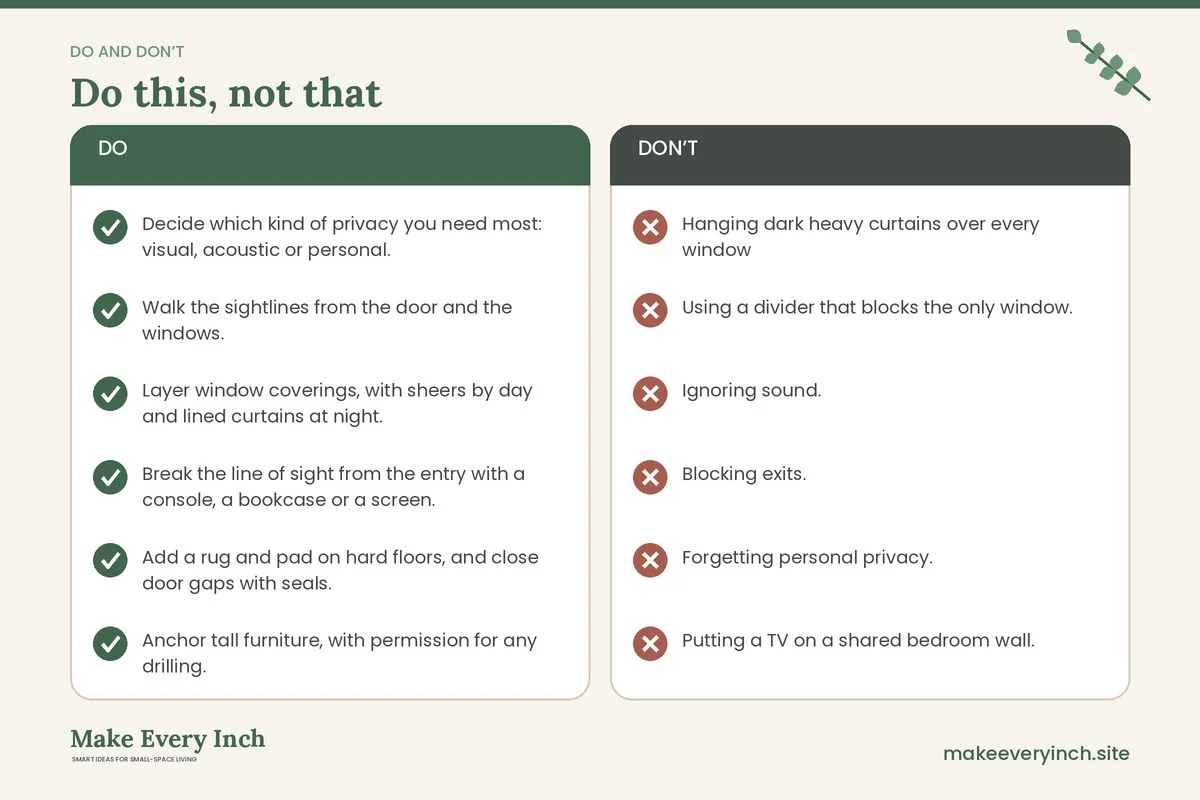
- Hanging dark heavy curtains over every window, which cuts daylight and makes the home feel smaller. Layer instead.
- Using a divider that blocks the only window. Place dividers at right angles to the window to keep light flowing.
- Ignoring sound. A visual screen does not stop a conversation.
- Blocking exits. Always keep a clear path and an uncluttered door.
- Forgetting personal privacy. Hardware helps, but routines and signals matter just as much.
- Putting a TV on a shared bedroom wall. Sound moves through the wall.
A privacy checklist
- Decide which kind of privacy you need most: visual, acoustic or personal.
- Walk the sightlines from the door and the windows.
- Layer window coverings, with sheers by day and lined curtains at night.
- Break the line of sight from the entry with a console, a bookcase or a screen.
- Add a rug and pad on hard floors, and close door gaps with seals.
- Anchor tall furniture, with permission for any drilling.
- Keep a clear exit route from every sleeping area.
- Check ventilation and alarms before sealing any gaps.
- Give each person a home base and an agreed signal.
- Review after a week and adjust.
FAQ
What is the cheapest way to create privacy small home dwellers can use right away?
Close a door, hang a floor-length curtain on a tension rod and turn the sofa so its back faces the entry. These steps cost little, require no drilling and can be undone in minutes. Add a rug and door seals when you are ready.
Can I make a small home soundproof?
Not fully, and not cheaply. You can reduce echo and some transmitted noise with rugs, curtains, bookcases and door seals, and you can mask noise with a fan or white noise. Serious soundproofing needs professional construction and landlord approval.
How do I get privacy in a studio apartment?
Use a ceiling track curtain, a bookcase or a screen to create a bed zone, and use headphones and routines for personal privacy. See the studio guide above for more detail.
Is window film safe for rentals?
Many static-cling films are removable, but check the lease and the product instructions. Clean the glass thoroughly and test a small corner first.
How do I give kids privacy in a shared room?
Give each child a defined area, such as a curtained bed nook or a drawer and a shelf. Use cordless coverings, anchor furniture and keep a clear path to the door.
How can roommates or couples get alone time?
Agree on a signal, such as headphones or a closed door, plan quiet hours, and use spaces outside the home when needed. Predictable alone time often helps more than another divider.
Keep going: Keep going with small home ideas, how to create a work zone in a small apartment and small bedroom ideas.
Save this guide for later
Pin the ideas you like to Pinterest so you can come back to them when you plan your space.