15 Small Living Room Furniture Ideas for Women Who Use the Room for Everything
Quick answer: The best small living room furniture ideas for women start with what you do in the room, not with a style. List your top four activities, such as working, reading, hosting and stretching, then pick one flexible piece for each: a compact sofa with a clear seat depth, a drop-leaf or nesting table, a lidded storage seat and a lamp you can reach. Keep a 30 to 36 inch walkway, anchor anything tall to the wall and leave one patch of open floor.
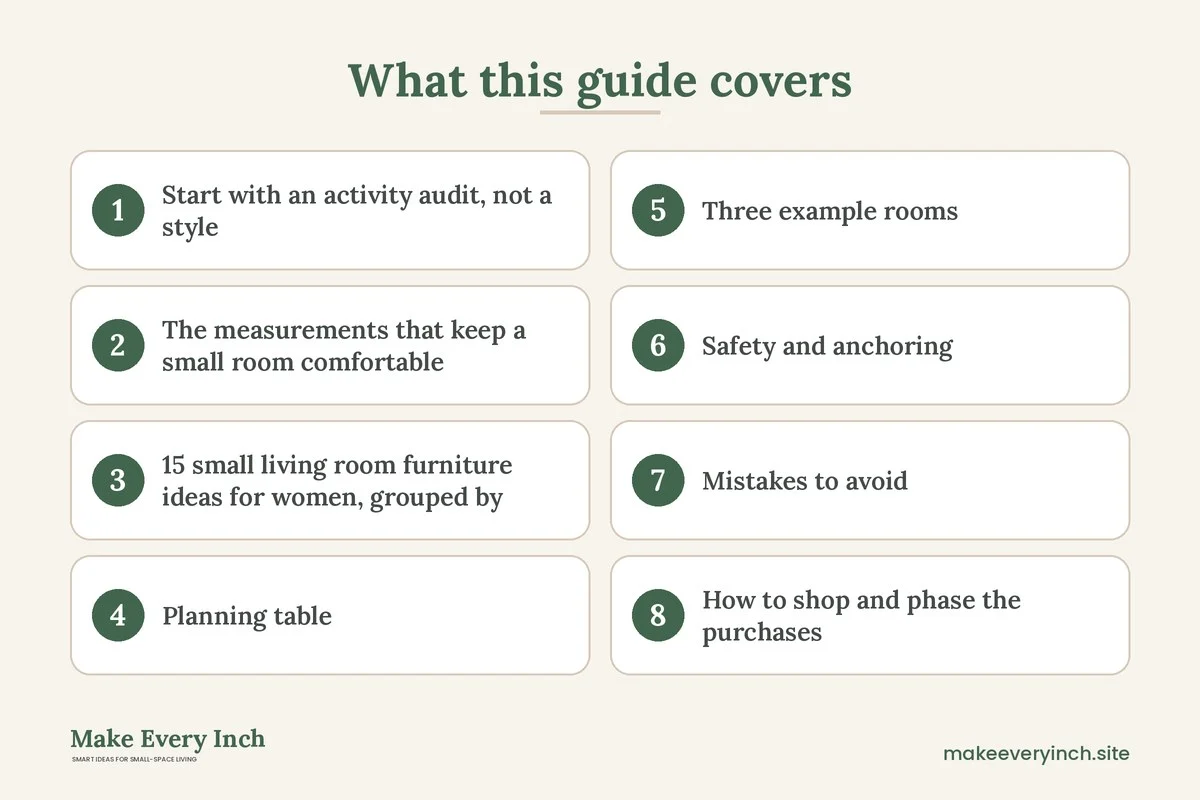
Small living room furniture ideas for women are most useful when they begin with the way you actually spend your hours at home, not with a mood board. One person works from the sofa on weekdays, another practices yoga on the rug at seven in the morning, and a third hosts a book club every other Thursday. The same 10 by 12 foot room has to handle all of it. This guide is activity-based. It walks through a quick audit of your habits, the measurements that make furniture comfortable, 15 ideas grouped by what you do, a planning table, three example rooms, safety notes for tall pieces, a checklist and an FAQ. For the full overview, see our parent guide to small living room furniture ideas, the broader small living room ideas pillar and our walkthrough of small living room layout ideas.
Start with an activity audit, not a style
Furniture is a tool. Before you shop, write down every activity that happens in the living room in a normal week and give each one an approximate number of hours. Most people find four to six activities, and two of them take up most of the time. Common ones include working on a laptop, watching shows, reading, eating a meal, video calls, exercise or stretching, crafts or hobbies, hosting one to four friends, and folding laundry in front of a film.
Next, mark each activity with the three things it needs: a body position (sitting upright, reclining, or on the floor), a surface (none, lap height, or table height) and storage (nothing, a few items, or a bulky kit). A video call needs upright sitting, a table surface and a plain background. Stretching needs floor and no surface. A hobby such as knitting or painting needs a surface, good light and a place to hide the kit afterward.
Finally, rank the activities. Your top two should get the best furniture and the best spot in the room. The rest should share pieces that fold, stack, slide or double up. This ranking is what separates a room that looks pleasant from a room that works. A sofa that is gorgeous but too deep for upright laptop work will end up with you hunched over, however good it looks in photos.
The measurements that keep a small room comfortable
These numbers are reasonable starting points, not strict rules. Adjust them for your own height, your mobility needs and any aids you use. Tape each piece on the floor first, then live with the outline for a day.
- Main walkway: 30 to 36 inches between the sofa and the nearest obstacle. A path used only now and then can be 24 inches. If you use a wheelchair, walker or stroller, plan for at least 36 inches and test the turning spot.
- Seat height: around 17 to 19 inches from the floor to the top of the cushion. Lower seats are hard to rise from, and higher ones leave shorter legs dangling.
- Seat depth: 20 to 22 inches suits upright work and reading. Deeper seats of 24 inches or more suit lounging but need back cushions for support.
- Sofa to table: 14 to 18 inches between the sofa edge and a coffee table, so a knee does not hit the edge.
- Side table: 12 to 16 inches wide, with the top within about 2 inches of arm height, usually 20 to 26 inches.
- Desk or work surface: 28 to 30 inches high, 18 to 24 inches deep for a laptop setup and at least 30 inches wide.
- Lamp reach: a switch or dimmer within arm’s reach of the seat you use after dark.
- Open floor patch: at least 6 by 3 feet for stretching, a yoga mat or a play area.
15 small living room furniture ideas for women, grouped by activity
For working from home
1. A drop-leaf table that doubles as a console
A drop-leaf table folds down to about 8 to 12 inches deep against the wall and opens to 30 inches or more across. In the morning it is a desk for the laptop, and in the evening it folds away and holds a lamp and a plant. Pick one with a leaf that locks securely and legs that do not wobble when you type.
2. A slim desk behind the sofa
When the sofa floats away from the wall, a desk or console 14 to 18 inches deep fits behind it. The sofa back becomes a divider, and the work zone stays visually separate from the lounging zone. Add a chair that tucks fully under so it does not block the path.
3. A supportive chair on a rug edge
If you take video calls, an upright dining-style or small armchair with firm back support beats a soft sofa. A chair 18 to 22 inches wide takes little floor, and you can slide it to the window for better light on calls.
For resting, reading and winding down
4. A compact sofa with the right seat depth
For a room under about 11 by 13 feet, a sofa 68 to 76 inches long works well and still seats two comfortably. Look at the seat depth first, then the arm width. Narrow, slightly raised arms save 4 to 6 inches on each side compared with chunky rolled arms. For specific models and features worth comparing, see our guide to the best sofas for small apartments.
5. A reading chair with a built-in footrest
A small armchair paired with a footstool creates a second seat that is as comfortable as a sofa end. Choose one with legs that show floor beneath it, because visible floor makes the room look larger. A slim footstool can double as a seat for a friend.
6. A lamp you can reach, plus one more
Light is part of furniture planning. A floor lamp with an arm that curves over the chair and a small table lamp on the opposite side give you task light for reading and softer light for the evening. For layout options, browse the best floor lamps for small rooms.
7. A lidded storage ottoman
An ottoman with a flat lid works as a footrest, an extra seat, a tray base and a hiding place for blankets or a hobby kit. A size of 28 to 34 inches across suits most small rooms. For ideas on choosing one, see our roundup of the best storage ottomans.
For hosting and eating
8. Nesting tables for four people
Three nesting tables take the space of one when stacked and spread across a row when guests arrive. Slide one beside each seat so everyone has a surface for a plate or a glass, and nobody has to balance things on a knee.
9. A bench instead of two chairs
A narrow bench 14 to 16 inches deep seats two adults against a wall and slides under a table when you do not need it. It also works as a shoe seat in the entry. Add a cushion for comfort and a few hooks above for coats.
10. Stackable stools or poufs
Keep two or three stools in a closet or under the console. They give you extra seats for a gathering of five or six, and they disappear afterward. Choose stools with a flat seat of at least 12 inches across so they feel stable.
For hobbies, exercise and play
11. A fold-down wall table
A wall-mounted fold-down table gives you a craft surface when you need one and an empty wall when you do not. Check your lease and the wall type before drilling. If you rent, our guide to no-drill storage ideas for renters covers freestanding options.
12. Furniture on wheels
A rolling cart, a lightweight side table or a pouf with a handle can be moved aside in ten seconds. This is the easiest way to create the 6 by 3 foot floor patch for exercise, stretching or play without losing storage. Lock the wheels when a surface holds drinks or anything that could tip.
13. A shelf unit that doubles as a divider
An open shelf 12 inches deep, set perpendicular to the wall, divides the hobby corner from the lounge. It also holds supplies at eye level. A pair of fabric bins on the lower shelves hides messy items. For help choosing a unit, see the best narrow bookshelves.
For everyday storage and comfort
14. A console or media unit with doors
A low unit 14 to 18 inches deep with closed doors holds a router, a game console and spare cables, while its top carries the TV or a lamp. Doors keep the visual noise down, which matters in a room you use for relaxing. Our post on small living room storage ideas covers more options.
15. A coat and bag spot near the door
A small entry bench, a wall hook rail or a slim shoe cabinet near the front door keeps bags, jackets and shoes out of the living room. If your door opens straight into the room, this one piece can make the biggest difference to how tidy the space feels. See small entryway storage ideas for options that suit tight doorways.
Planning table: match the activity to the piece
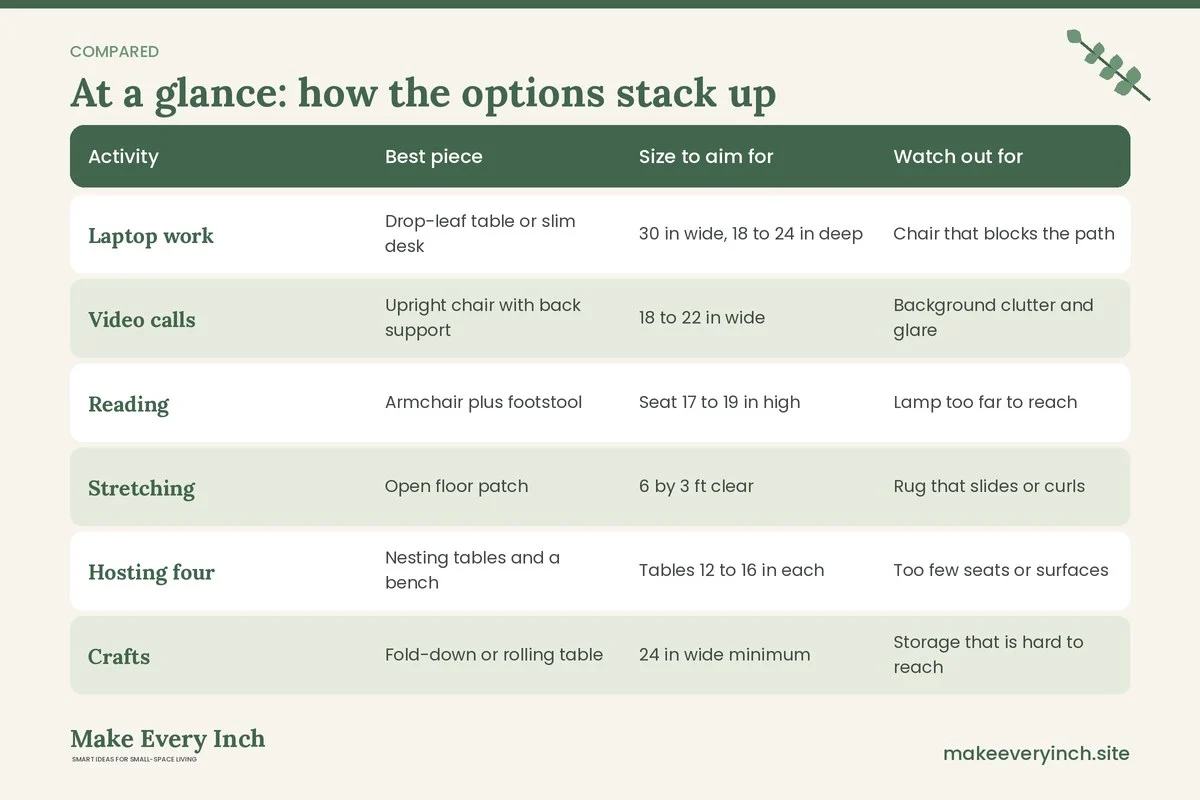
The table below links common activities to a furniture choice, a size to aim for and a note on what to watch for. Use it as a quick reference when you are comparing options.
| Activity | Best piece | Size to aim for | Watch out for |
|---|---|---|---|
| Laptop work | Drop-leaf table or slim desk | 30 in wide, 18 to 24 in deep | Chair that blocks the path |
| Video calls | Upright chair with back support | 18 to 22 in wide | Background clutter and glare |
| Reading | Armchair plus footstool | Seat 17 to 19 in high | Lamp too far to reach |
| Stretching | Open floor patch | 6 by 3 ft clear | Rug that slides or curls |
| Hosting four | Nesting tables and a bench | Tables 12 to 16 in each | Too few seats or surfaces |
| Crafts | Fold-down or rolling table | 24 in wide minimum | Storage that is hard to reach |
| Movie night | Sofa plus ottoman | Sofa 68 to 76 in long | Screen too close or too high |
| Everyday storage | Closed console | 14 to 18 in deep | Doors that cannot open fully |
Three example rooms
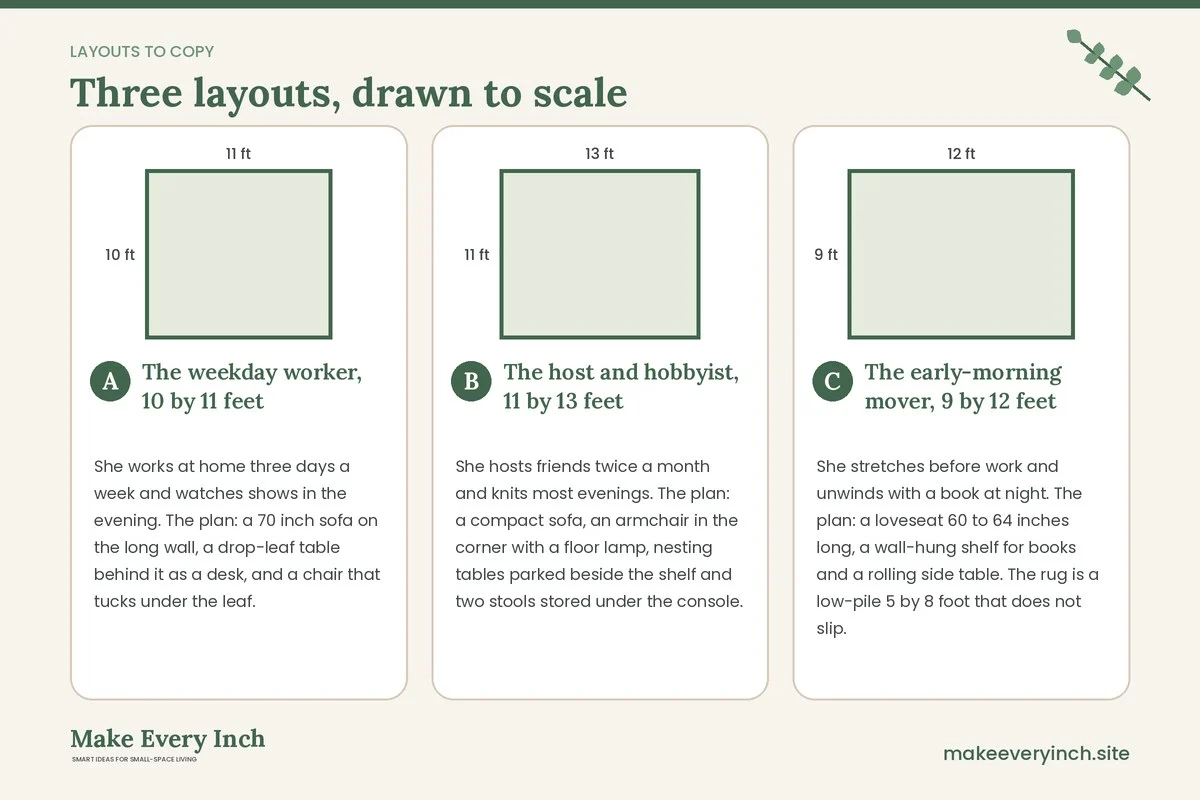
The weekday worker, 10 by 11 feet
She works at home three days a week and watches shows in the evening. The plan: a 70 inch sofa on the long wall, a drop-leaf table behind it as a desk, and a chair that tucks under the leaf. A table lamp and a floor lamp frame the sofa. A lidded ottoman takes the place of a coffee table and holds a throw. The walkway stays at 32 inches, and when the leaf folds the desk becomes a console.
The host and hobbyist, 11 by 13 feet
She hosts friends twice a month and knits most evenings. The plan: a compact sofa, an armchair in the corner with a floor lamp, nesting tables parked beside the shelf and two stools stored under the console. A tall shelf unit near the window holds yarn bins and is anchored to the wall. Furniture legs stay visible, and the center of the room has a clear 5 by 7 foot rug.
The early-morning mover, 9 by 12 feet
She stretches before work and unwinds with a book at night. The plan: a loveseat 60 to 64 inches long, a wall-hung shelf for books and a rolling side table. The rug is a low-pile 5 by 8 foot that does not slip. The side table slides into a corner every morning, which leaves 6 by 4 feet of clear floor. A storage bench by the door holds the mat and a pair of weights.
Safety and anchoring: tall furniture needs a wall
Any tall or top-heavy piece, such as a bookcase, a shelf unit, a tall cabinet or a dresser, should be anchored to the wall with the manufacturer’s tipping restraint or a suitable bracket and screws into a stud or a wall anchor rated for the load. This matters in every home, and especially if children, pets or earthquake risk are part of life. Place heavier items on lower shelves, and avoid a heavy television on a narrow unit. If you rent, read your lease and ask your landlord about anchoring options, since a small screw hole is usually easier to repair than a fallen shelf. Our guide to renter friendly shelving covers stable solutions that reduce damage to the wall.
Mistakes to avoid
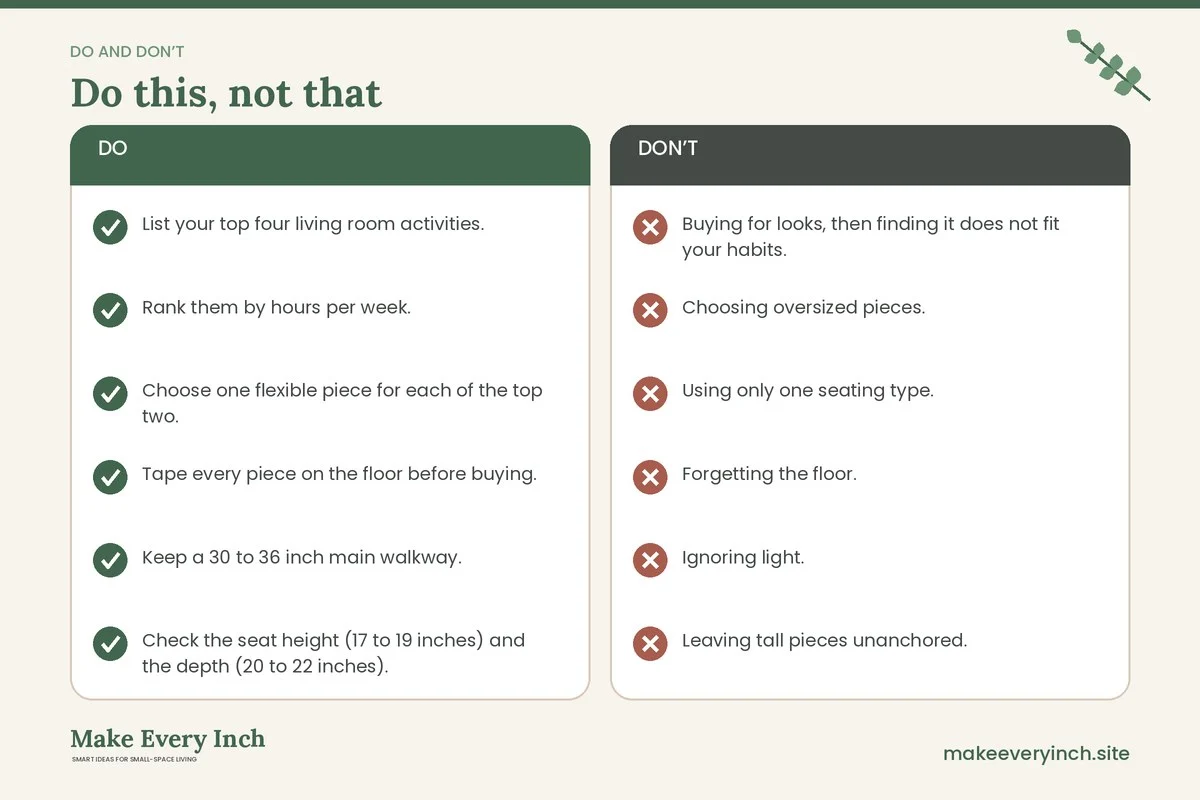
- Buying for looks, then finding it does not fit your habits. If you work in the room, test the seat height and the depth before you commit.
- Choosing oversized pieces. A 90 inch sofa in a 10 foot room leaves almost no walkway. Measure first, and tape it out.
- Using only one seating type. A room with only a deep sofa is hard for upright work and for guests who prefer a firm seat. Mix at least two types.
- Forgetting the floor. If every inch holds furniture, there is no room for stretching or play. Plan one clear patch and protect it.
- Ignoring light. A single overhead light flattens the room. Add a lamp at each activity zone.
- Leaving tall pieces unanchored. It is a simple fix that prevents a serious accident.
- Skipping hidden storage. Without a place for the hobby kit, it ends up on the floor and the room feels crowded.
How to shop and phase the purchases
You do not need to furnish a room in a single weekend. Start with the piece that serves your top activity. If you work most days, buy or adapt the desk and chair first. Live with the setup for two weeks and note what bothers you. Then add the second piece. Buy used where you can, since solid second-hand tables and chairs are common and often sturdier than flat-packed ones. Check delivery access too: measure the door, the stairwell and the elevator before ordering a sofa, because a piece that does not fit through is the most common reason for returns. Compare the box or product dimensions with your tape outline on the floor.
If you are on a tight spending plan, our guide to small living room makeover ideas shows where a few changes go a long way, and the best small dining tables list can help if your hosting table has to double as a desk.
Quick comfort upgrades that cost little
- Layered lighting: a lamp at head height, a second at floor level and a dimmer or a warm bulb around 2700 kelvin.
- A throw and two cushions per seat: gives you comfort without extra furniture.
- A rug that reaches the front legs of the sofa: a 5 by 8 foot rug usually does the job in a small room.
- A mirror opposite the window: reflects light and makes the room feel bigger.
- Plants at different heights: one on the floor, one on a shelf and one on the window ledge add life without taking floor space.
- A tray for small items: keeps remotes, candles and a mug in one place.
Your furniture planning checklist
- List your top four living room activities.
- Rank them by hours per week.
- Choose one flexible piece for each of the top two.
- Tape every piece on the floor before buying.
- Keep a 30 to 36 inch main walkway.
- Check the seat height (17 to 19 inches) and the depth (20 to 22 inches).
- Plan a clear floor patch of at least 6 by 3 feet.
- Add task light at every activity zone.
- Anchor every tall or top-heavy piece to the wall.
- Choose at least one piece with hidden storage.
- Put a bag and coat spot near the door.
- Measure doors and stairwells before delivery.
FAQ
What furniture does a small living room really need?
At minimum, a comfortable seat, a surface within reach, a light you can control and a place to hide small items. Add a desk or hosting piece only if you use the room for those activities.
How big should a sofa be in a small living room?
For rooms under about 11 by 13 feet, a sofa between 68 and 76 inches long usually works. Check the seat depth and the arm width as well as the length.
Can I work from the living room without it feeling like an office?
Yes. Use a drop-leaf table, a fold-down desk or a console that doubles as a work surface, and put the laptop away at the end of the day. Closed storage keeps paperwork out of sight.
How do I make space for exercise in a small room?
Use furniture on wheels and keep a clear 6 by 3 foot patch of floor. A rolling side table and a light pouf can move aside in seconds.
Is it safe to put a tall bookcase in a rental?
Yes, when you anchor it properly. Use the supplied restraint or a bracket into a stud, and ask your landlord if you are unsure. Place heavy items low.
Should I buy a coffee table at all?
It depends on your activities. If you eat or craft on the sofa, a lidded ottoman or nesting tables may serve you better. Our guide to small living room ideas without a coffee table explores alternatives.
Keep going: Keep planning with our small living room ideas for renters, small living room storage ideas for women and small living room lighting ideas.
Save this guide for later
Pin the ideas you like to Pinterest so you can come back to them when you plan your space.