15 Small Home Cleaning Supply Storage Ideas for Tight Spaces
Quick answer: The best small home cleaning supply storage splits supplies into three tiers: a small daily kit you can reach in seconds, a weekly kit kept in one caddy, and a deep-clean reserve stored high or out of the way. Keep products upright in a leak-proof tray, store chemicals out of reach of children and pets, never mix products, and keep tools that need airflow (mops, brushes, cloths) hanging where they can dry.
Small home cleaning supply storage is a different puzzle from general closet organizing. Cleaning supplies are awkward shapes, they leak, they smell, they need to dry, and some of them are unsafe around children and pets. A spray bottle does not stack, a mop will not fit on a shelf, and a vacuum has a cord and a hose that spill out of every cupboard. Most small homes do not have a dedicated closet for any of this, so the supplies spread across the bathroom, the kitchen and the hall until nobody can find the glass cleaner when they need it. This guide shows how to sort supplies by how often you use them, where each tier can live in a small home, how to keep it safe, and how to build a system that takes five minutes to reset. It includes 15 ideas, a comparison table, three example homes, a safety section, a checklist and a FAQ. If you want the wider picture, start with our main guide to small space organization ideas, then look at small home organization without buying bins and small utility closet organization ideas.
Why cleaning supplies are hard to store in a small home
Before choosing containers, it helps to understand what makes this category different from towels or books. Understanding the problem makes the solutions feel obvious.
- Odd shapes. Brooms, mops, dusters and a vacuum are long, thin or bulky. They fall over, lean against walls and block doors.
- Leaks and drips. Bottles weep around the cap and sponges drip. Anything under a sink or on a shelf needs a tray that can be wiped.
- Safety. Many household cleaners can be harmful if swallowed, spilled on skin or mixed with other products. That affects where you can keep them and how high.
- Moisture and airflow. Wet cloths, sponges and mop heads grow odors in a closed cupboard. They need to dry in air.
- Frequency. You reach for a spray and a cloth several times a week, but you might use oven cleaner twice a year. Storing both in the same spot wastes your best space.
The answer to all five is a tiered system, which we cover next. The idea is that the things you use most are the easiest to reach, the things you use rarely are stored out of the way, and everything that is unsafe sits above a child’s and pet’s reach or behind a latch.
The three-tier method
Sort every cleaning item you own into one of three tiers. This single step removes most of the clutter in a small home, because people usually discover they own three bottles of the same cleaner and a dozen cloths they never use.
Tier 1: the daily kit
This is what you reach for after cooking or brushing your teeth. For most households it is a multi-purpose spray, a bathroom wipe or spray, a few cloths, a sponge, a small brush and a dish soap. It needs to live where the mess happens: one small set in the kitchen and one small set in the bathroom. A set can be as small as a shoebox-sized tray. Keep only what you will actually use in the next two weeks.
Tier 2: the weekly kit
This is the caddy you carry around during a weekly clean. It holds the glass cleaner, a toilet brush or cleaner, a scrub brush, spare cloths, a duster and gloves. It lives in one place and moves with you. A caddy with a handle is the key feature, because it turns a scattered set of bottles into a single object you can grab and put back in ten seconds.
Tier 3: the deep-clean reserve
This tier includes oven cleaner, descaler, a spare refill, a carpet spot treatment, bulk cloths and anything used monthly or seasonally. It goes in the least convenient space you have, such as a high shelf, the back of a closet or a lidded bin under a bed. It should also be the tier with the strictest safety rules, since it often holds the strongest products.
If you run out of room, shrink the reserve first. Buy smaller bottles, decant only if a product’s label allows and never keep products you stopped using last year.
Map your home before you buy anything
Spend ten minutes walking through the home with a notepad. Write down where you currently clean what. You are looking for three things: dead space near where the mess happens, safe high or locked spots for the strong products, and a place where tools can hang to dry.
- Under the kitchen sink: often the default, but plumbing and the trap take up half the space. It is only suitable if you can latch it.
- Behind the bathroom door: a flat strip of wall that is often wasted.
- Inside a cupboard door: a few inches of depth that can hold small bottles, if the hinges can carry the weight.
- The side of a fridge or a tall cabinet: a narrow gap where a slim rack or hooks can sit, but never block ventilation grilles.
- Top shelf of a closet: safe from kids and pets, ideal for the reserve.
- A rolling cart: if you have no fixed spot, a cart gives you a moveable one.
Measure each spot: width, depth and height. Note any pipes, switches, vents or hinges. Take the notes with you when you shop so you do not buy a caddy that does not fit.
15 small home cleaning supply storage ideas
Under-sink ideas
1. A leak-proof tray for the base
Place a shallow tray with a raised edge under the sink to catch drips. If a bottle leaks, you wipe the tray instead of the cabinet floor. This also keeps the bottles upright and in a group so you can slide them out as one unit. Check regularly for slow leaks from the plumbing, since a tray can hide a drip.
2. A U-shaped organizer around the pipes
Under-sink space is awkward because the drain sits in the middle. A U-shaped or two-piece organizer wraps around the pipe and uses the full width. Measure the pipe position first. Do not move or alter plumbing.
3. A tension rod for spray bottles
Hang spray bottles by their triggers from a tension rod set across the cabinet. This frees the floor for tall bottles and lets you see each label. Keep the rod low enough that nothing hits the pipe, and choose a rod rated for the total weight. Tension rods work only if the sides of the cabinet are sturdy.
4. A small rack on the cabinet door
A door-mounted rack holds sponges, gloves and small bottles. Check the weight limit and the hinge strength before you load it. If you rent, choose a rack that hooks over the door edge or sticks with a removable adhesive instead of screws, and read the lease before you fix anything.
Closet and hall ideas
5. A slim broom closet made from a shallow cabinet
If you have a hall wall, a shallow cabinet only 10 to 14 inches deep can hold a broom, a mop, a duster and a caddy. Use a tall, narrow cabinet and anchor it to the wall with the hardware provided, with permission if you rent. Tall furniture can tip, so anchoring is not optional, especially if there are children in the home.
6. Hooks on the back of a door
Hang a mop, a dustpan and a duster on three hooks inside a closet or utility door. Hooks that hang over the top edge of the door need no screws. Space them 8 to 10 inches apart so the tools do not tangle, and keep heavy items at the hinge side of the door.
7. A wall-mounted tool holder with spring clips
A rail with clips grips handles so brooms and mops stand off the floor. This keeps mop heads from sitting in a puddle and lets them dry. If you cannot drill, an over-door rail or a freestanding stand can do the same job.
8. A high shelf for the reserve
A high closet shelf above 60 inches keeps strong products away from children. Use a lidded bin with a clear label so you do not need a step stool every week. A bin that holds three or four items is easier to lift than one that holds twelve.
Bathroom ideas
9. A caddy inside a bathroom cabinet
Keep a toilet brush, a bathroom spray and a pair of gloves in one caddy inside the vanity. Use a caddy with drain holes and place a tray beneath it. If the cabinet is small, choose a slim one that sits on its side.
10. A narrow cart beside the toilet or machine
A rolling cart 6 to 8 inches wide can slide into a gap beside a washer or vanity. It holds the weekly kit and can be pulled out for a cleaning session. Keep it clear of the floor drain and the water supply. Our post on small bathroom storage ideas for tight spaces has more narrow-gap ideas, and best over the toilet storage covers a freestanding option.
11. A hanging bag for tools
A fabric bag on the back of a bathroom door holds a brush, sponge and cloths. Pick a mesh bag so the contents can dry. Do not put sprays in a hanging bag, since the weight and the leak risk are higher than in a tray.
Kitchen and flexible ideas
12. A cleaning drawer or pull-out basket
If you have one drawer to spare in the kitchen, give it to the daily kit: a spray, cloths, a sponge and a brush. Use dividers to keep bottles upright. A pull-out basket under the counter does the same when there is no spare drawer. Our post on small kitchen cabinet organization ideas covers drawer layouts.
13. A rolling cart as a cleaning station
A narrow rolling cart can carry the weekly kit from room to room and then park in a corner. Choose a model with a lip so bottles cannot slide off, and lock the wheels while you load or unload. This works well in homes without any closet at all.
14. A lidded bin under the bed
The deep-clean reserve can go in a lidded bin under a bed or in a wardrobe base, as long as there are no children or pets who can open it and the products have no strong fumes. Keep the lid latched, and use the bin only for sealed products. For more ideas, see under bed storage ideas.
15. A hidden compartment inside a bench or ottoman
A lidded storage bench in the hall can hold the vacuum attachments, spare bags and cloths. Keep liquids out of it unless the bench has a waterproof lining, and make sure the lid cannot trap a child’s fingers. For other disguised spots, see hidden storage ideas.
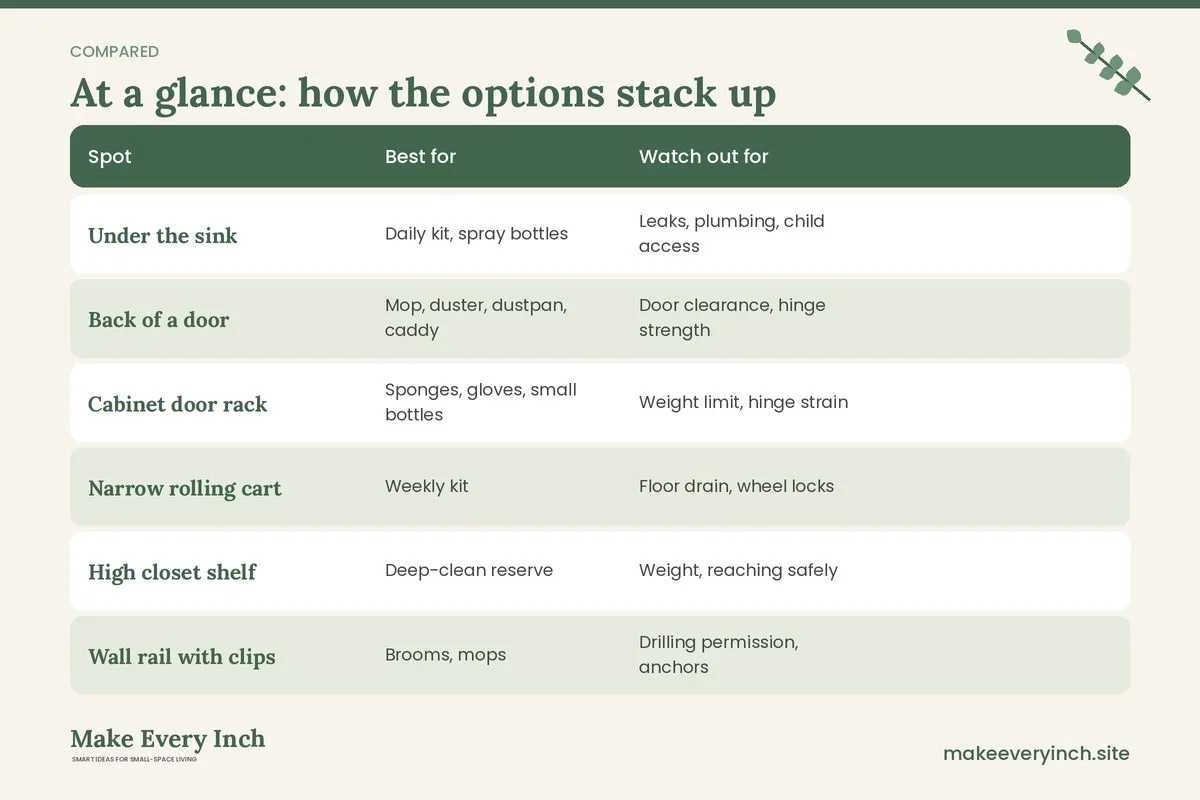
A comparison table of storage spots
| Spot | Best for | Watch out for | |
|---|---|---|---|
| Under the sink | Daily kit, spray bottles | Leaks, plumbing, child access | |
| Back of a door | Mop, duster, dustpan, caddy | Door clearance, hinge strength | |
| Cabinet door rack | Sponges, gloves, small bottles | Weight limit, hinge strain | |
| Narrow rolling cart | Weekly kit | Floor drain, wheel locks | |
| High closet shelf | Deep-clean reserve | Weight, reaching safely | |
| Wall rail with clips | Brooms, mops | Drilling permission, anchors | |
| Under-bed bin | Sealed reserve, spare cloths | Fumes, child access, humidity | |
| Bench or ottoman | Vacuum attachments, bags | Lid safety, no liquids |
Read the table as a menu rather than a ranking. Most small homes use three or four of these spots at once. The point is to match each tier to a spot that suits its size, weight and risk.
Safety rules for small home cleaning supply storage
Storing cleaning supplies safely matters more in a small home because everything is close together. Follow these rules and check the label of every product for its own instructions.
- Keep products out of reach of children and pets. Use a high shelf, a latched cabinet or a lockable box. A low cupboard with a child-safe latch works for the daily kit, but do not rely on a latch alone for strong products.
- Store in original containers. Keep labels, directions and warnings intact. Do not move a cleaner into a drink bottle, and never reuse food containers for chemicals.
- Never mix products. Some combinations release harmful fumes. Keep products with different purposes apart and read the label before using two in the same space. Do not combine cleaners unless the label says it is safe.
- Ventilate. Open a window or turn on a fan while cleaning, and store products in a space that is not sealed in a way that traps fumes. Avoid keeping strong-smelling products in a bedroom.
- Keep away from heat and flame. Store aerosols and flammable products away from the stove, heaters, radiators and direct sun. Do not keep them next to a water heater or a furnace.
- Mind the electrical side. Keep spray bottles away from sockets, power strips and appliances. Unplug a vacuum before changing parts and store the cord loosely so it does not kink.
- Wet areas and GFCI. Any socket near a sink or tub should be a GFCI outlet. If you do not have one, ask a qualified electrician and do not run extension cords through wet areas.
- Anchor tall storage. A tall, narrow cabinet or a shelf that holds heavy bottles can tip. Anchor it to the wall studs, and ask your landlord for permission before drilling.
- Know the emergency numbers. Keep a poison control number near the phone and follow the label if someone swallows or inhales a product.
- Dispose of old products properly. Many areas have collection sites for household chemicals. Do not pour unknown products down a drain.
If you rent, these rules sit alongside your lease. Do not drill into walls, cabinets or tile without permission, and prefer solutions that hook, tension or sit on the floor. Our guide to no drill storage ideas for renters covers other options.
Keep tools drying, not rotting
Cloths, sponges and mop heads are the most overlooked part of a cleaning system. If you store them damp in a closed cupboard, they will smell within days and spread bacteria around your home. A few habits solve this.
- Wring cloths and hang them over a rail or a hook after use.
- Stand a sponge on its edge in a draining dish and replace it on a regular schedule.
- Hang mop heads upside down or lay them on a rack so air can reach every part.
- Wash cloths with your laundry rather than letting them pile up in a bucket. Our post on how to organize laundry supplies in a small home shows how to set up a laundry basket for this.
- Keep one drying hook per room so wet items never travel through the home.
Three example homes
Example 1: a studio with no closet
A studio has a small kitchen, a bathroom and a main room, and no hall closet. The owner keeps a daily kit in a tray under the kitchen sink and a second in a small bathroom caddy. The weekly kit lives on a narrow rolling cart that parks beside the fridge, and the broom hangs from an over-door hook on the bathroom door. The deep-clean reserve is a single lidded bin on top of the wardrobe, out of reach of a curious cat. Because the cart is mobile, the owner can pull it out for the Saturday clean and push it back in 30 seconds.
Example 2: a one-bedroom with a small child
A one-bedroom has a hall cupboard with a latch and a toddler who explores everything. The strongest products go on a top shelf in a lockable box, and the daily kit uses a child-safe latch under the sink. The parent keeps a bottle of child-friendly cleaner in a lower drawer for quick wipes. A shallow cabinet beside the washer holds the mop and broom, anchored to the wall with the owner’s permission. The rule is that no bottle ever sits on the floor or on a low shelf, even for a minute.
Example 3: a rented two-bedroom with pets
The renter cannot drill, and two dogs shake everything off low shelves. The weekly kit lives in a caddy on a high closet shelf, the vacuum stands in an over-door rack, and the mop hangs on a tension-rod bracket in the utility space. A freestanding shelf unit with a tray holds paper towels and cloths, and a pet-proof lidded bin holds the daily kit. Spare bags and filters go in a labeled box so the vacuum can be serviced in a few minutes. The renter reviews the lease before adding anything to a wall.
Mistakes to avoid
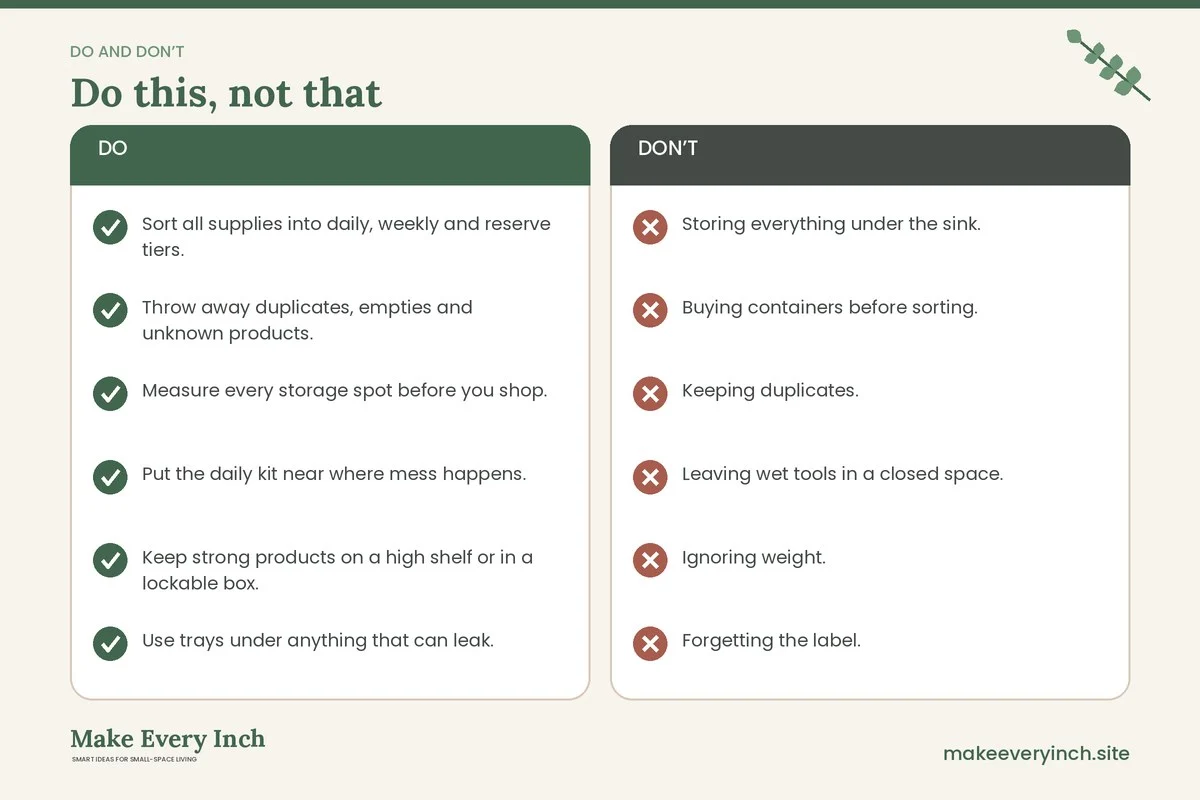
- Storing everything under the sink. The space is small, damp and shared with plumbing. Use it for the daily kit only.
- Buying containers before sorting. Decide what you own, then buy storage. Otherwise you buy a caddy that fits half of it.
- Keeping duplicates. Three nearly empty bottles of the same cleaner waste space. Combine only if the label allows, or use one up first.
- Leaving wet tools in a closed space. Hang them where air can circulate.
- Ignoring weight. Bottles are heavy. Check the limit of every hook, rack and shelf before loading.
- Forgetting the label. A box with no label becomes a mystery, and then a pile.
- Skipping the reset. A system only works if each item has one home and goes back after use.
For more on avoiding common traps, read our post on small home organization mistakes to avoid.
A five-minute weekly reset
A cleaning system is only as good as its upkeep. Try this short routine once a week, ideally after the main clean.
- Return every bottle to its tray and every tool to its hook.
- Wipe the tray and the shelf under the sink with a cloth.
- Check caps, triggers and seals for leaks.
- Throw away anything empty, expired or no longer used.
- Move any bottle that has migrated to a low shelf back to a high one.
- Put used cloths in the laundry and hang a fresh one.
- Note what is running low so you can replace it on your next shop.
Once a season, empty the reserve bin, check every label and take unwanted products to a collection point.
Budget and shopping approach
You rarely need to buy much. A tray, a caddy and a few hooks can transform a small home. Use what you have first: a shoebox, a sturdy basket or a drawer can hold a daily kit. When you do buy, choose pieces that wipe clean, have no sharp edges and fit your measured space. Prefer containers with a lip, so a leak stays contained, and avoid anything that needs permanent fixings unless you own the home or have permission. Our guide to small home organization ideas that actually last explains why simple systems outlast elaborate ones.
Checklist
- Sort all supplies into daily, weekly and reserve tiers.
- Throw away duplicates, empties and unknown products.
- Measure every storage spot before you shop.
- Put the daily kit near where mess happens.
- Keep strong products on a high shelf or in a lockable box.
- Use trays under anything that can leak.
- Hang cloths, sponges and mops to dry.
- Anchor any tall cabinet to the wall with permission.
- Keep labels and original containers.
- Never mix products and always ventilate.
- Check hook, rack and shelf weight limits.
- Set a five-minute weekly reset.
FAQ
Where should I store cleaning supplies in a small apartment with no closet?
Split them by frequency. Keep a small daily kit in the kitchen and bathroom, a weekly caddy on a rolling cart or a high shelf, and the rarely used products in a lidded bin on top of a wardrobe or under a bed. Make sure strong products are out of reach of children and pets.
Is it safe to keep cleaning products under the sink?
It can be, if you have a child-safe latch and there are no leaks. Many households prefer to keep only the daily kit there and move stronger products higher up. Always check the label for storage instructions.
How do I store a mop and broom in a small space?
Hang them from hooks on the back of a door, a wall rail with clips or an over-door rack. This keeps the heads off the floor so they can dry. If you rent, use a hook or rack that needs no drilling.
How do I keep sponges and cloths from smelling?
Let them dry in open air between uses. Hang cloths over a rail, stand sponges on their edge, and wash cloths regularly. Do not store them damp in a closed cupboard.
Can I store cleaning supplies in a bedroom?
It is possible for sealed, mild products, but avoid strong-smelling items and anything flammable. Keep them in a lidded bin, away from sleeping areas where possible, and out of reach of children and pets.
How can I store cleaning supplies if I rent and cannot drill?
Use tension rods, over-door hooks, freestanding carts and adhesive hooks within their weight limits. Always read your lease and ask your landlord before attaching anything to walls, tile or cabinets.
How much should I keep?
Only what you will use within a few months. Small homes work best with one multi-purpose spray, one bathroom product, one glass product and a handful of cloths, plus a short list of specialty items.
Keep going: Keep organizing with our small space organization ideas, small home storage ideas for every room and small home organization for families.
Save this guide for later
Pin the ideas you like to Pinterest so you can come back to them when you plan your space.